
Product Presentation Chapter 14 Presenting the Product Section
- Slides: 21
Product Presentation Chapter 14 Presenting the Product • Section 14. 1 Product Presentation • Section 14. 2 Objections
Objections Objectives Recognize an objection Explain the five elements that are common objections Demonstrate the general four-step method for handling customer objections List seven specific methods of handling objections and note when each should be used Marketing Essentials Chapter 14, Section 14. 2
If a customer is not ready to Buy After Presenting the product if the customer says no: • How to Handle in Retail Selling: • be polite and courteously encourage the customer to look around ask you any questions they may have • Handling In a business-to-business situation • leave a business card • ask if it is possible to see the potential customer at a more convenient time
• After presenting the Product, a customer will either say no or may be hesitant to buy. When a customer is hesitant you have an opportunity to change their mind
Understanding Objections. X are concerns, hesitations, doubts, or other reasons a customer has for not making a purchase Objections can be responded to as either questions/inquiries or statements: Do you carry any other brands I already have one like this Do you have something less expensive I will have to check with my spouse I don’t have enough in my budget Marketing Essentials Chapter 14, Section 14. 2
Common Objections Most objections are based on five key elements: 1. Need: The customer wants the item but doesn’t need it. 2. Product: Concerns about quality, size, color, style, etc. 3. Source: Negative past experiences with a firm or brand. 4. Price: The product is too expensive. 5. Time: A hesitation to buy immediately.
• To overcome an objection: – Offer a different option – Clarify the features that dispel the objection – Don’t tell them they are wrong, tell them how their thought is false (without saying no or your wrong
Plan for Objections You can prepare yourself for most objections by completing an objection analysis sheet before selling items. objection analysis sheet X, a document that lists common objections and possible responses to them You can address potential objections by emphasizing special features of the product that counter their doubts can include these items up front
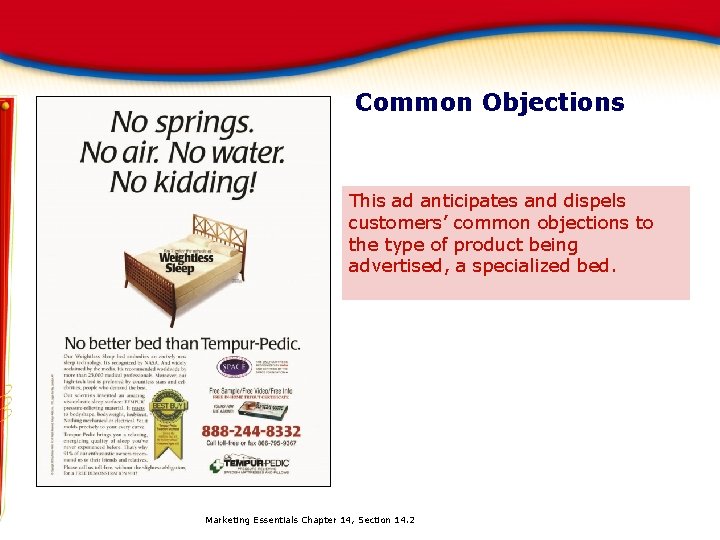
Common Objections This ad anticipates and dispels customers’ common objections to the type of product being advertised, a specialized bed. Marketing Essentials Chapter 14, Section 14. 2
• Divide into groups of 4. Discuss the types of objections and develop a response to overcome it without saying no, or your wrong.
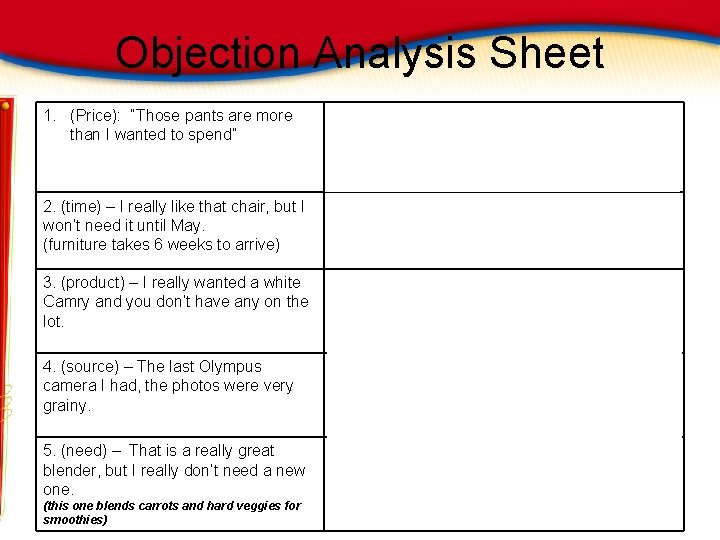
Objection Analysis Sheet 1. (Price): “Those pants are more than I wanted to spend” 1. “Our prices are a little higher than our competitors but that is because we use the highest quality materials and we guarantee our products for life” 2. (time) – I really like that chair, but I won’t need it until May. (furniture takes 6 weeks to arrive) 2. We can write up that contract now, order it for you, it takes 4 weeks, but we can hold it here until you are ready for it. 3. (product) – I really wanted a white Camry and you don’t have any on the lot. 3. We have six different colors to pick from on the lot and you would get your car today. If you want a white one, we can order it but it will take about a week. 4. (source) – The last Olympus camera I had, the photos were very grainy. 4. I understand this was the case on old cameras. The new technology, plus the higher megapixels today take crystal clear photos. Plus it has a 90 day money back guarantee 5. (need) – That is a really great blender, but I really don’t need a new one. 5. This blender is better than the one you have. Can it blend carrots, hard veggies, and almonds like this one? (this one blends carrots and hard veggies for smoothies)
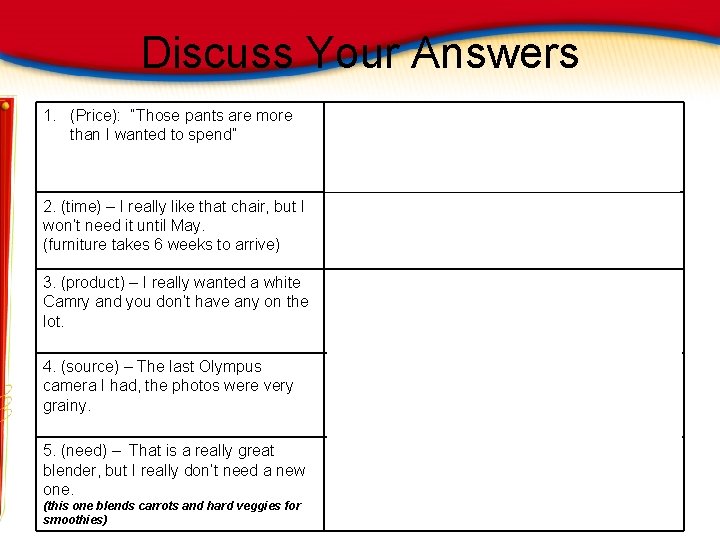
Discuss Your Answers 1. (Price): “Those pants are more than I wanted to spend” 1. “Our prices are a little higher than our competitors but that is because we use the highest quality materials and we guarantee our products for life” 2. (time) – I really like that chair, but I won’t need it until May. (furniture takes 6 weeks to arrive) 2. We can write up that contract now, order it for you, it takes 4 weeks, but we can hold it here until you are ready for it. 3. (product) – I really wanted a white Camry and you don’t have any on the lot. 3. We have six different colors to pick from on the lot and you would get your car today. If you want a white one, we can order it but it will take about a week. 4. (source) – The last Olympus camera I had, the photos were very grainy. 4. I understand this was the case on old cameras. The new technology, plus the higher megapixels today take crystal clear photos. Plus it has a 90 day money back guarantee 5. (need) – That is a really great blender, but I really don’t need a new one. 5. This blender is better than the one you have. Can it blend carrots, hard veggies, and almonds like this one? (this one blends carrots and hard veggies for smoothies)
Four-Step Process for Handling Objections It takes four basic steps to handle objections: • Listen • Acknowledge • Restate • Answer
Four-Step Process for Handling Objections 1. Listening: When listening, remember to: Be attentive Maintain eye contact Let the customer talk Marketing Essentials Chapter 14, Section 14. 2
Four-Step Process for Handling Objections 2. Acknowledging objections • demonstrates that you understand care about the customer’s concerns. Some common statements used are: • “I can see your point. ” • “Other customers have asked the same question. ” Disagreeing with your customer can put them on the defensive and you risk losing the sale. Marketing Essentials Chapter 14, Section 14. 2
Four-Step Process for Handling Objections 3. Restate: you can restate or paraphrase the objections paraphrase. X is to restate something in a different way. • “I can understand your concerns. You feel. . Am I correct? ” • “In other words, you feel that. . ” Marketing Essentials Chapter 14, Section 14. 2
Four-Step Process for Handling Objections 4. Answer each objection tactfully. • Never answer with an air of superiority or suggest that the person’s concern is unimportant. Marketing Essentials Chapter 14, Section 14. 2
Sevan Methods to Handling Objections
Specialized Methods of Handling Objections There are seven specialized methods for handling objections: • Substitution : involves recommending a different product that would satisfy the customer’s needs. • Boomerang: brings the objection back or converts the objection to a selling point. • Question: is a technique in which you question the customer to learn more about objections. • Superior-point: is a technique that permits the salesperson to acknowledge objections as valid, yet still offset them with other features and benefits.
Specialized Methods of Handling Objections • Denial: is when the customer’s objection is based on misinformation. You must back up the denial with proof and accurate facts. • Demonstration : involves showing the features of the product and how it works. Letting the customer do it also • Third-party: selling method that involves using a previous customer or another neutral person who can give a testimonial about the product. Marketing Essentials Chapter 14, Section 14. 2
Group Assignment: • Divide into groups of 4 • In the note packet, discuss the objection example. Then come up with a valid answer for each. • Each student enters the answer in their own note packet.