
Product presentation calf milk pasteurizer Maxi Steam II

- Slides: 18
Product presentation calf milk pasteurizer “Maxi. Steam II” Functions – Specification – Technical data Engen, July 2008 Kathrin Aymanns
Background < Feeding of fresh milk gets more and more important (MR prices increases; non marketable milk) < Pasteurization is important to feed the milk without concerns < Especially for non-marketable milk (Mastitis milk) < Reduction of the germ content < Improvement of the animal health < Not clear: kill of Para tuberculosis germ < Difficult up to now: pasteurization of colostrum and mixed colostrum (sticking of plate pasteurizers, scorch in batch pasteurizers)
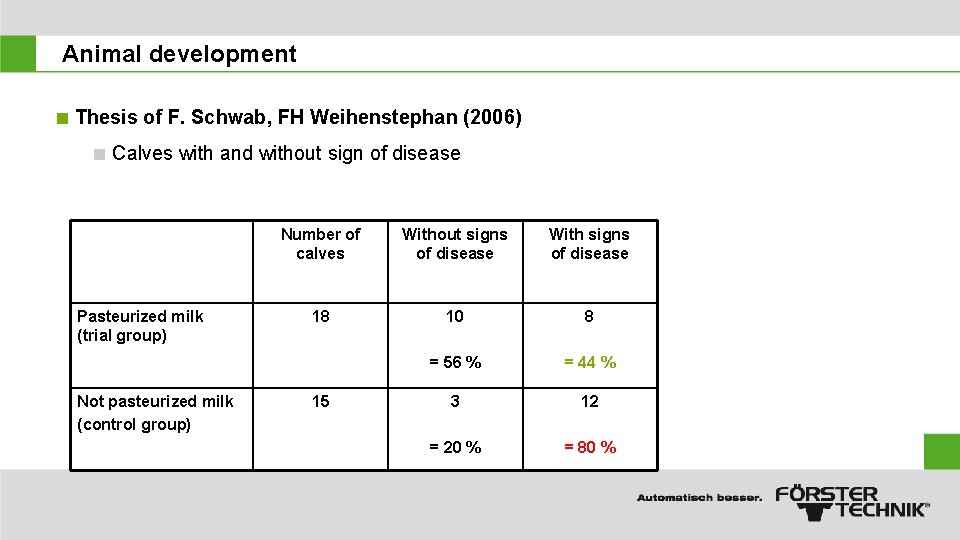
Animal development < Thesis of F. Schwab, FH Weihenstephan (2006) < Calves with and without sign of disease Pasteurized milk (trial group) Not pasteurized milk (control group) Number of calves Without signs of disease With signs of disease 18 10 8 = 56 % = 44 % 3 12 = 20 % = 80 % 15
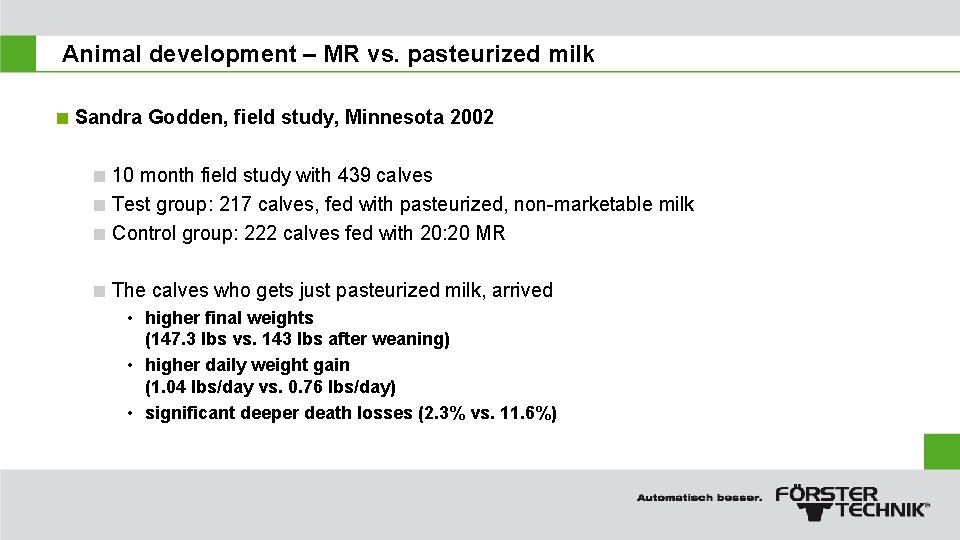
Animal development – MR vs. pasteurized milk < Sandra Godden, field study, Minnesota 2002 < 10 month field study with 439 calves < Test group: 217 calves, fed with pasteurized, non-marketable milk < Control group: 222 calves fed with 20: 20 MR < The calves who gets just pasteurized milk, arrived • higher final weights (147. 3 lbs vs. 143 lbs after weaning) • higher daily weight gain (1. 04 lbs/day vs. 0. 76 lbs/day) • significant deeper death losses (2. 3% vs. 11. 6%)
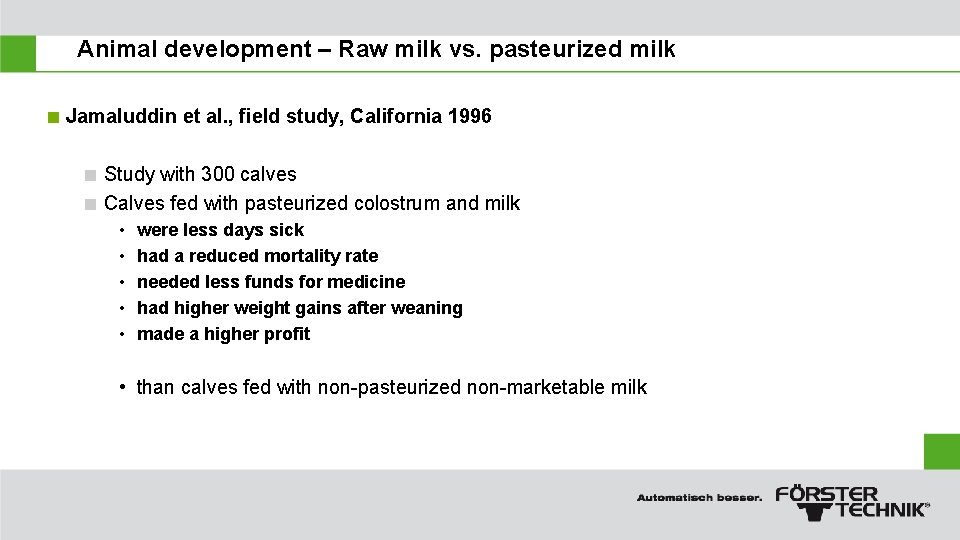
Animal development – Raw milk vs. pasteurized milk < Jamaluddin et al. , field study, California 1996 < Study with 300 calves < Calves fed with pasteurized colostrum and milk • • • were less days sick had a reduced mortality rate needed less funds for medicine had higher weight gains after weaning made a higher profit • than calves fed with non-pasteurized non-marketable milk
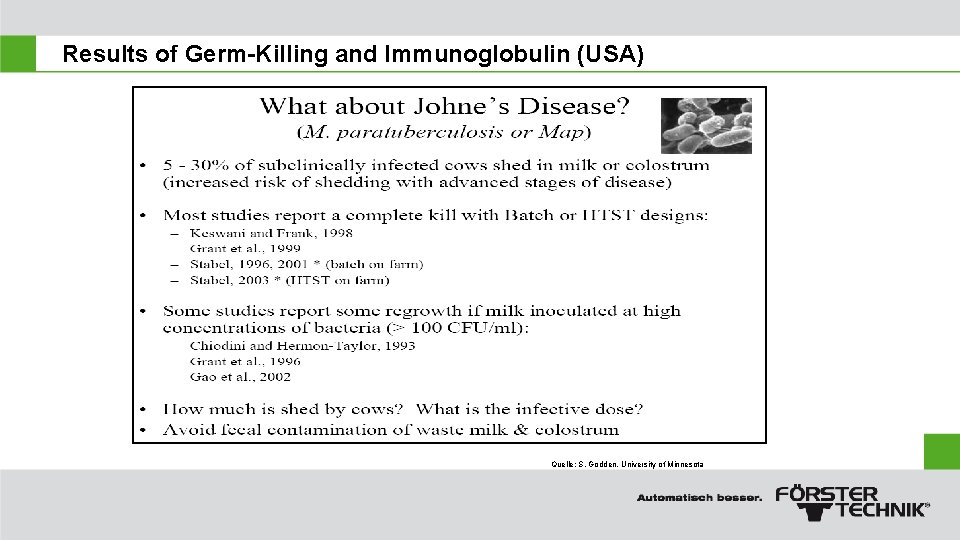
Results of Germ-Killing and Immunoglobulin (USA) Quelle: S. Godden, University of Minnesota
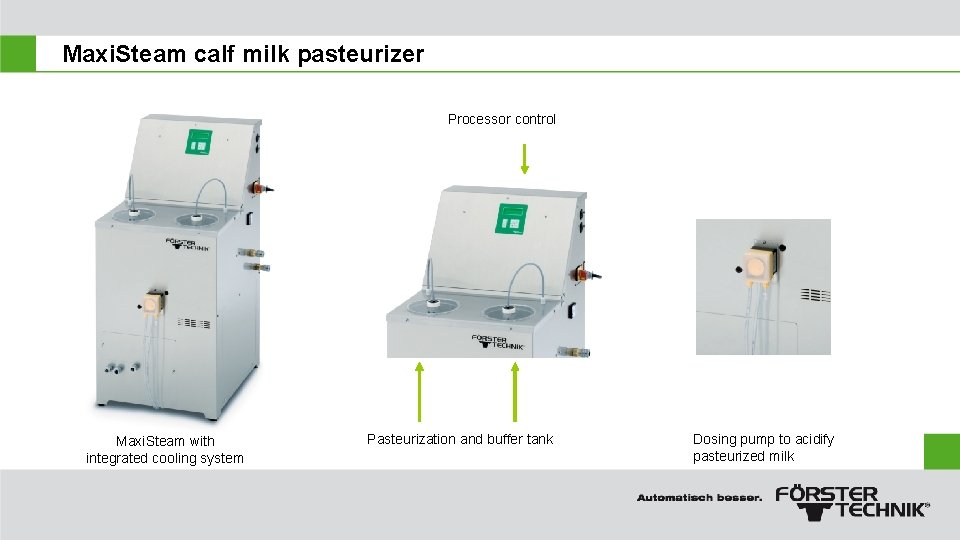
Maxi. Steam calf milk pasteurizer Processor control Maxi. Steam with integrated cooling system Pasteurization and buffer tank Dosing pump to acidify pasteurized milk
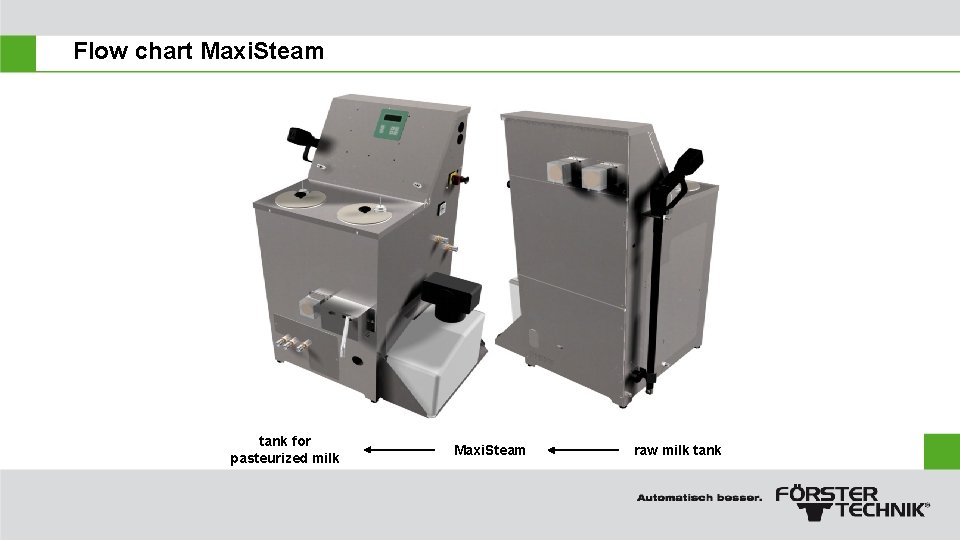
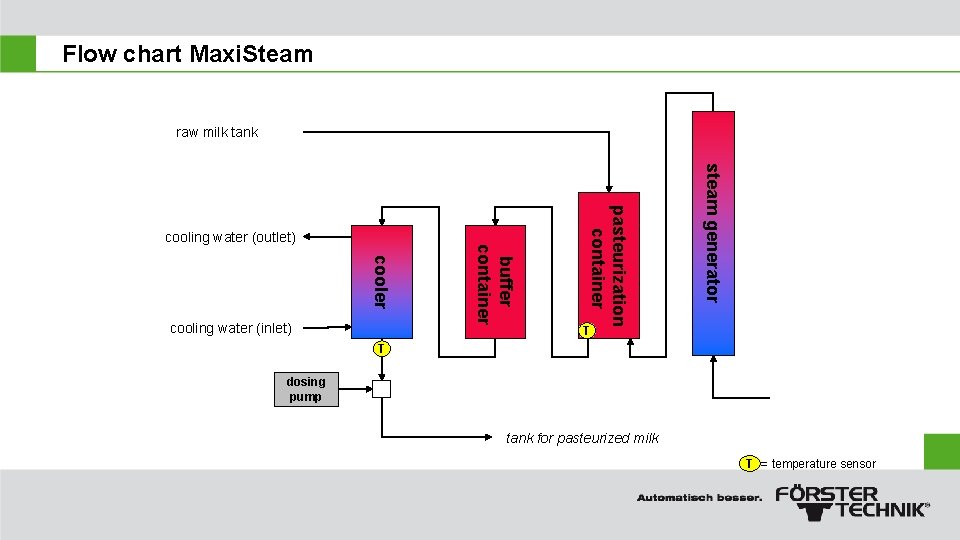
Flow chart Maxi. Steam tank for pasteurized milk Maxi. Steam raw milk tank
Flow chart Maxi. Steam raw milk tank steam generator pasteurization container cooling water (inlet) buffer container cooling water (outlet) T T dosing pump tank for pasteurized milk T = temperature sensor
Product features Maxi. Steam < Processing every milk type by steam pasteurization, e. g. < Whole milk < Non marketable milk < Mixed colostrum < High flexibility by pasteurization small portions, thus suitable for < small and daily changing quantities < growing farms < Quick heating and cooling of the milk ensures gentle processing
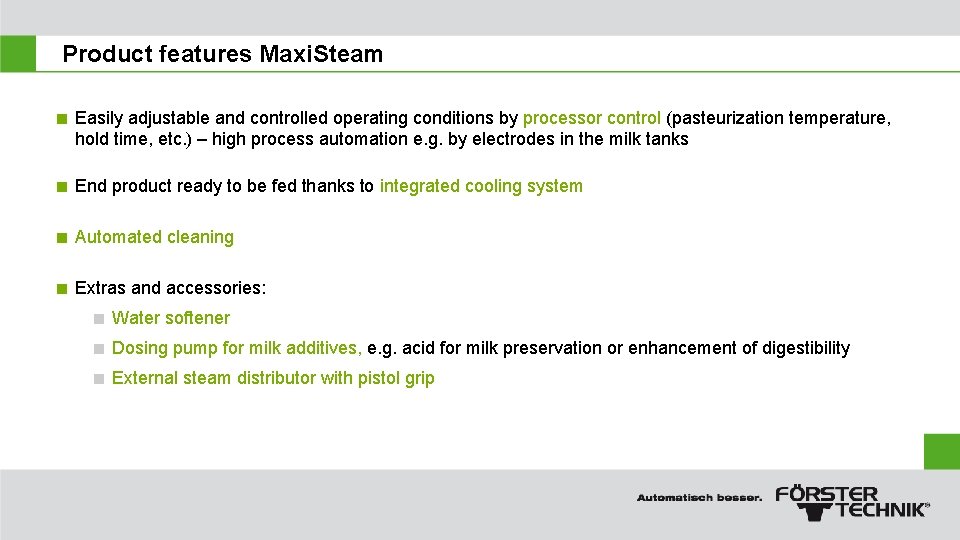
Product features Maxi. Steam < Easily adjustable and controlled operating conditions by processor control (pasteurization temperature, hold time, etc. ) – high process automation e. g. by electrodes in the milk tanks < End product ready to be fed thanks to integrated cooling system < Automated cleaning < Extras and accessories: < Water softener < Dosing pump for milk additives, e. g. acid for milk preservation or enhancement of digestibility < External steam distributor with pistol grip
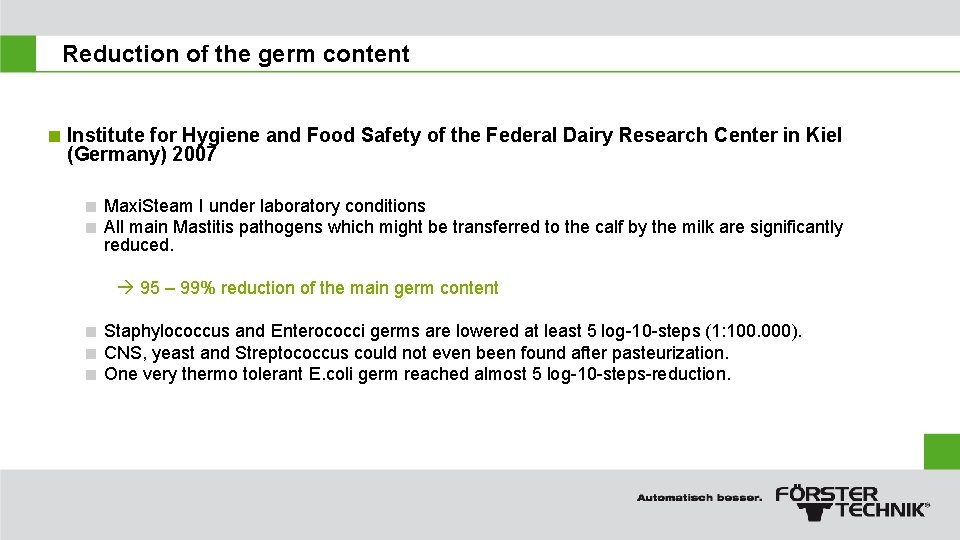
Reduction of the germ content < Institute for Hygiene and Food Safety of the Federal Dairy Research Center in Kiel (Germany) 2007 < Maxi. Steam I under laboratory conditions < All main Mastitis pathogens which might be transferred to the calf by the milk are significantly reduced. 95 – 99% reduction of the main germ content < Staphylococcus and Enterococci germs are lowered at least 5 log-10 -steps (1: 100. 000). < CNS, yeast and Streptococcus could not even been found after pasteurization. < One very thermo tolerant E. coli germ reached almost 5 log-10 -steps-reduction.
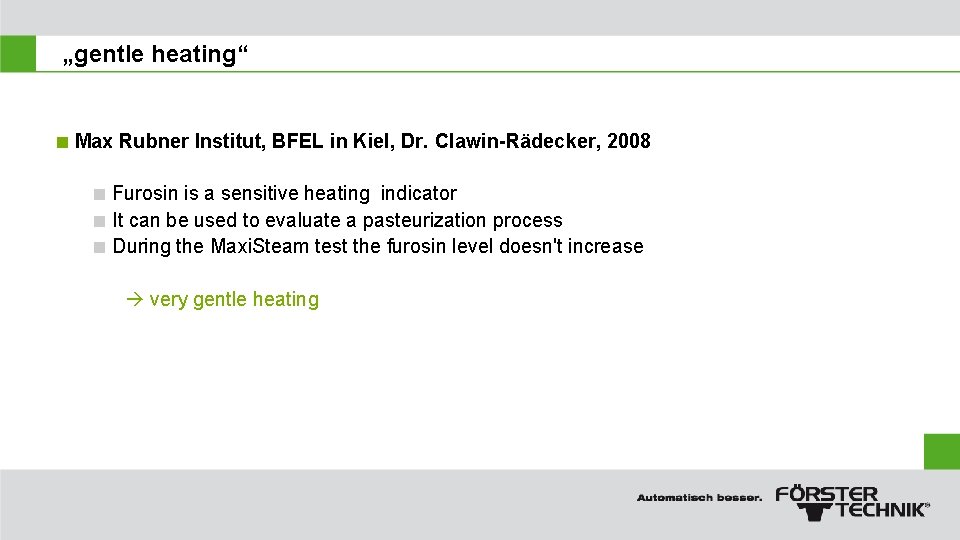
„gentle heating“ < Max Rubner Institut, BFEL in Kiel, Dr. Clawin-Rädecker, 2008 < Furosin is a sensitive heating indicator < It can be used to evaluate a pasteurization process < During the Maxi. Steam test the furosin level doesn't increase very gentle heating
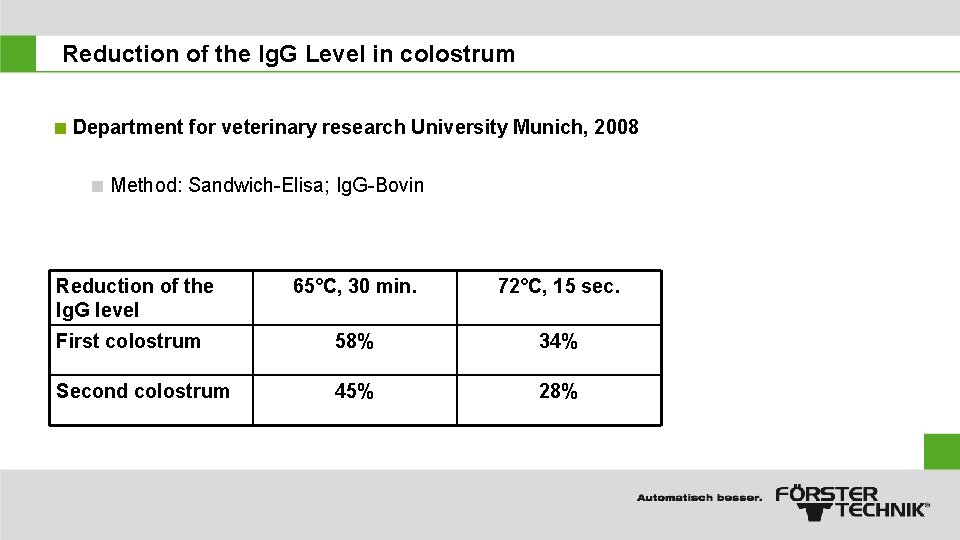
Reduction of the Ig. G Level in colostrum < Department for veterinary research University Munich, 2008 < Method: Sandwich-Elisa; Ig. G-Bovin Reduction of the Ig. G level 65°C, 30 min. 72°C, 15 sec. First colostrum 58% 34% Second colostrum 45% 28%
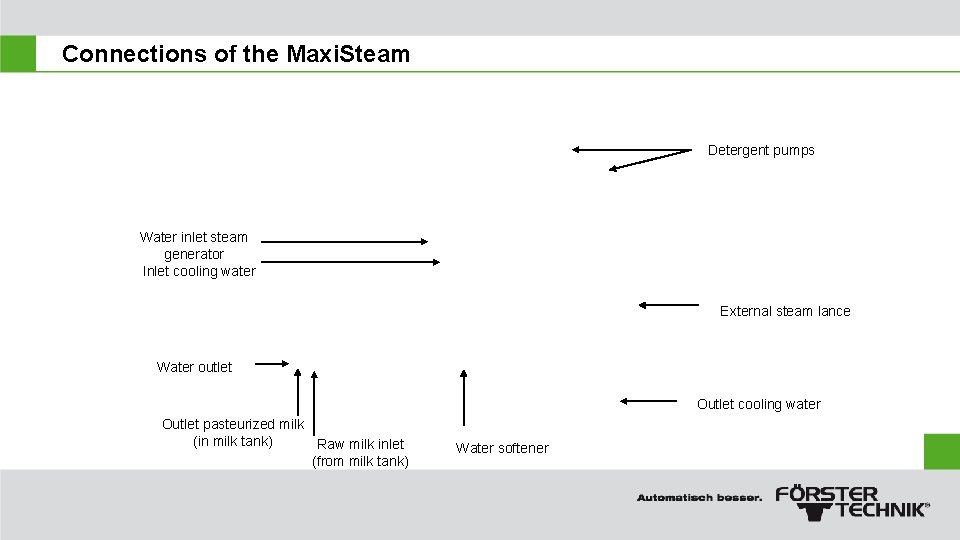
Connections of the Maxi. Steam Detergent pumps Water inlet steam generator Inlet cooling water External steam lance Water outlet Outlet cooling water Outlet pasteurized milk (in milk tank) Raw milk inlet (from milk tank) Water softener
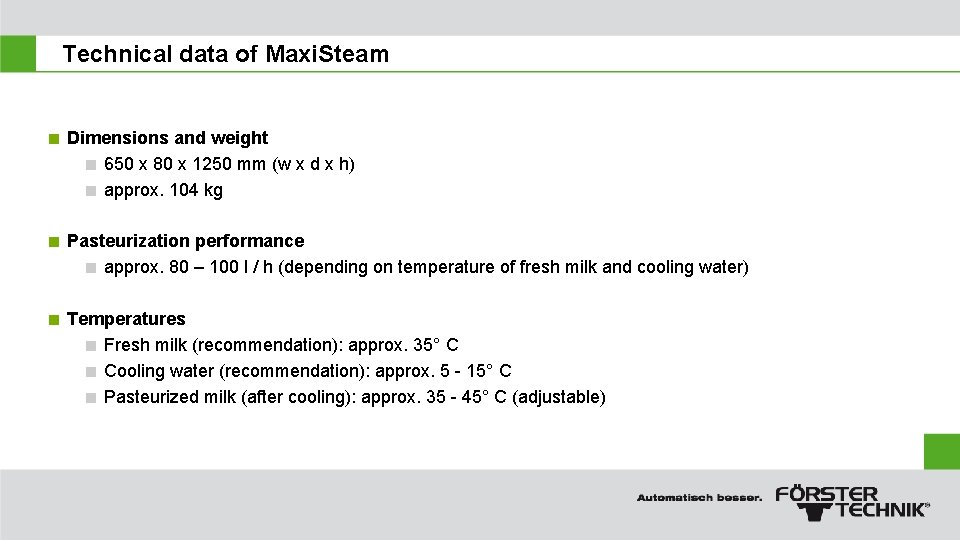
Technical data of Maxi. Steam < Dimensions and weight < 650 x 80 x 1250 mm (w x d x h) < approx. 104 kg < Pasteurization performance < approx. 80 – 100 l / h (depending on temperature of fresh milk and cooling water) < Temperatures < Fresh milk (recommendation): approx. 35° C < Cooling water (recommendation): approx. 5 - 15° C < Pasteurized milk (after cooling): approx. 35 - 45° C (adjustable)
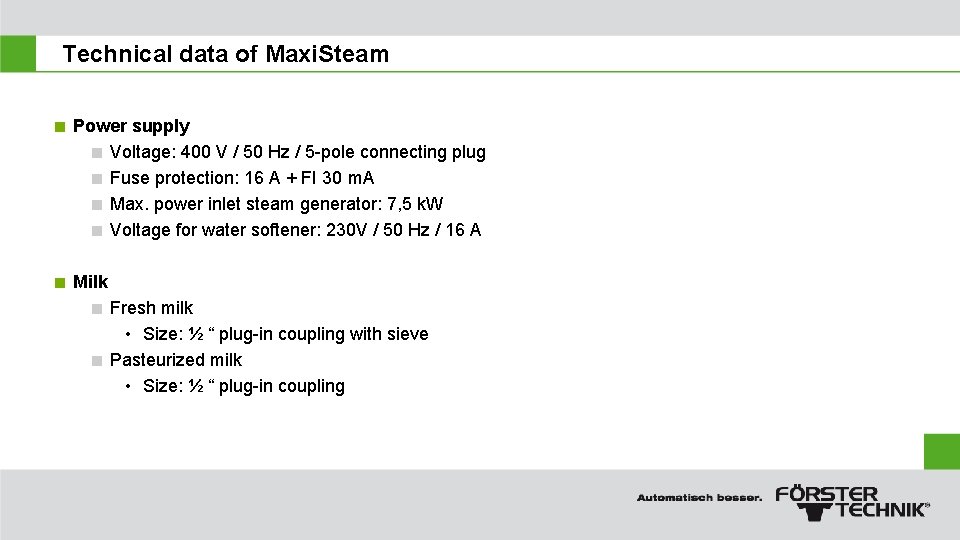
Technical data of Maxi. Steam < Power supply < Voltage: 400 V / 50 Hz / 5 -pole connecting plug < Fuse protection: 16 A + FI 30 m. A < Max. power inlet steam generator: 7, 5 k. W < Voltage for water softener: 230 V / 50 Hz / 16 A < Milk < Fresh milk • Size: ½ “ plug-in coupling with sieve < Pasteurized milk • Size: ½ “ plug-in coupling
Technical data of Maxi. Steam < Water inlet steam generator • Size: ½ “ hose, ¾“ plug-in coupling • Water pressure between 2, 5 and 6 bar • Caution: Use of softened water or water softener is recommended < Water inlet cooler • Size: ½ “ hose, ¾“ plug-in coupling • Minimal pressure: 1, 5 bar < Water outlet • Size: ½ “ hose, ½ “ plug-in coupling < Drain off < Gully • Size: ½ “ plug-in coupling