
Product Lifecycle Management Customer Background o Lockheed Martin
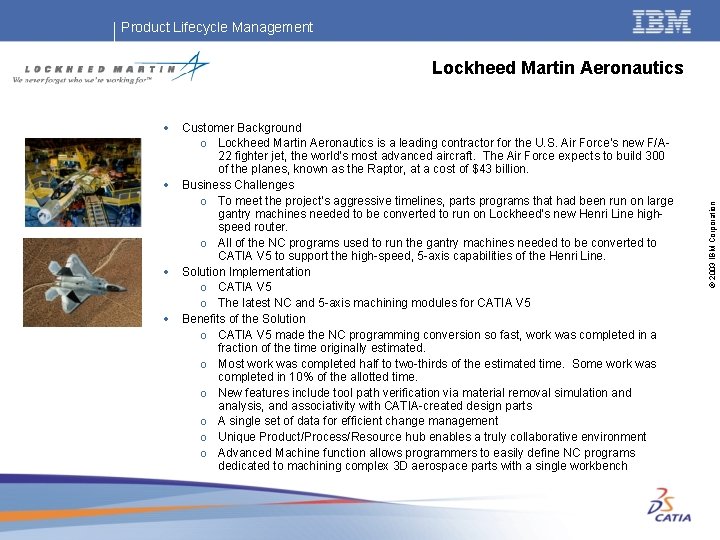
Product Lifecycle Management · Customer Background o Lockheed Martin Aeronautics is a leading contractor for the U. S. Air Force’s new F/A 22 fighter jet, the world’s most advanced aircraft. The Air Force expects to build 300 of the planes, known as the Raptor, at a cost of $43 billion. · Business Challenges o To meet the project’s aggressive timelines, parts programs that had been run on large gantry machines needed to be converted to run on Lockheed’s new Henri Line highspeed router. o All of the NC programs used to run the gantry machines needed to be converted to CATIA V 5 to support the high-speed, 5 -axis capabilities of the Henri Line. · Solution Implementation o CATIA V 5 o The latest NC and 5 -axis machining modules for CATIA V 5 · Benefits of the Solution o CATIA V 5 made the NC programming conversion so fast, work was completed in a fraction of the time originally estimated. o Most work was completed half to two-thirds of the estimated time. Some work was completed in 10% of the allotted time. o New features include tool path verification via material removal simulation and analysis, and associativity with CATIA-created design parts o A single set of data for efficient change management o Unique Product/Process/Resource hub enables a truly collaborative environment o Advanced Machine function allows programmers to easily define NC programs dedicated to machining complex 3 D aerospace parts with a single workbench © 2003 IBM Corporation Lockheed Martin Aeronautics

Product Lifecycle Management To meet the aggressive timelines for manufacturing the U. S. Air Force’s new F/A-22 Raptor, Lockheed Martin Aeronautics needed to upgrade from gantry machines to a new Henri Line high-speed router. Could the work to revise its NC programs be done in time? Learn how CATIA V 5 helped Lockheed beat its estimated programming times by as much as 90%. “Some jobs were programmed in as little as a tenth of the estimated hours scheduled for conversion to the Henri Line machine. ” Mike Lally, Manager, Manufacturing Engineering, Lockheed “ © 2003 IBM Corporation Lockheed upgrades NC programming in record time

Product Lifecycle Management Lockheed Martin Aeronautics ▪ The Challenge To meet the aggressive timelines of the F/A-22 Raptor fighter jet, parts programs that had been run on large gantry machines needed to be converted to run on Lockheed’s new Henri Line high-speed router. Lockheed needed a CAD program that could support sufficient multi-axis capabilities to support critical-tolerance F/A-22 composite panel trim and light milling applications. ▪ The Solution Lockheed tested and selected CATIA V 5 computer-aided manufacturing tools and processes, including the latest NC and 5 -axis machining modules. New features include tool path verification via material removal simulation and analysis, and associativity with CATIA-created design parts. CATIA’s unique Product/Process/Resource hub enables a truly collaborative environment, and Advanced Machine function allows programmers to easily define NC programs dedicated to machining complex 3 D aerospace parts with a single workbench. ▪ The Customer Benefits CATIA V 5 proved that it could convert parts programs that had been run on large gantry machines to harness the highspeed capabilities of the company’s new Henri Line router. “Some jobs were programmed in as little as a tenth of the estimated hours scheduled for conversion. ” – Mike Lally, Manager of Manufacturing Engineering, Lockheed Martin Aeronautics © 2003 IBM Corporation ▪ The Industry Lockheed Martin Aeronautics Company, headquartered in Fort Worth, Texas, is a world leader in building military aircraft, including the F-16, C-130 J, F-117 (Stealth fighter) and the next-generation F-22. The 20, 000 -employee company has recently been awarded the contract to build the multi-service, multi-mission Joint Strike Fighter of the future.
- Slides: 3