
Product Life Cycle Support PLCS The Information Backbone
Product Life Cycle Support (PLCS) The Information Backbone to transform the Logistics Enterprise The Benefits of PLCS Howard Mason Corporate IT Office BAE Systems Chair, ISO TC 184 SC 4 Industrial Data Co-chair, OASIS PLCS TC Chair, e. Business Mo. U Management Group
The PLCS Initiative l l The Business Context v The key problem Overview of PLCS v Vision v Approach v Capabilities v Status Exploiting the benefits Future plans 2
Setting the Business Context Business Drivers l l l Reduced Cost of Ownership v Users of products are seeking improved availability, reliability, maintainability and lower cost of ownership Sustainable Business Growth v Companies are seeking to make money through the life cycle support of their products to improve profits, improve quality and be more competitive Protect investment in product data v Users of information systems want to ensure long term usability for product information as IT and processes change 3
Setting the Business Context Digital Product Data has become a valuable business asset l l l New Business Opportunities v Leading manufacturers are ‘going downstream’ to generate additional revenue from supply of lifecycle support services v Major users are seeking to outsource their support and information services Product Lifecycle Management v Businesses are focusing on total cost of ownership, as product life cycles increase and products become more expensive to maintain v Increased focus on managing information throughout the product lifecycle – Concept to Disposal Extended Enterprise v Increasingly complex business networks v Not practical to adopt common system mandate v Knowledge workers need to share information in real time 4
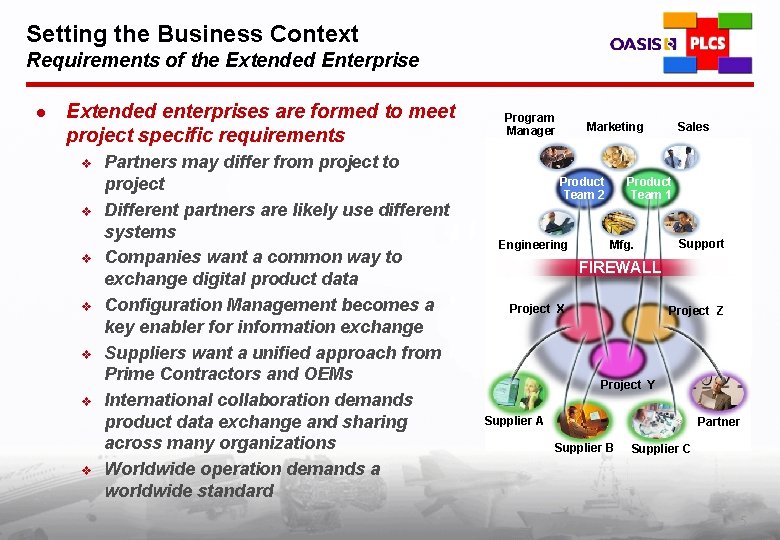
Setting the Business Context Requirements of the Extended Enterprise l Extended enterprises are formed to meet project specific requirements v v v v Partners may differ from project to project Different partners are likely use different systems Companies want a common way to exchange digital product data Configuration Management becomes a key enabler for information exchange Suppliers want a unified approach from Prime Contractors and OEMs International collaboration demands product data exchange and sharing across many organizations Worldwide operation demands a worldwide standard Program Manager Marketing Product Team 2 Engineering Sales Product Team 1 Mfg. Support FIREWALL Project X Project Z Project Y Supplier A Partner Supplier B Supplier C 5
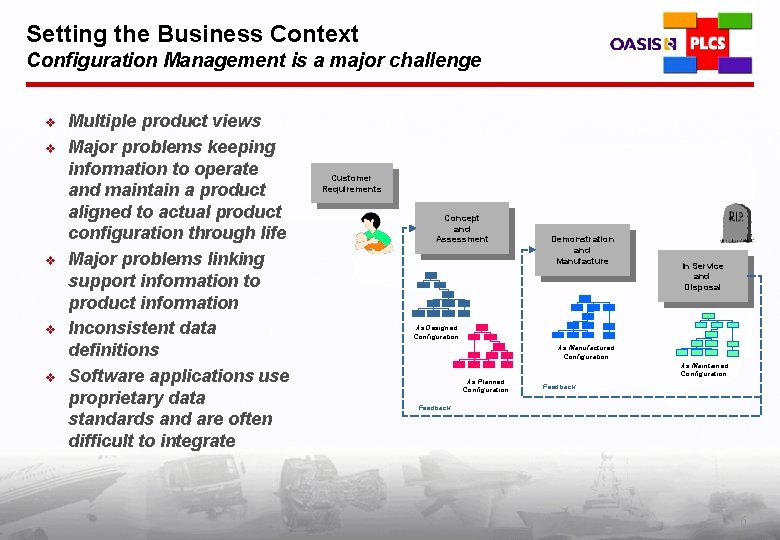
Setting the Business Context Configuration Management is a major challenge v v v Multiple product views Major problems keeping information to operate and maintain a product aligned to actual product configuration through life Major problems linking support information to product information Inconsistent data definitions Software applications use proprietary data standards and are often difficult to integrate Customer Requirements Concept and Assessment Demonstration and Manufacture In Service and Disposal As Designed Configuration As Manufactured Configuration As Planned Configuration As Maintained Configuration Feedback 6
Setting the Business Context Limitations with current standards Current standards are specialized and focus on either: v a piece of a business transaction or process, e. g. Order Part; or v presentation of specific content, I. e. Aircraft maintenance manual Example: Transaction oriented v Defence: ASD 2000 M (ex-AECMA) v Commercial: ATA Spec 2000, EDIFACT, ANSI X. 12, eb. XML Example: Content oriented v Manufacturing and process centric: l v ISO 9000, STEP Operations and maintenance centric: l l Defence: MIL-STD-1388, Def-Stan-00 -60, ASD S 1000 D Commercial: ATA Spec 2000, 2100 7
Setting the Business Context Imagine the opportunities if … v v v Configuration management information was always accurate, up to date and immediately accessible Maintenance information was precisely tailored to the work to be done Spares and inventory costs were minimized through vendor involvement in an integrated supply chain In-service feedback was accurate, meaningful and readily available to product designers and support managers Change was easy to manage 8
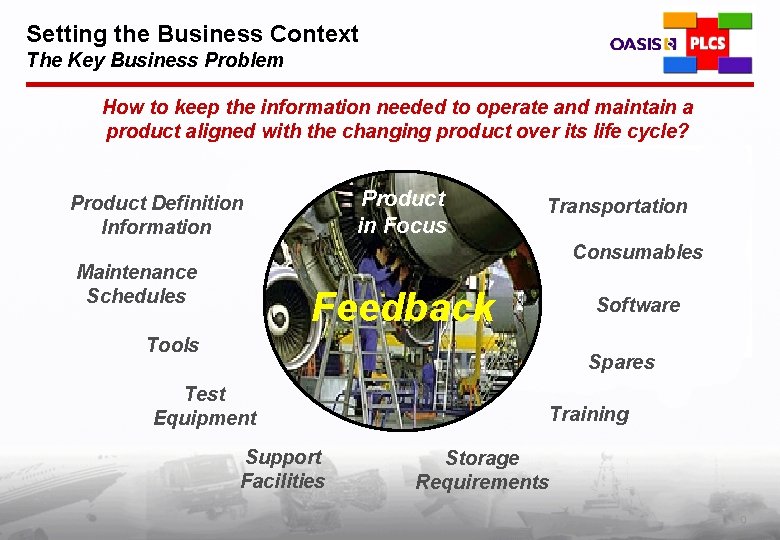
Setting the Business Context The Key Business Problem How to keep the information needed to operate and maintain a product aligned with the changing product over its life cycle? Product in Focus Product Definition Information Transportation Consumables Maintenance Schedules Feedback Tools Software Spares Test Equipment Support Facilities Training Storage Requirements 9
Product Life Cycle Support (PLCS) The stakeholders Finnish Defence Forces 10

Product Life Cycle Support (PLCS) The Initiative A joint industry and government initiative to accelerate development of new standards for product support information An international project to produce an approved ISO standard within 4 years; ran from November 1999 – September 2003 PLCS is designed to ensure support information is aligned to the evolving product definition over the entire life cycle PLCS extends ISO 10303 STEP - the STandard for Exchange of Product model data 11
Product Life Cycle Support (PLCS) Available capabilities - ISO STEP l STEP is an established international standard for the exchange, integration and sharing of product data v v v v v l l Geometry Product structure Manufacturing interfaces Drawings Finite Element Analysis Printed Circuit Assemblies Wiring looms Mechanical Design Construction industry Supports wide range of IT – ASCII, databases, XML, XMI, …. . Process modelling independent of information in EXPRESS 12
Product Life Cycle Support (PLCS) STEP in service Product Data Management exchange for Eurofighter Supplier interface for Lockheed Martin Configuration Management and Digital Pre-Assembly exchange at Boeing - RR, GE and P&W Interface between A 380 and its engines IBM's global e-procurement design data exchange Solid model exchange for Electric Boat US and UK Navy RAMP programmes Japanese SCADEC programme for the construction industry Ford CAD/PDM data integration NASA Engineering information 13
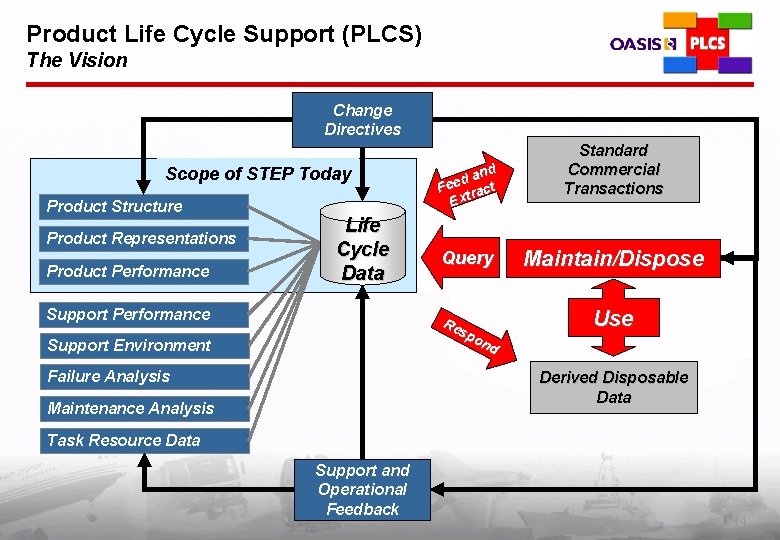
Product Life Cycle Support (PLCS) The Vision Change Directives Scope of STEP Today Product Structure Product Representations Product Performance Life Shared Cycle Data Support Performance and d e Fe ract Ext Query Re sp on d Support Environment Failure Analysis Standard Commercial Transactions Maintain/Dispose Use Derived Disposable Data Maintenance Analysis Task Resource Data Support and Operational Feedback 14
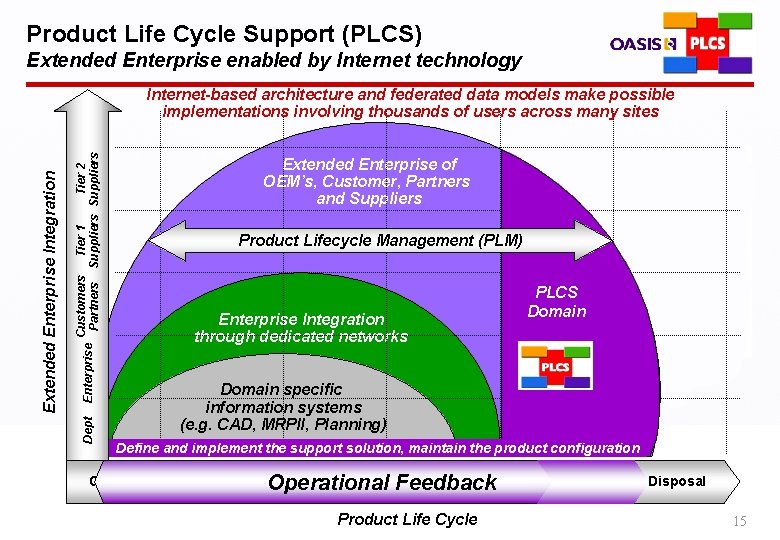
Product Life Cycle Support (PLCS) Extended Enterprise enabled by Internet technology Customers Tier 1 Tier 2 Partners Suppliers Extended Enterprise of OEM’s, Customer, Partners and Suppliers Product Lifecycle Management (PLM) Enterprise Integration through dedicated networks Enterprise Dept Extended Enterprise Integration Internet-based architecture and federated data models make possible implementations involving thousands of users across many sites PLCS Domain specific information systems (e. g. CAD, MRPII, Planning) Define and implement the support solution, maintain the product configuration Concept Assessment Demonstration Feedback Manufacture Operational Product Life Cycle In-Service Disposal 15
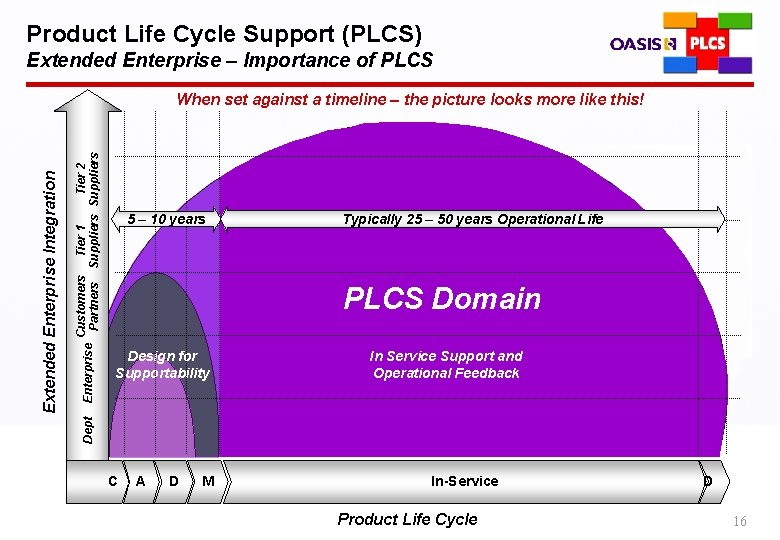
Product Life Cycle Support (PLCS) Extended Enterprise – Importance of PLCS Customers Tier 1 Tier 2 Partners Suppliers Enterprise 5 – 10 years Typically 25 – 50 years Operational Life PLCS Domain Design for Supportability In Service Support and Operational Feedback Dept Extended Enterprise Integration When set against a timeline – the picture looks more like this! C A D M In-Service Product Life Cycle D 16
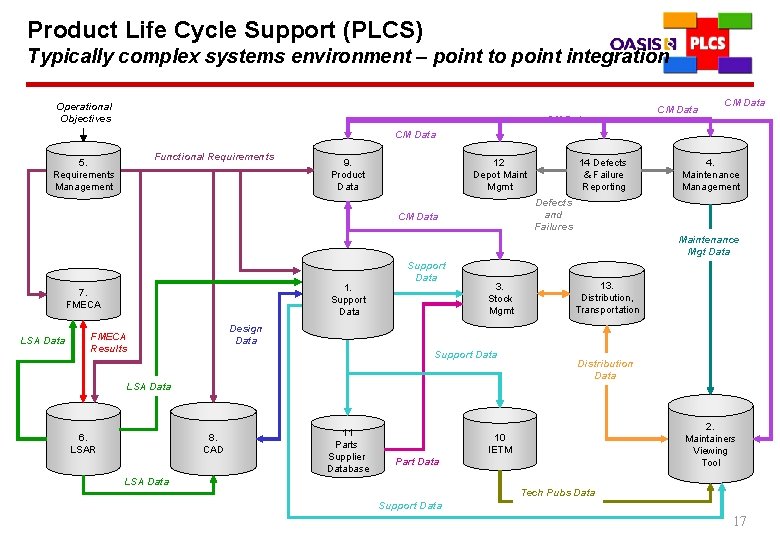
Product Life Cycle Support (PLCS) Typically complex systems environment – point to point integration Operational Objectives CM Data Functional Requirements 5. Requirements Management 12 Depot Maint Mgmt 9. Product Data 14 Defects & Failure Reporting 4. Maintenance Management Defects and Failures CM Data Maintenance Mgt Data 1. Support Data 7. FMECA LSA Data Support Data 3. Stock Mgmt Design Data FMECA Results Support Data LSA Data 6. LSAR 13. Distribution, Transportation 8. CAD 11 Parts Supplier Database Distribution Data 2. Maintainers Viewing Tool 10 IETM Part Data LSA Data Tech Pubs Data Support Data 17
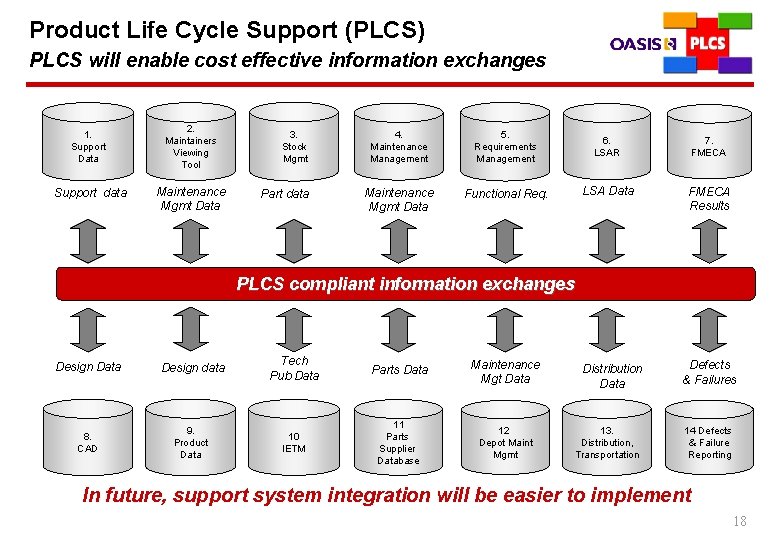
Product Life Cycle Support (PLCS) PLCS will enable cost effective information exchanges 1. Support Data Support data 2. Maintainers Viewing Tool Maintenance Mgmt Data 3. Stock Mgmt Part data 4. Maintenance Management 5. Requirements Management 6. LSAR 7. FMECA Maintenance Mgmt Data Functional Req. LSA Data FMECA Results PLCS compliant information exchanges Design Data Design data Tech Pub Data Parts Data Maintenance Mgt Data 8. CAD 9. Product Data 10 IETM 11 Parts Supplier Database 12 Depot Maint Mgmt Distribution Data 13. Distribution, Transportation Defects & Failures 14 Defects & Failure Reporting In future, support system integration will be easier to implement 18
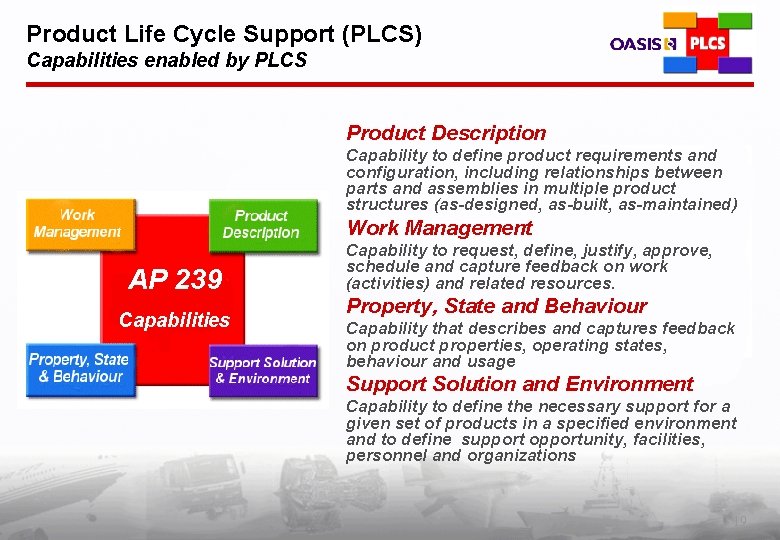
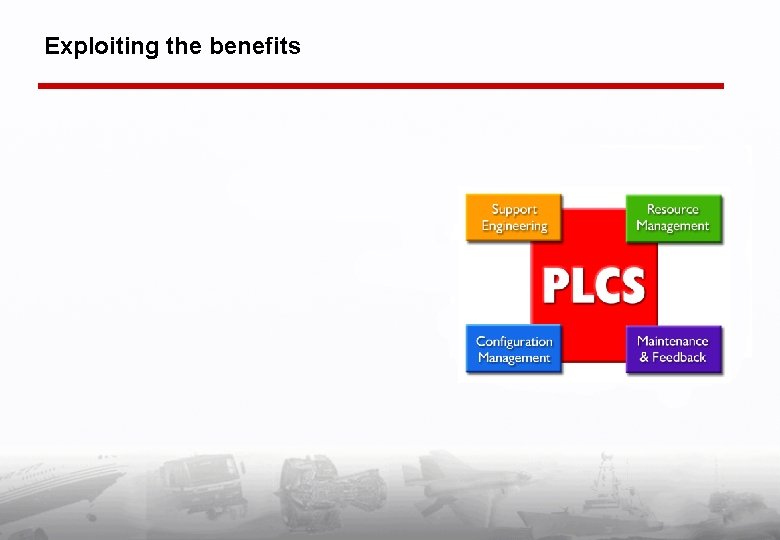
Product Life Cycle Support (PLCS) Capabilities enabled by PLCS Product Description Capability to define product requirements and configuration, including relationships between parts and assemblies in multiple product structures (as-designed, as-built, as-maintained) Work Management AP 239 Capabilities Capability to request, define, justify, approve, schedule and capture feedback on work (activities) and related resources. Property, State and Behaviour Capability that describes and captures feedback on product properties, operating states, behaviour and usage Support Solution and Environment Capability to define the necessary support for a given set of products in a specified environment and to define support opportunity, facilities, personnel and organizations 19
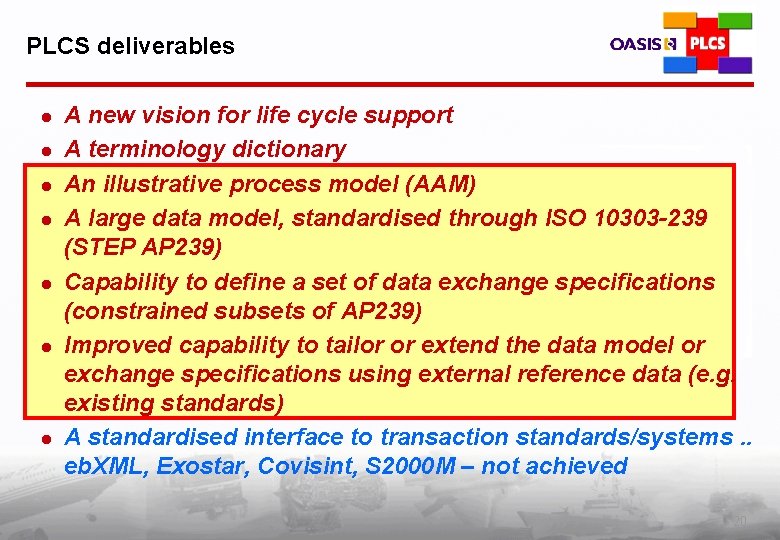
PLCS deliverables l l l l A new vision for life cycle support A terminology dictionary An illustrative process model (AAM) A large data model, standardised through ISO 10303 -239 (STEP AP 239) Capability to define a set of data exchange specifications (constrained subsets of AP 239) Improved capability to tailor or extend the data model or exchange specifications using external reference data (e. g. existing standards) A standardised interface to transaction standards/systems. . eb. XML, Exostar, Covisint, S 2000 M – not achieved 20
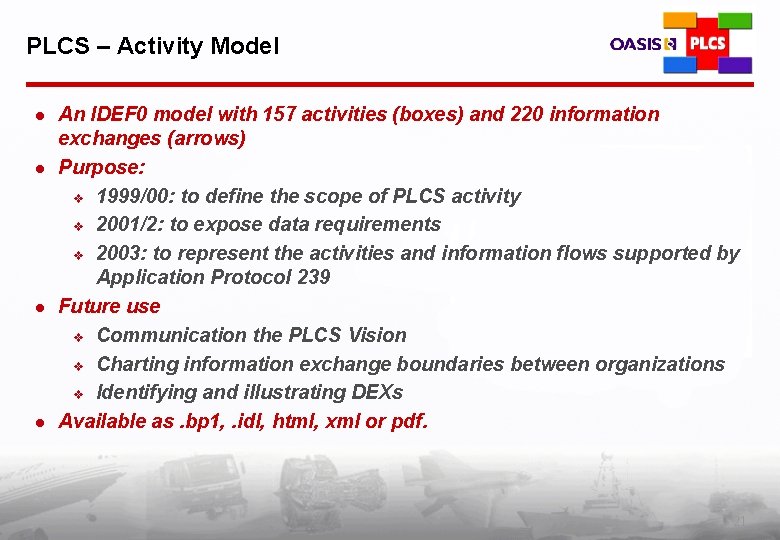
PLCS – Activity Model l l An IDEF 0 model with 157 activities (boxes) and 220 information exchanges (arrows) Purpose: v 1999/00: to define the scope of PLCS activity v 2001/2: to expose data requirements v 2003: to represent the activities and information flows supported by Application Protocol 239 Future use v Communication the PLCS Vision v Charting information exchange boundaries between organizations v Identifying and illustrating DEXs Available as. bp 1, . idl, html, xml or pdf. 21
PLCS – Activity Model Concepts l l l l The PIF – Product in focus: “what products do you want me to support? ” A PIF will be supported by one or more support solution definitions: how to support these products Each support solution definition is based on v A deployment environment v A support solution requirement The deployment environment defines: v A product group – a sub-set of the PIF needing tailored support v A usage pattern v A definition of the expected support organizations, locations, facilities and resources A support requirement is a structured requirement statement including performance metrics and targets for support performance Support metrics are required to enable: v Continuous optimization of support solution definition through life, based on feedback from use v Specification of an assessment strategy (what data to collect and how) A PIF scope may include many deployment environments and hence many support solution definitions These will be derived from a common set of task and resource descriptions 22
PLCS – Activity Model Concepts l (Each) Support solution definition includes: v Task specifications and task logic (e. g. diagnostic procedures) v Relationship of tasks to the product configuration (including “effectivity” /“applicability” to all product versions) v Specification of task trigger conditions based on: l l l State of individual product (as identified by UID) Usage of individual product Prior task or other events Identification and quantification of resources needed for each task, including a resource consumption model Task specifications may: v point to an existing document v point to an SGML document (e. g. an ASD S 1000 D Module) v be fully “machine readable” Task specifications may be linked to resources v Required resources v Resource items (products, people, facilities etc) v l l 23
PLCS - APSI and Related Information l l l Assured Product Support Information comprises v PIF scope v Description of relevant deployment environments v Support Solution requirements v Product Definition Information (at least that needed for support) v Support Solution Definitions This full data set is subject to configuration change management Related Information may comprise v Test results v Manufacturing records v History of collected feedback on: l l l Individual product configuration over time Product state and properties over time Activities, including: u Product use u Work done u Resource use 24
PLCS - Information modelling principles l l Create a durable data model standard that can be extended/adapted over time without re-modelling or re-ballot v Identify key generic concepts and relationships v Extend/adapt by classification and reference data libraries Build on existing standards: v PDM Schema and the STEP Modular Architecture Accommodate values that change over time v Support multiple values for the same property v Support back-tracking & audit Maintain unambiguous histories v Product Structure, State, Activity Aim: to enable optimisation of support through life 25
PLCS – The information model l Main concepts v v A large, comprehensive data model Defined in EXPRESS to facilitate integration with other product data l l v v Maps to multiple representation formats EXPRESS-G graphical representation 153 Modules, ~500 Entities, ~1200 attributes Can be extended using classification based on reference data, stored in external libraries (RDL) l Built around OWL 26
PLCS is a Modular STEP AP l l Modules allow common definitions of product data to be reused Extensive re-use of PDM modules v To bring compatibility with design/PDM tools v Basic work order/work request process common to change in design Extended to provide v Life cycle CM v Full work management capability v Condition based task triggers All modules feature two levels of model, with mapping v User view of information v Link to common concepts across all of STEP v Full harmonization achieved where needed by common modules l l With CAD/PDM via PDM Modules With Requirement Tools via Systems Engineering modules 27
PLCS enables requirement management through life l AP 239 will share common modules with AP 233 – Systems Engineering (currently in draft): v v v Text-based Requirements Multiple, related breakdowns, including “System” concept Interfaces l Aim is to support requirements trace from pre-design through to maintenance and disposal l UK MOD has funded demonstration project for this capability with BAE Systems 28
PLCS provides full history to support optimization and change over time l In the PLCS models it is assumed that any value supplied v E. g. a property such as mean time to perform a task may have multiple values over time where each value could have been: v v v l l supplied at different times by different people subject to approval subject to security classification Have an associated justification/probability/risk This requirement has been recognised from the start of modelling Improve CM of support information by use of “single source” Assured Product and Support Information (APSI) 29
PLCS - Life Cycle PDM Capability (1) l PDM Schema already supports automated exchange of v v l Part id and properties Associated documents and files (incl. CAx) Product structure Product (and document) approval status This is already in production use by v v v US Aerospace and Defence prime contractors (via AP 203) German/Swedish/French Automotive sector (via AP 214 cc 6) Eurofighter Typhoon PDM partners . . A powerful and proven capability for Configuration Management of a complex product design 30
PLCS - Life Cycle PDM Capability (2) l AP 239 has added: v Classification, supported by reference data libraries v Product_as_individual (planned and realized) - UID v Product breakdowns (system, physical, functional, zonal and hybrid) v Text based requirements (from AP 233) v Extended property capability v Interfaces v Attachment_slot v Message, Envelope (similar to ENGDAT) v Information Rights … A powerful capability for Life Cycle Configuration Management of Assured Product and Support Information 31
Model overview Information scope What follows is a high level abstract view of the scope showing key elements v v From 10, 000 feet! And from 100 feet. Used by Permission. Presentation Material Copyright Eurostep Group 32
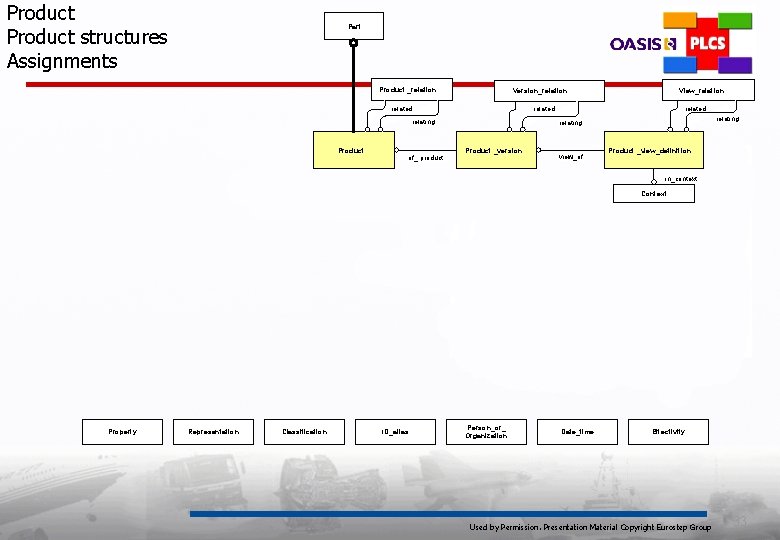
Product structures Assignments Part Product _relation related relating Product of_ product View_relation Version_relation related relating Product _version view_of Product _view_definition in_context Context Property Representation Classification ID_alias Person_or_ Organization Date_time Effectivity Used by Permission. Presentation Material Copyright Eurostep Group 33
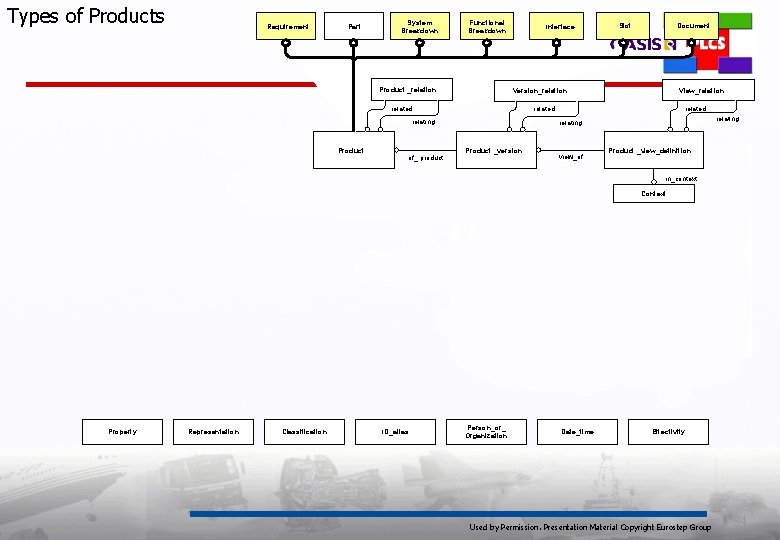
Types of Products Requirement Part System Breakdown Functional Breakdown Product _relation Interface related relating of_ product View_relation Version_relation related Product Document Slot related relating Product _version view_of Product _view_definition in_context Context Property Representation Classification ID_alias Person_or_ Organization Date_time Effectivity Used by Permission. Presentation Material Copyright Eurostep Group 34
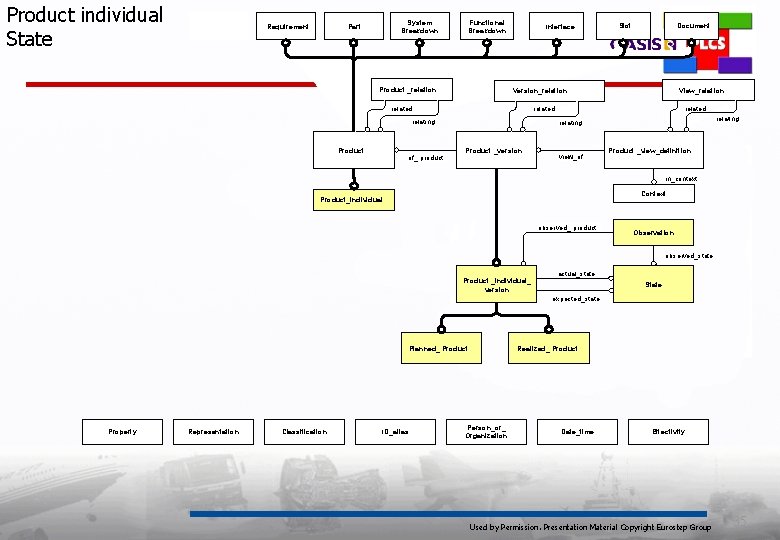
Product individual State Requirement System Breakdown Part Functional Breakdown Product _relation Interface related relating of_ product View_relation Version_relation related Product Document Slot related relating Product _version view_of Product _view_definition in_context Context Product_individual observed_ product Observation observed_state Product _individual_ version actual_state State expected_state Planned_ Product Property Representation Classification ID_alias Realized_ Product Person_or_ Organization Date_time Effectivity Used by Permission. Presentation Material Copyright Eurostep Group 35
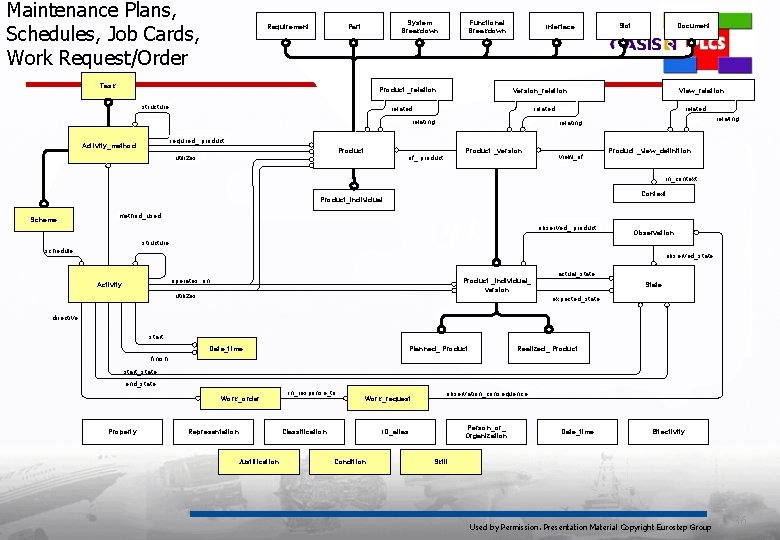
Maintenance Plans, Schedules, Job Cards, Work Request/Order Requirement System Breakdown Part Task Functional Breakdown Product _relation structure Interface Document Slot View_relation Version_relation related relating required_ product Activity_method Product utilizes Product _version of_ product view_of Product _view_definition in_context Context Product_individual Scheme method_used observed_ product Observation structure schedule observed_state operates_on Activity Product _individual_ version utilizes actual_state State expected_state directive start Planned_ Product Date_time Realized_ Product finish start_state end_state Work_order Property Representation Justification in_response_to Work_request Classification observation_consequence Person_or_ Organization ID_alias Condition Date_time Effectivity Skill Used by Permission. Presentation Material Copyright Eurostep Group 36
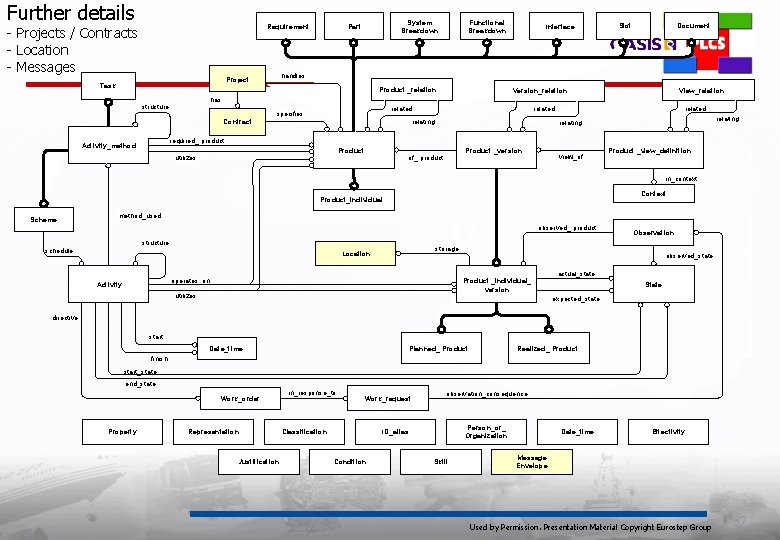
Further details Requirement - Projects / Contracts - Location - Messages Functional Breakdown Interface Document Slot handles Project Task System Breakdown Part Product _relation View_relation Version_relation has structure related specifies related relating Contract related relating required_ product Activity_method Product utilizes Product _version of_ product view_of Product _view_definition in_context Context Product_individual Scheme method_used observed_ product structure schedule storage Location operates_on Activity Observation observed_state Product _individual_ version utilizes actual_state State expected_state directive start Planned_ Product Date_time Realized_ Product finish start_state end_state Work_order Property Representation Justification in_response_to Work_request Classification observation_consequence Person_or_ Organization ID_alias Condition Skill Date_time Effectivity Message Envelope Used by Permission. Presentation Material Copyright Eurostep Group 37
All PLCS Used by Permission. Presentation Material Copyright Eurostep Group 38
PLCS - Reference data l What is it? v v v l Values for attributes that are agreed and defined in advance of use E. g types of task, grades of people, types of products, types of document E. g. Nato Stock Number – classifications Why use it? v v Because it improves reliability and effectiveness of exchange Because it can be extended: l l v l To add to the scope of the standard To provide project specific functions Because it supports re-use of values from existing standards Idea proven in Oil and Gas industry 39
PLCS – Data Exchange Specifications (DEXs) l DEXs are: v v v l l Subsets of the AP 239 Information model Selected to meet a specific data exchange need Built from relevant modules Supported by Usage Guidance, population rules and Reference data Can be refined from other DEXs may be standardized at any level (work group, company, project, organization, national, international) DEXs enable v v Consistent implementation of AP 239 Data consolidation through time 40
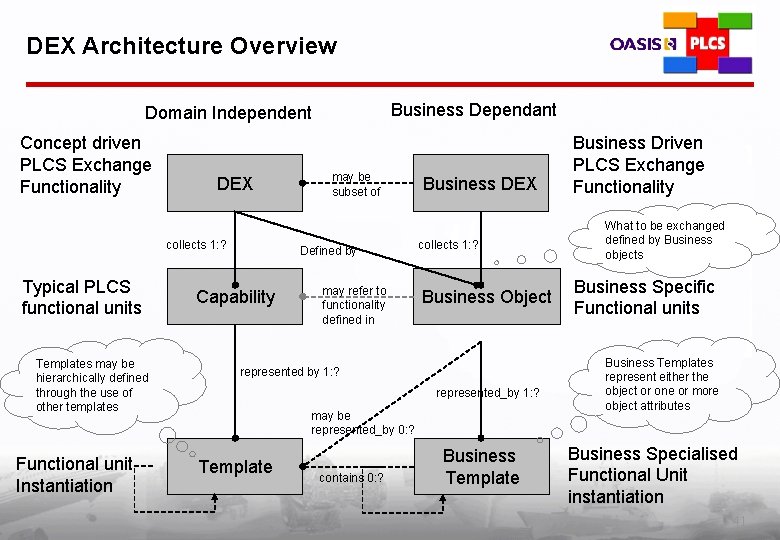
DEX Architecture Overview Business Dependant Domain Independent Concept driven PLCS Exchange Functionality DEX collects 1: ? Typical PLCS functional units Templates may be hierarchically defined through the use of other templates Functional unit Instantiation may be subset of Defined by Capability may refer to functionality defined in Business DEX collects 1: ? Business Object represented by 1: ? represented_by 1: ? may be represented_by 0: ? Template contains 0: ? Business Template Business Driven PLCS Exchange Functionality What to be exchanged defined by Business objects Business Specific Functional units Business Templates represent either the object or one or more object attributes Business Specialised Functional Unit instantiation 41
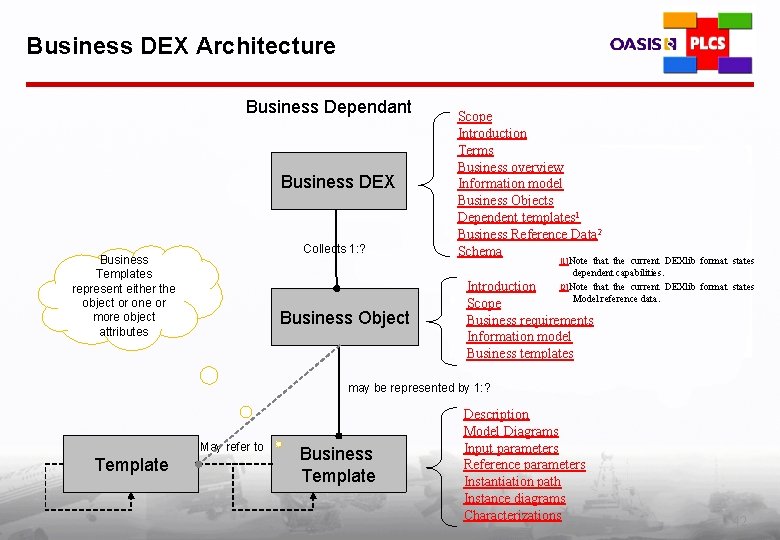
Business DEX Architecture Business Dependant Business DEX Collects 1: ? Business Templates represent either the object or one or more object attributes Business Object Scope Introduction Terms Business overview Information model Business Objects Dependent templates 1 Business Reference Data 2 Schema [1]Note that the current DEXlib format states dependent capabilities. [2]Note that the current DEXlib format states Model reference data. Introduction Scope Business requirements Information model Business templates may be represented by 1: ? May refer to Template Business Template Description Model Diagrams Input parameters Reference parameters Instantiation path Instance diagrams Characterizations 42
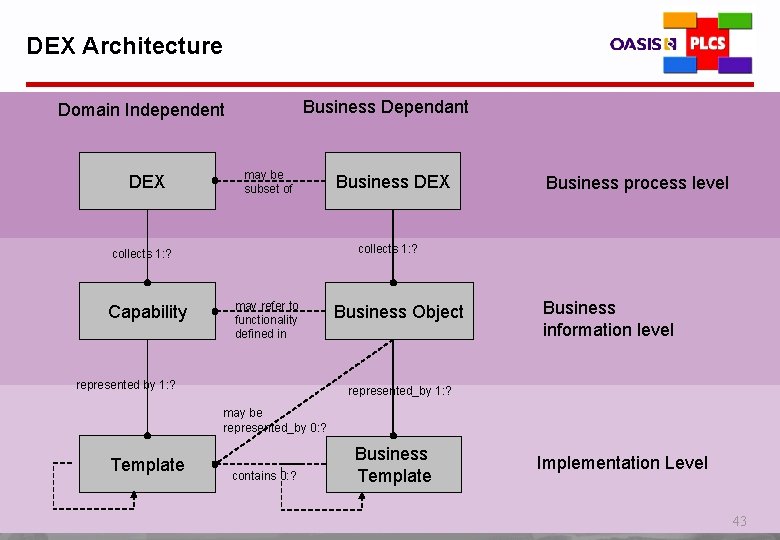
DEX Architecture Business Dependant Domain Independent DEX may be subset of Business process level collects 1: ? Capability Business DEX may refer to functionality defined in represented by 1: ? Business Object Business information level represented_by 1: ? may be represented_by 0: ? Template contains 0: ? Business Template Implementation Level 43
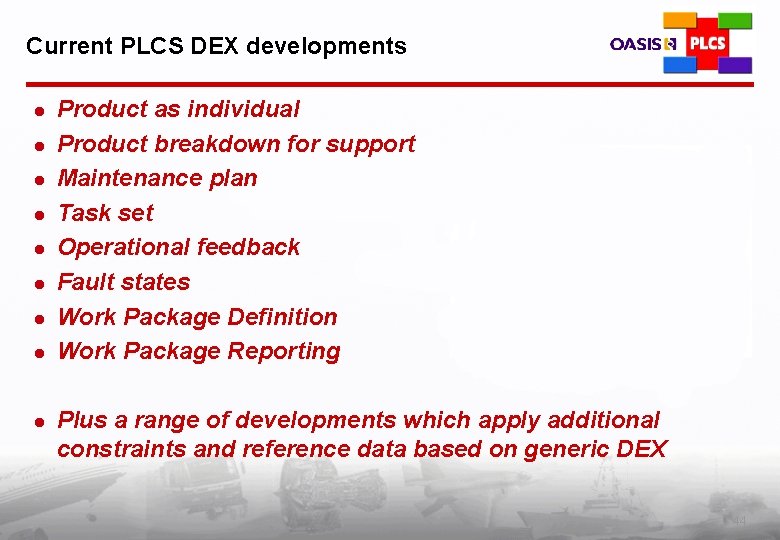
Current PLCS DEX developments l l l l l Product as individual Product breakdown for support Maintenance plan Task set Operational feedback Fault states Work Package Definition Work Package Reporting Plus a range of developments which apply additional constraints and reference data based on generic DEX 44
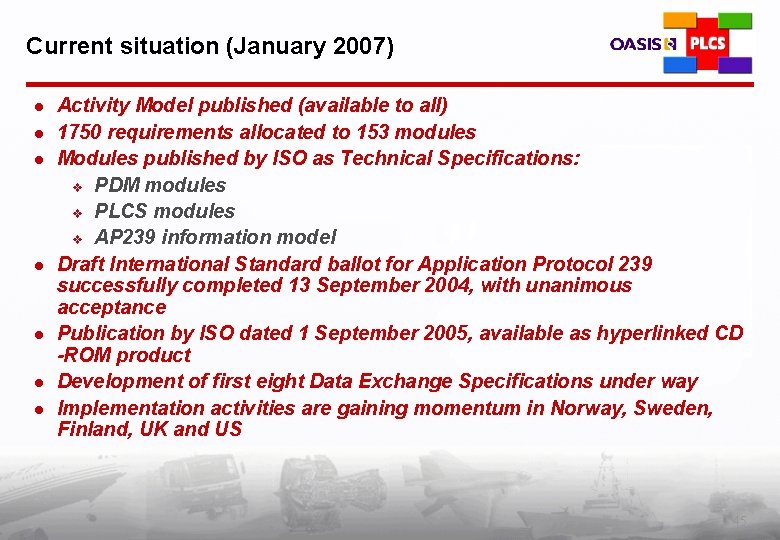
Current situation (January 2007) l l l l Activity Model published (available to all) 1750 requirements allocated to 153 modules Modules published by ISO as Technical Specifications: v PDM modules v PLCS modules v AP 239 information model Draft International Standard ballot for Application Protocol 239 successfully completed 13 September 2004, with unanimous acceptance Publication by ISO dated 1 September 2005, available as hyperlinked CD -ROM product Development of first eight Data Exchange Specifications under way Implementation activities are gaining momentum in Norway, Sweden, Finland, UK and US 45
Product Life Cycle Support (PLCS) Unique Value Proposition l l l International Standard for product support information - based on the ISO 10303 standard for product data (STEP) Complete product lifecycle – from concept to disposal Single source of assured product and support information Data independence from Processes and Systems Interoperability across enterprises and systems through: v v v l Standardization of semantics for product support Integrated suite of data models for data exchange and information sharing Utilization of ISO STEP standards, methods and tools Extensibility and tailoring through the use of Reference data libraries Customers, Contractors and Software Vendors working together to develop and implement a neutral data exchange standard for product support 46
Exploiting the benefits
Implementing PLCS l l The standardized PLCS information model can be implemented in 3 ways: v As an integration architecture for product life cycle support management systems and information v As a mapping between systems (APIs) v As a standardized data exchange capability (plus compliant software) STEP technology supports all three and is language independent (Cobol, Java, C++, XML) STEP is in production use, with proven benefits, for CAD, CAM and PDM systems PLCS can also be used to promote further standardization via Reference Data (e. g. fault codes, skill grades) 48
Implementing PLCS for a new program l l Use PLCS/STEP formats to capture design information as it is generated in a way that support engineers can re-use Develop Support Information in PLCS format v v v l Deliver a PLCS enabled maintenance management capability v v v l Less duplication – single assured source Easy to present/deliver in any required form (e. g. S 1000 D, XML, PDF) Improved management of effectivity/applicability Automatic upload from single assured source The right data is available for maintainers (can be tailored to serialized item) Improved feedback collection Better in-service metrics Faster learning Identify DEXs for specific exchange requirements 49
Implementing PLCS for an existing program l l l Identify current information shortfalls or problems Use the PLCS Activity Model to identify relevant data exchanges that cross IT system boundaries, within and beyond your company Implement appropriate DEXs, where there is a valid business case Identify new DEXs if required (business, company, national or sector level) Consider adopting PLCS for new data generated (changes, modifications, upgrades etc. ) v Most current formats can readily be delivered from a PLCS integrated source. The latter is cheaper to build and easier to maintain. l What NOT to do – immediately abandon current systems (and standards) that meet business needs 50
Benefits from data quality l l PLCS provides standardised rules and relationships for information Converting to standard form will reveal many of the inconsistencies in existing information sets Need to apply resources to cleanse existing data MUCH cheaper than discovering errors later! 51
Current implementations l l l Visby Corvette Gripen pilot project Norwegian frigate v v l l l Eurostep Share-A-Space BAE Systems Land Systems Hagglunds UK MOD pilots for RAF LITS and Navy UMMS v l Extending to other NDLO programmes Being promoted actively for JSF Logistics Coherence project US Do. D ELITE project for UH-60 helicopter v v Extending to other service linked to UID Plans for HMMWV and Bradley 52
Future Plans
Standards development and maintenance l l l ISO TC 184/SC 4 is responsible for “Industrial data” Working Group 3 is responsible for “Product modelling” Team 8 is responsible for “Product life cycle” Team 8 will retain responsibility for AP 239 Resources committed through national standards bodies Also provides active liaison to Systems Engineering development 54
DEX Development and publication l l l l Open-source infrastructure developed Seeking more open participation v lower cost entry Need enhanced links with other information standards development Selected OASIS consortium as parent Formed OASIS Technical Committee for “Product Life Cycle Support” Open to all OASIS members Operating under OASIS rules Depends on resources contributed by participants 55
The OASIS Technical Committee l The purpose of the OASIS Product Life Cycle Support TC is to: v v v establish structured data exchange and sharing capabilities for use by industry to support complex engineered assets throughout their total life cycle define, develop, test and publish OASIS Product Life Cycle Support DEX’s based upon ISO 10303 (STEP) Application Protocol 239 (Product Life Cycle Support). liaise with ISO TC 184/SC 4 coordinate with relevant OASIS Technical Committees promote the use of OASIS Product Life Cycle Support DEX’s across industries and governments world-wide 56
The way ahead l The PLCS consortium has delivered the basic standard, and an infrastructure for exploiting it, and has closed down l Join in an early implementation Join the OASIS Technical Committee to participate in DEX development l v l See www. oasis-open. org and select PLCS Contribute to further developments in ISO through your national standards body 57
PLCS: Relationship to other standards “If I have seen further, it is by standing on the shoulders of giants. ” (Sir Isaac Newton) 58
PLCS: Relationship to other standards POSC/ Caesar EXPRESS based Mil Spec 2549 Def Stan 00 -60 Logical RCM IT AP 208 Mil Spec 1388 TC 184/SC 4 WG 3/T 8 PWI FMV CTG 2 PLCS STEP NCDM AP 203 AECMA 1000 D 2000 M SGML EDIFACT ATA Effectivity PDM Schema OMG AP 233 PLIB ISO 15288 59
PLCS: Relationship to other standards l Current position v l The opportunity v v v l PLCS can use the data generated by current ILS standards PLCS can enable much higher levels of data integration PLCS, and other factors, will drive change in most current ILS standards The pace and direction of this change depends on market factors The challenge v To exploit the development of PLCS to deliver improved logistics services and capabilities 60
Product Life Cycle Support (PLCS) The Information Backbone for the Enterprise Questions? Answers!
- Slides: 61