
Product Introduction First Applied Sorbent Treatment Against Chemical
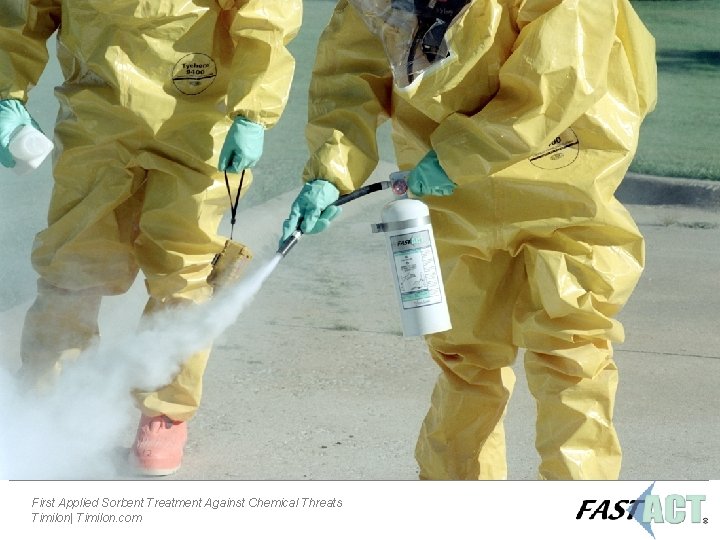
Product Introduction First Applied Sorbent Treatment Against Chemical Threats Timilon| Timilon. com
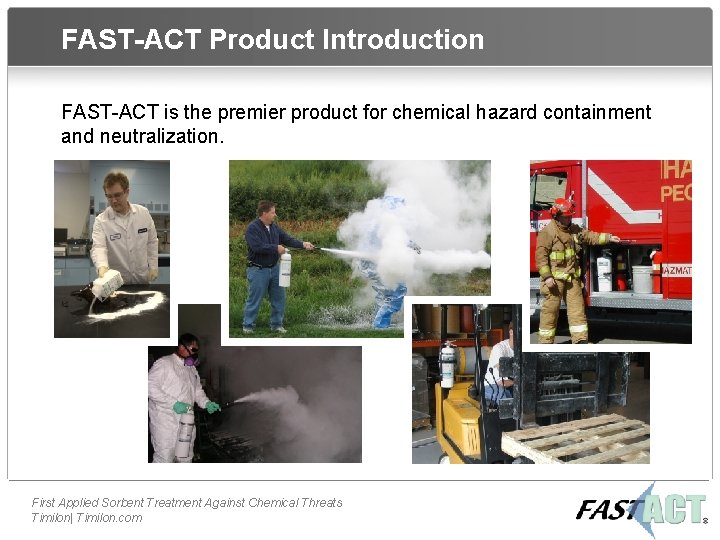
FAST-ACT Product Introduction FAST-ACT is the premier product for chemical hazard containment and neutralization. First Applied Sorbent Treatment Against Chemical Threats Timilon| Timilon. com
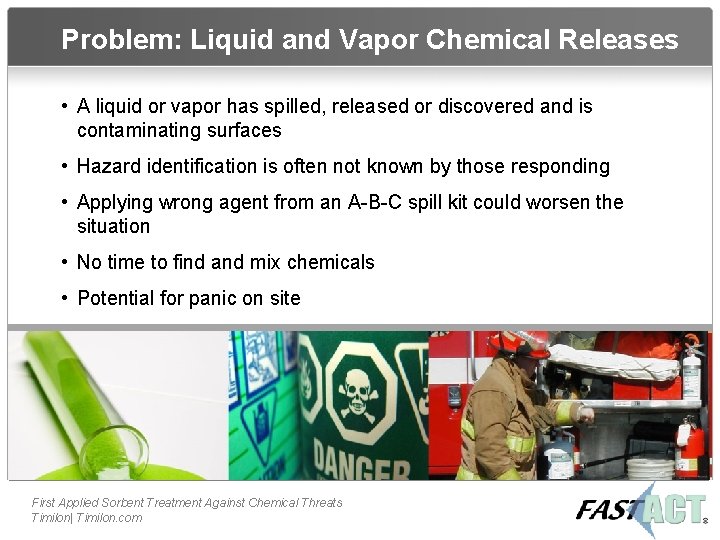
Problem: Liquid and Vapor Chemical Releases • A liquid or vapor has spilled, released or discovered and is contaminating surfaces • Hazard identification is often not known by those responding • Applying wrong agent from an A-B-C spill kit could worsen the situation • No time to find and mix chemicals • Potential for panic on site First Applied Sorbent Treatment Against Chemical Threats Timilon| Timilon. com
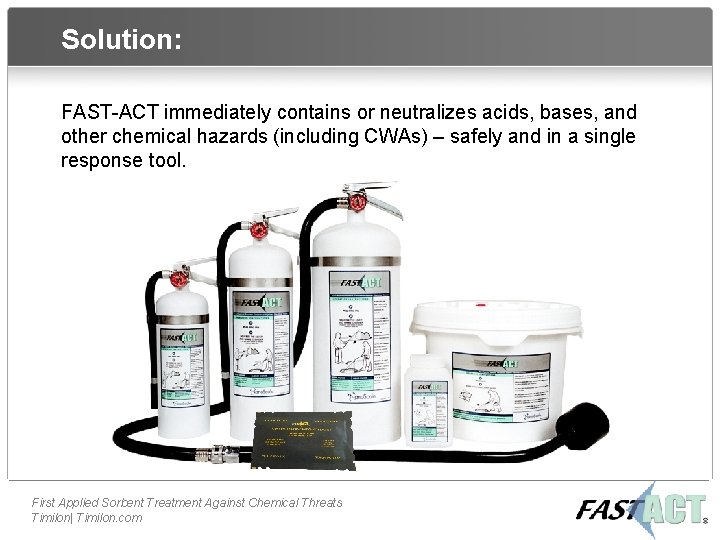
Solution: FAST-ACT immediately contains or neutralizes acids, bases, and other chemical hazards (including CWAs) – safely and in a single response tool. First Applied Sorbent Treatment Against Chemical Threats Timilon| Timilon. com
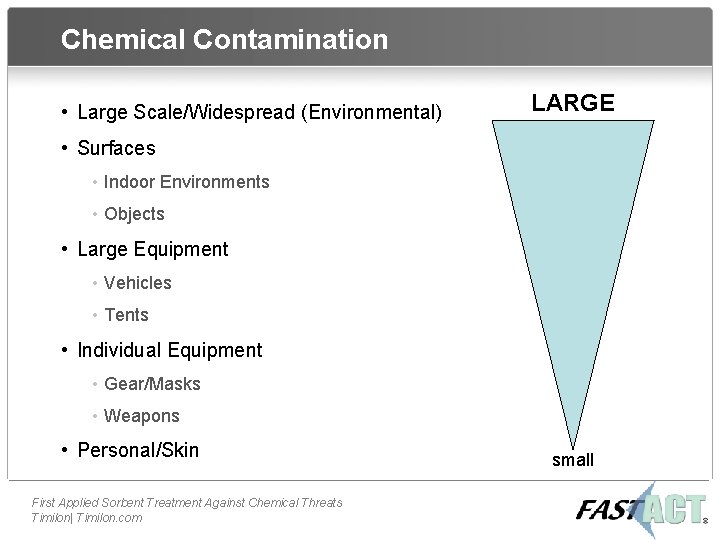
Chemical Contamination • Large Scale/Widespread (Environmental) LARGE • Surfaces • Indoor Environments • Objects • Large Equipment • Vehicles • Tents • Individual Equipment • Gear/Masks • Weapons • Personal/Skin First Applied Sorbent Treatment Against Chemical Threats Timilon| Timilon. com small

FAST-ACT Chemical Decontamination • Surfaces • Indoor Environments • Objects • Large Equipment • Vehicles • Tents • Individual Equipment • Gear/Masks • Weapons First Applied Sorbent Treatment Against Chemical Threats Timilon| Timilon. com
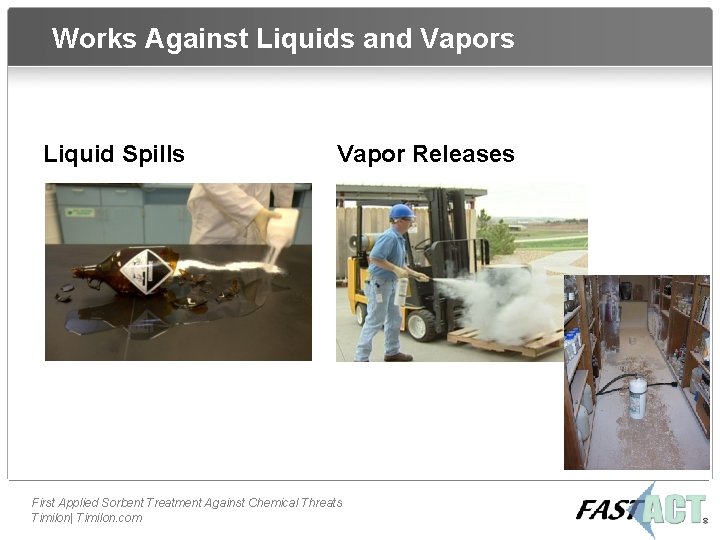
Works Against Liquids and Vapors Liquid Spills Vapor Releases First Applied Sorbent Treatment Against Chemical Threats Timilon| Timilon. com
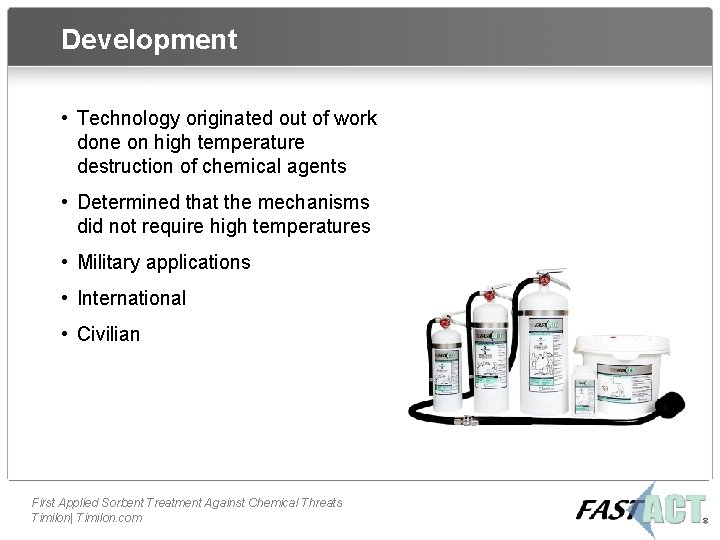
Development • Technology originated out of work done on high temperature destruction of chemical agents • Determined that the mechanisms did not require high temperatures • Military applications • International • Civilian First Applied Sorbent Treatment Against Chemical Threats Timilon| Timilon. com
Patent Protection U. S. and International Patent Protection • 7 U. S. Patents and international equivalents: • 5, 990, 373 • 7, 276, 640 • 7, 279, 129 • 7, 335, 808 • 7, 661, 483 • 7, 956, 232 • 8, 038, 935 First Applied Sorbent Treatment Against Chemical Threats Timilon| Timilon. com
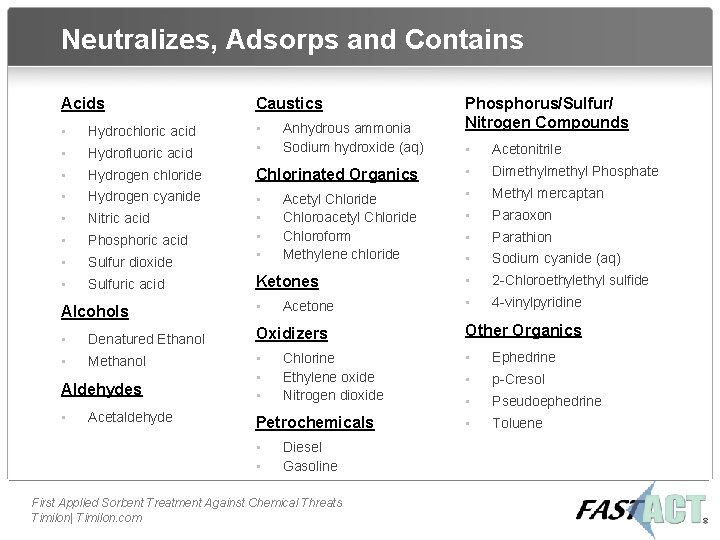
Neutralizes, Adsorps and Contains Acids Caustics • Hydrochloric acid • Hydrofluoric acid • • • Hydrogen chloride • Hydrogen cyanide • Nitric acid • Phosphoric acid • Sulfur dioxide • Sulfuric acid Anhydrous ammonia Sodium hydroxide (aq) Phosphorus/Sulfur/ Nitrogen Compounds • Acetonitrile Chlorinated Organics • Dimethyl Phosphate • • • Methyl mercaptan • Paraoxon • Parathion • Sodium cyanide (aq) Ketones • 2 -Chloroethyl sulfide Alcohols • • 4 -vinylpyridine • Denatured Ethanol Oxidizers Other Organics • Methanol • Ephedrine Aldehydes • • p-Cresol • • Pseudoephedrine Petrochemicals • Toluene Acetaldehyde • • Acetyl Chloride Chloroacetyl Chloride Chloroform Methylene chloride Acetone Chlorine Ethylene oxide Nitrogen dioxide Diesel Gasoline First Applied Sorbent Treatment Against Chemical Threats Timilon| Timilon. com
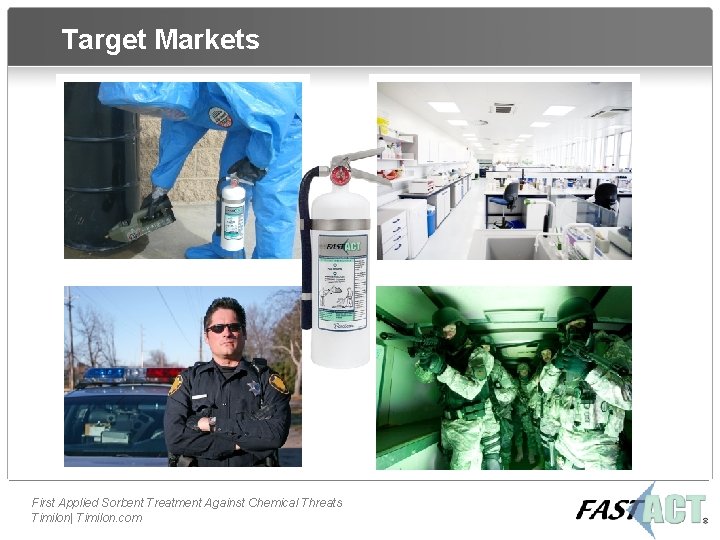
Target Markets • • HAZMAT • Laboratories • First Responders • Universities & Colleges • Transportation Leaks • Hospitals • Abandoned Materials • Government • Biotech Industry Law Enforcement • Military • Drug Labs • M 295 Analogs • Terrorism Response • M 100 Analogs • Public Venues First Applied Sorbent Treatment Against Chemical Threats Timilon| Timilon. com
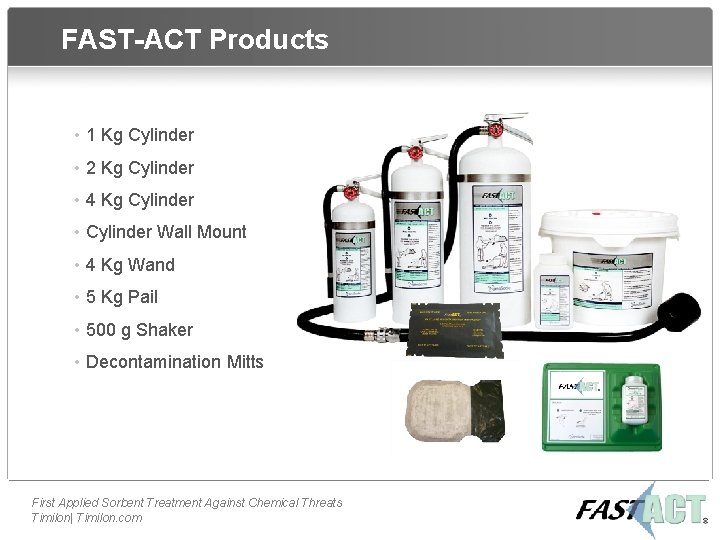
FAST-ACT Products • 1 Kg Cylinder • 2 Kg Cylinder • 4 Kg Cylinder • Cylinder Wall Mount • 4 Kg Wand • 5 Kg Pail • 500 g Shaker • Decontamination Mitts First Applied Sorbent Treatment Against Chemical Threats Timilon| Timilon. com
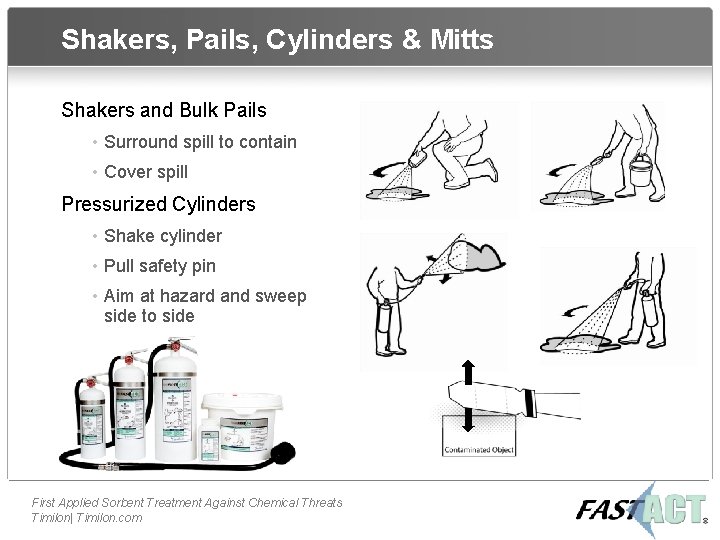
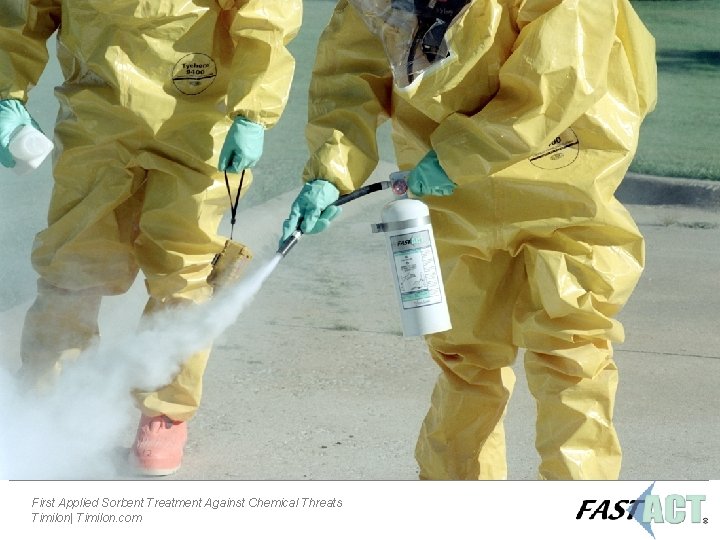
Shakers, Pails, Cylinders & Mitts Shakers and Bulk Pails • Surround spill to contain • Cover spill Pressurized Cylinders • Shake cylinder • Pull safety pin • Aim at hazard and sweep side to side First Applied Sorbent Treatment Against Chemical Threats Timilon| Timilon. com
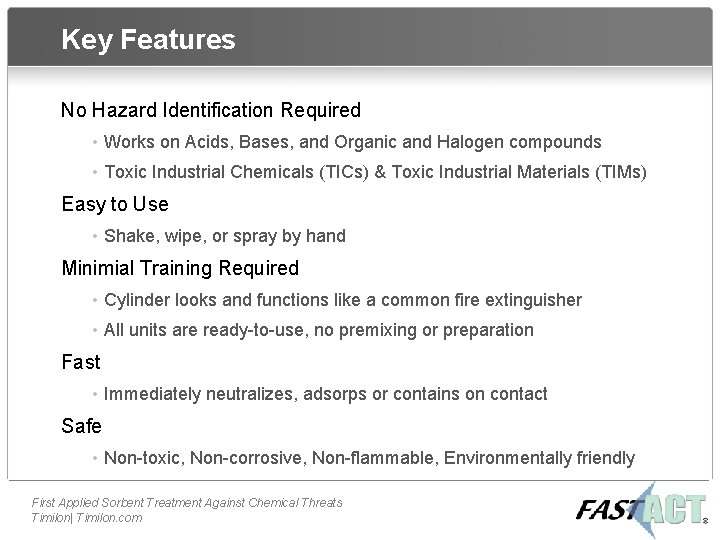
Key Features No Hazard Identification Required • Works on Acids, Bases, and Organic and Halogen compounds • Toxic Industrial Chemicals (TICs) & Toxic Industrial Materials (TIMs) Easy to Use • Shake, wipe, or spray by hand Minimial Training Required • Cylinder looks and functions like a common fire extinguisher • All units are ready-to-use, no premixing or preparation Fast • Immediately neutralizes, adsorps or contains on contact Safe • Non-toxic, Non-corrosive, Non-flammable, Environmentally friendly First Applied Sorbent Treatment Against Chemical Threats Timilon| Timilon. com
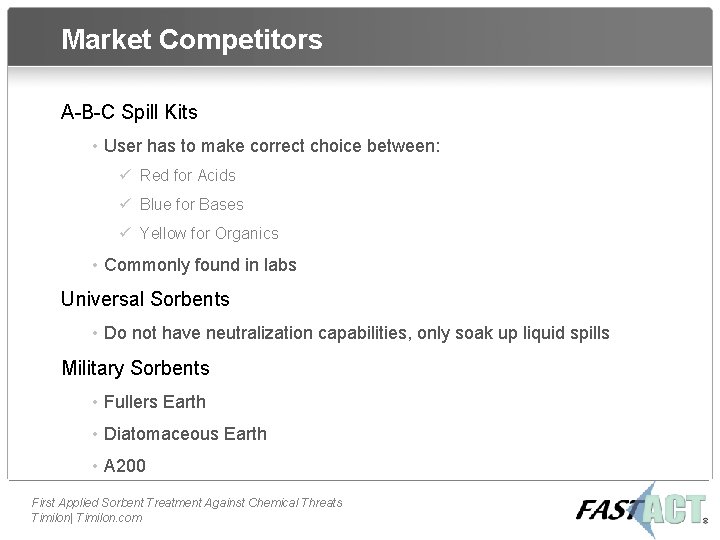
Market Competitors A-B-C Spill Kits • User has to make correct choice between: ü Red for Acids ü Blue for Bases ü Yellow for Organics • Commonly found in labs Universal Sorbents • Do not have neutralization capabilities, only soak up liquid spills Military Sorbents • Fullers Earth • Diatomaceous Earth • A 200 First Applied Sorbent Treatment Against Chemical Threats Timilon| Timilon. com
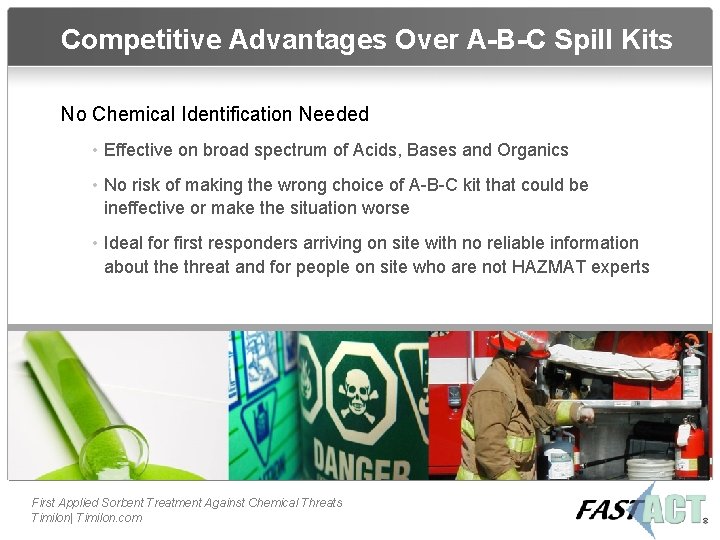
Competitive Advantages Over A-B-C Spill Kits No Chemical Identification Needed • Effective on broad spectrum of Acids, Bases and Organics • No risk of making the wrong choice of A-B-C kit that could be ineffective or make the situation worse • Ideal for first responders arriving on site with no reliable information about the threat and for people on site who are not HAZMAT experts First Applied Sorbent Treatment Against Chemical Threats Timilon| Timilon. com
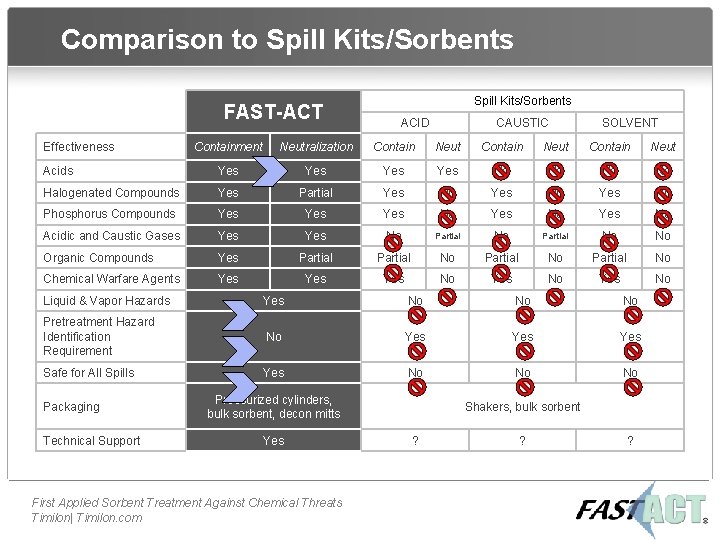
Comparison to Spill Kits/Sorbents FAST-ACT Effectiveness Spill Kits/Sorbents ACID CAUSTIC SOLVENT Containment Neutralization Contain Neut Acids Yes Yes No No Halogenated Compounds Yes Partial Yes No Phosphorus Compounds Yes Yes No Acidic and Caustic Gases Yes No Partial No No Organic Compounds Yes Partial No Chemical Warfare Agents Yes Yes No Liquid & Vapor Hazards Yes No No No Pretreatment Hazard Identification Requirement No Yes Yes Safe for All Spills Yes No No No Packaging Technical Support Pressurized cylinders, bulk sorbent, decon mitts Yes First Applied Sorbent Treatment Against Chemical Threats Timilon| Timilon. com Shakers, bulk sorbent ? ? ?
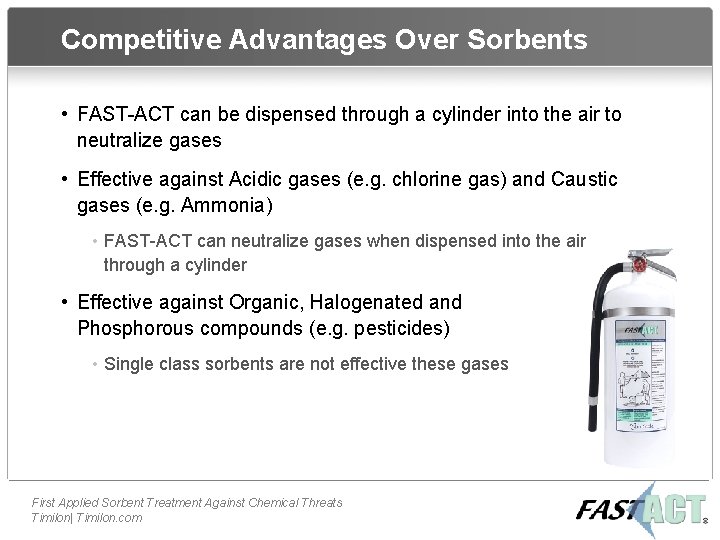
Competitive Advantages Over Sorbents • FAST-ACT can be dispensed through a cylinder into the air to neutralize gases • Effective against Acidic gases (e. g. chlorine gas) and Caustic gases (e. g. Ammonia) • FAST-ACT can neutralize gases when dispensed into the air through a cylinder • Effective against Organic, Halogenated and Phosphorous compounds (e. g. pesticides) • Single class sorbents are not effective these gases First Applied Sorbent Treatment Against Chemical Threats Timilon| Timilon. com
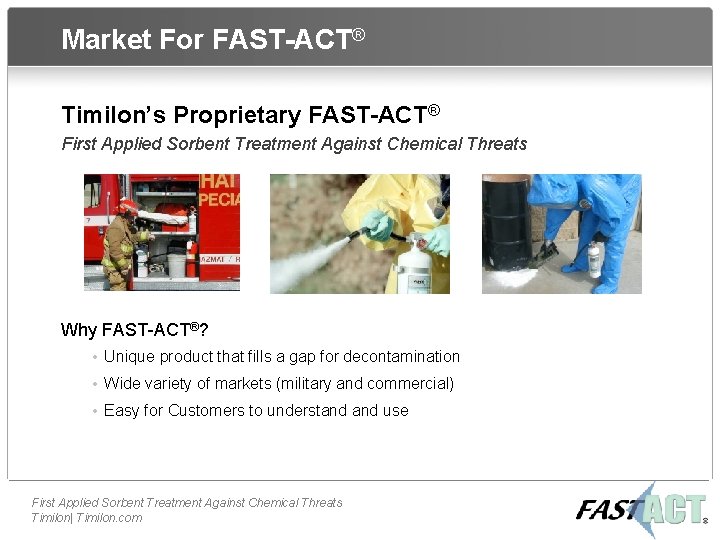
Market For FAST-ACT® Timilon’s Proprietary FAST-ACT® First Applied Sorbent Treatment Against Chemical Threats Why FAST-ACT®? • Unique product that fills a gap for decontamination • Wide variety of markets (military and commercial) • Easy for Customers to understand use First Applied Sorbent Treatment Against Chemical Threats Timilon| Timilon. com
FAST-ACT Testing and Validation • FAST-ACT has been extensively tested by leading laboratories around the world, this list includes, but is not limited to: • Battelle Memorial Institute • Edgewood Chemical Biological Command • Coal Mines Technical Services • Organization for the Prohibition of Chemical Weapons (OPCW) • Lloyds Register: Certificate PVS 1400001, dated June 17, 2014 • U. S. Army Center for Health Promotion and Preventative Medicine • MPI Research • Nelson Laboratories, Inc. First Applied Sorbent Treatment Against Chemical Threats Timilon| Timilon. com
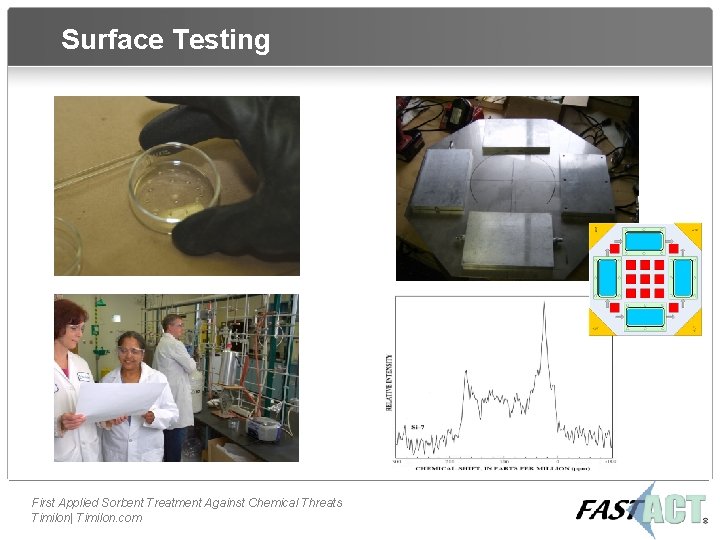
Surface Testing First Applied Sorbent Treatment Against Chemical Threats Timilon| Timilon. com
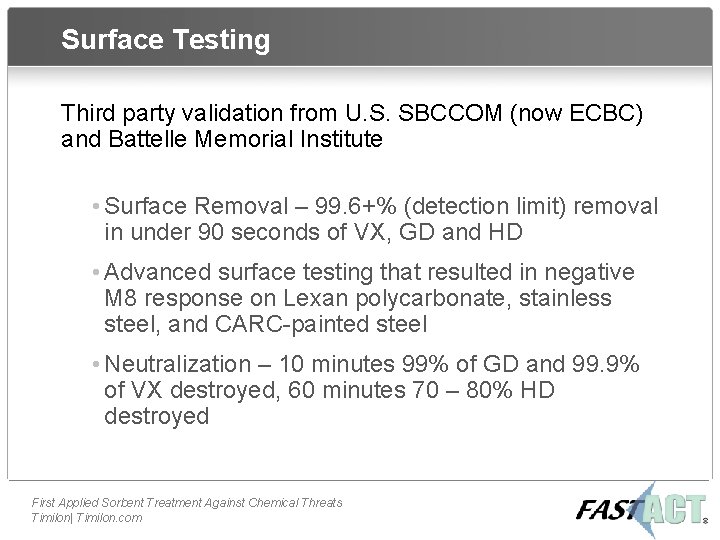
Surface Testing Third party validation from U. S. SBCCOM (now ECBC) and Battelle Memorial Institute • Surface Removal – 99. 6+% (detection limit) removal in under 90 seconds of VX, GD and HD • Advanced surface testing that resulted in negative M 8 response on Lexan polycarbonate, stainless steel, and CARC-painted steel • Neutralization – 10 minutes 99% of GD and 99. 9% of VX destroyed, 60 minutes 70 – 80% HD destroyed First Applied Sorbent Treatment Against Chemical Threats Timilon| Timilon. com
Neutralization Testing Third party validation from Battelle Memorial Institute • Neutralization – 10 minutes 99% of GD and 99. 9% of VX destroyed, 60 minutes 70 – 80% HD destroyed First Applied Sorbent Treatment Against Chemical Threats Timilon| Timilon. com
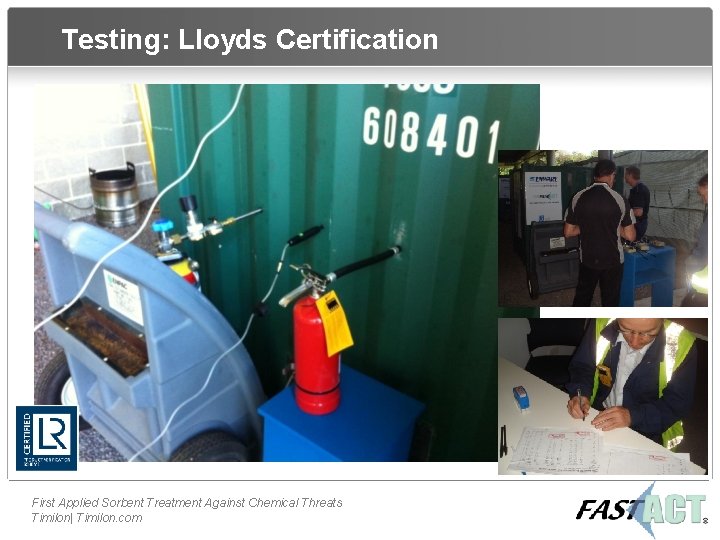
Testing: Lloyds Certification First Applied Sorbent Treatment Against Chemical Threats Timilon| Timilon. com
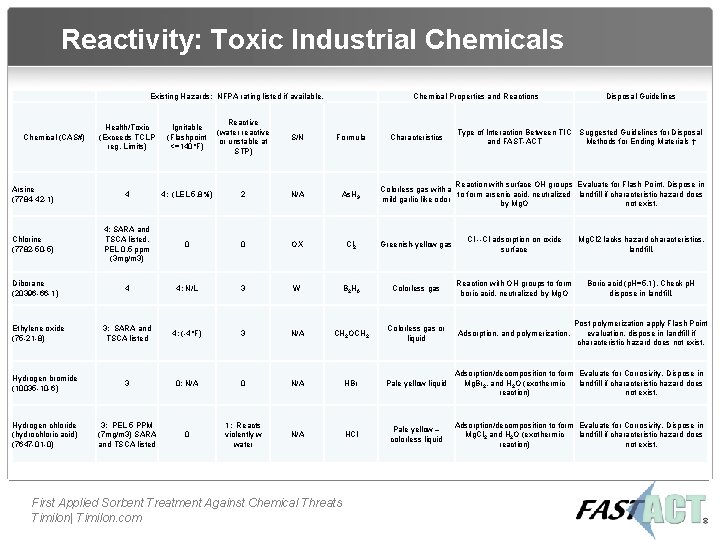
Reactivity: Toxic Industrial Chemicals Existing Hazards: NFPA rating listed if available. Chemical Properties and Reactions Disposal Guidelines Health/Toxic (Exceeds TCLP reg. Limits) Ignitable (Flashpoint <=140°F) Reactive (water reactive or unstable at STP) S/N Formula Arsine (7784 -42 -1) 4 4: (LEL 5. 8%) 2 N/A As. H 3 Chlorine (7782 -50 -5) 4: SARA and TSCA listed. PEL 0. 5 ppm (3 mg/m 3) 0 0 OX Cl 2 Greenish-yellow gas Cl---Cl adsorption on oxide surface Mg. Cl 2 lacks hazard characteristics, landfill. Diborane (20396 -66 -1) 4 4: N/L 3 W B 2 H 6 Colorless gas Reaction with OH groups to form boric acid, neutralized by Mg. O Boric acid (p. H=5. 1). Check p. H dispose in landfill. 3: SARA and TSCA listed 4: (-4°F) 3 N/A CH 2 OCH 2 Colorless gas or liquid Adsorption, and polymerization. Hydrogen bromide (10035 -10 -6) 3 0: N/A 0 N/A HBr Pale yellow liquid Adsorption/decomposition to form Evaluate for Corrosivity. Dispose in Mg. Br 2, and H 2 O (exothermic landfill if characteristic hazard does reaction) not exist. Hydrogen chloride (hydrochloric acid) (7647 -01 -0) 3: PEL 5 PPM (7 mg/m 3) SARA and TSCA listed 0 1: Reacts violently w water N/A HCl Pale yellow – colorless liquid Adsorption/decomposition to form Evaluate for Corrosivity. Dispose in Mg. Cl 2 and H 2 O (exothermic landfill if characteristic hazard does reaction) not exist. Chemical (CAS#) Ethylene oxide (75 -21 -8) First Applied Sorbent Treatment Against Chemical Threats Timilon| Timilon. com Characteristics Type of Interaction Between TIC Suggested Guidelines for Disposal and FAST-ACT Methods for Ending Materials † Reaction with surface OH groups Evaluate for Flash Point. Dispose in Colorless gas with a to form arsenic acid, neutralized landfill if characteristic hazard does mild garlic like odor by Mg. O not exist. Post polymerization apply Flash Point evaluation, dispose in landfill if characteristic hazard does not exist.
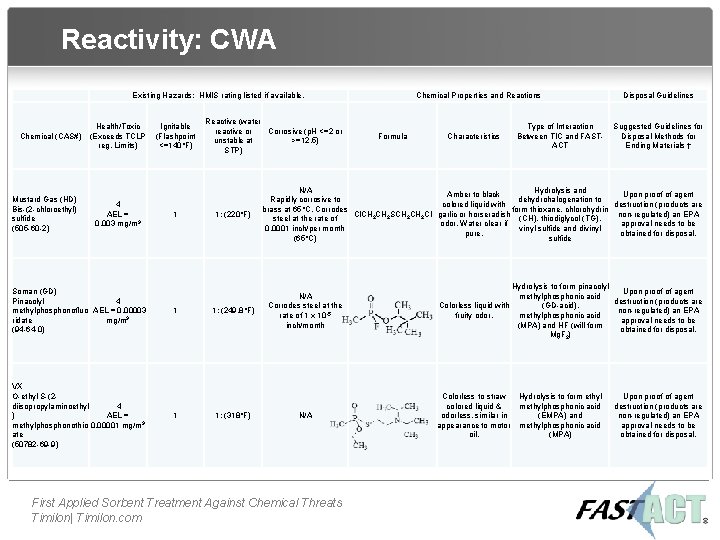
Reactivity: CWA Chemical (CAS#) Mustard Gas (HD) Bis-(2 -chloroethyl) sulfide (505 -60 -2) Existing Hazards: HMIS rating listed if available. Health/Toxic Ignitable (Exceeds TCLP (Flashpoint reg. Limits) <=140°F) 4 AEL = 0. 003 mg/m 3 Soman (GD) Pinacolyl 4 methylphosphonofluo AEL = 0. 00003 ridate mg/m 3 (94 -64 -0) VX O-ethyl S-(2 diisopropylaminoethyl 4 AEL = ) methylphosphonothio 0. 00001 mg/m 3 ate (50782 -69 -9) 1 1 1 Reactive (water reactive or Corrosive (p. H <=2 or unstable at >=12. 5) STP) 1: (220°F) 1: (249. 8°F) 1: (318°F) Chemical Properties and Reactions Formula Characteristics Type of Interaction Between TIC and FASTACT Disposal Guidelines Suggested Guidelines for Disposal Methods for Ending Materials † N/A Hydrolysis and Amber to black Upon proof of agent Rapidly corrosive to dehydrohalogenation to colored liquid with destruction (products are brass at 65°C. Corrodes form thioxane, chlorohydrin non-regulated) an EPA Cl. CH 2 SCH 2 Cl garlic or horseradish steel at the rate of (CH), thiodiglycol (TG). odor. Water clear if approval needs to be 0. 0001 inch/per month vinyl sulfide and divinyl pure. obtained for disposal. (65°C) sulfide N/A Corrodes steel at the rate of 1 x 10 -5 inch/month N/A First Applied Sorbent Treatment Against Chemical Threats Timilon| Timilon. com Hydrolysis to form pinacolyl Upon proof of agent methylphosphonic acid destruction (products are Colorless liquid with (GD-acid), non-regulated) an EPA fruity odor. methylphosphonic acid approval needs to be (MPA) and HF (will form obtained for disposal. Mg. F 2) Colorless to straw Hydrolysis to form ethyl colored liquid & methylphosphonic acid odorless, similar in (EMPA) and appearance to motor methylphosphonic acid oil. (MPA) Upon proof of agent destruction (products are non-regulated) an EPA approval needs to be obtained for disposal.
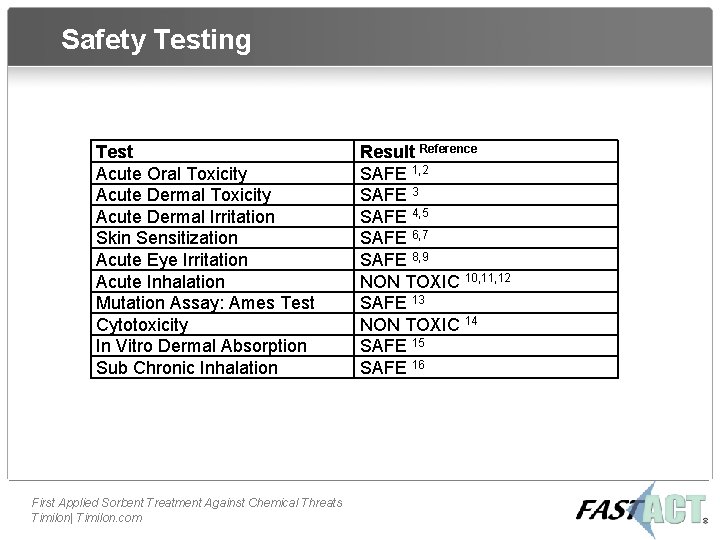
Safety Testing Test Acute Oral Toxicity Acute Dermal Irritation Skin Sensitization Acute Eye Irritation Acute Inhalation Mutation Assay: Ames Test Cytotoxicity In Vitro Dermal Absorption Sub Chronic Inhalation First Applied Sorbent Treatment Against Chemical Threats Timilon| Timilon. com Result Reference SAFE 1, 2 SAFE 3 SAFE 4, 5 SAFE 6, 7 SAFE 8, 9 NON TOXIC 10, 11, 12 SAFE 13 NON TOXIC 14 SAFE 15 SAFE 16
Product Introduction First Applied Sorbent Treatment Against Chemical Threats Timilon| Timilon. com
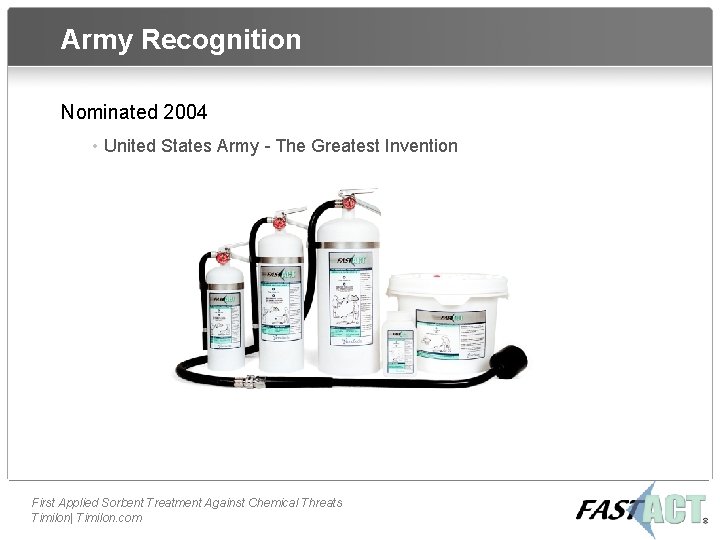
Army Recognition Nominated 2004 • United States Army - The Greatest Invention First Applied Sorbent Treatment Against Chemical Threats Timilon| Timilon. com
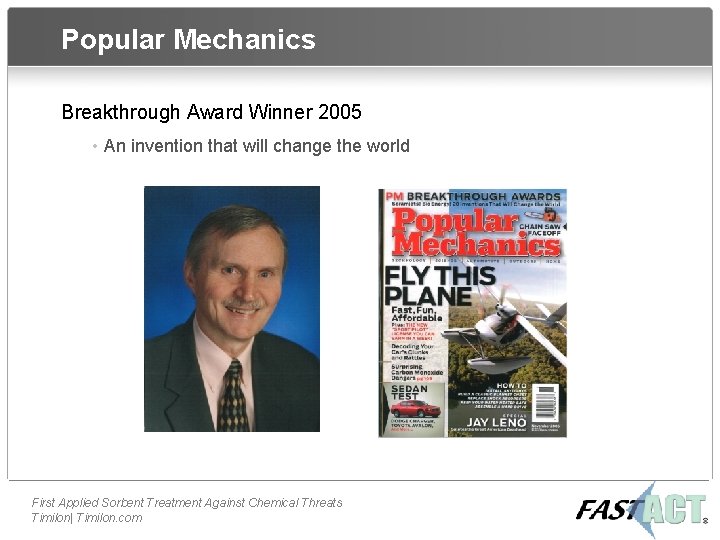
Popular Mechanics Breakthrough Award Winner 2005 • An invention that will change the world First Applied Sorbent Treatment Against Chemical Threats Timilon| Timilon. com
- Slides: 30