
Product Flow Model Overview Copyright 2005 POSC Flow




- Slides: 13
Product Flow Model Overview © Copyright 2005 POSC
Flow Component Hierarchy • Model – Collection of networks. – Network – Collection of connected units. • Unit – Black box with ports. –Port – Allows flow in or out. » Node – Allows ports to connect. © Copyright 2005 POSC
Product Flow Model • Defines the flow behavior of something (normally larger installations). • Collection of networks. – The model is represented by one network. – The other networks represent smaller things within the model. • External ports. – Allows models to connect. © Copyright 2005 POSC
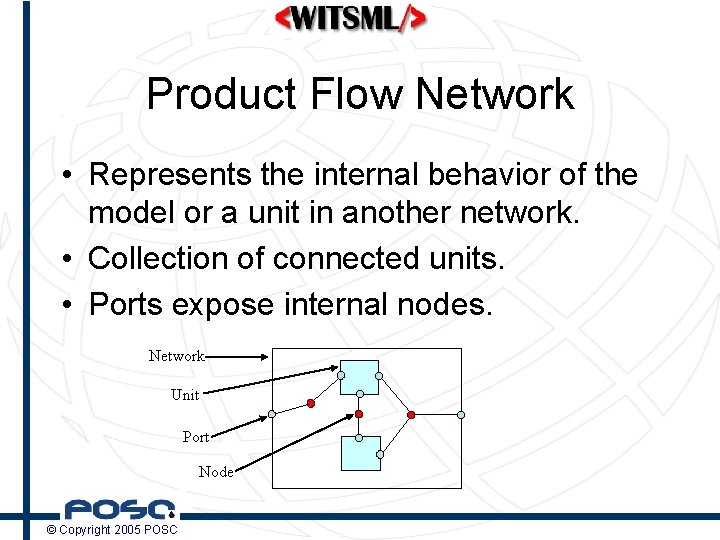
Product Flow Network • Represents the internal behavior of the model or a unit in another network. • Collection of connected units. • Ports expose internal nodes. Network Unit Port Node © Copyright 2005 POSC
Product Flow Unit • A black box with ports but internal network allows drill-down for more details. • A unit can represent: – A complex thing like a platform or separator. – A simple thing like a valve or choke. • Contextual knowledge (i. e. , what does this unit represent). © Copyright 2005 POSC
Product Flow Port • Expected direction (inlet or outlet). • Connects to one Node – May represent many-to-many connection. • Expected Product Flow (for validation). – For example, oil production or gas injection. © Copyright 2005 POSC
Node • All ports that are connected to the same node are connected to each asserts a other. Unit Port connection Node • For an actual flow diagram the graphics may ignore the node. © Copyright 2005 POSC
Flow Assumptions • Steady state fluid flow across nodes and ports. That is, pressure is constant across internally and externally connected ports and nodes. • Conservation of mass across a node or port. • The temperature and other properties can vary between connected ports. • Pressure can vary internally between ports on a unit. • Connections between models should be oneto-one so that mass balance concerns are internal to each model. © Copyright 2005 POSC
Internal Network of a Unit • Corresponding ports have the same name (i. e. , they are logically the same port). • There is no pressure change across ports or nodes. Thus, there is no pressure change between ports A 2 and C 1. B 1 A A 2 B B 2 B 3 B Internal Network B 1 C B 3 © Copyright 2005 POSC B 2
Direction • The direction is the intended direction of flow. • A change in pressure across a unit can change the actual flow direction at a port. • In the Product Volume Report: – A positive volume represents an intended direction (i. e. , a flow out of an outlet port or into an inlet port). – A negative volume represents an unintended direction (i. e. , a flow into an B 3 © Copyright 2005 POSC
Expected Product Flow • Pairs of product kind and flow kind where: – Product = oil, gas, condensate, aqueous, oleic, vapor, water, carbon dioxide gas, etc. – Flow = production, injection, consume, import, export, gas lift, overboard, etc. © Copyright 2005 POSC
Properties • The Product Flow Model only defines connectivity (i. e. , how things could flow). • The Product Volume Report can define: – A period of time (e. g. , day, month, YTD, etc). – A type of flow (e. g. , production, injection, etc). – A type of product (e. g. , oil, aqueous, gas, etc). – A volume and other fluid properties at a port. © Copyright 2005 POSC
Summary • Flow behavior defined by Network, Unit, Port and Node (connection). • Unit can represent anything (big or small). • Steady state fluid flow across ports/nodes • Conservation of mass across ports/nodes. • Properties are assigned by the Product © Copyright 2005 POSC