
Product Development Capstone Project Creating a new or
- Slides: 23
Product Development Capstone Project – Creating a new or modified food product D 9. 03 -- Product Development
Brainstorming n Ideas for new products can be obtained from: n n n Customers Research and Development Department Competitors Employees/salespeople, Ideas can be listed and then prioritized by the team. D 9. 03 -- Product Development
Target Audience n Identify target audience for the product. n n n specific age group, gender, marital status, or combination, like single males between 20 and 30 years old. Without knowing the target audience, selling can be difficult and expensive. D 9. 03 -- Product Development
Market analysis n n n To be profitable, the product developed must sell. Determine if there is an existing market for the product. Develop a marketing plan -- written document that details the necessary actions to sell product. D 9. 03 -- Product Development
Formula for new product n n All processed foods have a formula or recipe. The formula will include: n n Ingredients Their amounts in weight Procedures for making the product. A flow chart of the formula and procedures must be prepared. D 9. 03 -- Product Development
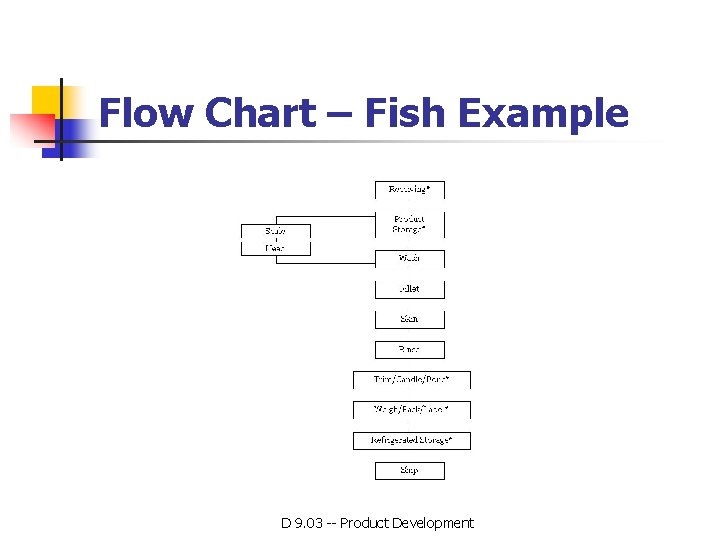
Flow Chart – Fish Example D 9. 03 -- Product Development
Ingredient function n n Each ingredient has a function, which is its purpose in the formula. Functions include: n n Binding agent Thickening agent Preservative Flavoring agent D 9. 03 -- Product Development
Processing n Many products require processing steps that include: n n n preparing ingredients (peel, chop, grind, sorting, grading) mixing of ingredients (creaming, stirring, creating foams, etc. ) selecting thermal / nonthermal methods include: n n Crystallization Evaporation Concentration Distillation D 9. 03 -- Product Development
Preservation Method n n Most foods are not sold as fresh so a preservation method is needed to extend shelf-life. Preservation methods include: n n Canning Drying Fermenting Salting D 9. 03 -- Product Development
Shelf-life n The period of time that a product can be: n n n stored, under specified conditions, and remain in optimum condition and suitable for consumption. The preservation method chosen directly affects the shelf-life of a food product. D 9. 03 -- Product Development
Regulatory Agencies n n Food can be regulated by both state and federal governmental agencies. The primary regulatory agencies of food are: n n n USDA U. S. Food and Drug Administration Other agencies also regulate foods. D 9. 03 -- Product Development
Hazards and Controls n Hazards n n n Risks present in a particular food product. Microbiological, chemical, and/or physical agents are the risks in the food industry. Controls n Specific point, procedure or step where the risk can be reduced, eliminated, or prevented. D 9. 03 -- Product Development
GMPs and HACCP n Good Manufacturing Practices (Sanitation) n n Focus on personnel Includes recordkeeping, personnel qualifications, sanitation, cleanliness, equipment verification, process validation, and complaint handling. Hazard Analysis Critical Control Points (Safety) n A seven-step system to actively reduce and/or eliminate hazards that can cause foodborne illness. D 9. 03 -- Product Development
Sensory Analysis § § Conducted by food scientists, trained taste panels, and/or consumers using valid and reliable scoring forms. Involves assessing the sensory properties of food: § Appearance – shape, color, and size of a product. § Flavor – combination of aroma and taste. § Texture – chewiness, graininess, brittleness, firmness, and consistency. D 9. 03 -- Product Development
Labeling n All product labels must have the following four required statements: n n an identity statement – what is the common name of the product a net weight statement – how much is in the package a list of ingredients, and company name. D 9. 03 -- Product Development
Labeling – List of Ingredients n n n Ingredients must be listed in decreasing order of predominance from most to least. The ingredient present in the greatest quantity is listed first and the least is listed last. Calculate the weight of each ingredient in the formula to determine order. D 9. 03 -- Product Development
Nutrient analysis n n Must provide information on certain nutrients so must determine the nutritive value. Mandatory nutrients and order in which they must appear are: n n n Total calories and calories from fat, total fat, saturated fat, cholesterol Sodium Total carbohydrate, dietary fiber, sugars Protein Vitamin A, Vitamin C, calcium and iron D 9. 03 -- Product Development
Nutrient Analysis -- continued § Non-mandatory nutrients include: n n n polyunsaturated fat and monounsaturated fat potassium soluble fiber and insoluble fiber sugar alcohol -- xylitol, mannitol, and sorbitol percent of vitamin A present as beta-carotene other essential vitamins and minerals D 9. 03 -- Product Development
Equipment and Facility Needs n n n Food must be prepared, packed, and held under sanitary conditions to prevent its contamination by hazards. All equipment and facilities must meet regulatory guidelines. Equipment and facility guidelines are part of the standards outlined in Good Manufacturing Practices (GMPs). D 9. 03 -- Product Development
Production Costs n n Determine how much it will cost to make the product. Include in product costs: n n n n Ingredient costs Capital costs – equipment and facilities Energy Personnel Cleaning supplies Insurance Other – list other possible costs D 9. 03 -- Product Development
Pilot n n Before a product is produced for market, it must be piloted. A pilot allows one to practice making the product so problems or errors in the formula and/or process can be corrected before taking the product to market. D 9. 03 -- Product Development
Distribution § Distribution involves getting food products from the producer or manufacturer to the retail store. § This segment of the industry includes: § food manufacturers § wholesalers/distributors § retailers D 9. 03 -- Product Development
Advertising n n A paid, one-way communication through a medium in which the sponsor is identified and the message is controlled by the sponsor. Every major medium is used to advertise: n n n television and radio movies, magazines and newspapers, billboards video games, and internet D 9. 03 -- Product Development