
PRODUCT COSTING IN PRICE ESTIMATES AND PROFIT MANAGEMENT

- Slides: 33
PRODUCT COSTING IN PRICE ESTIMATES AND PROFIT MANAGEMENT
Product Costing plays an important role in price estimates and profit managementØ Organizations selling differentiated products Ø Organizations selling other products
PRODUCT COSTING- MEANING Product costing can be defined as the process of determining how much it costs to produce or sell a product. It is a process of studying and listing down all expenses which are incurred for manufacturing and sale of the product from acquiring raw material to the cost of transporting the final product to the retail business. Company uses the overall cost to plan a variety of business strategies including setting product prices and developing promotional campaigns. Company also uses product costing to find ways to streamline production costs to maximize profits.
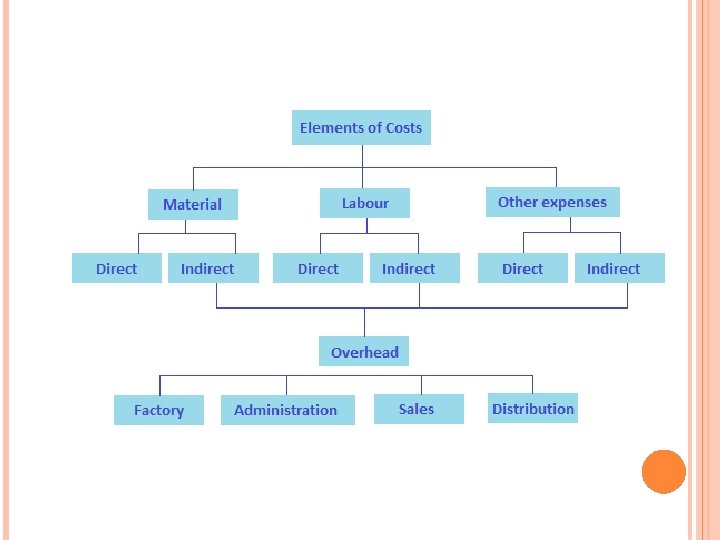
ELEMENTS OF COST The cost of any product or service is a sum of various segments of the cost. Such segments are treated as elements of costs. Elements of cost are generic in nature and not considered as definitive examples since accounting practices of different firms and organization may vary greatly.
ELEMENTS OF COST Mere knowledge of total cost cannot satisfy the needs of management. For proper control and managerial decisions, management is to be provided with necessary data to analyze and classify cost. For this purpose, total cost is analyzed by elements of cost
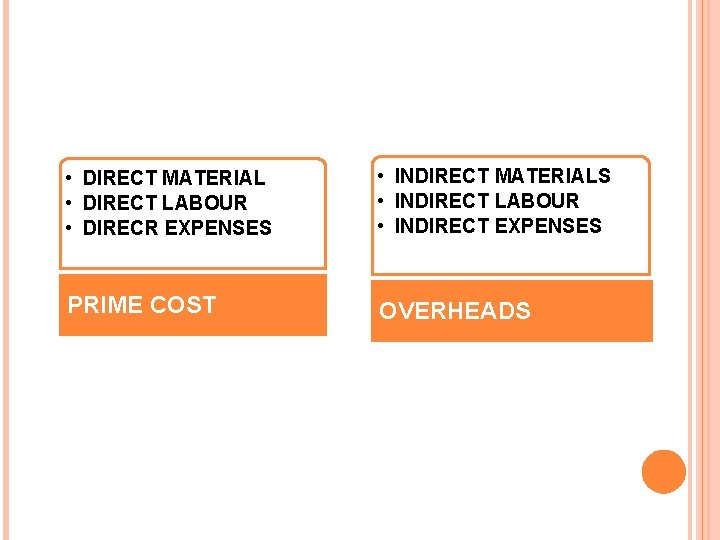
• DIRECT MATERIAL • DIRECT LABOUR • DIRECR EXPENSES • INDIRECT MATERIALS • INDIRECT LABOUR • INDIRECT EXPENSES PRIME COST OVERHEADS
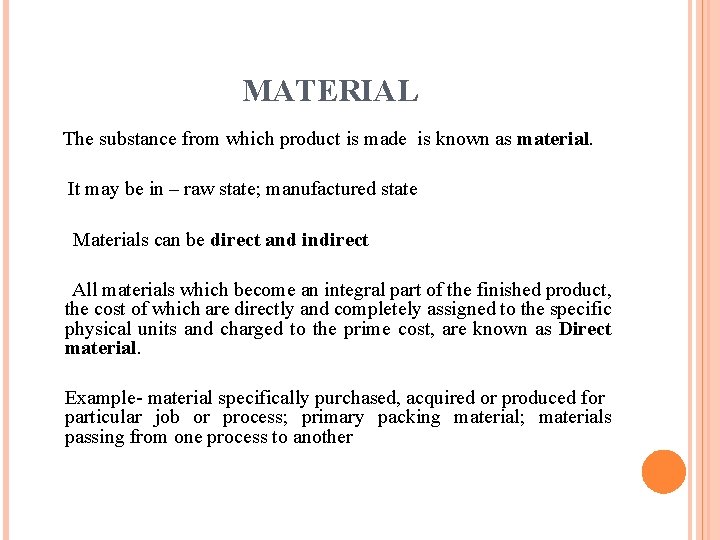
MATERIAL The substance from which product is made is known as material. It may be in – raw state; manufactured state Materials can be direct and indirect All materials which become an integral part of the finished product, the cost of which are directly and completely assigned to the specific physical units and charged to the prime cost, are known as Direct material. Example- material specifically purchased, acquired or produced for particular job or process; primary packing material; materials passing from one process to another
MATERIAL To calculate cost of material, expenses such as import duties, dock charges, transport cost of materials are added to the invoice price. All materials which cannot be conveniently assigned to specific physical units are termed as Indirect materials. Such commodities do not form a part of the finished products Example- Consumable stores; lubrication oil; stationery; spare parts for the machinery. Material considered direct at one time may be indirect on other occasion.
LABOUR Human efforts used for conversion of materials into finished products or doing various jobs in business are known as labour. Payment made towards labour is called labour cost. It can also be direct and indirect. All labour expended and directly involving in altering the condition, composition or construction of the product is called Direct labour. The wages paid to skilled and unskilled workers for their work which can be specifically allocated to a particular unit of production is known as direct wages or direct labour cost.
LABOUR Labour employed to perform work incidental to production of goods those engaged for office work, selling and distribution activities are known as Indirect labour. The wages paid to such workers are known as indirect wages or indirect labour cost
EXPENSES All expenditure other than material and labour for manufacturing a product or rendering service are termed as expenses. It may be direct or indirect. Expenses which are specifically incurred an can be directly and wholly allocated to a particular product, job or service are termed as Direct expenses. All expenses excluding indirect material and indirect labour, which can not be directly and wholly attributed to a particular product, job or service are termed as Indirect expenses.
OVERHEADS Overheads is an indirect expense incurred at various levels of activities of an enterprise. These expenses cannot be conveniently identified with or allocated to cost centers or cost units.
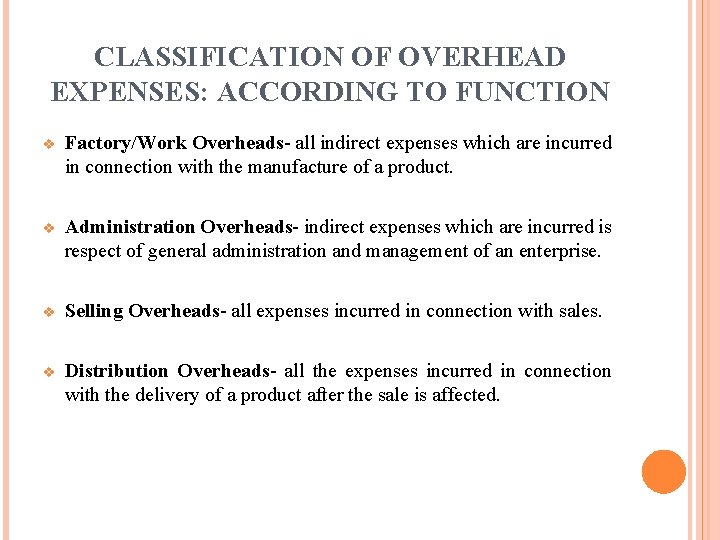
CLASSIFICATION OF OVERHEAD EXPENSES: ACCORDING TO FUNCTION v Factory/Work Overheads- all indirect expenses which are incurred in connection with the manufacture of a product. v Administration Overheads- indirect expenses which are incurred is respect of general administration and management of an enterprise. v Selling Overheads- all expenses incurred in connection with sales. v Distribution Overheads- all the expenses incurred in connection with the delivery of a product after the sale is affected.
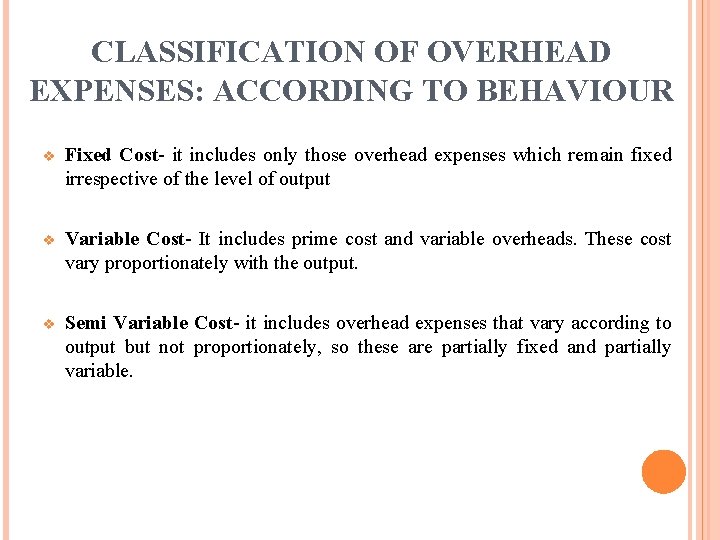
CLASSIFICATION OF OVERHEAD EXPENSES: ACCORDING TO BEHAVIOUR v Fixed Cost- it includes only those overhead expenses which remain fixed irrespective of the level of output v Variable Cost- It includes prime cost and variable overheads. These cost vary proportionately with the output. v Semi Variable Cost- it includes overhead expenses that vary according to output but not proportionately, so these are partially fixed and partially variable.
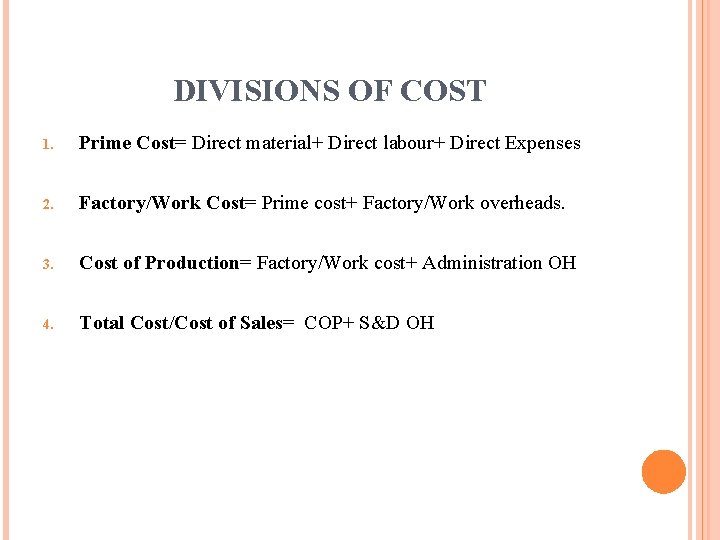
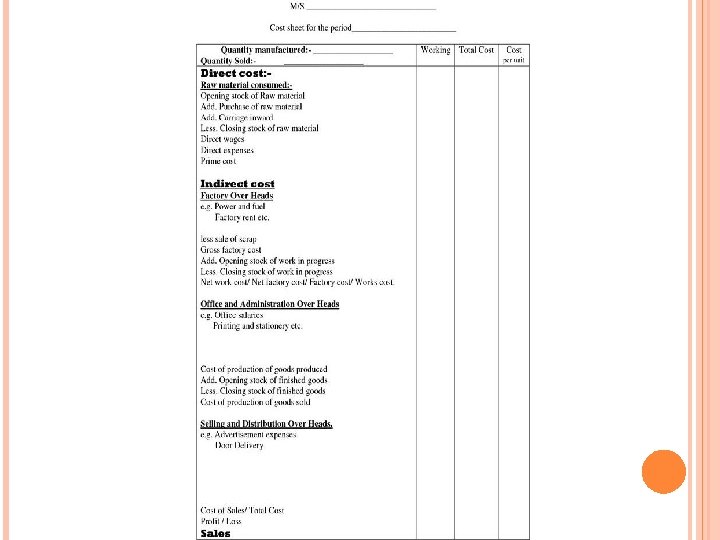
DIVISIONS OF COST 1. Prime Cost= Direct material+ Direct labour+ Direct Expenses 2. Factory/Work Cost= Prime cost+ Factory/Work overheads. 3. Cost of Production= Factory/Work cost+ Administration OH 4. Total Cost/Cost of Sales= COP+ S&D OH
COST SHEET OR STATEMENT OF COST AND PROFIT Cost Sheet is a statement of cost. It is usually adopted when there is only one product being produced and costs are incurred for that product only It may be prepared weekly, monthly, quarterly or yearly indicating various components of cost as prime cost, works cost, cost of production, cost of goods sold, total cost and also profitability on a production.
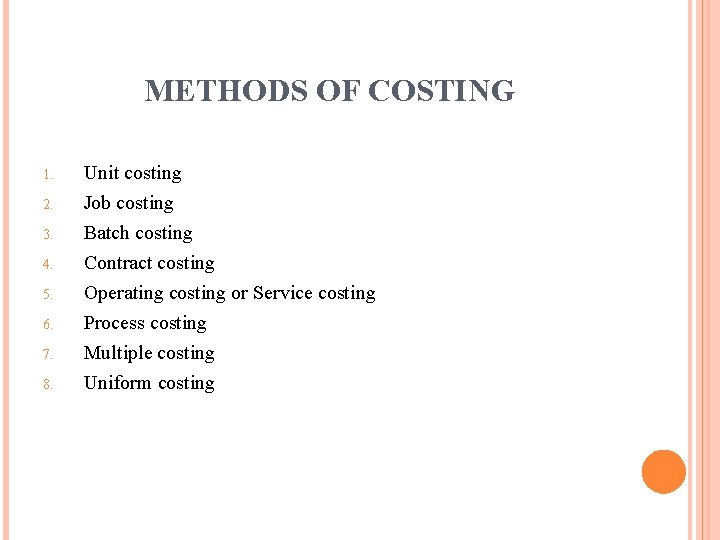
METHODS OF COSTING 1. 2. 3. 4. 5. 6. 7. 8. Unit costing Job costing Batch costing Contract costing Operating costing or Service costing Process costing Multiple costing Uniform costing
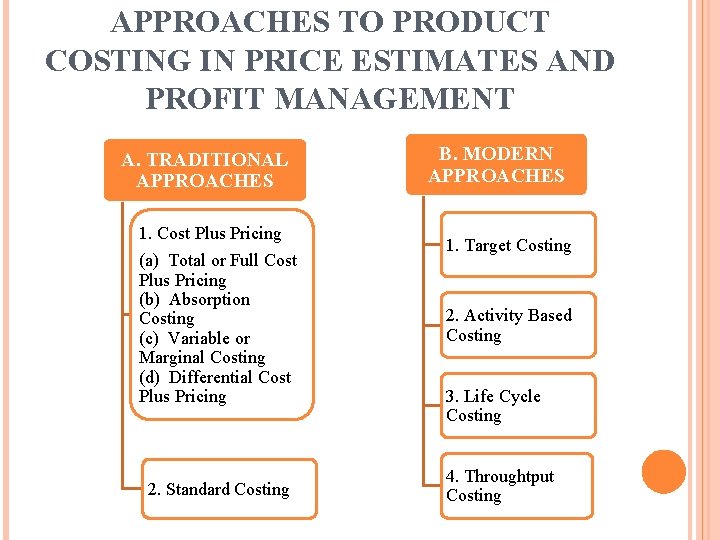
APPROACHES TO PRODUCT COSTING IN PRICE ESTIMATES AND PROFIT MANAGEMENT A. TRADITIONAL APPROACHES 1. Cost Plus Pricing (a) Total or Full Cost Plus Pricing (b) Absorption Costing (c) Variable or Marginal Costing (d) Differential Cost Plus Pricing 2. Standard Costing B. MODERN APPROACHES 1. Target Costing 2. Activity Based Costing 3. Life Cycle Costing 4. Throughtput Costing
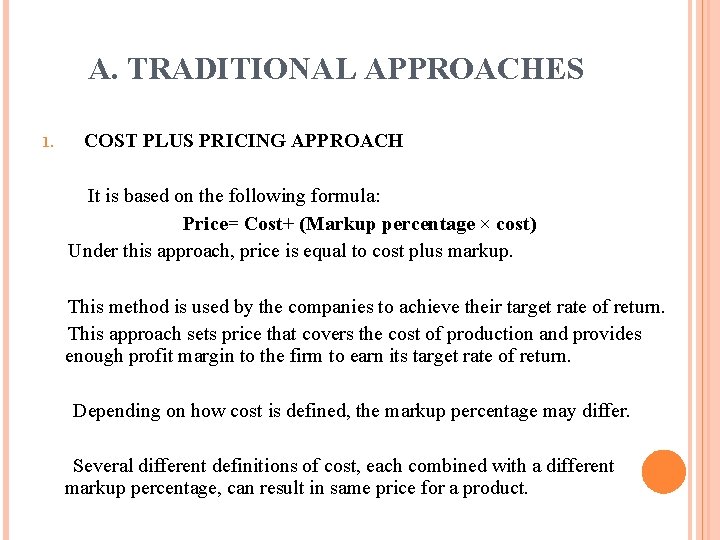
A. TRADITIONAL APPROACHES 1. COST PLUS PRICING APPROACH It is based on the following formula: Price= Cost+ (Markup percentage × cost) Under this approach, price is equal to cost plus markup. This method is used by the companies to achieve their target rate of return. This approach sets price that covers the cost of production and provides enough profit margin to the firm to earn its target rate of return. Depending on how cost is defined, the markup percentage may differ. Several different definitions of cost, each combined with a different markup percentage, can result in same price for a product.
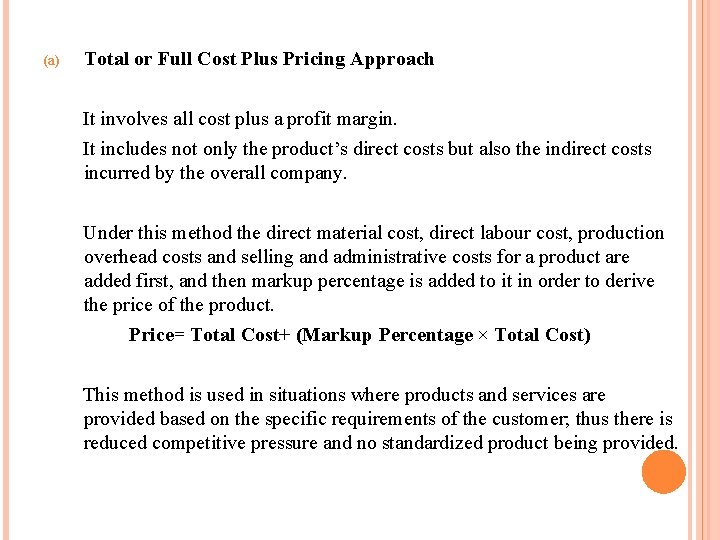
(a) Total or Full Cost Plus Pricing Approach It involves all cost plus a profit margin. It includes not only the product’s direct costs but also the indirect costs incurred by the overall company. Under this method the direct material cost, direct labour cost, production overhead costs and selling and administrative costs for a product are added first, and then markup percentage is added to it in order to derive the price of the product. Price= Total Cost+ (Markup Percentage × Total Cost) This method is used in situations where products and services are provided based on the specific requirements of the customer; thus there is reduced competitive pressure and no standardized product being provided.
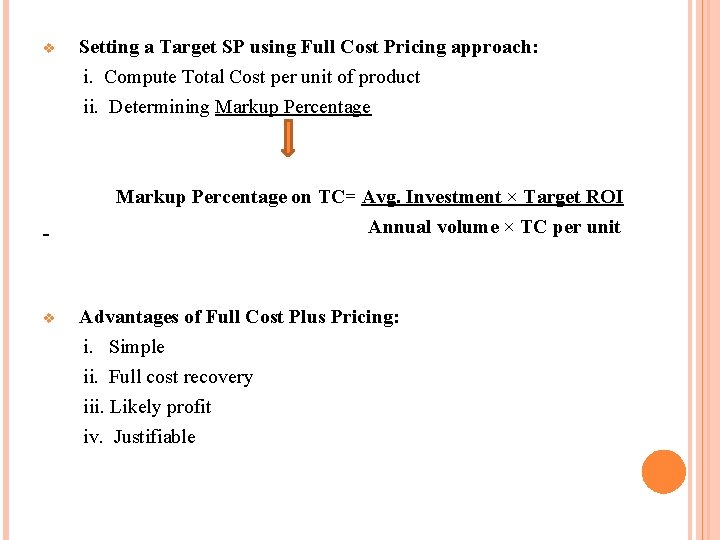
v Setting a Target SP using Full Cost Pricing approach: i. Compute Total Cost per unit of product ii. Determining Markup Percentage on TC= Avg. Investment × Target ROI Annual volume × TC per unit v Advantages of Full Cost Plus Pricing: i. Simple ii. Full cost recovery iii. Likely profit iv. Justifiable
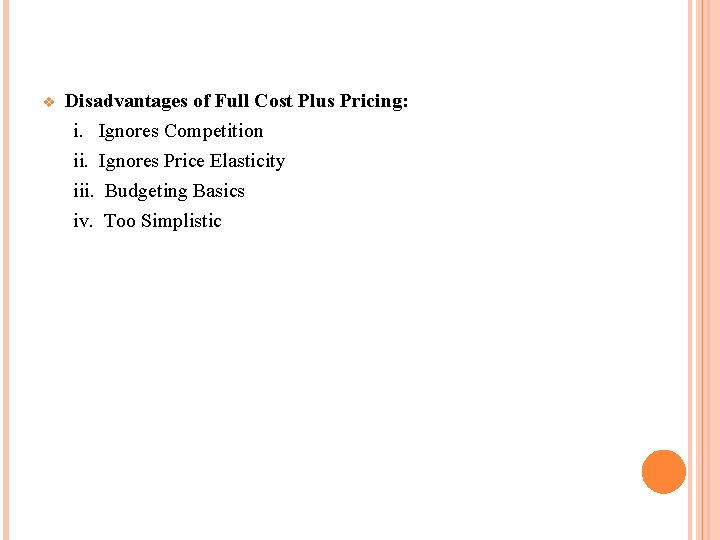
v Disadvantages of Full Cost Plus Pricing: i. Ignores Competition ii. Ignores Price Elasticity iii. Budgeting Basics iv. Too Simplistic
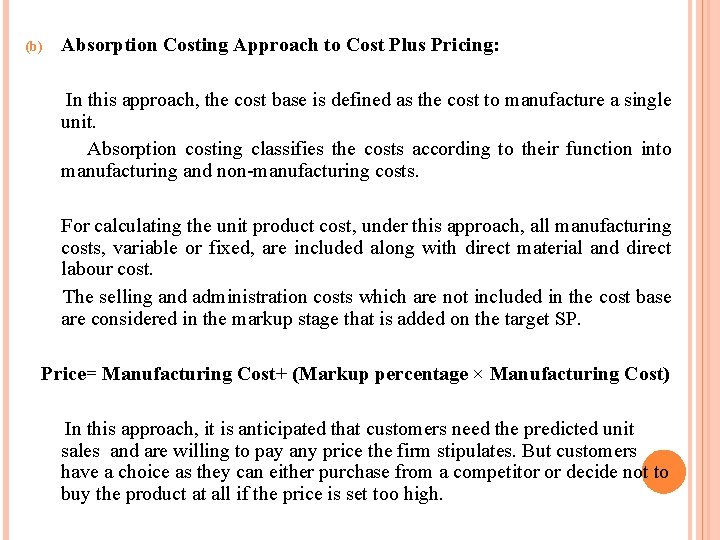
(b) Absorption Costing Approach to Cost Plus Pricing: In this approach, the cost base is defined as the cost to manufacture a single unit. Absorption costing classifies the costs according to their function into manufacturing and non-manufacturing costs. For calculating the unit product cost, under this approach, all manufacturing costs, variable or fixed, are included along with direct material and direct labour cost. The selling and administration costs which are not included in the cost base are considered in the markup stage that is added on the target SP. Price= Manufacturing Cost+ (Markup percentage × Manufacturing Cost) In this approach, it is anticipated that customers need the predicted unit sales and are willing to pay any price the firm stipulates. But customers have a choice as they can either purchase from a competitor or decide not to buy the product at all if the price is set too high.
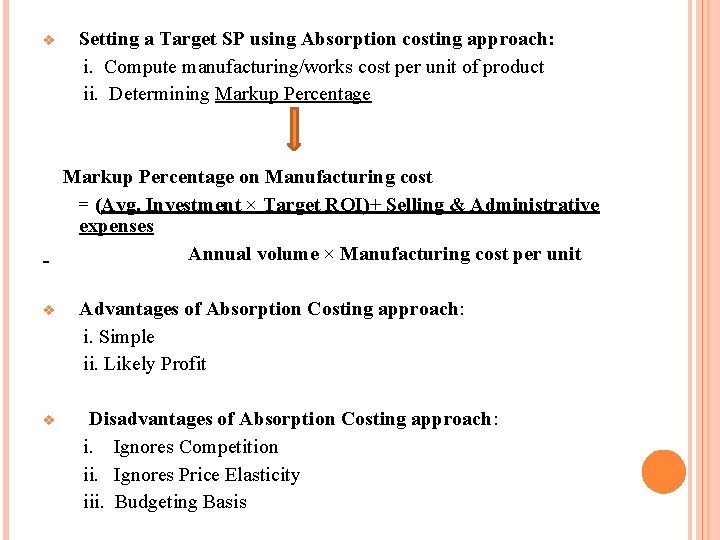
v Setting a Target SP using Absorption costing approach: i. Compute manufacturing/works cost per unit of product ii. Determining Markup Percentage on Manufacturing cost = (Avg. Investment × Target ROI)+ Selling & Administrative expenses Annual volume × Manufacturing cost per unit v Advantages of Absorption Costing approach: i. Simple ii. Likely Profit v Disadvantages of Absorption Costing approach: i. Ignores Competition ii. Ignores Price Elasticity iii. Budgeting Basis
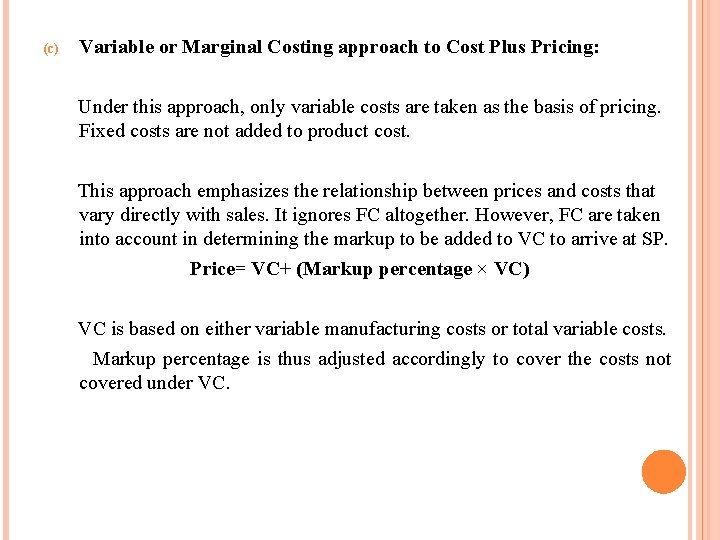
(c) Variable or Marginal Costing approach to Cost Plus Pricing: Under this approach, only variable costs are taken as the basis of pricing. Fixed costs are not added to product cost. This approach emphasizes the relationship between prices and costs that vary directly with sales. It ignores FC altogether. However, FC are taken into account in determining the markup to be added to VC to arrive at SP. Price= VC+ (Markup percentage × VC) VC is based on either variable manufacturing costs or total variable costs. Markup percentage is thus adjusted accordingly to cover the costs not covered under VC.
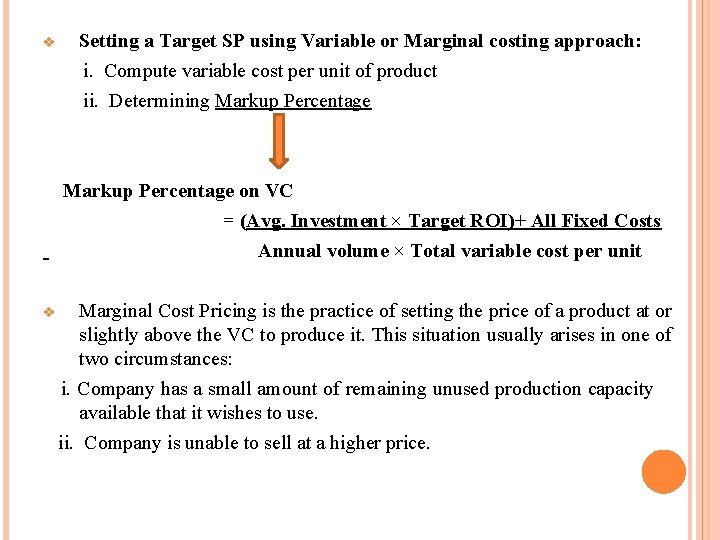
v Setting a Target SP using Variable or Marginal costing approach: i. Compute variable cost per unit of product ii. Determining Markup Percentage on VC = (Avg. Investment × Target ROI)+ All Fixed Costs Annual volume × Total variable cost per unit v Marginal Cost Pricing is the practice of setting the price of a product at or slightly above the VC to produce it. This situation usually arises in one of two circumstances: i. Company has a small amount of remaining unused production capacity available that it wishes to use. ii. Company is unable to sell at a higher price.
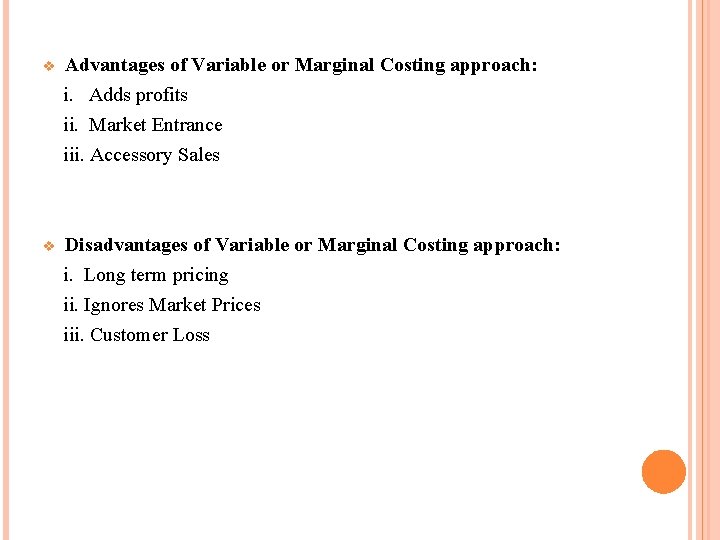
v Advantages of Variable or Marginal Costing approach: i. Adds profits ii. Market Entrance iii. Accessory Sales v Disadvantages of Variable or Marginal Costing approach: i. Long term pricing ii. Ignores Market Prices iii. Customer Loss
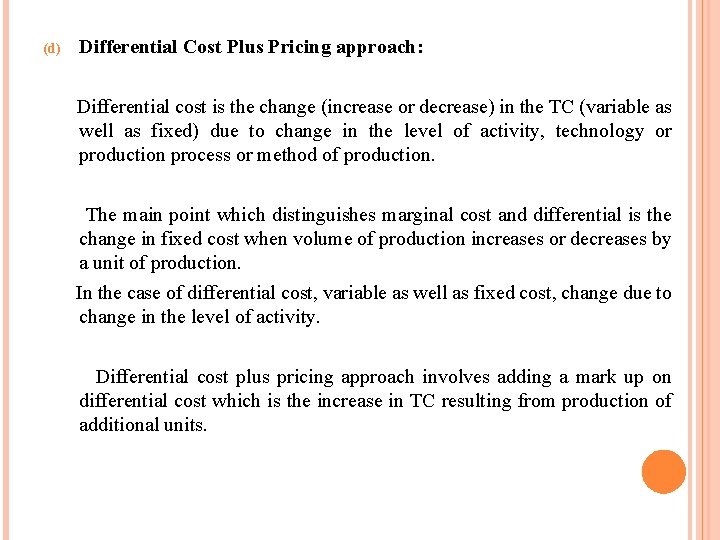
(d) Differential Cost Plus Pricing approach: Differential cost is the change (increase or decrease) in the TC (variable as well as fixed) due to change in the level of activity, technology or production process or method of production. The main point which distinguishes marginal cost and differential is the change in fixed cost when volume of production increases or decreases by a unit of production. In the case of differential cost, variable as well as fixed cost, change due to change in the level of activity. Differential cost plus pricing approach involves adding a mark up on differential cost which is the increase in TC resulting from production of additional units.
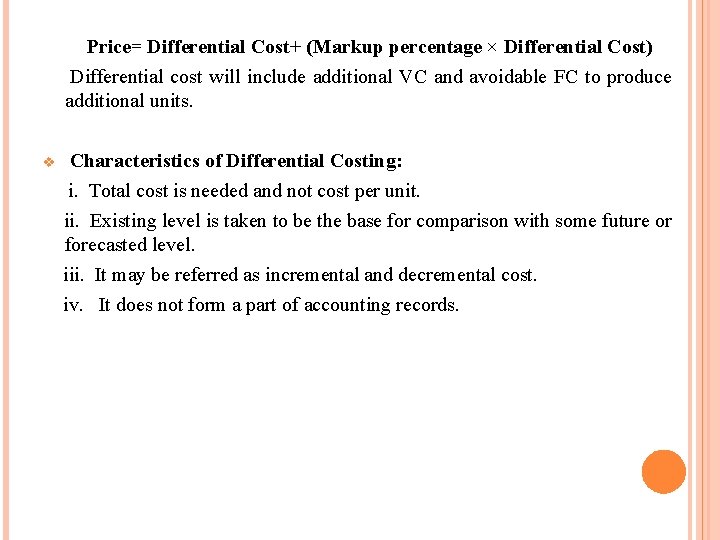
Price= Differential Cost+ (Markup percentage × Differential Cost) Differential cost will include additional VC and avoidable FC to produce additional units. v Characteristics of Differential Costing: i. Total cost is needed and not cost per unit. ii. Existing level is taken to be the base for comparison with some future or forecasted level. iii. It may be referred as incremental and decremental cost. iv. It does not form a part of accounting records.
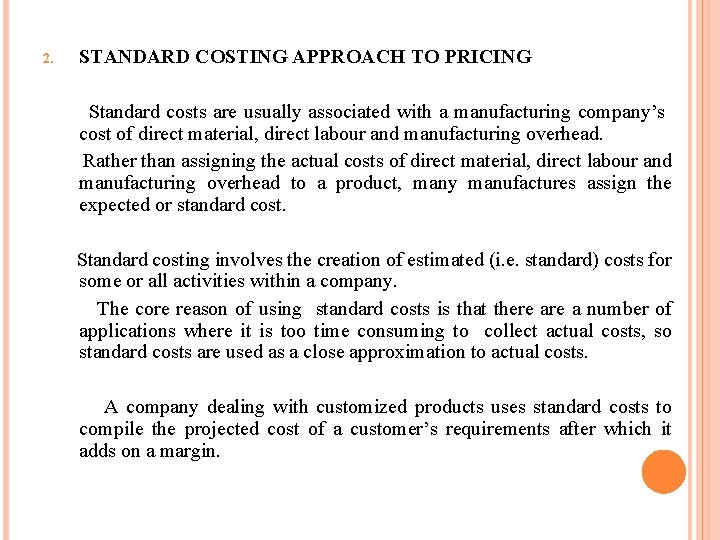
2. STANDARD COSTING APPROACH TO PRICING Standard costs are usually associated with a manufacturing company’s cost of direct material, direct labour and manufacturing overhead. Rather than assigning the actual costs of direct material, direct labour and manufacturing overhead to a product, many manufactures assign the expected or standard cost. Standard costing involves the creation of estimated (i. e. standard) costs for some or all activities within a company. The core reason of using standard costs is that there a number of applications where it is too time consuming to collect actual costs, so standard costs are used as a close approximation to actual costs. A company dealing with customized products uses standard costs to compile the projected cost of a customer’s requirements after which it adds on a margin.
v Advantages of Standard Costing approach: i. Efficiency ii. Quick Pricing v Disadvantages of Standard Costing approach: i. Cost plus contracts ii. Fast paced environment.