
Product and Service Costing A Process Systems Approach

- Slides: 48
Product and Service Costing: A Process Systems Approach Prepared by Douglas Cloud Pepperdine University 5 -1
Objectives 1. Describe the. After basicstudying characteristics this of process costing, including cost flows, journal entries, chapter, you should and the cost of production be able to: report. 2. Describe process costing for settings without work-in-process inventories. 3. Define equivalent units, and explain their role in process costing. 4. Prepare a departmental production report using the FIFO method. 5 -2
Objectives 5. Prepare a departmental production report using the weighted average method. 6. Prepare a departmental production report with transferred-in goods and changes in output measures. 7. Describe the basic features of operating costing. 8. Explain how spoilage is treated in a process costing system. 5 -3
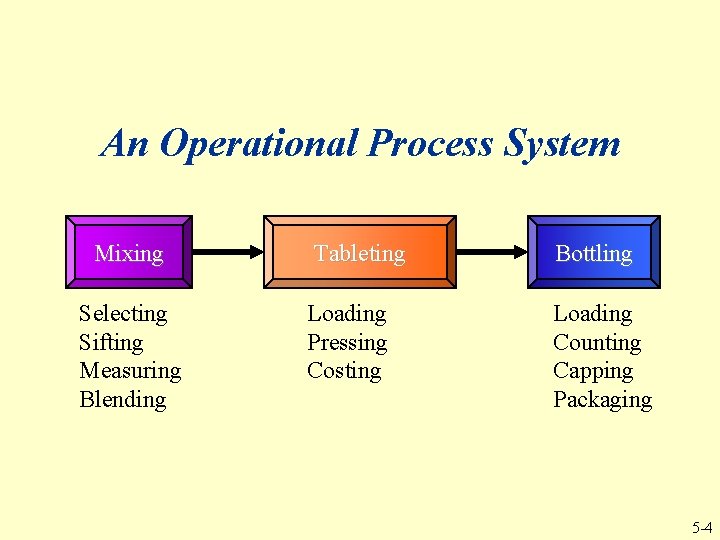
An Operational Process System Mixing Selecting Sifting Measuring Blending Tableting Bottling Loading Pressing Costing Loading Counting Capping Packaging 5 -4
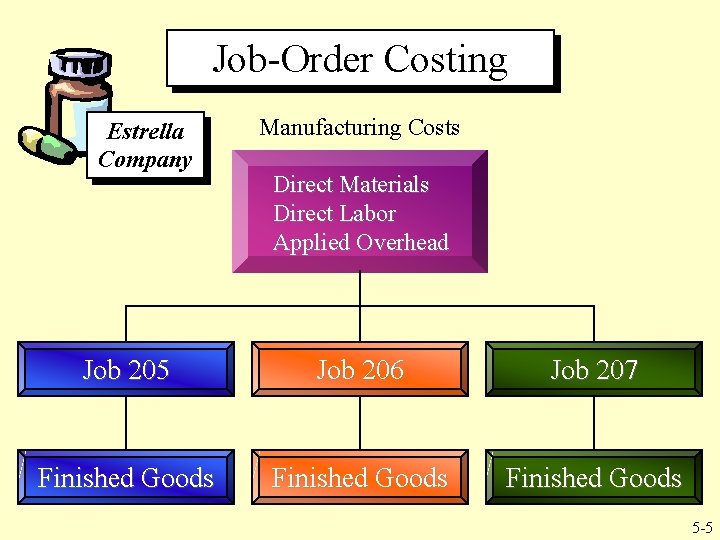
Job-Order Costing Estrella Company Manufacturing Costs Direct Materials Direct Labor Applied Overhead Job 205 Job 206 Job 207 Finished Goods 5 -5
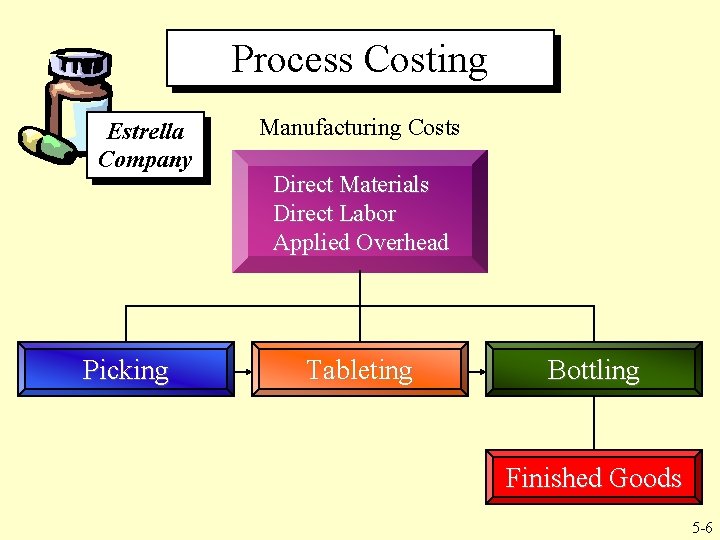
Process Costing Estrella Company Picking Manufacturing Costs Direct Materials Direct Labor Applied Overhead Tableting Bottling Finished Goods 5 -6
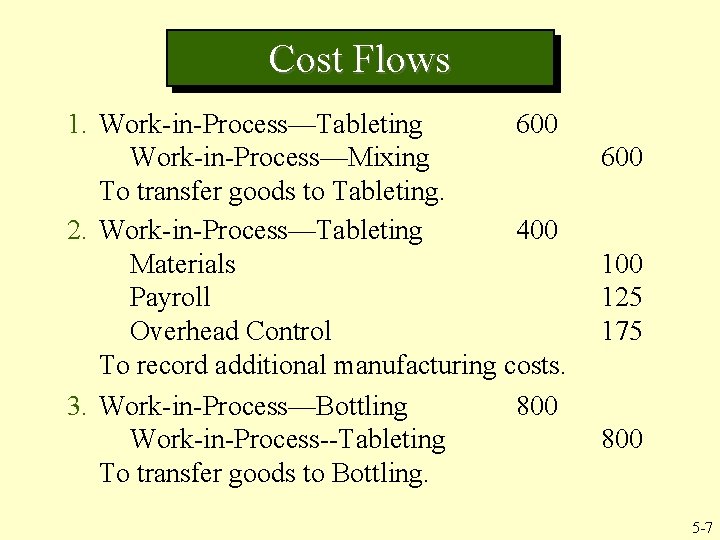
Cost Flows 1. Work-in-Process—Tableting 600 Work-in-Process—Mixing To transfer goods to Tableting. 2. Work-in-Process—Tableting 400 Materials Payroll Overhead Control To record additional manufacturing costs. 3. Work-in-Process—Bottling 800 Work-in-Process--Tableting To transfer goods to Bottling. 600 125 175 800 5 -7
Characteristics of Process Costing § Homogeneous units pass through a series of similar processes. § Each unit in each process receives a similar dose of manufacturing costs. § Manufacturing costs are accumulated by a process for a given period of time. 5 -8
Characteristics of Process Costing § There is a work-in-process account for each process. § Manufacturing cost flows and the associated journal entries are generally similar to joborder costing. § The departmental production report is the key document for tracking manufacturing activity and costs. § Unit costs are computed by dividing the departmental costs of the period by the output for the period. 5 -9
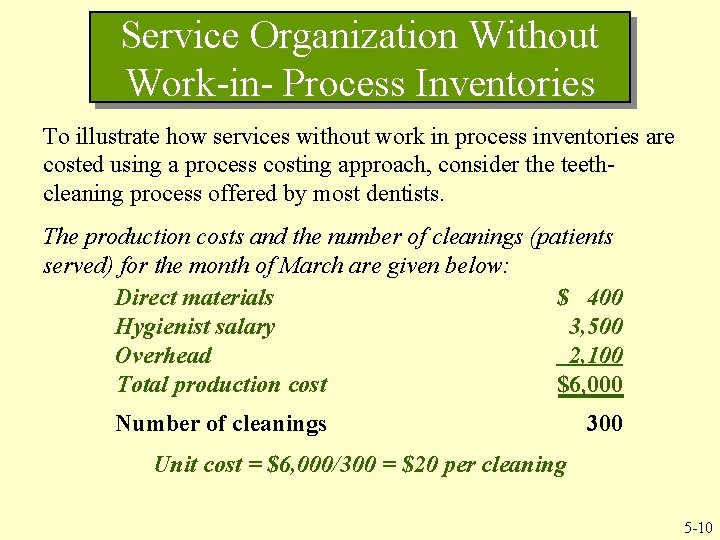
Service Organization Without Work-in- Process Inventories To illustrate how services without work in process inventories are costed using a process costing approach, consider the teethcleaning process offered by most dentists. The production costs and the number of cleanings (patients served) for the month of March are given below: Direct materials $ 400 Hygienist salary 3, 500 Overhead 2, 100 Total production cost $6, 000 Number of cleanings 300 Unit cost = $6, 000/300 = $20 per cleaning 5 -10
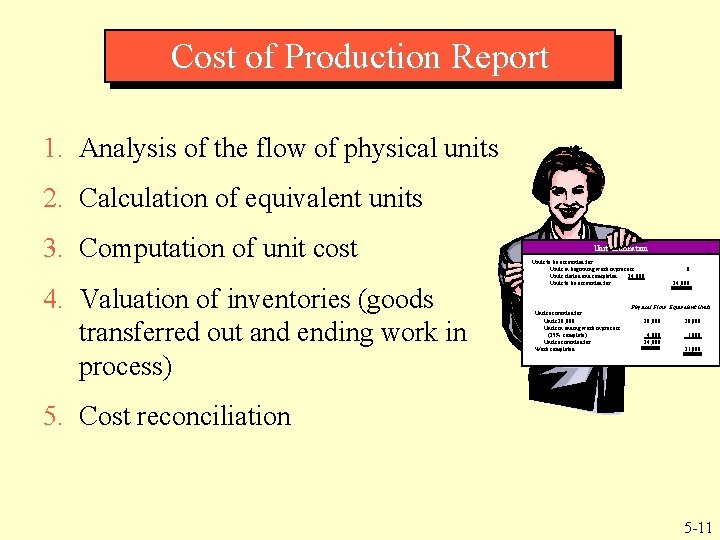
Cost of Production Report 1. Analysis of the flow of physical units 2. Calculation of equivalent units 3. Computation of unit cost 4. Valuation of inventories (goods transferred out and ending work in process) Unit Information Units to be accounted for: Units in beginning work in process Units started and completed 24, 000 Units to be accounted for Units accounted for: Units 20, 000 Units in ending work in process (25% complete) Units accounted for Work completed 0 24, 000 Physical Flow Equivalent Units 20, 000 4, 000 20, 000 1, 000 21, 000 5. Cost reconciliation 5 -11
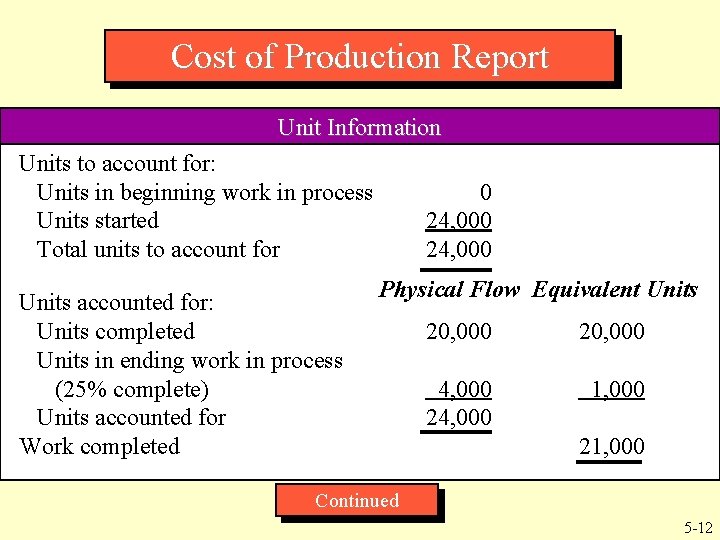
Cost of Production Report Unit Information Units to account for: Units in beginning work in process Units started Total units to account for Units accounted for: Units completed Units in ending work in process (25% complete) Units accounted for Work completed 0 24, 000 Physical Flow Equivalent Units 20, 000 4, 000 24, 000 1, 000 21, 000 Continued 5 -12
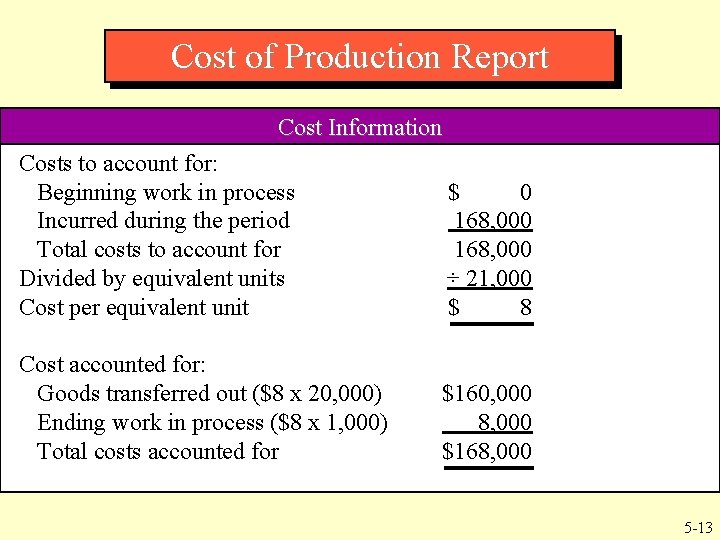
Cost of Production Report Cost Information Costs to account for: Beginning work in process Incurred during the period Total costs to account for Divided by equivalent units Cost per equivalent unit $ 0 168, 000 ÷ 21, 000 $ 8 Cost accounted for: Goods transferred out ($8 x 20, 000) Ending work in process ($8 x 1, 000) Total costs accounted for $160, 000 8, 000 $168, 000 5 -13
FIFO Costing Method Under the FIFO costing method, the equivalent units and manufacturing costs in beginning work in process are excluded from the current-period unit cost calculation. Thus, FIFO recognizes that the work and costs carried over from the prior period legitimately belong to that period. 5 -14
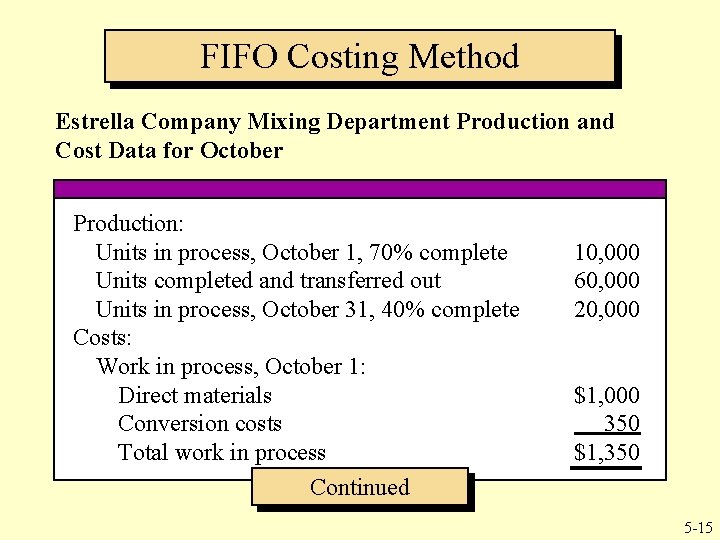
FIFO Costing Method Estrella Company Mixing Department Production and Cost Data for October Production: Units in process, October 1, 70% complete Units completed and transferred out Units in process, October 31, 40% complete Costs: Work in process, October 1: Direct materials Conversion costs Total work in process Continued 10, 000 60, 000 20, 000 $1, 000 350 $1, 350 5 -15
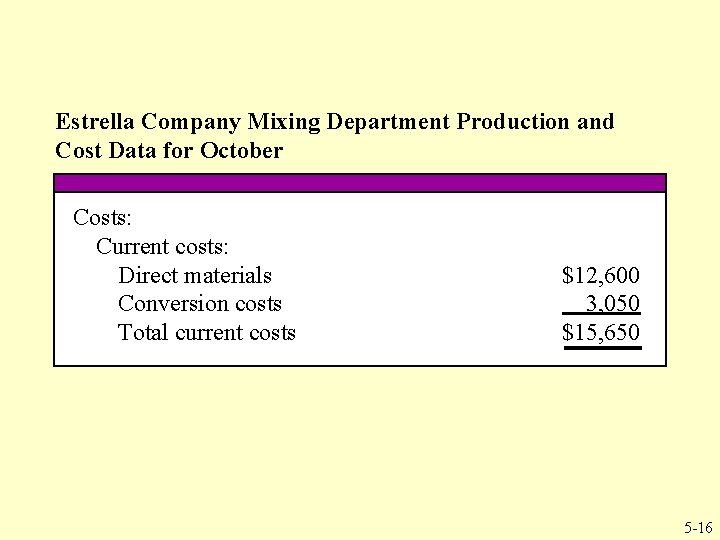
Estrella Company Mixing Department Production and Cost Data for October Costs: Current costs: Direct materials Conversion costs Total current costs $12, 600 3, 050 $15, 650 5 -16
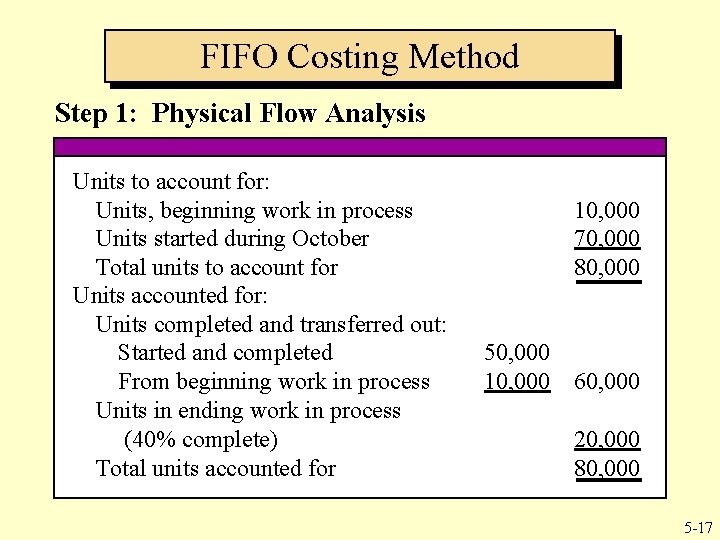
FIFO Costing Method Step 1: Physical Flow Analysis Units to account for: Units, beginning work in process Units started during October Total units to account for Units accounted for: Units completed and transferred out: Started and completed From beginning work in process Units in ending work in process (40% complete) Total units accounted for 10, 000 70, 000 80, 000 50, 000 10, 000 60, 000 20, 000 80, 000 5 -17
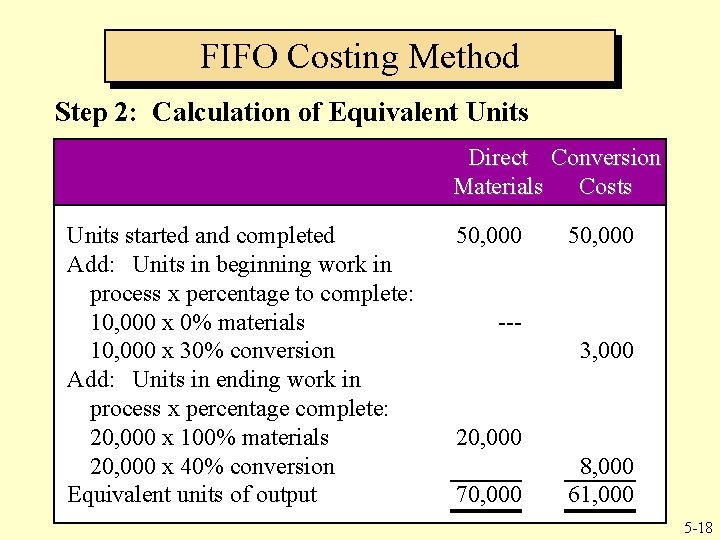
FIFO Costing Method Step 2: Calculation of Equivalent Units Direct Conversion Materials Costs Units started and completed Add: Units in beginning work in process x percentage to complete: 10, 000 x 0% materials 10, 000 x 30% conversion Add: Units in ending work in process x percentage complete: 20, 000 x 100% materials 20, 000 x 40% conversion Equivalent units of output 50, 000 --3, 000 20, 000 70, 000 8, 000 61, 000 5 -18
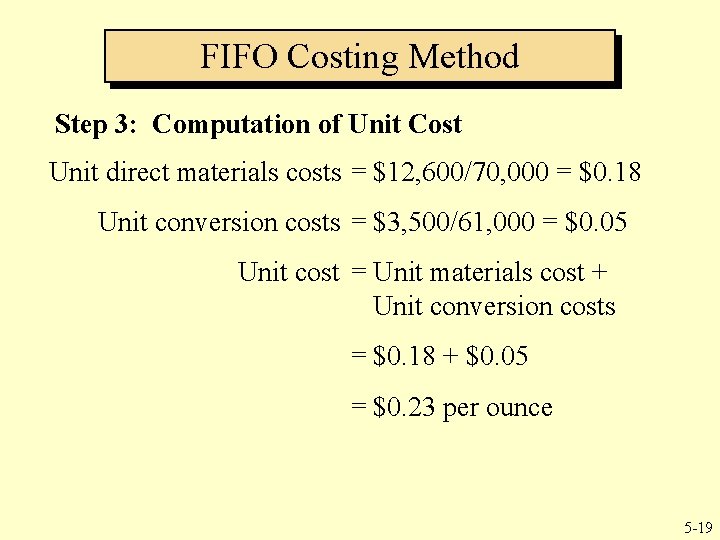
FIFO Costing Method Step 3: Computation of Unit Cost Unit direct materials costs = $12, 600/70, 000 = $0. 18 Unit conversion costs = $3, 500/61, 000 = $0. 05 Unit cost = Unit materials cost + Unit conversion costs = $0. 18 + $0. 05 = $0. 23 per ounce 5 -19
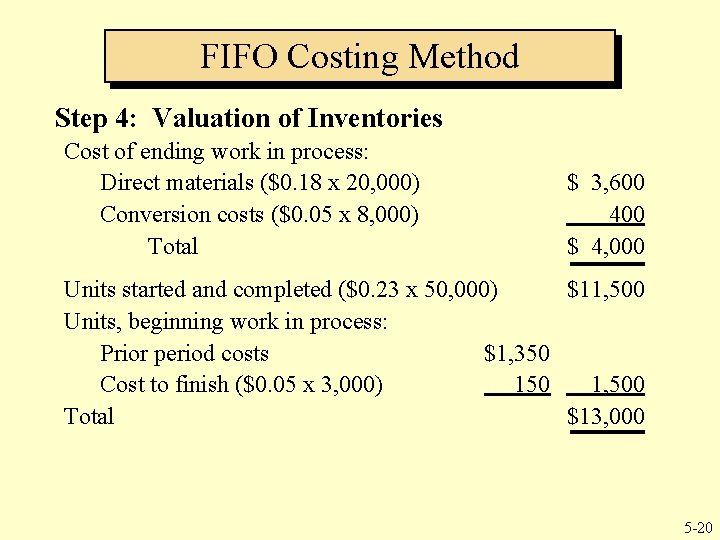
FIFO Costing Method Step 4: Valuation of Inventories Cost of ending work in process: Direct materials ($0. 18 x 20, 000) Conversion costs ($0. 05 x 8, 000) Total $ 3, 600 400 $ 4, 000 Units started and completed ($0. 23 x 50, 000) $11, 500 Units, beginning work in process: Prior period costs $1, 350 Cost to finish ($0. 05 x 3, 000) 150 1, 500 Total $13, 000 5 -20
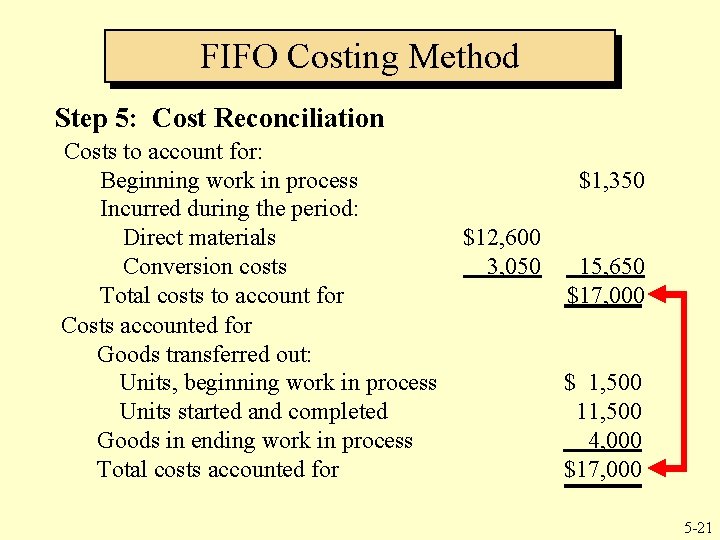
FIFO Costing Method Step 5: Cost Reconciliation Costs to account for: Beginning work in process Incurred during the period: Direct materials Conversion costs Total costs to account for Costs accounted for Goods transferred out: Units, beginning work in process Units started and completed Goods in ending work in process Total costs accounted for $1, 350 $12, 600 3, 050 15, 650 $17, 000 $ 1, 500 11, 500 4, 000 $17, 000 5 -21
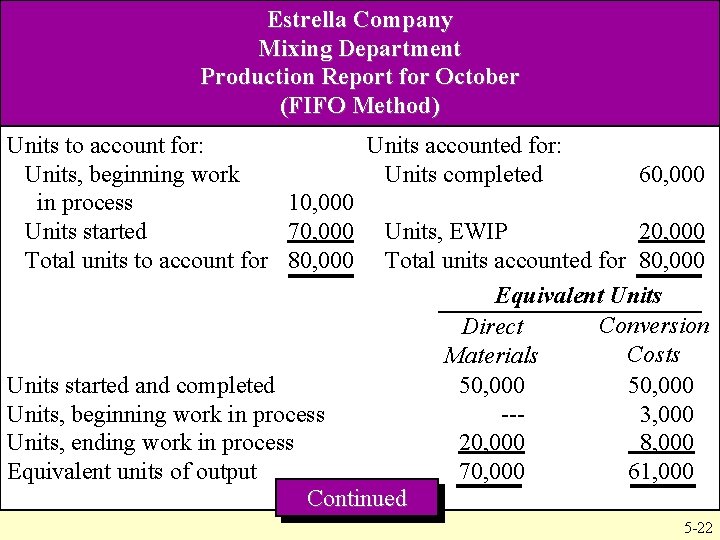
Estrella Company Mixing Department Production Report for October (FIFO Method) Units to account for: Units accounted for: Unit Information Units, beginning work Units completed 60, 000 in process 10, 000 Units started 70, 000 Units, EWIP 20, 000 Total units to account for 80, 000 Total units accounted for 80, 000 Equivalent Units Conversion Direct Costs Materials Units started and completed 50, 000 Units, beginning work in process --3, 000 Units, ending work in process 20, 000 8, 000 Equivalent units of output 70, 000 61, 000 Continued 5 -22
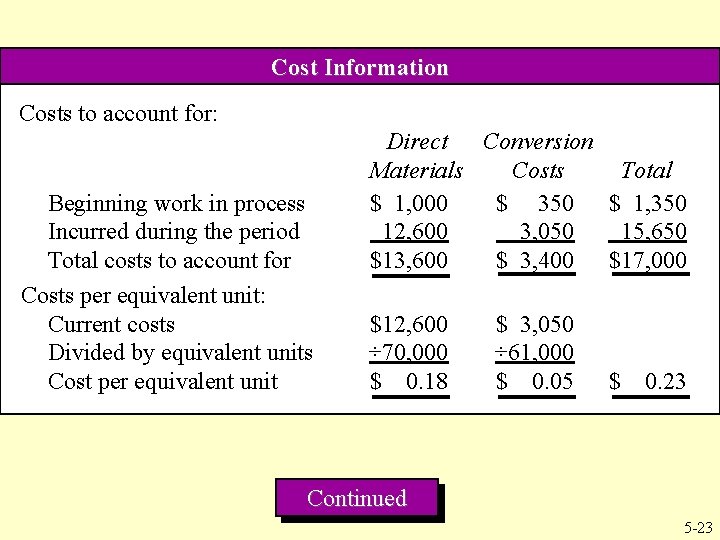
Cost Information Costs to account for: Beginning work in process Incurred during the period Total costs to account for Costs per equivalent unit: Current costs Divided by equivalent units Cost per equivalent unit Direct Conversion Materials Costs Total $ 1, 000 $ 350 $ 1, 350 12, 600 3, 050 15, 650 $13, 600 $ 3, 400 $17, 000 $12, 600 ÷ 70, 000 $ 0. 18 $ 3, 050 ÷ 61, 000 $ 0. 05 $ 0. 23 Continued 5 -23
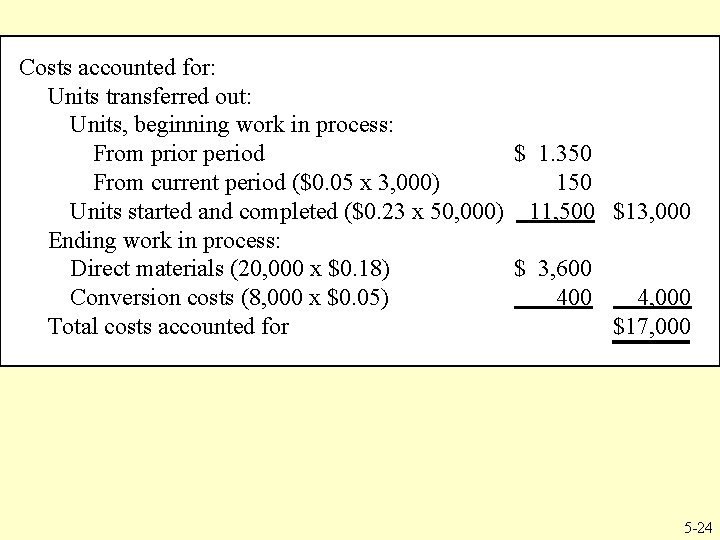
Costs accounted for: Units transferred out: Units, beginning work in process: From prior period $ 1. 350 From current period ($0. 05 x 3, 000) 150 Units started and completed ($0. 23 x 50, 000) 11, 500 $13, 000 Ending work in process: Direct materials (20, 000 x $0. 18) $ 3, 600 Conversion costs (8, 000 x $0. 05) 400 4, 000 Total costs accounted for $17, 000 5 -24
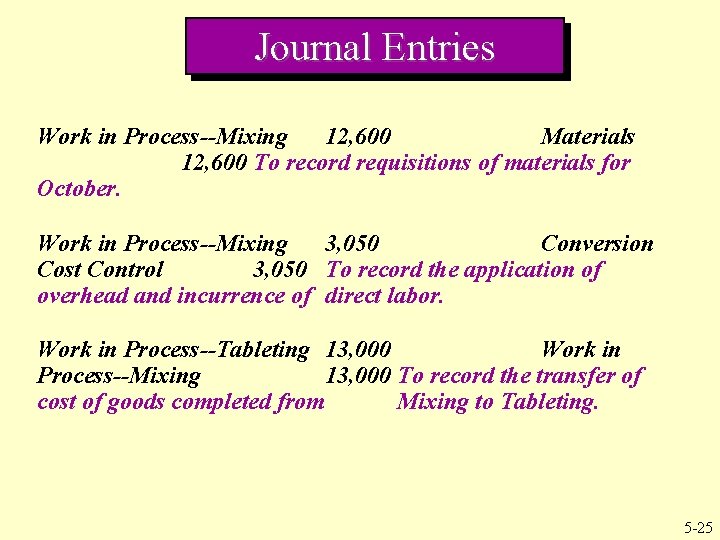
Journal Entries Work in Process--Mixing 12, 600 Materials 12, 600 To record requisitions of materials for October. Work in Process--Mixing 3, 050 Conversion Cost Control 3, 050 To record the application of overhead and incurrence of direct labor. Work in Process--Tableting 13, 000 Work in Process--Mixing 13, 000 To record the transfer of cost of goods completed from Mixing to Tableting. 5 -25
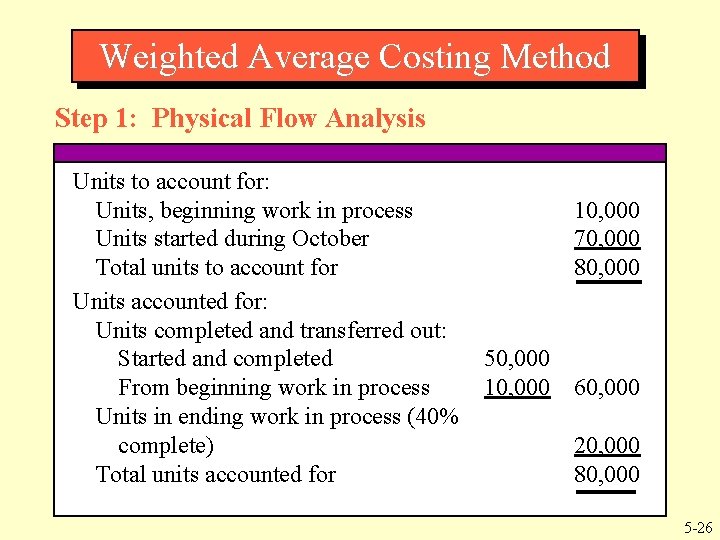
Weighted Average Costing Method Step 1: Physical Flow Analysis Units to account for: Units, beginning work in process Units started during October Total units to account for Units accounted for: Units completed and transferred out: Started and completed From beginning work in process Units in ending work in process (40% complete) Total units accounted for 10, 000 70, 000 80, 000 50, 000 10, 000 60, 000 20, 000 80, 000 5 -26
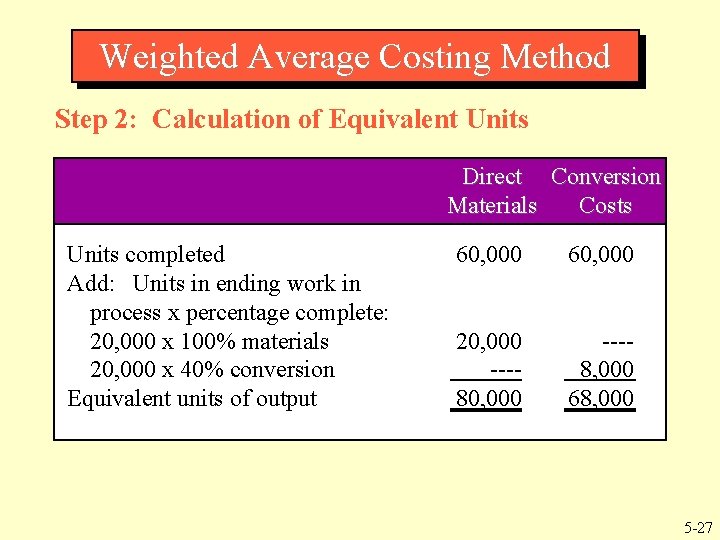
Weighted Average Costing Method Step 2: Calculation of Equivalent Units Direct Conversion Materials Costs Units completed Add: Units in ending work in process x percentage complete: 20, 000 x 100% materials 20, 000 x 40% conversion Equivalent units of output 60, 000 20, 000 ---8, 000 68, 000 5 -27
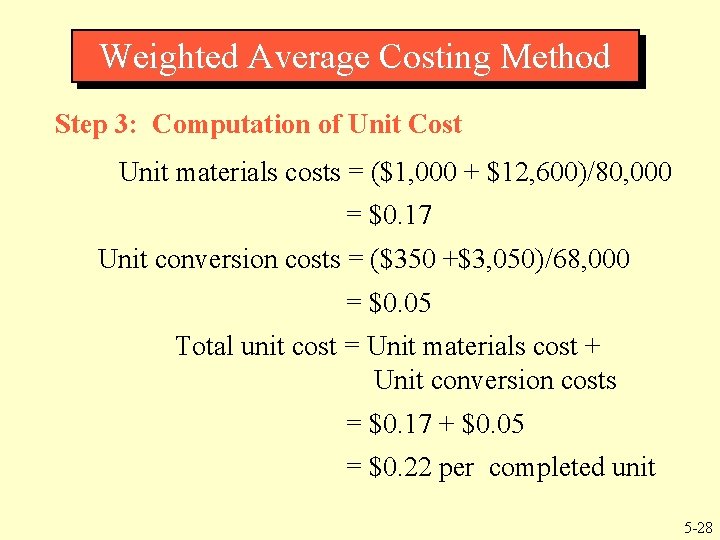
Weighted Average Costing Method Step 3: Computation of Unit Cost Unit materials costs = ($1, 000 + $12, 600)/80, 000 = $0. 17 Unit conversion costs = ($350 +$3, 050)/68, 000 = $0. 05 Total unit cost = Unit materials cost + Unit conversion costs = $0. 17 + $0. 05 = $0. 22 per completed unit 5 -28
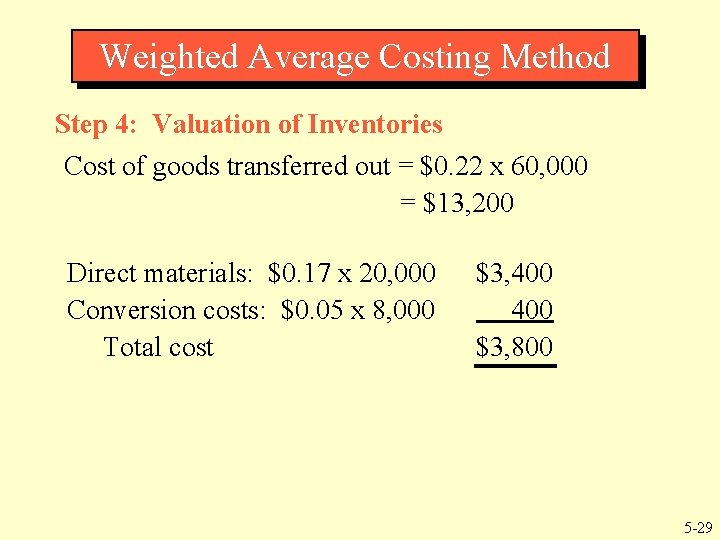
Weighted Average Costing Method Step 4: Valuation of Inventories Cost of goods transferred out = $0. 22 x 60, 000 = $13, 200 Direct materials: $0. 17 x 20, 000 Conversion costs: $0. 05 x 8, 000 Total cost $3, 400 $3, 800 5 -29
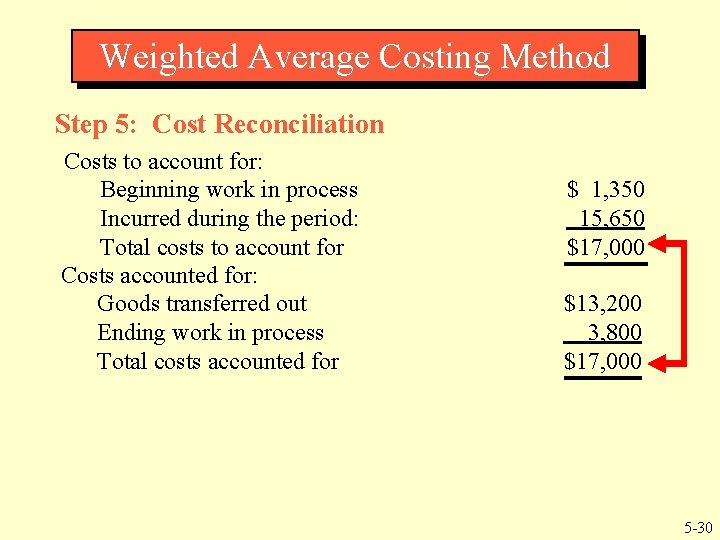
Weighted Average Costing Method Step 5: Cost Reconciliation Costs to account for: Beginning work in process Incurred during the period: Total costs to account for Costs accounted for: Goods transferred out Ending work in process Total costs accounted for $ 1, 350 15, 650 $17, 000 $13, 200 3, 800 $17, 000 5 -30
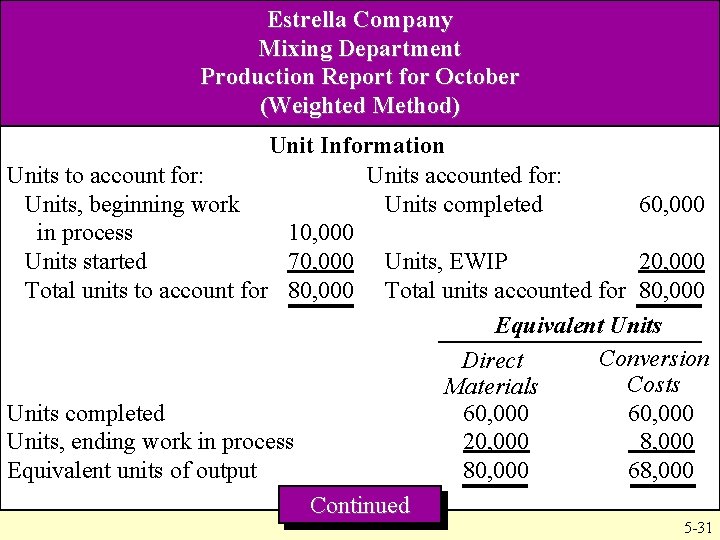
Estrella Company Mixing Department Production Report for October (Weighted Method) Unit Information Units to account for: Units accounted for: Units, beginning work Units completed 60, 000 in process 10, 000 Units started 70, 000 Units, EWIP 20, 000 Total units to account for 80, 000 Total units accounted for 80, 000 Equivalent Units Conversion Direct Costs Materials Units completed 60, 000 Units, ending work in process 20, 000 8, 000 Equivalent units of output 80, 000 68, 000 Continued 5 -31
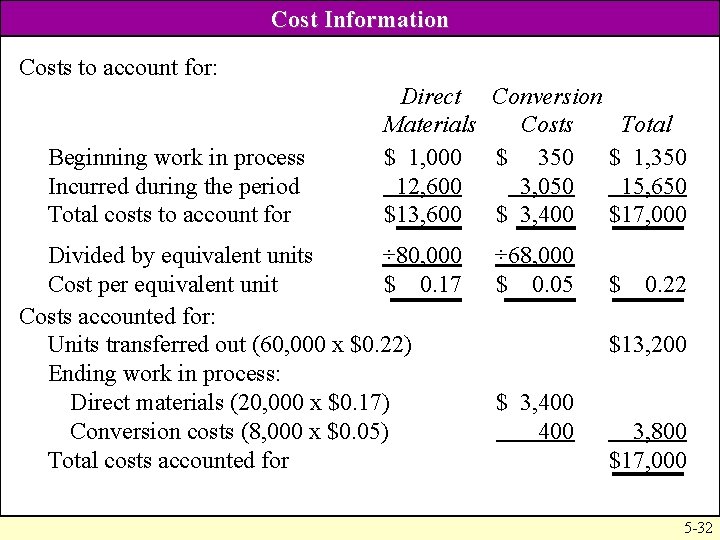
Cost Information Costs to account for: Beginning work in process Incurred during the period Total costs to account for Direct Conversion Materials Costs Total $ 1, 000 $ 350 $ 1, 350 12, 600 3, 050 15, 650 $13, 600 $ 3, 400 $17, 000 Divided by equivalent units ÷ 80, 000 Cost per equivalent unit $ 0. 17 Costs accounted for: Units transferred out (60, 000 x $0. 22) Ending work in process: Direct materials (20, 000 x $0. 17) Conversion costs (8, 000 x $0. 05) Total costs accounted for ÷ 68, 000 $ 0. 05 $ 0. 22 $13, 200 $ 3, 400 3, 800 $17, 000 5 -32
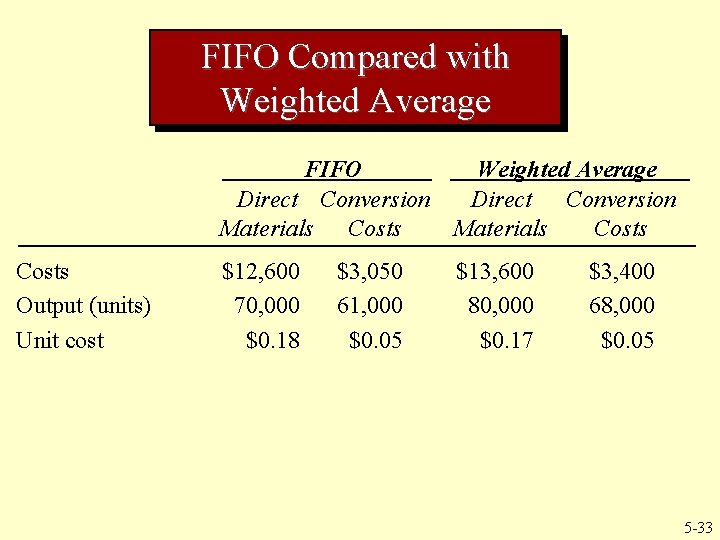
FIFO Compared with Weighted Average Costs Output (units) Unit cost FIFO Direct Conversion Materials Costs Weighted Average Direct Conversion Materials Costs $12, 600 70, 000 $0. 18 $13, 600 80, 000 $0. 17 $3, 050 61, 000 $0. 05 $3, 400 68, 000 $0. 05 5 -33
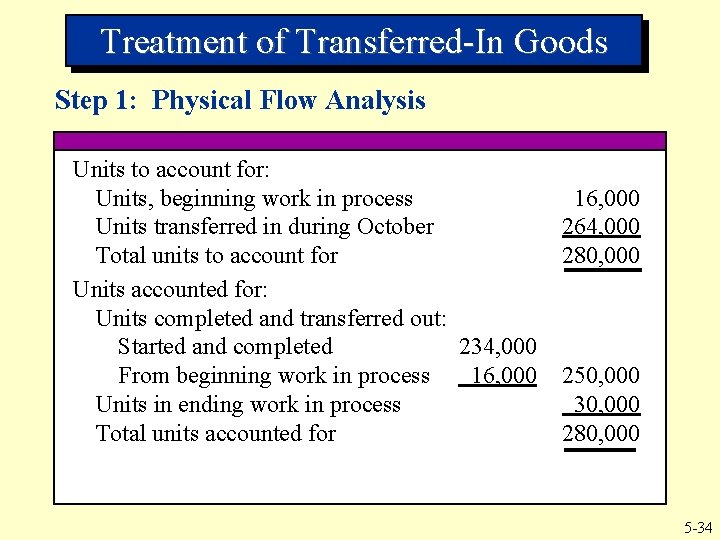
Treatment of Transferred-In Goods Step 1: Physical Flow Analysis Units to account for: Units, beginning work in process Units transferred in during October Total units to account for Units accounted for: Units completed and transferred out: Started and completed 234, 000 From beginning work in process 16, 000 Units in ending work in process Total units accounted for 16, 000 264, 000 280, 000 250, 000 30, 000 280, 000 5 -34
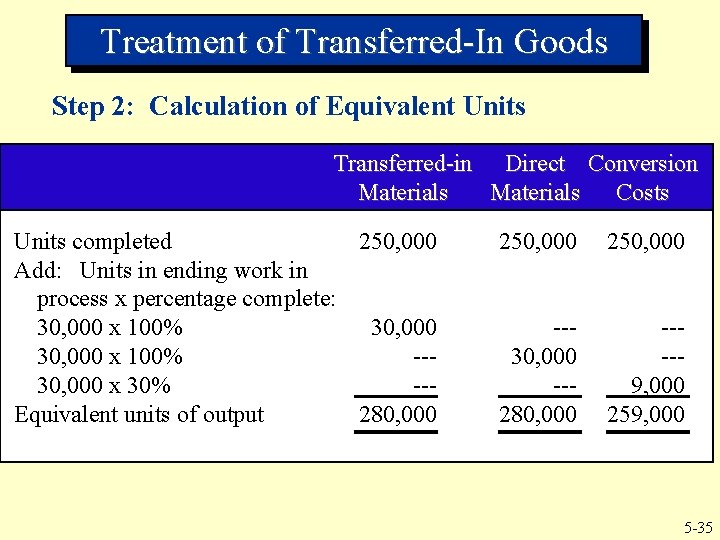
Treatment of Transferred-In Goods Step 2: Calculation of Equivalent Units Transferred-in Direct Conversion Materials Costs Units completed 250, 000 Add: Units in ending work in process x percentage complete: 30, 000 x 100% --30, 000 x 30% --Equivalent units of output 280, 000 250, 000 --30, 000 --280, 000 ----9, 000 259, 000 5 -35
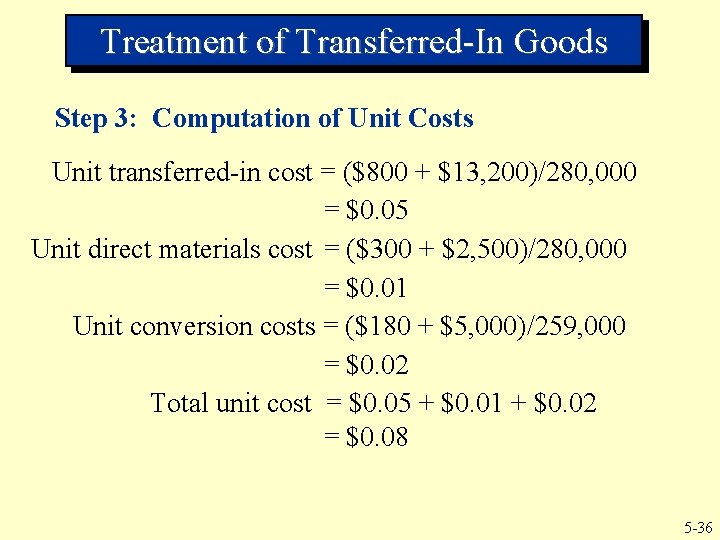
Treatment of Transferred-In Goods Step 3: Computation of Unit Costs Unit transferred-in cost = ($800 + $13, 200)/280, 000 = $0. 05 Unit direct materials cost = ($300 + $2, 500)/280, 000 = $0. 01 Unit conversion costs = ($180 + $5, 000)/259, 000 = $0. 02 Total unit cost = $0. 05 + $0. 01 + $0. 02 = $0. 08 5 -36
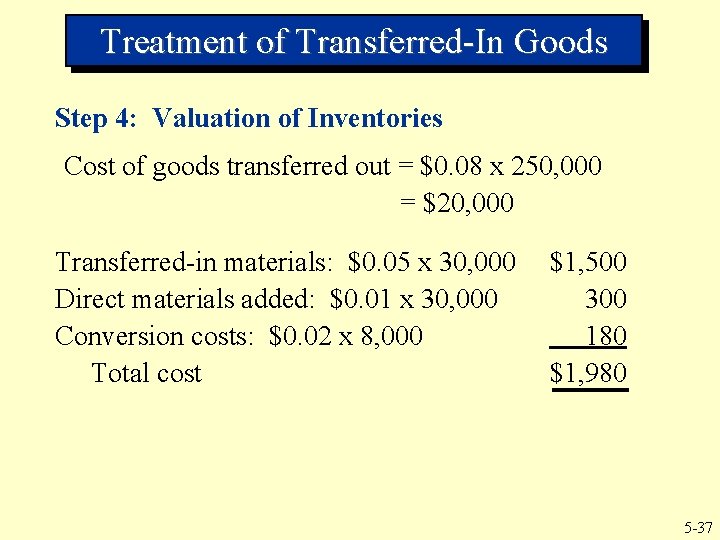
Treatment of Transferred-In Goods Step 4: Valuation of Inventories Cost of goods transferred out = $0. 08 x 250, 000 = $20, 000 Transferred-in materials: $0. 05 x 30, 000 Direct materials added: $0. 01 x 30, 000 Conversion costs: $0. 02 x 8, 000 Total cost $1, 500 300 180 $1, 980 5 -37
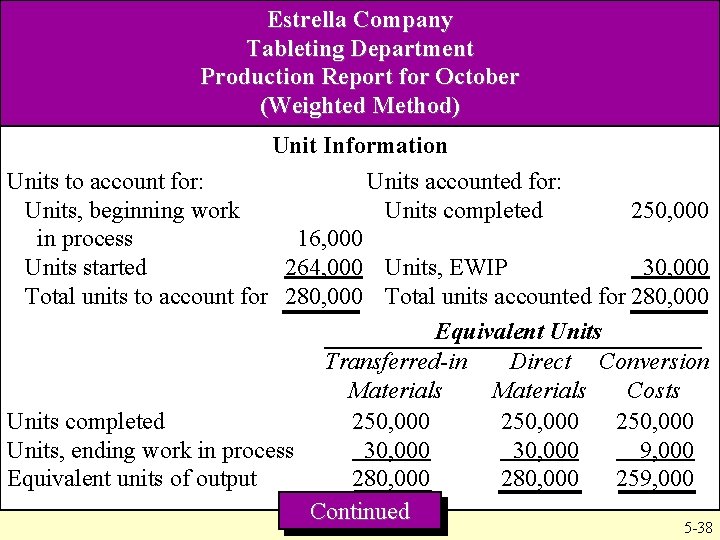
Estrella Company Tableting Department Production Report for October (Weighted Method) Unit Information Units to account for: Units accounted for: Units, beginning work Units completed 250, 000 in process 16, 000 Units started 264, 000 Units, EWIP 30, 000 Total units to account for 280, 000 Total units accounted for 280, 000 Equivalent Units Transferred-in Direct Conversion Materials Costs Units completed 250, 000 Units, ending work in process 30, 000 9, 000 Equivalent units of output 280, 000 259, 000 Continued 5 -38
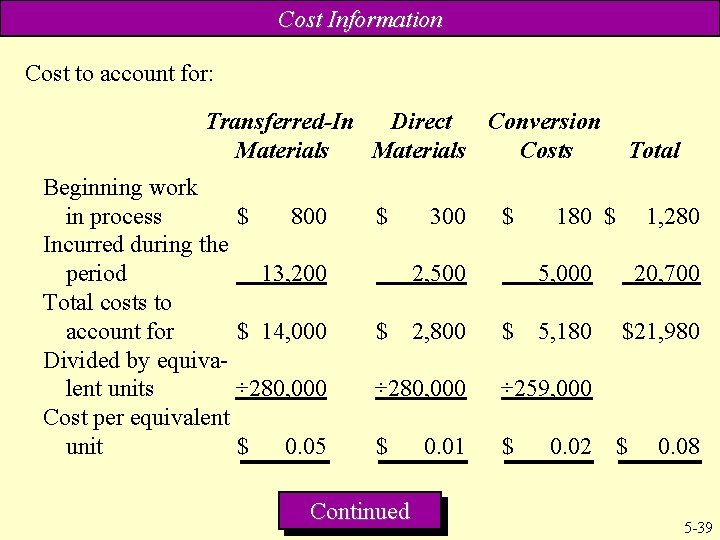
Cost Information Cost to account for: Transferred-In Direct Conversion Materials Costs Beginning work in process $ 800 Incurred during the period 13, 200 Total costs to account for $ 14, 000 Divided by equivalent units ÷ 280, 000 Cost per equivalent unit $ 0. 05 $ 300 $ 2, 500 $ 2, 800 $ 180 $ 20, 700 5, 180 $21, 980 ÷ 259, 000 $ $ Continued 1, 280 5, 000 ÷ 280, 000 0. 01 Total 0. 02 $ 0. 08 5 -39
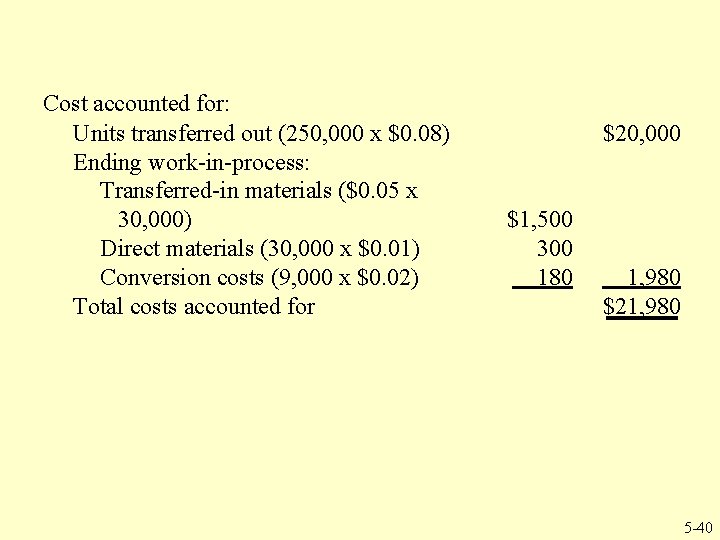
Cost accounted for: Units transferred out (250, 000 x $0. 08) Ending work-in-process: Transferred-in materials ($0. 05 x 30, 000) Direct materials (30, 000 x $0. 01) Conversion costs (9, 000 x $0. 02) Total costs accounted for $20, 000 $1, 500 300 180 1, 980 $21, 980 5 -40
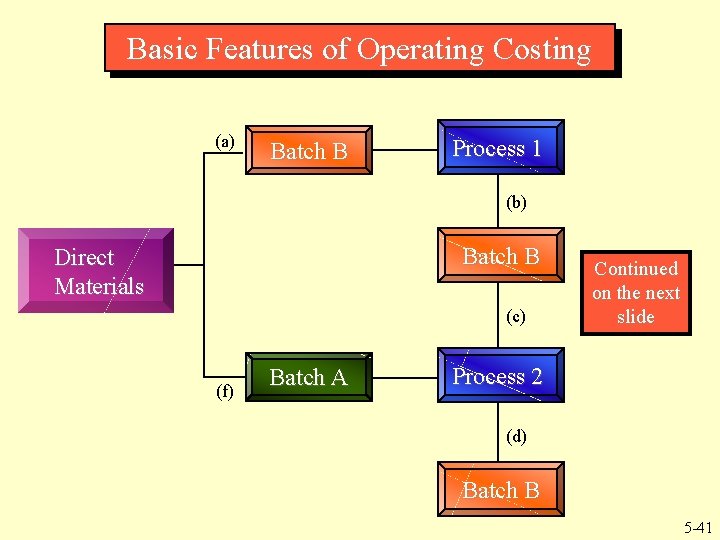
Basic Features of Operating Costing (a) Batch B Process 1 (b) Batch B Direct Materials (c) (f) Batch A Continued on the next slide Process 2 (d) Batch B 5 -41
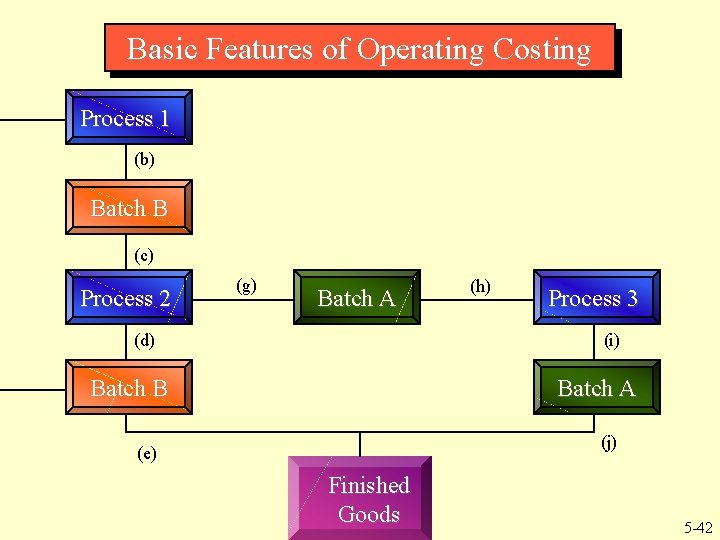
Basic Features of Operating Costing Process 1 (b) Batch B (c) Process 2 (g) Batch A (d) (h) Process 3 (i) Batch B Batch A (j) (e) Finished Goods 5 -42
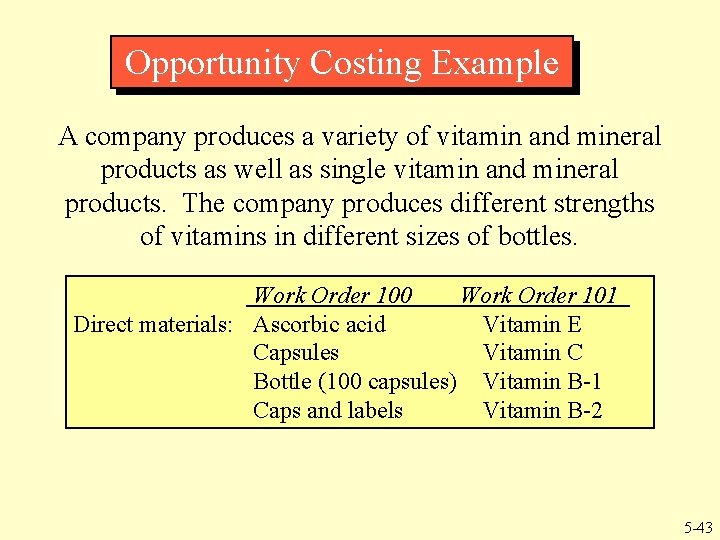
Opportunity Costing Example A company produces a variety of vitamin and mineral products as well as single vitamin and mineral products. The company produces different strengths of vitamins in different sizes of bottles. Work Order 100 Work Order 101 Direct materials: Ascorbic acid Vitamin E Capsules Vitamin C Bottle (100 capsules) Vitamin B-1 Caps and labels Vitamin B-2 5 -43
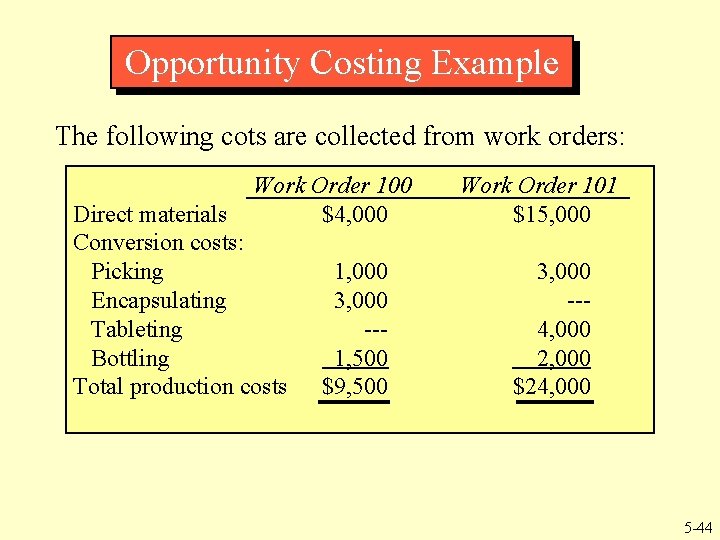
Opportunity Costing Example The following cots are collected from work orders: Work Order 100 $4, 000 Direct materials Conversion costs: Picking Encapsulating Tableting Bottling Total production costs 1, 000 3, 000 --1, 500 $9, 500 Work Order 101 $15, 000 3, 000 --4, 000 2, 000 $24, 000 5 -44
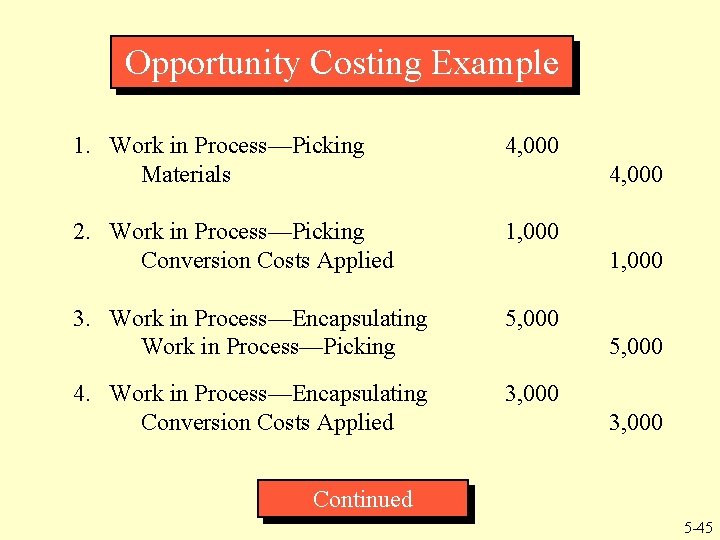
Opportunity Costing Example 1. Work in Process—Picking Materials 4, 000 2. Work in Process—Picking Conversion Costs Applied 1, 000 3. Work in Process—Encapsulating Work in Process—Picking 5, 000 4. Work in Process—Encapsulating Conversion Costs Applied 3, 000 4, 000 1, 000 5, 000 3, 000 Continued 5 -45
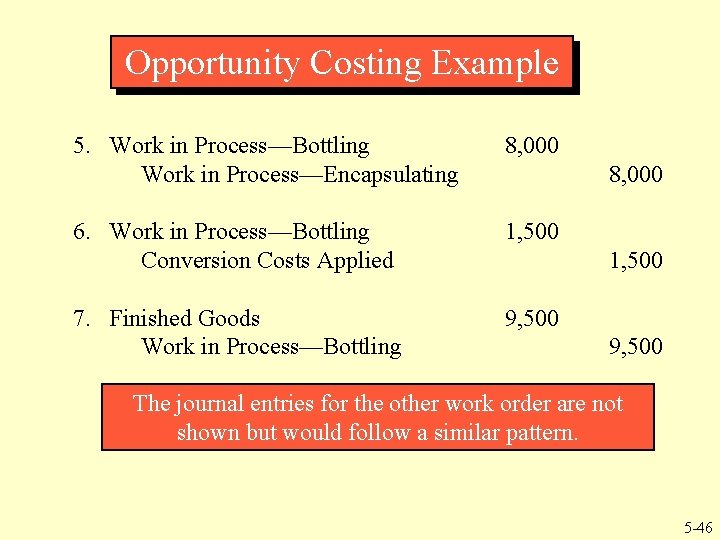
Opportunity Costing Example 5. Work in Process—Bottling Work in Process—Encapsulating 8, 000 6. Work in Process—Bottling Conversion Costs Applied 1, 500 7. Finished Goods Work in Process—Bottling 9, 500 8, 000 1, 500 9, 500 The journal entries for the other work order are not shown but would follow a similar pattern. 5 -46
End of Chapter 5 -47
5 -48