
Product and Equipment Analysis Chapter 2 S S

- Slides: 47
Product and Equipment Analysis Chapter 2 S. S. Heragu, Facilities Design, 4 th Edition, CRC Press
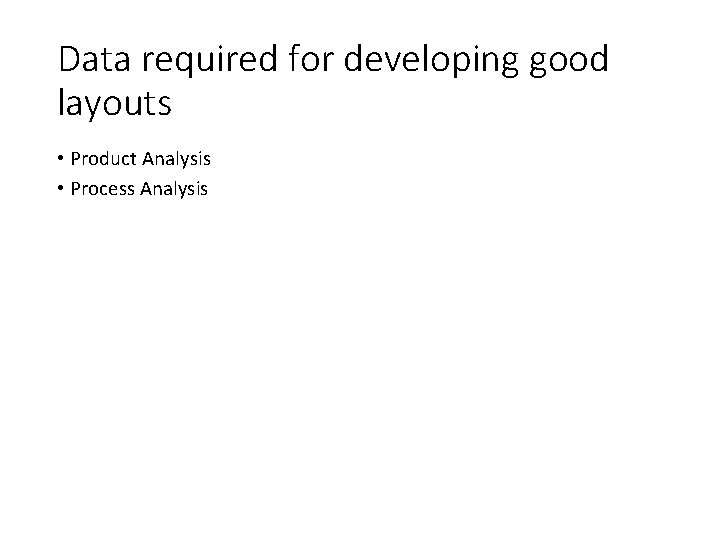
Data required for developing good layouts • Product Analysis • Process Analysis
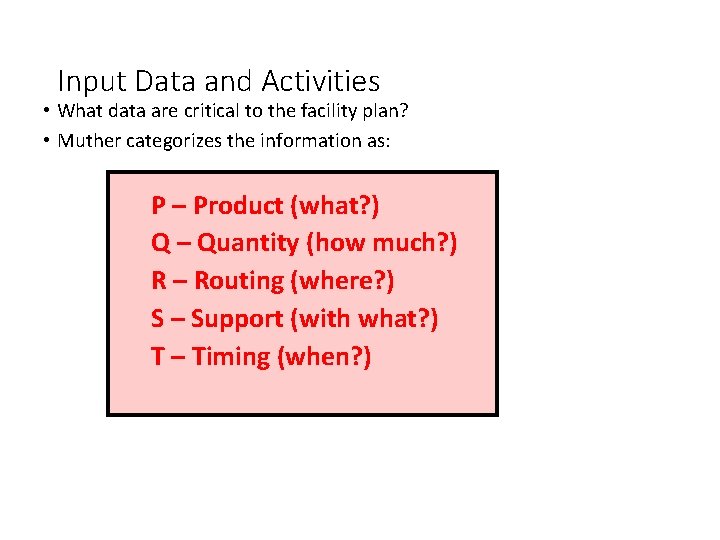
Input Data and Activities • What data are critical to the facility plan? • Muther categorizes the information as: P – Product (what? ) Q – Quantity (how much? ) R – Routing (where? ) S – Support (with what? ) T – Timing (when? )
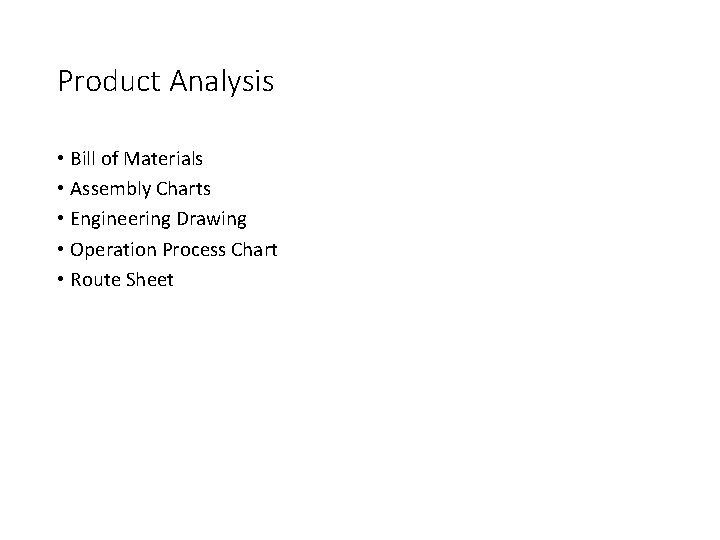
Product Analysis • Bill of Materials • Assembly Charts • Engineering Drawing • Operation Process Chart • Route Sheet
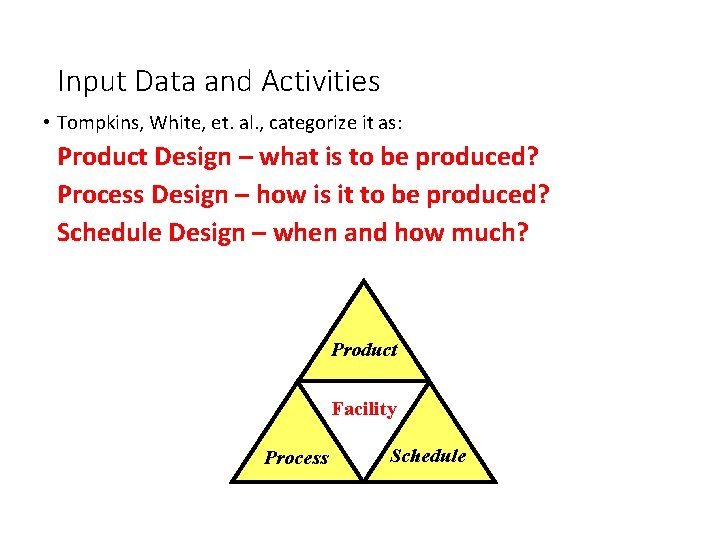
Input Data and Activities • Tompkins, White, et. al. , categorize it as: Product Design – what is to be produced? Process Design – how is it to be produced? Schedule Design – when and how much? Product Facility Process Schedule
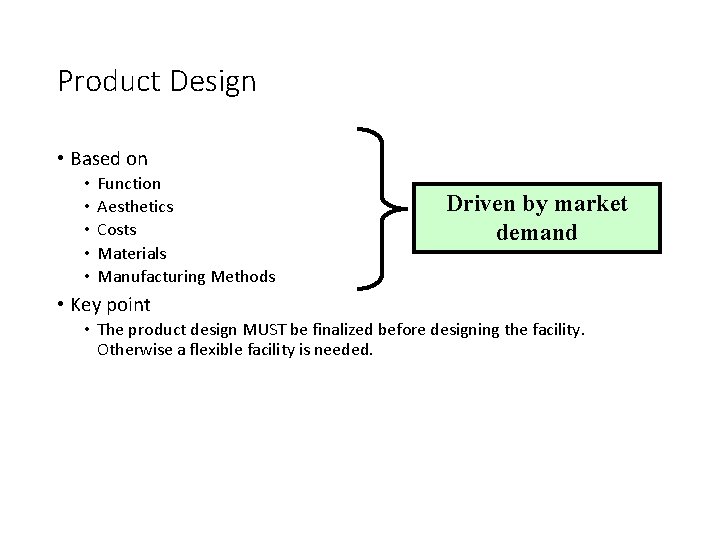
Product Design • Based on • • • Function Aesthetics Costs Materials Manufacturing Methods Driven by market demand • Key point • The product design MUST be finalized before designing the facility. Otherwise a flexible facility is needed.
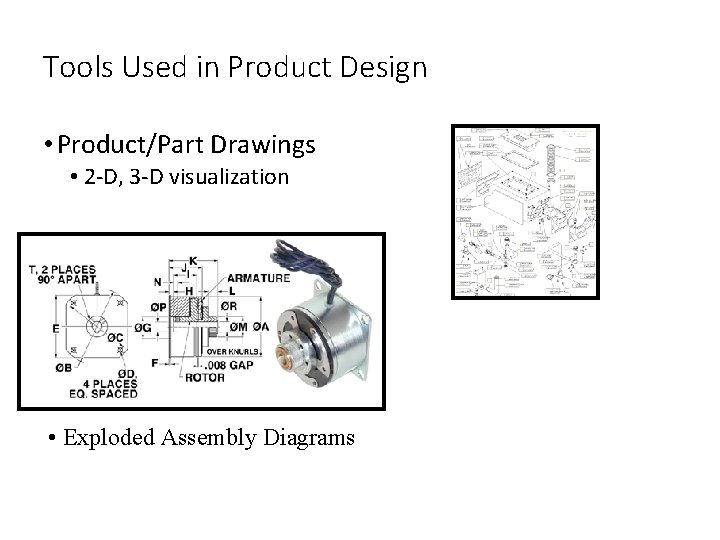
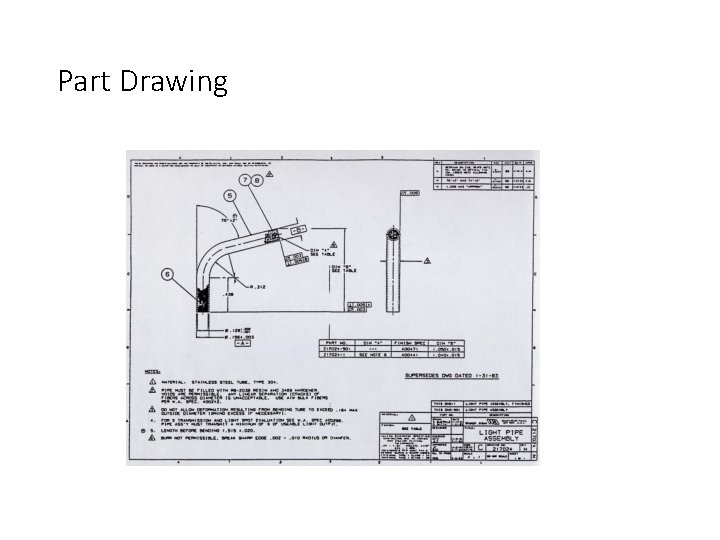
Tools Used in Product Design • Product/Part Drawings • 2 -D, 3 -D visualization • Exploded Assembly Diagrams
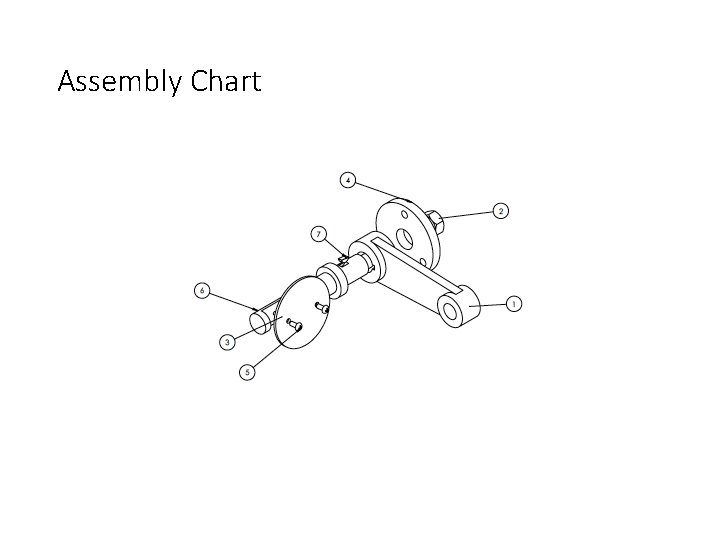
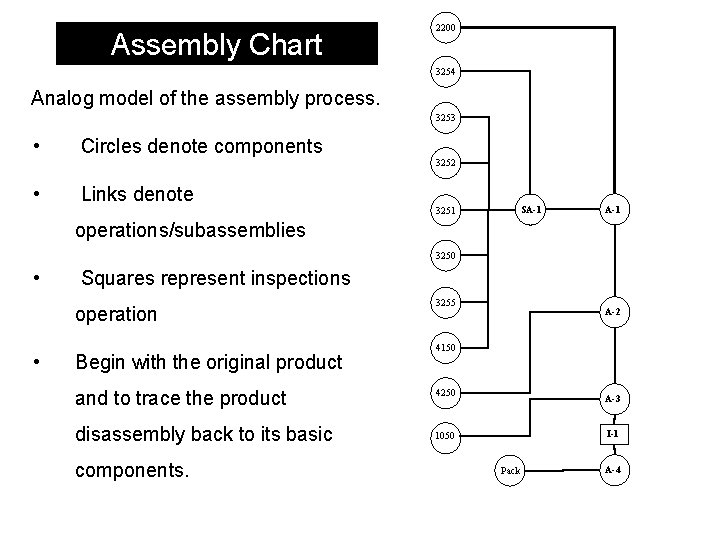
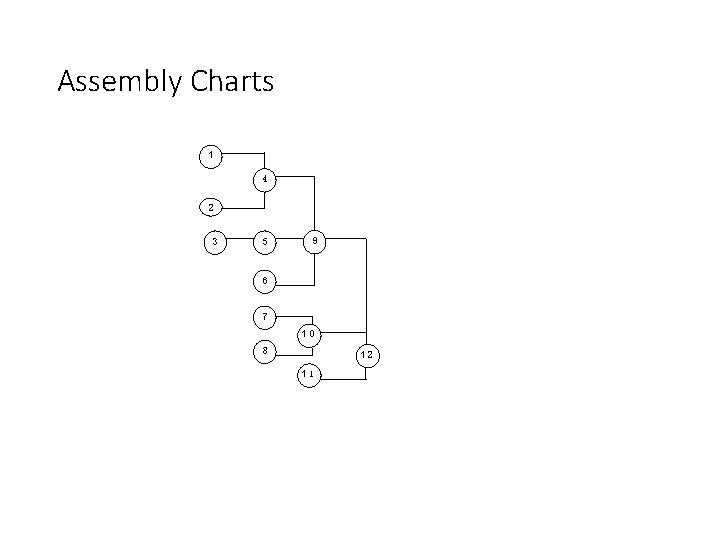
Assembly Chart
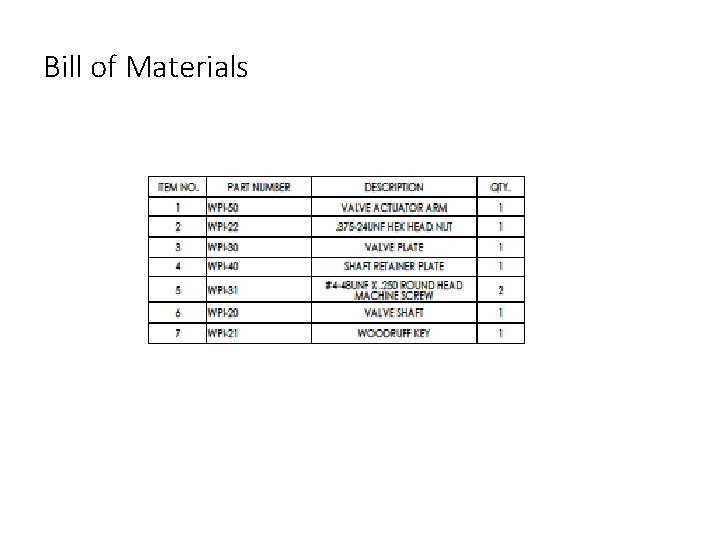
Bill of Materials
Part Drawing
Tools Used in Process Design A partial list (dependent on product and service): • Process Flowcharts and Process Maps • Make vs. Buy • Parts Lists • Bill of Materials • Route Sheets • Assembly Charts • Operations Process Charts • Precedence Diagrams
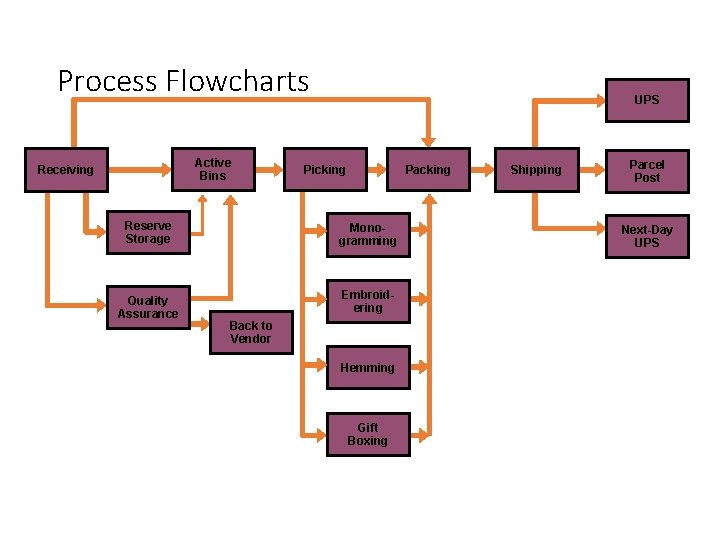
Process Flowcharts Active Bins Receiving Reserve Storage Quality Assurance UPS Picking Packing Monogramming Embroidering Back to Vendor Hemming Gift Boxing Shipping Parcel Post Next-Day UPS
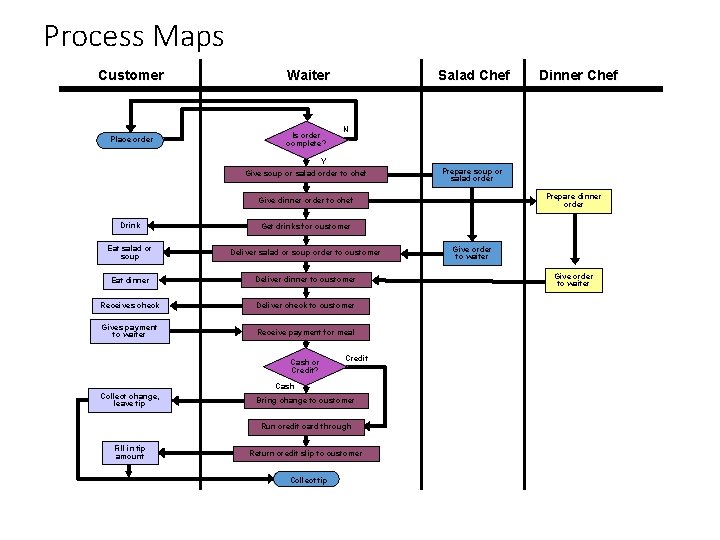
Process Maps Customer Waiter Place order Is order complete? Salad Chef Dinner Chef N Y Give soup or salad order to chef Prepare soup or salad order Prepare dinner order Give dinner order to chef Drink Get drinks for customer Eat salad or soup Deliver salad or soup order to customer Eat dinner Deliver dinner to customer Receives check Deliver check to customer Gives payment to waiter Receive payment for meal Cash or Credit? Credit Cash Collect change, leave tip Bring change to customer Run credit card through Fill in tip amount Return credit slip to customer Collect tip Give order to waiter
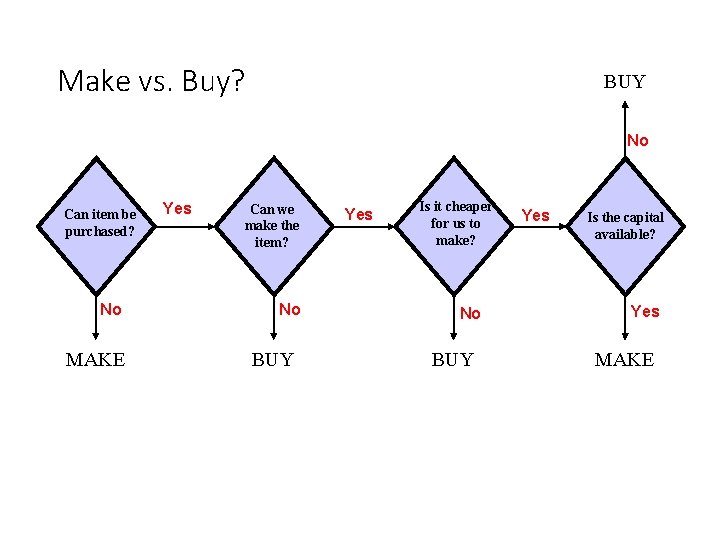
Make vs. Buy? BUY No Can item be purchased? No MAKE Yes Can we make the item? No BUY Yes Is it cheaper for us to make? No BUY Yes Is the capital available? Yes MAKE
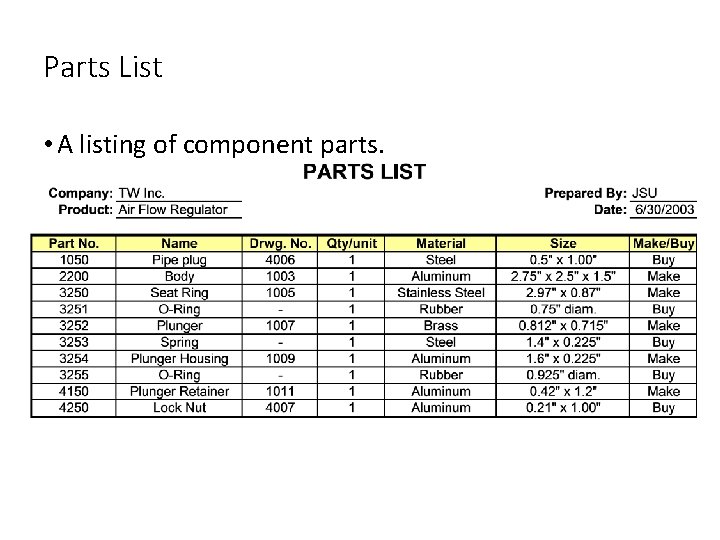
Parts List • A listing of component parts.
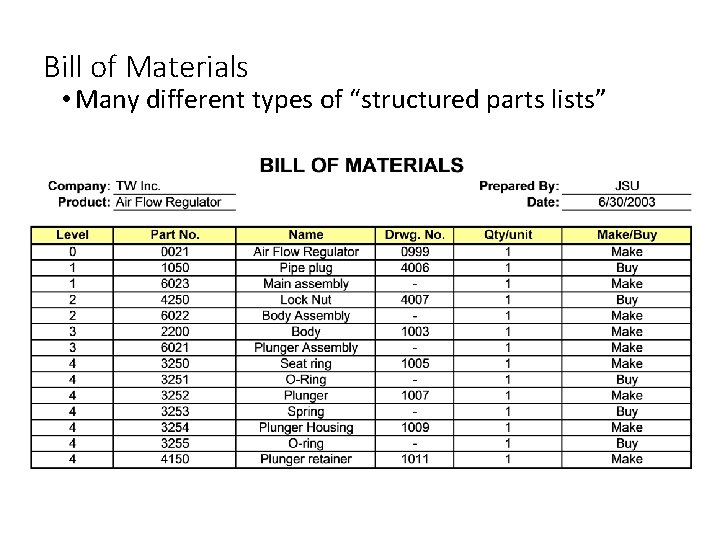
Bill of Materials • Many different types of “structured parts lists”
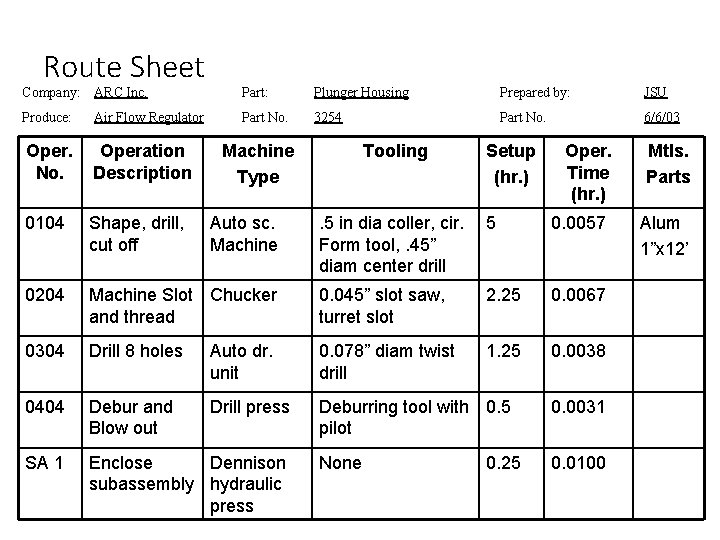
Route Sheet Company: ARC Inc. Part: Plunger Housing Prepared by: JSU Produce: Part No. 3254 Part No. 6/6/03 Air Flow Regulator Oper. No. Operation Description 0104 Shape, drill, cut off 0204 Machine Type Auto sc. Machine Tooling Setup (hr. ) Oper. Time (hr. ) . 5 in dia coller, cir. Form tool, . 45” diam center drill 5 0. 0057 Machine Slot Chucker and thread 0. 045” slot saw, turret slot 2. 25 0. 0067 0304 Drill 8 holes Auto dr. unit 0. 078” diam twist drill 1. 25 0. 0038 0404 Debur and Blow out Drill press Deburring tool with 0. 5 pilot 0. 0031 SA 1 Enclose Dennison subassembly hydraulic press None 0. 0100 0. 25 Mtls. Parts Alum 1”x 12’
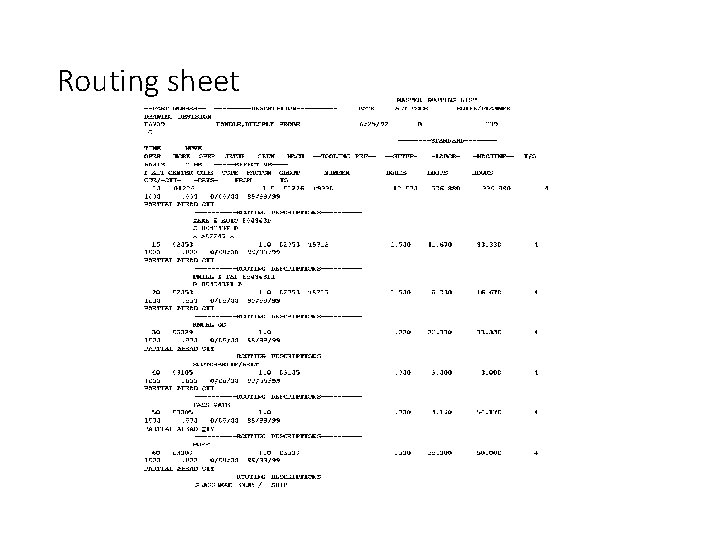
Routing sheet
Assembly Chart 2200 3254 Analog model of the assembly process. 3253 • Circles denote components 3252 • Links denote SA-1 3251 A-1 operations/subassemblies 3250 • Squares represent inspections operation • Begin with the original product 3255 4150 and to trace the product 4250 disassembly back to its basic 1050 components. A-2 A-3 I-1 Pack A-4
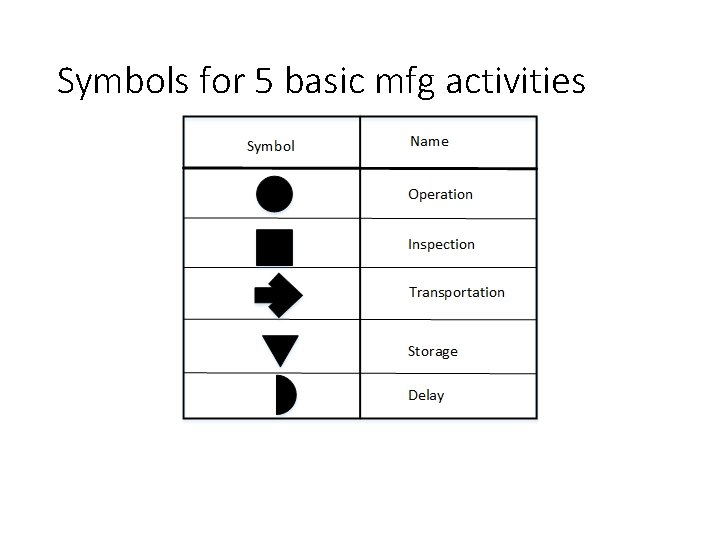
Symbols for 5 basic mfg activities
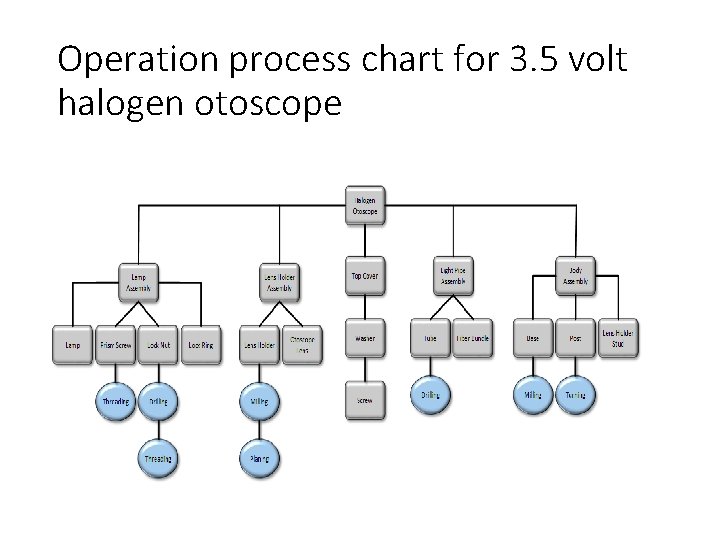
Operation process chart for 3. 5 volt halogen otoscope
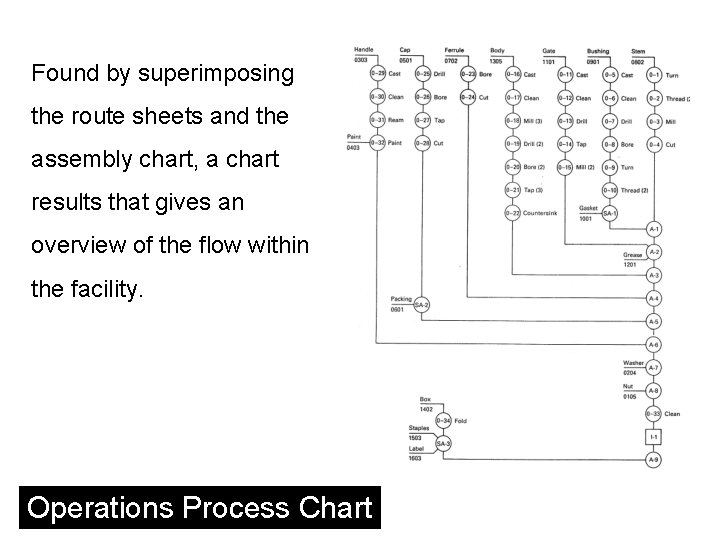
Found by superimposing the route sheets and the assembly chart, a chart results that gives an overview of the flow within the facility. Operations Process Chart
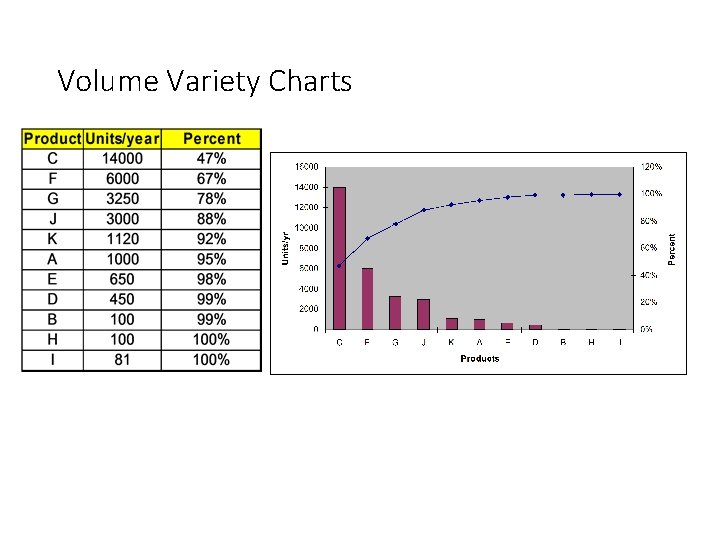
Volume Variety Charts
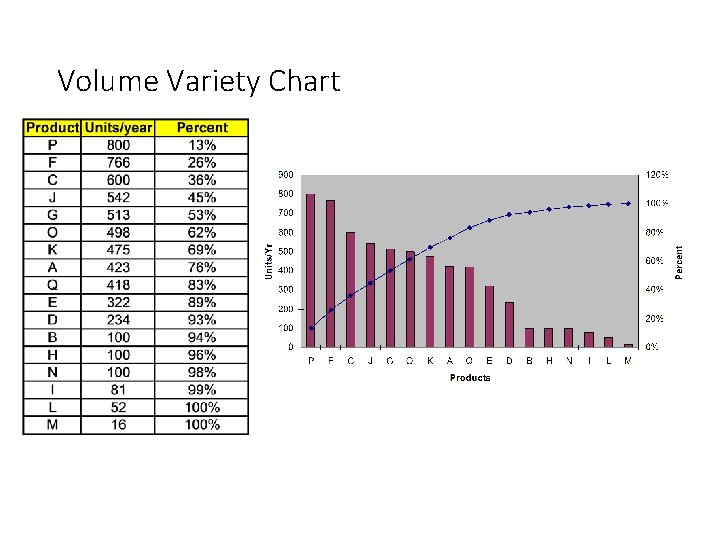
Volume Variety Chart
Equipment Selection • Traditional Model • Queuing Model
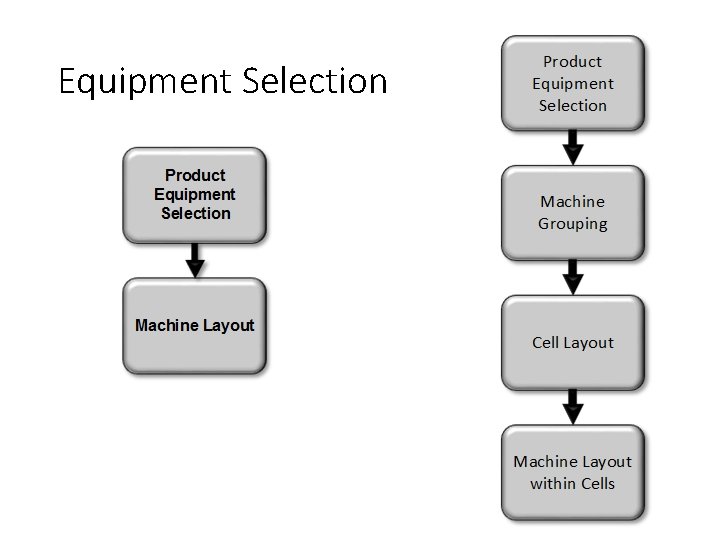
Equipment Selection
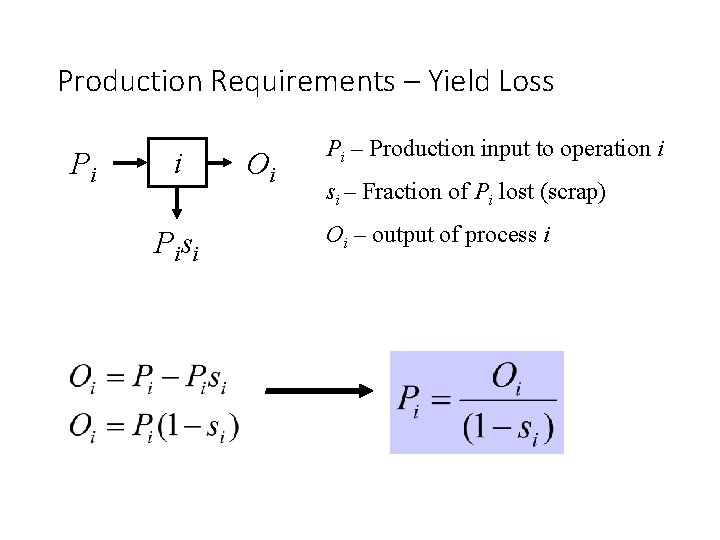
Production Requirements – Yield Loss Pi i P i si Oi Pi – Production input to operation i si – Fraction of Pi lost (scrap) Oi – output of process i
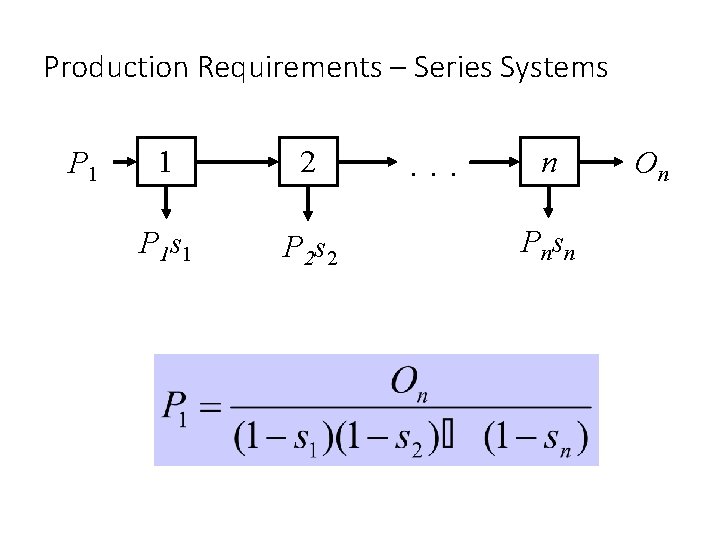
Production Requirements – Series Systems P 1 1 2 P 1 s 1 P 2 s 2 . . . n Pnsn On
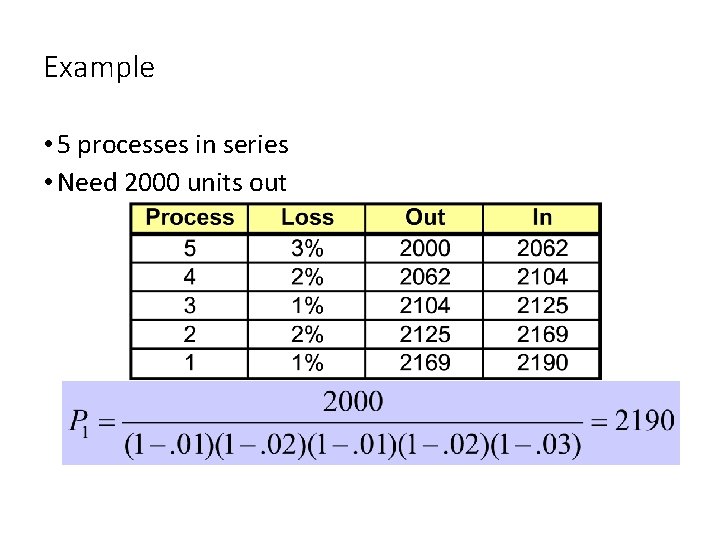
Example • 5 processes in series • Need 2000 units out
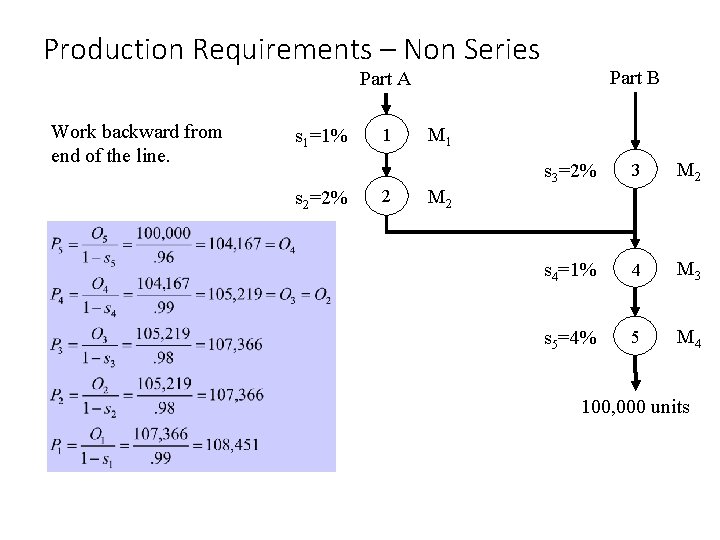
Production Requirements – Non Series Part B Part A Work backward from end of the line. s 1=1% s 2=2% 1 2 M 1 s 3=2% 3 M 2 s 4=1% 4 M 3 s 5=4% 5 M 4 M 2 100, 000 units
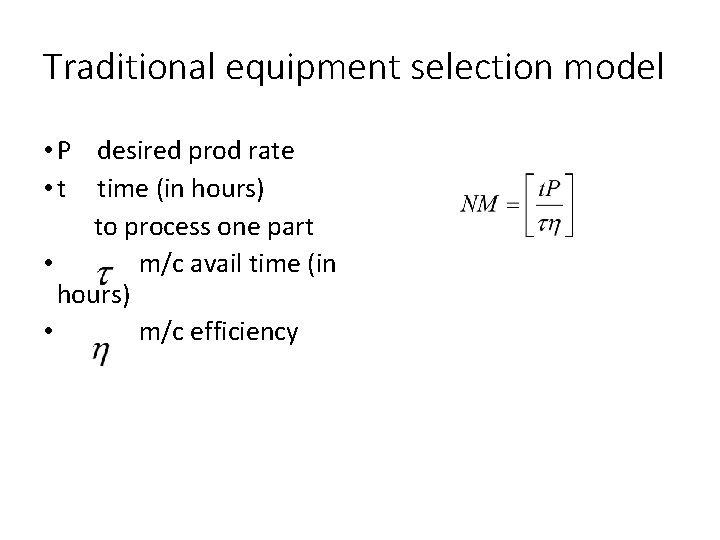
Traditional equipment selection model • P desired prod rate • t time (in hours) to process one part • m/c avail time (in hours) • m/c efficiency
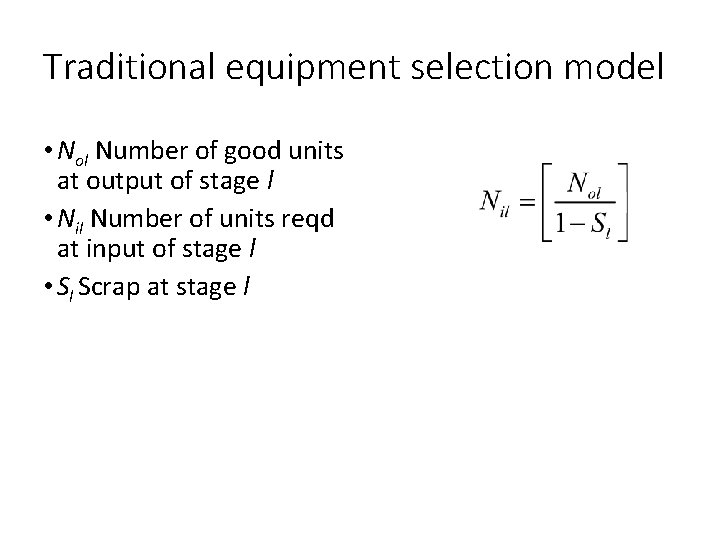
Traditional equipment selection model • Nol Number of good units at output of stage l • Nil Number of units reqd at input of stage l • Sl Scrap at stage l
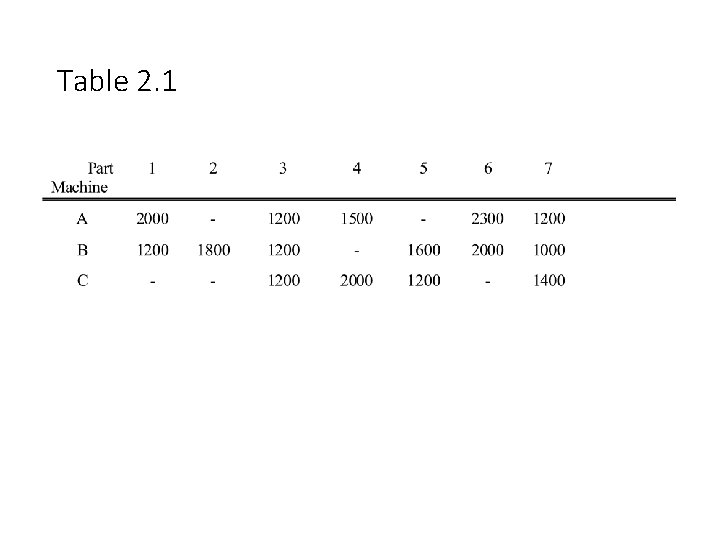
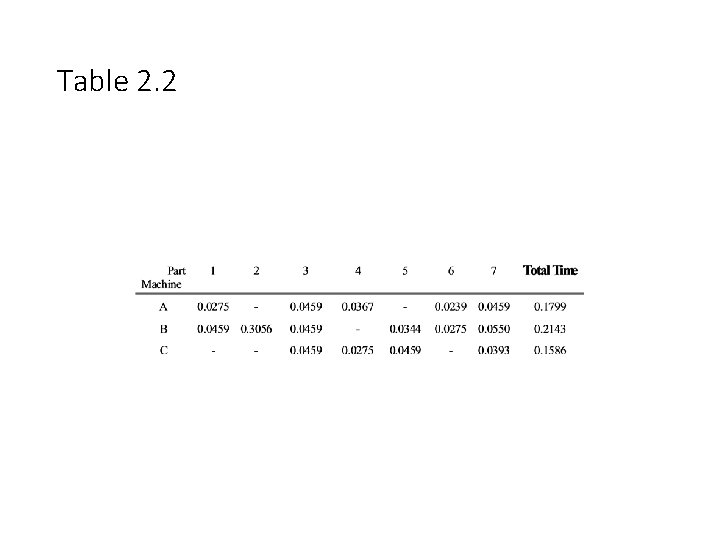
Simple example 1. Consider a simple jobshop manufacturing system that makes three major “Class A” products requiring five types of machines. The three products include seven parts shown in Table 2. 1 also shows the time standards in units per hour. 2. Assume we an hour has only 55 minutes of productive time and that 5 minutes are lost due to operator or machine unavailability and machine downtime. 3. Dividing the value 55 by the values in Table 2. 1, we get the as well as time per unit. 4. Determine the quantities of machines of each type required to make the standard time per unit. 5. Assuming 12000 “representative” parts are to be made and that only 440 minutes of productive time is available per shift, we can find that we need 4. 9 units of machine A, 5. 85 units of machine B, and 4. 3 units of machine C. 6. Rounding up these numbers gives us 5, 6, and 5 units of machine types A, B, and C, respectively.
Table 2. 1
Table 2. 2
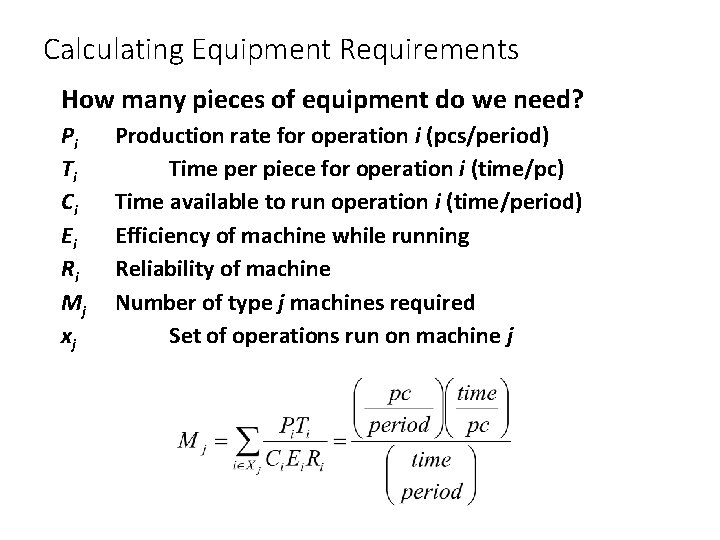
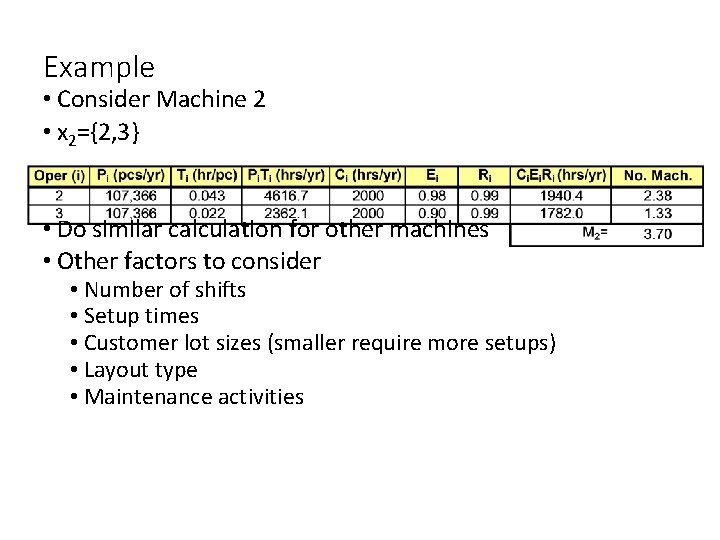
Calculating Equipment Requirements How many pieces of equipment do we need? Pi Ti Ci Ei Ri Mj xj Production rate for operation i (pcs/period) Time per piece for operation i (time/pc) Time available to run operation i (time/period) Efficiency of machine while running Reliability of machine Number of type j machines required Set of operations run on machine j
Example • Consider Machine 2 • x 2={2, 3} • Do similar calculation for other machines • Other factors to consider • Number of shifts • Setup times • Customer lot sizes (smaller require more setups) • Layout type • Maintenance activities
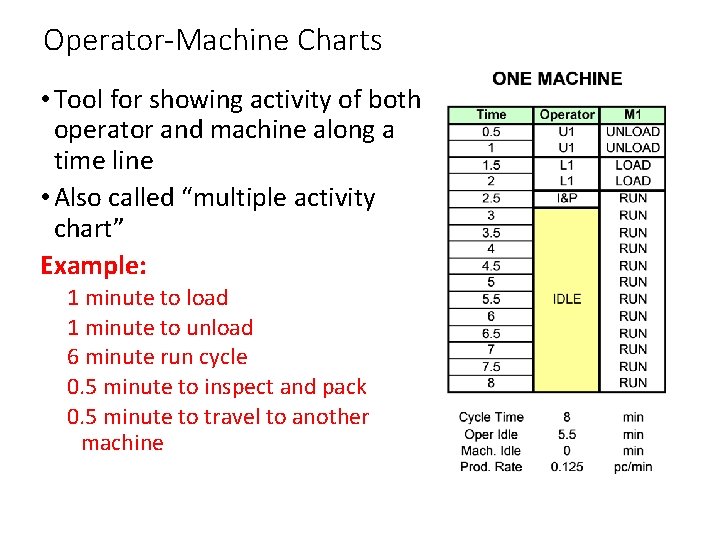
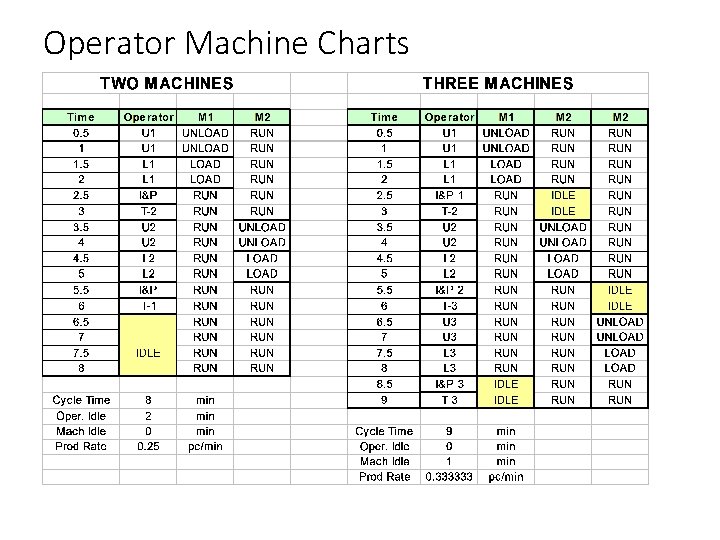
Operator-Machine Charts • Tool for showing activity of both operator and machine along a time line • Also called “multiple activity chart” Example: 1 minute to load 1 minute to unload 6 minute run cycle 0. 5 minute to inspect and pack 0. 5 minute to travel to another machine
Operator Machine Charts
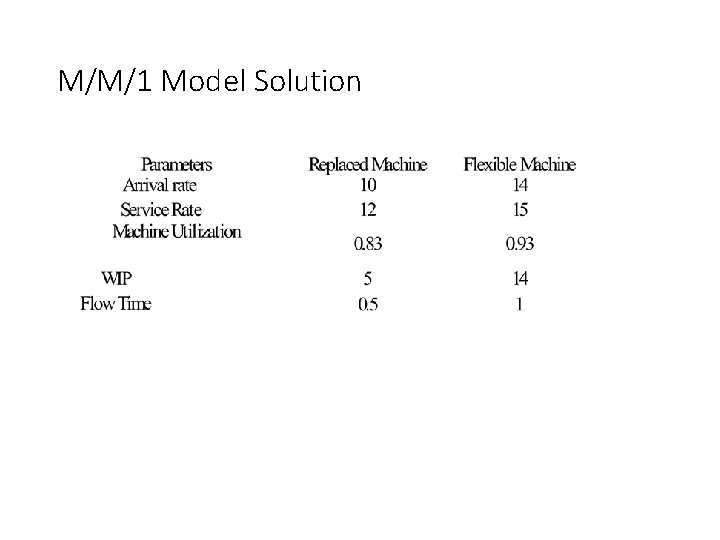
Queuing Model Manufacturing engineers at the Widget Manufacturing Company recently convinced their manger to purchase a more expensive, but flexible machine that can do multiple operations simultaneously. The rate at which parts arrived at the old machine followed a Poisson process with a mean of 10 parts per hour. The service rate of the flexible machine is 15 units parts per hour compared with the 12 units per hour service rate of the machine it replaced. (All service times follow an exponential distribution. )
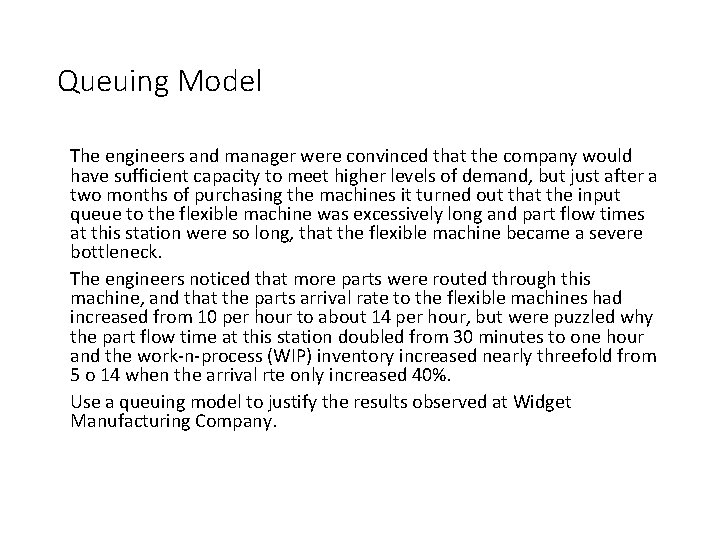
Queuing Model The engineers and manager were convinced that the company would have sufficient capacity to meet higher levels of demand, but just after a two months of purchasing the machines it turned out that the input queue to the flexible machine was excessively long and part flow times at this station were so long, that the flexible machine became a severe bottleneck. The engineers noticed that more parts were routed through this machine, and that the parts arrival rate to the flexible machines had increased from 10 per hour to about 14 per hour, but were puzzled why the part flow time at this station doubled from 30 minutes to one hour and the work-n-process (WIP) inventory increased nearly threefold from 5 o 14 when the arrival rte only increased 40%. Use a queuing model to justify the results observed at Widget Manufacturing Company.
M/M/1 Model Solution
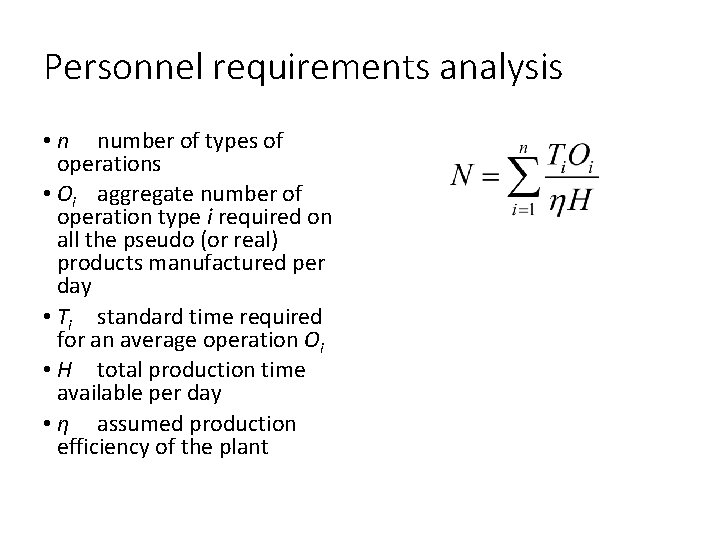
Personnel requirements analysis • n number of types of operations • Oi aggregate number of operation type i required on all the pseudo (or real) products manufactured per day • Ti standard time required for an average operation Oi • H total production time available per day • η assumed production efficiency of the plant
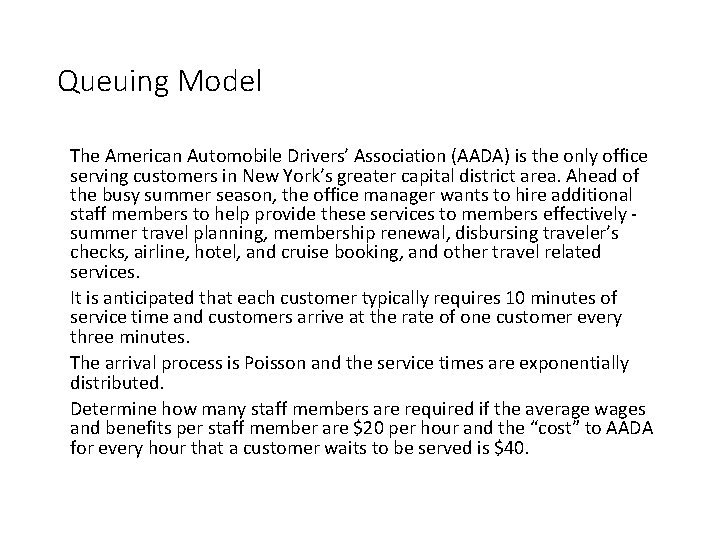
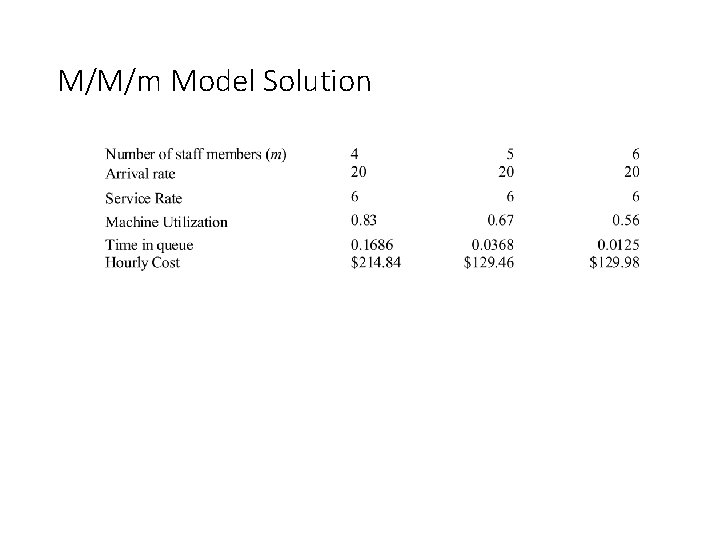
Queuing Model The American Automobile Drivers’ Association (AADA) is the only office serving customers in New York’s greater capital district area. Ahead of the busy summer season, the office manager wants to hire additional staff members to help provide these services to members effectively summer travel planning, membership renewal, disbursing traveler’s checks, airline, hotel, and cruise booking, and other travel related services. It is anticipated that each customer typically requires 10 minutes of service time and customers arrive at the rate of one customer every three minutes. The arrival process is Poisson and the service times are exponentially distributed. Determine how many staff members are required if the average wages and benefits per staff member are $20 per hour and the “cost” to AADA for every hour that a customer waits to be served is $40.
M/M/m Model Solution
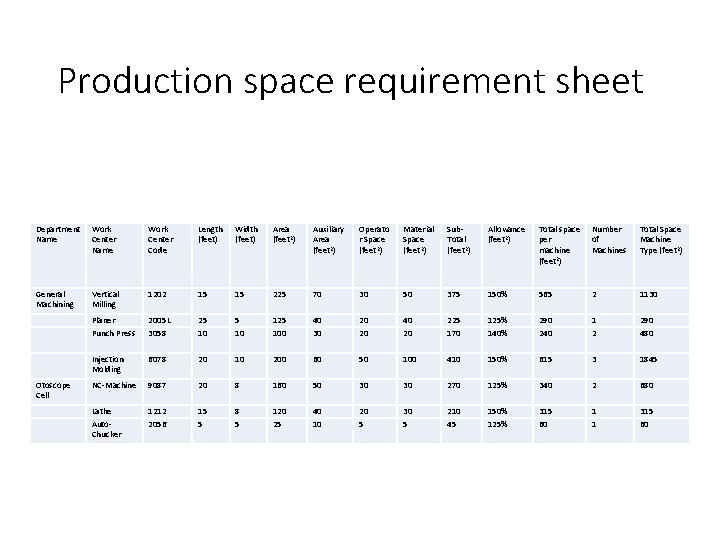
Production space requirement sheet Department Name Work Center Code Length (feet) Width (feet) Area (feet 2) Auxiliary Area (feet 2) Operato r Space (feet 2) Material Space (feet 2) Sub. Total (feet 2) Allowance (feet 2) Total space per machine (feet 2) Number of Machines Total Space Machine Type (feet 2) General Machining Vertical Milling 1202 15 15 225 70 30 50 375 150% 565 2 1130 Planer Punch Press 2005 L 3058 25 10 125 100 40 30 20 20 40 20 225 170 125% 140% 290 240 1 2 290 480 Injection Molding 6078 20 10 200 60 50 100 410 150% 615 3 1845 NC-Machine 9087 20 8 160 50 30 30 270 125% 340 2 680 Lathe Auto. Chucker 1212 2056 15 5 8 5 120 25 40 10 20 5 30 5 210 45 150% 125% 315 60 1 1 315 60 Otoscope Cell