
Product and Distribution Strategies http www wileybusinessupdates com
Product and Distribution Strategies http: //www. wileybusinessupdates. com Chapter 12 Copyright 2017 John Wiley & Sons, Inc.
Learning Objectives 2 1 2 3 4 Explain production strategy. 5 Explain wholesaling. Briefly describe the four stages of the product life cycle. 6 Describe retailing. Discuss production identification. Outline the major components of an effective production strategy. 7 Identify distribution channel decisions and logistics. Copyright (c) 2017 John Wiley & Sons, Inc.
Product Strategy 3 Product - a bundle of physical, service, and symbolic characteristics designed to satisfy consumer wants Product Categories: � Convenience products- items the consumer seeks to purchase frequently, immediately, and with little effort � Shopping products- typically purchased only after the buyer has compared competing products in competing stores � Specialty products- items a purchaser is willing to make a special effort to obtain � d. Unsought products are goods and services that consumers either do not know about or know about but don’t think of buying until a need arises. Copyright (c) 2017 John Wiley & Sons, Inc.
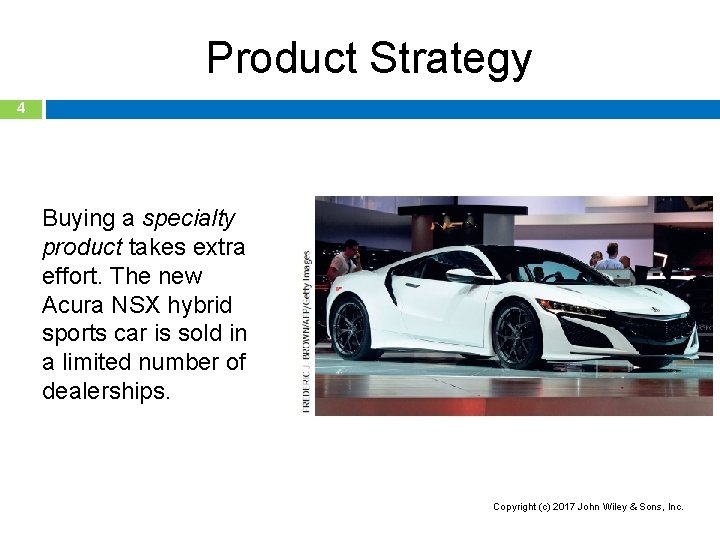
Product Strategy 4 Buying a specialty product takes extra effort. The new Acura NSX hybrid sports car is sold in a limited number of dealerships. Copyright (c) 2017 John Wiley & Sons, Inc.
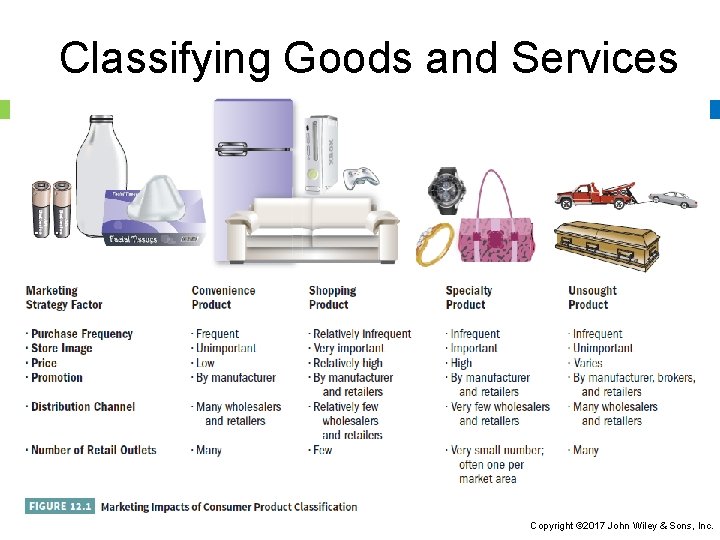
Classifying Goods and Services 5 Copyright © 2017 John Wiley & Sons, Inc.
Classifying Business Goods 6 Capital versus Expense Items � Installations- major capital items such as new factories, heavy equipment and machinery, and custom-made equipment � Accessory equipment- includes less expensive and shorter-lived capital items than installations and involves fewer decision makers � Component parts and materials- become part of a final product � Raw materials- farm and natural products used in producing other final products � Supplies- expense items used in a firm’s daily operations that do not become part of the final product Copyright (c) 2017 John Wiley & Sons, Inc.
Classifying Services 7 Services are different from goods � Intangible � Perishable � Difficult to standardize � Service provider is the service Copyright (c) 2017 John Wiley & Sons, Inc.
Marketing Strategy Implications 8 In B 2 B there is a greater emphasis on personal selling for installations and many component parts and a concentration on quality and customer service. Producers of installations and component parts may involve customers in new-product development. Advertising is more commonly used to sell supplies and accessory equipment. Producers of supplies and accessory equipment place a greater emphasis on competitive pricing strategies. Copyright (c) 2017 John Wiley & Sons, Inc.
Product Lines and Product Mix 9 Product Line – a group of related products marked by physical similarities or intended for a similar market Product mix - assortment of product lines and individual goods and services a firm offers to consumers and business users Copyright (c) 2017 John Wiley & Sons, Inc.
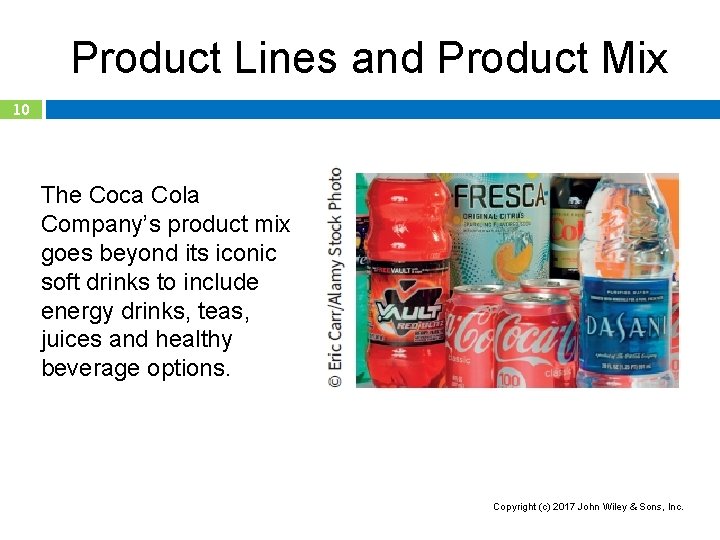
Product Lines and Product Mix 10 The Coca Cola Company’s product mix goes beyond its iconic soft drinks to include energy drinks, teas, juices and healthy beverage options. Copyright (c) 2017 John Wiley & Sons, Inc.
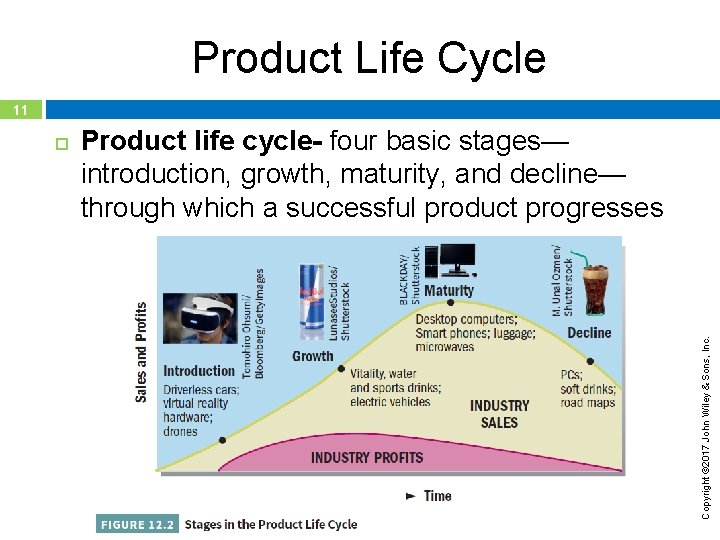
Product Life Cycle 11 Product life cycle- four basic stages— introduction, growth, maturity, and decline— through which a successful product progresses Copyright © 2017 John Wiley & Sons, Inc.
Stages of the Product Life Cycle 12 Introduction stage– firm promotes demand for its new offering; informs the market about it; gives free samples to entice consumers to make a trial purchase; and explains its features, uses, and benefits. Growth stage- sales climb quickly as new customers join early users who are repurchasing the item. company begins to earn profits on the new product Maturity stage- industry sales eventually reach a saturation level at which further expansion is difficult. Decline stage- sales fall and profits decline. Copyright (c) 2017 John Wiley & Sons, Inc.
Implications of the Product Life Cycle 13 Marketer’s objective is to extend the life cycle as long as product is profitable. Marketers’ goals: � Increasing customers’ frequency of use � Adding new users � Finding new uses for product � Changing package sizes, labels, and product designs Copyright (c) 2017 John Wiley & Sons, Inc.
Stages in New Product Development 14 Expensive, time-consuming, and risky �Not properly developed and tested �Poorly packaged �Inadequate promotional support or distribution �Do not satisfy a customer need Each step requires a “go or no-go” decision Copyright (c) 2017 John Wiley & Sons, Inc.
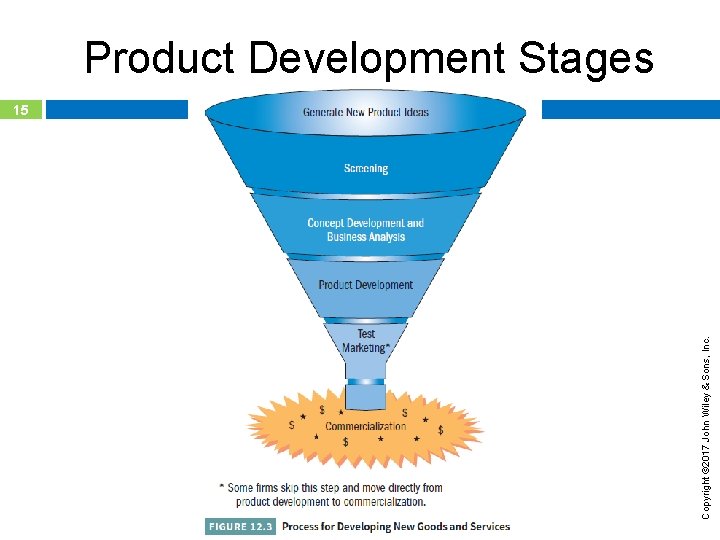
Copyright © 2017 John Wiley & Sons, Inc. Product Development Stages 15
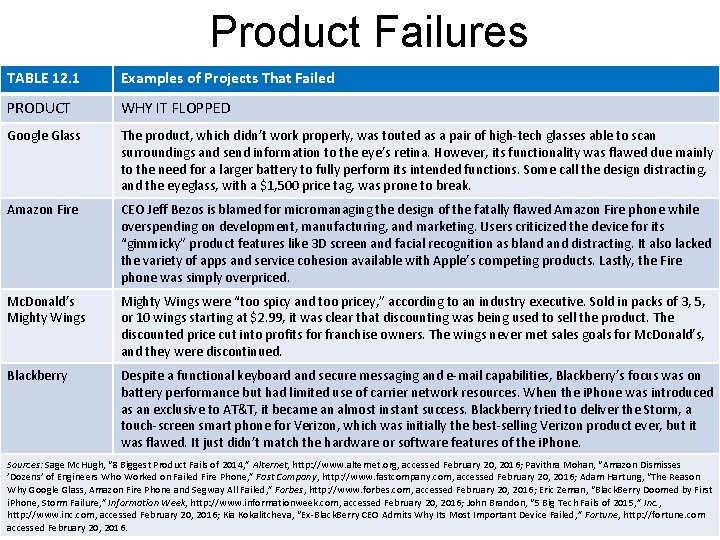
Product Failures TABLE 12. 1 Examples of Projects That Failed PRODUCT 16 WHY IT FLOPPED Google Glass The product, which didn’t work properly, was touted as a pair of high-tech glasses able to scan surroundings and send information to the eye’s retina. However, its functionality was flawed due mainly to the need for a larger battery to fully perform its intended functions. Some call the design distracting, and the eyeglass, with a $1, 500 price tag, was prone to break. Amazon Fire CEO Jeff Bezos is blamed for micromanaging the design of the fatally flawed Amazon Fire phone while overspending on development, manufacturing, and marketing. Users criticized the device for its “gimmicky” product features like 3 D screen and facial recognition as bland distracting. It also lacked the variety of apps and service cohesion available with Apple’s competing products. Lastly, the Fire phone was simply overpriced. Mc. Donald’s Mighty Wings were “too spicy and too pricey, ” according to an industry executive. Sold in packs of 3, 5, or 10 wings starting at $2. 99, it was clear that discounting was being used to sell the product. The discounted price cut into profits for franchise owners. The wings never met sales goals for Mc. Donald’s, and they were discontinued. Blackberry Despite a functional keyboard and secure messaging and e-mail capabilities, Blackberry’s focus was on battery performance but had limited use of carrier network resources. When the i. Phone was introduced as an exclusive to AT&T, it became an almost instant success. Blackberry tried to deliver the Storm, a touch-screen smart phone for Verizon, which was initially the best-selling Verizon product ever, but it was flawed. It just didn’t match the hardware or software features of the i. Phone. Sources: Sage Mc. Hugh, “ 8 Biggest Product Fails of 2014, ” Alternet, http: //www. alternet. org, accessed February 20, 2016; Pavithra Mohan, “Amazon Dismisses ’Dozens’ of Engineers Who Worked on Failed Fire Phone, ” Fast Company, http: //www. fastcompany. com, accessed February 20, 2016; Adam Hartung, “The Reason Why Google Glass, Amazon Fire Phone and Segway All Failed, ” Forbes, http: //www. forbes. com, accessed February 20, 2016; Eric Zeman, “Black. Berry Doomed by First i. Phone, Storm Failure, ” Information Week, http: //www. informationweek. com, accessed February 20, 2016; John Brandon, “ 5(c) Big 2017 Tech. John Fails of 2015, ” Inc. , Inc. Copyright Wiley & Sons, http: //www. inc. com, accessed February 20, 2016; Kia Kokalitcheva, “Ex-Black. Berry CEO Admits Why Its Most Important Device Failed, ” Fortune, http: //fortune. com accessed February 20, 2016.
Product Identification 17 Brand - name, term, sign, symbol, design, or some combination that identifies the products of one firm and differentiates them from competitors’ offerings Brand name- part of the brand consisting of words or letters included in a name used to identify and distinguish the firm’s offerings from those of competitors. Trademark- brand that has been given legal protection granted solely to the brand’s owner Copyright (c) 2017 John Wiley & Sons, Inc.
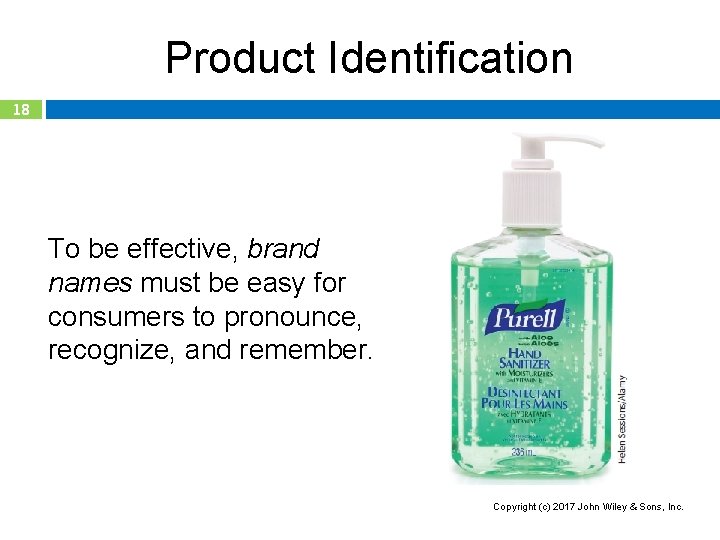
Product Identification 18 To be effective, brand names must be easy for consumers to pronounce, recognize, and remember. Copyright (c) 2017 John Wiley & Sons, Inc.
Brand Categories 19 Manufacturer’s brand- brand offered and promoted by a manufacturer. Examples: Tide, Cheerios, Windex, Fossil, and Nike. Private or store brand- brand that is not linked to the manufacturer but instead carries a wholesaler’s or retailer’s label. Examples: Sears’ Die. Hard batteries and Walmart’s Ol’Roy dog food. Family branding strategy- a single brand name used for several related products. Examples: Kitchen. Aid, Johnson & Johnson, Hewlett-Packard, and Arm & Hammer. Individual branding strategy- giving each product within a line a different name. Examples: Procter & Gamble products Tide, Cheer, and Dash Copyright (c) 2017 John Wiley & Sons, Inc.
Brand Loyalty 20 Brand recognition- consumer is aware of the brand but does not have a preference for it over other brands Brand preference- consumer chooses one firm’s brand over a competitor’s Brand insistence- consumer will seek out preferred brand accept no substitute for it (the ultimate degree of brand loyalty) Copyright (c) 2017 John Wiley & Sons, Inc.
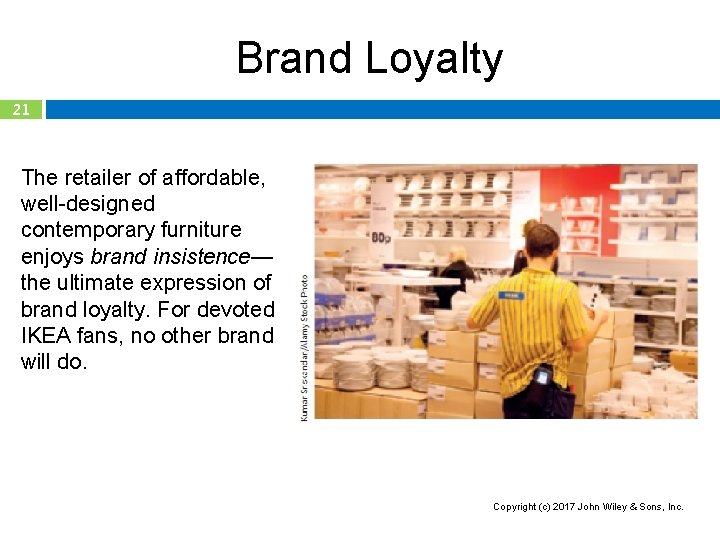
Brand Loyalty 21 The retailer of affordable, well-designed contemporary furniture enjoys brand insistence— the ultimate expression of brand loyalty. For devoted IKEA fans, no other brand will do. Copyright (c) 2017 John Wiley & Sons, Inc.
Brand Equity 22 Brand equity- added value that a respected and successful name gives to a product Brand awareness- product is the first one that comes to mind when a product category is mentioned Copyright (c) 2017 John Wiley & Sons, Inc.
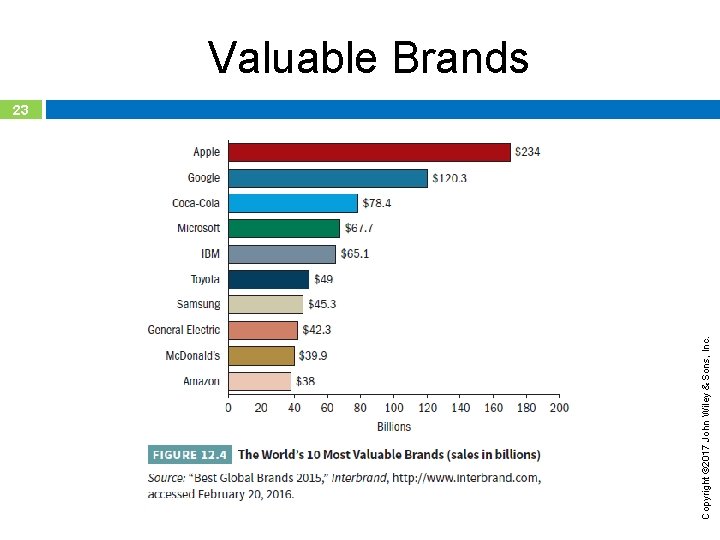
Copyright © 2017 John Wiley & Sons, Inc. Valuable Brands 23
Packages and Labels 24 Packaging affects the durability, image, and convenience of an item and is responsible for one of the biggest costs in many consumer products. Packing is important in product identification and play is an important role in a firm’s overall product strategy. Choosing the right package is especially important in international marketing. Packing must meet legal requirements of all countries in which product is sold. Universal Product Code- bar code read by optical scanner Environmental impact of packaging– Sun Chips Copyright (c) 2017 John Wiley & Sons, Inc.
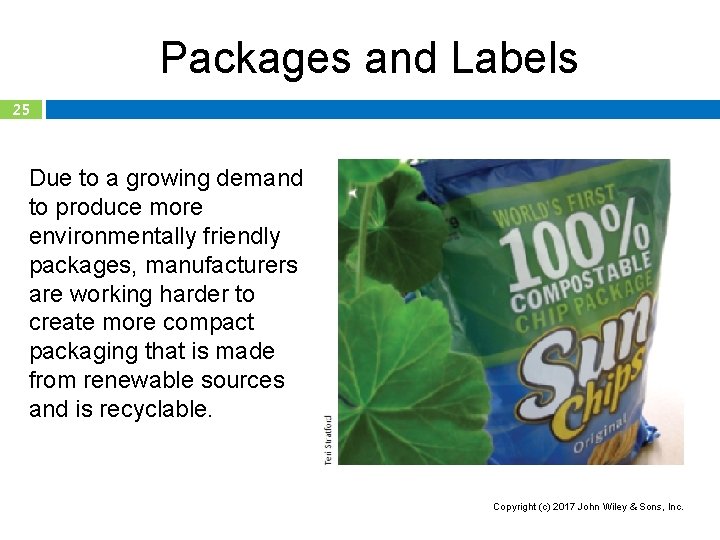
Packages and Labels 25 Due to a growing demand to produce more environmentally friendly packages, manufacturers are working harder to create more compact packaging that is made from renewable sources and is recyclable. Copyright (c) 2017 John Wiley & Sons, Inc.
Distribution Strategy 26 Distribution channel: path through which products—and legal ownership of them— flow from producer to consumers or business users Physical distribution: actual movement of products from producer to consumers or business users Copyright (c) 2017 John Wiley & Sons, Inc.
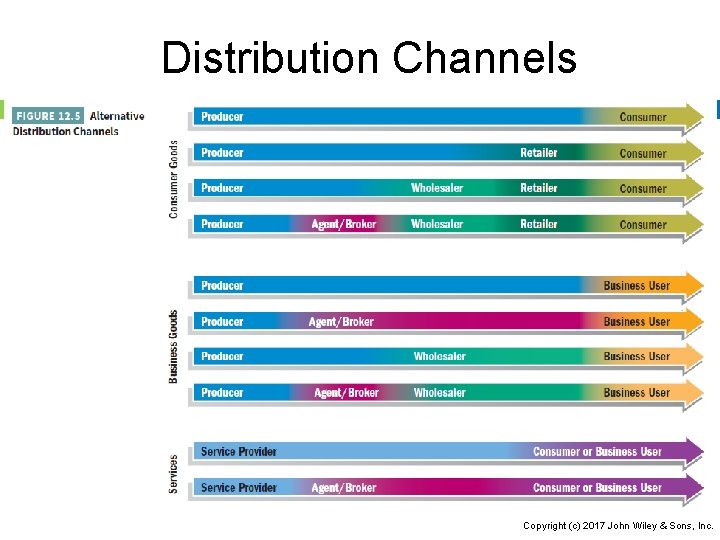
Distribution Channels 27 Copyright (c) 2017 John Wiley & Sons, Inc.
Distribution Channels Using Marketing Intermediaries 28 Direct Distribution � Direct contact between producer and customer. � Most common in B 2 B markets. � Often found in the marketing of relatively expensive, complex products that may require demonstrations. � Internet is helping companies distribute directly to consumer market. Distribution Channels Using Marketing Intermediaries � Producers distribute products through wholesalers and retailers. � Inexpensive products sold to thousands of consumers in widely scattered locations. � Lowers costs of goods to consumers by creating market utility Copyright (c) 2017 John Wiley & Sons, Inc.

Copyright (c) 2017 John Wiley & Sons, Inc. Marketing Intermediaries 29
Wholesaling 30 Wholesaler - distribution channel member that sells primarily to retailers, other wholesalers, or business users Manufacturer-Owned Wholesaling Intermediaries � Owned by the manufacturer of the goods or products to control distribution or customer service � Sales branch that stocks products and fills orders from inventories � Sales office that takes orders but does not stock the product Copyright (c) 2017 John Wiley & Sons, Inc.
Retailers 31 Retailer – channel member that sells goods and services to individuals for their own use rather than for resale Final link of the distribution channel Two types: � Store � Nonstore Copyright (c) 2017 John Wiley & Sons, Inc.
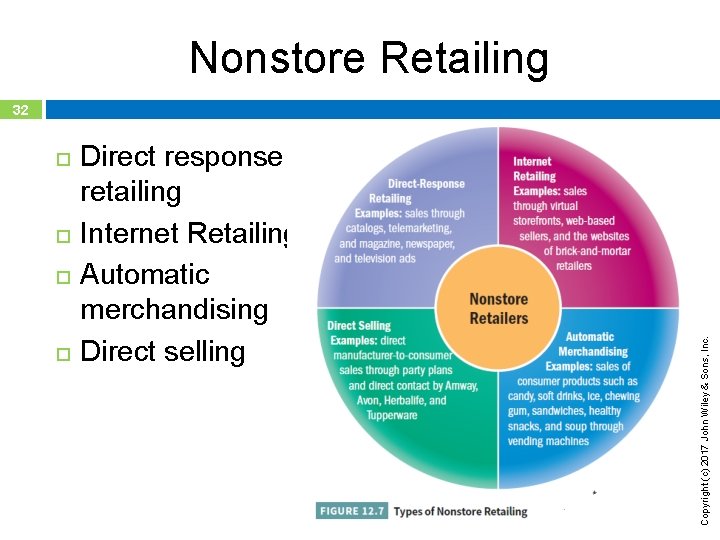
Nonstore Retailing Direct response retailing Internet Retailing Automatic merchandising Direct selling Copyright (c) 2017 John Wiley & Sons, Inc. 32
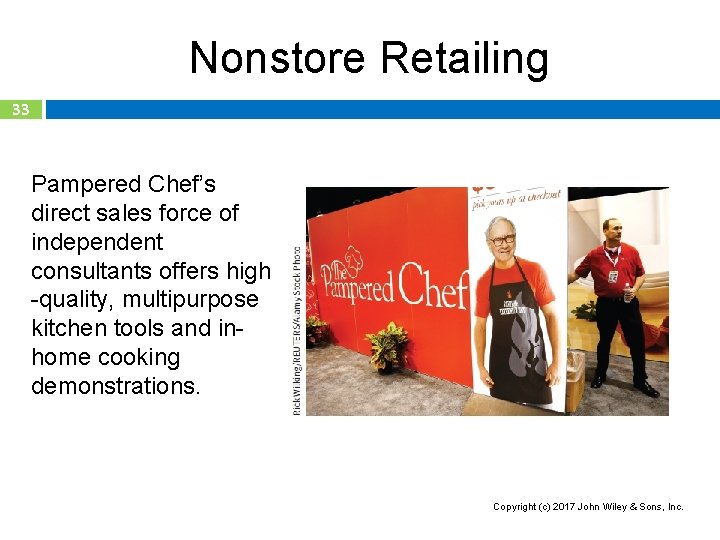
Nonstore Retailing 33 Pampered Chef’s direct sales force of independent consultants offers high -quality, multipurpose kitchen tools and inhome cooking demonstrations. Copyright (c) 2017 John Wiley & Sons, Inc.
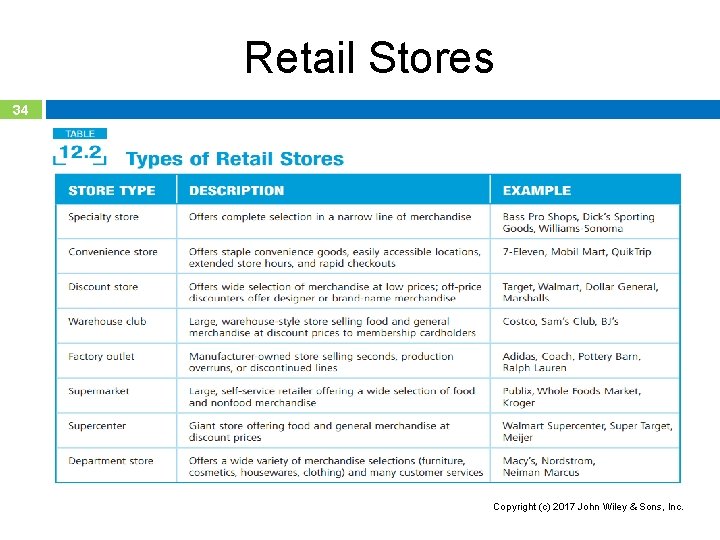
Retail Stores 34 Copyright (c) 2017 John Wiley & Sons, Inc.
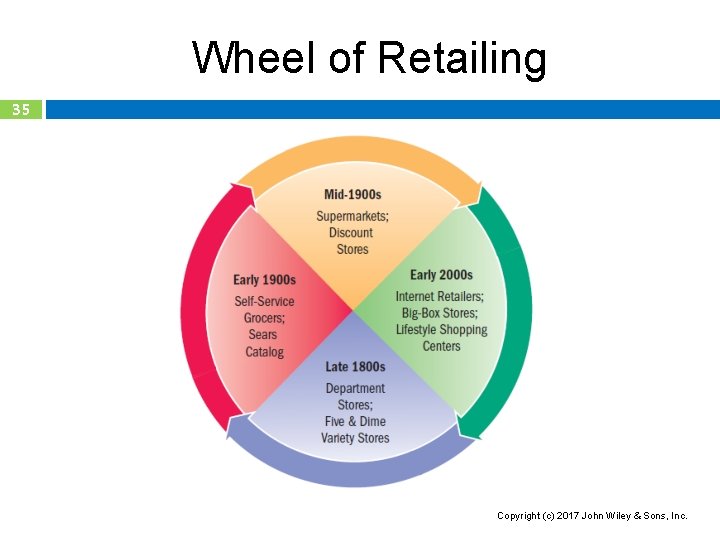
Wheel of Retailing 35 Copyright (c) 2017 John Wiley & Sons, Inc.
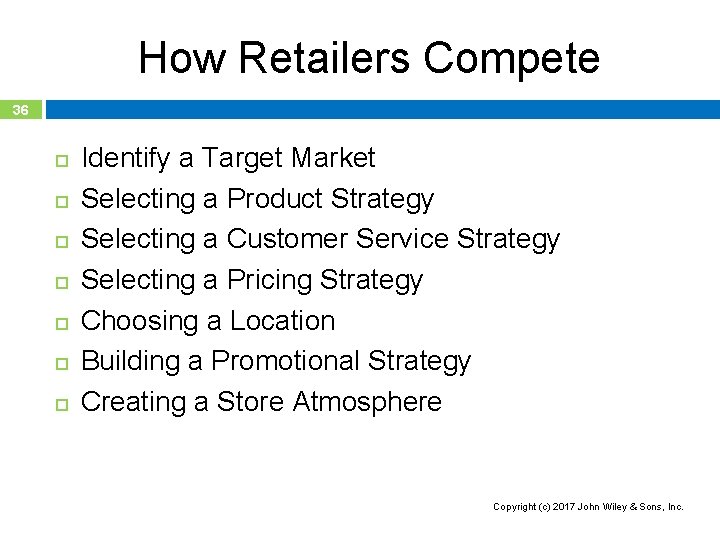
How Retailers Compete 36 Identify a Target Market Selecting a Product Strategy Selecting a Customer Service Strategy Selecting a Pricing Strategy Choosing a Location Building a Promotional Strategy Creating a Store Atmosphere Copyright (c) 2017 John Wiley & Sons, Inc.
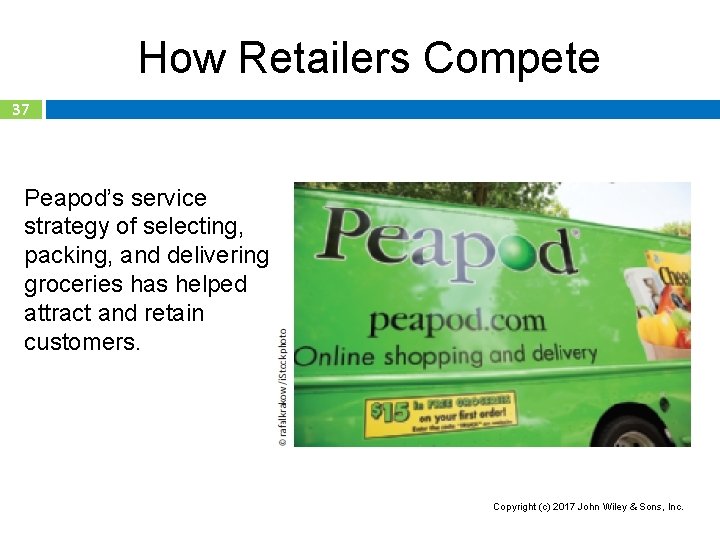
How Retailers Compete 37 Peapod’s service strategy of selecting, packing, and delivering groceries has helped attract and retain customers. Copyright (c) 2017 John Wiley & Sons, Inc.
Retail Locations 38 For a retailer, a good location can make the difference between success and failure Location depends upon the retailer’s size, financial resources, product, competition, and target market. � Planned Shopping Center � Shopping Mall � Regional Mall � Lifestyle Mall Copyright (c) 2017 John Wiley & Sons, Inc.
Distribution Channel Decisions and Logistics 39 What specific channel will it use? What will be the level of distribution intensity? Selecting Distribution Channels � Complex, expensive, custom-made, or perishable products move through shorter distribution channels involving few—or no—intermediaries. � Standardized products or items with low unit values usually pass through relatively long distribution channels. � Start-up companies often use direct channels because they can’t persuade intermediaries to carry their products, or because they want to extend their sales reach. Copyright (c) 2017 John Wiley & Sons, Inc.
Distribution Intensity 40 Intensive distribution – firm’s products in nearly every available outlet; requires cooperation of many intermediaries Selective Distribution – manufacturer selects limited number of retailers to distribute its product lines Exclusive distribution – limits market coverage in a specific geographic region Copyright (c) 2017 John Wiley & Sons, Inc.
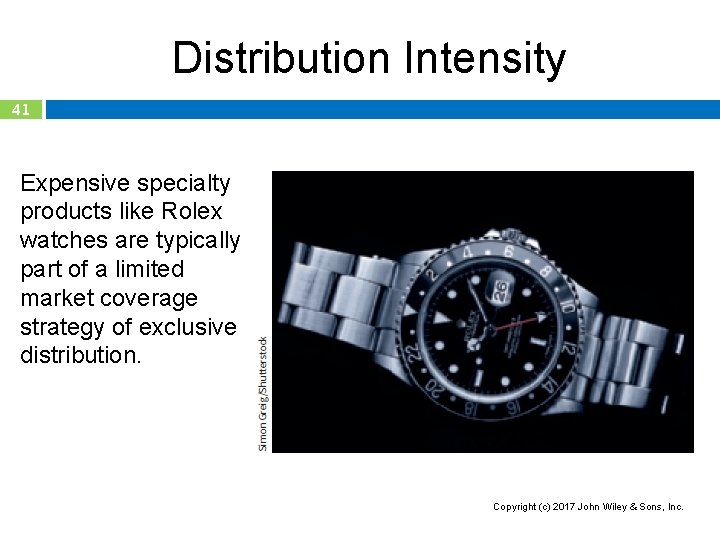
Distribution Intensity 41 Expensive specialty products like Rolex watches are typically part of a limited market coverage strategy of exclusive distribution. Copyright (c) 2017 John Wiley & Sons, Inc.
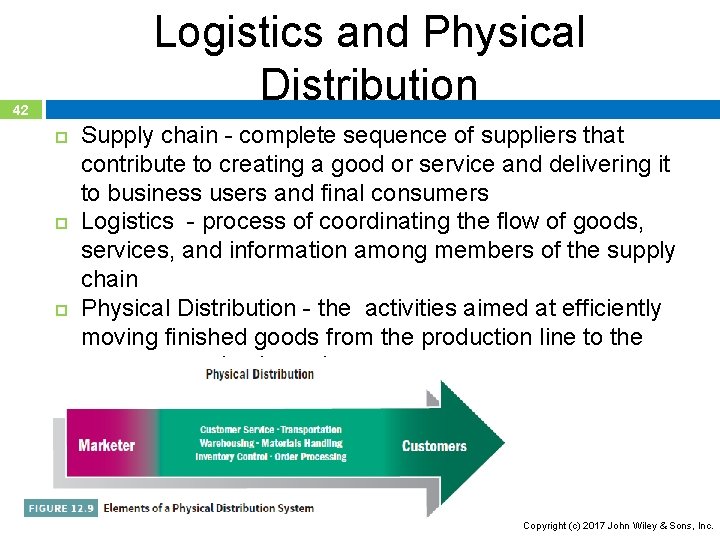
Logistics and Physical Distribution 42 Supply chain - complete sequence of suppliers that contribute to creating a good or service and delivering it to business users and final consumers Logistics - process of coordinating the flow of goods, services, and information among members of the supply chain Physical Distribution - the activities aimed at efficiently moving finished goods from the production line to the consumer or business buyer Copyright (c) 2017 John Wiley & Sons, Inc.
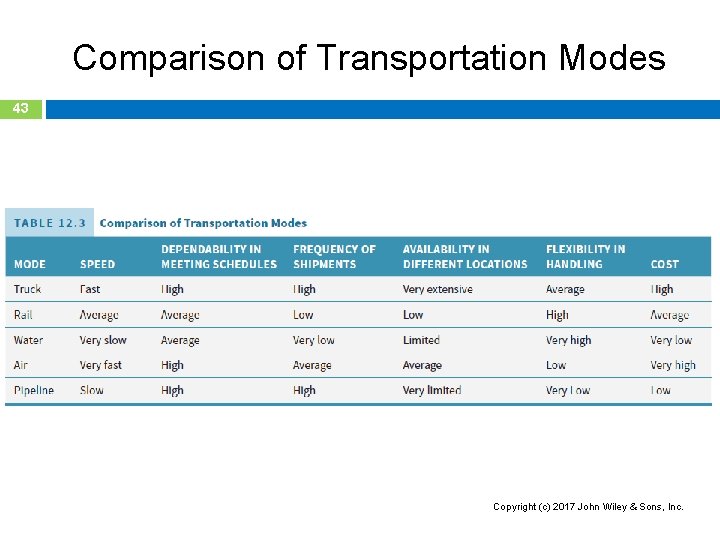
Comparison of Transportation Modes 43 Copyright (c) 2017 John Wiley & Sons, Inc.
Customer Service 44 Customer service standards measure the quality of service a firm provides for its customers Warranties are a firm’s promises to repair a defective product, refund money paid, or replace product if it proves unsatisfactory Internet retailers have worked to humanize their customer interactions and deal with customer concerns more effectively Copyright (c) 2017 John Wiley & Sons, Inc.
- Slides: 44