
Procurements Value Proposition Kurt Albertson Principal Procurement Advisory

Procurement’s Value Proposition Kurt Albertson Principal, Procurement Advisory May 9 th, 2016
Areas to explore § What is the role and associated priorities for Procurement and how do these evolve? § What is the potential impact of not involving Procurement formally? § What level of value does Procurement deliver? § What are the key capabilities within Procurement and associated trends? © 2015 The Hackett Group, Inc. All rights reserved. Reproduction of this document or any portion thereof without prior written consent is prohibited. 2016 Enterprise Key Issues -PR 2

Role Procurement's role in the organization generally evolves as organizational objectives change Procurement’s Evolving Role + Value Trusted business advisor and change agent Mgmt. VA LU E Demand Management Total Cost of Ownership Price Spend/ budget consultant & relationship manager Supply expert, supplier performance, team leader, project manager Negotiator Supply Assurance © 2015 The Hackett Group, Inc. All rights reserved. Reproduction of this document or any portion thereof without prior written consent is prohibited. Buyer / Planner 2016 Enterprise Key Issues -PR 3
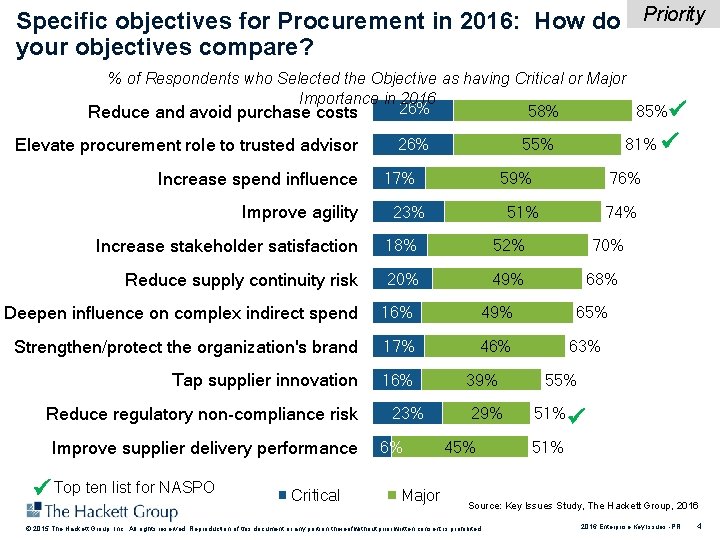
Specific objectives for Procurement in 2016: How do Priority your objectives compare? % of Respondents who Selected the Objective as having Critical or Major Importance in 2016 26% 58% 85% Reduce and avoid purchase costs Elevate procurement role to trusted advisor Increase spend influence Improve agility 26% 17% 59% 23% 18% 52% Reduce supply continuity risk 20% 49% Deepen influence on complex indirect spend 16% 49% Strengthen/protect the organization's brand 17% 46% Tap supplier innovation 16% Improve supplier delivery performance Top ten list for NASPO Critical 23% 6% Major 76% 51% Increase stakeholder satisfaction Reduce regulatory non-compliance risk 81% 55% 74% 70% 68% 65% 63% 39% 55% 29% 51% 45% 51% Source: Key Issues Study, The Hackett Group, 2016 © 2015 The Hackett Group, Inc. All rights reserved. Reproduction of this document or any portion thereof without prior written consent is prohibited. 2016 Enterprise Key Issues -PR 4
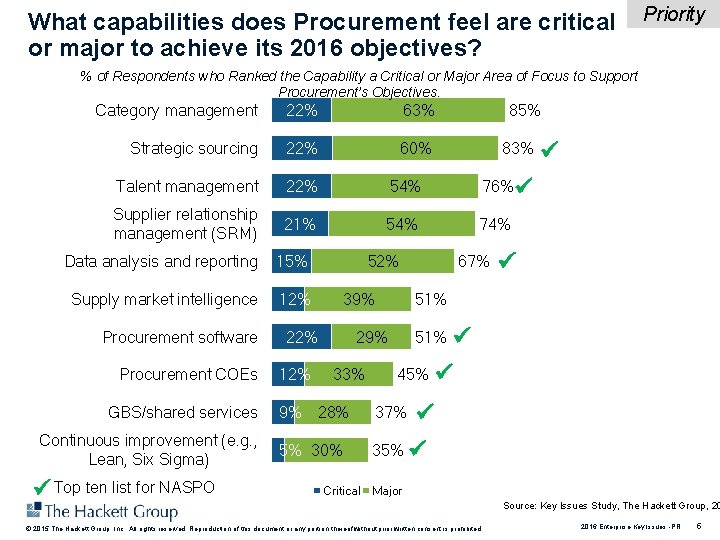
What capabilities does Procurement feel are critical or major to achieve its 2016 objectives? Priority % of Respondents who Ranked the Capability a Critical or Major Area of Focus to Support Procurement’s Objectives. Category management 22% 63% Strategic sourcing 22% 60% Talent management 22% 54% 76% Supplier relationship management (SRM) 21% 54% 74% Data analysis and reporting 15% Supply market intelligence 12% Procurement software Procurement COEs GBS/shared services Continuous improvement (e. g. , Lean, Six Sigma) Top ten list for NASPO 83% 52% 39% 22% 12% 85% 51% 29% 33% 67% 51% 45% 9% 28% 37% 5% 30% 35% Critical Major © 2015 The Hackett Group, Inc. All rights reserved. Reproduction of this document or any portion thereof without prior written consent is prohibited. Source: Key Issues Study, The Hackett Group, 20 2016 Enterprise Key Issues -PR 5
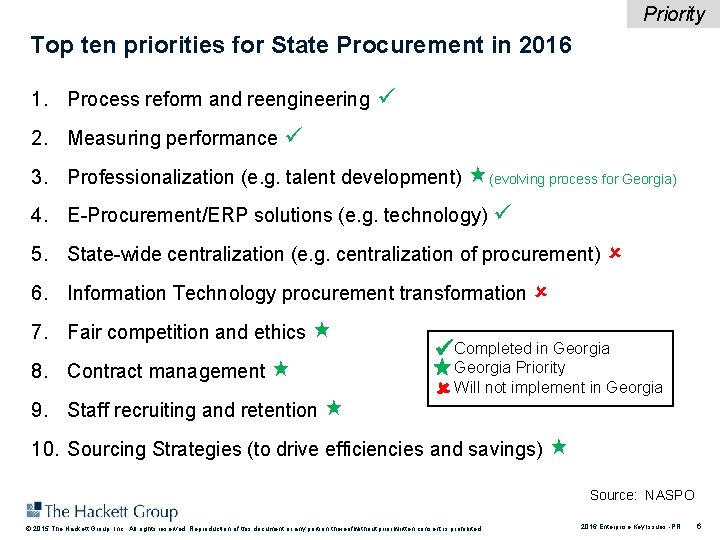
Priority Top ten priorities for State Procurement in 2016 1. Process reform and reengineering 2. Measuring performance 3. Professionalization (e. g. talent development) (evolving process for Georgia) 4. E-Procurement/ERP solutions (e. g. technology) 5. State-wide centralization (e. g. centralization of procurement) 6. Information Technology procurement transformation 7. Fair competition and ethics 8. Contract management 9. Staff recruiting and retention Completed in Georgia Priority Will not implement in Georgia 10. Sourcing Strategies (to drive efficiencies and savings) Source: NASPO © 2015 The Hackett Group, Inc. All rights reserved. Reproduction of this document or any portion thereof without prior written consent is prohibited. 2016 Enterprise Key Issues -PR 6
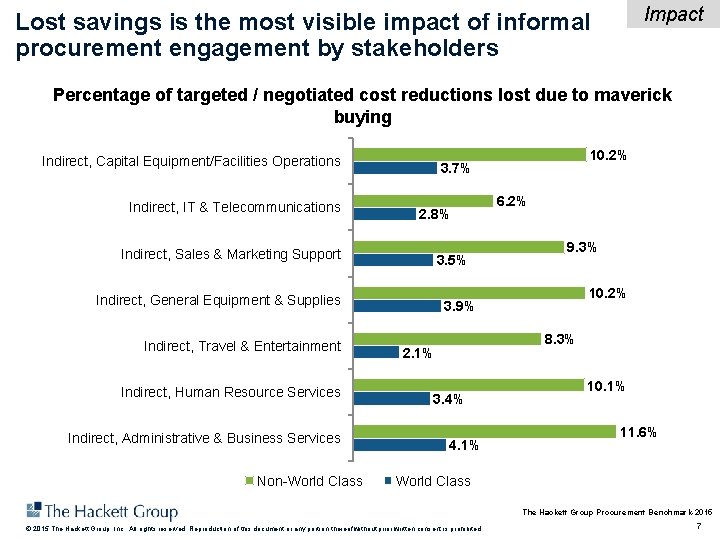
Impact Lost savings is the most visible impact of informal procurement engagement by stakeholders Percentage of targeted / negotiated cost reductions lost due to maverick buying Indirect, Capital Equipment/Facilities Operations Indirect, IT & Telecommunications 3. 7% 2. 8% Indirect, Sales & Marketing Support 3. 5% Indirect, General Equipment & Supplies Indirect, Travel & Entertainment Indirect, Human Resource Services Indirect, Administrative & Business Services Non-World Class 10. 2% 6. 2% 9. 3% 10. 2% 3. 9% 8. 3% 2. 1% 3. 4% 4. 1% 10. 1% 11. 6% World Class The Hackett Group Procurement Benchmark-2015 © 2015 The Hackett Group, Inc. All rights reserved. Reproduction of this document or any portion thereof without prior written consent is prohibited. 7
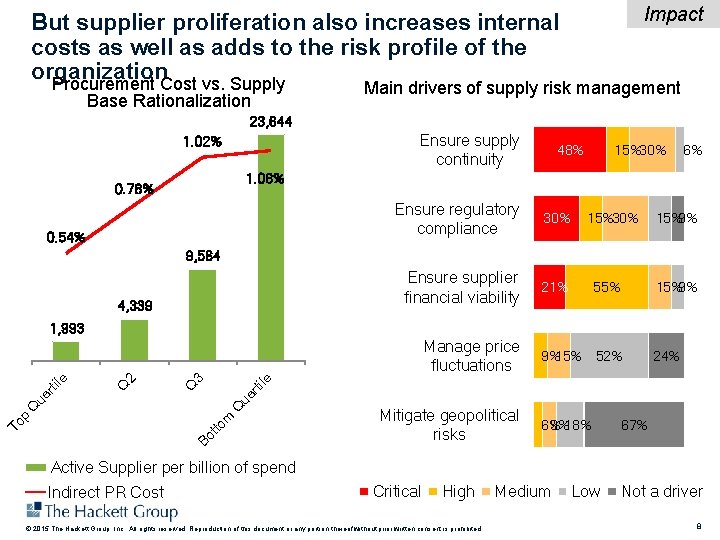
Impact But supplier proliferation also increases internal costs as well as adds to the risk profile of the organization Procurement Cost vs. Supply Main drivers of supply risk management Base Rationalization 23, 644 Ensure supply continuity 1. 02% 48% 15%30% 6% 1. 06% 0. 78% 0. 54% Ensure regulatory compliance 30% Ensure supplier financial viability 21% 15%30% 15%9% 9, 564 4, 339 55% 15%9% 1, 993 24% ua rti Q m p Bo tto To 9%15% 52% le 3 Q 2 Q Q ua rti le Manage price fluctuations Mitigate geopolitical risks 6% 9%18% 67% Active Supplier per billion of spend Indirect PR Cost Critical High © 2015 The Hackett Group, Inc. All rights reserved. Reproduction of this document or any portion thereof without prior written consent is prohibited. Medium Low Not a driver 8
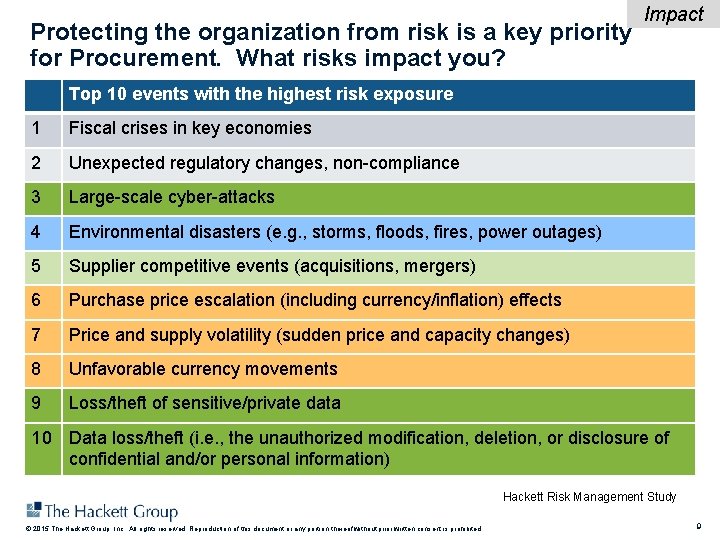
Protecting the organization from risk is a key priority for Procurement. What risks impact you? Impact Top 10 events with the highest risk exposure 1 Fiscal crises in key economies 2 Unexpected regulatory changes, non-compliance 3 Large-scale cyber-attacks 4 Environmental disasters (e. g. , storms, floods, fires, power outages) 5 Supplier competitive events (acquisitions, mergers) 6 Purchase price escalation (including currency/inflation) effects 7 Price and supply volatility (sudden price and capacity changes) 8 Unfavorable currency movements 9 Loss/theft of sensitive/private data 10 Data loss/theft (i. e. , the unauthorized modification, deletion, or disclosure of confidential and/or personal information) Hackett Risk Management Study © 2015 The Hackett Group, Inc. All rights reserved. Reproduction of this document or any portion thereof without prior written consent is prohibited. 9
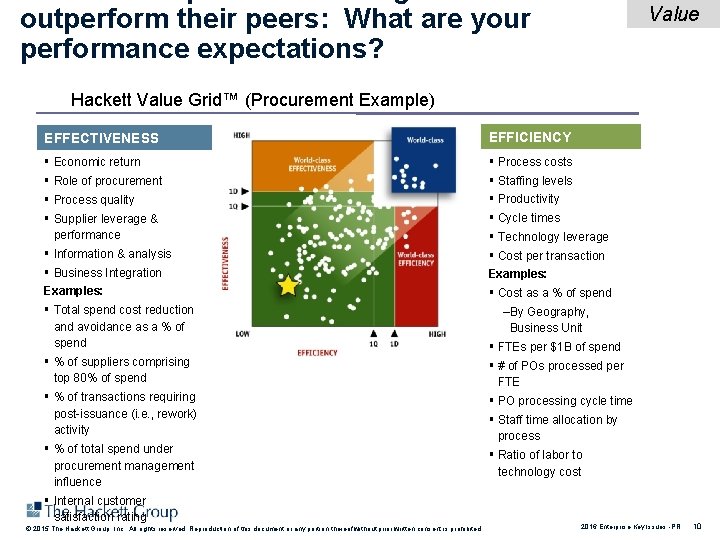
outperform their peers: What are your performance expectations? Value Hackett Value Grid™ (Procurement Example) EFFECTIVENESS EFFICIENCY § Economic return § Role of procurement § Process quality § Supplier leverage & performance § Information & analysis § Business Integration Examples: § Total spend cost reduction and avoidance as a % of spend § % of suppliers comprising top 80% of spend § % of transactions requiring post-issuance (i. e. , rework) activity § % of total spend under procurement management influence § Internal customer satisfaction rating § Process costs § Staffing levels § Productivity § Cycle times § Technology leverage § Cost per transaction Examples: § Cost as a % of spend –By Geography, Business Unit § FTEs per $1 B of spend § # of POs processed per FTE § PO processing cycle time § Staff time allocation by process § Ratio of labor to technology cost © 2015 The Hackett Group, Inc. All rights reserved. Reproduction of this document or any portion thereof without prior written consent is prohibited. 2016 Enterprise Key Issues -PR 10
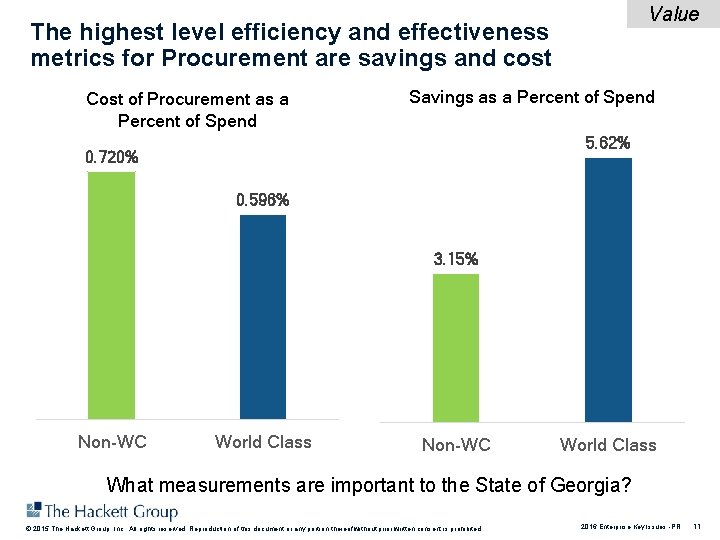
Value The highest level efficiency and effectiveness metrics for Procurement are savings and cost Cost of Procurement as a Percent of Spend Savings as a Percent of Spend 5. 62% 0. 720% 0. 596% 3. 15% Non-WC World Class What measurements are important to the State of Georgia? © 2015 The Hackett Group, Inc. All rights reserved. Reproduction of this document or any portion thereof without prior written consent is prohibited. 2016 Enterprise Key Issues -PR 11
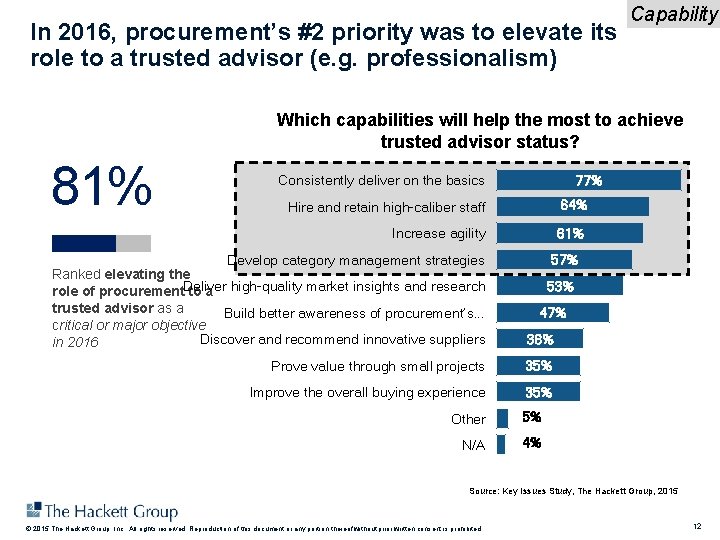
In 2016, procurement’s #2 priority was to elevate its role to a trusted advisor (e. g. professionalism) Capability Which capabilities will help the most to achieve trusted advisor status? 81% Consistently deliver on the basics 77% Hire and retain high-caliber staff 64% Increase agility 61% Develop category management strategies Ranked elevating the role of procurement. Deliver to a high-quality market insights and research trusted advisor as a Build better awareness of procurement’s. . . critical or major objective Discover and recommend innovative suppliers in 2016 57% 36% Prove value through small projects 35% Improve the overall buying experience 35% 53% 47% Other 5% N/A 4% Source: Key Issues Study, The Hackett Group, 2015 © 2015 The Hackett Group, Inc. All rights reserved. Reproduction of this document or any portion thereof without prior written consent is prohibited. 12
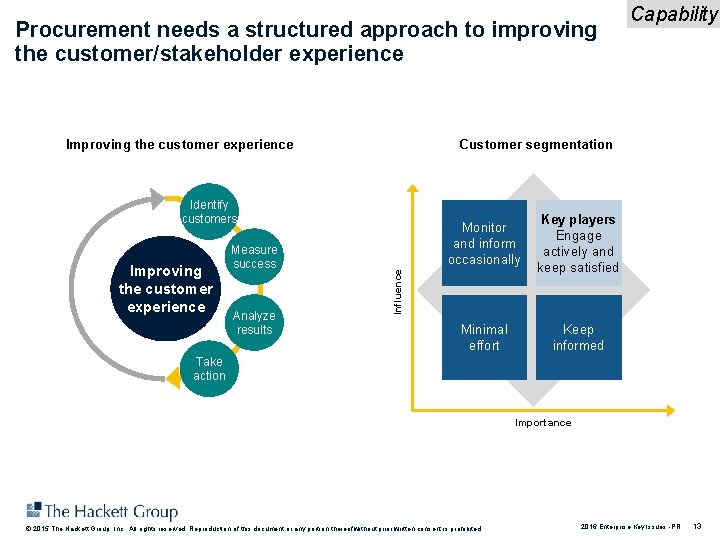
Procurement needs a structured approach to improving the customer/stakeholder experience Improving the customer experience Customer segmentation Improving the customer experience Analyze results Monitor and inform occasionally Key players Engage actively and keep satisfied Minimal effort Keep informed Influence Identify customers Measure success Capability Take action Importance © 2015 The Hackett Group, Inc. All rights reserved. Reproduction of this document or any portion thereof without prior written consent is prohibited. 2016 Enterprise Key Issues -PR 13
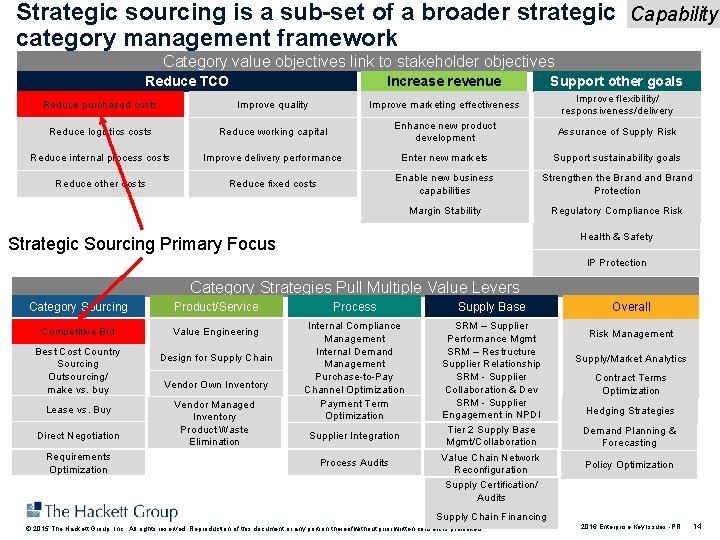
Strategic sourcing is a sub-set of a broader strategic Capability category management framework Category value objectives link to stakeholder objectives Reduce TCO Increase revenue Support other goals Reduce purchased costs Improve quality Improve marketing effectiveness Improve flexibility/ responsiveness/delivery Reduce logistics costs Reduce working capital Enhance new product development Assurance of Supply Risk Reduce internal process costs Improve delivery performance Enter new markets Support sustainability goals Reduce other costs Reduce fixed costs Enable new business capabilities Strengthen the Brand Protection Margin Stability Regulatory Compliance Risk Health & Safety Strategic Sourcing Primary Focus IP Protection Category Strategies Pull Multiple Value Levers Category Sourcing Product/Service Competitive Bid Value Engineering Best Country Sourcing Outsourcing/ make vs. buy Lease vs. Buy Direct Negotiation Requirements Optimization Design for Supply Chain Vendor Own Inventory Vendor Managed Inventory Product Waste Elimination Process Supply Base Internal Compliance Management Internal Demand Management Purchase-to-Pay Channel Optimization Payment Term Optimization SRM – Supplier Performance Mgmt SRM – Restructure Supplier Relationship SRM - Supplier Collaboration & Dev SRM - Supplier Engagement in NPDI Tier 2 Supply Base Mgmt/Collaboration Value Chain Network Reconfiguration Supply Certification/ Audits Supplier Integration Process Audits Overall Risk Management Supply/Market Analytics Contract Terms Optimization Hedging Strategies Demand Planning & Forecasting Policy Optimization Supply Chain Financing © 2015 The Hackett Group, Inc. All rights reserved. Reproduction of this document or any portion thereof without prior written consent is prohibited. 2016 Enterprise Key Issues -PR 14
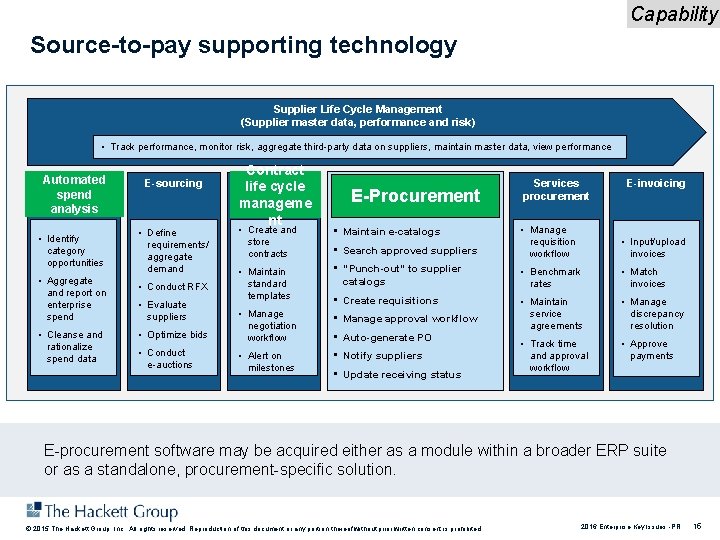
Capability Source-to-pay supporting technology Supplier Life Cycle Management (Supplier master data, performance and risk) • Track performance, monitor risk, aggregate third-party data on suppliers, maintain master data, view performance Automated spend analysis E-sourcing • Identify category opportunities • Define requirements/ aggregate demand analysis • Aggregate and report on enterprise spend • Cleanse and rationalize spend data Contract life cycle management nt E-Procurement • Search approved suppliers • Input/upload invoices • Maintain standard templates • “Punch-out” to supplier catalogs • Benchmark rates • Match invoices • Create requisitions • Manage approval workflow • Optimize bids • Manage negotiation workflow • Maintain service agreements • Manage discrepancy resolution • Conduct e-auctions • Alert on milestones • Notify suppliers • Track time and approval workflow • Approve payments • Evaluate suppliers • Maintain e-catalogs E-invoicing • Manage requisition workflow • Conduct RFX • Create and store contracts Services procurement • Auto-generate PO • Update receiving status E-procurement software may be acquired either as a module within a broader ERP suite or as a standalone, procurement-specific solution. © 2015 The Hackett Group, Inc. All rights reserved. Reproduction of this document or any portion thereof without prior written consent is prohibited. 2016 Enterprise Key Issues -PR 15
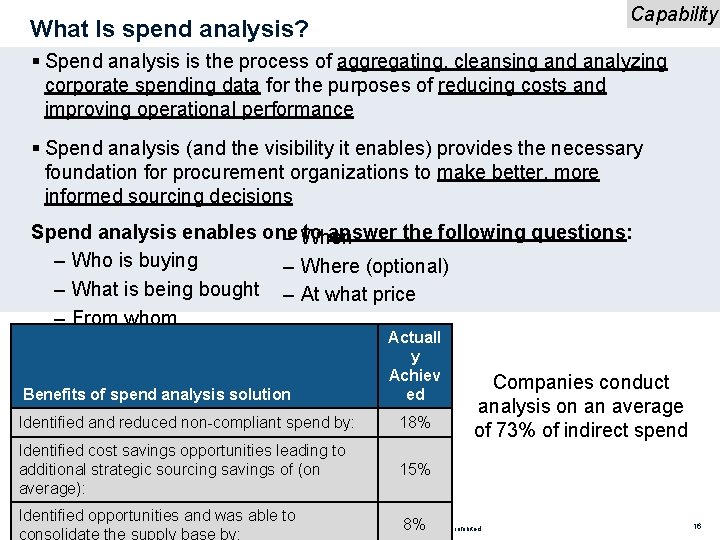
Capability What Is spend analysis? § Spend analysis is the process of aggregating, cleansing and analyzing corporate spending data for the purposes of reducing costs and improving operational performance § Spend analysis (and the visibility it enables) provides the necessary foundation for procurement organizations to make better, more informed sourcing decisions Spend analysis enables one to answer the following questions: – When – Who is buying – Where (optional) – What is being bought – At what price – From whom Benefits of spend analysis solution Actuall y Achiev ed Identified and reduced non-compliant spend by: 18% Identified cost savings opportunities leading to additional strategic sourcing savings of (on average): 15% Companies conduct analysis on an average of 73% of indirect spend Identified opportunities and was able to 8% © 2015 The Hackett Group, Inc. All rights reserved. Reproduction of this document or any portion thereof without prior written consent is prohibited. consolidate the supply base by: 16
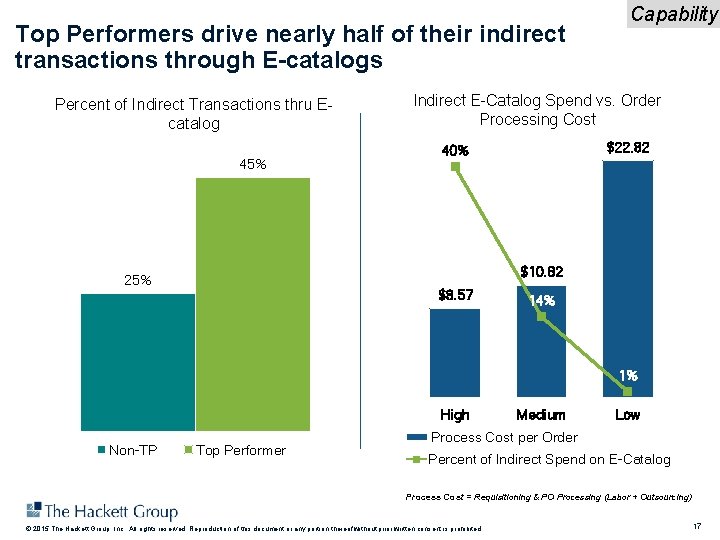
Top Performers drive nearly half of their indirect transactions through E-catalogs Capability Indirect E-Catalog Spend vs. Order Processing Cost Percent of Indirect Transactions thru Ecatalog $25. 00 45% $22. 82 40% 45% 40% $20. 00 35% 30% $15. 00 25% $10. 82 25% $10. 00 $8. 57 20% 14% 15% 10% $5. 00 1% $0. 00 0% High Non-TP Top Performer 5% Medium Low Process Cost per Order Percent of Indirect Spend on E-Catalog Process Cost = Requisitioning & PO Processing (Labor + Outsourcing) © 2015 The Hackett Group, Inc. All rights reserved. Reproduction of this document or any portion thereof without prior written consent is prohibited. 17
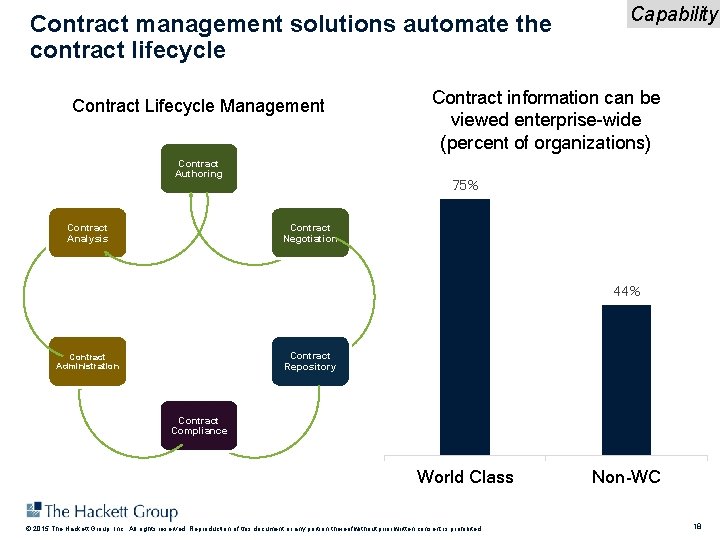
Contract management solutions automate the contract lifecycle Contract Lifecycle Management Contract Authoring Contract Analysis Capability Contract information can be viewed enterprise-wide (percent of organizations) 75% Contract Negotiation 44% Contract Repository Contract Administration Contract Compliance World Class © 2015 The Hackett Group, Inc. All rights reserved. Reproduction of this document or any portion thereof without prior written consent is prohibited. Non-WC 18
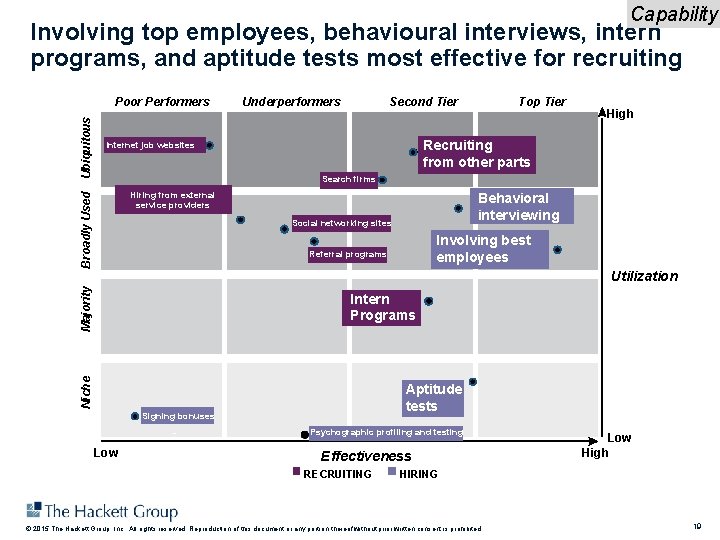
Capability Involving top employees, behavioural interviews, intern programs, and aptitude tests most effective for recruiting Underperformers Second Tier Top Tier High Recruiting from other parts Internet job websites Search firms Hiring from external service providers Broadly Used Ubiquitous Poor Performers Behavioral interviewing Social networking sites Involving best employees Referral programs Majority Utilization Niche Intern Programs Aptitude tests Signing bonuses - Low Psychographic profiling and testing Effectiveness RECRUITING Low High HIRING © 2015 The Hackett Group, Inc. All rights reserved. Reproduction of this document or any portion thereof without prior written consent is prohibited. 19
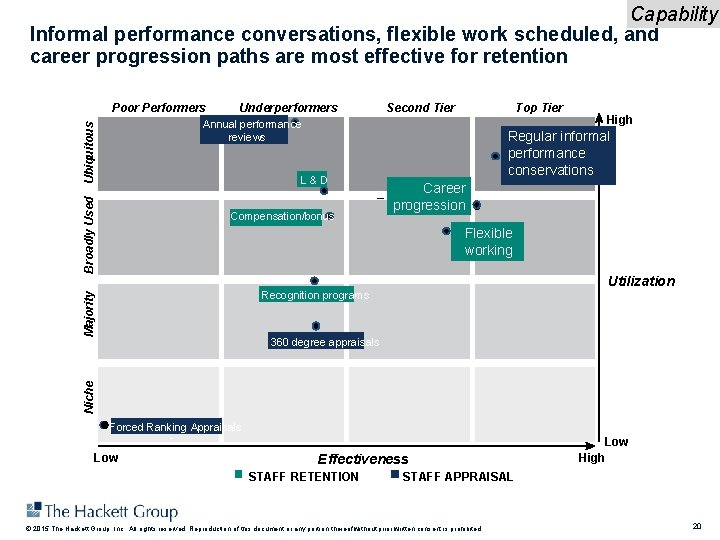
Capability Informal performance conversations, flexible work scheduled, and career progression paths are most effective for retention Poor Performers Underperformers Second Tier Top Tier Ubiquitous Annual performance reviews Broadly Used L&D Compensation/bonus High Regular informal performance conservations Career progression Flexible working Utilization Majority Recognition programs Niche 360 degree appraisals Forced Ranking Appraisals - Low Effectiveness STAFF RETENTION Low High STAFF APPRAISAL © 2015 The Hackett Group, Inc. All rights reserved. Reproduction of this document or any portion thereof without prior written consent is prohibited. 20
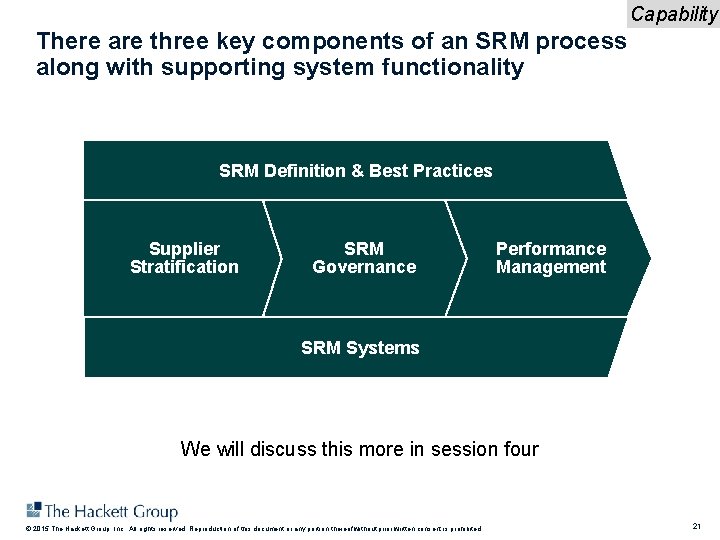
Capability There are three key components of an SRM process along with supporting system functionality SRM Definition & Best Practices Supplier Stratification SRM Governance Performance Management SRM Systems We will discuss this more in session four © 2015 The Hackett Group, Inc. All rights reserved. Reproduction of this document or any portion thereof without prior written consent is prohibited. 21
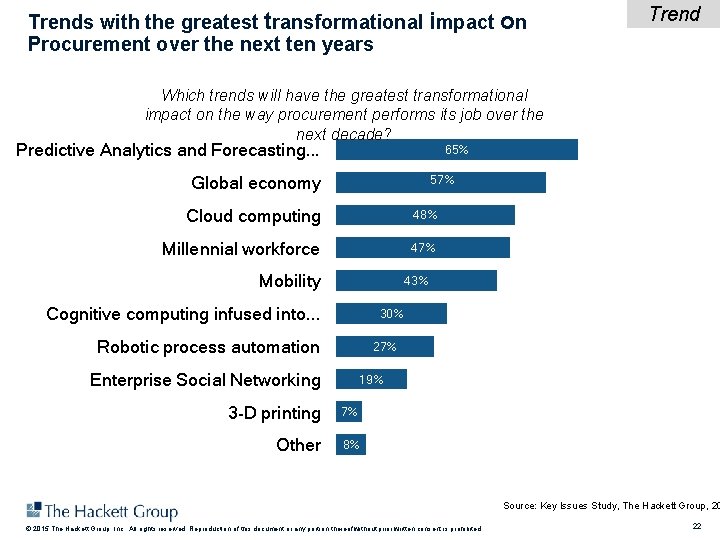
Trends with the greatest transformational impact on Procurement over the next ten years Trend Which trends will have the greatest transformational impact on the way procurement performs its job over the next decade? Predictive Analytics and Forecasting. . . 65% Global economy 57% Cloud computing 48% Millennial workforce 47% Mobility 43% Cognitive computing infused into. . . 30% Robotic process automation 27% Enterprise Social Networking 19% 3 -D printing 7% Other 8% Source: Key Issues Study, The Hackett Group, 20 © 2015 The Hackett Group, Inc. All rights reserved. Reproduction of this document or any portion thereof without prior written consent is prohibited. 22
Contact information Kurt Albertson Principal, Procurement Advisory The Hackett Group 770 -225 -7570 | office kalbertson@thehackettgroup. com Amsterdam | Atlanta | Frankfurt | Hyderabad | London Miami | New York | Paris | Philadelphia | San Francisco | Sydney © 2015 The Hackett Group, Inc. All rights reserved. Reproduction of this document or any portion thereof without prior written consent is prohibited. 2016 Enterprise Key Issues -PR 23
- Slides: 23