
Procurement Process Request for Proposal Proposal Evaluation and



- Slides: 27
Procurement Process Request for Proposal, Proposal & Evaluation and Selection
Request for Proposal & Proposal Two parties involved: 1. Customer – buyerrequestor 2. Contractor – seller provider
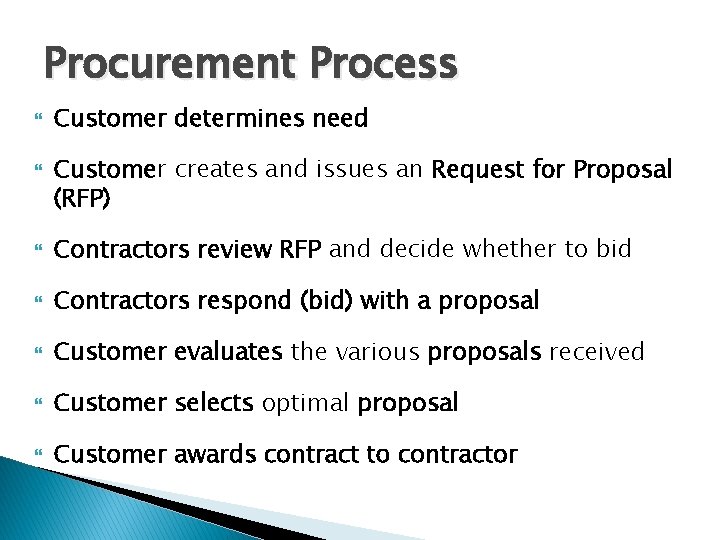
Procurement Process Customer determines need Customer creates and issues an Request for Proposal (RFP) Contractors review RFP and decide whether to bid Contractors respond (bid) with a proposal Customer evaluates the various proposals received Customer selects optimal proposal Customer awards contract to contractor
Request for proposal (RFP) - Customer issued solicitation to attract interested contractors to develop and submit proposed solutions. It is a formal document outlining: Specific requirements for the project or service Bidding process: submission, evaluation and selection
Request for quote (RFQ) - Customer issued solicitation for contractor/vendor to supply specific products or services. In addition to quantity and price, the RFQ typically includes information about: Product or services specifics Payment terms Type / length of contract Bidding process: submission, evaluation and selection
Request for Proposal: The Customer’s View
Prior to preparing an RFP Recognize a need, problem, or opportunity Clearly define the need, problem, or opportunity Quantify the need, problem, or opportunity Determine preliminary budget Determine preliminary schedule
Preparing a RFP State, comprehensively and in detail, what is required, from the customer’s point of view Enable contractors or a project team to understand what the customer expects so that they can prepare a thorough proposal Usually formally in written format Sometimes may be communicated informally and sometimes only orally
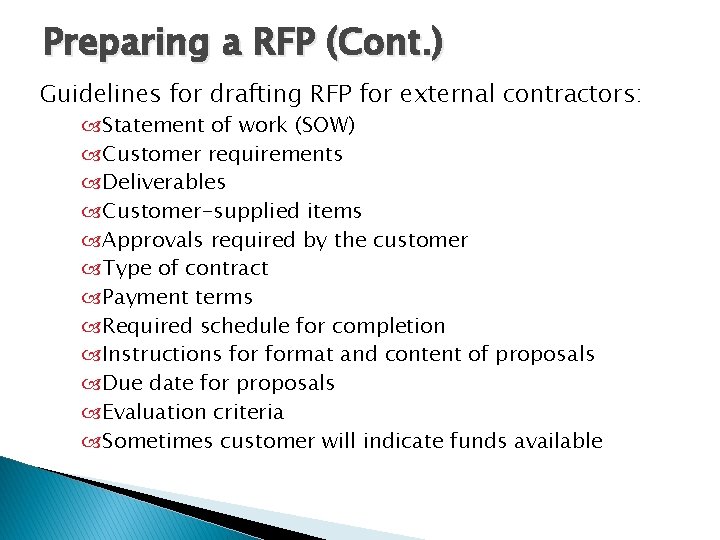
Preparing a RFP (Cont. ) Guidelines for drafting RFP for external contractors: Statement of work (SOW) Customer requirements Deliverables Customer-supplied items Approvals required by the customer Type of contract Payment terms Required schedule for completion Instructions format and content of proposals Due date for proposals Evaluation criteria Sometimes customer will indicate funds available
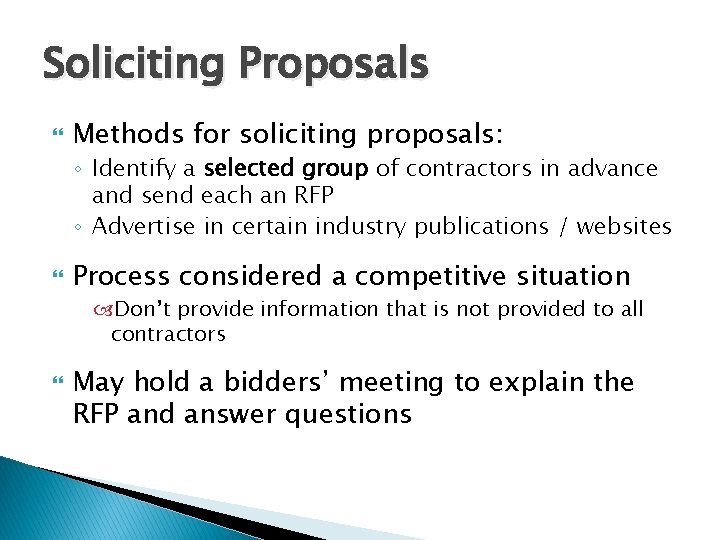
Soliciting Proposals Methods for soliciting proposals: ◦ Identify a selected group of contractors in advance and send each an RFP ◦ Advertise in certain industry publications / websites Process considered a competitive situation Don’t provide information that is not provided to all contractors May hold a bidders’ meeting to explain the RFP and answer questions
Proposal: The Contractor’s View
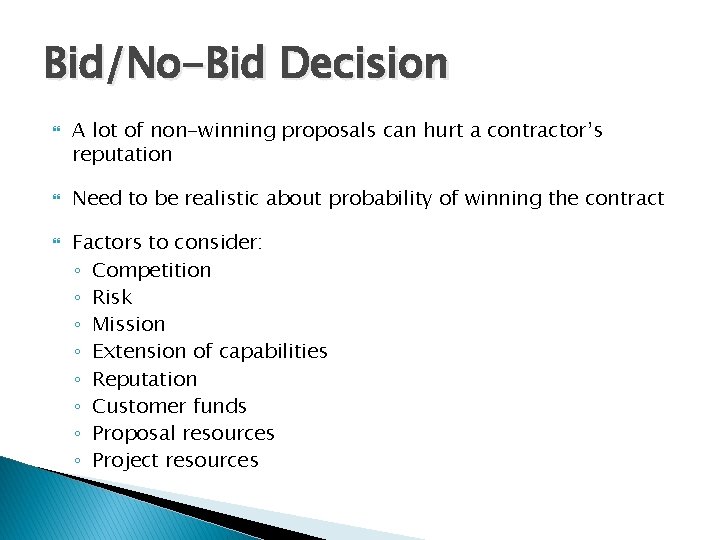
Bid/No-Bid Decision A lot of non-winning proposals can hurt a contractor’s reputation Need to be realistic about probability of winning the contract Factors to consider: ◦ Competition ◦ Risk ◦ Mission ◦ Extension of capabilities ◦ Reputation ◦ Customer funds ◦ Proposal resources ◦ Project resources
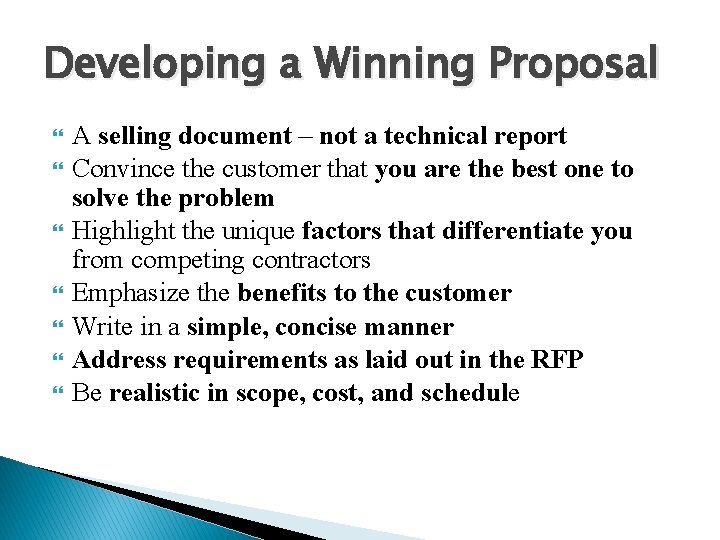
Developing a Winning Proposal A selling document – not a technical report Convince the customer that you are the best one to solve the problem Highlight the unique factors that differentiate you from competing contractors Emphasize the benefits to the customer Write in a simple, concise manner Address requirements as laid out in the RFP Be realistic in scope, cost, and schedule
Proposal Preparation Can be a straightforward task performed by one person or a resource-intensive effort requiring a team Schedule must allow time for review and approval by management Can be a few pages or few hundred pages Customers do not pay contractors to prepare proposals
Proposal Contents Proposals are organized into three sections: Technical Section Management Section Cost Section
Proposal Contents (Cont. ) Technical Section ◦ Understanding of the problem ◦ Proposed approach or solution Exception – variation from specified requirements ◦ Benefits to the customer
Proposal Contents (Cont. ) Management Section ◦ ◦ ◦ Description of work tasks Deliverables Project schedule Project organization Related experience Equipment and facilities
Proposal Contents (Cont. ) Cost Section ◦ ◦ ◦ ◦ ◦ Labor Materials Subcontractors and consultants Equipment and facilities rental Travel Documentation Overhead Escalation (cost increases) Contingency or management reserve Fee or profit
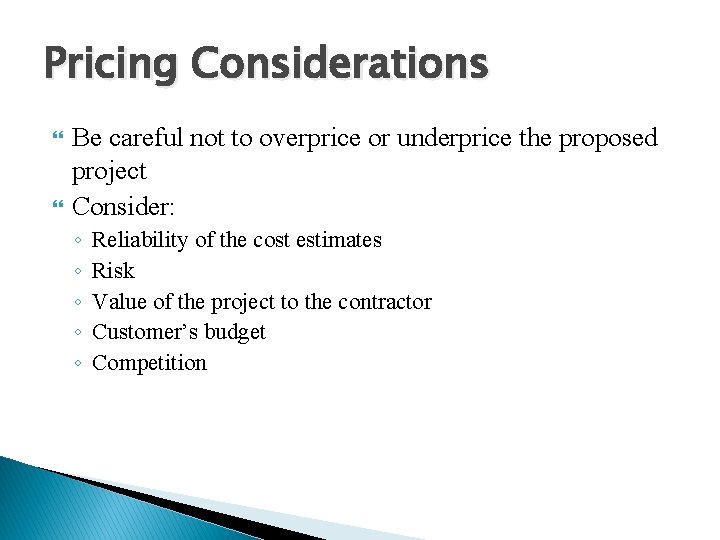
Pricing Considerations Be careful not to overprice or underprice the proposed project Consider: ◦ ◦ ◦ Reliability of the cost estimates Risk Value of the project to the contractor Customer’s budget Competition
Proposal Submission and Follow-Up Submit proposals on time Follow submission requirements ◦ Some customers require hardcopy submission ◦ Some customers require electronic submission Continue to be proactive even after submission ◦ Follow-up needs to be done in a professional manner
Proposal Evaluation, Selection and Contract (By the Customer)
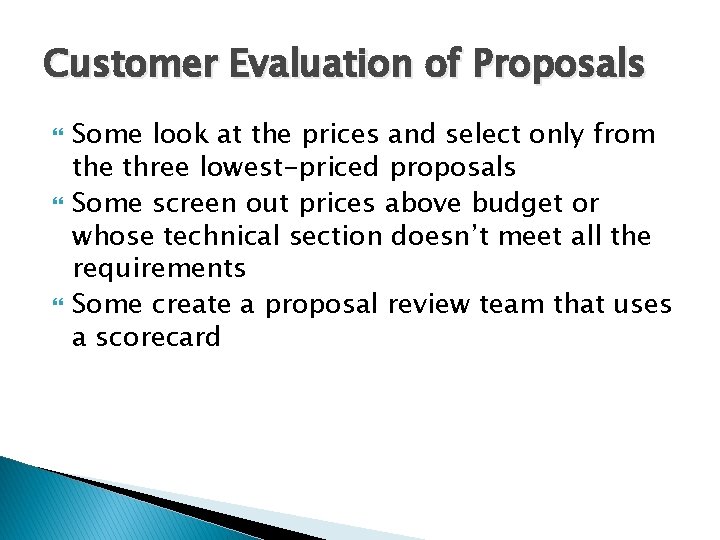
Customer Evaluation of Proposals Some look at the prices and select only from the three lowest-priced proposals Some screen out prices above budget or whose technical section doesn’t meet all the requirements Some create a proposal review team that uses a scorecard
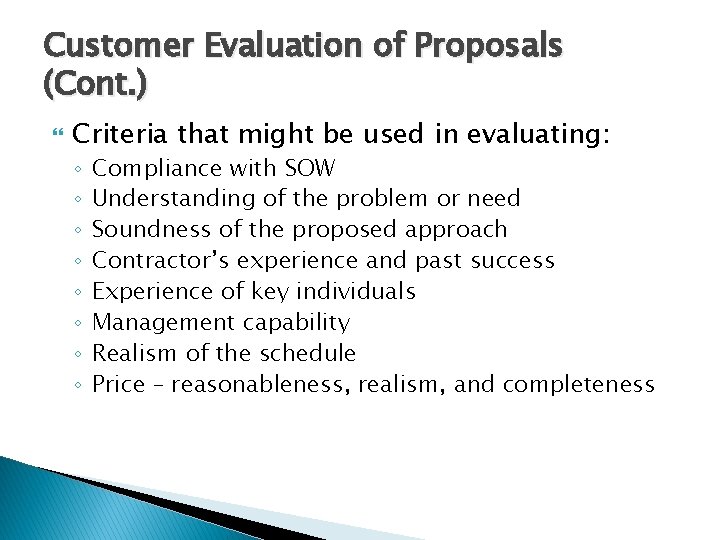
Customer Evaluation of Proposals (Cont. ) Criteria that might be used in evaluating: ◦ ◦ ◦ ◦ Compliance with SOW Understanding of the problem or need Soundness of the proposed approach Contractor’s experience and past success Experience of key individuals Management capability Realism of the schedule Price – reasonableness, realism, and completeness
Types of Contracts A contract is: ◦ A vehicle for establishing customer-contractor communications and arriving at a mutual understanding and clear expectations ◦ An agreement between the contractor, who agrees to provide a product or service, and the customer, who agrees to pay It must clearly spell out the deliverables Two types of contracts: fixed price and cost reimbursement
Types of Contracts (Cont. ) Fixed-price contract ◦ Price remains fixed unless the customer and contractor agree ◦ Provides low risk for the customer ◦ Provides high risk for the contractor ◦ Is most appropriate for projects that are well defined and entail little risk
Types of Contracts (Cont. ) Cost-reimbursement contract ◦ ◦ ◦ Contractor is reimbursed for all expenditures Provides high risk for the customer Provides low risk for the contractor Is most appropriate for projects that involve risk Customer often requires that the contractor regularly compare actual expenditures with the proposed budget and reforecast cost-at-completion
Contract Provisions Miscellaneous provisions that may be included in project contracts: ◦ ◦ ◦ ◦ ◦ Misrepresentation of costs Notice of cost overruns or schedule delays Approval of subcontractor Customer-furnished equipment or information Patents Disclosure of proprietary information Termination Terms of payment Bonus/penalty payments Changes