
PROCUREMENT CAPACITY BUILDING TRAINING 1 What is Procurement
PROCUREMENT CAPACITY BUILDING TRAINING
1. What is Procurement Ø “Procurement” is the process of acquiring supplies, works and services, covering both acquisitions from third Parties and from in-house providers. In its narrow sense the term procurement refers to procurement of goods, whereas in its wider sense the term procurement coversprocurementofgoodsaswellas services. .
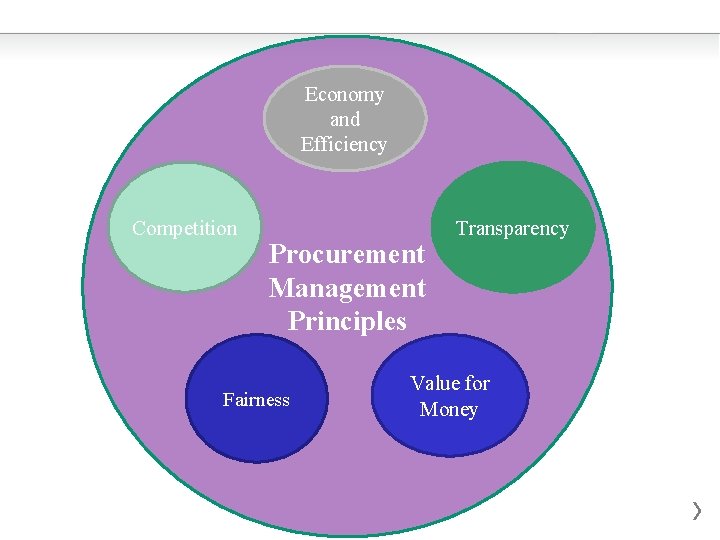
Economy and Efficiency Competition Procurement Management Principles Fairness Transparency Value for Money

Procurement Cycle Procurement Plan / determining need Stage 1 Requisitions Describing Requirements Stage 2 Identifying Suppliers and Preparing Bidding Documents Stage 3 Evaluation of Bidders Stage 4 Issuance / Award of contract Stage 5 Receiving Goods / Services Stage 6 Administering Contracts / Closeout Stage 7
2. Code of Ethics The Code applies to all employees in the organization. The Code defines the values and sets forth the principles to guide behavior. It is important for each individual to fully understand these principles and to implement them in all business activities. It is the duty of each employee to ensure that all business relationships are conducted with integrity and honesty. Ø In case there is conflict of interests, it must be disclosed upfront. Ø Members of the procurement committee and procurement staff shall not be participating in any business deal with a business concern of his/her spouse, children, and other immediate family members, other household dependents, or friends. Ø Neither consultants (including their personnel and sub-consultants) nor any of their affiliates shall be hired for any assignment that, by its nature, may be in conflict with another assignment taken up by the consultants. Ø Accepting costly gifts from existing or potential contractors is prohibited. Ø Working of close relatives in the same organization where one has the authority to affect the other’s career is against the code of ethics. Ø All parties involved in procurement process shall sign a Conflict of Interest Disclosure Statement
3. Fraud & Corruption In most of the projects substantial part of the budget is spent on procurement. Consequently misappropriation of funds and corrupt practices are common. There is quite a variety of methods employed to commit fraud and indulge in corrupt practices, a few are listed as follows: Ø Use of restrictive specifications Ø Leaking procurement information to one bidder in advance and providing inadequate time for preparation and submission of bids to others, thereby making it convenient for one and difficult for others Ø Acceptance of low quality goods Ø At the time of payment, withholding a cheque, until the supplier is willing to share part of the payment Ø Taking or giving items of value in order to influence decision making Allocation of duties maybe made in such a way that commitment of fraud becomes impossible without collusion of at least two persons. It is observed that collusion does not last long
Strengthen your Systems Ø Handle fraud and Corruption before it happens by strengthening your internal checks and internal controls.
4. Procurement Planning Ø It is often argued that due to limited resources and lack of control over events, planning is difficult. However procurement planning helps identify difficult areas such as non restrictive specifications. Competition leads to competitive prices thereby achieving economy. Ø Thus non restrictive specifications along with provision of adequate time for preparation & submission of bids makes the entire exercise transparent. Ø Non restrictive specifications are those which can be met by several suppliers/ bidders.
4. 1 Contents of Procurement Plan The plan shall address all technical, business, management, and other significant considerations that can influence and control procurement. The specific content of plans shall vary, depending on the nature, circumstances, and stage of the procurement. Each procurement plan must constitutes the following main components Ø Description of items required Ø Estimated cost for procuring the goods Ø Method of procurement Ø Review type/approvals i. e. whether the procurement actions are subject to prior review or post review Ø Date of preparation of Bidding Documents, specifications/ Request for Quotations (RFQ) Ø Advertisement date Ø Opening of bids date Ø Date on which evaluations were completed & recommendations were given by the procurement committee Ø Award of Contract date Ø Completion of contract & Final payment date
4. 2 Review of Procurement Plan Procurement plans are not static. The procurement plan should be reviewed every six months or as needed for any changes and must be revised accordingly. Moreover, all activities conducted during the year should be recorded against their planned dates to facilitate the comparison between planned versus actual dates. Changes may occur in procurement plan mainly due to: Ø Shortage of funds Ø Late release of funds Ø Unexpected availability of supplementary funds Ø Delays in obtaining necessary approvals from senior management or from the donor agency. Ø Failure of contractors to supply as contracted, necessitating re-bidding
5. Methods of Procurement The bidding process needs to be well planned and all factors that can affect the bidding process should be carefully analyzed and completed. The first step in bidding process is determining the method of procurement required. The various methods of procurements usually used by organizations are as follows: 5. 1 Competitive & Non-Competitive Procurement 5. 2 National Competitive Bidding (NCB) 5. 3 Direct Contracting

5. 1 Competitive Procurement for is a procurement method based on comparing price quotations obtained from several suppliers (in the case of goods) or several contractors (in case of works), with a minimum of three, to assure competitive prices, and is an appropriate method for procuring readily available off-the-shelf goods or standard specification commodities of small value. This does not include the standardized vendors and sole source procurement.
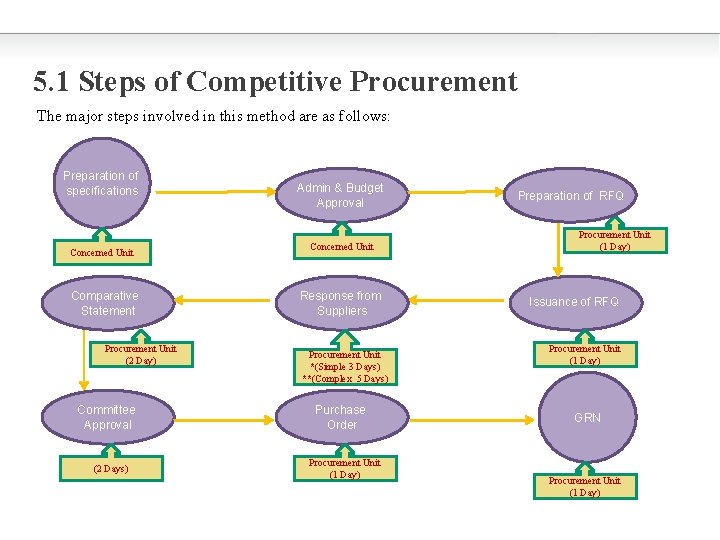
5. 1 Steps of Competitive Procurement The major steps involved in this method are as follows: Preparation of specifications Concerned Unit Comparative Statement Procurement Unit (2 Day) Committee Approval (2 Days) Admin & Budget Approval Concerned Unit Response from Suppliers Procurement Unit *(Simple 3 Days) **(Complex 5 Days) Purchase Order Procurement Unit (1 Day) Preparation of RFQ Procurement Unit (1 Day) Issuance of RFQ Procurement Unit (1 Day) GRN Procurement Unit (1 Day)
5. 1 Competitive Procurement Purpose of Requisition Slip: A requisition must be raised to start any procurement process. It serves a number of purposes, including: § Documenting the need for the goods, works or services required § Confirming the availability of funding § Establishing the chain of responsibility for authorizing the procurement for purposes of pre- and post-procurement monitoring. Step 1: Requisition Contents of Requisition Slip: Purchase Requisition form constitutes the following main components: § Subject of Procurement § Date of issuance of requisition § Quantity & Description of goods § Estimated Unit Cost & Total Cost § Delivery date & delivery place § Approval from originating department, finance department & CEO / Chairman.
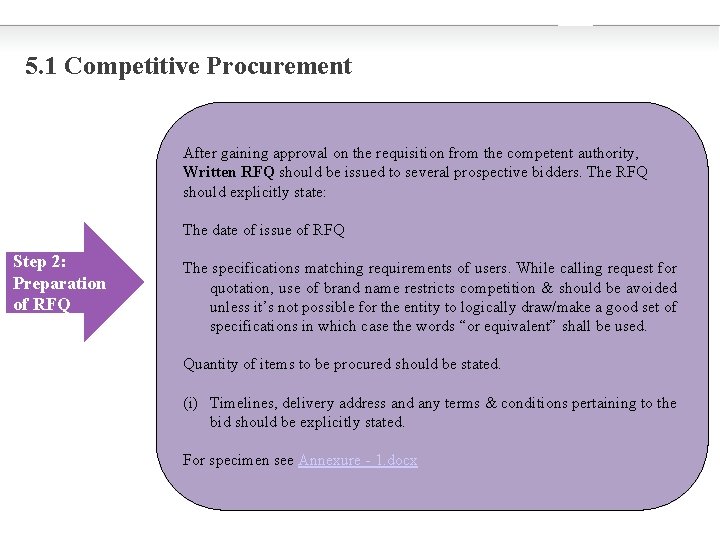
5. 1 Competitive Procurement After gaining approval on the requisition from the competent authority, Written RFQ should be issued to several prospective bidders. The RFQ should explicitly state: The date of issue of RFQ Step 2: Preparation of RFQ The specifications matching requirements of users. While calling request for quotation, use of brand name restricts competition & should be avoided unless it’s not possible for the entity to logically draw/make a good set of specifications in which case the words “or equivalent” shall be used. Quantity of items to be procured should be stated. (i) Timelines, delivery address and any terms & conditions pertaining to the bid should be explicitly stated. For specimen see Annexure - 1. docx

5. 1 Competitive Procurement Step 3: Three Quotations Step 4: Comparative Statement At minimum 3 quotations should be obtained to avoid possibilities of collusion and get best quote from different sources. Merely making a request to three prospective bidders may not necessarily meet the condition. In order to meet the condition, pursuing with the potential bidders to participate is permissible and in some cases necessary. After the submission deadline, quotations are opened and comparative statement containing date, suppliers / bidders name, quantity and prices offered is prepared. The bidder quoting the lowest price without modifying other terms & conditions is recommended for issuance of purchase order. Comparative statement must be signed by all members of the procurement committee stating names & designation of signatories.
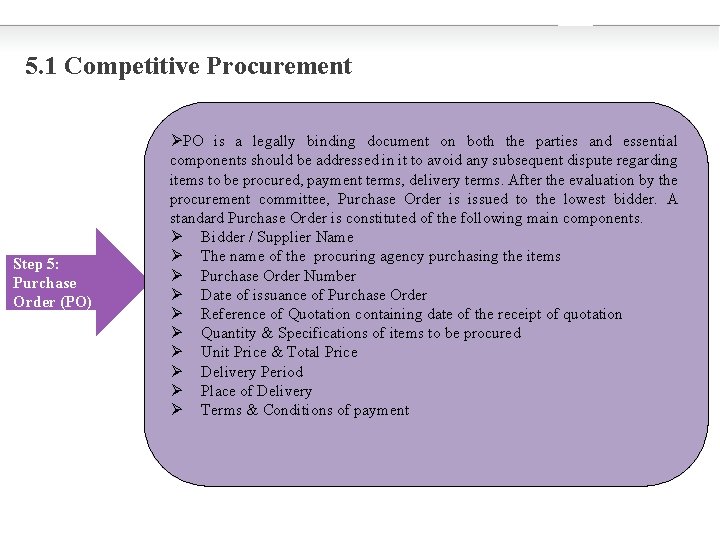
5. 1 Competitive Procurement Step 5: Purchase Order (PO) ØPO is a legally binding document on both the parties and essential components should be addressed in it to avoid any subsequent dispute regarding items to be procured, payment terms, delivery terms. After the evaluation by the procurement committee, Purchase Order is issued to the lowest bidder. A standard Purchase Order is constituted of the following main components. Ø Bidder / Supplier Name Ø The name of the procuring agency purchasing the items Ø Purchase Order Number Ø Date of issuance of Purchase Order Ø Reference of Quotation containing date of the receipt of quotation Ø Quantity & Specifications of items to be procured Ø Unit Price & Total Price Ø Delivery Period Ø Place of Delivery Ø Terms & Conditions of payment
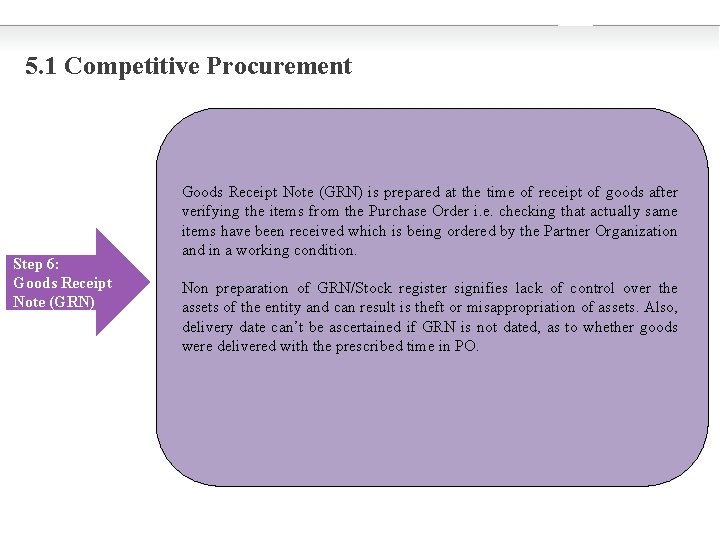
5. 1 Competitive Procurement Step 6: Goods Receipt Note (GRN) is prepared at the time of receipt of goods after verifying the items from the Purchase Order i. e. checking that actually same items have been received which is being ordered by the Partner Organization and in a working condition. Non preparation of GRN/Stock register signifies lack of control over the assets of the entity and can result is theft or misappropriation of assets. Also, delivery date can’t be ascertained if GRN is not dated, as to whether goods were delivered with the prescribed time in PO.
5. 1 Non-Competitive Procurement Ø Any procurement for which no quotations are obtained is noncompetitive procurement. This applies to both expendable and nonexpendable property. Any purchase of less than and equal to Rs. is noncompetitive procurement. However, if the total cost of the items or services purchased from a single vendor (except the standard vendors or sole source) exceeds Rs. , over a period of time quotations should be obtained at least once a quarter.
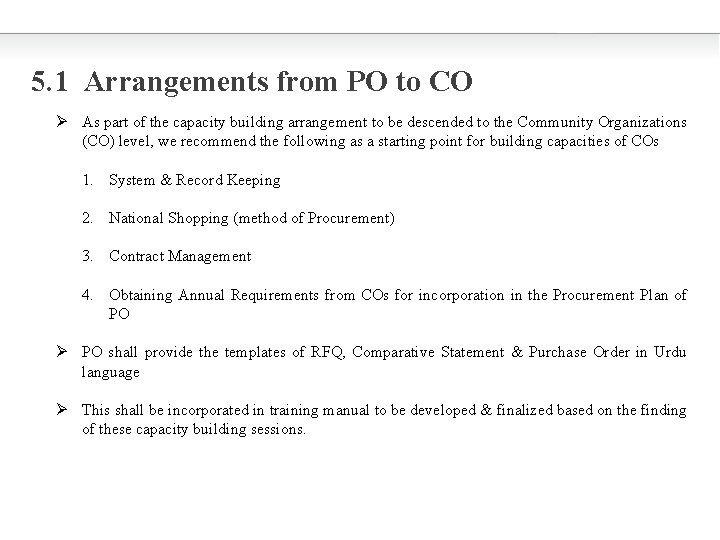
5. 1 Arrangements from PO to CO Ø As part of the capacity building arrangement to be descended to the Community Organizations (CO) level, we recommend the following as a starting point for building capacities of COs 1. System & Record Keeping 2. National Shopping (method of Procurement) 3. Contract Management 4. Obtaining Annual Requirements from COs for incorporation in the Procurement Plan of PO Ø PO shall provide the templates of RFQ, Comparative Statement & Purchase Order in Urdu language Ø This shall be incorporated in training manual to be developed & finalized based on the finding of these capacity building sessions.
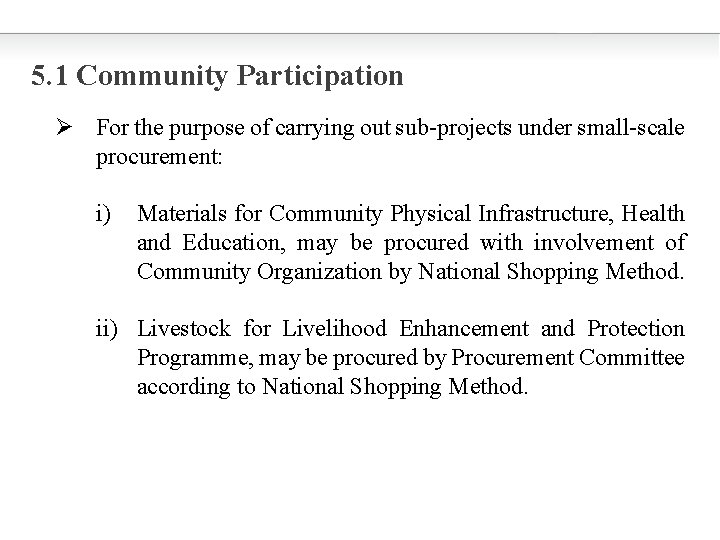
5. 1 Community Participation Ø For the purpose of carrying out sub-projects under small-scale procurement: i) Materials for Community Physical Infrastructure, Health and Education, may be procured with involvement of Community Organization by National Shopping Method. ii) Livestock for Livelihood Enhancement and Protection Programme, may be procured by Procurement Committee according to National Shopping Method.
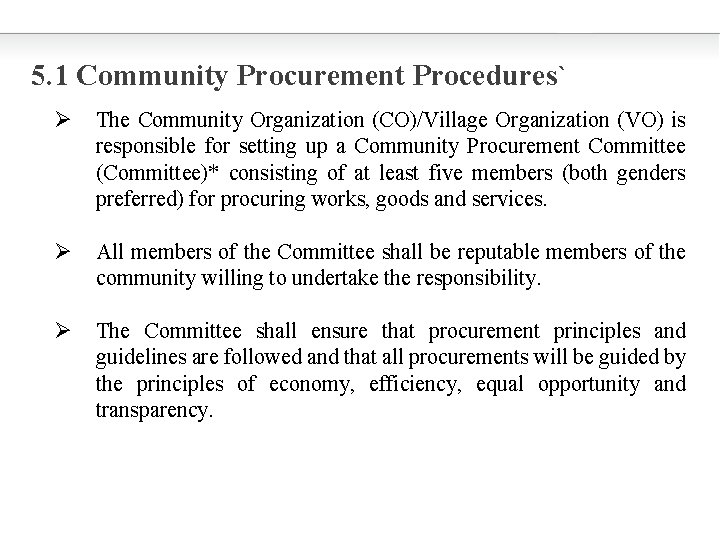
5. 1 Community Procurement Procedures` Ø The Community Organization (CO)/Village Organization (VO) is responsible for setting up a Community Procurement Committee (Committee)* consisting of at least five members (both genders preferred) for procuring works, goods and services. Ø All members of the Committee shall be reputable members of the community willing to undertake the responsibility. Ø The Committee shall ensure that procurement principles and guidelines are followed and that all procurements will be guided by the principles of economy, efficiency, equal opportunity and transparency.
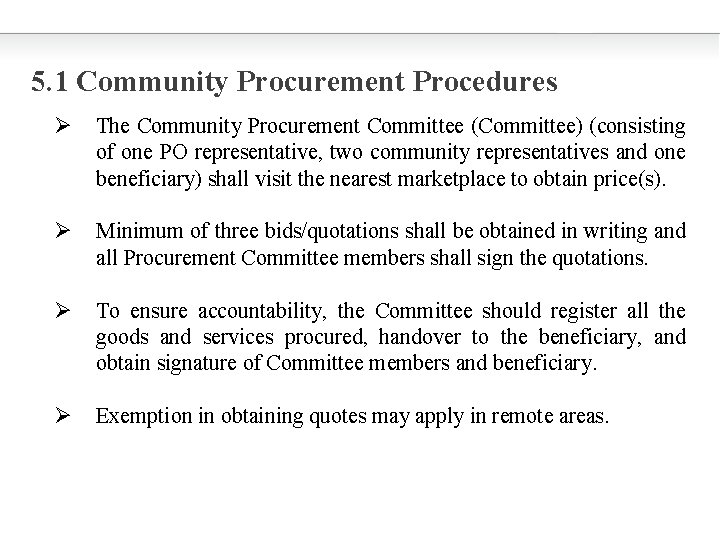
5. 1 Community Procurement Procedures Ø The Community Procurement Committee (Committee) (consisting of one PO representative, two community representatives and one beneficiary) shall visit the nearest marketplace to obtain price(s). Ø Minimum of three bids/quotations shall be obtained in writing and all Procurement Committee members shall sign the quotations. Ø To ensure accountability, the Committee should register all the goods and services procured, handover to the beneficiary, and obtain signature of Committee members and beneficiary. Ø Exemption in obtaining quotes may apply in remote areas.
5. 1 Funds Flow Ø PO should ensure timely disbursement of funds to COs for smooth procurement.
5. 2 National Competitive Bidding (NCB) NCB is a process which ensures that equal opportunity is given to all the suppliers working around the country to encourage competitiveness in the procurement process. As per policy/guidelines set by the organization procurements with estimated value of more than Pkr- /- NCB is recommended. Essential features of NCB are as follows: (i) Nationwide advertising / inviting bids (ii) Minimum of 7 days & maximum may vary from case to case going up to 30 days for preparation & submission of bids (iii) Bids must be opened at previously announced time and place. Validity of bids can be extended. However, refusal to extend by the bidder will not result in loss of bids security. (iv) Pre-qualification & Post-qualification of bidders – one of the two is mandatory
5. 3 Direct Contracting Direct contracting is contracting without competition (single-source) and may be an appropriate method under the following circumstances. Ø Time constraints, where we have limited amount of time to carry out the expenditure. Ø An existing contract for goods, works, and non-consulting services may be extended for additional goods, works, and non-consulting services of a similar nature. No advantage could be obtained by further competition and that the prices on the extended contract are reasonable. Provisions for such an extension, if considered likely in advance, shall be included in the original contract Ø Standardization of equipment or spare parts, to be compatible with existing equipment, may justify additional purchases from the original supplier. For such purchases to be justified, the original equipment shall be suitable, the number of new items shall generally be less than the existing number, the price shall be reasonable, and the advantages of another make or source of equipment shall have been considered and rejected on grounds acceptable to the BOD Ø The required equipment is proprietary and obtainable only from one source Ø In exceptional cases, such as, but not limited to, in response to natural disasters and emergency situations.
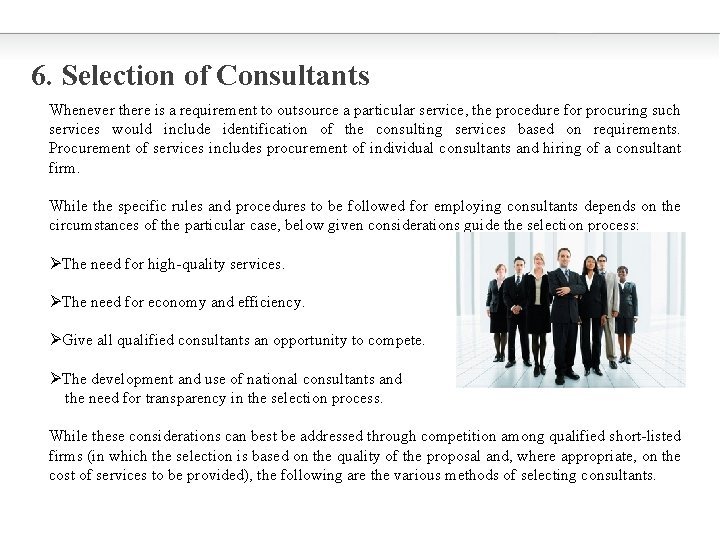
6. Selection of Consultants Whenever there is a requirement to outsource a particular service, the procedure for procuring such services would include identification of the consulting services based on requirements. Procurement of services includes procurement of individual consultants and hiring of a consultant firm. While the specific rules and procedures to be followed for employing consultants depends on the circumstances of the particular case, below given considerations guide the selection process: ØThe need for high-quality services. ØThe need for economy and efficiency. ØGive all qualified consultants an opportunity to compete. ØThe development and use of national consultants and the need for transparency in the selection process. While these considerations can best be addressed through competition among qualified short-listed firms (in which the selection is based on the quality of the proposal and, where appropriate, on the cost of services to be provided), the following are the various methods of selecting consultants.
6. 1 Procedures of Consultant Hiring There are several methods for selecting a team of consultants including individual consultants. Locally, use of individual consultants is fairly common. It is used where the individual consultant does not need support from head office and can handle the assignment single handedly. Its essential features are: (i) Advertisement specifying selection criteria, invite candidates with the required qualification & experience to submit Expression of Interest (EOI) along with CVs. (ii) Based on selection criteria, a minimum of 3 CVs are selected (iii) Interviewing the shortlisted candidates (iv) Negotiations are conducted with the best qualified. Reference Checks and charge out on last three assignments needs to be obtained. (v) In case negotiations with the best qualified failed, we can move to second best with the consult of all committee members. (vi) Quality based selection can be made by using a competitive process among short-listed firms that takes into account the quality of the proposal and the cost of the services.
7. Contract Management & Close out Contract Management starts as soon as contract is signed. Usually monitoring of contract regarding performance and reporting requirements are included in contracts. inspection regarding production process for quality assurance is another area where contract management is involved. Receipt of goods in accordance with contract terms and conditions is a part of contract administration. Training workshops for capacity building if included in the contract are monitored to ensure compliance. Close Out It involves authorizing adjustment in price if any. Usually, it happens in construction contracts. Goods Receipt Note (GRN) & a completion report will confirm receipt of goods or completion of construction. This is followed by issuance of check covering final payment.
PROCUREMENT AUDIT Procurement Audit emphasizes heavily on the adequacy of procurement arrangements at organization level and overall environment/personnel responsible for Procurement at organization level. Any organization undergoing procurement audit shall consider the following as pre-requisite for ensuring system compliance before undergoing procurement audit: • Has a manual on procurement procedure been prepared and is it available on site? If no, describe how the procurement procedure is guided? • Is the staff dedicated to procurement? Describe the procurement staff arrangements. • Is the staff handling the procurement aware of the agreed procurement arrangements for the project? Explain. • Was a complete list of contracts issued available? How is it kept and updated? Is it computerized? • Whether the procurement related documents are available systematically? How the procurement-related documents are stored and made available? • What internal approvals are necessary for inviting quotations/placing orders? • Is there separation of duties between various functions viz. indenting/receiving, procurement and releasing funds?
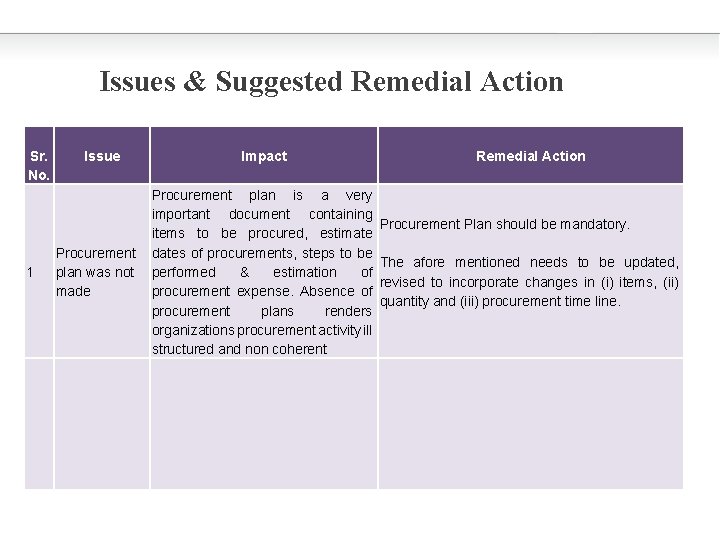
Issues & Suggested Remedial Action Sr. No. 1 Issue Procurement plan was not made Impact Procurement plan is a very important document containing items to be procured, estimate dates of procurements, steps to be performed & estimation of procurement expense. Absence of procurement plans renders organizations procurement activity ill structured and non coherent Remedial Action Procurement Plan should be mandatory. The afore mentioned needs to be updated, revised to incorporate changes in (i) items, (ii) quantity and (iii) procurement time line.
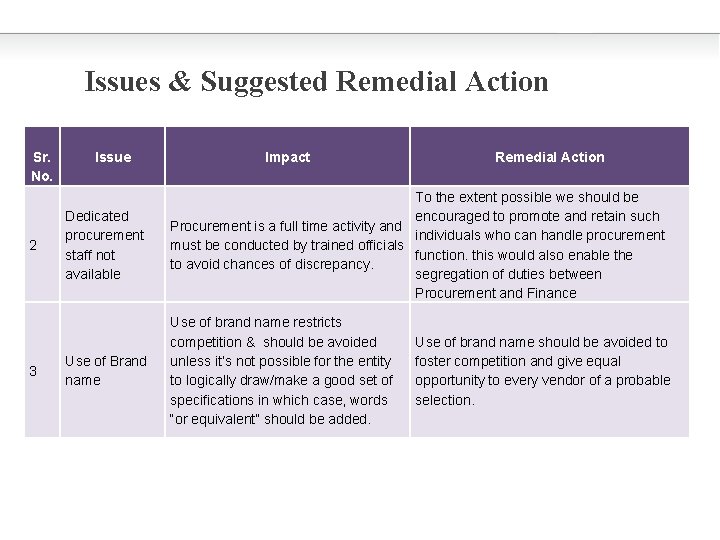
Issues & Suggested Remedial Action Sr. No. 2 3 Issue Impact Remedial Action Dedicated procurement staff not available To the extent possible we should be encouraged to promote and retain such Procurement is a full time activity and individuals who can handle procurement must be conducted by trained officials function. this would also enable the to avoid chances of discrepancy. segregation of duties between Procurement and Finance Use of Brand name Use of brand name restricts competition & should be avoided unless it’s not possible for the entity to logically draw/make a good set of specifications in which case, words “or equivalent” should be added. Use of brand name should be avoided to foster competition and give equal opportunity to every vendor of a probable selection.
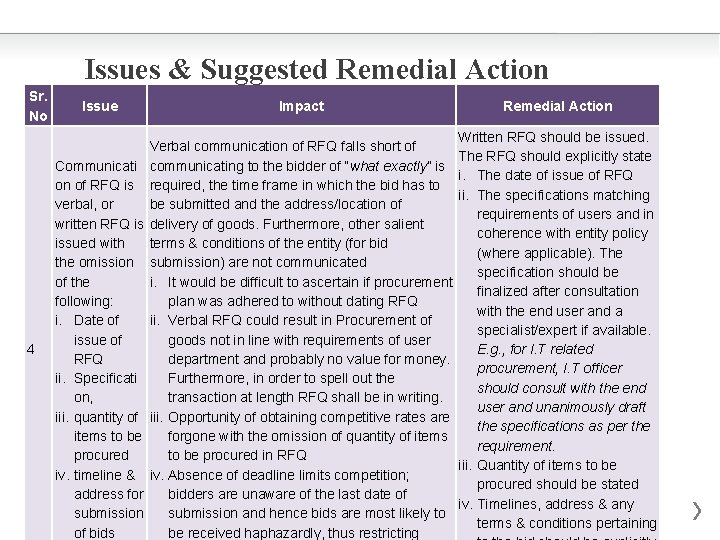
Issues & Suggested Remedial Action Sr. No 4 Issue Impact Communicati on of RFQ is verbal, or written RFQ is issued with the omission of the following: i. Date of issue of RFQ ii. Specificati on, iii. quantity of items to be procured iv. timeline & address for submission of bids Verbal communication of RFQ falls short of communicating to the bidder of “what exactly” is required, the time frame in which the bid has to be submitted and the address/location of delivery of goods. Furthermore, other salient terms & conditions of the entity (for bid submission) are not communicated i. It would be difficult to ascertain if procurement plan was adhered to without dating RFQ ii. Verbal RFQ could result in Procurement of goods not in line with requirements of user department and probably no value for money. Furthermore, in order to spell out the transaction at length RFQ shall be in writing. iii. Opportunity of obtaining competitive rates are forgone with the omission of quantity of items to be procured in RFQ iv. Absence of deadline limits competition; bidders are unaware of the last date of submission and hence bids are most likely to be received haphazardly, thus restricting Remedial Action Written RFQ should be issued. The RFQ should explicitly state i. The date of issue of RFQ ii. The specifications matching requirements of users and in coherence with entity policy (where applicable). The specification should be finalized after consultation with the end user and a specialist/expert if available. E. g. , for I. T related procurement, I. T officer should consult with the end user and unanimously draft the specifications as per the requirement. iii. Quantity of items to be procured should be stated iv. Timelines, address & any terms & conditions pertaining
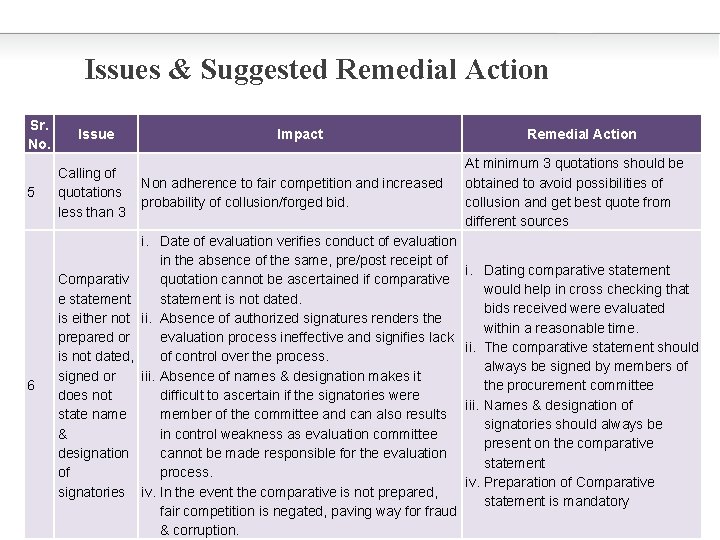
Issues & Suggested Remedial Action Sr. No. 5 6 Issue Impact Remedial Action Calling of quotations less than 3 Non adherence to fair competition and increased probability of collusion/forged bid. At minimum 3 quotations should be obtained to avoid possibilities of collusion and get best quote from different sources Comparativ e statement is either not prepared or is not dated, signed or does not state name & designation of signatories i. Date of evaluation verifies conduct of evaluation in the absence of the same, pre/post receipt of quotation cannot be ascertained if comparative statement is not dated. ii. Absence of authorized signatures renders the evaluation process ineffective and signifies lack of control over the process. iii. Absence of names & designation makes it difficult to ascertain if the signatories were member of the committee and can also results in control weakness as evaluation committee cannot be made responsible for the evaluation process. iv. In the event the comparative is not prepared, fair competition is negated, paving way for fraud & corruption. i. Dating comparative statement would help in cross checking that bids received were evaluated within a reasonable time. ii. The comparative statement should always be signed by members of the procurement committee iii. Names & designation of signatories should always be present on the comparative statement iv. Preparation of Comparative statement is mandatory
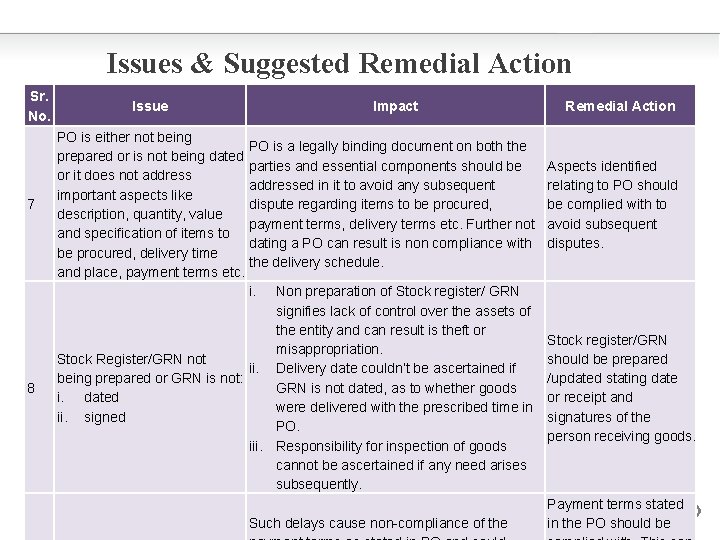
Issues & Suggested Remedial Action Sr. No. 7 Issue Impact PO is either not being prepared or is not being dated or it does not address important aspects like description, quantity, value and specification of items to be procured, delivery time and place, payment terms etc. PO is a legally binding document on both the parties and essential components should be addressed in it to avoid any subsequent dispute regarding items to be procured, payment terms, delivery terms etc. Further not dating a PO can result is non compliance with the delivery schedule. Remedial Action Aspects identified relating to PO should be complied with to avoid subsequent disputes. i. 8 Non preparation of Stock register/ GRN signifies lack of control over the assets of the entity and can result is theft or misappropriation. Stock Register/GRN not ii. Delivery date couldn’t be ascertained if being prepared or GRN is not: GRN is not dated, as to whether goods i. dated were delivered with the prescribed time in ii. signed PO. iii. Responsibility for inspection of goods cannot be ascertained if any need arises subsequently. Such delays cause non-compliance of the Stock register/GRN should be prepared /updated stating date or receipt and signatures of the person receiving goods. Payment terms stated in the PO should be
- Slides: 36