
Procurement 102 Processes and Procedures for Contracting at
- Slides: 30
Procurement 102 Processes and Procedures for Contracting at UO Presented by: Greg Shabram, Associate Director Purchasing and Contracting Services
2 Agenda • • Source Selection Negotiations Executing a Contract Administration
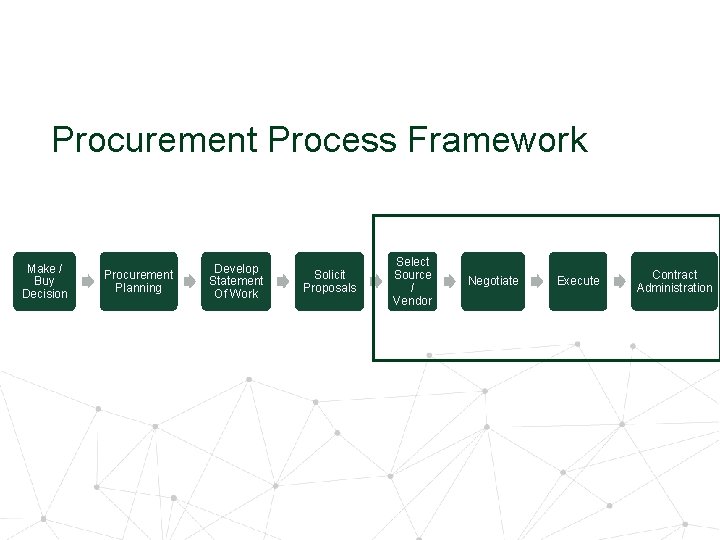
Procurement Process Framework Make / Buy Decision Procurement Planning Develop Statement Of Work Solicit Proposals Select Source / Vendor Negotiate Execute Contract Administration
Source Selection • • Bid Evaluation Plan Best Value v. Lowest Cost Evaluation Criteria Documentation and Protests
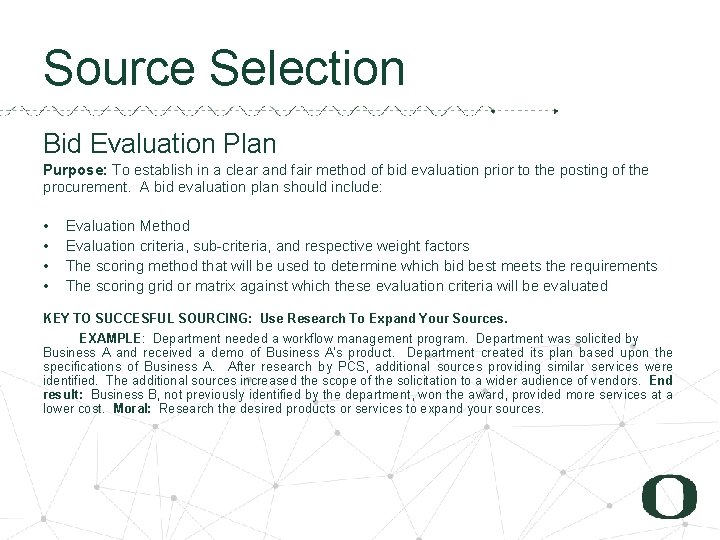
Source Selection Bid Evaluation Plan Purpose: To establish in a clear and fair method of bid evaluation prior to the posting of the procurement. A bid evaluation plan should include: • • Evaluation Method Evaluation criteria, sub-criteria, and respective weight factors The scoring method that will be used to determine which bid best meets the requirements The scoring grid or matrix against which these evaluation criteria will be evaluated KEY TO SUCCESFUL SOURCING: Use Research To Expand Your Sources. EXAMPLE: Department needed a workflow management program. Department was solicited by Business A and received a demo of Business A’s product. Department created its plan based upon the specifications of Business A. After research by PCS, additional sources providing similar services were identified. The additional sources increased the scope of the solicitation to a wider audience of vendors. End result: Business B, not previously identified by the department, won the award, provided more services at a lower cost. Moral: Research the desired products or services to expand your sources.
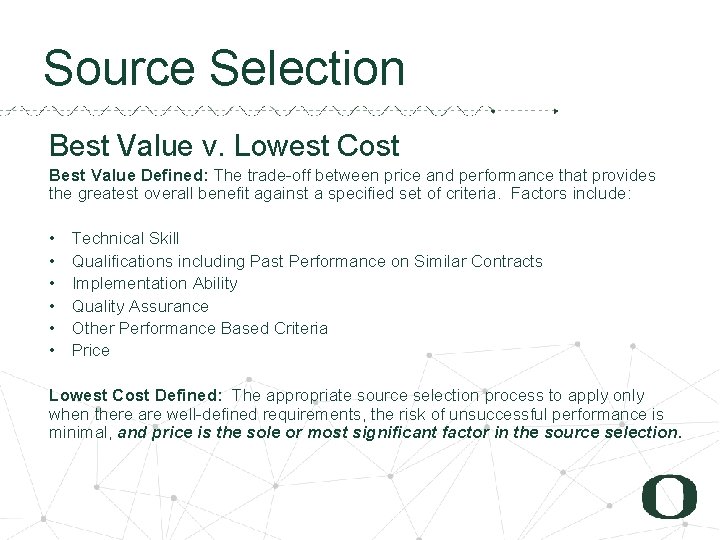
Source Selection Best Value v. Lowest Cost Best Value Defined: The trade-off between price and performance that provides the greatest overall benefit against a specified set of criteria. Factors include: • • • Technical Skill Qualifications including Past Performance on Similar Contracts Implementation Ability Quality Assurance Other Performance Based Criteria Price Lowest Cost Defined: The appropriate source selection process to apply only when there are well-defined requirements, the risk of unsuccessful performance is minimal, and price is the sole or most significant factor in the source selection.
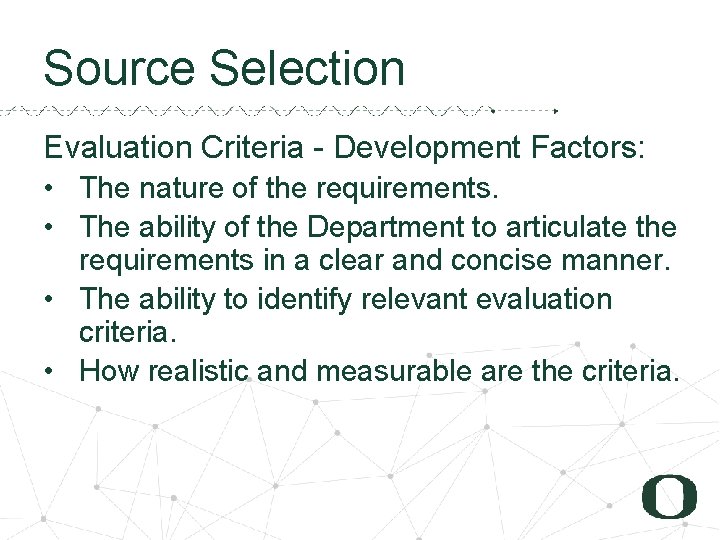
Source Selection Evaluation Criteria - Development Factors: • The nature of the requirements. • The ability of the Department to articulate the requirements in a clear and concise manner. • The ability to identify relevant evaluation criteria. • How realistic and measurable are the criteria.
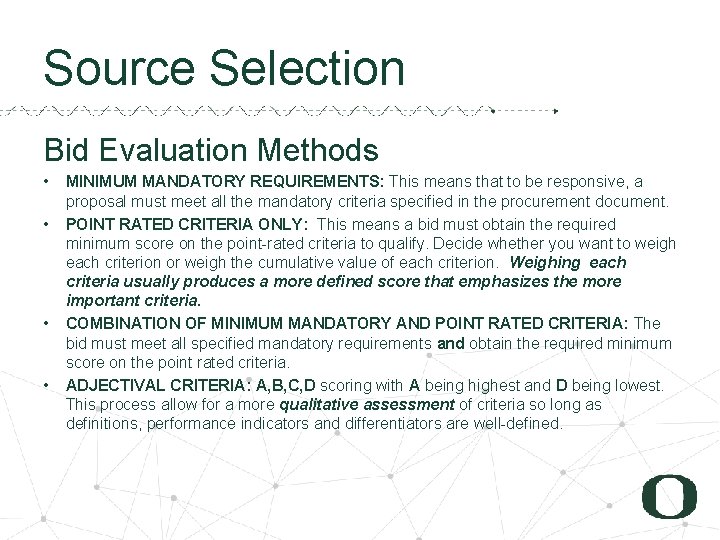
Source Selection Bid Evaluation Methods • • MINIMUM MANDATORY REQUIREMENTS: This means that to be responsive, a proposal must meet all the mandatory criteria specified in the procurement document. POINT RATED CRITERIA ONLY: This means a bid must obtain the required minimum score on the point-rated criteria to qualify. Decide whether you want to weigh each criterion or weigh the cumulative value of each criterion. Weighing each criteria usually produces a more defined score that emphasizes the more important criteria. COMBINATION OF MINIMUM MANDATORY AND POINT RATED CRITERIA: The bid must meet all specified mandatory requirements and obtain the required minimum score on the point rated criteria. ADJECTIVAL CRITERIA: A, B, C, D scoring with A being highest and D being lowest. This process allow for a more qualitative assessment of criteria so long as definitions, performance indicators and differentiators are well-defined.
Source Selection Minimizing Protests: • Evaluate each bid on its merits • Avoid oral communications with vendors during the bid process • Document your results with matrices, grids, written reasons, and consensus evaluations • Ensure vendors comply with all bid requirements and provide specific evidence to support bid • Do not change the proposal evaluation plan after the close of the bid • Do not used unpublished criteria in evaluating bids • Do not use personal knowledge about a vendors the ”benefit of the doubt” in bid evaluation • Follow UO’s Code of Ethics in all instances
Negotiation • Update your BATNA: BATNA may be an alternative vendor proposal • Negotiate based on interests, not positions • Attack problems, not people • Find the most elegant deal • You have an ethical duty to get the best value for UO, and to structure a deal in good faith that serves all parties and stakeholders • Negotiating is a problem solving tool, not merely a haggling process
Negotiate People • Know who you are dealing with, and, if possible, how they best process information. • Not about manipulation, its about accessibility. • Separate people from the problem: • • Counterparts not opposing team Negotiation is a process from solving problems, let your counterparts help you find the solution.
Negotiate Interests v. Positions • Positions: The offer or proposal of a negotiating party. • Interests: The underlying needs that support a position • An understanding of your counterparts interests will allow you to develop alternative mutually acceptable positions
Negotiate Options • Options are alternative ways to meet a parties interests, that also may meet the needs of that parties counterparts • A collaborative exercise, meant to develop trust and solve problems
Negotiate Standards • An objective measurement, based on common principals or provided by neutral third parties used to resolve disputes • Classic examples: CPI (Consumer Price Index); Professional Organizations (Work Standards); Industry Standards, etc.
Negotiate The Dark Arts • Canned responses • Artificial Pressure • Divide and Conquer • Know your style
Negotiate • • • Mock Negotiation Fact Pattern… Divide into groups of two 5 Mins. to read Fact Pattern 20 Mins. to negotiate. Disucssion
Executing the Contract • UO Form Contracts • Common Disputed Terms
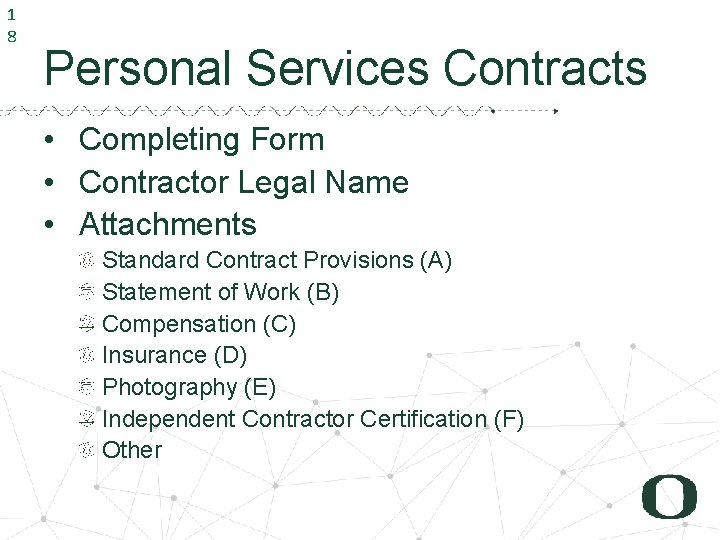
1 8 Personal Services Contracts • Completing Form • Contractor Legal Name • Attachments Standard Contract Provisions (A) Statement of Work (B) Compensation (C) Insurance (D) Photography (E) Independent Contractor Certification (F) Other
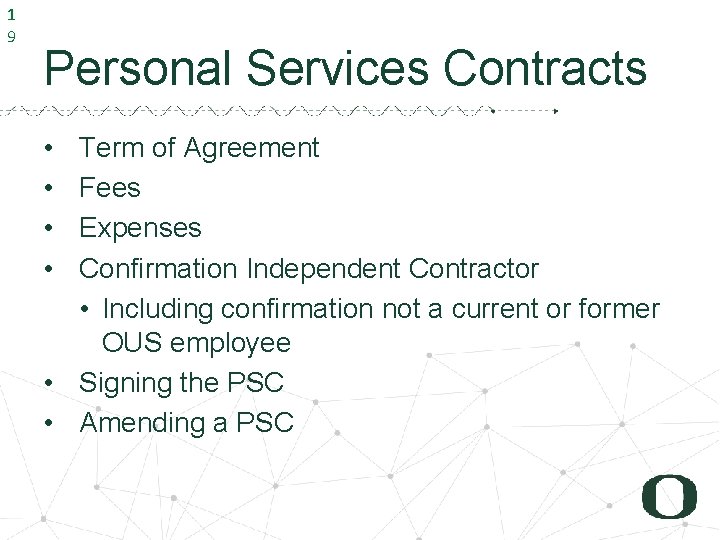
1 9 Personal Services Contracts • • Term of Agreement Fees Expenses Confirmation Independent Contractor • Including confirmation not a current or former OUS employee • Signing the PSC • Amending a PSC
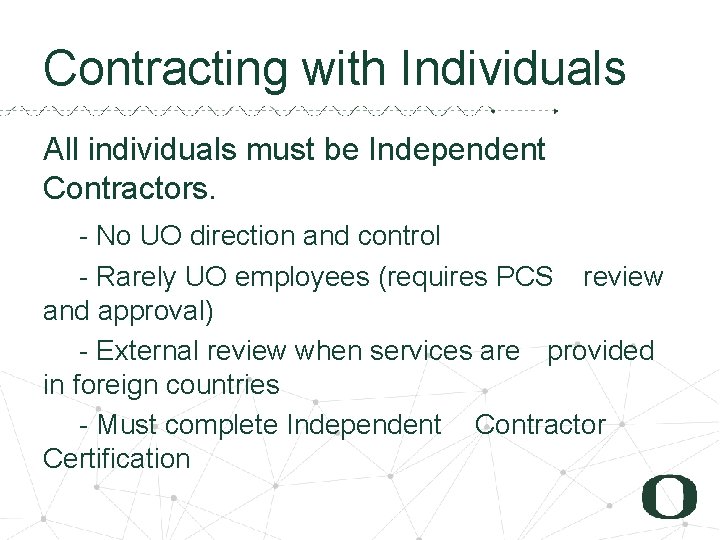
2 0 Contracting with Individuals All individuals must be Independent Contractors. - No UO direction and control - Rarely UO employees (requires PCS review and approval) - External review when services are provided in foreign countries - Must complete Independent Contractor Certification
2 1 Facility Use Agreement • • • Completing the form Legal Name Purpose of Rental Dates Rental Fees Insurance Requirements
2 2 Purchase Orders Completing Form Paper PO Banner PO Contractor’s/Entity’s Legal Name Referencing a Contract State of Oregon Other Price Agreements/Contracts Referencing Vendor Quotes
2 3 Purchase Orders, cont. • Terms & Conditions Check boxes • Insurance Certificates of Insurance Endorsements • Signing the Purchase Order • Entering Payment
UO Standard Terms and Conditions • If delegated by PCS, you may use UO’s Standard Terms and conditions to execute vendor paper. • Only applicable to Contracts under $25, 000. • Affix provided stamp, and attach most current terms • You must still read and understand all vendor terms. • You must still acquire any applicable approvals in accordance with the approvals list. • Vendors are required to carry applicable insurance, don’t sign until you have a certificate.
e. Procurement COMING SOON!
Execute an Agreement: Common Disputed Terms • • EEO FERPA Insurance Indemnification Infringement Gov. Law Ownership of IP • Limitations of Liability • Payment terms • SOW
Administer the Contract • READ THE CONTRACT • Track vendor performance in comparison to contract • Ensure UO meets its responsibilities/dependencies • Look for opportunities to make the deal better for everyone.
Amending, Renewing and Termination • Contract Amendments must be processed by PCS • Be aware of contractual mechanisms for renewal, and expiration • If a conflict with the vendor arises, be aware of your options to terminate • All amendments, renewals, and terminations must conform to procurement rules
Long Term Procurement Planning • Know all existing contracts, when the expire, and what steps are necessary replace them • When planning new business initiatives, work with PCS to include procurement planning into your over business plan • Review annually, update when needed • Avoid needless emergencies, retain UO’s leverage!
3 0 Tools & Support • • • Policy Training Templates Written Procedures and Instructions Website Direct assistance from PCS Staff via phone, email and in -person meetings • Each department is assigned a Contracts Officer and Contracts Tech. If you do not know yours let us know and we’ll put you in touch with them!