
PROCTER GAMBLEGILLETTE MERGER By Christine Cruell Kamika Hemphill
PROCTER & GAMBLEGILLETTE MERGER By: Christine Cruell Kamika Hemphill Antjuan Seawright Jonathan Toney
EXECUTIVE SUMMARY
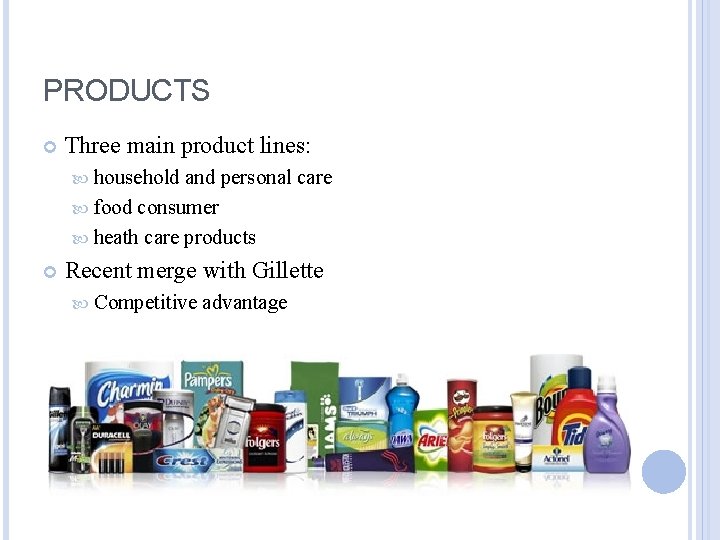
PRODUCTS Three main product lines: household and personal care food consumer heath care products Recent merge with Gillette Competitive advantage
DOMINANT FIRMS Procter and Gamble, Nestle, Unilever, L’Oreal, Colgate. Palmolive, Revlon, Bic, Pepsi. Co, Sara Lee, and Kimberly Clark. Success factors: positive brand image availability of products the ease of access
VISION AND MISSION Vision “Be, and be recognized as, the best consumer products and services in the world” Mission “Procter and Gamble will continue to serve consumers by continuously innovating products that will allow us to be leaders in household and personal care, health care, and food products. To produce products with the utmost care to give nothing but quality to our communities. And to continue to grow so that we can maximize our shareholder’s wealth. ”

EXTERNAL ENVIRONMENT
EXTERNAL ENVIRONMENT Economic Factors Social Factors Technological Factors Political Factors Ecological Factors
ECONOMIC FACTORS Concerned with nature and direction of economy in which the CP industry Threat/Opportunity SOCIAL Concerned with beliefs, values, opinions, and lifestyles of people Threat/Opportunity
TECHNOLOGICAL FACTORS Focus on technological changes affecting the industry: New Products, improvement in existing products, manufacturing and marketing techniques T hreat/Opportunity
INDUSTRY ANALYSIS
CONSUMER GOODS INDUSTRY 5 FORCES MODEL Buyers: large impact on industry Large retailers-Wal-Mart, Kmart, Target Rivalry: keeps industry thriving Differentiation, advertising, promotions, price, customer service and quality Threats to Entry: heavy impact on industry productivity Mergers and acquisitions
CONSUMER GOODS INDUSTRY 5 FORCES MODEL CONT… Substitutes: no huge impact Competitive products replacement Private label brands and small label brands-only real substitutes Suppliers: no threat to the industry Raw materials can be obtained anywhere
COMPANY PROFILE
VALUE CHAIN ANALYSIS Primary Activity Marketing and Sales=Brand Recognition Support Activities Research Technology-RFID
FINANCIAL ANALYSIS
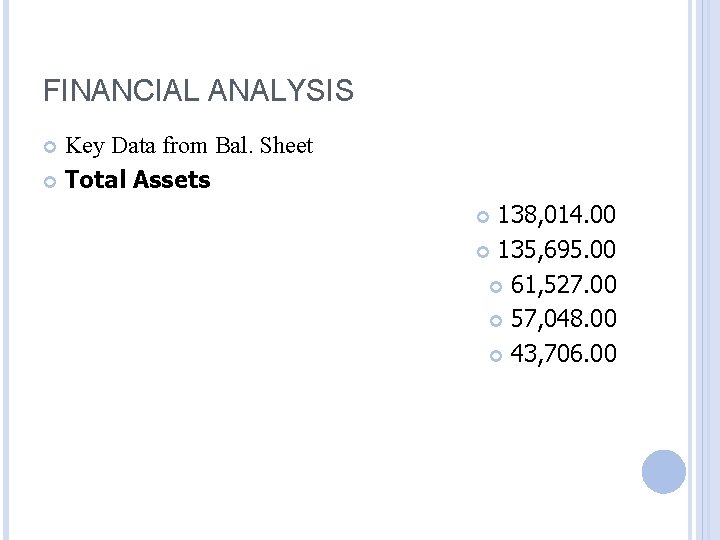
FINANCIAL ANALYSIS Key Data from Bal. Sheet Total Assets 138, 014. 00 135, 695. 00 61, 527. 00 57, 048. 00 43, 706. 00
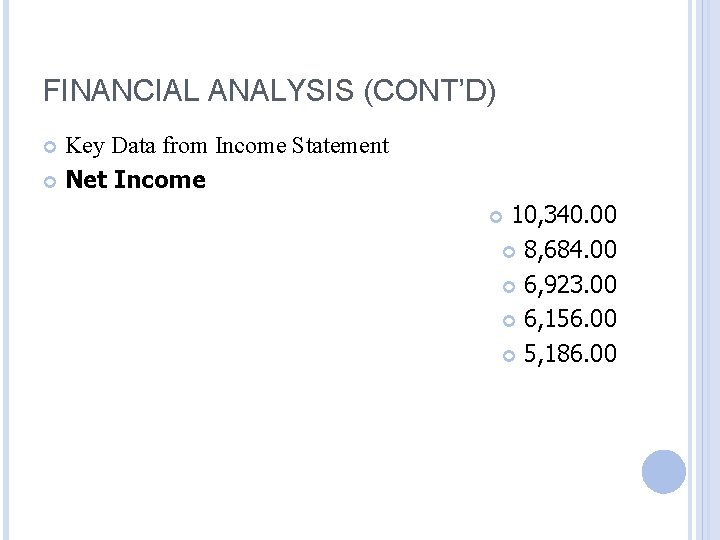
FINANCIAL ANALYSIS (CONT’D) Key Data from Income Statement Net Income 10, 340. 00 8, 684. 00 6, 923. 00 6, 156. 00 5, 186. 00
FINANCIAL ANALYSIS (CONT’D) Key Ratio’s Gross Margin Debt/Equity Ratio Current Ratio Quick Ratio Return On Equity Return On Assets Return On Capital
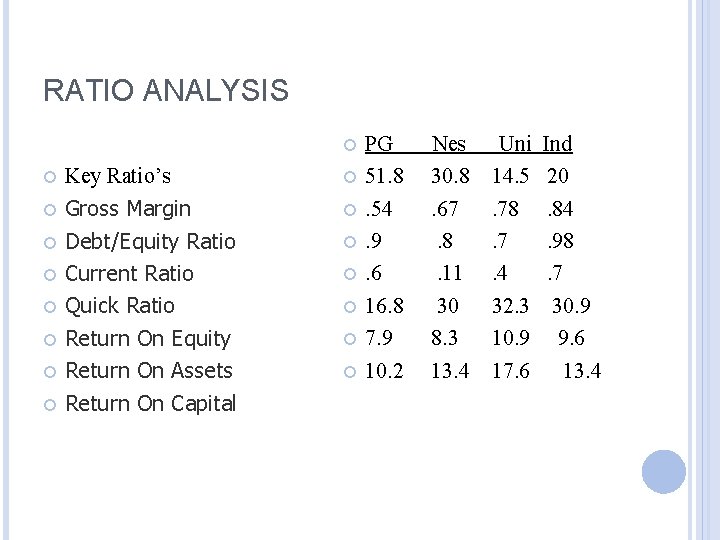
RATIO ANALYSIS Key Ratio’s Gross Margin Debt/Equity Ratio Current Ratio Quick Ratio Return On Equity Return On Assets Return On Capital PG 51. 8. 54. 9. 6 16. 8 7. 9 10. 2 Nes 30. 8. 67. 8. 11 30 8. 3 13. 4 Uni 14. 5. 78. 7. 4 32. 3 10. 9 17. 6 Ind 20. 84. 98. 7 30. 9 9. 6 13. 4
SWOT SUMMARY/CORE ISSUE
SWOT Strengths product variety and diversification Line of shaving /grooming products Supply chain technology Weaknesses Constant innovation= higher prices for consumers
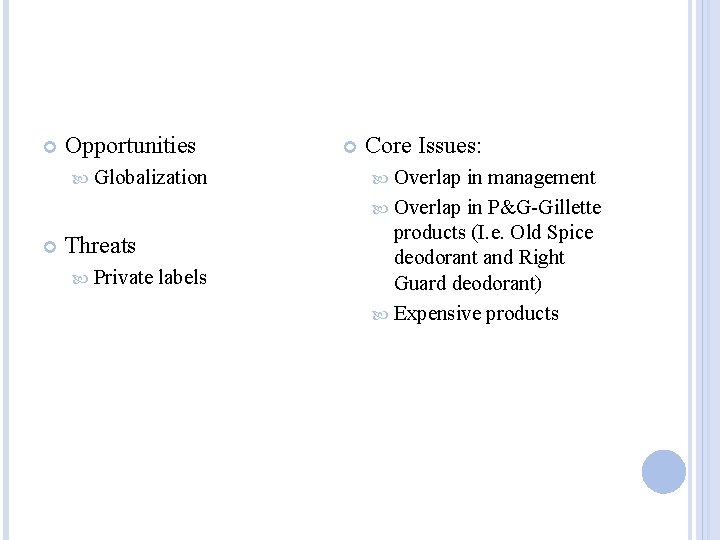
Opportunities Globalization Threats Private labels Core Issues: Overlap in management Overlap in P&G-Gillette products (I. e. Old Spice deodorant and Right Guard deodorant) Expensive products
LONG TERM OBJECTIVE AND STRATEGIC SCENARIOS
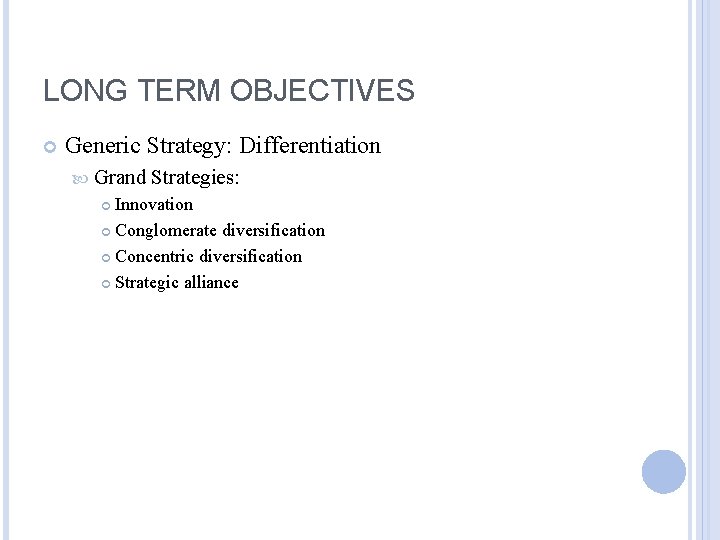
LONG TERM OBJECTIVES Generic Strategy: Differentiation Grand Strategies: Innovation Conglomerate diversification Concentric diversification Strategic alliance
SCENARIOS Best Worst Likely
CORPORATE LEVEL STRATEGIC ALTERNATIVES
CORPORATE LEVEL STRATEGY Stay in same SBU’S Get into new SBU’S Keys to success Proper asset mgmt Possible change of mission statement
CORP LEVEL STRATEGY Best Case Expand to new mkts Grow by 30% Worst Case Lose Mkt share Fail to expand Most Likely Grow by 10% Continue current corporate strategies
BUSINESS LEVEL STRATEGIC ALTERNATIVES
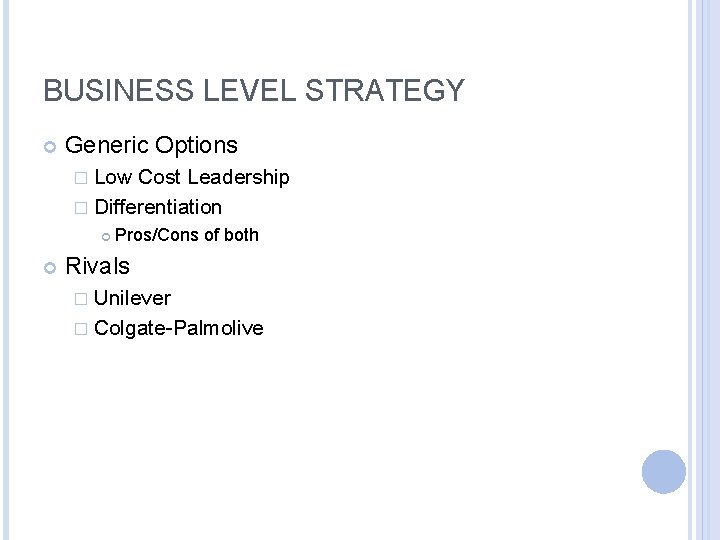
BUSINESS LEVEL STRATEGY Generic Options � Low Cost Leadership � Differentiation Pros/Cons of both Rivals � Unilever � Colgate-Palmolive
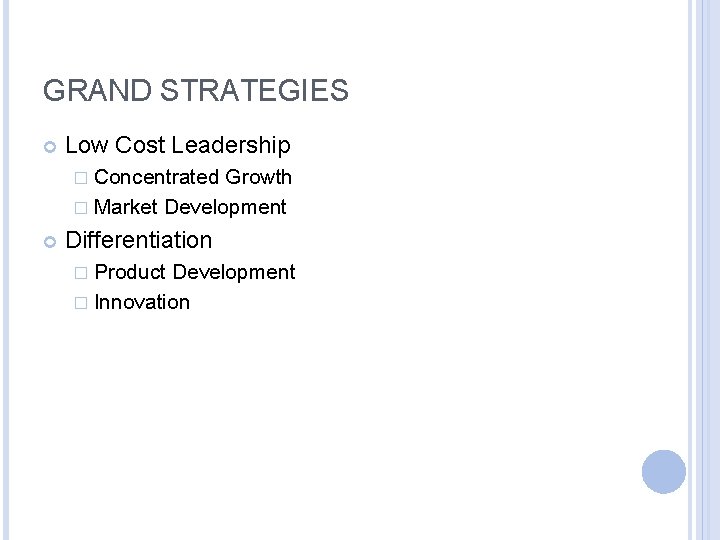
GRAND STRATEGIES Low Cost Leadership � Concentrated Growth � Market Development Differentiation � Product Development � Innovation
STRATEGIC CHOICE
STRATEGIC CHOICE Corporate level strategy: Get into new SBU’s.
- Slides: 33