
Procon Debate Continuous CRRT vs Intermittent Dialysis IRRT
Pro/con Debate: Continuous (CRRT) vs Intermittent Dialysis (IRRT) for AKI : a never-ending story yet approaching the finish? www. akronchildrens. org/giving
Case • The patient was the smaller of a pair of twins delivered by a 24 year-old primigravida at an outside institution. Because of this twin’s intrauterine growth retardation, labor was induced at 36 weeks gestation. • At birth, he weighed 3 pounds and 9 ounces. Over the first 9 days of life, he required intravenous (IV) glucose in addition to his Isomil feeds to maintain euglycemia. He was switched to breast milk on day 9 and subsequently developed feeding intolerance and emesis. • On day 10, he became lethargic and developed a strong body odor. Laboratory tests revealed mildly elevated serum ammonia (206 mmol/L) with no acidosis. • The next day he became progressively more lethargic and subsequently comatose; his serum ammonia was 1, 396 mmol/L and there was no acidosis. At this time, he was transferred to our hospital. www. akronchildrens. org/giving
Case • The patient’s clinical signs and symptoms are suggestive of an inborn error of metabolism. The markedly elevated serum ammonia level suggests a urea cycle disorder; however, other metabolic causes of hyperammonemia including organic acidemias are in the differential diagnosis. • Since a urea cycle disorder was considered the most likely possibility among the possible causes of hyperammonemia in infants, the patient was started on parenteral arginine in an effort to reduce the ammonia levels. www. akronchildrens. org/giving
Choice between a Rolls and a Ferrari? • Solute removal with IRRT at the origin essentially made use of diffusion – that is, gradient related molecule shifts in a liquid milieu from higher to lower concentration gradients • CRRT started as a convective strategy, driven by removal of solute-containing ultrafiltrate through large pores and its replacement by substitution fluid AJKD, 2014 Feb; 63(2): 329 -45 www. akronchildrens. org/giving

Hyperammonemia • Infants with hyperammonemia present with lethargy, hypotonia, and tachypnea • Worse outcome is associated with persistently elevated ammonia (>800 μmol/L) for >24 h or prolonged coma • Prompt treatment is critical to rapidly clear ammonia and minimize morbidity Eur J Ped , 2011 Jan; 170(1): 21 -34 www. akronchildrens. org/giving
Small Solute Removal in Acute Life-Threatening Conditions IRRT has a more efficient immediate effect than CRRT when small water-soluble compounds are to be removed in an acute life threatening condition because of the high blood and dialysate flows that can be achieved, resulting in a superior clearance and mass transfer per time unit ü Severe hyperkalemia ü Especially in the initiation phase of AKI ü Aftermath of disasters ü IEM ü Tumor lysis syndrome and certain cases of poisoning www. akronchildrens. org/giving
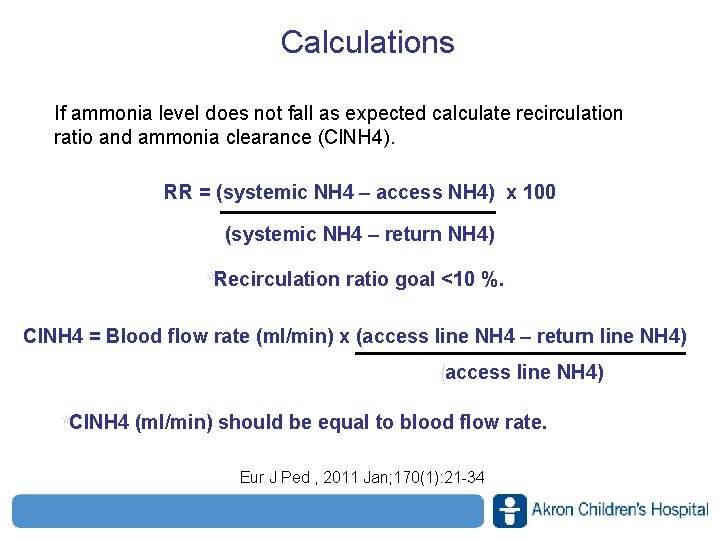
Calculations If ammonia level does not fall as expected calculate recirculation ratio and ammonia clearance (Cl. NH 4). RR = (systemic NH 4 – access NH 4) x 100 (systemic NH 4 – return NH 4) *Recirculation ratio goal <10 %. Cl. NH 4 = Blood flow rate (ml/min) x (access line NH 4 – return line NH 4) (access line NH 4) *Cl. NH 4 (ml/min) should be equal to blood flow rate. Eur J Ped , 2011 Jan; 170(1): 21 -34 www. akronchildrens. org/giving
Solute Removal • CRRT promotes solute removal due to better mobilization from extraplasmatic compartments • More down time with CRRT vs IRRT due to filter exchange • ? But higher intensity of solute removal leads to greater removal of drugs resulting in inadequate drug concentrations (for example, of antimicrobials) or more electrolyte disturbances • Removal of cytokines and other large molecules can be obtained just as well, if not better, with IRRT or SLEDD, with large pore size (socalled high-flux membranes) • No survival advantage of more efficient removal over standard removal. Intensive Care Med 1997, 23: 288 -296 and Crit Care Med 2010, 38: 1360 -1369 www. akronchildrens. org/giving
Caveats to CRRT • No evidence from randomized trials to support survival advantage • Risk of complications related to anticoagulation is higher • Training and equipment costs www. akronchildrens. org/giving
On line Equipments: Power Tools for Acute Hemodialysis not Too Tricky Tricks… …. . I am not dealing with old Hemodialysis Machine • Blood volume continuous monitoring (BVM) : refilling capacity test, secured and optimized UF • Blood thermal monitoring (BTM) : vascular stability, regional blood flow potential impact • HDF procedure : allowed sequential UF, HD, adapted to the individual patient needs, and evolution; on-line HDF provide for the restitutionhemofiltration fluid (possibility for adapted sodim concentration) • Profiled prescriptions: UFrate at the best intermittent (refilling time), Na. D not too high (interstitial storage, oedema) • Clearance and dialysis dose measurement, dialysis efficiency: slow (urea osmotic tolerance) but controlled purification (potassium gradient) www. akronchildrens. org/giving
Practicality and Flexibility of Application • IRRT also allows more liberty for patient care and investigations outside the treatment and monitoring unit, by offering a dialysis-free period, without loss of dialysis time or adequacy • IRRT machines can be used in an extended protracted mode when needed, and the treatment time can be decreased coupled to an increase in efficacy when the condition of the patient improves • CRRT machines, do not allow an increase of the intensity of the treatment to allow shorter treatments Crit Care 2010, 14: R 46 www. akronchildrens. org/giving
Summary • Modality: No overall benefit to CRRT compared to IHD, though CRRT may be better for patients at risk of increased ICP and for volume control • Dose: No benefit to “intensive” therapy, but delivered dose of both CRRT and IHD must be monitored to ensure minimum adequate dose • Anticoagulation: Citrate is gaining wider acceptance as the preferred anticoagulation for CRRT • Buffer: Bicarbonate should be the buffer in dialysate and replacement fluid for RRT in patients with AKI, especially with liver failure and/or lactic acidemia www. akronchildrens. org/giving
- Slides: 12