
Processor Organization CPU must do l l l





- Slides: 27
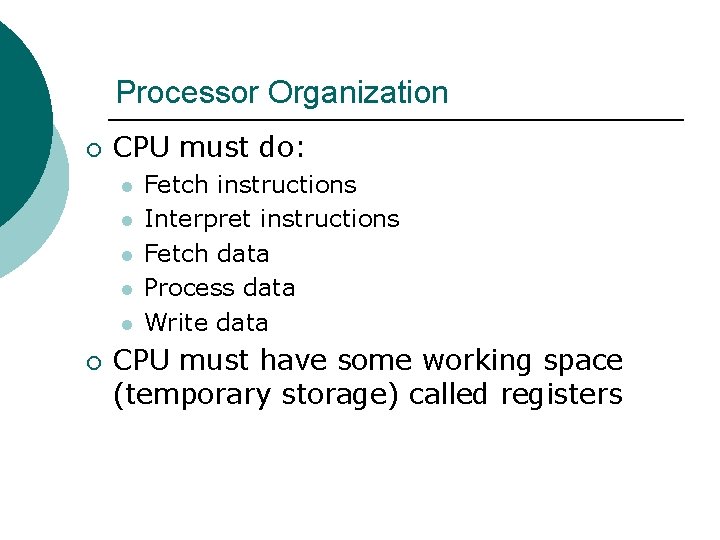
Processor Organization ¡ CPU must do: l l l ¡ Fetch instructions Interpret instructions Fetch data Process data Write data CPU must have some working space (temporary storage) called registers
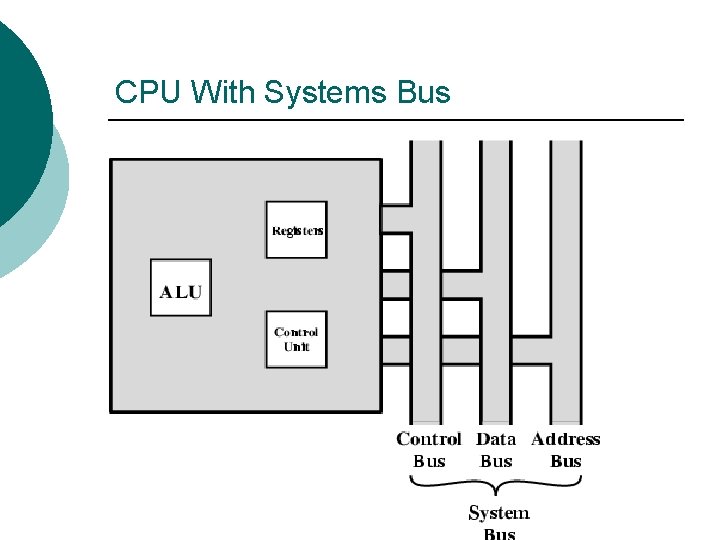
CPU With Systems Bus
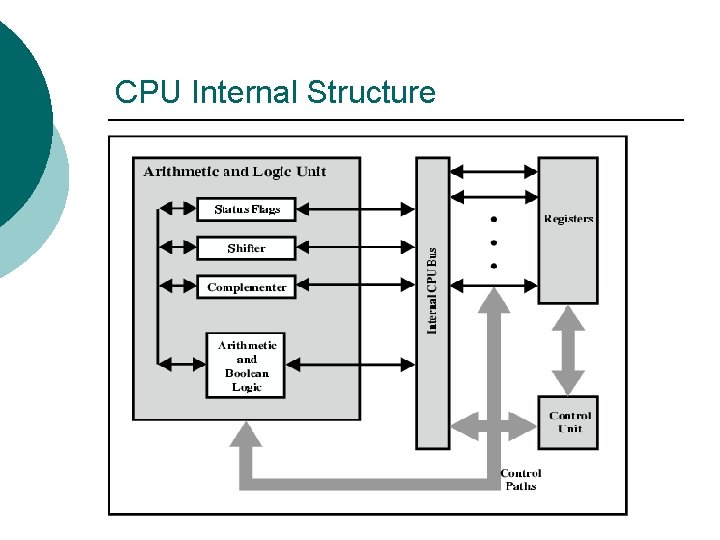
CPU Internal Structure
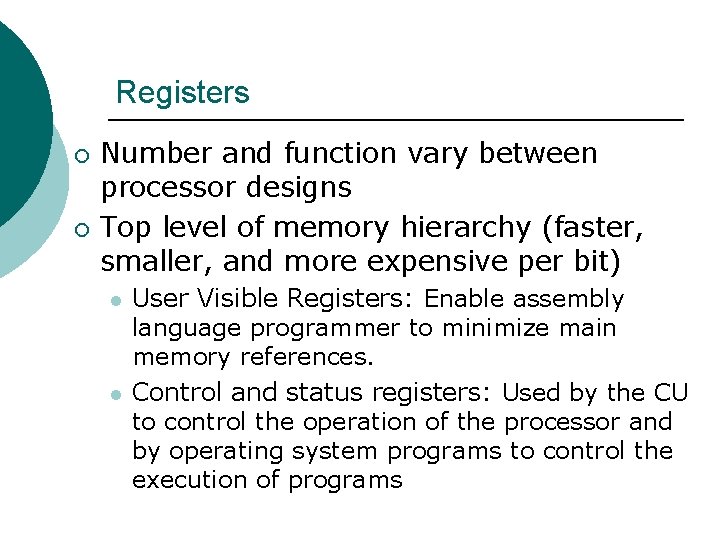
Registers ¡ ¡ Number and function vary between processor designs Top level of memory hierarchy (faster, smaller, and more expensive per bit) l l User Visible Registers: Enable assembly language programmer to minimize main memory references. Control and status registers: Used by the CU to control the operation of the processor and by operating system programs to control the execution of programs
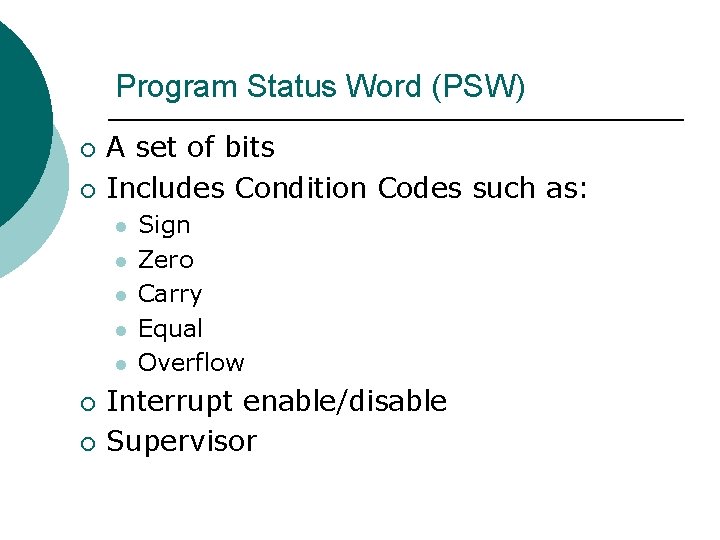
Program Status Word (PSW) ¡ ¡ A set of bits Includes Condition Codes such as: l l l ¡ ¡ Sign Zero Carry Equal Overflow Interrupt enable/disable Supervisor
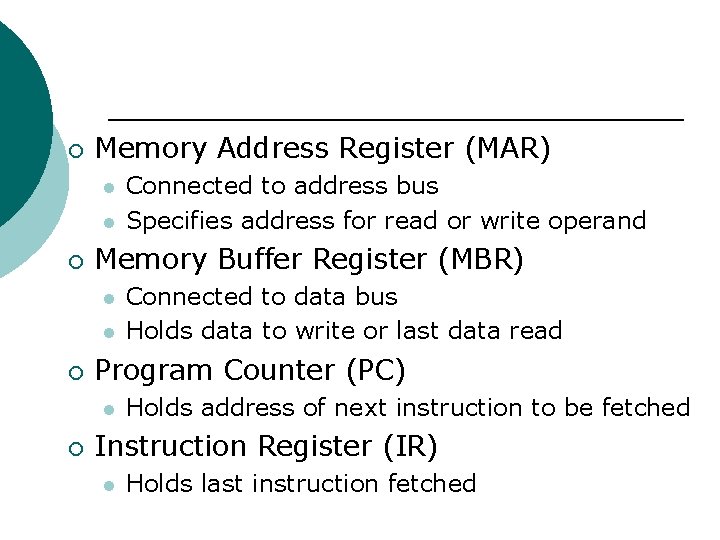
¡ Memory Address Register (MAR) l l ¡ Memory Buffer Register (MBR) l l ¡ Connected to data bus Holds data to write or last data read Program Counter (PC) l ¡ Connected to address bus Specifies address for read or write operand Holds address of next instruction to be fetched Instruction Register (IR) l Holds last instruction fetched
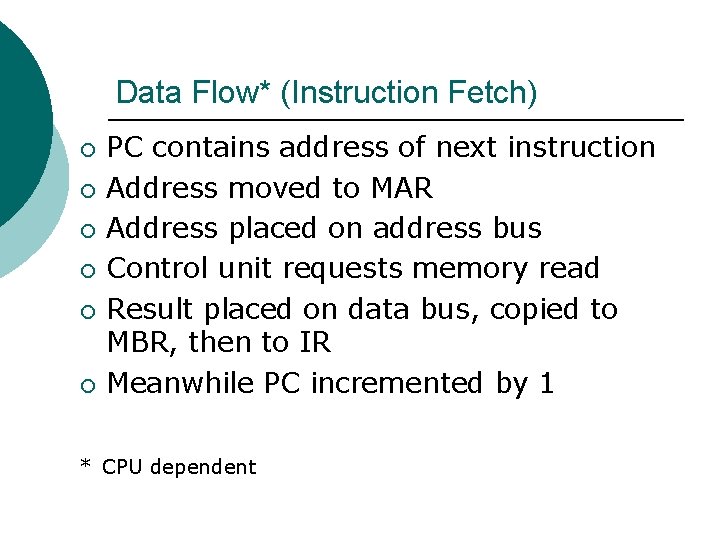
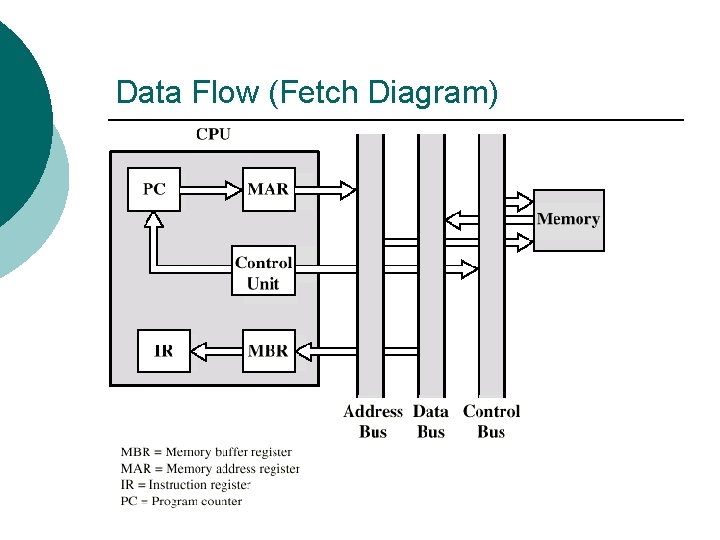
Data Flow* (Instruction Fetch) ¡ ¡ ¡ PC contains address of next instruction Address moved to MAR Address placed on address bus Control unit requests memory read Result placed on data bus, copied to MBR, then to IR Meanwhile PC incremented by 1 * CPU dependent
Data Flow (Fetch Diagram)
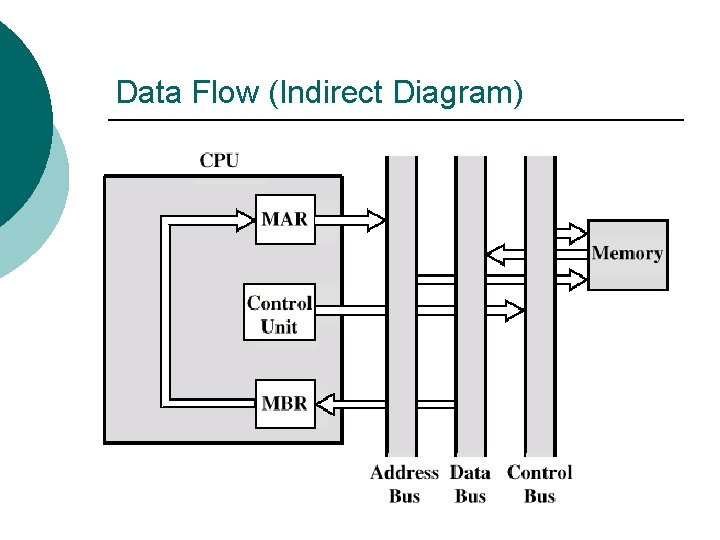
Data Flow (Data Fetch) ¡ ¡ IR is examined If indirect addressing, indirect cycle is performed l l l Right most N bits of MBR (address reference) transferred to MAR Control unit requests memory read Result (address of operand) moved to MBR
Data Flow (Indirect Diagram)
Instruction Cycle with Indirect
Instruction Cycle State Diagram
Data Flow (Execute) ¡ ¡ ¡ May take many forms Depends on instruction being executed May include: l l Memory read/write Input/Output read/write Register transfers ALU operations
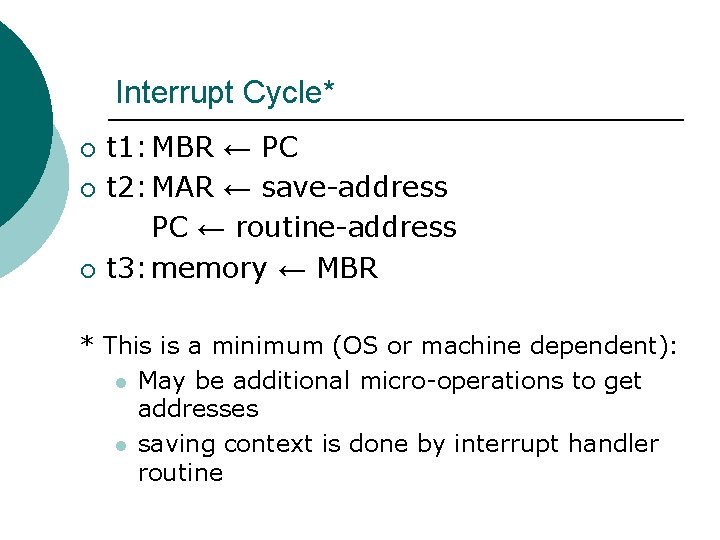
Data Flow (Interrupt) ¡ ¡ ¡ Current PC saved to allow resumption after interrupt Contents of PC copied to MBR Special memory location (e. g. stack pointer) loaded to MAR MBR written to memory PC loaded with address of interrupt handling routine (OS) Next instruction (first of interrupt handler) can be fetched
Data Flow (Interrupt Diagram)
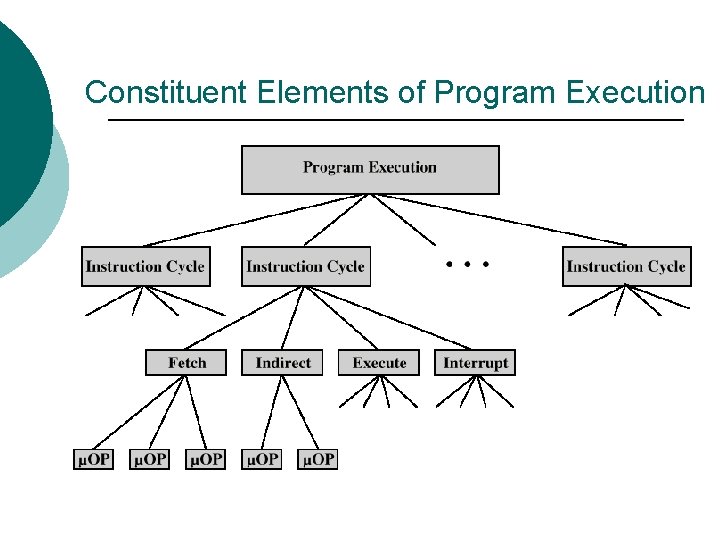
Constituent Elements of Program Execution
Micro-Operations ¡ ¡ A computer executes a program Fetch/execute cycle Each cycle has a number of steps called micro-operations Each micro-operation does very little e. g. : l l l a transfer between registers a transfer between a register and an external bus a simple ALU operation
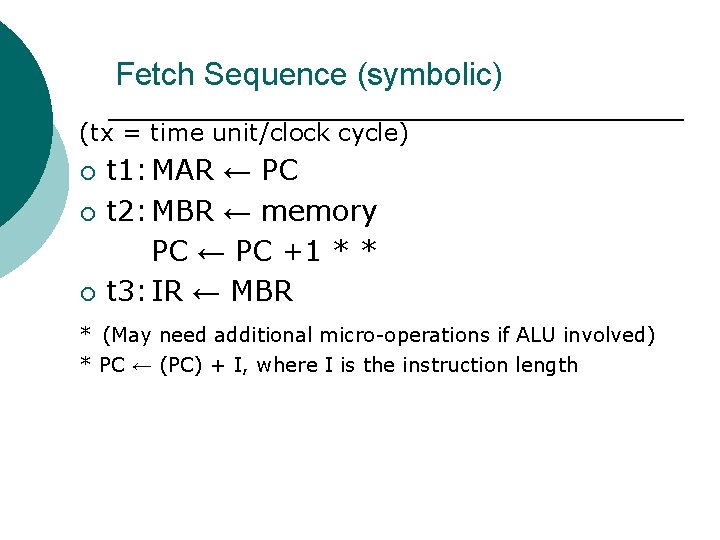
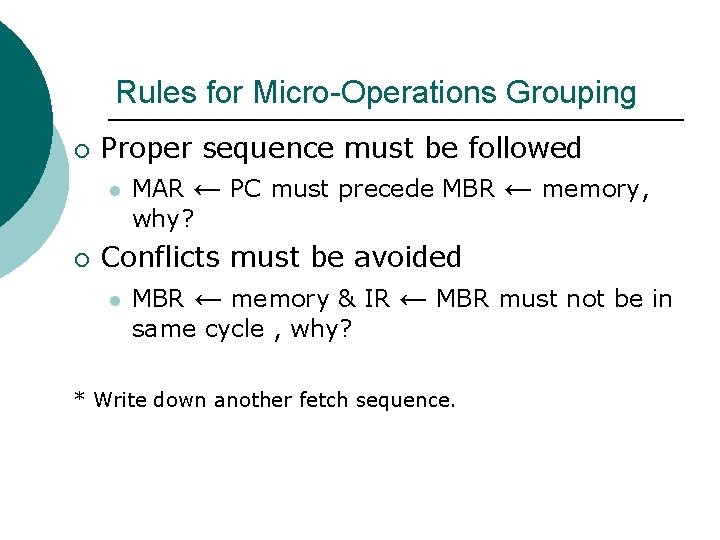
Fetch Sequence (symbolic) (tx = time unit/clock cycle) ¡ ¡ ¡ t 1: MAR ← PC t 2: MBR ← memory PC ← PC +1 * * t 3: IR ← MBR * (May need additional micro-operations if ALU involved) * PC ← (PC) + I, where I is the instruction length
Rules for Micro-Operations Grouping ¡ Proper sequence must be followed l MAR ← PC must precede MBR ← memory, why? ¡ Conflicts must be avoided l MBR ← memory & IR ← MBR must not be in same cycle , why? * Write down another fetch sequence.
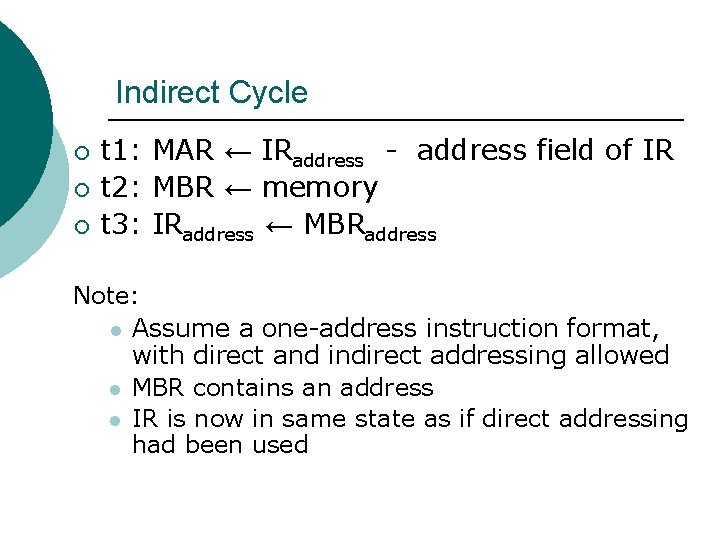
Indirect Cycle ¡ ¡ ¡ t 1: MAR ← IRaddress - address field of IR t 2: MBR ← memory t 3: IRaddress ← MBRaddress Note: l Assume a one-address instruction format, with direct and indirect addressing allowed l MBR contains an address l IR is now in same state as if direct addressing had been used
Interrupt Cycle* ¡ ¡ ¡ t 1: MBR ← PC t 2: MAR ← save-address PC ← routine-address t 3: memory ← MBR * This is a minimum (OS or machine dependent): l May be additional micro-operations to get addresses l saving context is done by interrupt handler routine
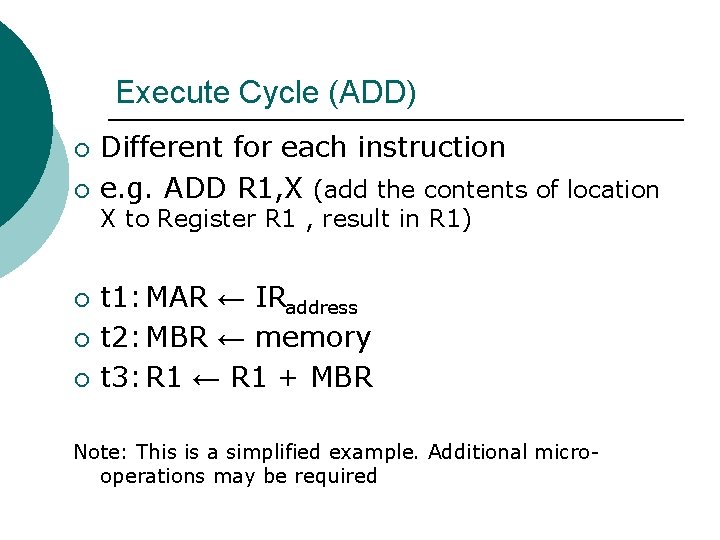
Execute Cycle (ADD) ¡ ¡ Different for each instruction e. g. ADD R 1, X (add the contents of location X to Register R 1 , result in R 1) ¡ ¡ ¡ t 1: MAR ← IRaddress t 2: MBR ← memory t 3: R 1 ← R 1 + MBR Note: This is a simplified example. Additional microoperations may be required
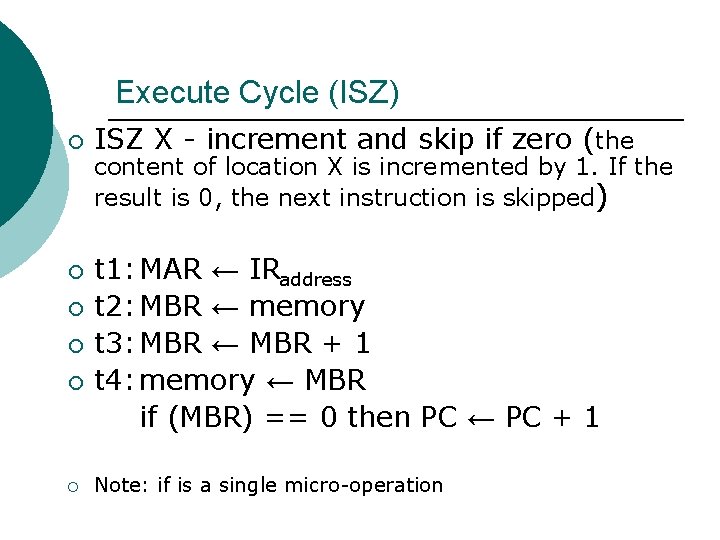
Execute Cycle (ISZ) ¡ ¡ ¡ ISZ X - increment and skip if zero (the content of location X is incremented by 1. If the result is 0, the next instruction is skipped) t 1: MAR ← IRaddress t 2: MBR ← memory t 3: MBR ← MBR + 1 t 4: memory ← MBR if (MBR) == 0 then PC ← PC + 1 Note: if is a single micro-operation
Execute Cycle (BSA) ¡ BSA X - Branch and save address (subroutine call: address of instruction following BSA is saved in X, Execution continues from X+K) ¡ ¡ ¡ t 1: MAR ← IRaddress MBR ← PC t 2: PC ← IRaddress memory ← MBR t 3: PC ← PC + K
Instruction Cycle ¡ ¡ ¡ Each sub-cycle decomposed into sequence of elementary micro-operations one sequence of micro-operations each for the fetch, indirect, and interrupt subcycles Execute sub-cycle: One sequence of micro-operations for each instruction (opcode)
¡ Assume a new 2 -bit register instruction cycle code (ICC) designates which part of cycle processor is in: l l 00: 01: 10: 11: Fetch Indirect Execute Interrupt
Flowchart for Instruction Cycle