
Processor Design Pipeline Handling Hazards Adapted from Computer
- Slides: 46
Processor Design: Pipeline Handling Hazards [Adapted from Computer Organization and Design, Patterson & Hennessy, © 2005, UCB, and Irwin, PSU 2005] page
Summary • All modern day processors use pipelining • Pipelining doesn’t help latency of single task, it helps throughput of entire workload • Potential speedup: a CPI of 1 • Pipeline rate limited by slowest pipeline stage – Unbalanced pipe stages makes for inefficiencies – The time to “fill” pipeline and time to “drain” it can impact speedup for deep pipelines and short code runs • Inter instruction dependencies lead to hazard conditions – Data hazards: reading data before it is written – Control hazards: branch • Data and control hazards can lead to incorrect results – Must detect and resolve hazards – Stalling negatively affects CPI (makes CPI less than the ideal of 1) 10/22/2021 page 2
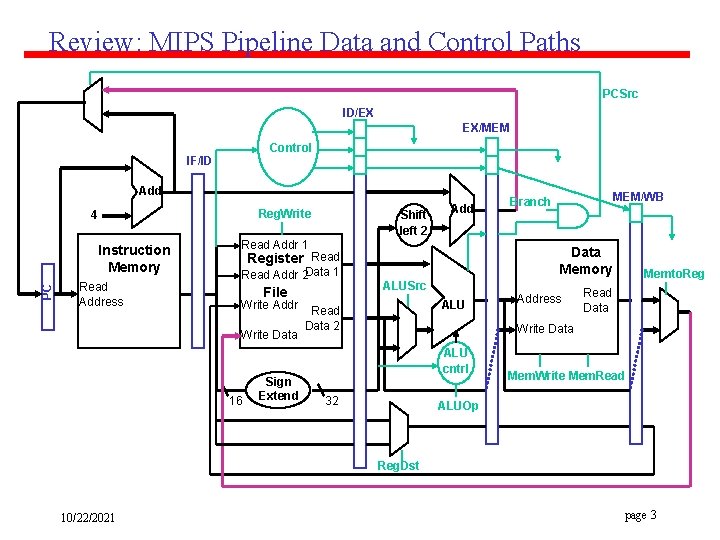
Review: MIPS Pipeline Data and Control Paths PCSrc ID/EX EX/MEM Control IF/ID Add Reg. Write 4 PC Instruction Memory Read Address Shift left 2 Add Read Addr 1 Data Memory Register Read Addr 2 Data 1 File Write Addr Write Data 16 Sign Extend MEM/WB Branch ALUSrc ALU Read Data 2 Address Memto. Reg Read Data Write Data ALU cntrl 32 Mem. Write Mem. Read ALUOp Reg. Dst 10/22/2021 page 3
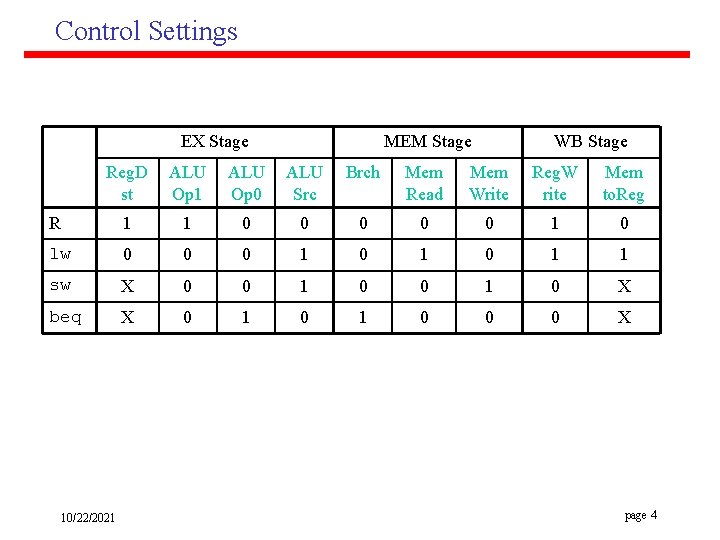
Control Settings EX Stage MEM Stage WB Stage Reg. D st ALU Op 1 ALU Op 0 ALU Src Brch Mem Read Mem Write Reg. W rite Mem to. Reg R 1 1 0 0 0 1 0 lw 0 0 0 1 0 1 1 sw X 0 0 1 0 X beq X 0 1 0 0 0 X 10/22/2021 page 4
Resolving Data Hazards 10/22/2021 page 5
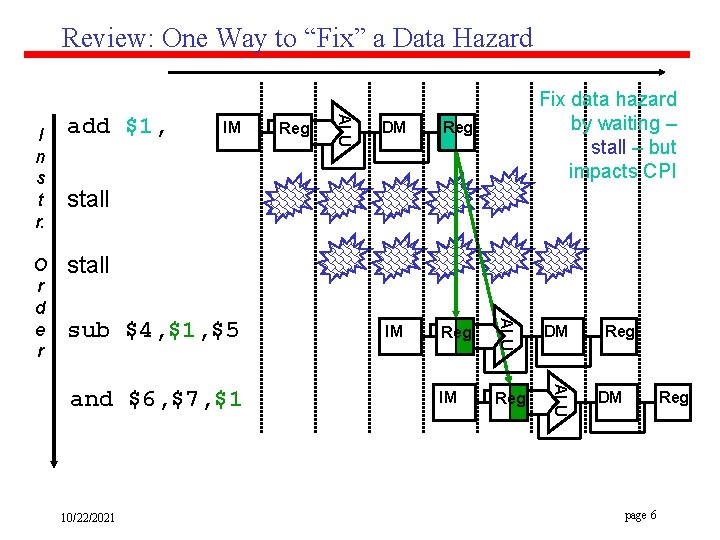
Review: One Way to “Fix” a Data Hazard Reg DM Reg IM Reg DM IM Reg ALU IM ALU O r d e r add $1, ALU I n s t r. Fix data hazard by waiting – stall – but impacts CPI stall sub $4, $1, $5 and $6, $7, $1 10/22/2021 Reg DM Reg page 6
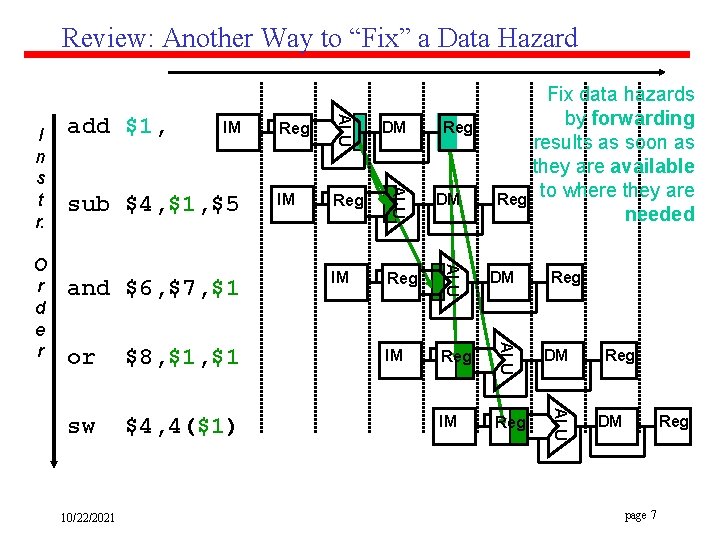
Review: Another Way to “Fix” a Data Hazard or $8, $1 sw $4, 4($1) 10/22/2021 IM Reg DM IM Reg ALU and $6, $7, $1 DM ALU sub $4, $1, $5 Reg ALU IM ALU O r d e r add $1, ALU I n s t r. Fix data hazards by forwarding results as soon as they are available to where they are Reg needed Reg Reg DM Reg page 7
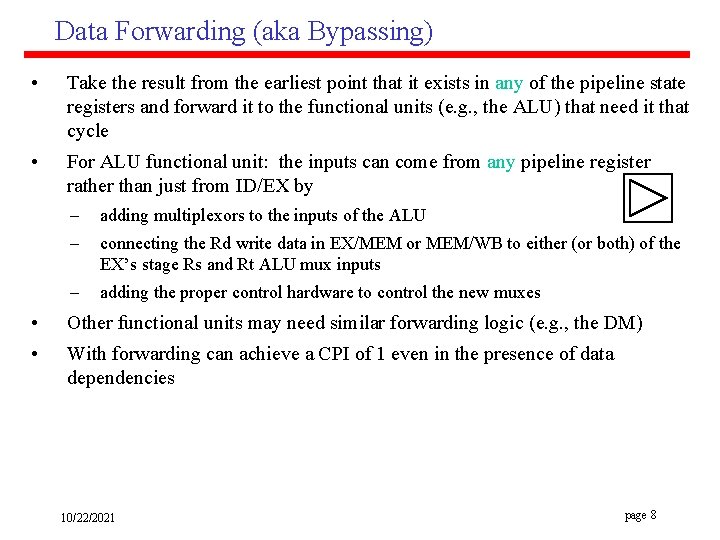
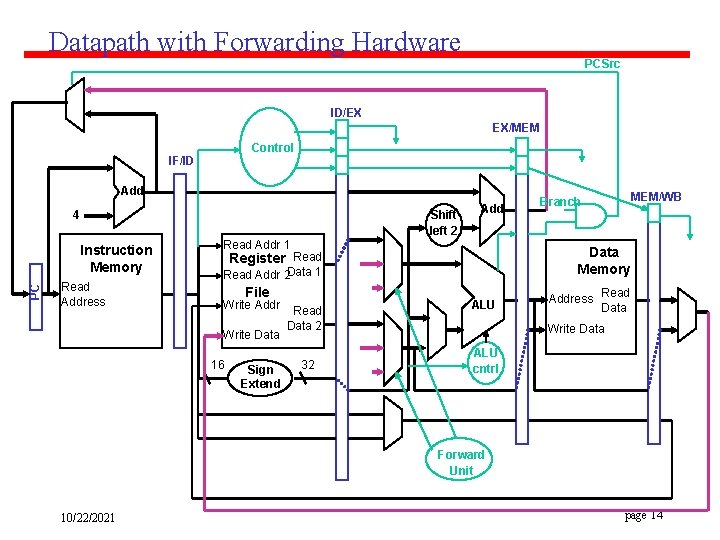
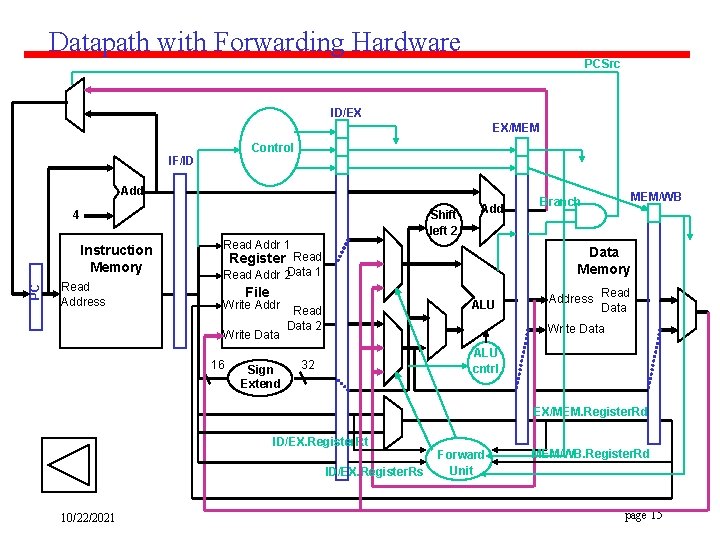
Data Forwarding (aka Bypassing) • Take the result from the earliest point that it exists in any of the pipeline state registers and forward it to the functional units (e. g. , the ALU) that need it that cycle • For ALU functional unit: the inputs can come from any pipeline register rather than just from ID/EX by – adding multiplexors to the inputs of the ALU – connecting the Rd write data in EX/MEM or MEM/WB to either (or both) of the EX’s stage Rs and Rt ALU mux inputs – adding the proper control hardware to control the new muxes • Other functional units may need similar forwarding logic (e. g. , the DM) • With forwarding can achieve a CPI of 1 even in the presence of data dependencies 10/22/2021 page 8
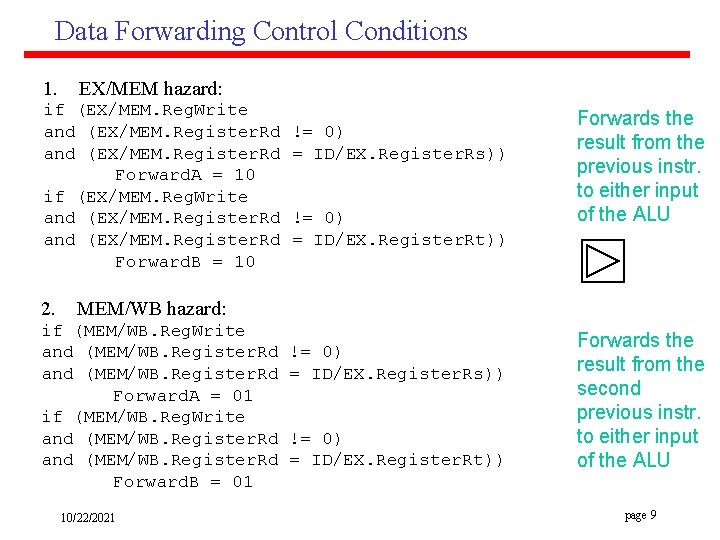
Data Forwarding Control Conditions 1. EX/MEM hazard: if (EX/MEM. Reg. Write and (EX/MEM. Register. Rd Forward. A = 10 if (EX/MEM. Reg. Write and (EX/MEM. Register. Rd Forward. B = 10 2. != 0) = ID/EX. Register. Rs)) != 0) = ID/EX. Register. Rt)) Forwards the result from the previous instr. to either input of the ALU MEM/WB hazard: if (MEM/WB. Reg. Write and (MEM/WB. Register. Rd Forward. A = 01 if (MEM/WB. Reg. Write and (MEM/WB. Register. Rd Forward. B = 01 10/22/2021 != 0) = ID/EX. Register. Rs)) != 0) = ID/EX. Register. Rt)) Forwards the result from the second previous instr. to either input of the ALU page 9
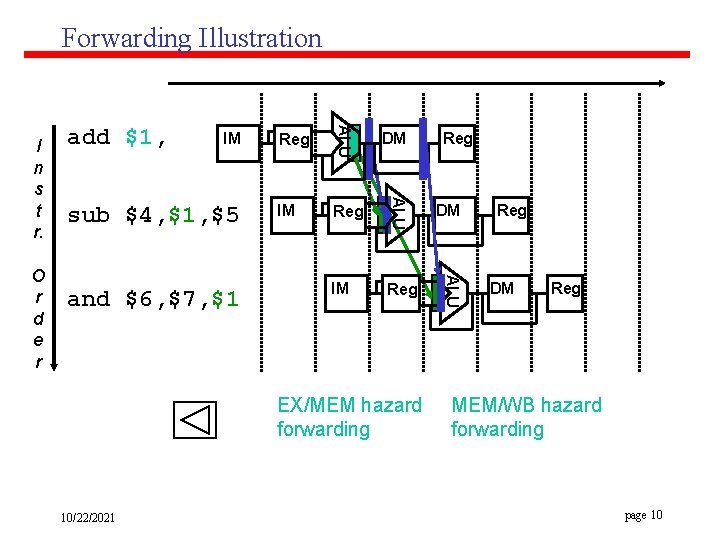
Forwarding Illustration sub $4, $1, $5 and $6, $7, $1 Reg DM IM Reg ALU IM ALU O r d e r add $1, ALU I n s t r. EX/MEM hazard forwarding 10/22/2021 Reg DM Reg MEM/WB hazard forwarding page 10
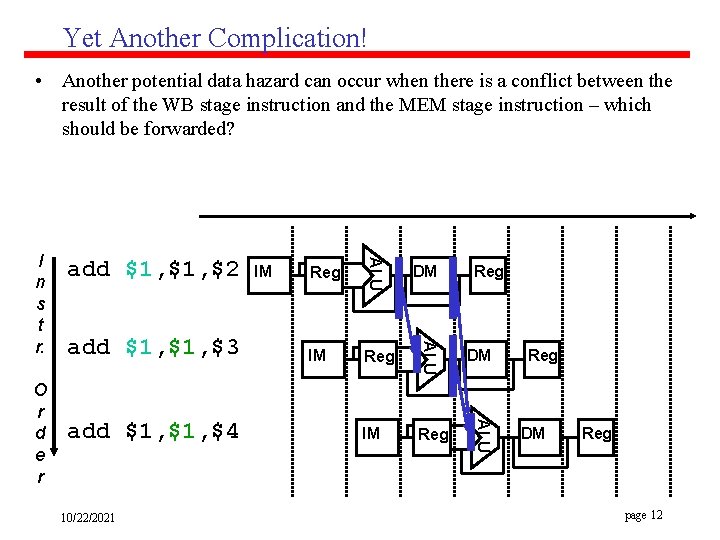
Yet Another Complication! • Another potential data hazard can occur when there is a conflict between the result of the WB stage instruction and the MEM stage instruction – which should be forwarded? add $1, $4 10/22/2021 Reg DM IM Reg ALU add $1, $3 IM ALU O r d e r add $1, $2 ALU I n s t r. Reg DM Reg page 12
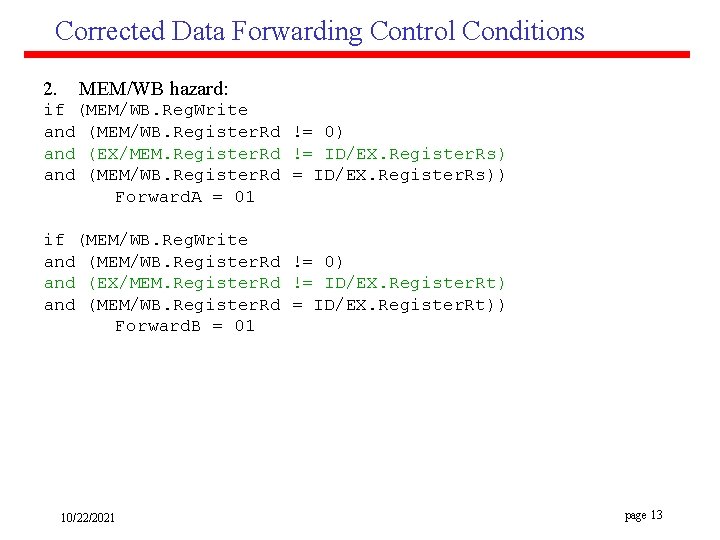
Corrected Data Forwarding Control Conditions 2. MEM/WB hazard: if (MEM/WB. Reg. Write and (MEM/WB. Register. Rd != 0) and (EX/MEM. Register. Rd != ID/EX. Register. Rs) and (MEM/WB. Register. Rd = ID/EX. Register. Rs)) Forward. A = 01 if (MEM/WB. Reg. Write and (MEM/WB. Register. Rd != 0) and (EX/MEM. Register. Rd != ID/EX. Register. Rt) and (MEM/WB. Register. Rd = ID/EX. Register. Rt)) Forward. B = 01 10/22/2021 page 13
Datapath with Forwarding Hardware PCSrc ID/EX EX/MEM Control IF/ID Add Shift left 2 4 PC Instruction Memory Read Address Add Read Addr 1 Data Memory Register Read Addr 2 Data 1 File Write Addr Write Data 16 Sign Extend Read Data 2 32 MEM/WB Branch ALU Address Read Data Write Data ALU cntrl Forward Unit 10/22/2021 page 14
Datapath with Forwarding Hardware PCSrc ID/EX EX/MEM Control IF/ID Add Shift left 2 4 PC Instruction Memory Read Address Add Read Addr 1 Data Memory Register Read Addr 2 Data 1 File Write Addr Write Data 16 Sign Extend MEM/WB Branch ALU Read Data 2 Address Read Data Write Data ALU cntrl 32 EX/MEM. Register. Rd ID/EX. Register. Rt ID/EX. Register. Rs 10/22/2021 Forward Unit MEM/WB. Register. Rd page 15
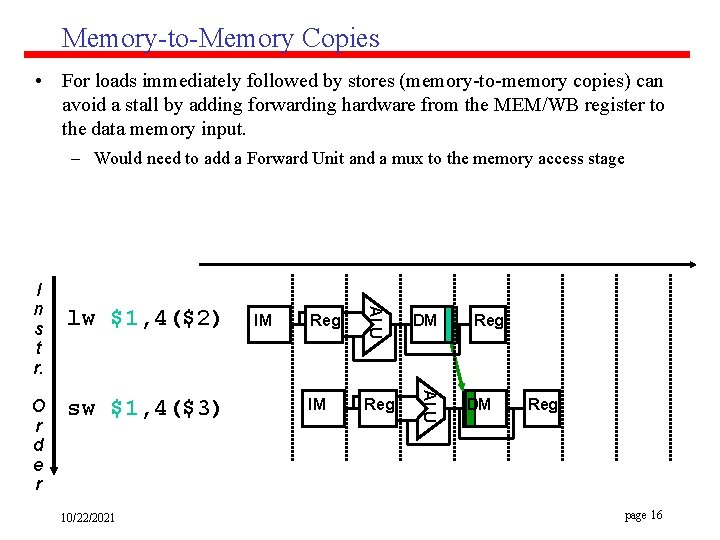
Memory-to-Memory Copies • For loads immediately followed by stores (memory-to-memory copies) can avoid a stall by adding forwarding hardware from the MEM/WB register to the data memory input. – Would need to add a Forward Unit and a mux to the memory access stage sw $1, 4($3) 10/22/2021 IM Reg DM IM Reg ALU O r d e r lw $1, 4($2) ALU I n s t r. Reg DM Reg page 16
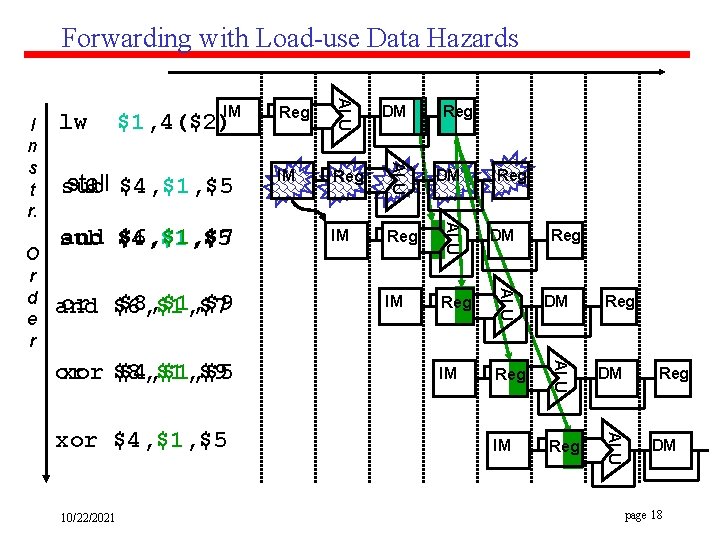
Forwarding with Load-use Data Hazards or xor $8, $1, $9 $4, $1, $5 xor $4, $1, $5 10/22/2021 Reg DM IM Reg ALU or $6, $1, $7 $8, $1, $9 and IM ALU and $4, $1, $5 $6, $1, $7 sub DM ALU stall $4, $1, $5 sub Reg ALU $1, 4($2)IM ALU O r d e r lw ALU I n s t r. Reg Reg Reg DM page 18
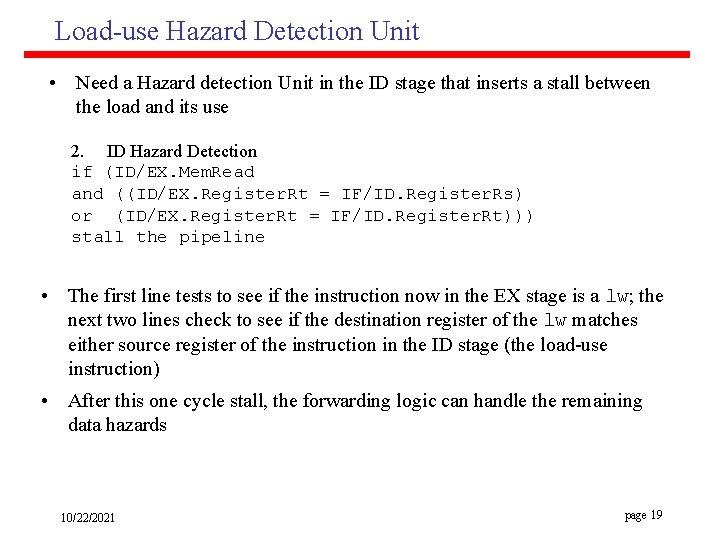
Load-use Hazard Detection Unit • Need a Hazard detection Unit in the ID stage that inserts a stall between the load and its use 2. ID Hazard Detection if (ID/EX. Mem. Read and ((ID/EX. Register. Rt = IF/ID. Register. Rs) or (ID/EX. Register. Rt = IF/ID. Register. Rt))) stall the pipeline • The first line tests to see if the instruction now in the EX stage is a lw; the next two lines check to see if the destination register of the lw matches either source register of the instruction in the ID stage (the load-use instruction) • After this one cycle stall, the forwarding logic can handle the remaining data hazards 10/22/2021 page 19
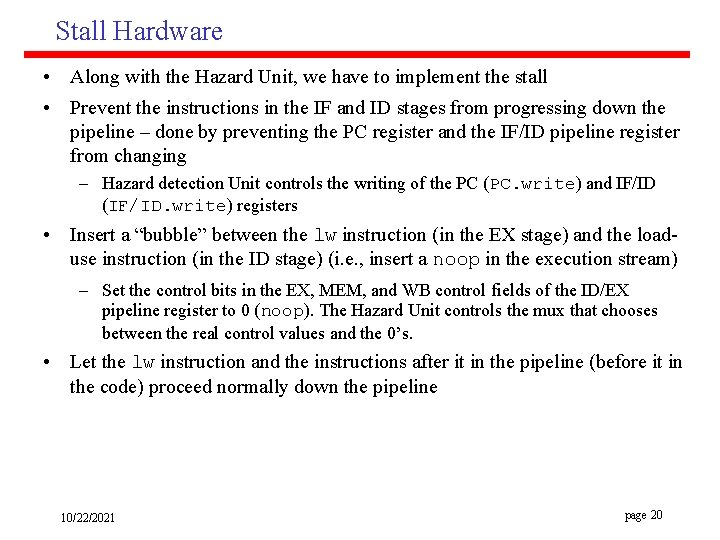
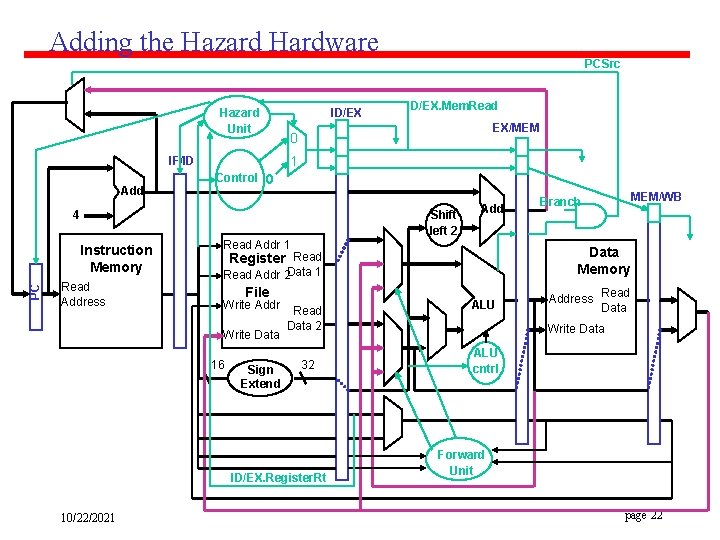
Stall Hardware • Along with the Hazard Unit, we have to implement the stall • Prevent the instructions in the IF and ID stages from progressing down the pipeline – done by preventing the PC register and the IF/ID pipeline register from changing – Hazard detection Unit controls the writing of the PC (PC. write) and IF/ID (IF/ID. write) registers • Insert a “bubble” between the lw instruction (in the EX stage) and the loaduse instruction (in the ID stage) (i. e. , insert a noop in the execution stream) – Set the control bits in the EX, MEM, and WB control fields of the ID/EX pipeline register to 0 (noop). The Hazard Unit controls the mux that chooses between the real control values and the 0’s. • Let the lw instruction and the instructions after it in the pipeline (before it in the code) proceed normally down the pipeline 10/22/2021 page 20
Adding the Hazard Hardware PCSrc Hazard Unit EX/MEM 0 Control 0 Shift left 2 4 Instruction Memory PC ID/EX. Mem. Read 1 IF/ID Add ID/EX Read Address Read Addr 1 Read Addr 2 Data 1 File Write Addr 16 Sign Extend Read Data 2 32 ID/EX. Register. Rt MEM/WB Branch Data Memory Register Read Write Data 10/22/2021 Add ALU Address Read Data Write Data ALU cntrl Forward Unit page 22
• Control Hazards 10/22/2021 page 23
Control Hazards • When the flow of instruction addresses is not sequential (i. e. , PC = PC + 4); incurred by change of flow instructions – Conditional branches (beq, bne) – Unconditional branches (j, jal, jr) – Exceptions • Possible approaches – Stall (impacts CPI) – Move decision point as early in the pipeline as possible, thereby reducing the number of stall cycles – Delay decision (requires compiler support) – Predict and hope for the best ! • Control hazards occur less frequently than data hazards, but there is nothing as effective against control hazards as forwarding is for data hazards 10/22/2021 page 24
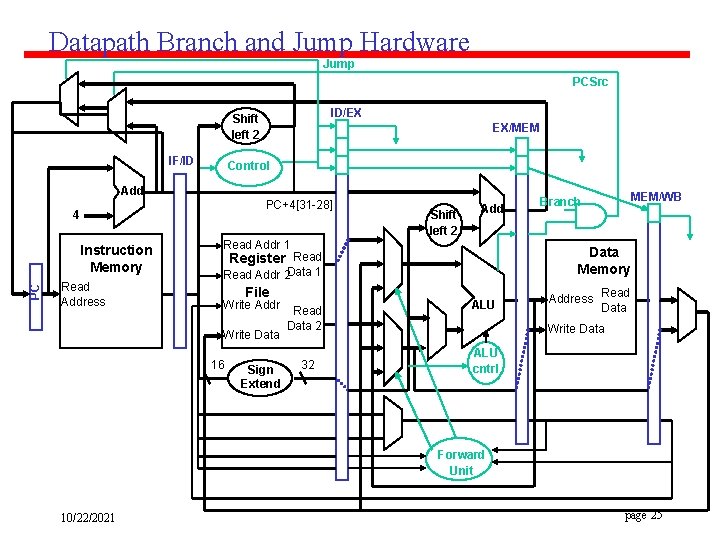
Datapath Branch and Jump Hardware Jump PCSrc ID/EX Shift left 2 IF/ID EX/MEM Control Add PC+4[31 -28] 4 PC Instruction Memory Read Address Shift left 2 Add Read Addr 1 Data Memory Register Read Addr 2 Data 1 File Write Addr Write Data 16 Sign Extend Read Data 2 32 MEM/WB Branch ALU Address Read Data Write Data ALU cntrl Forward Unit 10/22/2021 page 25
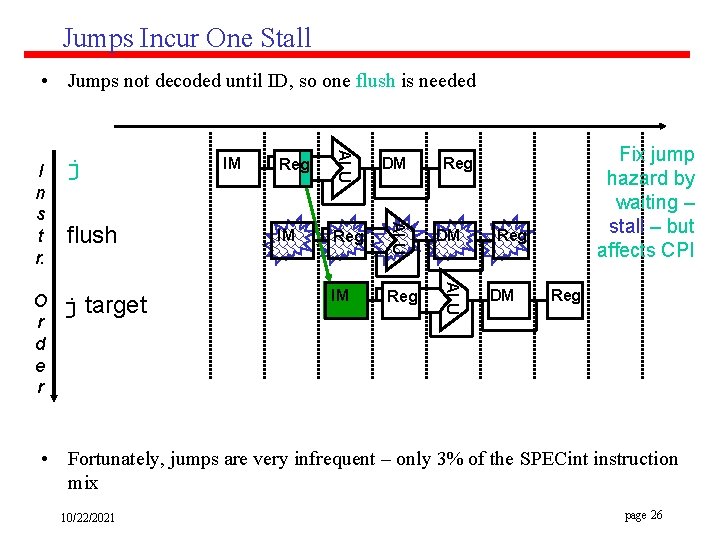
Jumps Incur One Stall • Jumps not decoded until ID, so one flush is needed DM IM Reg ALU j target Reg ALU O r d e r flush IM ALU I n s t r. j Fix jump hazard by waiting – stall – but affects CPI Reg DM Reg • Fortunately, jumps are very infrequent – only 3% of the SPECint instruction mix 10/22/2021 page 26
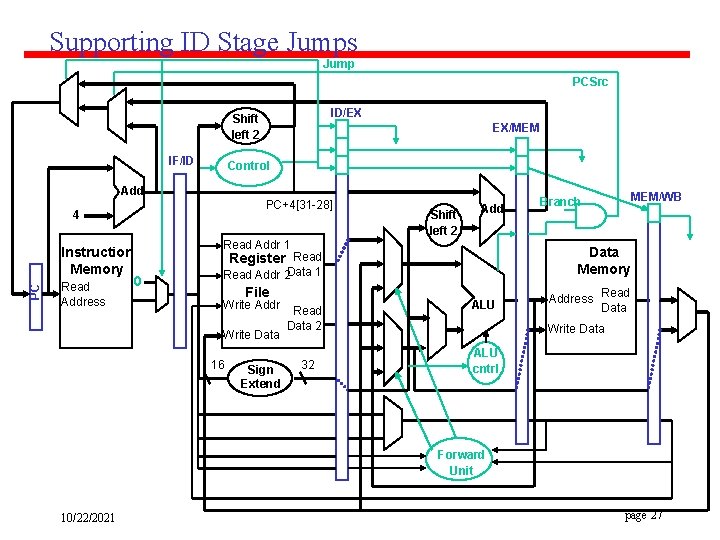
Supporting ID Stage Jumps Jump PCSrc ID/EX Shift left 2 IF/ID EX/MEM Control Add PC+4[31 -28] 4 PC Instruction Memory Read Address Shift left 2 Add Read Addr 1 Data Memory Register Read 0 Read Addr 2 Data 1 File Write Addr Write Data 16 Sign Extend Read Data 2 32 MEM/WB Branch ALU Address Read Data Write Data ALU cntrl Forward Unit 10/22/2021 page 27
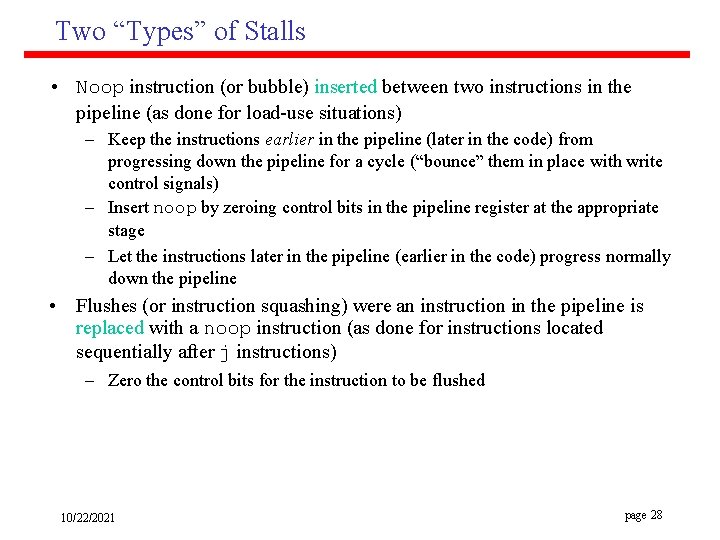
Two “Types” of Stalls • Noop instruction (or bubble) inserted between two instructions in the pipeline (as done for load-use situations) – Keep the instructions earlier in the pipeline (later in the code) from progressing down the pipeline for a cycle (“bounce” them in place with write control signals) – Insert noop by zeroing control bits in the pipeline register at the appropriate stage – Let the instructions later in the pipeline (earlier in the code) progress normally down the pipeline • Flushes (or instruction squashing) were an instruction in the pipeline is replaced with a noop instruction (as done for instructions located sequentially after j instructions) – Zero the control bits for the instruction to be flushed 10/22/2021 page 28
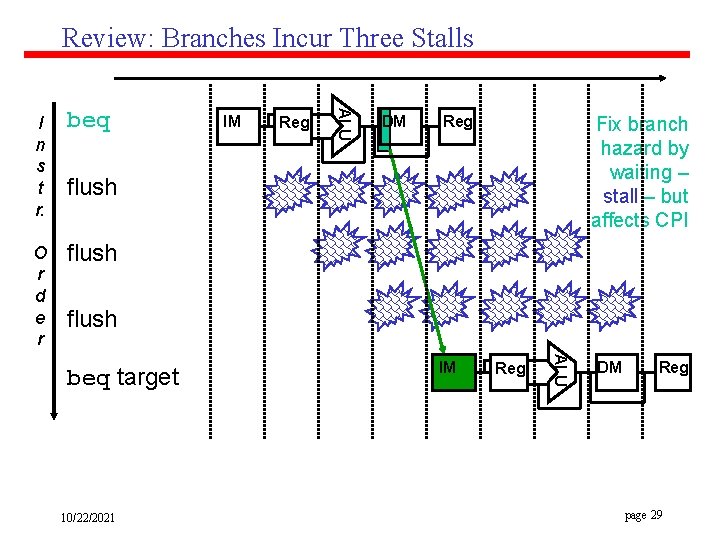
Review: Branches Incur Three Stalls beq O r d e r flush IM Reg ALU I n s t r. DM Reg Fix branch hazard by waiting – stall – but affects CPI flush 10/22/2021 IM Reg ALU beq target DM Reg page 29
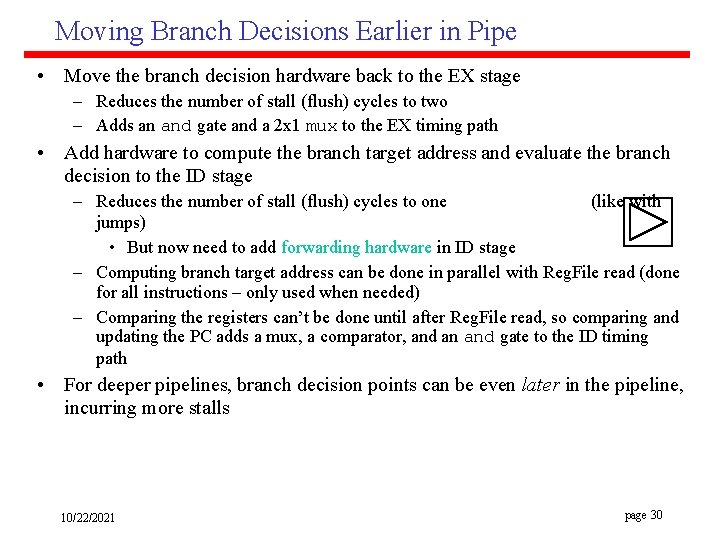
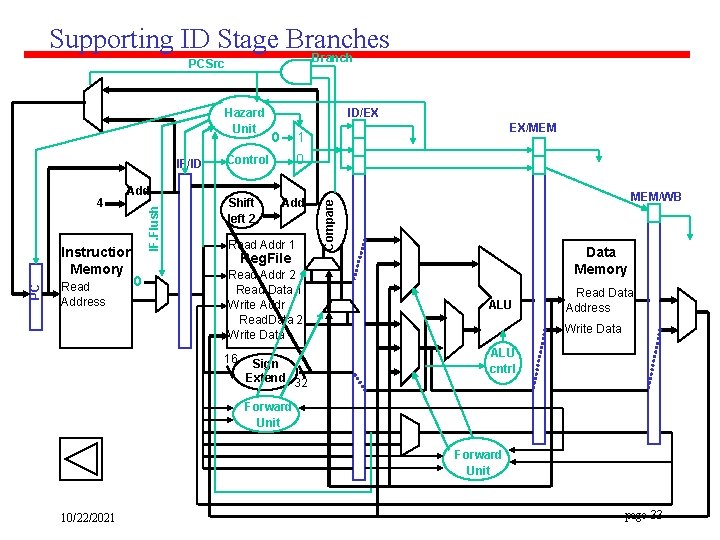
Moving Branch Decisions Earlier in Pipe • Move the branch decision hardware back to the EX stage – Reduces the number of stall (flush) cycles to two – Adds an and gate and a 2 x 1 mux to the EX timing path • Add hardware to compute the branch target address and evaluate the branch decision to the ID stage – Reduces the number of stall (flush) cycles to one (like with jumps) • But now need to add forwarding hardware in ID stage – Computing branch target address can be done in parallel with Reg. File read (done for all instructions – only used when needed) – Comparing the registers can’t be done until after Reg. File read, so comparing and updating the PC adds a mux, a comparator, and an and gate to the ID timing path • For deeper pipelines, branch decision points can be even later in the pipeline, incurring more stalls 10/22/2021 page 30
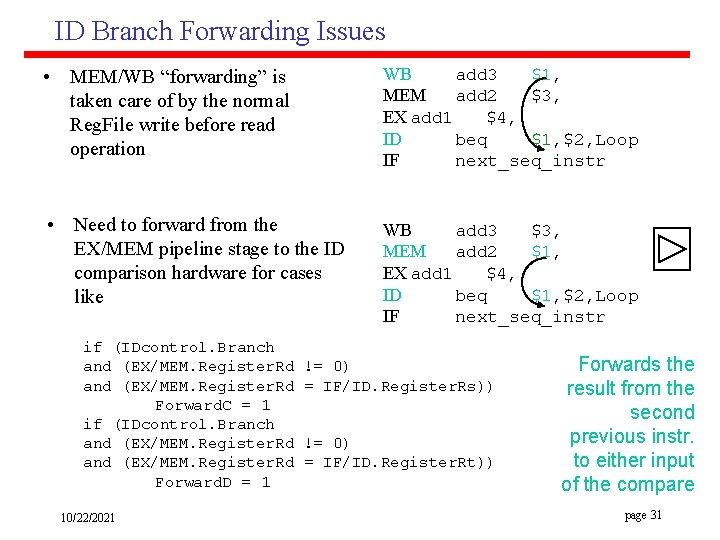
ID Branch Forwarding Issues • MEM/WB “forwarding” is taken care of by the normal Reg. File write before read operation WB add 3 $1, MEM add 2 $3, EX add 1 $4, ID beq $1, $2, Loop IF next_seq_instr • Need to forward from the EX/MEM pipeline stage to the ID comparison hardware for cases like WB add 3 $3, MEM add 2 $1, EX add 1 $4, ID beq $1, $2, Loop IF next_seq_instr if (IDcontrol. Branch and (EX/MEM. Register. Rd Forward. C = 1 if (IDcontrol. Branch and (EX/MEM. Register. Rd Forward. D = 1 10/22/2021 != 0) = IF/ID. Register. Rs)) != 0) = IF/ID. Register. Rt)) Forwards the result from the second previous instr. to either input of the compare page 31
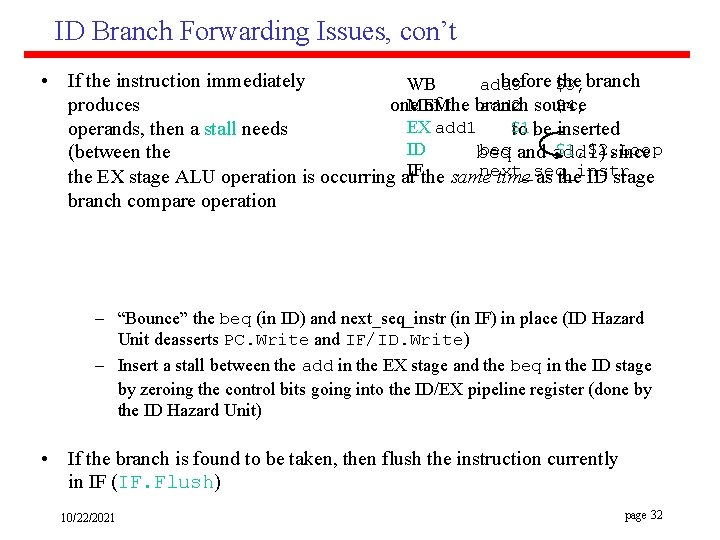
ID Branch Forwarding Issues, con’t • If the instruction immediately before $3, the branch WB add 3 produces one of the branch MEM add 2 source $4, EX add 1 $1, operands, then a stall needs to be inserted ID beq and add 1) $1, $2, Loop (between the beq since next_seq_instr the EX stage ALU operation is occurring at. IFthe same time as the ID stage branch compare operation – “Bounce” the beq (in ID) and next_seq_instr (in IF) in place (ID Hazard Unit deasserts PC. Write and IF/ID. Write) – Insert a stall between the add in the EX stage and the beq in the ID stage by zeroing the control bits going into the ID/EX pipeline register (done by the ID Hazard Unit) • If the branch is found to be taken, then flush the instruction currently in IF (IF. Flush) 10/22/2021 page 32
Supporting ID Stage Branches Branch PCSrc IF/ID Add PC Instruction Memory Read Address IF. Flush 4 0 ID/EX 0 0 Control Shift left 2 Add Read Addr 1 Reg. File Read Addr 2 Read Data 1 Write Addr Read. Data 2 Write Data 16 EX/MEM 1 Sign Extend 32 MEM/WB Compare Hazard Unit Data Memory ALU Read Data Address Write Data ALU cntrl Forward Unit 10/22/2021 page 33
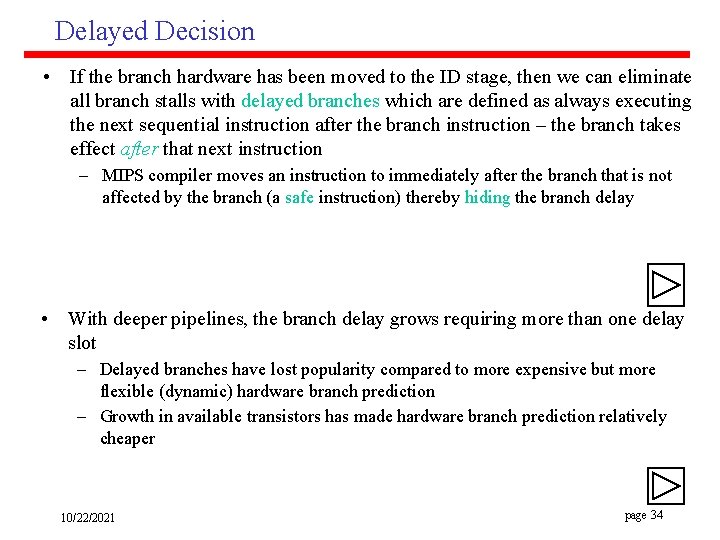
Delayed Decision • If the branch hardware has been moved to the ID stage, then we can eliminate all branch stalls with delayed branches which are defined as always executing the next sequential instruction after the branch instruction – the branch takes effect after that next instruction – MIPS compiler moves an instruction to immediately after the branch that is not affected by the branch (a safe instruction) thereby hiding the branch delay • With deeper pipelines, the branch delay grows requiring more than one delay slot – Delayed branches have lost popularity compared to more expensive but more flexible (dynamic) hardware branch prediction – Growth in available transistors has made hardware branch prediction relatively cheaper 10/22/2021 page 34
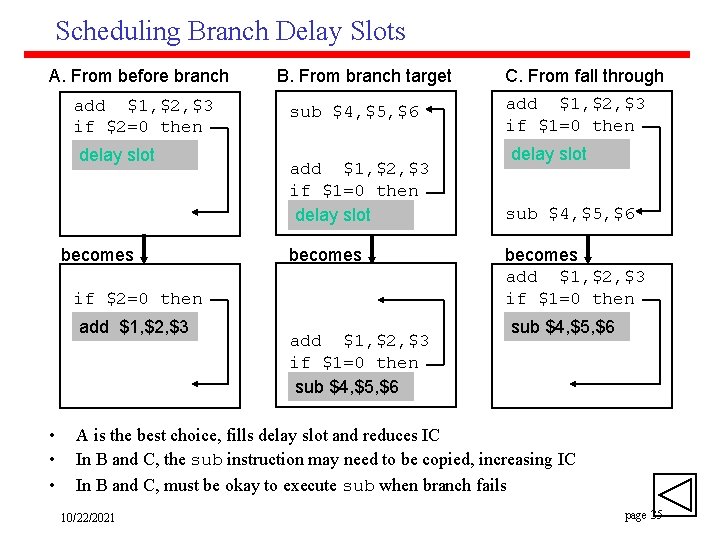
Scheduling Branch Delay Slots A. From before branch add $1, $2, $3 if $2=0 then delay slot becomes B. From branch target sub $4, $5, $6 add $1, $2, $3 if $1=0 then delay slot becomes if $2=0 then add $1, $2, $3 • • • add $1, $2, $3 if $1=0 then sub $4, $5, $6 C. From fall through add $1, $2, $3 if $1=0 then delay slot sub $4, $5, $6 becomes add $1, $2, $3 if $1=0 then sub $4, $5, $6 A is the best choice, fills delay slot and reduces IC In B and C, the sub instruction may need to be copied, increasing IC In B and C, must be okay to execute sub when branch fails 10/22/2021 page 35
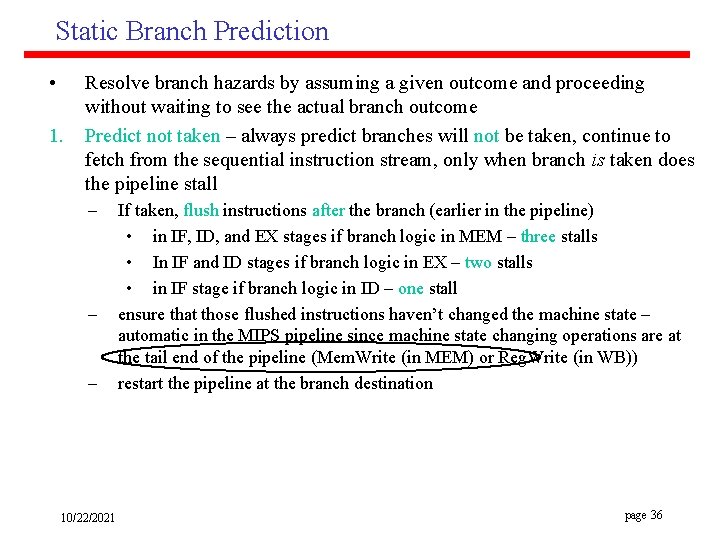
Static Branch Prediction • 1. Resolve branch hazards by assuming a given outcome and proceeding without waiting to see the actual branch outcome Predict not taken – always predict branches will not be taken, continue to fetch from the sequential instruction stream, only when branch is taken does the pipeline stall – – – 10/22/2021 If taken, flush instructions after the branch (earlier in the pipeline) • in IF, ID, and EX stages if branch logic in MEM – three stalls • In IF and ID stages if branch logic in EX – two stalls • in IF stage if branch logic in ID – one stall ensure that those flushed instructions haven’t changed the machine state – automatic in the MIPS pipeline since machine state changing operations are at the tail end of the pipeline (Mem. Write (in MEM) or Reg. Write (in WB)) restart the pipeline at the branch destination page 36
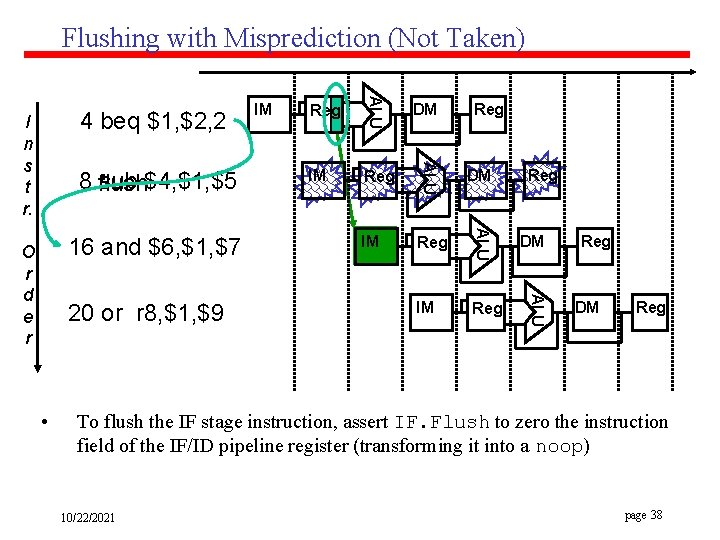
Flushing with Misprediction (Not Taken) • Reg DM IM Reg Reg DM ALU 20 or r 8, $1, $9 IM ALU 16 and $6, $1, $7 O r d e r DM ALU 8 flush sub $4, $1, $5 Reg ALU 4 beq $1, $2, 2 I n s t r. IM Reg DM Reg To flush the IF stage instruction, assert IF. Flush to zero the instruction field of the IF/ID pipeline register (transforming it into a noop) 10/22/2021 page 38
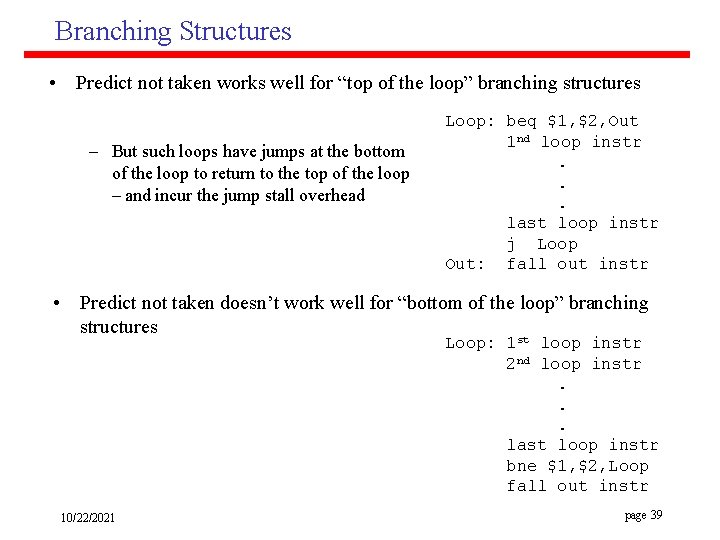
Branching Structures • Predict not taken works well for “top of the loop” branching structures – But such loops have jumps at the bottom of the loop to return to the top of the loop – and incur the jump stall overhead Loop: beq $1, $2, Out 1 nd loop instr. . . last loop instr j Loop Out: fall out instr • Predict not taken doesn’t work well for “bottom of the loop” branching structures st Loop: 1 loop instr 2 nd loop instr. . . last loop instr bne $1, $2, Loop fall out instr 10/22/2021 page 39
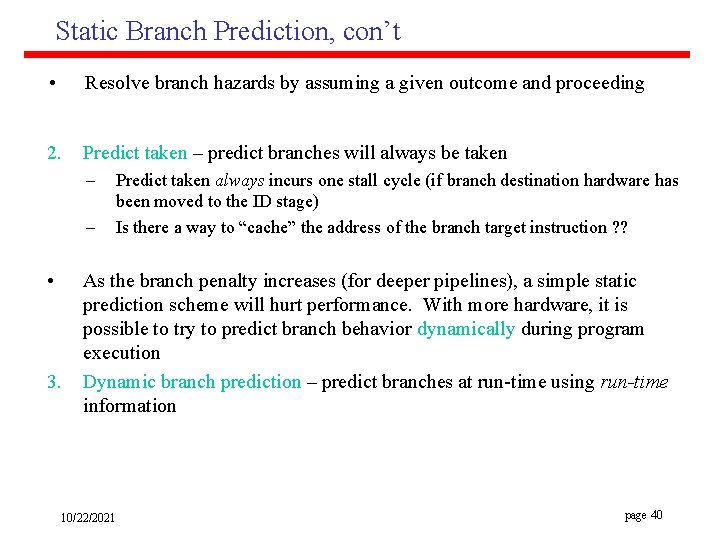
Static Branch Prediction, con’t • Resolve branch hazards by assuming a given outcome and proceeding 2. Predict taken – predict branches will always be taken – – • 3. Predict taken always incurs one stall cycle (if branch destination hardware has been moved to the ID stage) Is there a way to “cache” the address of the branch target instruction ? ? As the branch penalty increases (for deeper pipelines), a simple static prediction scheme will hurt performance. With more hardware, it is possible to try to predict branch behavior dynamically during program execution Dynamic branch prediction – predict branches at run-time using run-time information 10/22/2021 page 40
Dynamic Branch Prediction • A branch prediction buffer (aka branch history table (BHT)) in the IF stage addressed by the lower bits of the PC, contains a bit passed to the ID stage through the IF/ID pipeline register that tells whether the branch was taken the last time it was execute – Prediction bit may predict incorrectly (may be a wrong prediction for this branch this iteration or may be from a different branch with the same low order PC bits) but the doesn’t affect correctness, just performance • Branch decision occurs in the ID stage after determining that the fetched instruction is a branch and checking the prediction bit – If the prediction is wrong, flush the incorrect instruction(s) in pipeline, restart the pipeline with the right instruction, and invert the prediction bit • A 4096 bit BHT varies from 1% misprediction (nasa 7, tomcatv) to 18% (eqntott) 10/22/2021 page 41
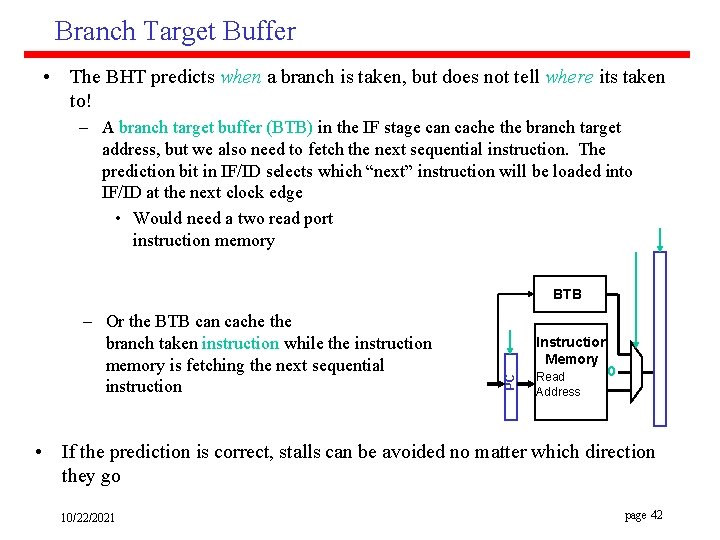
Branch Target Buffer • The BHT predicts when a branch is taken, but does not tell where its taken to! – A branch target buffer (BTB) in the IF stage can cache the branch target address, but we also need to fetch the next sequential instruction. The prediction bit in IF/ID selects which “next” instruction will be loaded into IF/ID at the next clock edge • Would need a two read port instruction memory – Or the BTB can cache the branch taken instruction while the instruction memory is fetching the next sequential instruction PC BTB Instruction Memory 0 Read Address • If the prediction is correct, stalls can be avoided no matter which direction they go 10/22/2021 page 42
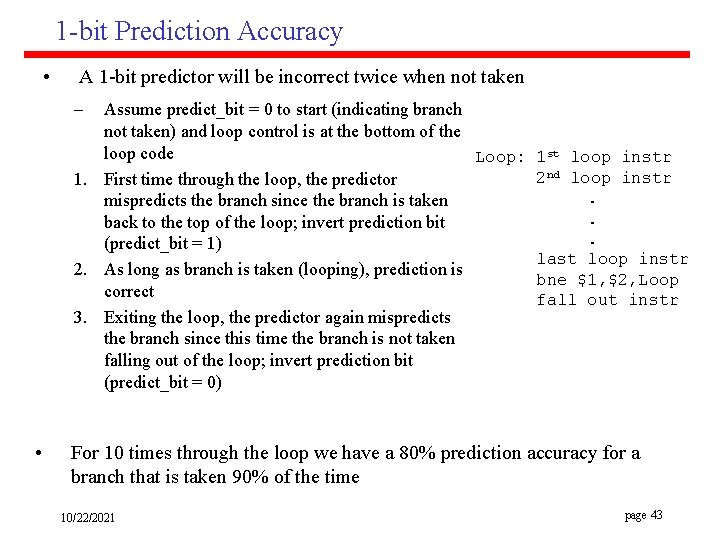
1 -bit Prediction Accuracy • A 1 -bit predictor will be incorrect twice when not taken – Assume predict_bit = 0 to start (indicating branch not taken) and loop control is at the bottom of the loop code Loop: 1 st loop instr 2 nd loop instr 1. First time through the loop, the predictor. mispredicts the branch since the branch is taken. back to the top of the loop; invert prediction bit. (predict_bit = 1) last loop instr 2. As long as branch is taken (looping), prediction is bne $1, $2, Loop correct fall out instr 3. Exiting the loop, the predictor again mispredicts the branch since this time the branch is not taken falling out of the loop; invert prediction bit (predict_bit = 0) • For 10 times through the loop we have a 80% prediction accuracy for a branch that is taken 90% of the time 10/22/2021 page 43
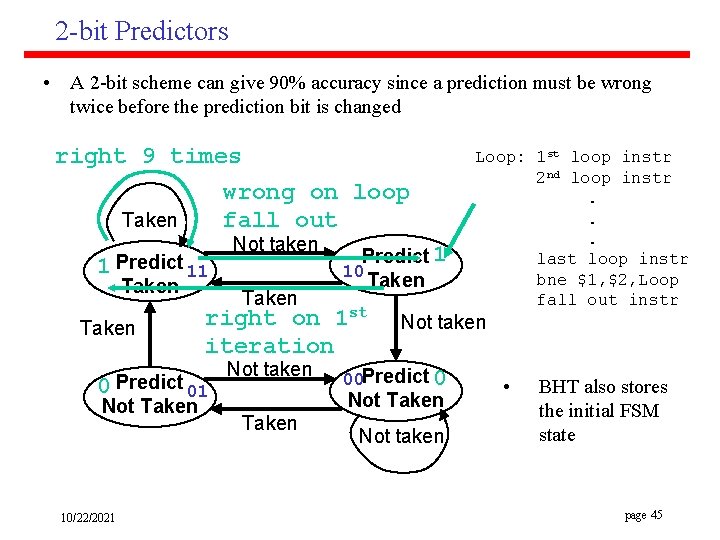
2 -bit Predictors • A 2 -bit scheme can give 90% accuracy since a prediction must be wrong twice before the prediction bit is changed right 9 times wrong on loop Taken fall out 1 Predict 11 Taken 10/22/2021 Taken Predict 1 10 Taken right on 1 st iteration 0 Predict 01 Not Taken Not taken 00 Predict 0 Not Taken Loop: 1 st loop instr 2 nd loop instr. . . last loop instr bne $1, $2, Loop fall out instr Not taken • BHT also stores the initial FSM state page 45
Dealing with Exceptions • Exceptions (aka interrupts) are just another form of control hazard. Exceptions arise from – – – R-type arithmetic overflow Trying to execute an undefined instruction An I/O device request An OS service request (e. g. , a page fault, TLB exception) A hardware malfunction • The pipeline has to stop executing the offending instruction in midstream, let all prior instructions complete, flush all following instructions, set a register to show the cause of the exception, save the address of the offending instruction, and then jump to a prearranged address (the address of the exception handler code) • The software (OS) looks at the cause of the exception and “deals” with it 10/22/2021 page 46
Two Types of Exceptions • Interrupts – asynchronous to program execution – caused by external events – may be handled between instructions, so can let the instructions currently active in the pipeline complete before passing control to the OS interrupt handler – simply suspend and resume user program • Traps (Exception) – synchronous to program execution – caused by internal events – condition must be remedied by the trap handler for that instruction, so much stop the offending instruction midstream in the pipeline and pass control to the OS trap handler – the offending instruction may be retried (or simulated by the OS) and the program may continue or it may be aborted 10/22/2021 page 47
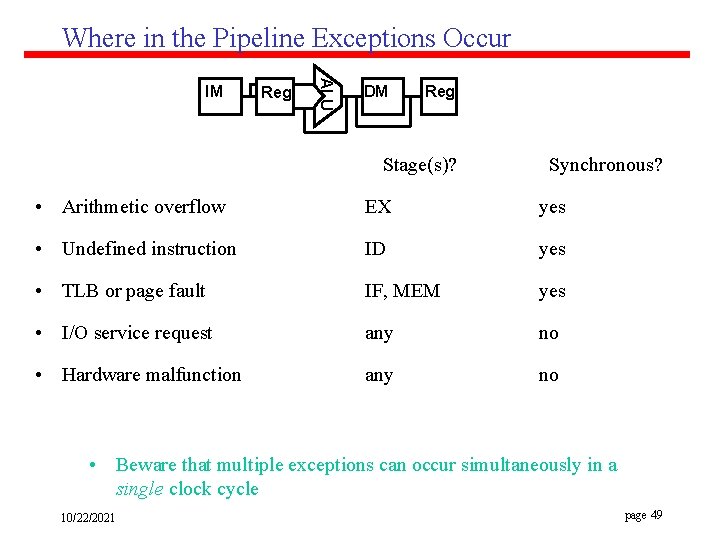
Where in the Pipeline Exceptions Occur Reg ALU IM DM Reg Stage(s)? Synchronous? • Arithmetic overflow EX yes • Undefined instruction ID yes • TLB or page fault IF, MEM yes • I/O service request any no • Hardware malfunction any no • Beware that multiple exceptions can occur simultaneously in a single clock cycle 10/22/2021 page 49
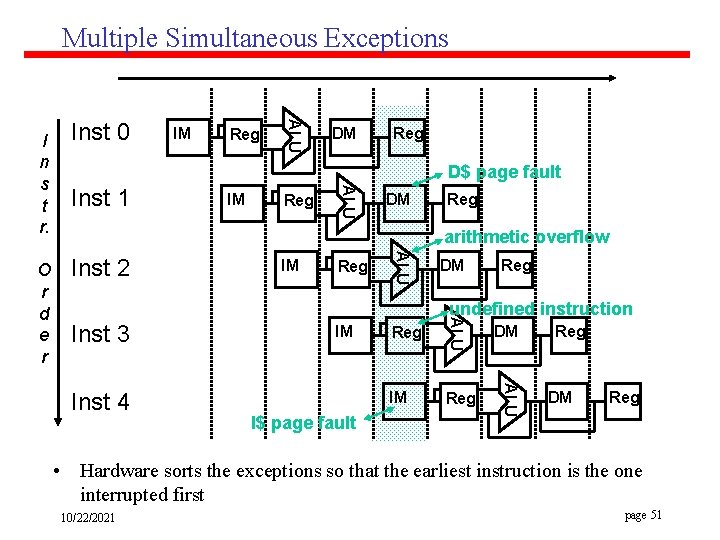
Multiple Simultaneous Exceptions IM Reg D$ page fault Inst 1 IM Reg ALU DM Reg arithmetic overflow Inst 2 IM Reg ALU DM Reg Inst 3 Inst 4 IM I$ page fault Reg DM IM Reg ALU undefined instruction ALU O r d e r Inst 0 ALU I n s t r. Reg DM Reg • Hardware sorts the exceptions so that the earliest instruction is the one interrupted first 10/22/2021 page 51
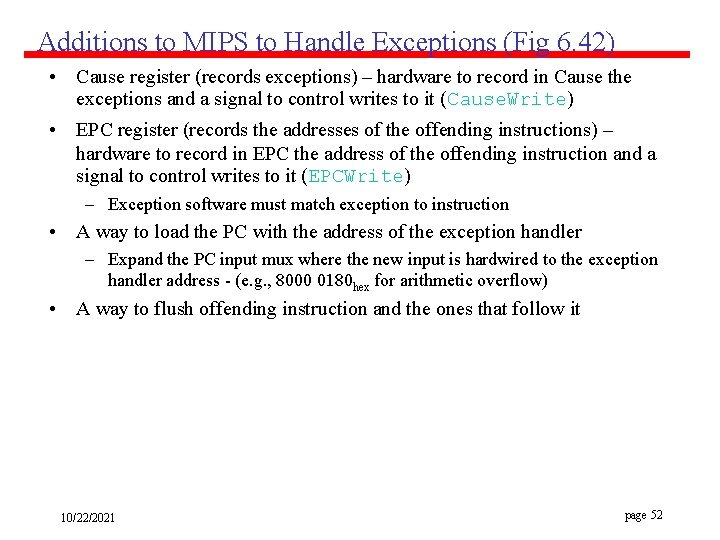
Additions to MIPS to Handle Exceptions (Fig 6. 42) • Cause register (records exceptions) – hardware to record in Cause the exceptions and a signal to control writes to it (Cause. Write) • EPC register (records the addresses of the offending instructions) – hardware to record in EPC the address of the offending instruction and a signal to control writes to it (EPCWrite) – Exception software must match exception to instruction • A way to load the PC with the address of the exception handler – Expand the PC input mux where the new input is hardwired to the exception handler address - (e. g. , 8000 0180 hex for arithmetic overflow) • A way to flush offending instruction and the ones that follow it 10/22/2021 page 52
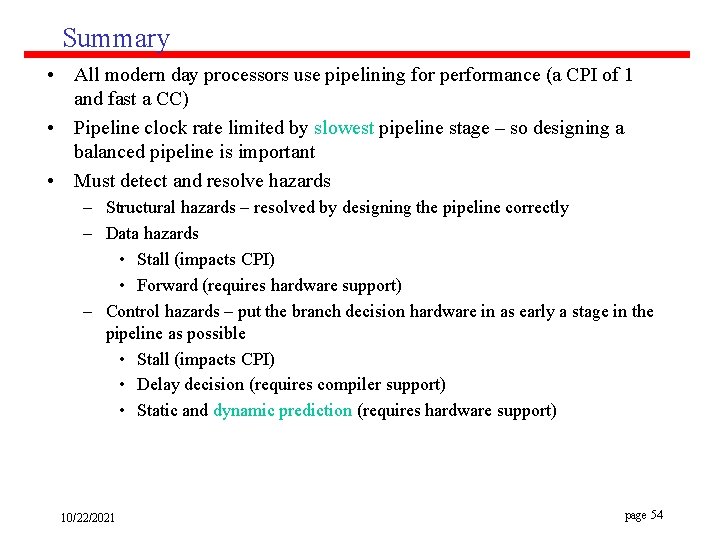
Summary • All modern day processors use pipelining for performance (a CPI of 1 and fast a CC) • Pipeline clock rate limited by slowest pipeline stage – so designing a balanced pipeline is important • Must detect and resolve hazards – Structural hazards – resolved by designing the pipeline correctly – Data hazards • Stall (impacts CPI) • Forward (requires hardware support) – Control hazards – put the branch decision hardware in as early a stage in the pipeline as possible • Stall (impacts CPI) • Delay decision (requires compiler support) • Static and dynamic prediction (requires hardware support) 10/22/2021 page 54