
Processor Design 5 Z 032 Introduction to Operating
![Process Creation in Linux (cont. ) main(int argc, char *argv[]) { pid_t pid_value; int](https://slidetodoc.com/presentation_image/28b64c59a6e7cd7e150cc25ded51c480/image-27.jpg "Process Creation in Linux (cont. ) main(int argc, char *argv[]) { pid_t pid_value; int")
![IPC in Linux (cont. ) main() { int fd[2], i, status; char c, msg[13]](https://slidetodoc.com/presentation_image/28b64c59a6e7cd7e150cc25ded51c480/image-29.jpg "IPC in Linux (cont. ) main() { int fd[2], i, status; char c, msg[13]")
![Attempt 2 – Warning Flags Process P 0 Process P 1 shared int flag[2];](https://slidetodoc.com/presentation_image/28b64c59a6e7cd7e150cc25ded51c480/image-44.jpg "Attempt 2 – Warning Flags Process P 0 Process P 1 shared int flag[2];")
![Dining Philosophers Problem n Shared data semaphore fork[5]; TU/e Processor Design 5 Z 032](https://slidetodoc.com/presentation_image/28b64c59a6e7cd7e150cc25ded51c480/image-56.jpg "Dining Philosophers Problem n Shared data semaphore fork[5]; TU/e Processor Design 5 Z 032")
![Dining Philosophers Problem (cont. ) semaphore fork[5]; /* the 5 forks */ fork[0] =](https://slidetodoc.com/presentation_image/28b64c59a6e7cd7e150cc25ded51c480/image-57.jpg "Dining Philosophers Problem (cont. ) semaphore fork[5]; /* the 5 forks */ fork[0] =")
- Slides: 77
Processor Design 5 Z 032 Introduction to Operating Systems Henk Corporaal Eindhoven University of Technology 2009 TU/e Processor Design 5 Z 032
Topics n n n Objectives Layered view of a computer system OS overview Process management Time sharing and scheduling Process synchronization u Example: n dining philosophers Threads u Simple thread package u Example: sieve of Erastoshenes Based on report Introduction to Operating Systems Ben Juurlink (TUD) and Henk Corporaal (TUE) TU/e Processor Design 5 Z 032 2
Objectives After this lecture, you should be able to n n n tell what an operating system is and what it does name and describe the most important OS components write small C-programs that invoke Linux system calls sketch how time sharing is implemented recognize the synchronization problem associated with shared data and solve it using semaphores understand how multithreading is implemented TU/e Processor Design 5 Z 032 3
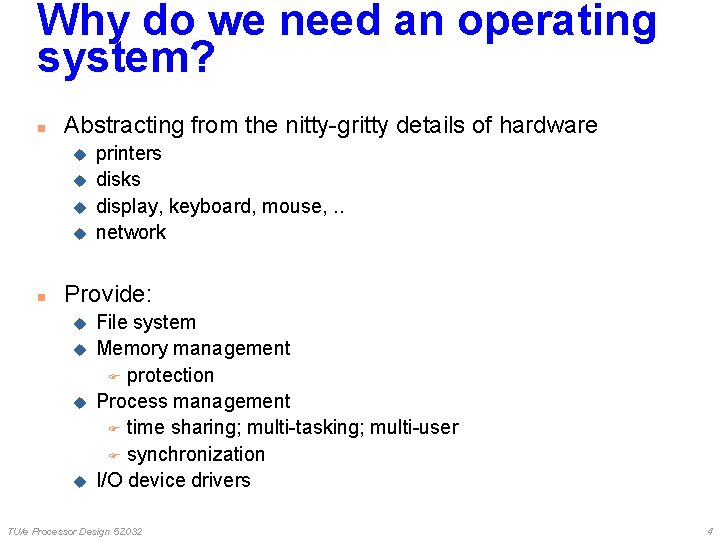
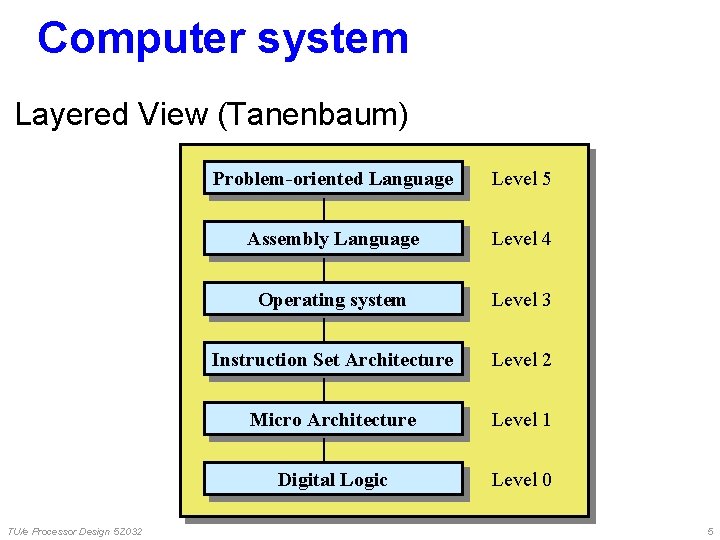
Why do we need an operating system? n Abstracting from the nitty-gritty details of hardware u u n printers disks display, keyboard, mouse, . . network Provide: u u File system Memory management F protection Process management F time sharing; multi-tasking; multi-user F synchronization I/O device drivers TU/e Processor Design 5 Z 032 4
Computer system Layered View (Tanenbaum) TU/e Processor Design 5 Z 032 Problem-oriented Language Level 5 Assembly Language Level 4 Operating system Level 3 Instruction Set Architecture Level 2 Micro Architecture Level 1 Digital Logic Level 0 5
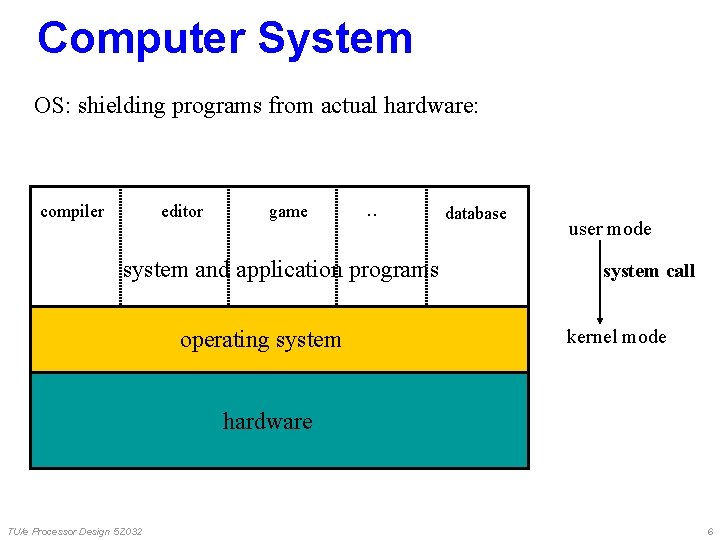
Computer System OS: shielding programs from actual hardware: compiler editor game . . system and application programs operating system database user mode system call kernel mode hardware TU/e Processor Design 5 Z 032 6
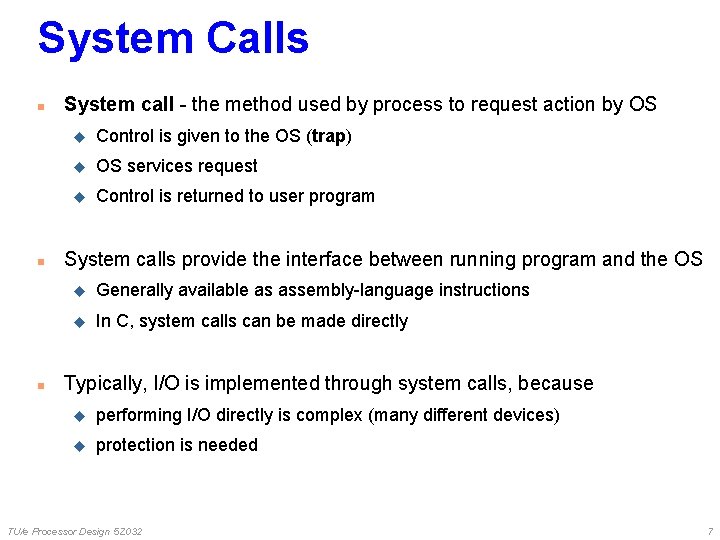
System Calls n n n System call - the method used by process to request action by OS u Control is given to the OS (trap) u OS services request u Control is returned to user program System calls provide the interface between running program and the OS u Generally available as assembly-language instructions u In C, system calls can be made directly Typically, I/O is implemented through system calls, because u performing I/O directly is complex (many different devices) u protection is needed TU/e Processor Design 5 Z 032 7
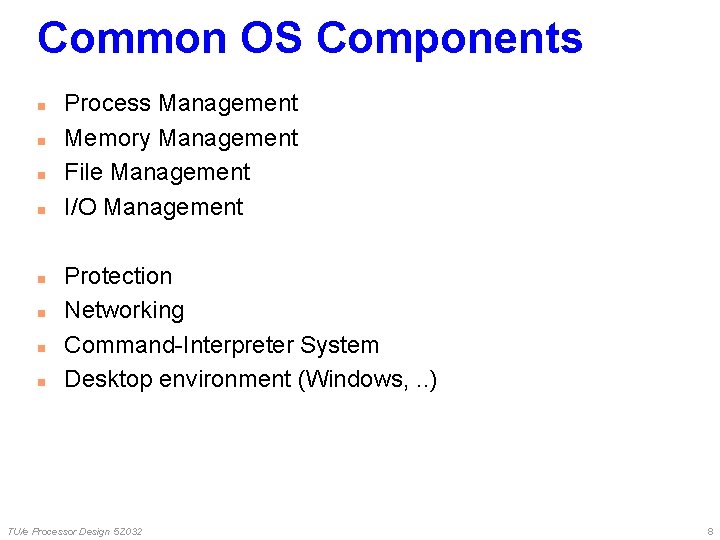
Common OS Components n n n n Process Management Memory Management File Management I/O Management Protection Networking Command-Interpreter System Desktop environment (Windows, . . ) TU/e Processor Design 5 Z 032 8
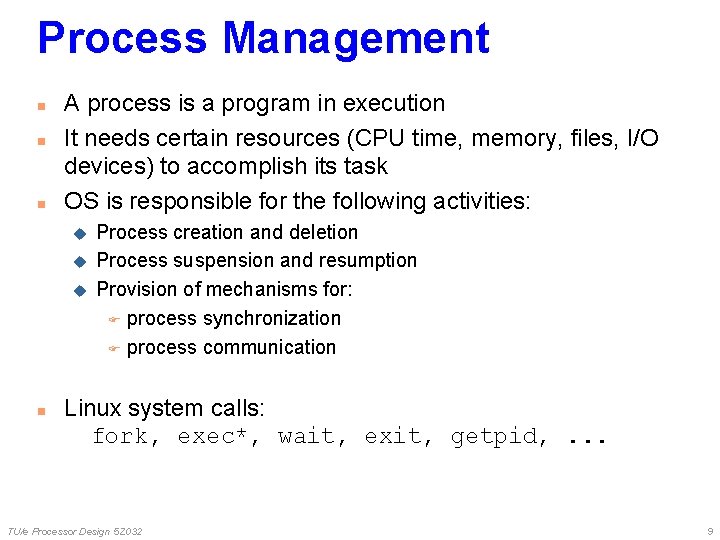
Process Management n n n A process is a program in execution It needs certain resources (CPU time, memory, files, I/O devices) to accomplish its task OS is responsible for the following activities: u u u n Process creation and deletion Process suspension and resumption Provision of mechanisms for: F process synchronization F process communication Linux system calls: fork, exec*, wait, exit, getpid, . . . TU/e Processor Design 5 Z 032 9
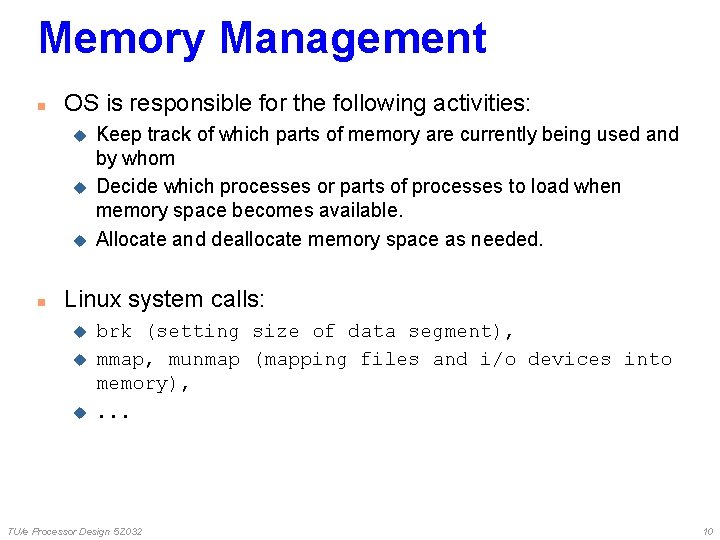
Memory Management n OS is responsible for the following activities: u u u n Keep track of which parts of memory are currently being used and by whom Decide which processes or parts of processes to load when memory space becomes available. Allocate and deallocate memory space as needed. Linux system calls: u u u brk (setting size of data segment), mmap, munmap (mapping files and i/o devices into memory), . . . TU/e Processor Design 5 Z 032 10
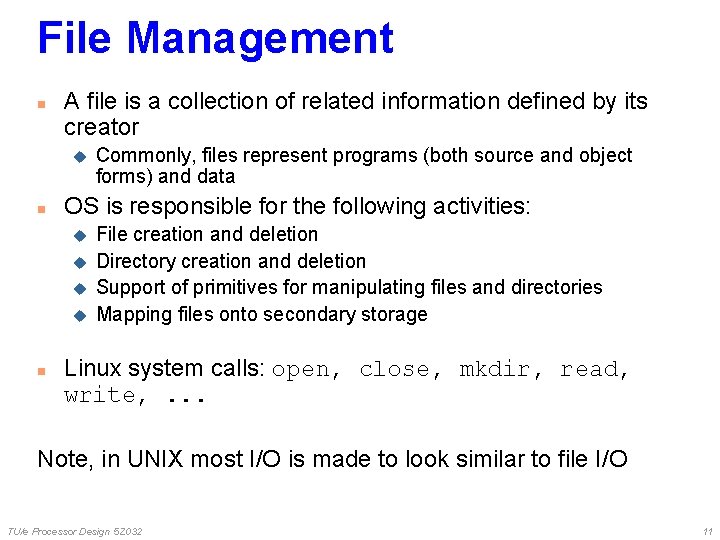
File Management n A file is a collection of related information defined by its creator u n OS is responsible for the following activities: u u n Commonly, files represent programs (both source and object forms) and data File creation and deletion Directory creation and deletion Support of primitives for manipulating files and directories Mapping files onto secondary storage Linux system calls: open, close, mkdir, read, write, . . . Note, in UNIX most I/O is made to look similar to file I/O TU/e Processor Design 5 Z 032 11
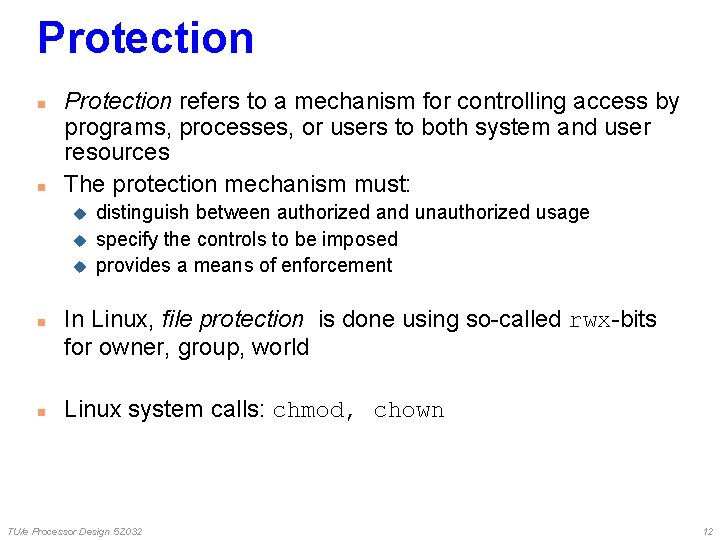
Protection n n Protection refers to a mechanism for controlling access by programs, processes, or users to both system and user resources The protection mechanism must: u u u n n distinguish between authorized and unauthorized usage specify the controls to be imposed provides a means of enforcement In Linux, file protection is done using so-called rwx-bits for owner, group, world Linux system calls: chmod, chown TU/e Processor Design 5 Z 032 12
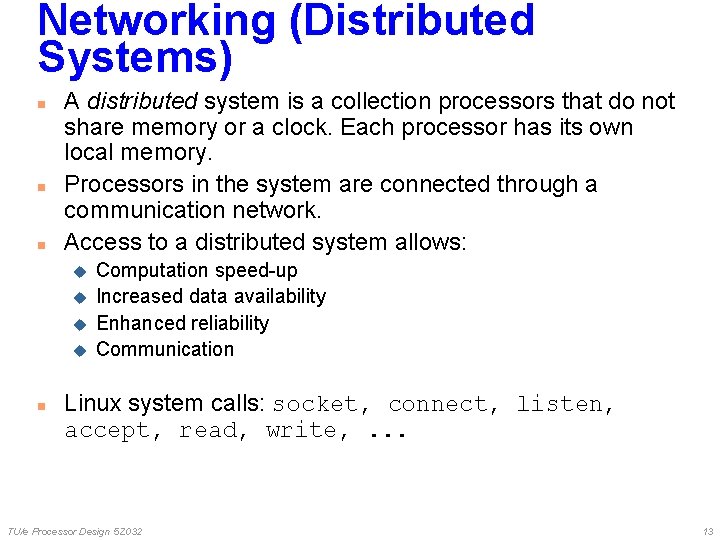
Networking (Distributed Systems) n n n A distributed system is a collection processors that do not share memory or a clock. Each processor has its own local memory. Processors in the system are connected through a communication network. Access to a distributed system allows: u u n Computation speed-up Increased data availability Enhanced reliability Communication Linux system calls: socket, connect, listen, accept, read, write, . . . TU/e Processor Design 5 Z 032 13
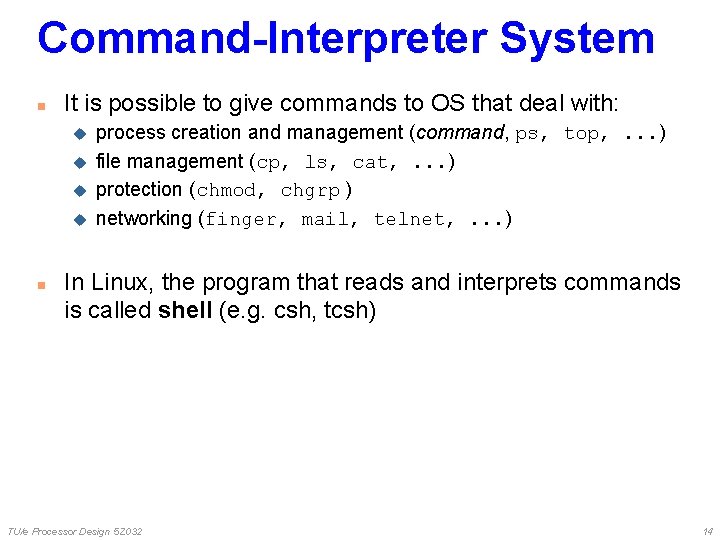
Command-Interpreter System n It is possible to give commands to OS that deal with: u u n process creation and management (command, ps, top, . . . ) file management (cp, ls, cat, . . . ) protection (chmod, chgrp ) networking (finger, mail, telnet, . . . ) In Linux, the program that reads and interprets commands is called shell (e. g. csh, tcsh) TU/e Processor Design 5 Z 032 14
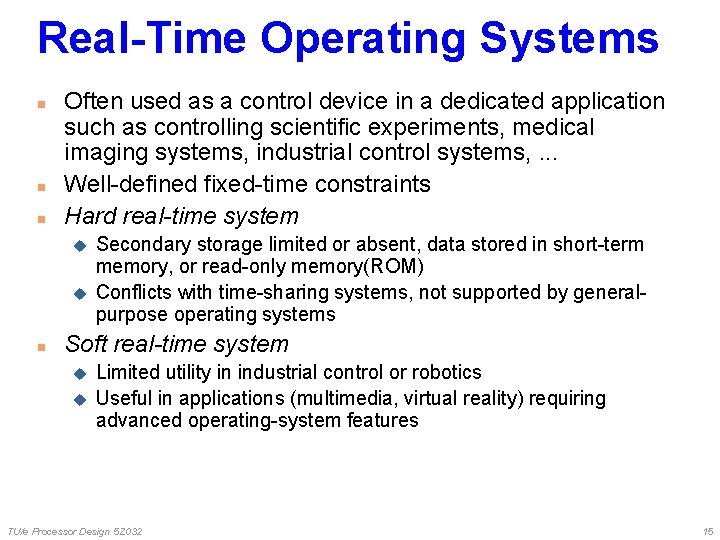
Real-Time Operating Systems n n n Often used as a control device in a dedicated application such as controlling scientific experiments, medical imaging systems, industrial control systems, . . . Well-defined fixed-time constraints Hard real-time system u u n Secondary storage limited or absent, data stored in short-term memory, or read-only memory(ROM) Conflicts with time-sharing systems, not supported by generalpurpose operating systems Soft real-time system u u Limited utility in industrial control or robotics Useful in applications (multimedia, virtual reality) requiring advanced operating-system features TU/e Processor Design 5 Z 032 15
Distribute Operating System n n n OS running on a networked system (with multiple processors) Gives user feeling of a single computer Automatic task/process mapping to processor TU/e Processor Design 5 Z 032 16
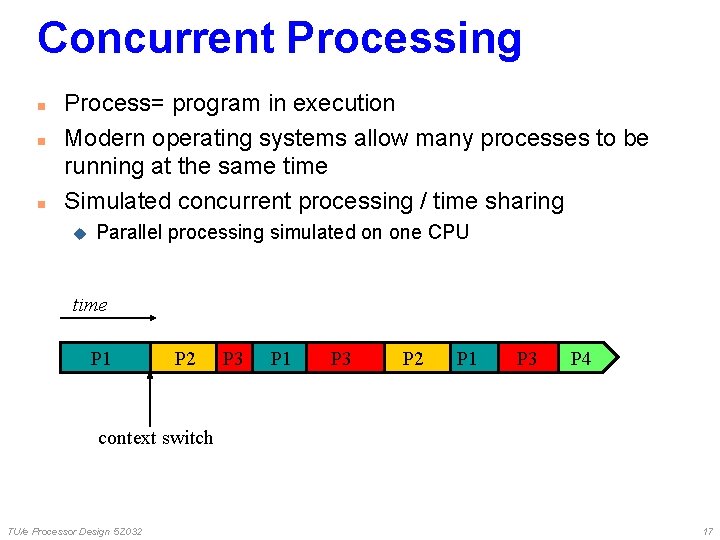
Concurrent Processing n n n Process= program in execution Modern operating systems allow many processes to be running at the same time Simulated concurrent processing / time sharing u Parallel processing simulated on one CPU time P 1 P 2 P 3 P 1 P 3 P 2 P 1 P 3 P 4 context switch TU/e Processor Design 5 Z 032 17
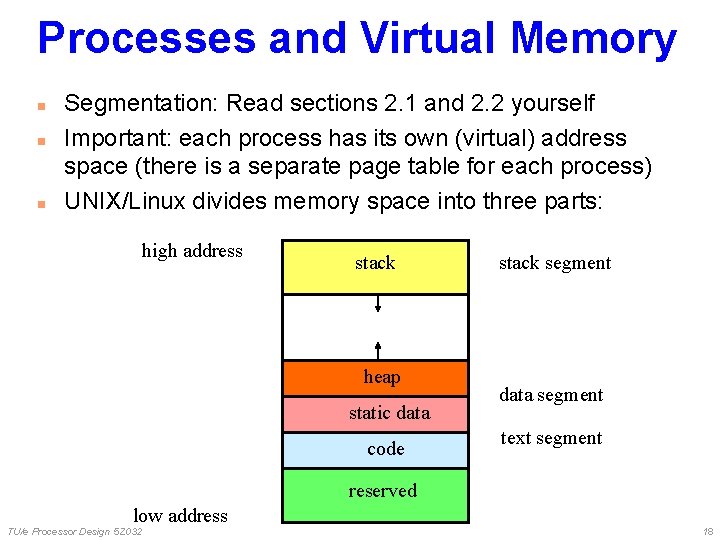
Processes and Virtual Memory n n n Segmentation: Read sections 2. 1 and 2. 2 yourself Important: each process has its own (virtual) address space (there is a separate page table for each process) UNIX/Linux divides memory space into three parts: high address stack heap static data code stack segment data segment text segment reserved low address TU/e Processor Design 5 Z 032 18
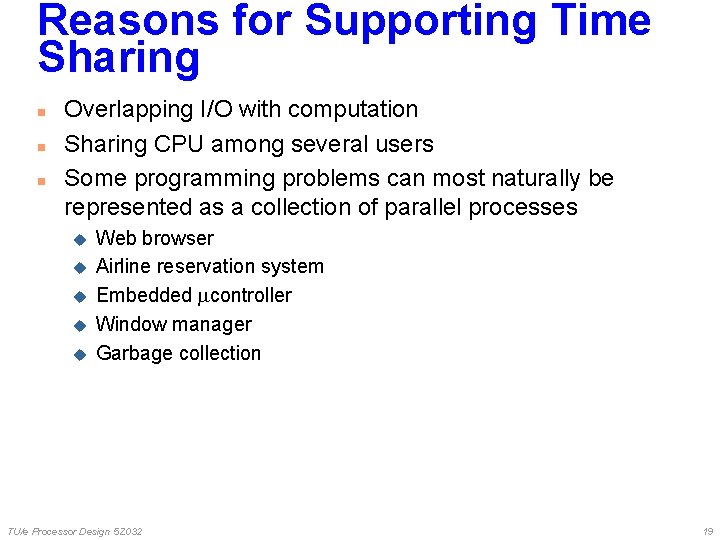
Reasons for Supporting Time Sharing n n n Overlapping I/O with computation Sharing CPU among several users Some programming problems can most naturally be represented as a collection of parallel processes u u u Web browser Airline reservation system Embedded controller Window manager Garbage collection TU/e Processor Design 5 Z 032 19
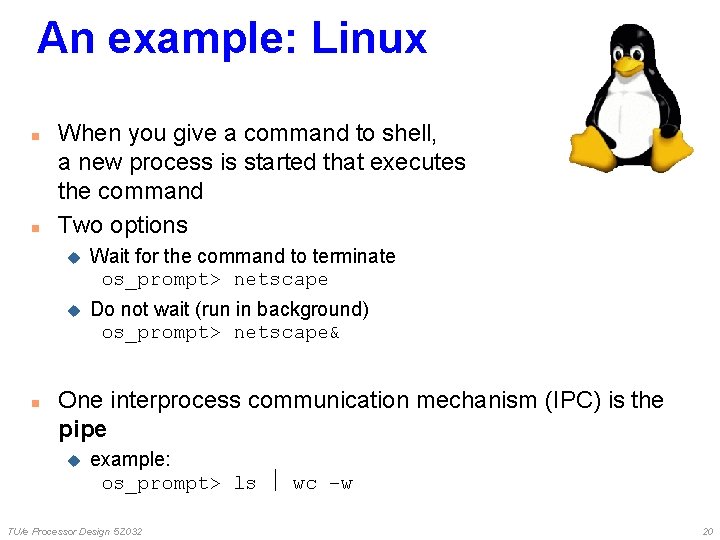
An example: Linux n n n When you give a command to shell, a new process is started that executes the command Two options u Wait for the command to terminate os_prompt> netscape u Do not wait (run in background) os_prompt> netscape& One interprocess communication mechanism (IPC) is the pipe u example: os_prompt> ls wc –w TU/e Processor Design 5 Z 032 20
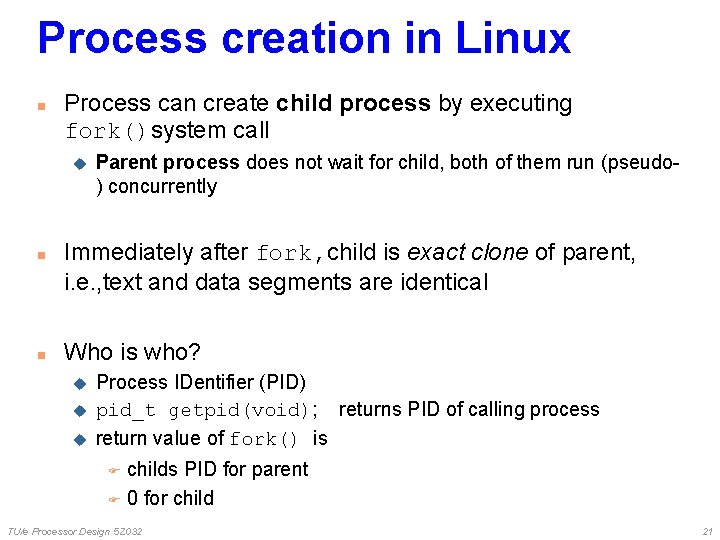
Process creation in Linux n Process can create child process by executing fork()system call u n n Parent process does not wait for child, both of them run (pseudo) concurrently Immediately after fork, child is exact clone of parent, i. e. , text and data segments are identical Who is who? u u u Process IDentifier (PID) pid_t getpid(void); returns PID of calling process return value of fork() is childs PID for parent F 0 for child F TU/e Processor Design 5 Z 032 21
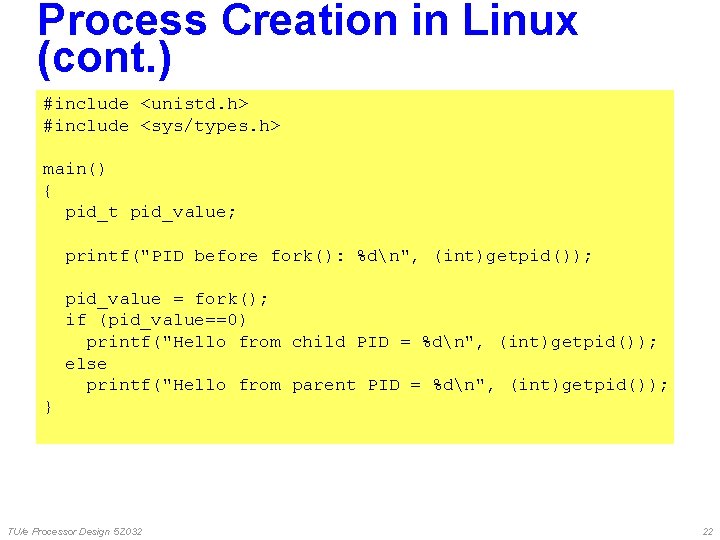
Process Creation in Linux (cont. ) #include <unistd. h> #include <sys/types. h> main() { pid_t pid_value; printf("PID before fork(): %dn", (int)getpid()); pid_value = fork(); if (pid_value==0) printf("Hello from child PID = %dn", (int)getpid()); else printf("Hello from parent PID = %dn", (int)getpid()); } TU/e Processor Design 5 Z 032 22
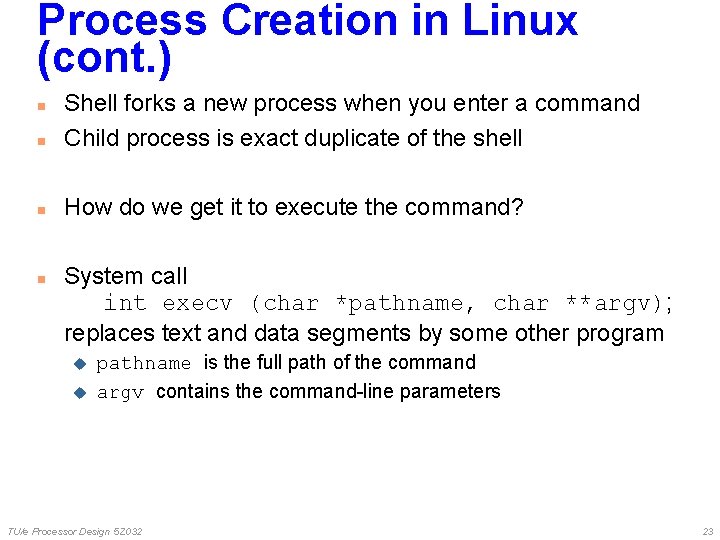
Process Creation in Linux (cont. ) n Shell forks a new process when you enter a command Child process is exact duplicate of the shell n How do we get it to execute the command? n n System call int execv (char *pathname, char **argv); replaces text and data segments by some other program u u pathname is the full path of the command argv contains the command-line parameters TU/e Processor Design 5 Z 032 23
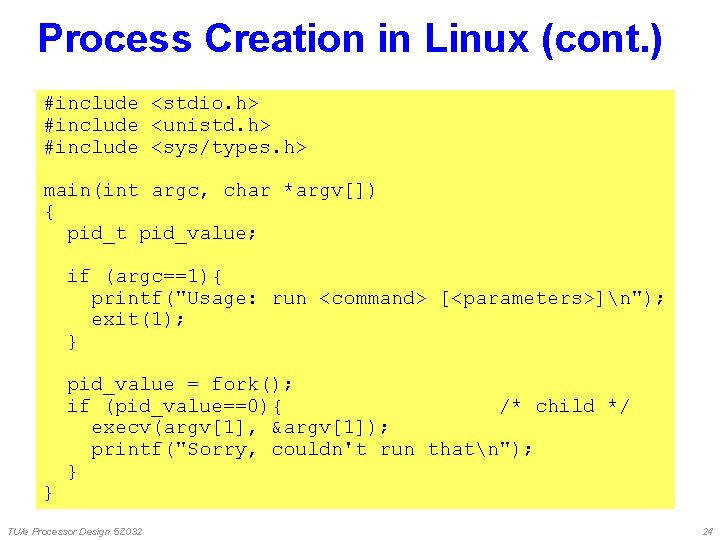
Process Creation in Linux (cont. ) #include <stdio. h> #include <unistd. h> #include <sys/types. h> main(int argc, char *argv[]) { pid_t pid_value; if (argc==1){ printf("Usage: run <command> [<parameters>]n"); exit(1); } } pid_value = fork(); if (pid_value==0){ /* child */ execv(argv[1], &argv[1]); printf("Sorry, couldn't run thatn"); } TU/e Processor Design 5 Z 032 24
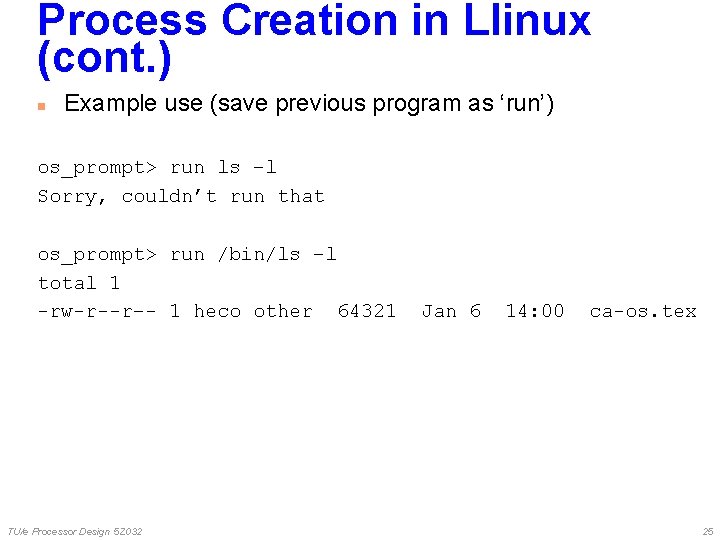
Process Creation in Llinux (cont. ) n Example use (save previous program as ‘run’) os_prompt> run ls –l Sorry, couldn’t run that os_prompt> run /bin/ls –l total 1 -rw-r--r–- 1 heco other 64321 TU/e Processor Design 5 Z 032 Jan 6 14: 00 ca-os. tex 25
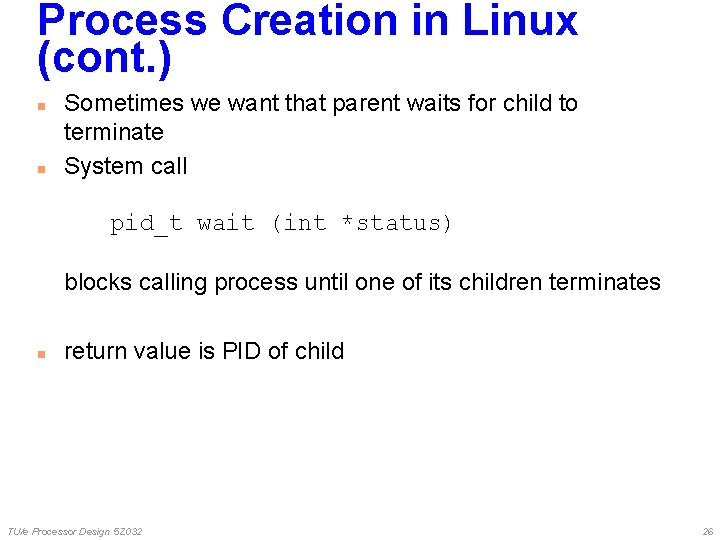
Process Creation in Linux (cont. ) n n Sometimes we want that parent waits for child to terminate System call pid_t wait (int *status) blocks calling process until one of its children terminates n return value is PID of child TU/e Processor Design 5 Z 032 26
Process Creation in Linux (cont. ) main(int argc, char *argv[]) { pid_t pid_value; int status; if (argc==1) { printf("Usage: run <command> [<parameters>]n"); exit(1); } pid_value = fork(); if (pid_value==0) { /* child */ execv(argv[1], &argv[1]); printf("Sorry, couldn't run thatn"); } else /* parent */ wait(&status); } TU/e Processor Design 5 Z 032 27
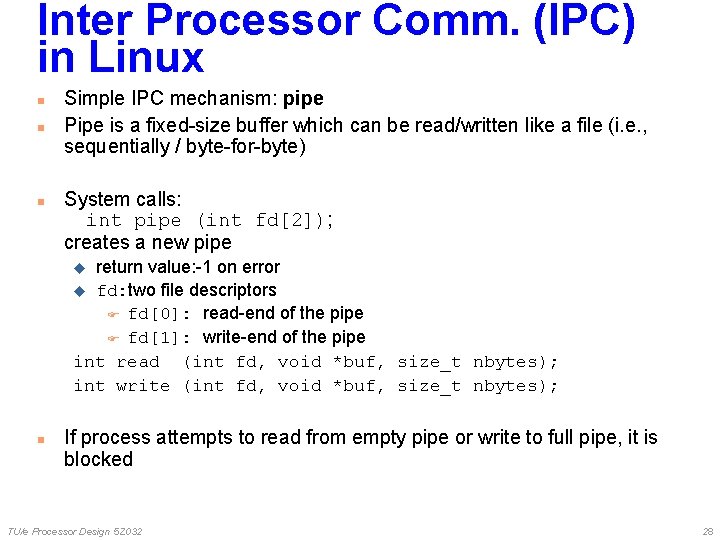
Inter Processor Comm. (IPC) in Linux n n n Simple IPC mechanism: pipe Pipe is a fixed-size buffer which can be read/written like a file (i. e. , sequentially / byte-for-byte) System calls: int pipe (int fd[2]); creates a new pipe return value: -1 on error u fd: two file descriptors F fd[0]: read-end of the pipe F fd[1]: write-end of the pipe int read (int fd, void *buf, size_t nbytes); int write (int fd, void *buf, size_t nbytes); u n If process attempts to read from empty pipe or write to full pipe, it is blocked TU/e Processor Design 5 Z 032 28
IPC in Linux (cont. ) main() { int fd[2], i, status; char c, msg[13] = "Hello world!"; if (pipe(fd)==-1) { printf("Error creating pipen"); exit(1); } } if (fork()) { /* parent process is pipe writer */ close(fd[0]); /* close read-end of pipe */ for (i=0; i<12; i++) write(fd[1], &msg[i], 1); wait(&status); } else { /* child process is pipe reader */ close(fd[1]); /* close write-end of pipe */ for (i=0; i<12; i++) { read(fd[0], &c, 1); printf("%c", c); } printf("n"); } TU/e Processor Design 5 Z 032 29
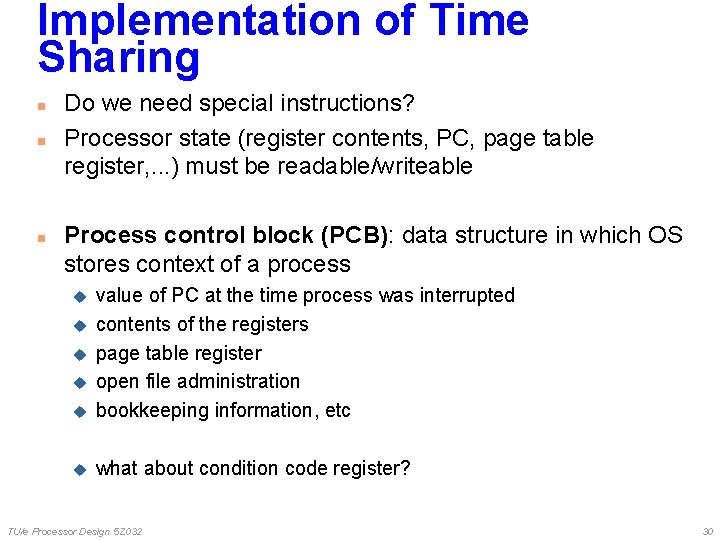
Implementation of Time Sharing n n n Do we need special instructions? Processor state (register contents, PC, page table register, . . . ) must be readable/writeable Process control block (PCB): data structure in which OS stores context of a process u value of PC at the time process was interrupted contents of the registers page table register open file administration bookkeeping information, etc u what about condition code register? u u TU/e Processor Design 5 Z 032 30
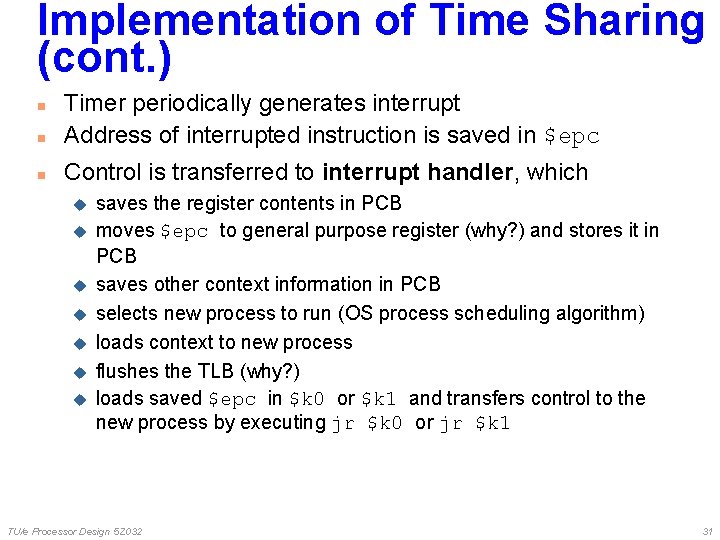
Implementation of Time Sharing (cont. ) n Timer periodically generates interrupt Address of interrupted instruction is saved in $epc n Control is transferred to interrupt handler, which n u u u u saves the register contents in PCB moves $epc to general purpose register (why? ) and stores it in PCB saves other context information in PCB selects new process to run (OS process scheduling algorithm) loads context to new process flushes the TLB (why? ) loads saved $epc in $k 0 or $k 1 and transfers control to the new process by executing jr $k 0 or jr $k 1 TU/e Processor Design 5 Z 032 31
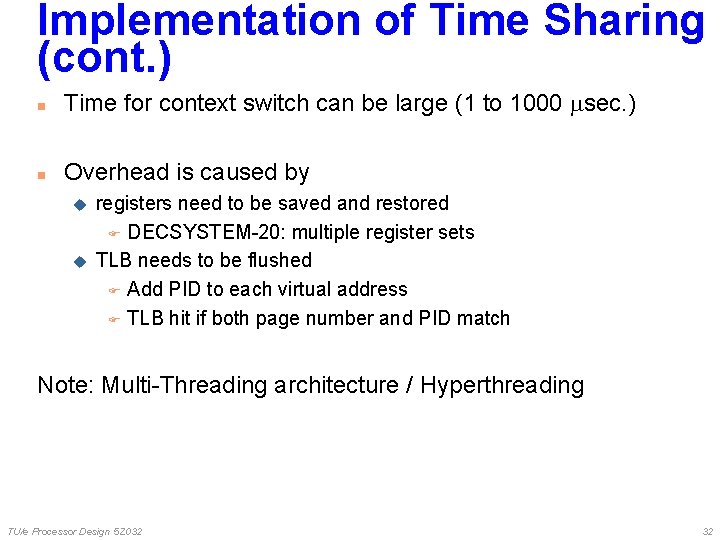
Implementation of Time Sharing (cont. ) n Time for context switch can be large (1 to 1000 sec. ) n Overhead is caused by u u registers need to be saved and restored F DECSYSTEM-20: multiple register sets TLB needs to be flushed F Add PID to each virtual address F TLB hit if both page number and PID match Note: Multi-Threading architecture / Hyperthreading TU/e Processor Design 5 Z 032 32
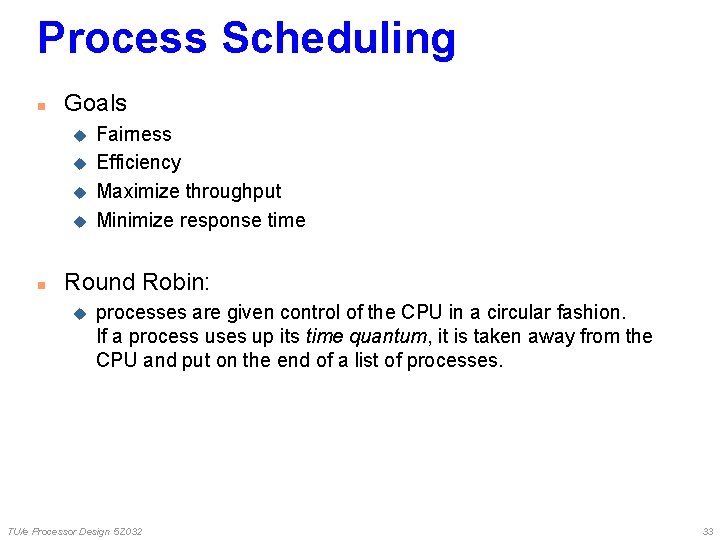
Process Scheduling n Goals u u n Fairness Efficiency Maximize throughput Minimize response time Round Robin: u processes are given control of the CPU in a circular fashion. If a process uses up its time quantum, it is taken away from the CPU and put on the end of a list of processes. TU/e Processor Design 5 Z 032 33
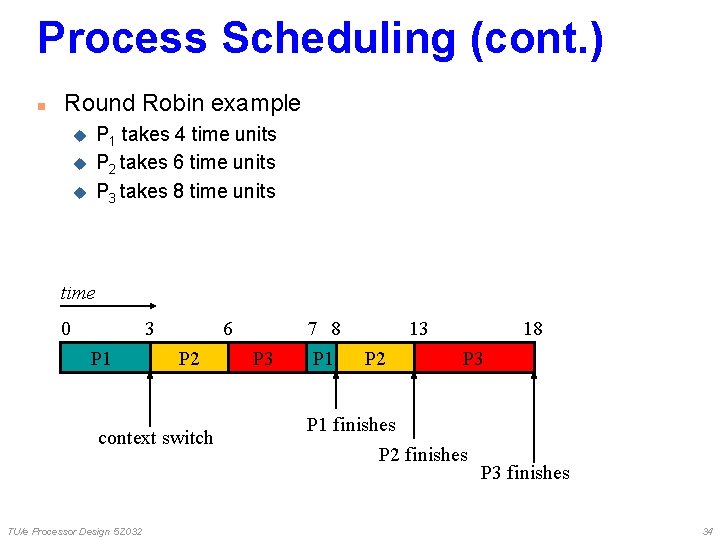
Process Scheduling (cont. ) n Round Robin example P 1 takes 4 time units P 2 takes 6 time units P 3 takes 8 time units u u u time 0 3 P 1 6 P 2 context switch TU/e Processor Design 5 Z 032 P 3 7 8 P 1 13 P 2 18 P 3 P 1 finishes P 2 finishes P 3 finishes 34
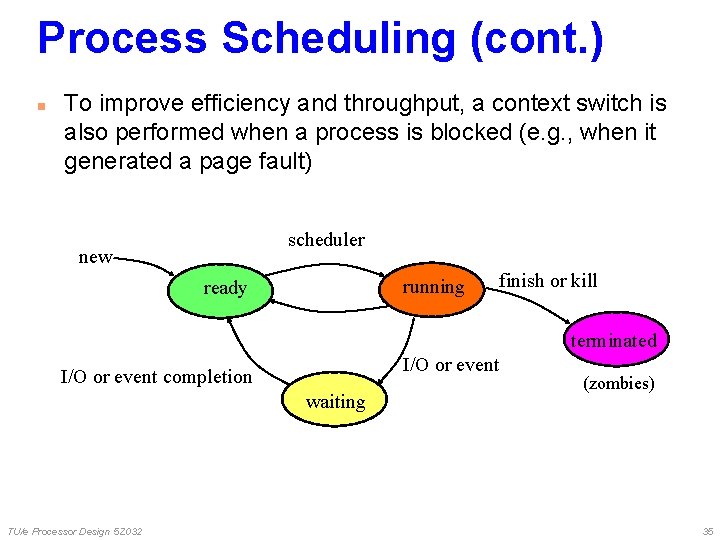
Process Scheduling (cont. ) n To improve efficiency and throughput, a context switch is also performed when a process is blocked (e. g. , when it generated a page fault) scheduler new running ready finish or kill terminated I/O or event completion waiting TU/e Processor Design 5 Z 032 (zombies) 35
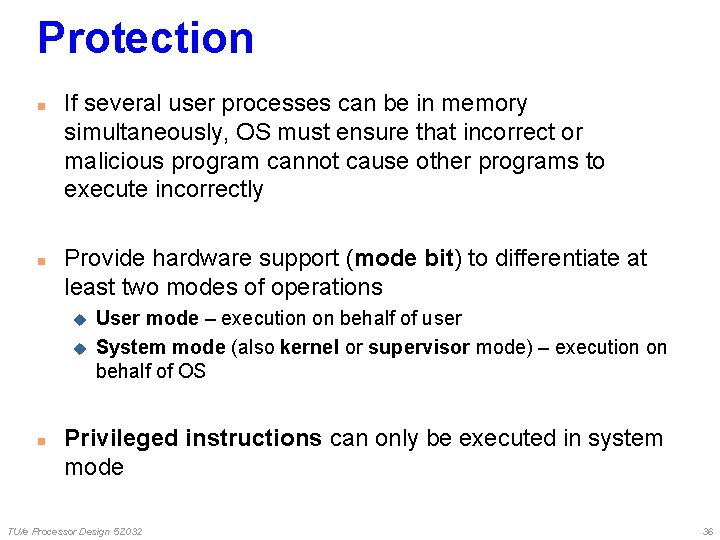
Protection n n If several user processes can be in memory simultaneously, OS must ensure that incorrect or malicious program cannot cause other programs to execute incorrectly Provide hardware support (mode bit) to differentiate at least two modes of operations u u n User mode – execution on behalf of user System mode (also kernel or supervisor mode) – execution on behalf of OS Privileged instructions can only be executed in system mode TU/e Processor Design 5 Z 032 36
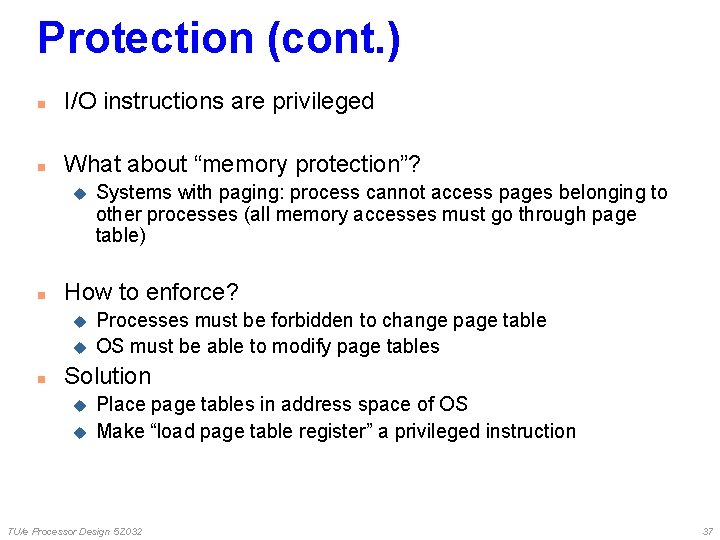
Protection (cont. ) n I/O instructions are privileged n What about “memory protection”? u n How to enforce? u u n Systems with paging: process cannot access pages belonging to other processes (all memory accesses must go through page table) Processes must be forbidden to change page table OS must be able to modify page tables Solution u u Place page tables in address space of OS Make “load page table register” a privileged instruction TU/e Processor Design 5 Z 032 37
Process Synchronization n n Synchronization problem Critical section problem Synchronization hardware Semaphores Classical synchronization problems TU/e Processor Design 5 Z 032 38
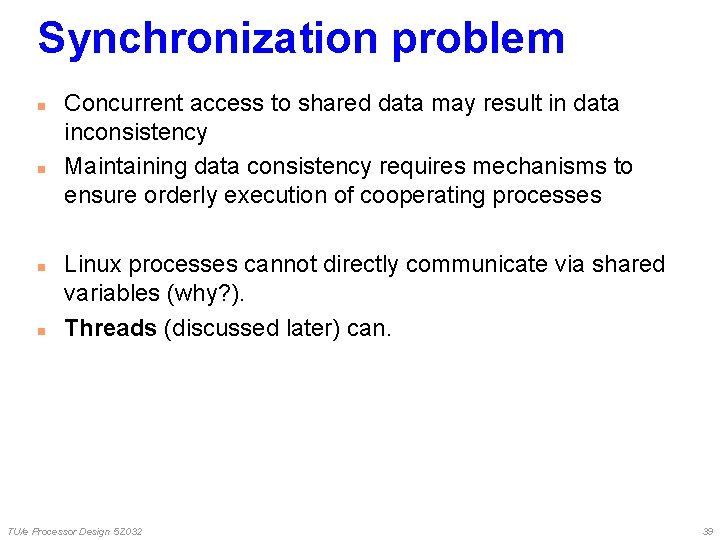
Synchronization problem n n Concurrent access to shared data may result in data inconsistency Maintaining data consistency requires mechanisms to ensure orderly execution of cooperating processes Linux processes cannot directly communicate via shared variables (why? ). Threads (discussed later) can. TU/e Processor Design 5 Z 032 39
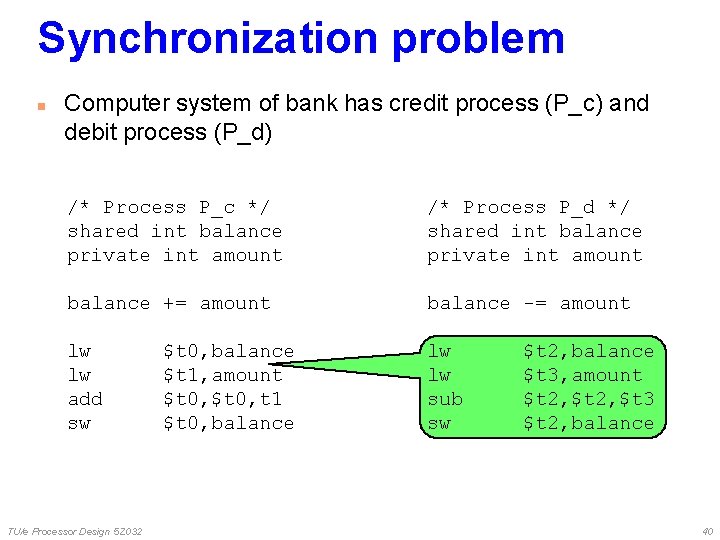
Synchronization problem n Computer system of bank has credit process (P_c) and debit process (P_d) /* Process P_c */ shared int balance private int amount /* Process P_d */ shared int balance private int amount balance += amount balance -= amount lw lw add sw lw lw sub sw TU/e Processor Design 5 Z 032 $t 0, balance $t 1, amount $t 0, t 1 $t 0, balance $t 2, balance $t 3, amount $t 2, $t 3 $t 2, balance 40
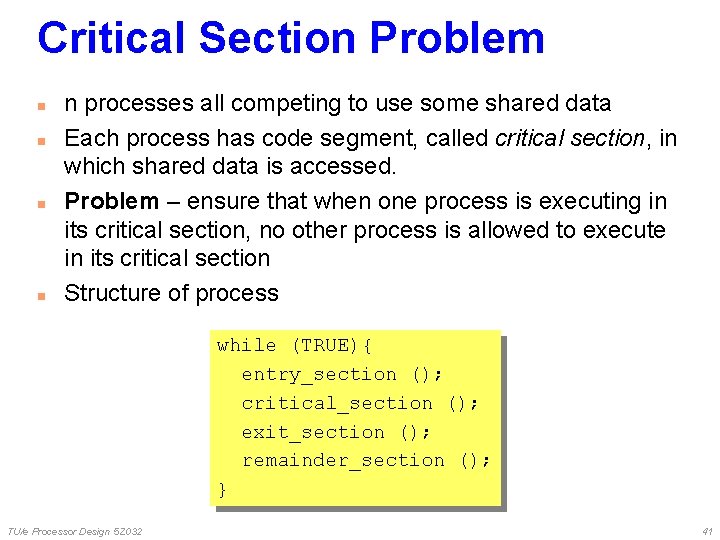
Critical Section Problem n n n processes all competing to use some shared data Each process has code segment, called critical section, in which shared data is accessed. Problem – ensure that when one process is executing in its critical section, no other process is allowed to execute in its critical section Structure of process while (TRUE){ entry_section (); critical_section (); exit_section (); remainder_section (); } TU/e Processor Design 5 Z 032 41
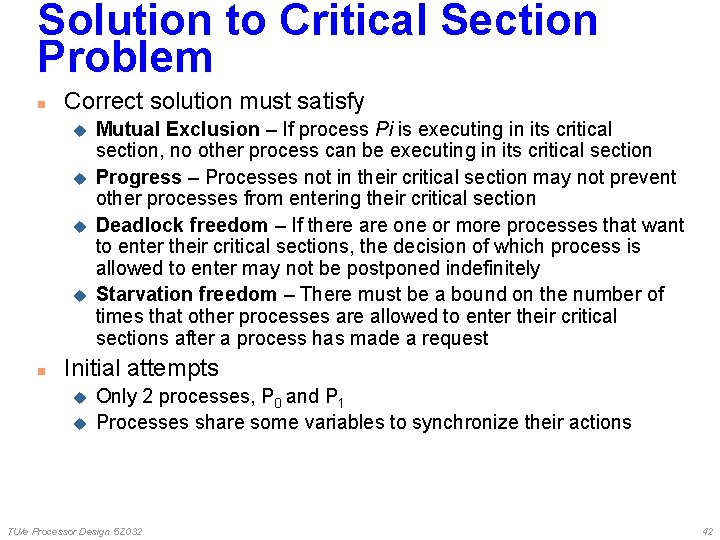
Solution to Critical Section Problem n Correct solution must satisfy u u n Mutual Exclusion – If process Pi is executing in its critical section, no other process can be executing in its critical section Progress – Processes not in their critical section may not prevent other processes from entering their critical section Deadlock freedom – If there are one or more processes that want to enter their critical sections, the decision of which process is allowed to enter may not be postponed indefinitely Starvation freedom – There must be a bound on the number of times that other processes are allowed to enter their critical sections after a process has made a request Initial attempts u u Only 2 processes, P 0 and P 1 Processes share some variables to synchronize their actions TU/e Processor Design 5 Z 032 42
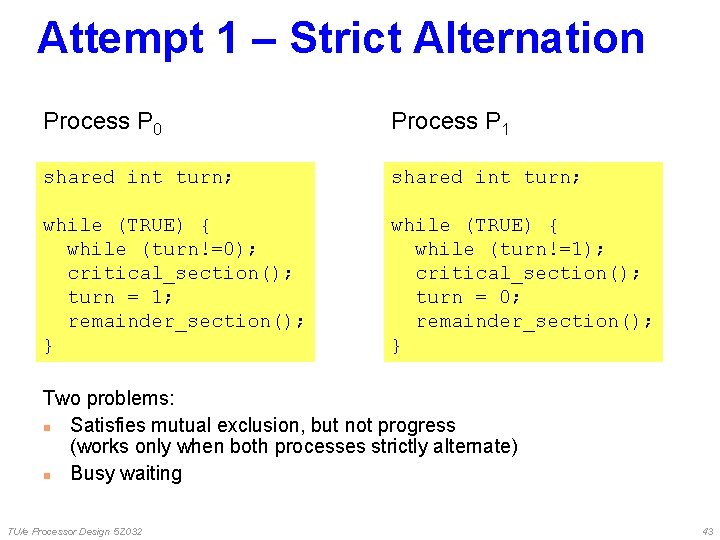
Attempt 1 – Strict Alternation Process P 0 Process P 1 shared int turn; while (TRUE) { while (turn!=0); critical_section(); turn = 1; remainder_section(); } while (TRUE) { while (turn!=1); critical_section(); turn = 0; remainder_section(); } Two problems: n Satisfies mutual exclusion, but not progress (works only when both processes strictly alternate) n Busy waiting TU/e Processor Design 5 Z 032 43
Attempt 2 – Warning Flags Process P 0 Process P 1 shared int flag[2]; while (TRUE) { flag[0] = TRUE; while (flag[1]); critical_section(); flag[0] = FALSE; remainder_section(); } while (TRUE) { flag[1] = TRUE; while (flag[0]); critical_section(); flag[1] = FALSE; remainder_section(); } n n Satisfies mutual exclusion u P 0 in critical section: flag[0] !flag[1] u P 1 in critical section: !flag[0] flag[1] However, contains a deadlock (both flags may be set to TRUE !!) TU/e Processor Design 5 Z 032 44
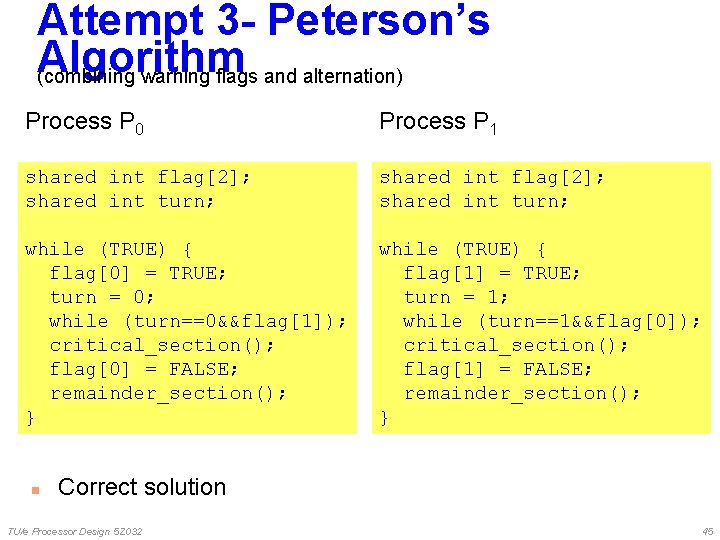
Attempt 3 - Peterson’s Algorithm (combining warning flags and alternation) Process P 0 Process P 1 shared int flag[2]; shared int turn; while (TRUE) { flag[0] = TRUE; turn = 0; while (turn==0&&flag[1]); critical_section(); flag[0] = FALSE; remainder_section(); } while (TRUE) { flag[1] = TRUE; turn = 1; while (turn==1&&flag[0]); critical_section(); flag[1] = FALSE; remainder_section(); } n Correct solution TU/e Processor Design 5 Z 032 45
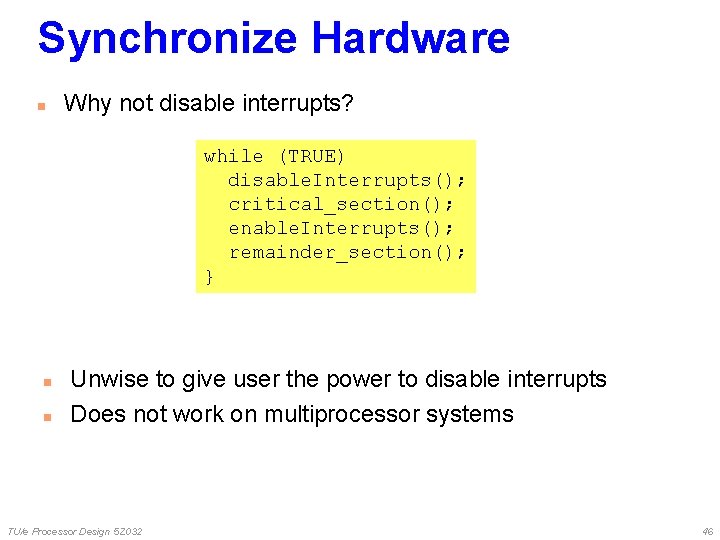
Synchronize Hardware n Why not disable interrupts? while (TRUE) disable. Interrupts(); critical_section(); enable. Interrupts(); remainder_section(); } n n Unwise to give user the power to disable interrupts Does not work on multiprocessor systems TU/e Processor Design 5 Z 032 46
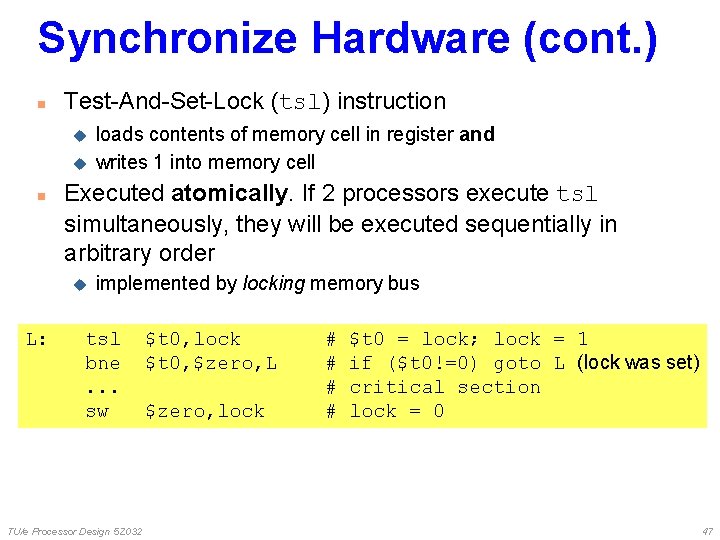
Synchronize Hardware (cont. ) n Test-And-Set-Lock (tsl) instruction u u n Executed atomically. If 2 processors execute tsl simultaneously, they will be executed sequentially in arbitrary order u L: loads contents of memory cell in register and writes 1 into memory cell implemented by locking memory bus tsl bne. . . sw TU/e Processor Design 5 Z 032 $t 0, lock $t 0, $zero, L $zero, lock # # $t 0 = lock; lock = 1 if ($t 0!=0) goto L (lock was set) critical section lock = 0 47
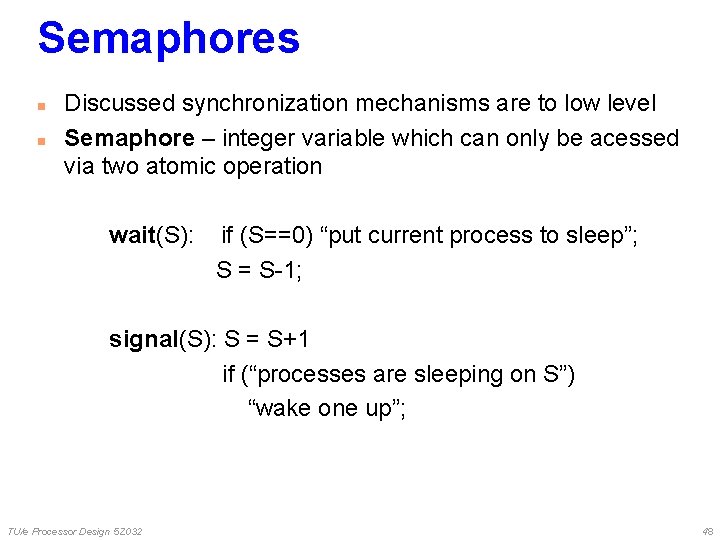
Semaphores n n Discussed synchronization mechanisms are to low level Semaphore – integer variable which can only be acessed via two atomic operation wait(S): if (S==0) “put current process to sleep”; S = S-1; signal(S): S = S+1 if (“processes are sleeping on S”) “wake one up”; TU/e Processor Design 5 Z 032 48
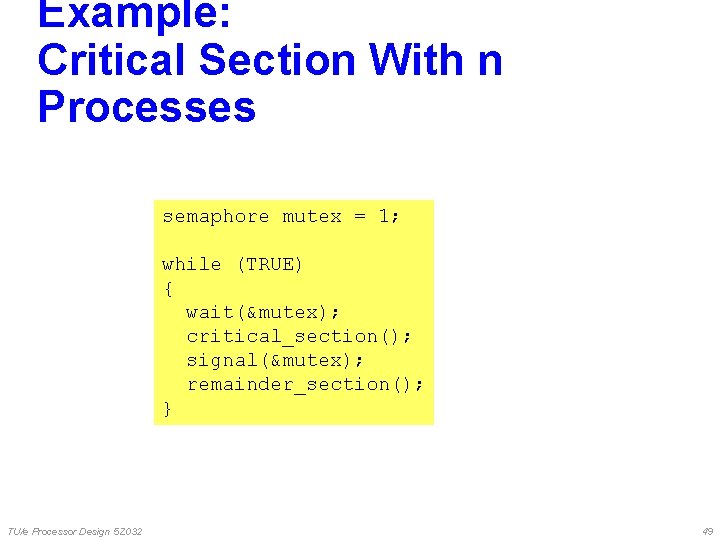
Example: Critical Section With n Processes semaphore mutex = 1; while (TRUE) { wait(&mutex); critical_section(); signal(&mutex); remainder_section(); } TU/e Processor Design 5 Z 032 49
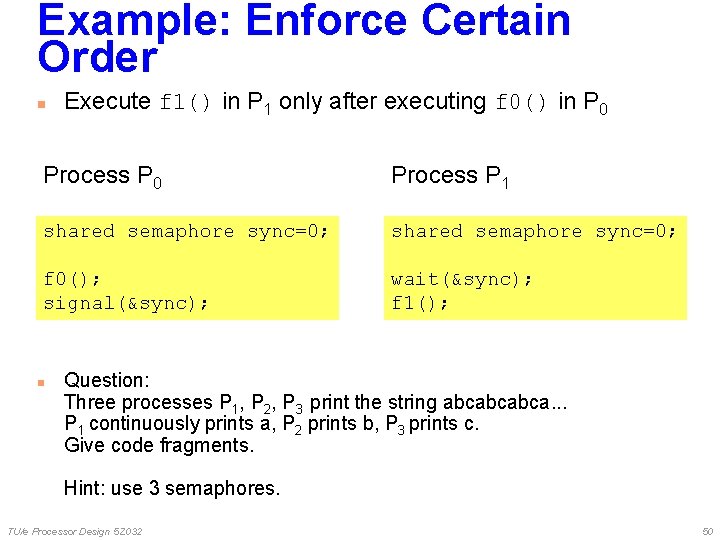
Example: Enforce Certain Order n Execute f 1() in P 1 only after executing f 0() in P 0 Process P 1 shared semaphore sync=0; f 0(); signal(&sync); wait(&sync); f 1(); n Question: Three processes P 1, P 2, P 3 print the string abcabcabca. . . P 1 continuously prints a, P 2 prints b, P 3 prints c. Give code fragments. Hint: use 3 semaphores. TU/e Processor Design 5 Z 032 50
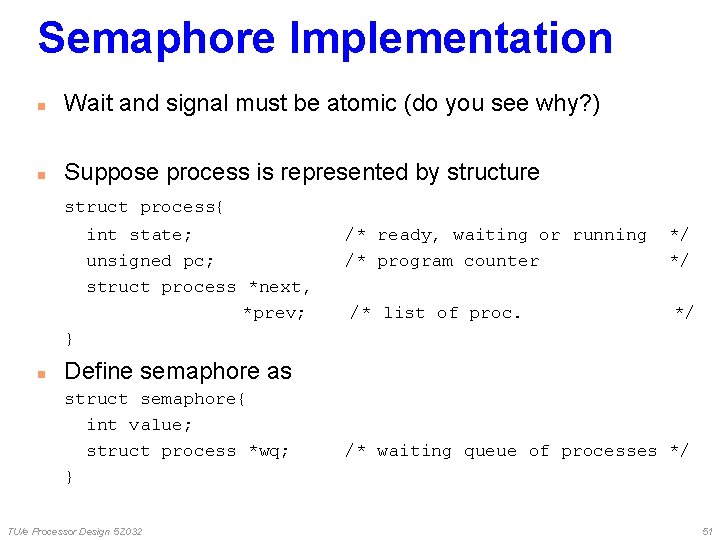
Semaphore Implementation n Wait and signal must be atomic (do you see why? ) n Suppose process is represented by structure struct process{ int state; unsigned pc; struct process *next, *prev; /* ready, waiting or running /* program counter /* list of proc. */ */ */ } n Define semaphore as struct semaphore{ int value; struct process *wq; } TU/e Processor Design 5 Z 032 /* waiting queue of processes */ 51
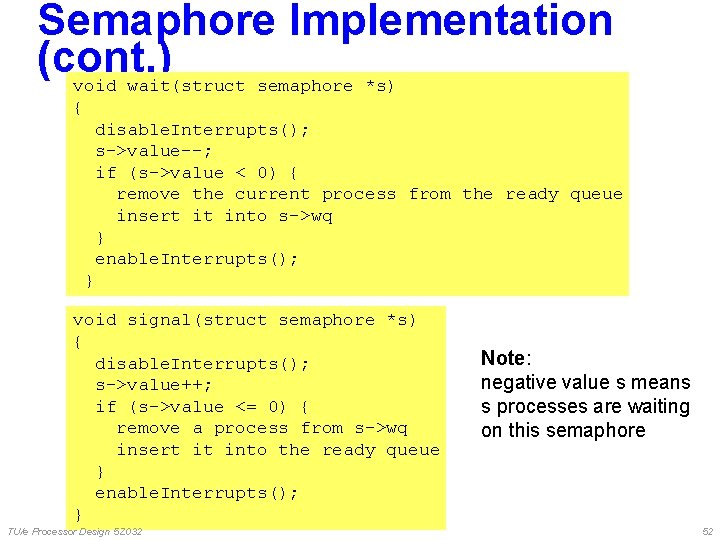
Semaphore Implementation (cont. ) void wait(struct semaphore *s) { disable. Interrupts(); s->value--; if (s->value < 0) { remove the current process from the ready queue insert it into s->wq } enable. Interrupts(); } void signal(struct semaphore *s) { disable. Interrupts(); s->value++; if (s->value <= 0) { remove a process from s->wq insert it into the ready queue } enable. Interrupts(); } TU/e Processor Design 5 Z 032 Note: negative value s means s processes are waiting on this semaphore 52
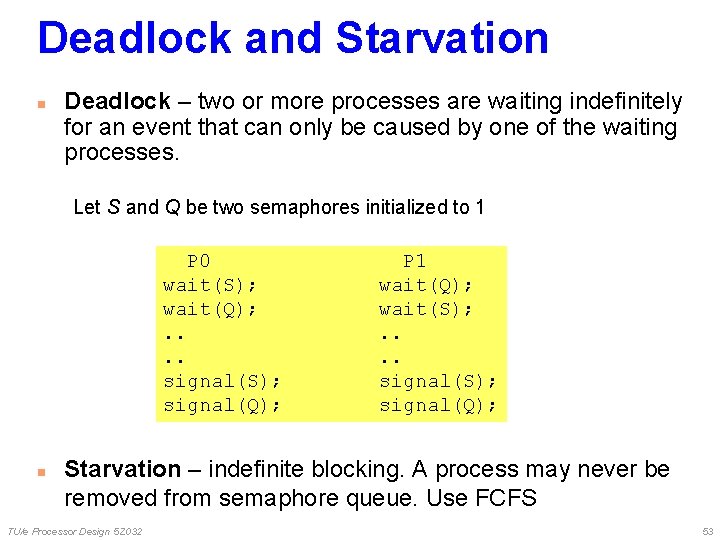
Deadlock and Starvation n Deadlock – two or more processes are waiting indefinitely for an event that can only be caused by one of the waiting processes. Let S and Q be two semaphores initialized to 1 P 0 wait(S); wait(Q); . . signal(S); signal(Q); n P 1 wait(Q); wait(S); . . signal(S); signal(Q); Starvation – indefinite blocking. A process may never be removed from semaphore queue. Use FCFS TU/e Processor Design 5 Z 032 53
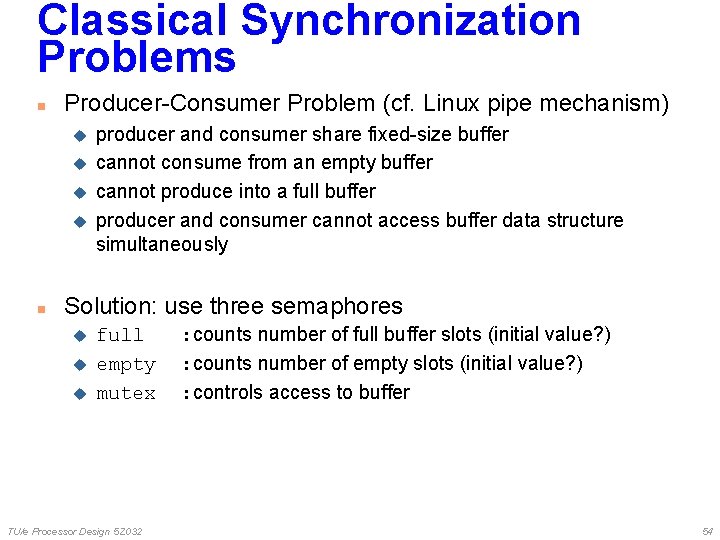
Classical Synchronization Problems n Producer-Consumer Problem (cf. Linux pipe mechanism) u u n producer and consumer share fixed-size buffer cannot consume from an empty buffer cannot produce into a full buffer producer and consumer cannot access buffer data structure simultaneously Solution: use three semaphores u u u full empty mutex TU/e Processor Design 5 Z 032 : counts number of full buffer slots (initial value? ) : counts number of empty slots (initial value? ) : controls access to buffer 54
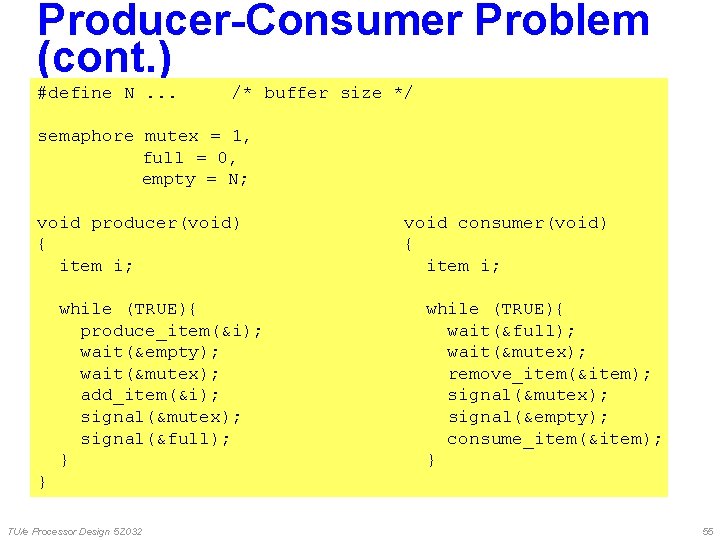
Producer-Consumer Problem (cont. ) #define N. . . /* buffer size */ semaphore mutex = 1, full = 0, empty = N; void producer(void) { item i; while (TRUE){ produce_item(&i); wait(&empty); wait(&mutex); add_item(&i); signal(&mutex); signal(&full); } void consumer(void) { item i; while (TRUE){ wait(&full); wait(&mutex); remove_item(&item); signal(&mutex); signal(&empty); consume_item(&item); } } TU/e Processor Design 5 Z 032 55
Dining Philosophers Problem n Shared data semaphore fork[5]; TU/e Processor Design 5 Z 032 /* All initially 1, meaning /* “fork on the table” */ */ 56
Dining Philosophers Problem (cont. ) semaphore fork[5]; /* the 5 forks */ fork[0] = fork[1] = fork[2] = fork[3] = fork[4] = 1; void philosopher(int i) { /* i is the number of the philosopher (0. . 4) */ while (TRUE) { think(); wait(&fork[i]); wait(&fork[(i+1)%5]); eat(); signal(&fork[i]); signal(&fork[(i+1)%5]); } /* pick up left fork /* pick up right fork */ */ /* put down left fork */ /* put down right fork */ } n Contains possible deadlock (can you see it? ) TU/e Processor Design 5 Z 032 57
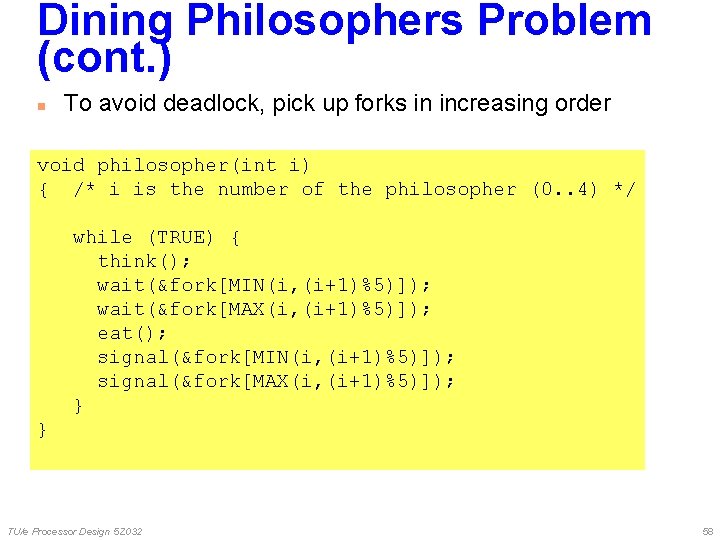
Dining Philosophers Problem (cont. ) n To avoid deadlock, pick up forks in increasing order void philosopher(int i) { /* i is the number of the philosopher (0. . 4) */ while (TRUE) { think(); wait(&fork[MIN(i, (i+1)%5)]); wait(&fork[MAX(i, (i+1)%5)]); eat(); signal(&fork[MIN(i, (i+1)%5)]); signal(&fork[MAX(i, (i+1)%5)]); } } TU/e Processor Design 5 Z 032 58
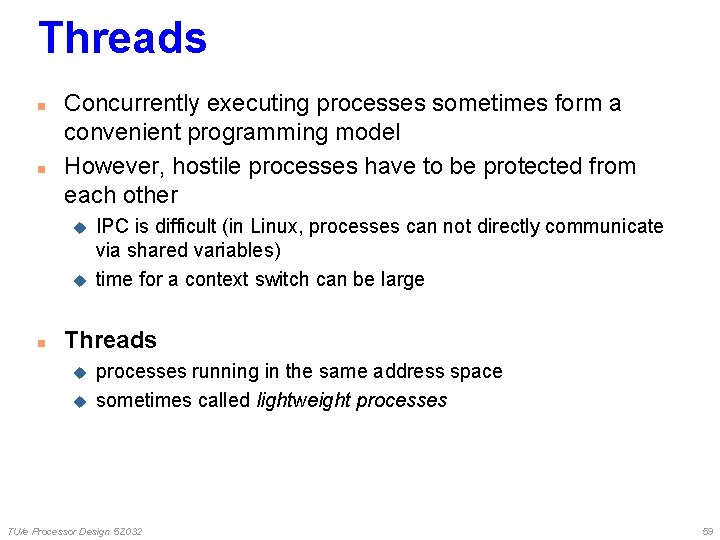
Threads n n Concurrently executing processes sometimes form a convenient programming model However, hostile processes have to be protected from each other u u n IPC is difficult (in Linux, processes can not directly communicate via shared variables) time for a context switch can be large Threads u u processes running in the same address space sometimes called lightweight processes TU/e Processor Design 5 Z 032 59
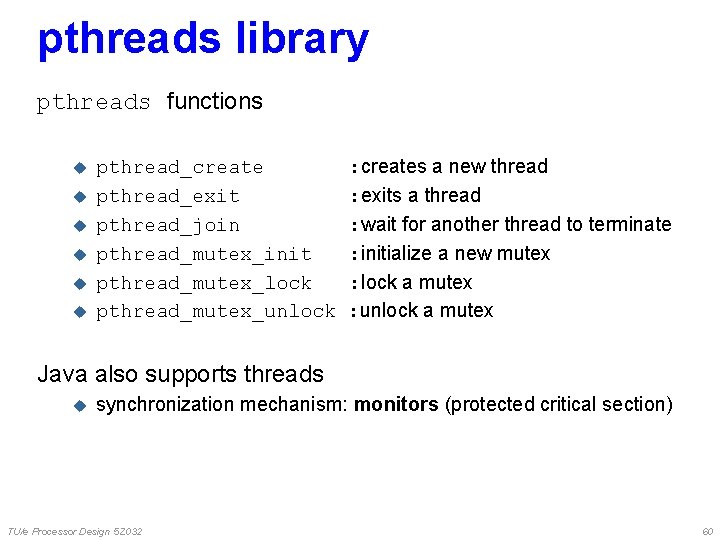
pthreads library pthreads functions u u u pthread_create pthread_exit pthread_join pthread_mutex_init pthread_mutex_lock pthread_mutex_unlock : creates a new thread : exits a thread : wait for another thread to terminate : initialize a new mutex : lock a mutex : unlock a mutex Java also supports threads u synchronization mechanism: monitors (protected critical section) TU/e Processor Design 5 Z 032 60
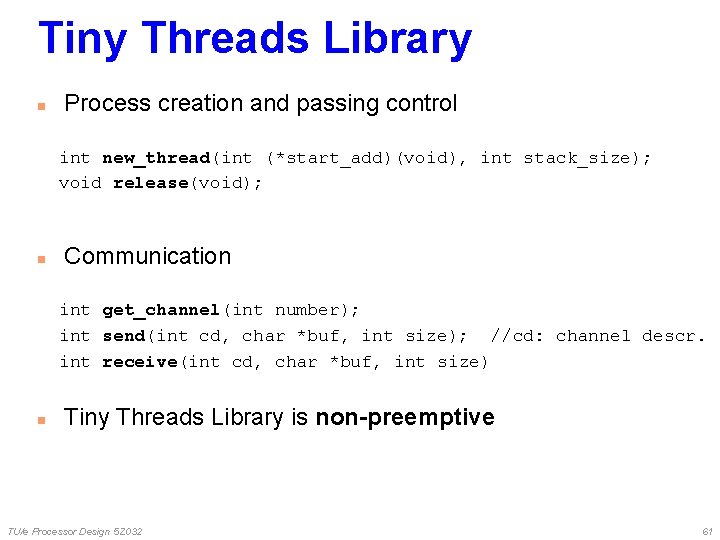
Tiny Threads Library n Process creation and passing control int new_thread(int (*start_add)(void), int stack_size); void release(void); n Communication int get_channel(int number); int send(int cd, char *buf, int size); //cd: channel descr. int receive(int cd, char *buf, int size) n Tiny Threads Library is non-preemptive TU/e Processor Design 5 Z 032 61
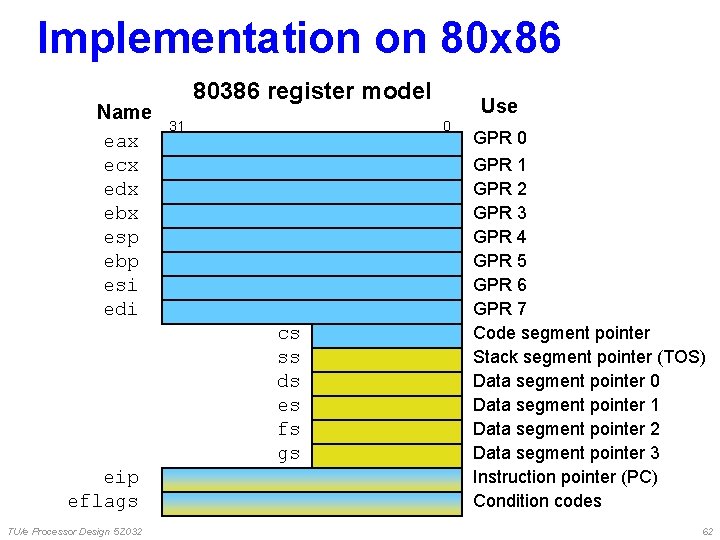
Implementation on 80 x 86 Name eax ecx edx ebx esp ebp esi edi 80386 register model 31 0 cs ss ds es fs gs eip eflags TU/e Processor Design 5 Z 032 Use GPR 0 GPR 1 GPR 2 GPR 3 GPR 4 GPR 5 GPR 6 GPR 7 Code segment pointer Stack segment pointer (TOS) Data segment pointer 0 Data segment pointer 1 Data segment pointer 2 Data segment pointer 3 Instruction pointer (PC) Condition codes 62
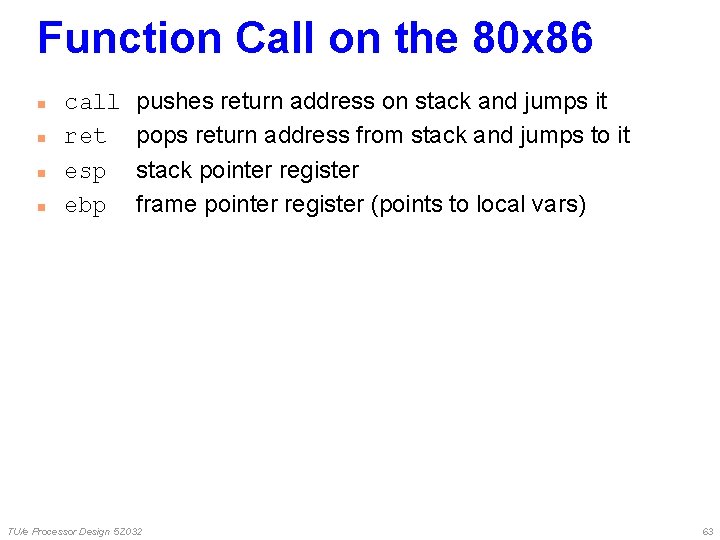
Function Call on the 80 x 86 n n call ret esp ebp pushes return address on stack and jumps it pops return address from stack and jumps to it stack pointer register frame pointer register (points to local vars) TU/e Processor Design 5 Z 032 63
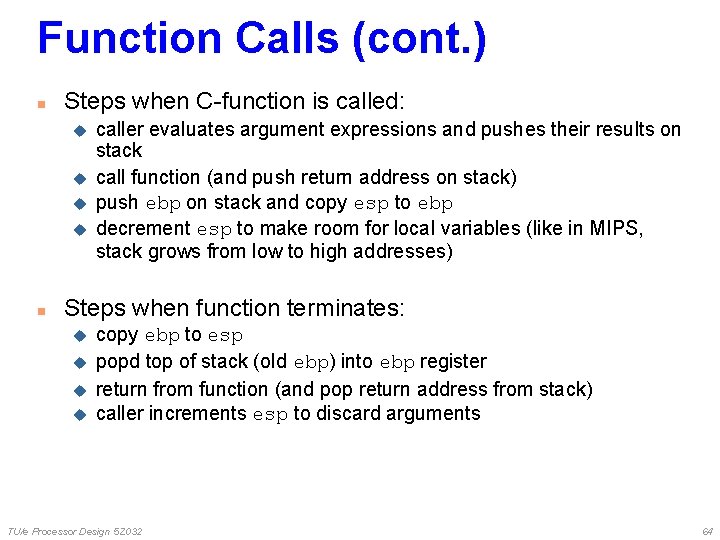
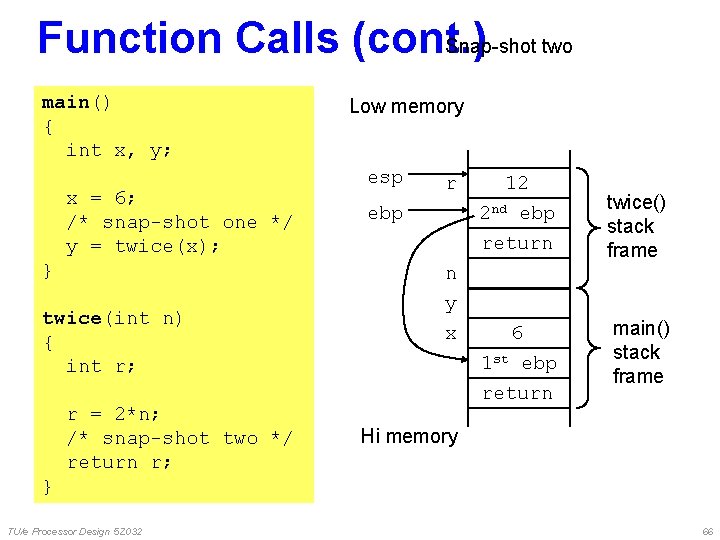
Function Calls (cont. ) n Steps when C-function is called: u u n caller evaluates argument expressions and pushes their results on stack call function (and push return address on stack) push ebp on stack and copy esp to ebp decrement esp to make room for local variables (like in MIPS, stack grows from low to high addresses) Steps when function terminates: u u copy ebp to esp popd top of stack (old ebp) into ebp register return from function (and pop return address from stack) caller increments esp to discard arguments TU/e Processor Design 5 Z 032 64
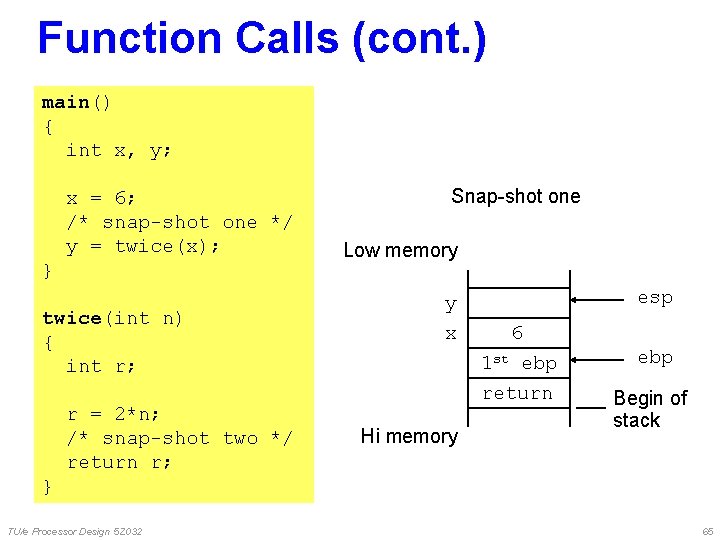
Function Calls (cont. ) main() { int x, y; x = 6; /* snap-shot one */ y = twice(x); } twice(int n) { int r; r = 2*n; /* snap-shot two */ return r; Snap-shot one Low memory y x Hi memory esp 6 1 st ebp return ebp Begin of stack } TU/e Processor Design 5 Z 032 65
Snap-shot two Function Calls (cont. ) main() { int x, y; x = 6; /* snap-shot one */ y = twice(x); } twice(int n) { int r; r = 2*n; /* snap-shot two */ return r; Low memory esp r ebp n y x 12 2 nd ebp return 6 1 st ebp return twice() stack frame main() stack frame Hi memory } TU/e Processor Design 5 Z 032 66
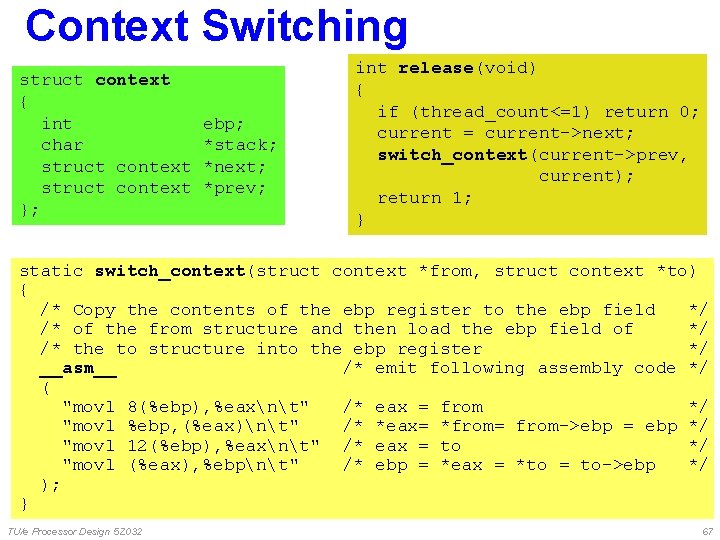
Context Switching struct context { int char struct context }; ebp; *stack; *next; *prev; int release(void) { if (thread_count<=1) return 0; current = current->next; switch_context(current->prev, current); return 1; } static switch_context(struct context *from, struct context *to) { /* Copy the contents of the ebp register to the ebp field */ /* of the from structure and then load the ebp field of */ /* the to structure into the ebp register */ __asm__ /* emit following assembly code */ ( "movl 8(%ebp), %eaxnt" /* eax = from */ "movl %ebp, (%eax)nt" /* *eax= *from= from->ebp = ebp */ "movl 12(%ebp), %eaxnt" /* eax = to */ "movl (%eax), %ebpnt" /* ebp = *eax = *to = to->ebp */ ); } TU/e Processor Design 5 Z 032 67
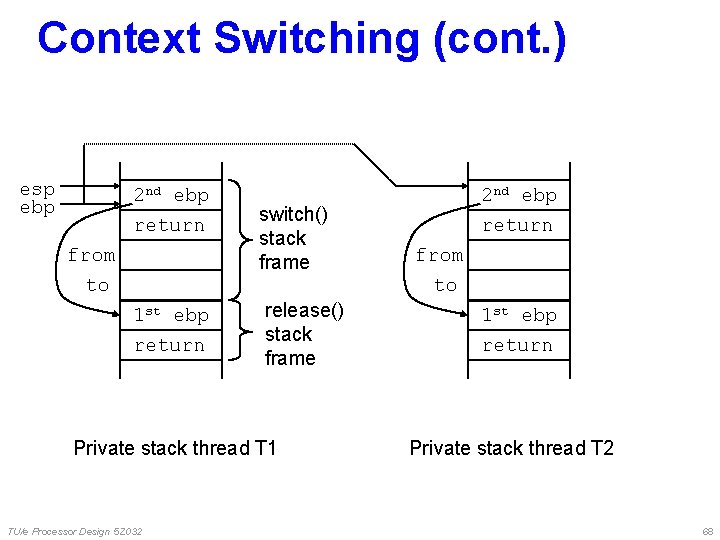
Context Switching (cont. ) esp ebp 2 nd ebp return from to 1 st ebp return switch() stack frame release() stack frame Private stack thread T 1 TU/e Processor Design 5 Z 032 2 nd ebp return from to 1 st ebp return Private stack thread T 2 68
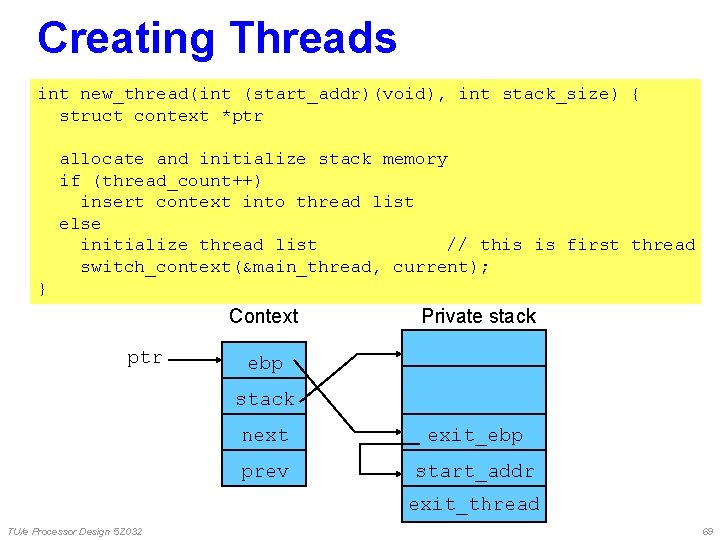
Creating Threads int new_thread(int (start_addr)(void), int stack_size) { struct context *ptr allocate and initialize stack memory if (thread_count++) insert context into thread list else initialize thread list // this is first thread switch_context(&main_thread, current); } Context ptr Private stack ebp stack next exit_ebp prev start_addr exit_thread TU/e Processor Design 5 Z 032 69
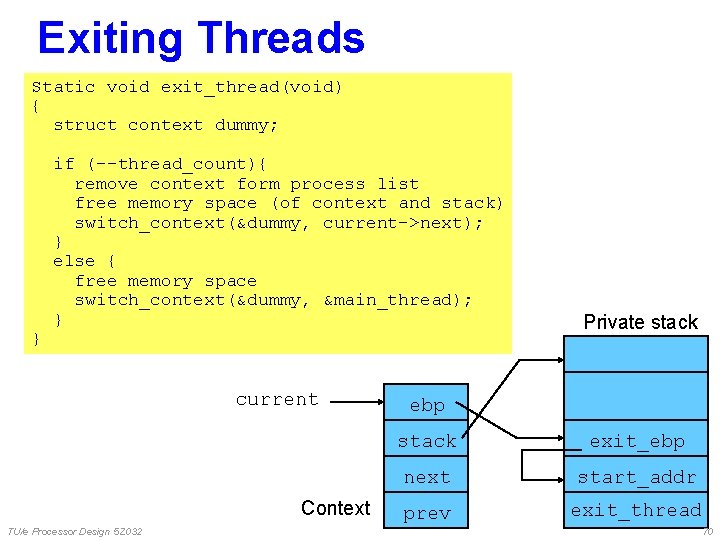
Exiting Threads Static void exit_thread(void) { struct context dummy; } if (--thread_count){ remove context form process list free memory space (of context and stack) switch_context(&dummy, current->next); } else { free memory space switch_context(&dummy, &main_thread); } current Context TU/e Processor Design 5 Z 032 Private stack ebp stack exit_ebp next start_addr prev exit_thread 70
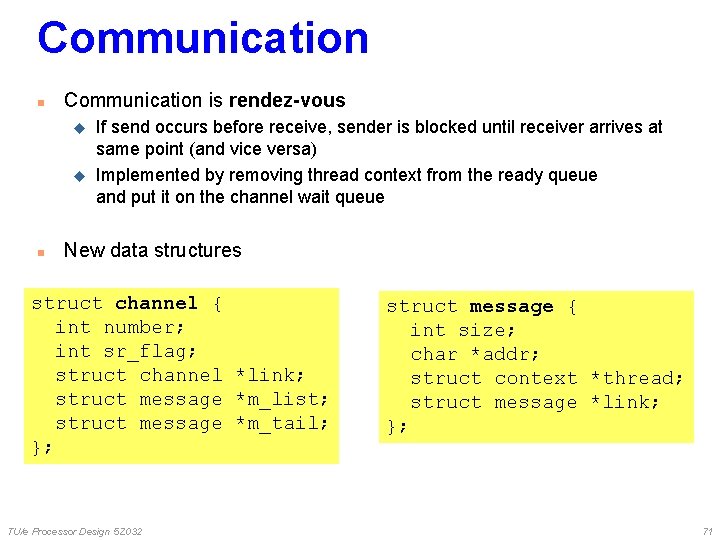
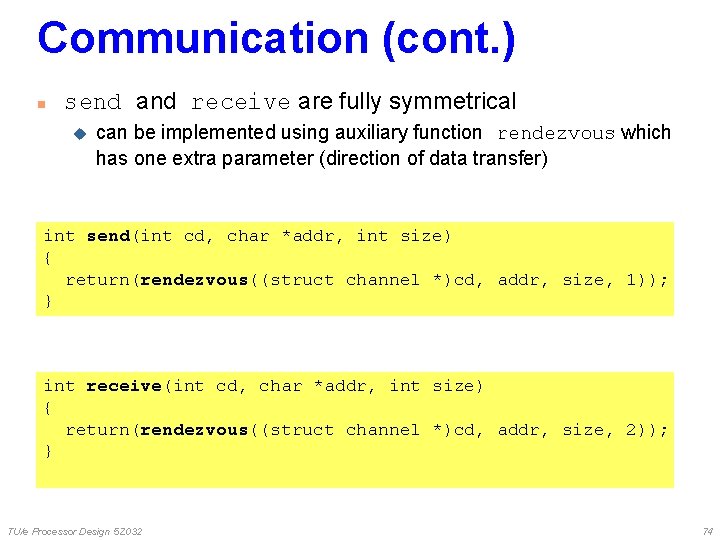
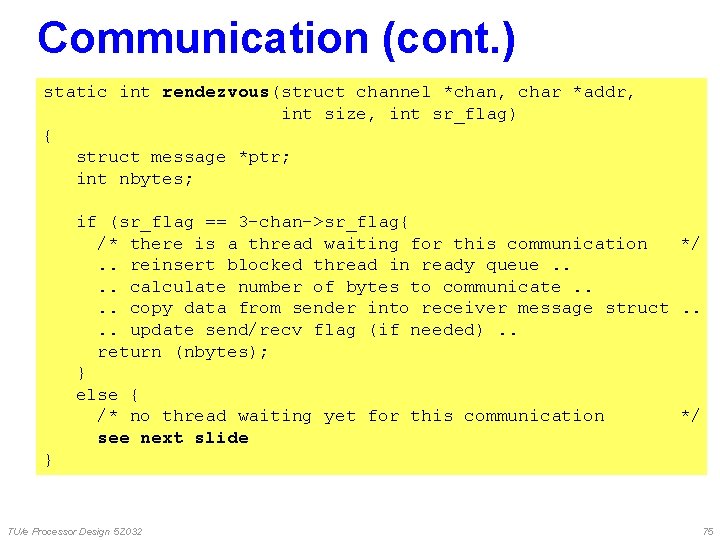
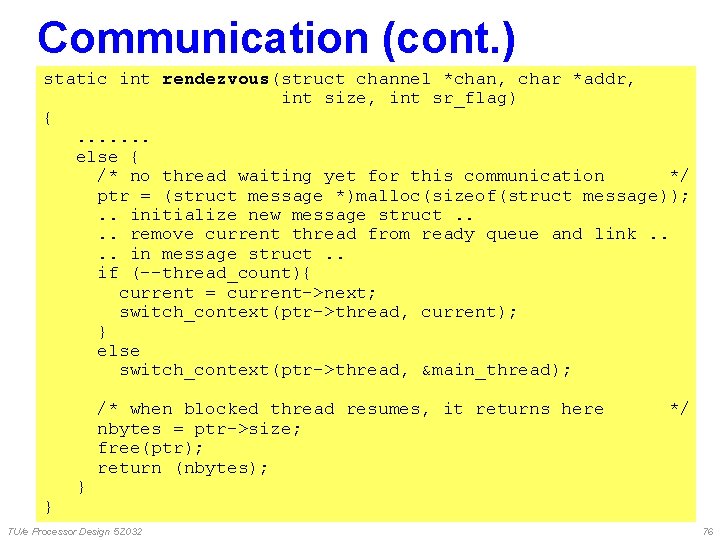
Communication n Communication is rendez-vous u u n If send occurs before receive, sender is blocked until receiver arrives at same point (and vice versa) Implemented by removing thread context from the ready queue and put it on the channel wait queue New data structures struct channel { int number; int sr_flag; struct channel *link; struct message *m_list; struct message *m_tail; }; TU/e Processor Design 5 Z 032 struct message { int size; char *addr; struct context *thread; struct message *link; }; 71
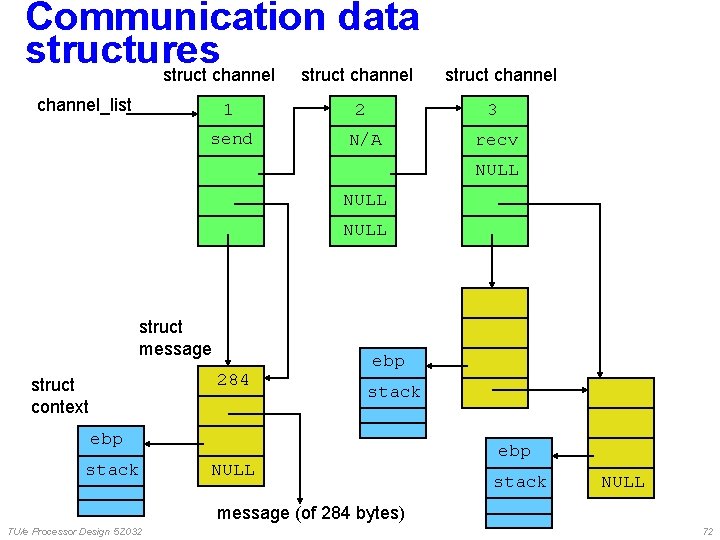
Communication data structures struct channel_list struct channel 1 2 3 send N/A recv NULL struct message 284 struct context ebp stack NULL message (of 284 bytes) TU/e Processor Design 5 Z 032 72
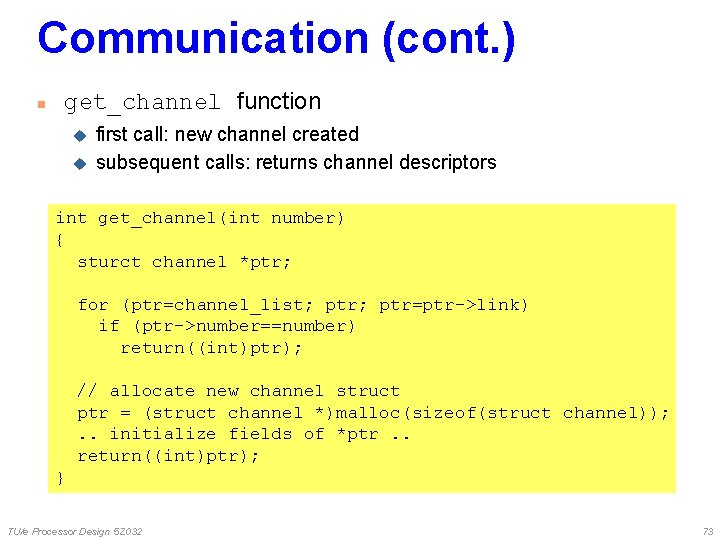
Communication (cont. ) n get_channel function u u first call: new channel created subsequent calls: returns channel descriptors int get_channel(int number) { sturct channel *ptr; for (ptr=channel_list; ptr=ptr->link) if (ptr->number==number) return((int)ptr); // allocate new channel struct ptr = (struct channel *)malloc(sizeof(struct channel)); . . initialize fields of *ptr. . return((int)ptr); } TU/e Processor Design 5 Z 032 73
Communication (cont. ) n send and receive are fully symmetrical u can be implemented using auxiliary function rendezvous which has one extra parameter (direction of data transfer) int send(int cd, char *addr, int size) { return(rendezvous((struct channel *)cd, addr, size, 1)); } int receive(int cd, char *addr, int size) { return(rendezvous((struct channel *)cd, addr, size, 2)); } TU/e Processor Design 5 Z 032 74
Communication (cont. ) static int rendezvous(struct channel *chan, char *addr, int size, int sr_flag) { struct message *ptr; int nbytes; if (sr_flag == 3 -chan->sr_flag{ /* there is a thread waiting for this communication */. . reinsert blocked thread in ready queue. . calculate number of bytes to communicate. . copy data from sender into receiver message struct. . update send/recv flag (if needed). . return (nbytes); } else { /* no thread waiting yet for this communication */ see next slide } TU/e Processor Design 5 Z 032 75
Communication (cont. ) static int rendezvous(struct channel *chan, char *addr, int size, int sr_flag) {. . . . else { /* no thread waiting yet for this communication */ ptr = (struct message *)malloc(sizeof(struct message)); . . initialize new message struct. . remove current thread from ready queue and link. . in message struct. . if (--thread_count){ current = current->next; switch_context(ptr->thread, current); } else switch_context(ptr->thread, &main_thread); } } /* when blocked thread resumes, it returns here nbytes = ptr->size; free(ptr); return (nbytes); TU/e Processor Design 5 Z 032 */ 76
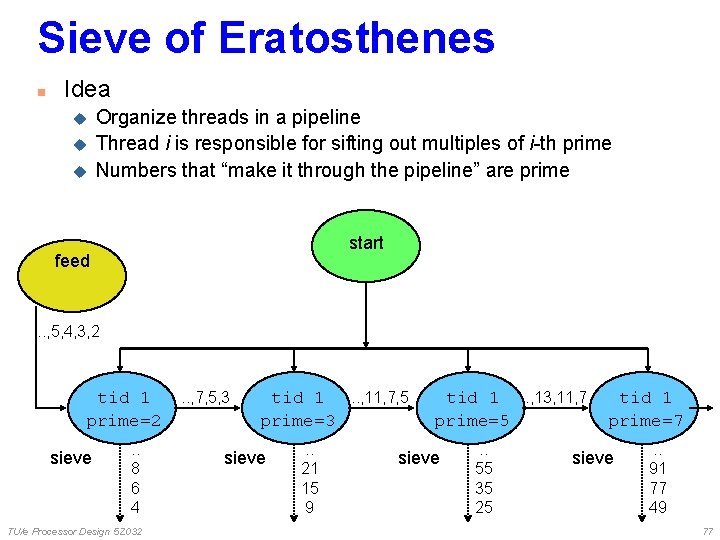
Sieve of Eratosthenes n Idea u u u Organize threads in a pipeline Thread i is responsible for sifting out multiples of i-th prime Numbers that “make it through the pipeline” are prime start feed . . , 5, 4, 3, 2 tid 1 prime=2 sieve . . 8 6 4 TU/e Processor Design 5 Z 032 . . , 7, 5, 3 tid 1. . , 11, 7, 5 prime=3 sieve . . 21 15 9 tid 1. . , 13, 11, 7 prime=5 sieve . . 55 35 25 tid 1 prime=7 sieve . . 91 77 49 77