
Processing Sequential Files SET SOURCEFORMATFREE IDENTIFICATION DIVISION PROGRAMID
- Slides: 30
Processing Sequential Files
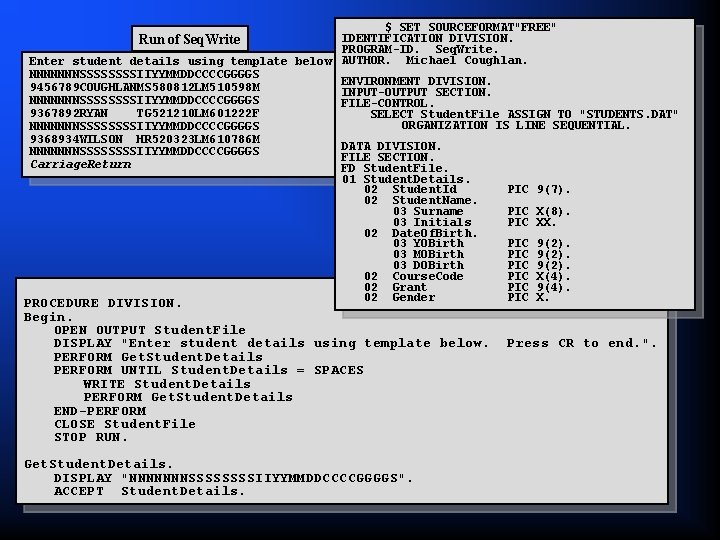
$ SET SOURCEFORMAT"FREE" IDENTIFICATION DIVISION. PROGRAM-ID. Seq. Write. Enter student details using template below. AUTHOR. Press CRMichael to end. Coughlan. NNNNNNNSSSSIIYYMMDDCCCCGGGGS ENVIRONMENT DIVISION. 9456789 COUGHLANMS 580812 LM 510598 M INPUT-OUTPUT SECTION. NNNNNNNSSSSIIYYMMDDCCCCGGGGS FILE-CONTROL. 9367892 RYAN TG 521210 LM 601222 F SELECT Student. File ASSIGN TO "STUDENTS. DAT" ORGANIZATION IS LINE SEQUENTIAL. NNNNNNNSSSSIIYYMMDDCCCCGGGGS 9368934 WILSON HR 520323 LM 610786 M DATA DIVISION. NNNNNNNSSSSIIYYMMDDCCCCGGGGS FILE SECTION. Carriage. Return FD Student. File. 01 Student. Details. 02 Student. Id PIC 9(7). 02 Student. Name. 03 Surname PIC X(8). 03 Initials PIC XX. 02 Date. Of. Birth. 03 YOBirth PIC 9(2). 03 MOBirth PIC 9(2). 03 DOBirth PIC 9(2). 02 Course. Code PIC X(4). 02 Grant PIC 9(4). 02 Gender PIC X. PROCEDURE DIVISION. Run of Seq. Write Begin. OPEN OUTPUT Student. File DISPLAY "Enter student details using template below. PERFORM Get. Student. Details PERFORM UNTIL Student. Details = SPACES WRITE Student. Details PERFORM Get. Student. Details END-PERFORM CLOSE Student. File STOP RUN. Get. Student. Details. DISPLAY "NNNNNNNSSSSIIYYMMDDCCCCGGGGS". ACCEPT Student. Details. Press CR to end. ".
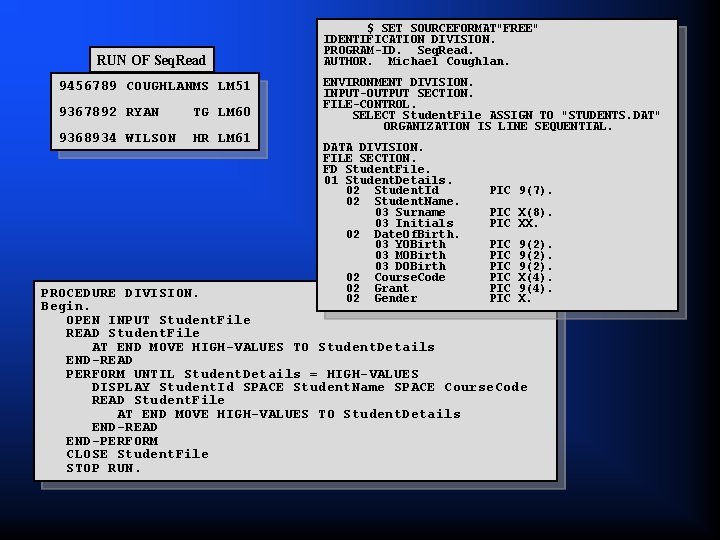
RUN OF Seq. Read 9456789 COUGHLANMS LM 51 9367892 RYAN TG LM 60 9368934 WILSON HR LM 61 $ SET SOURCEFORMAT"FREE" IDENTIFICATION DIVISION. PROGRAM-ID. Seq. Read. AUTHOR. Michael Coughlan. ENVIRONMENT DIVISION. INPUT-OUTPUT SECTION. FILE-CONTROL. SELECT Student. File ASSIGN TO "STUDENTS. DAT" ORGANIZATION IS LINE SEQUENTIAL. DATA DIVISION. FILE SECTION. FD Student. File. 01 Student. Details. 02 Student. Id 02 Student. Name. 03 Surname 03 Initials 02 Date. Of. Birth. 03 YOBirth 03 MOBirth 03 DOBirth 02 Course. Code 02 Grant 02 Gender PIC 9(7). PIC X(8). PIC XX. PIC PIC PIC 9(2). X(4). 9(4). X. PROCEDURE DIVISION. Begin. OPEN INPUT Student. File READ Student. File AT END MOVE HIGH-VALUES TO Student. Details END-READ PERFORM UNTIL Student. Details = HIGH-VALUES DISPLAY Student. Id SPACE Student. Name SPACE Course. Code READ Student. File AT END MOVE HIGH-VALUES TO Student. Details END-READ END-PERFORM CLOSE Student. File STOP RUN.
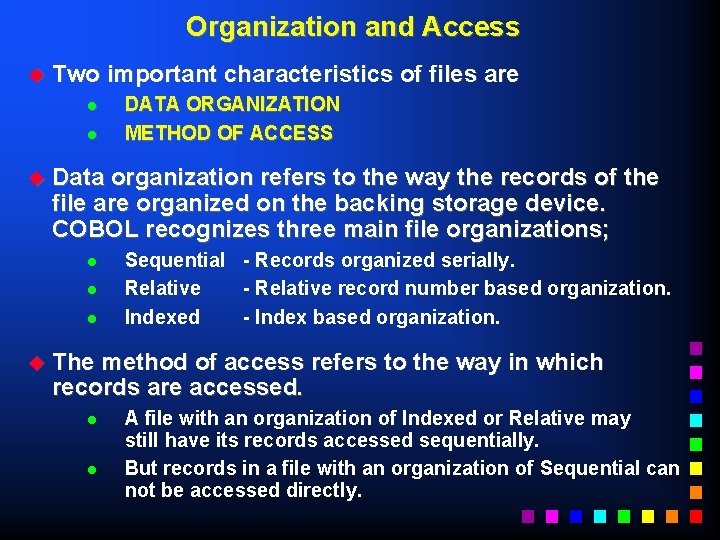
Organization and Access u Two important characteristics of files are l l u Data organization refers to the way the records of the file are organized on the backing storage device. COBOL recognizes three main file organizations; l l l u DATA ORGANIZATION METHOD OF ACCESS Sequential - Records organized serially. Relative - Relative record number based organization. Indexed - Index based organization. The method of access refers to the way in which records are accessed. l l A file with an organization of Indexed or Relative may still have its records accessed sequentially. But records in a file with an organization of Sequential can not be accessed directly.
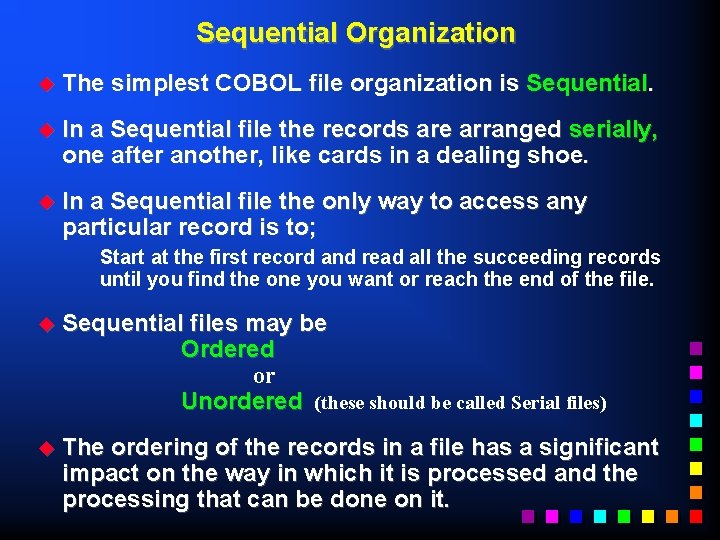
Sequential Organization u The simplest COBOL file organization is Sequential. u In a Sequential file the records are arranged serially, one after another, like cards in a dealing shoe. u In a Sequential file the only way to access any particular record is to; Start at the first record and read all the succeeding records until you find the one you want or reach the end of the file. u Sequential files may be Ordered or Unordered (these should be called Serial files) u The ordering of the records in a file has a significant impact on the way in which it is processed and the processing that can be done on it.
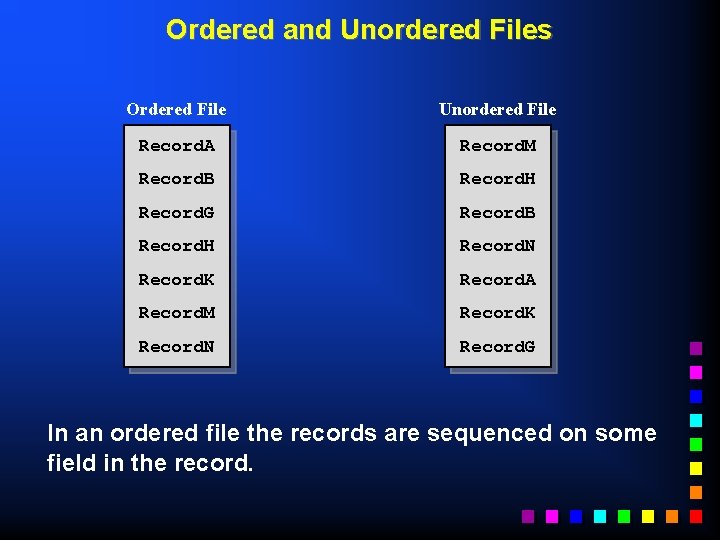
Ordered and Unordered Files Ordered File Unordered File Record. A Record. M Record. B Record. H Record. G Record. B Record. H Record. N Record. K Record. A Record. M Record. K Record. N Record. G In an ordered file the records are sequenced on some field in the record.
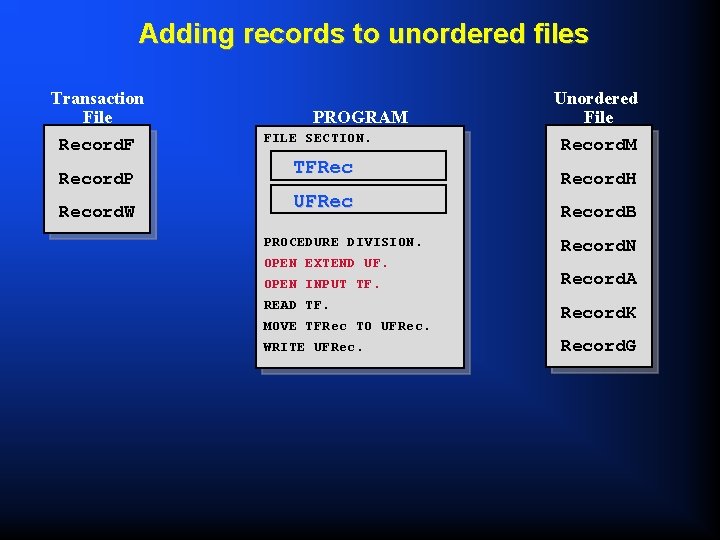
Adding records to unordered files Transaction File Record. F Record. P Record. W PROGRAM FILE SECTION. PROGRAM TFRec UFRec PROCEDURE DIVISION. OPEN EXTEND UF. OPEN INPUT TF. READ TF. MOVE TFRec TO UFRec. WRITE UFRec. Unordered File Record. M Record. H Record. B Record. N Record. A Record. K Record. G
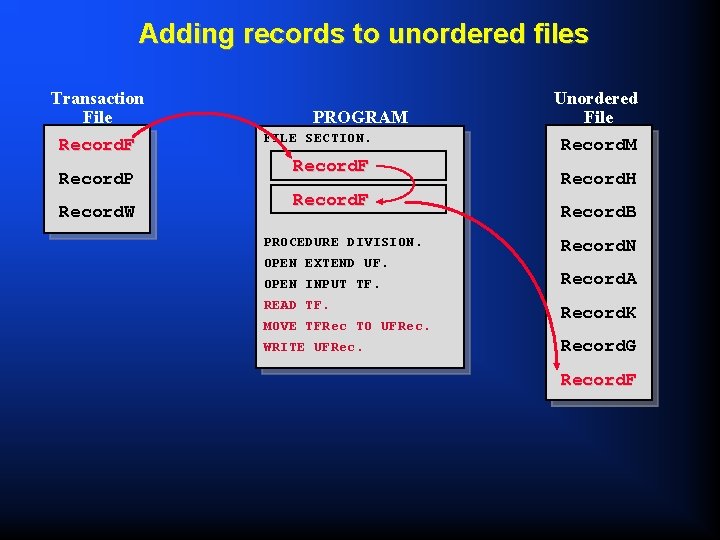
Adding records to unordered files Transaction File Record. F Record. P Record. W PROGRAM FILE SECTION. PROGRAM Record. F PROCEDURE DIVISION. OPEN EXTEND UF. OPEN INPUT TF. READ TF. MOVE TFRec TO UFRec. WRITE UFRec. Unordered File Record. M Record. H Record. B Record. N Record. A Record. K Record. G Record. F
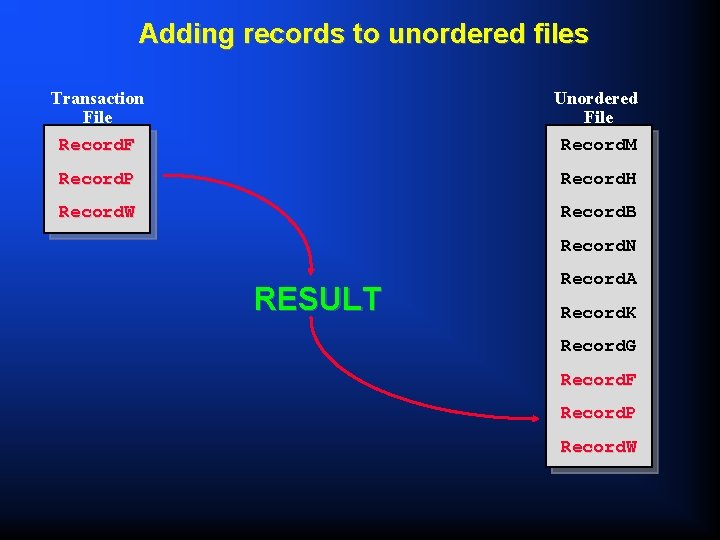
Adding records to unordered files Transaction File Unordered File Record. F Record. M Record. P Record. H Record. W Record. B Record. N RESULT Record. A Record. K Record. G Record. F Record. P Record. W
Problems with Unordered Sequential Files u It is easy to add records to an unordered Sequential file. u But it is not really possible to delete records from an unordered Sequential file. u And it is not feasible to update records in an unordered Sequential file
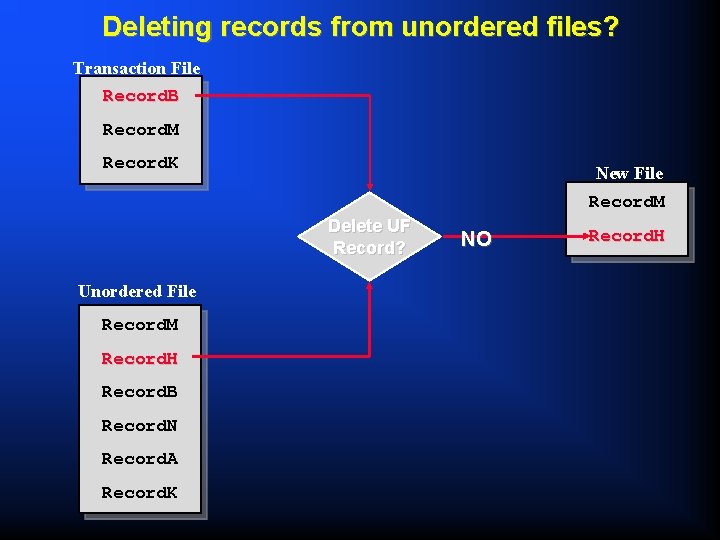
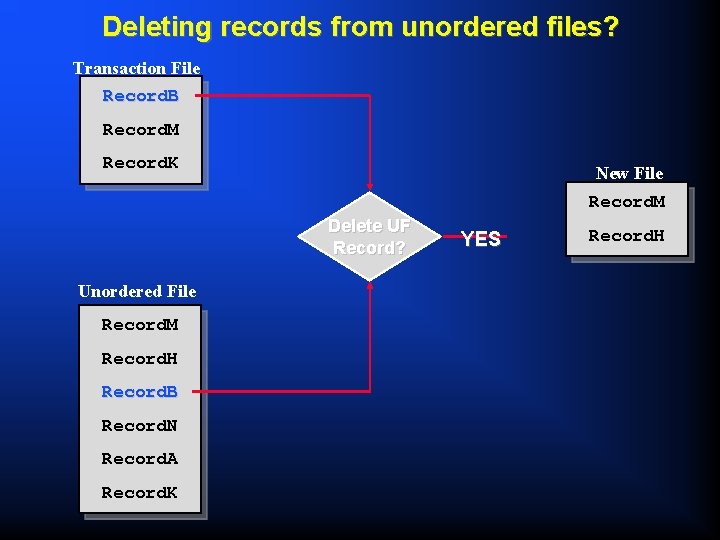
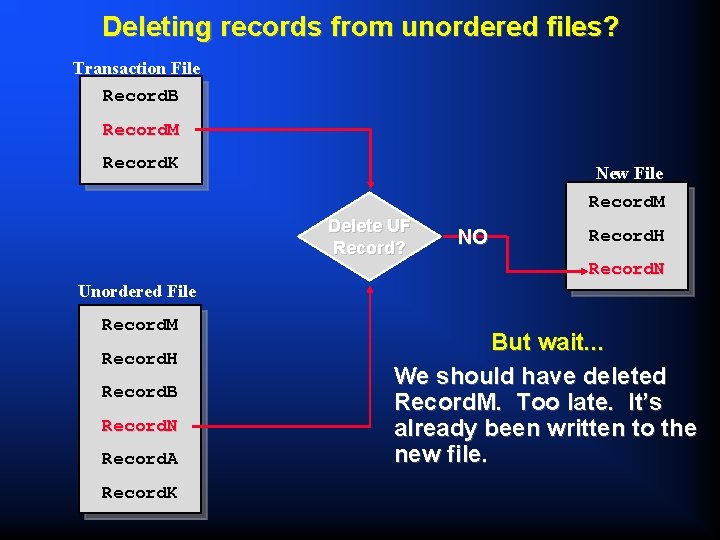
Problems with Unordered Sequential Files u Records in a Sequential file can not be deleted or updated “in situ”. u The only way to delete Sequential file records is to create a new file which does not contain them. u The only way to update records in a Sequential File is to create a new file which contains the updated records. u Because both these operations rely on record matching they do not work for unordered Sequential files. u Why?
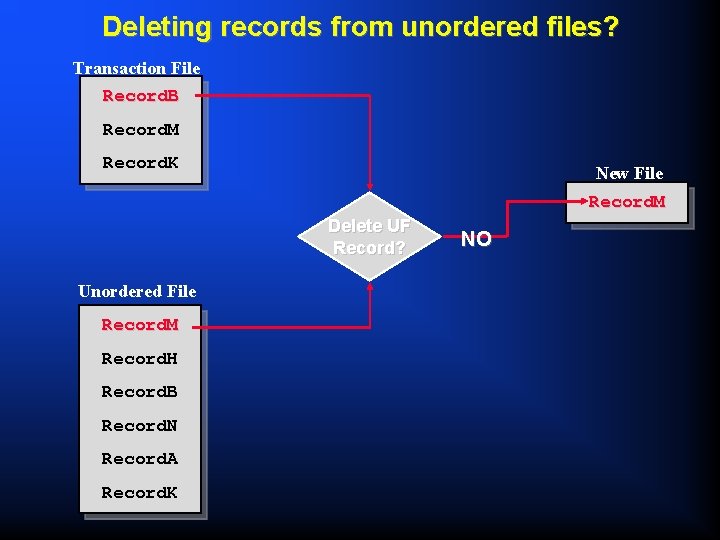
Deleting records from unordered files? Transaction File Record. B Record. M Record. K New File Record. M Delete UF Record? Unordered File Record. M Record. H Record. B Record. N Record. A Record. K NO
Deleting records from unordered files? Transaction File Record. B Record. M Record. K New File Record. M Delete UF Record? Unordered File Record. M Record. H Record. B Record. N Record. A Record. K NO Record. H
Deleting records from unordered files? Transaction File Record. B Record. M Record. K New File Record. M Delete UF Record? Unordered File Record. M Record. H Record. B Record. N Record. A Record. K YES Record. H
Deleting records from unordered files? Transaction File Record. B Record. M Record. K New File Record. M Delete UF Record? Unordered File Record. M Record. H Record. B Record. N Record. A Record. K NO Record. H Record. N But wait. . . We should have deleted Record. M. Too late. It’s already been written to the new file.
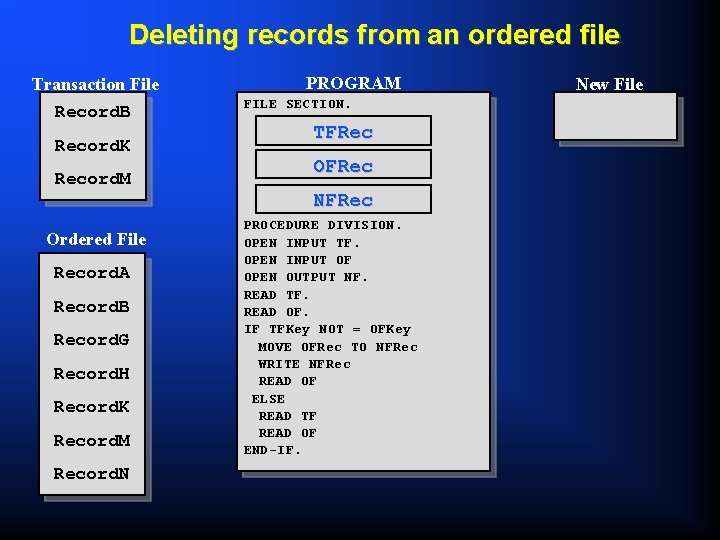
Deleting records from an ordered file Transaction File Record. B Record. K Record. M Ordered File Record. A Record. B Record. G Record. H Record. K Record. M Record. N PROGRAM FILE SECTION. TFRec OFRec NFRec PROCEDURE DIVISION. OPEN INPUT TF. OPEN INPUT OF OPEN OUTPUT NF. READ TF. READ OF. IF TFKey NOT = OFKey MOVE OFRec TO NFRec WRITE NFRec READ OF ELSE READ TF READ OF END-IF. New File
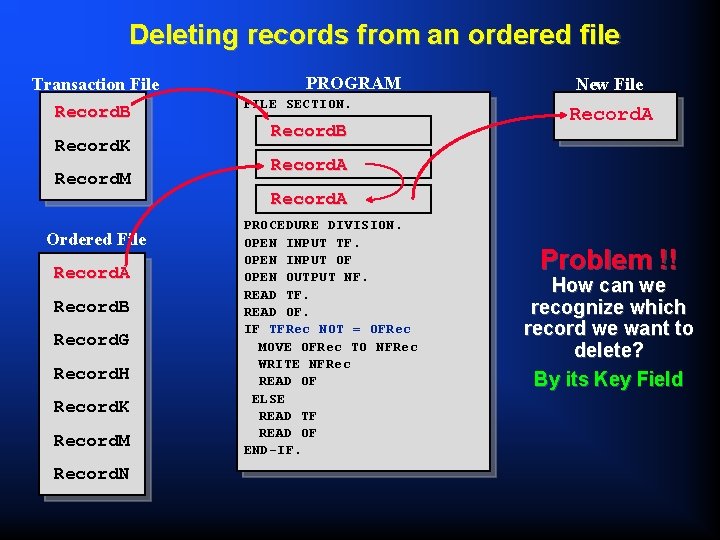
Deleting records from an ordered file Transaction File Record. B Record. K Record. M Ordered File Record. A Record. B Record. G Record. H Record. K Record. M Record. N PROGRAM FILE SECTION. Record. B New File Record. A PROCEDURE DIVISION. OPEN INPUT TF. OPEN INPUT OF OPEN OUTPUT NF. READ TF. READ OF. IF TFRec NOT = OFRec MOVE OFRec TO NFRec WRITE NFRec READ OF ELSE READ TF READ OF END-IF. Problem !! How can we recognize which record we want to delete? By its Key Field
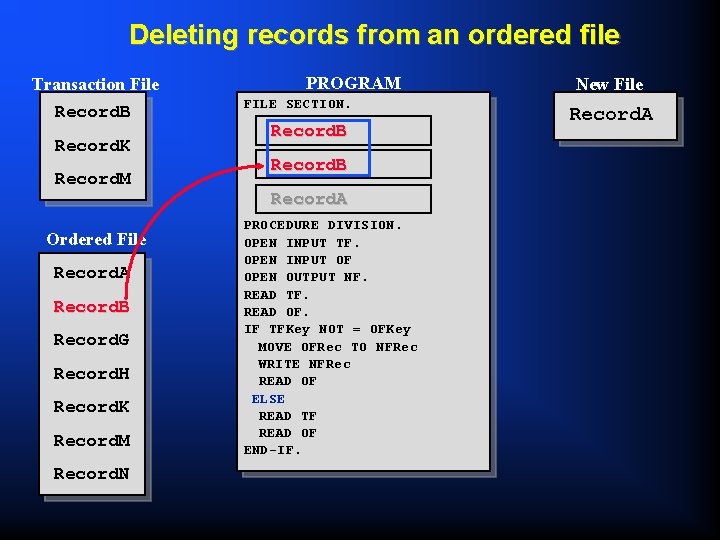
Deleting records from an ordered file Transaction File Record. B Record. K Record. M Ordered File Record. A Record. B Record. G Record. H Record. K Record. M Record. N PROGRAM FILE SECTION. Record. B Record. A PROCEDURE DIVISION. OPEN INPUT TF. OPEN INPUT OF OPEN OUTPUT NF. READ TF. READ OF. IF TFKey NOT = OFKey MOVE OFRec TO NFRec WRITE NFRec READ OF ELSE READ TF READ OF END-IF. New File Record. A
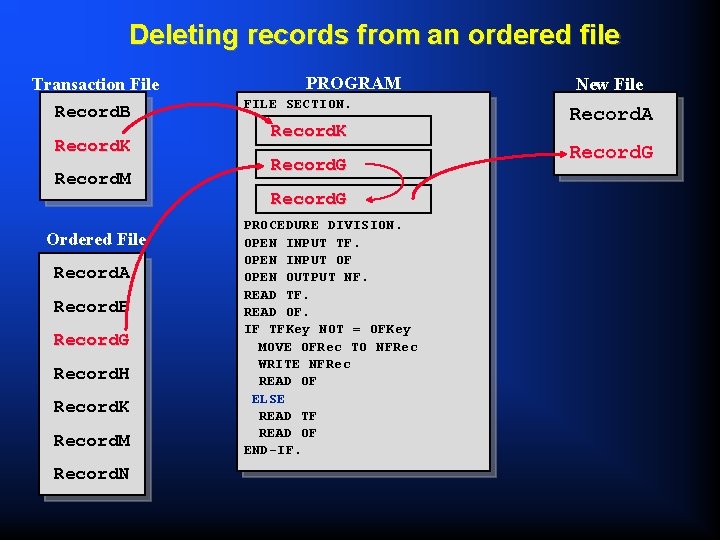
Deleting records from an ordered file Transaction File Record. B Record. K Record. M Ordered File Record. A Record. B Record. G Record. H Record. K Record. M Record. N PROGRAM FILE SECTION. Record. K Record. G PROCEDURE DIVISION. OPEN INPUT TF. OPEN INPUT OF OPEN OUTPUT NF. READ TF. READ OF. IF TFKey NOT = OFKey MOVE OFRec TO NFRec WRITE NFRec READ OF ELSE READ TF READ OF END-IF. New File Record. A Record. G
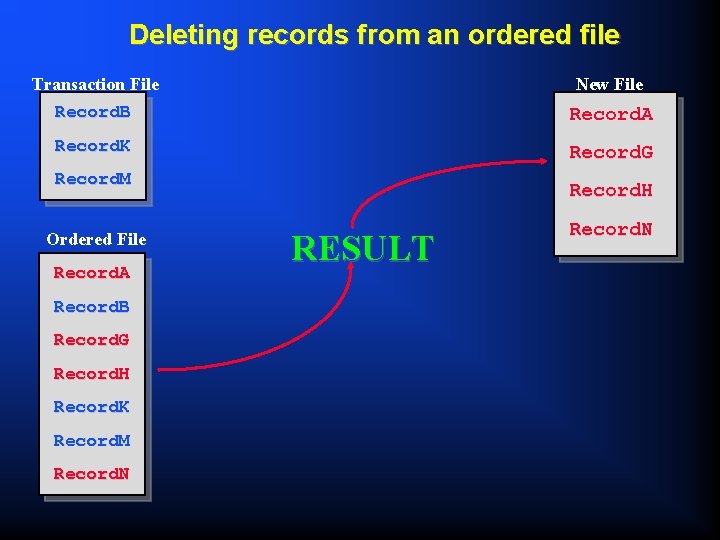
Deleting records from an ordered file Transaction File New File Record. B Record. A Record. K Record. G Record. M Ordered File Record. A Record. B Record. G Record. H Record. K Record. M Record. N Record. H RESULT Record. N
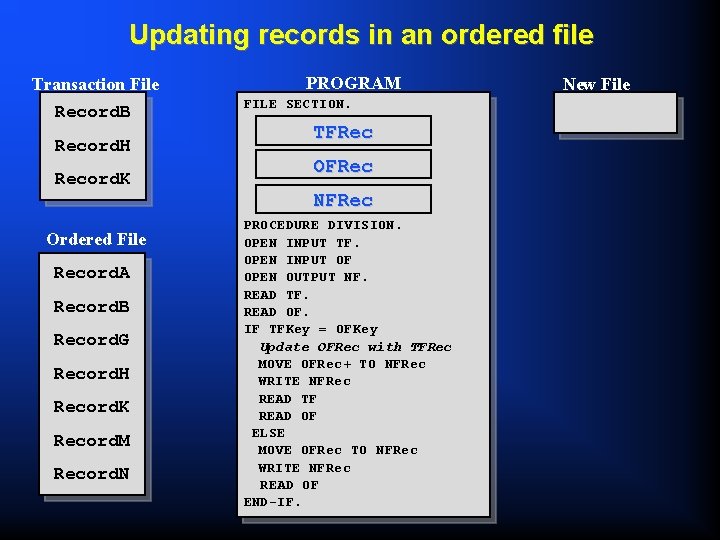
Updating records in an ordered file Transaction File Record. B Record. H Record. K Ordered File Record. A Record. B Record. G Record. H Record. K Record. M Record. N PROGRAM FILE SECTION. TFRec OFRec NFRec PROCEDURE DIVISION. OPEN INPUT TF. OPEN INPUT OF OPEN OUTPUT NF. READ TF. READ OF. IF TFKey = OFKey Update OFRec with TFRec MOVE OFRec+ TO NFRec WRITE NFRec READ TF READ OF ELSE MOVE OFRec TO NFRec WRITE NFRec READ OF END-IF. New File
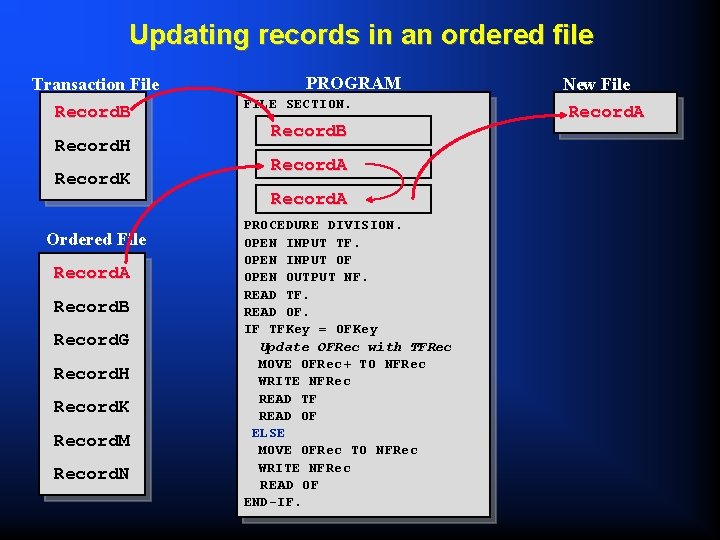
Updating records in an ordered file Transaction File Record. B Record. H Record. K Ordered File Record. A Record. B Record. G Record. H Record. K Record. M Record. N PROGRAM FILE SECTION. Record. B Record. A PROCEDURE DIVISION. OPEN INPUT TF. OPEN INPUT OF OPEN OUTPUT NF. READ TF. READ OF. IF TFKey = OFKey Update OFRec with TFRec MOVE OFRec+ TO NFRec WRITE NFRec READ TF READ OF ELSE MOVE OFRec TO NFRec WRITE NFRec READ OF END-IF. New File Record. A
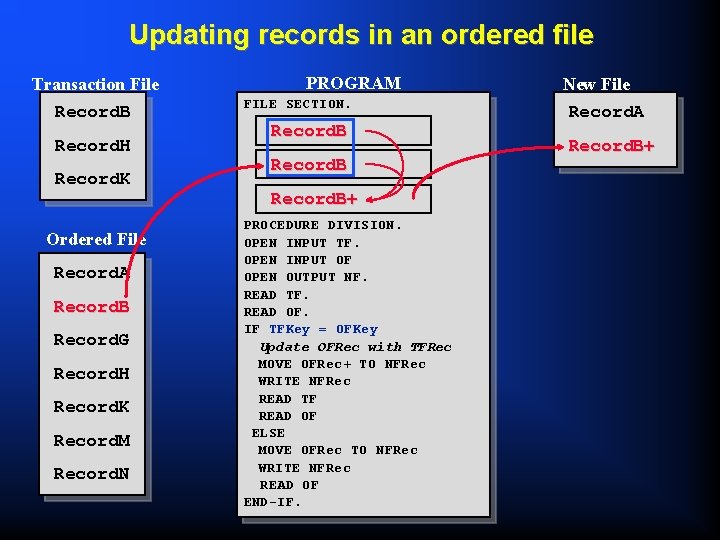
Updating records in an ordered file Transaction File Record. B Record. H Record. K Ordered File Record. A Record. B Record. G Record. H Record. K Record. M Record. N PROGRAM FILE SECTION. Record. B+ PROCEDURE DIVISION. OPEN INPUT TF. OPEN INPUT OF OPEN OUTPUT NF. READ TF. READ OF. IF TFKey = OFKey Update OFRec with TFRec MOVE OFRec+ TO NFRec WRITE NFRec READ TF READ OF ELSE MOVE OFRec TO NFRec WRITE NFRec READ OF END-IF. New File Record. A Record. B+
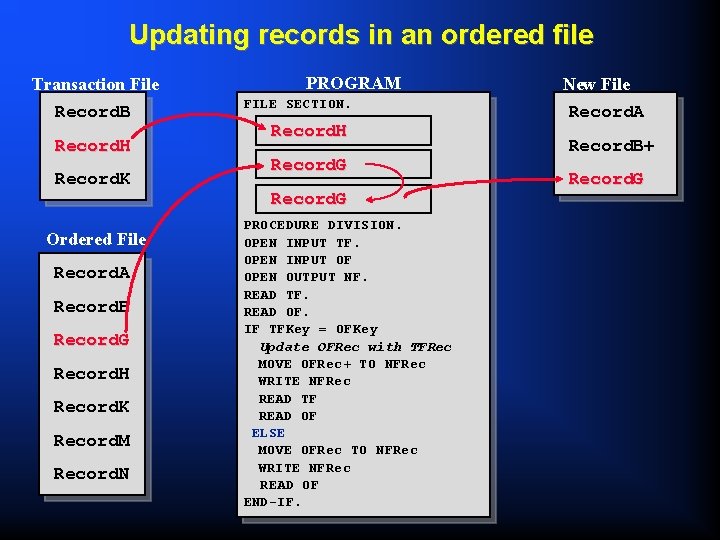
Updating records in an ordered file Transaction File Record. B Record. H Record. K Ordered File Record. A Record. B Record. G Record. H Record. K Record. M Record. N PROGRAM FILE SECTION. Record. H Record. G PROCEDURE DIVISION. OPEN INPUT TF. OPEN INPUT OF OPEN OUTPUT NF. READ TF. READ OF. IF TFKey = OFKey Update OFRec with TFRec MOVE OFRec+ TO NFRec WRITE NFRec READ TF READ OF ELSE MOVE OFRec TO NFRec WRITE NFRec READ OF END-IF. New File Record. A Record. B+ Record. G
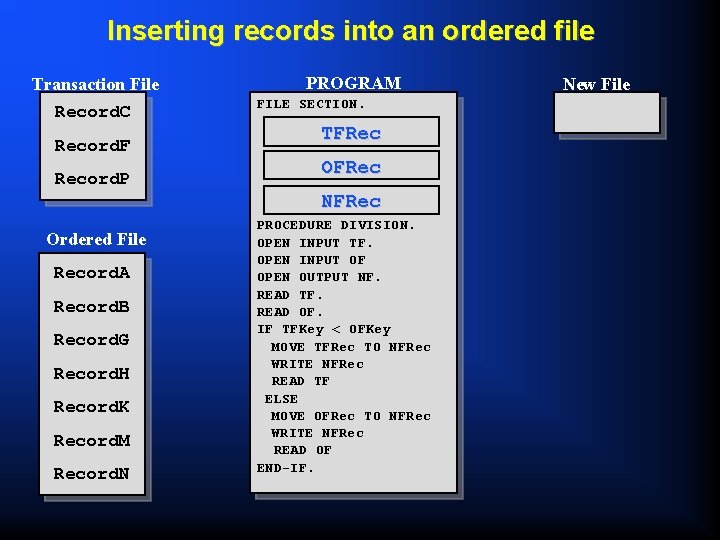
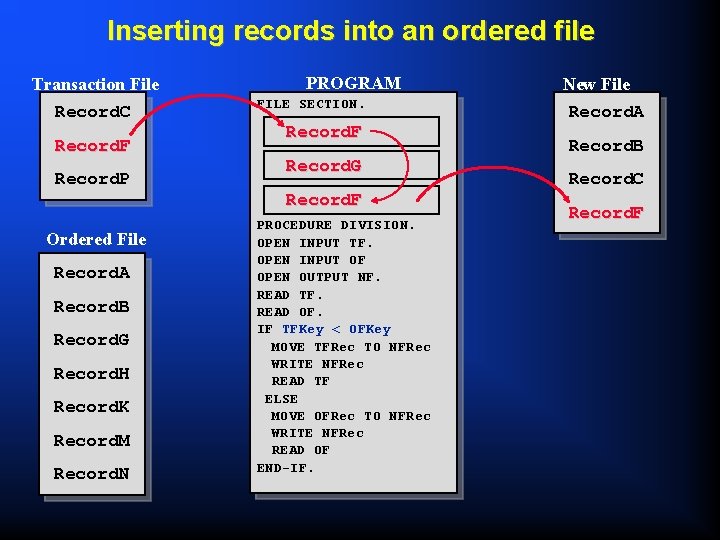
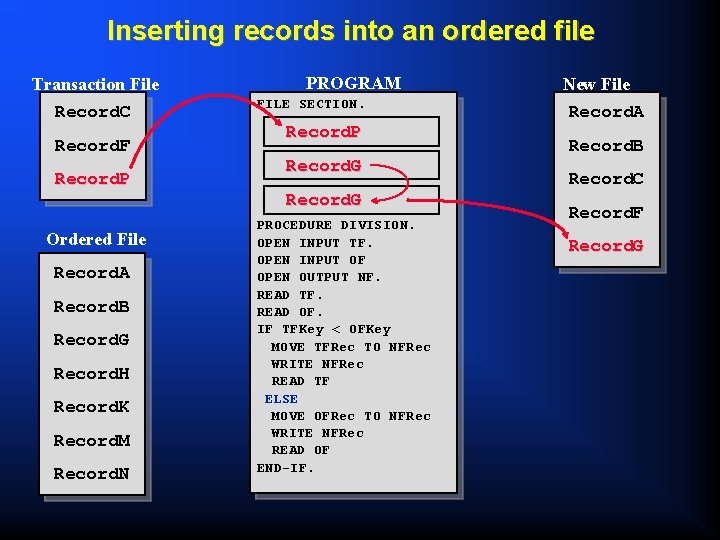
Inserting records into an ordered file Transaction File Record. C Record. F Record. P PROGRAM FILE SECTION. TFRec OFRec NFRec Ordered File Record. A Record. B Record. G Record. H Record. K Record. M Record. N PROCEDURE DIVISION. OPEN INPUT TF. OPEN INPUT OF OPEN OUTPUT NF. READ TF. READ OF. IF TFKey < OFKey MOVE TFRec TO NFRec WRITE NFRec READ TF ELSE MOVE OFRec TO NFRec WRITE NFRec READ OF END-IF. New File
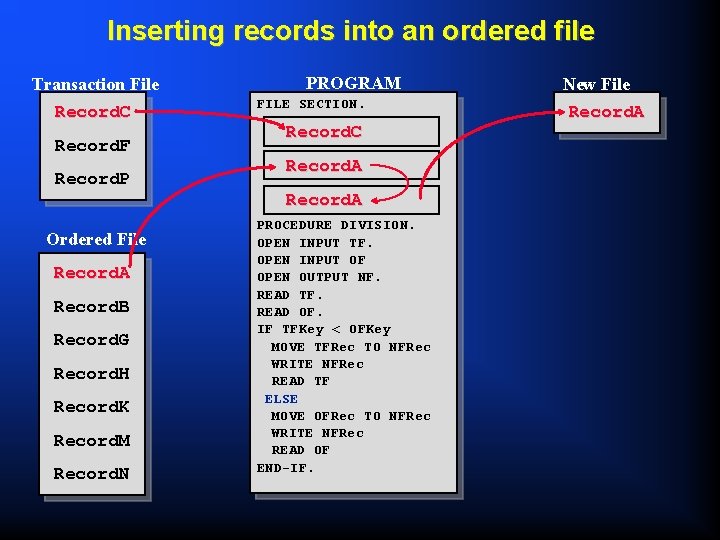
Inserting records into an ordered file Transaction File Record. C Record. F Record. P PROGRAM FILE SECTION. Record. C Record. A Ordered File Record. A Record. B Record. G Record. H Record. K Record. M Record. N PROCEDURE DIVISION. OPEN INPUT TF. OPEN INPUT OF OPEN OUTPUT NF. READ TF. READ OF. IF TFKey < OFKey MOVE TFRec TO NFRec WRITE NFRec READ TF ELSE MOVE OFRec TO NFRec WRITE NFRec READ OF END-IF. New File Record. A
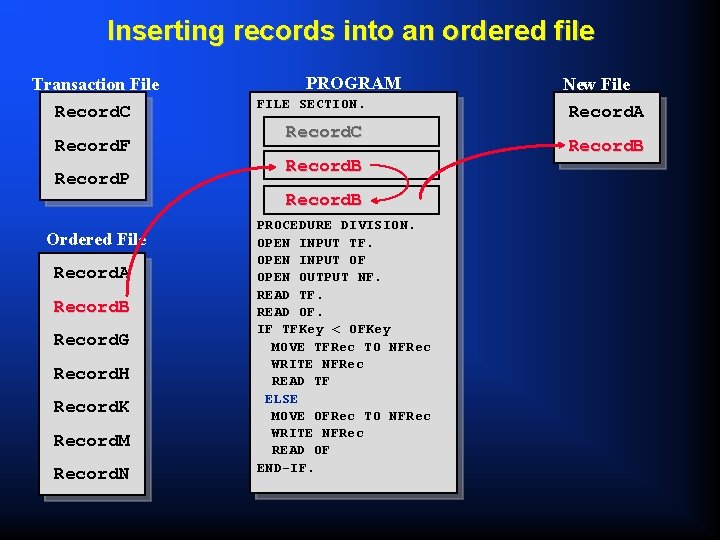
Inserting records into an ordered file Transaction File Record. C Record. F Record. P PROGRAM FILE SECTION. Record. C Record. B Ordered File Record. A Record. B Record. G Record. H Record. K Record. M Record. N PROCEDURE DIVISION. OPEN INPUT TF. OPEN INPUT OF OPEN OUTPUT NF. READ TF. READ OF. IF TFKey < OFKey MOVE TFRec TO NFRec WRITE NFRec READ TF ELSE MOVE OFRec TO NFRec WRITE NFRec READ OF END-IF. New File Record. A Record. B
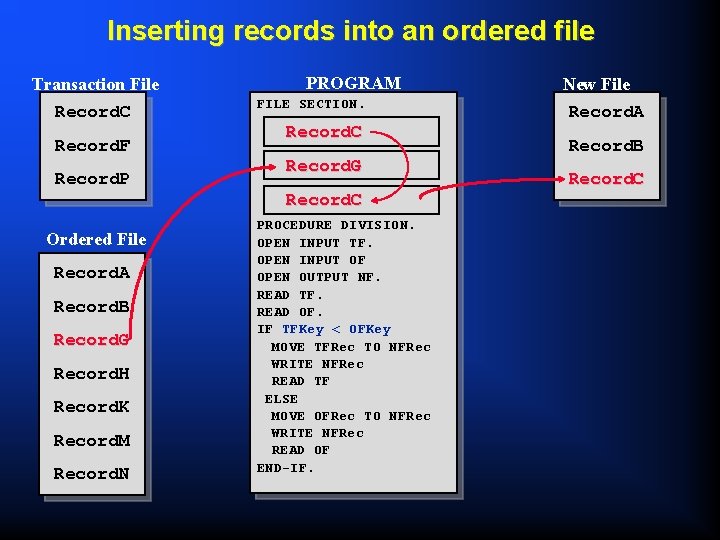
Inserting records into an ordered file Transaction File Record. C Record. F Record. P PROGRAM FILE SECTION. Record. C Record. G Record. C Ordered File Record. A Record. B Record. G Record. H Record. K Record. M Record. N PROCEDURE DIVISION. OPEN INPUT TF. OPEN INPUT OF OPEN OUTPUT NF. READ TF. READ OF. IF TFKey < OFKey MOVE TFRec TO NFRec WRITE NFRec READ TF ELSE MOVE OFRec TO NFRec WRITE NFRec READ OF END-IF. New File Record. A Record. B Record. C
Inserting records into an ordered file Transaction File Record. C Record. F Record. P PROGRAM FILE SECTION. Record. F Record. G Record. F Ordered File Record. A Record. B Record. G Record. H Record. K Record. M Record. N PROCEDURE DIVISION. OPEN INPUT TF. OPEN INPUT OF OPEN OUTPUT NF. READ TF. READ OF. IF TFKey < OFKey MOVE TFRec TO NFRec WRITE NFRec READ TF ELSE MOVE OFRec TO NFRec WRITE NFRec READ OF END-IF. New File Record. A Record. B Record. C Record. F
Inserting records into an ordered file Transaction File Record. C Record. F Record. P Ordered File Record. A Record. B Record. G Record. H Record. K Record. M Record. N PROGRAM FILE SECTION. Record. P Record. G PROCEDURE DIVISION. OPEN INPUT TF. OPEN INPUT OF OPEN OUTPUT NF. READ TF. READ OF. IF TFKey < OFKey MOVE TFRec TO NFRec WRITE NFRec READ TF ELSE MOVE OFRec TO NFRec WRITE NFRec READ OF END-IF. New File Record. A Record. B Record. C Record. F Record. G