
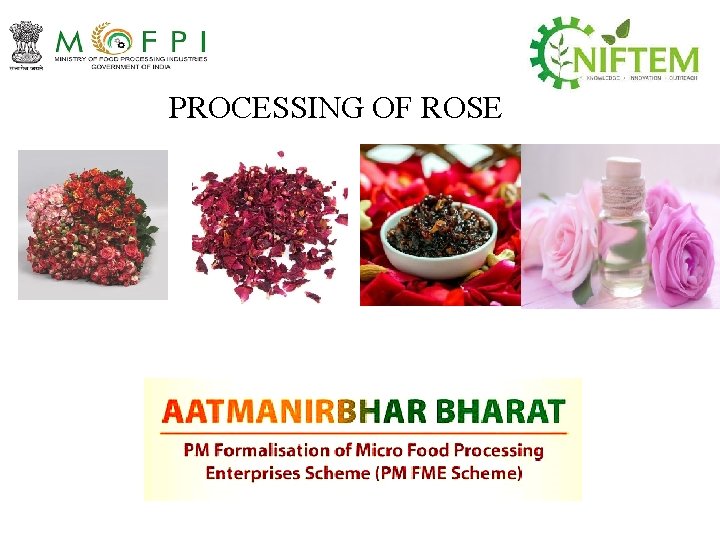
PROCESSING OF ROSE Rose is a woody perennial
- Slides: 47
PROCESSING OF ROSE
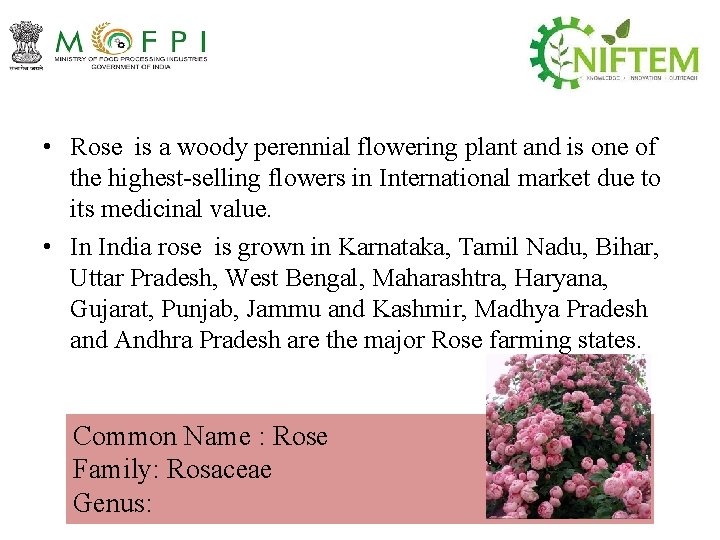
• Rose is a woody perennial flowering plant and is one of the highest-selling flowers in International market due to its medicinal value. • In India rose is grown in Karnataka, Tamil Nadu, Bihar, Uttar Pradesh, West Bengal, Maharashtra, Haryana, Gujarat, Punjab, Jammu and Kashmir, Madhya Pradesh and Andhra Pradesh are the major Rose farming states. Common Name : Rose Family: Rosaceae Genus:
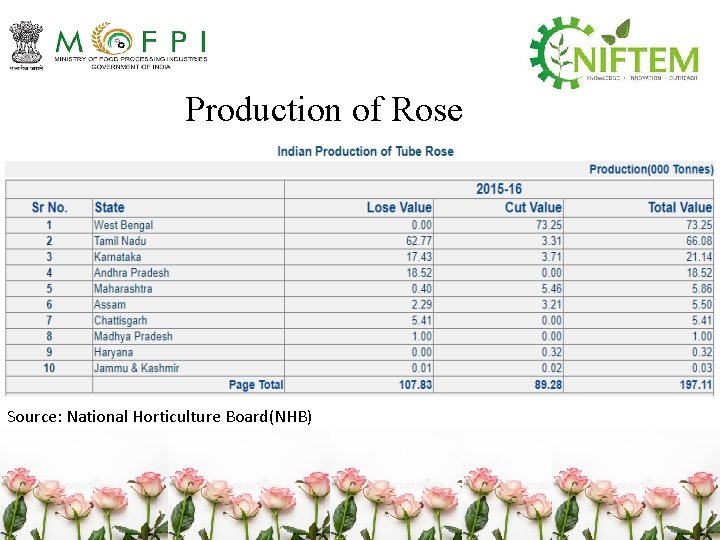
Production of Rose Source: National Horticulture Board(NHB)
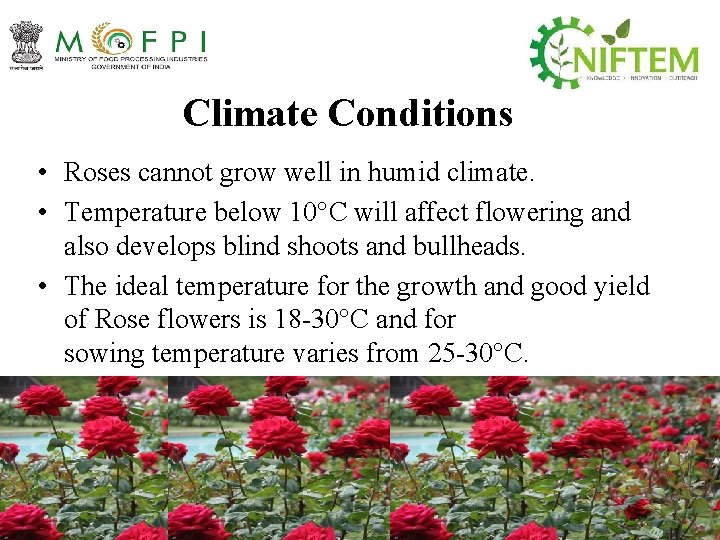
Climate Conditions • Roses cannot grow well in humid climate. • Temperature below 10°C will affect flowering and also develops blind shoots and bullheads. • The ideal temperature for the growth and good yield of Rose flowers is 18 -30°C and for sowing temperature varies from 25 -30°C.
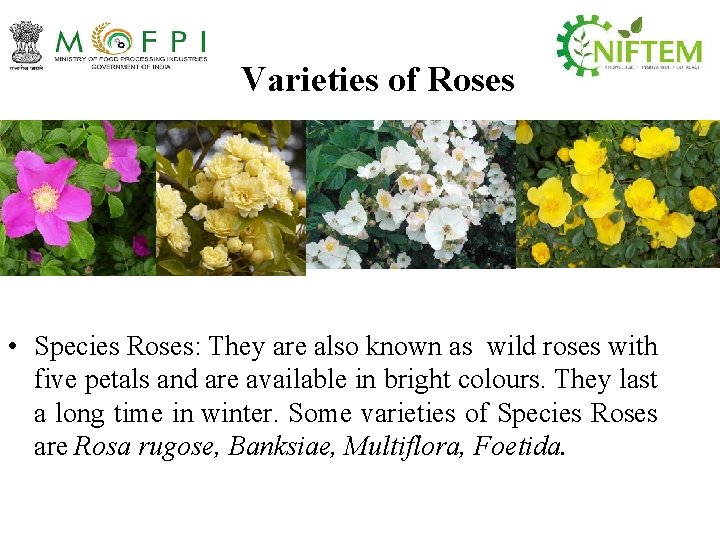
Varieties of Roses • Species Roses: They are also known as wild roses with five petals and are available in bright colours. They last a long time in winter. Some varieties of Species Roses are Rosa rugose, Banksiae, Multiflora, Foetida.
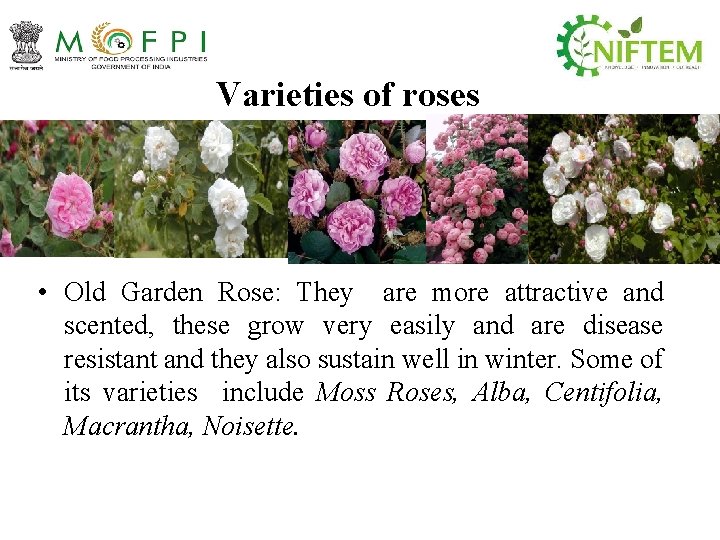
Varieties of roses • Old Garden Rose: They are more attractive and scented, these grow very easily and are disease resistant and they also sustain well in winter. Some of its varieties include Moss Roses, Alba, Centifolia, Macrantha, Noisette.
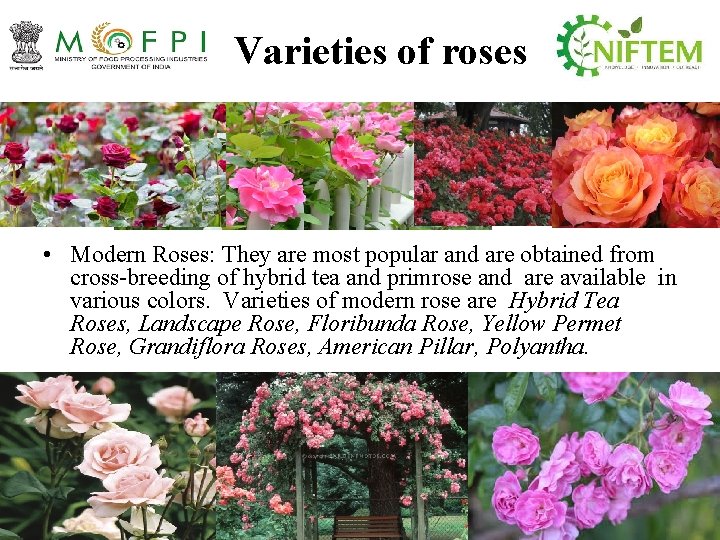
Varieties of roses • Modern Roses: They are most popular and are obtained from cross-breeding of hybrid tea and primrose and are available in various colors. Varieties of modern rose are Hybrid Tea Roses, Landscape Rose, Floribunda Rose, Yellow Permet Rose, Grandiflora Roses, American Pillar, Polyantha.
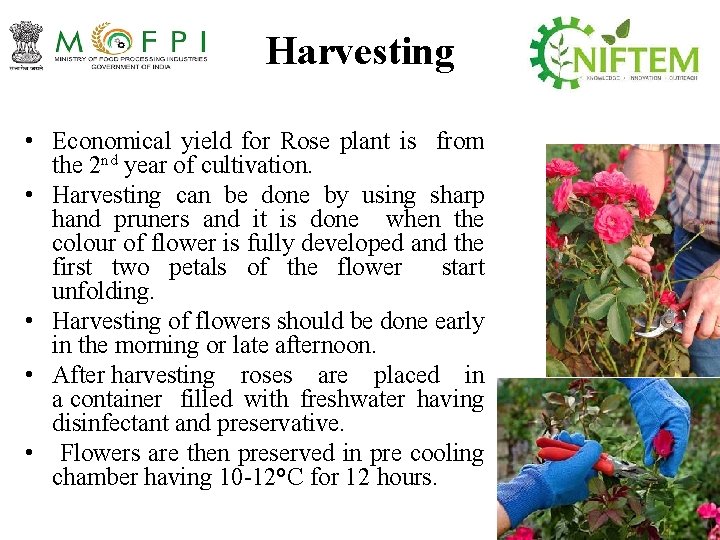
Harvesting • Economical yield for Rose plant is from the 2 nd year of cultivation. • Harvesting can be done by using sharp hand pruners and it is done when the colour of flower is fully developed and the first two petals of the flower start unfolding. • Harvesting of flowers should be done early in the morning or late afternoon. • After harvesting roses are placed in a container filled with freshwater having disinfectant and preservative. • Flowers are then preserved in pre cooling chamber having 10 -12°C for 12 hours.
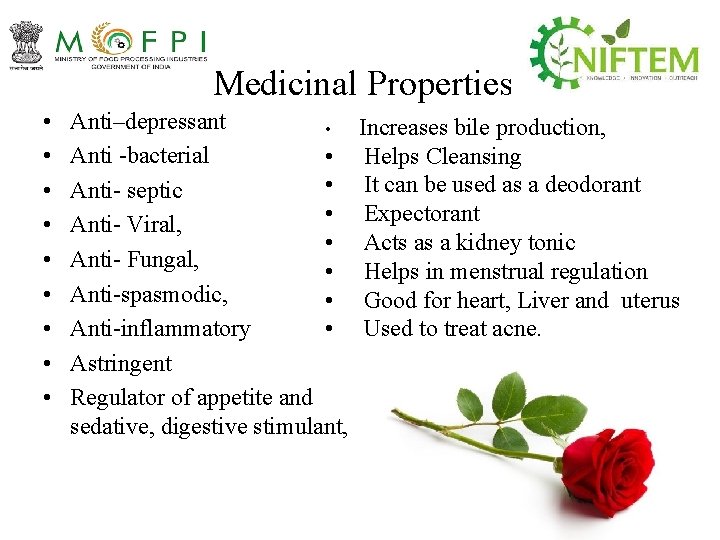
Medicinal Properties • • • Anti–depressant • Anti -bacterial • • Anti- septic • Anti- Viral, • Anti- Fungal, • Anti-spasmodic, • Anti-inflammatory • Astringent Regulator of appetite and sedative, digestive stimulant, Increases bile production, Helps Cleansing It can be used as a deodorant Expectorant Acts as a kidney tonic Helps in menstrual regulation Good for heart, Liver and uterus Used to treat acne.
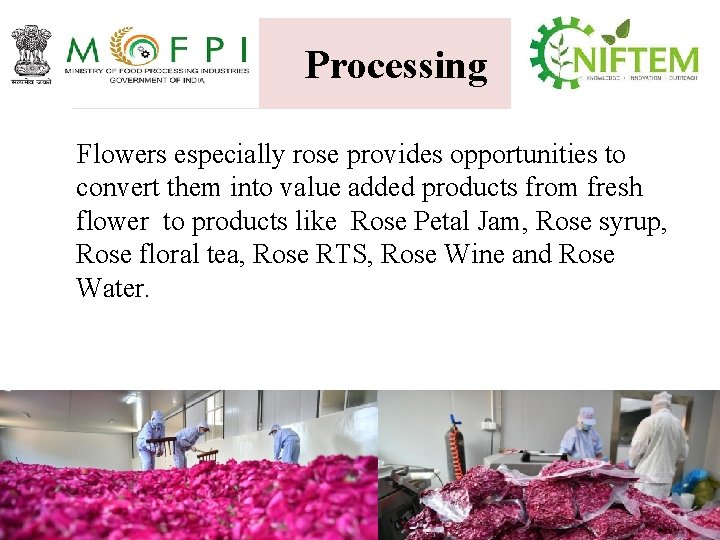
Processing Flowers especially rose provides opportunities to convert them into value added products from fresh flower to products like Rose Petal Jam, Rose syrup, Rose floral tea, Rose RTS, Rose Wine and Rose Water.
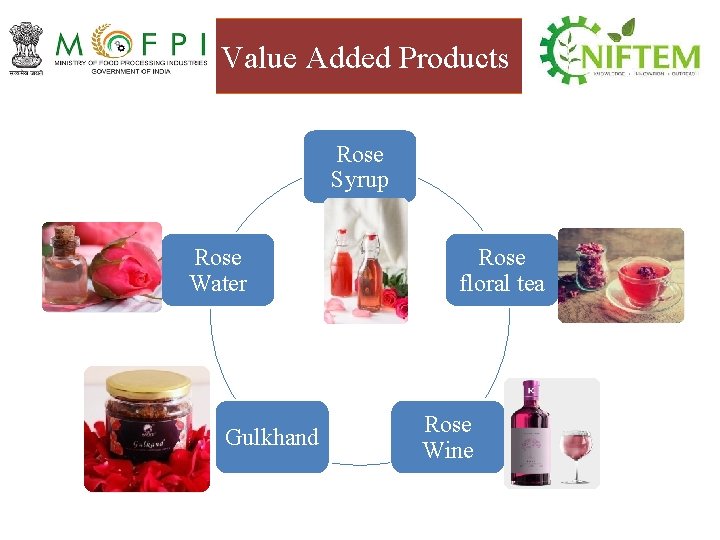
Value Added Products Rose Syrup Rose Water Gulkhand Rose floral tea Rose Wine
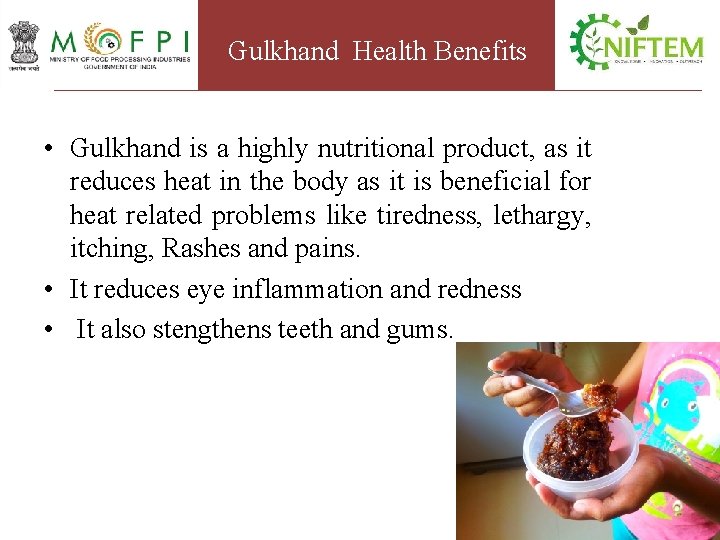
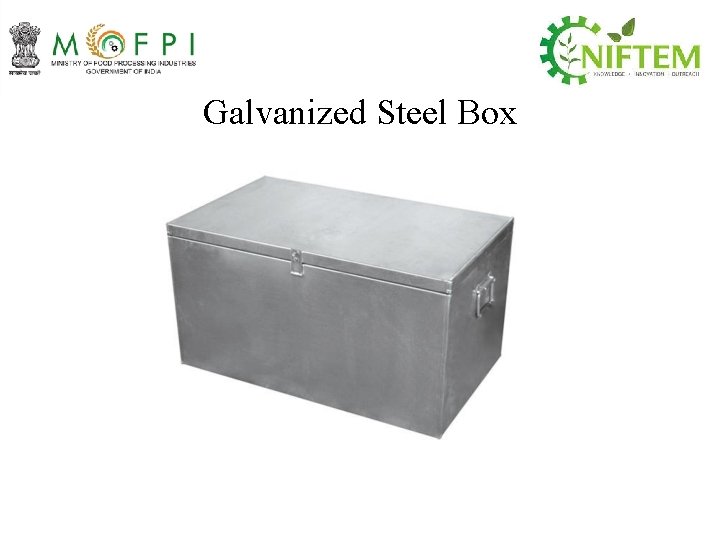
Gulkhand • Gulkhand is a sweet product made of rose petals • Rose petals of R. bourboniana and R. damascena are used for making Gulkhand • Rose petals and sugar are placed in wide mouthed steel pot or galvanised steel box • The jar or box is exposed to sun light for 3 to 4 weeks • Gulkhand Stir the contents in the with snacks a wooden can be used forbox making likestick Gulkhand Shahi • Gujiya Whenand the. Cakes. process is over Gulkhand in placed indoor in tightly closed containers
Gulkhand Health Benefits • Gulkhand is a highly nutritional product, as it reduces heat in the body as it is beneficial for heat related problems like tiredness, lethargy, itching, Rashes and pains. • It reduces eye inflammation and redness • It also stengthens teeth and gums.
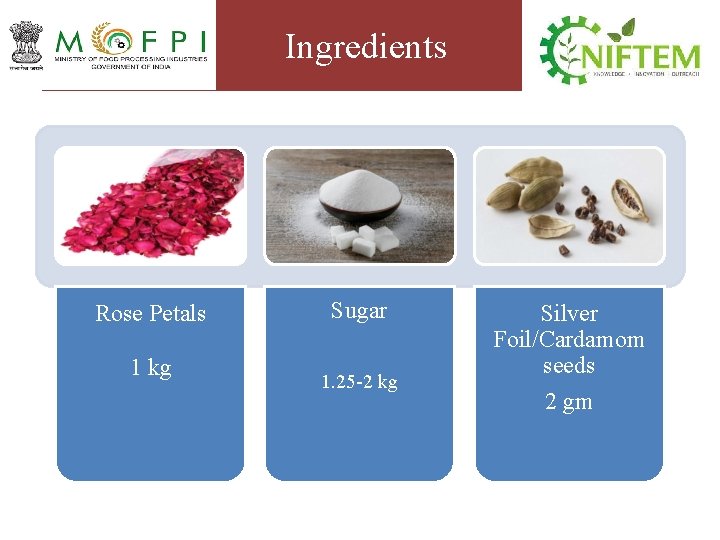
Ingredients Rose Petals 1 kg Sugar 1. 25 -2 kg Silver Foil/Cardamom seeds 2 gm
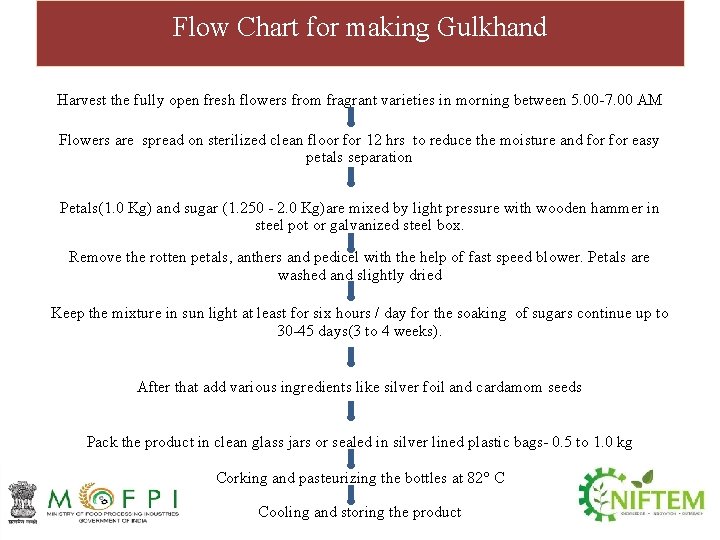
Flow Chart for making Gulkhand Harvest the fully open fresh flowers from fragrant varieties in morning between 5. 00 -7. 00 AM Flowers are spread on sterilized clean floor for 12 hrs to reduce the moisture and for easy petals separation Petals(1. 0 Kg) and sugar (1. 250 - 2. 0 Kg)are mixed by light pressure with wooden hammer in steel pot or galvanized steel box. Remove the rotten petals, anthers and pedicel with the help of fast speed blower. Petals are washed and slightly dried Keep the mixture in sun light at least for six hours / day for the soaking of sugars continue up to 30 -45 days(3 to 4 weeks). After that add various ingredients like silver foil and cardamom seeds Pack the product in clean glass jars or sealed in silver lined plastic bags- 0. 5 to 1. 0 kg Corking and pasteurizing the bottles at 82° C Cooling and storing the product
Galvanized Steel Box
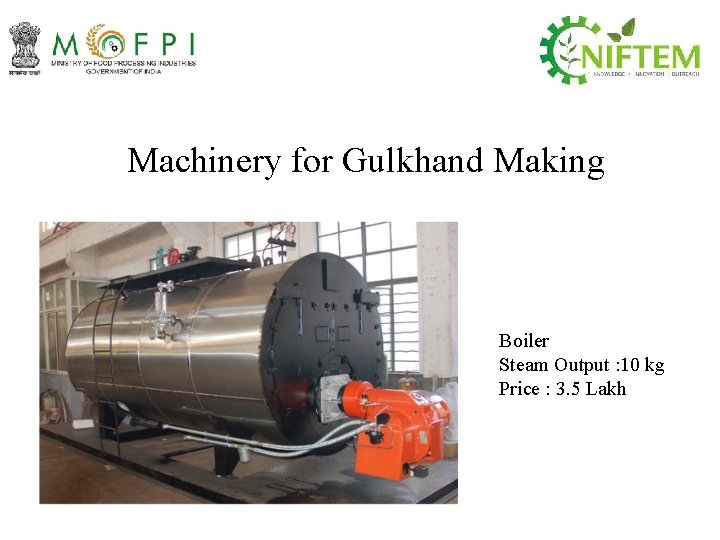
Machinery for Gulkhand Making Boiler Steam Output : 10 kg Price : 3. 5 Lakh
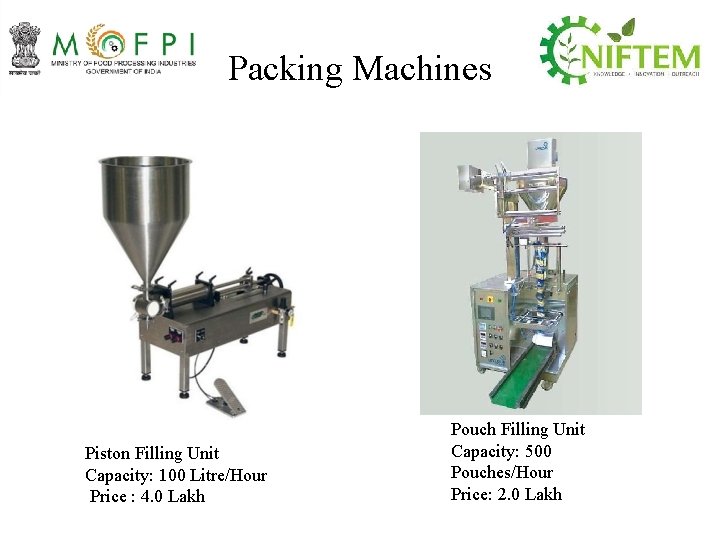
Packing Machines Piston Filling Unit Capacity: 100 Litre/Hour Price : 4. 0 Lakh Pouch Filling Unit Capacity: 500 Pouches/Hour Price: 2. 0 Lakh
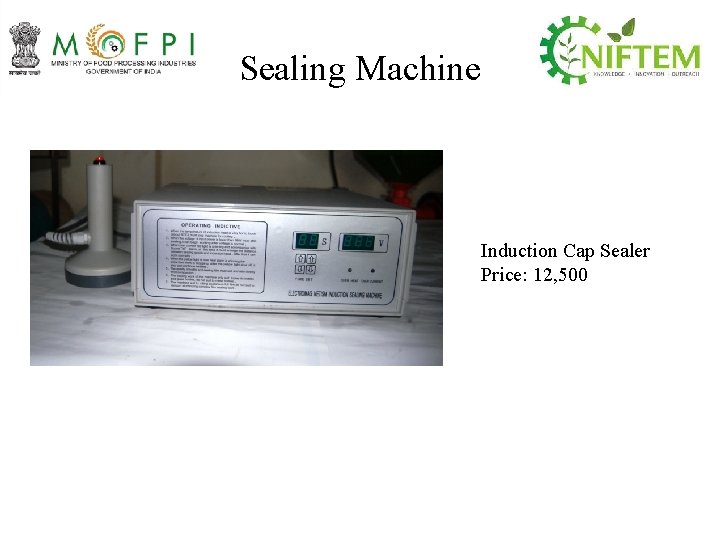
Sealing Machine Induction Cap Sealer Price: 12, 500
Rose Syrup Different kinds of value added products are nowadays formulated and marketed by the companies and are mostly with synthetic colour These synthetic colours and flavours are carcinogenic and may cause allergens. For this reason, consumers are increasingly interested in natural sources with high anthocyanin contents for manufacture of products Rose Syrup is made from the extracts of rose flower petals by adding sugar into it Rose Syrup can be stored for a long time and can be used instead of synthetic flavour for making rose milk, cakes and marshmallows
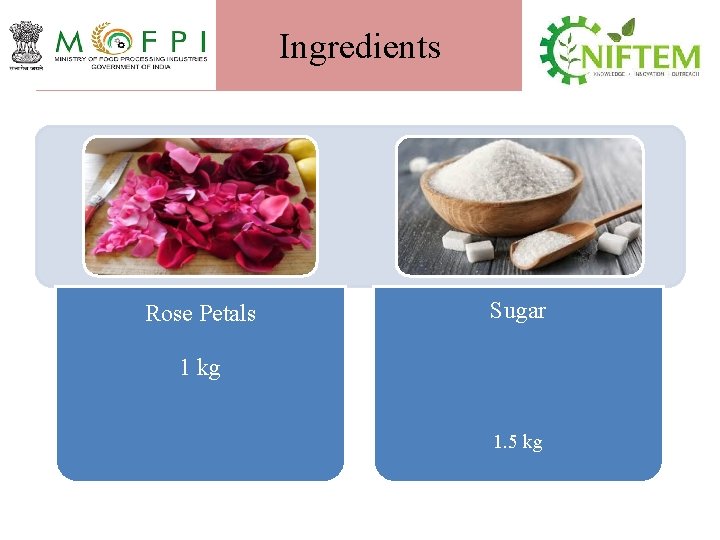
Ingredients Rose Petals Sugar 1 kg 1. 5 kg
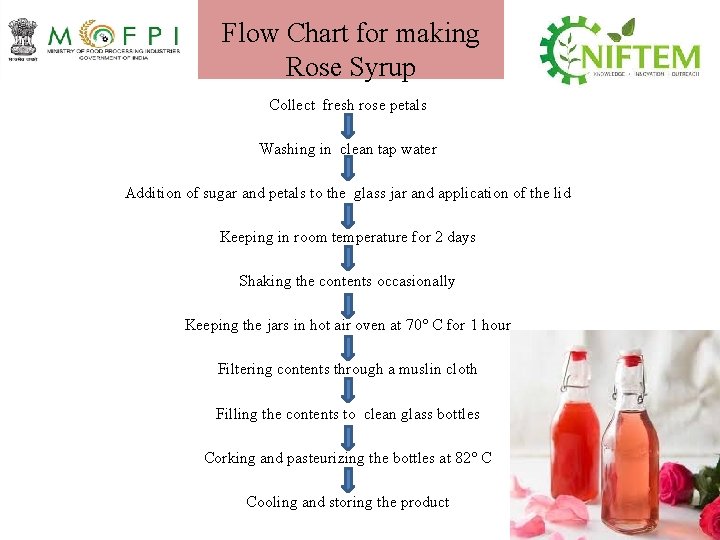
Flow Chart for making Rose Syrup Collect fresh rose petals Washing in clean tap water Addition of sugar and petals to the glass jar and application of the lid Keeping in room temperature for 2 days Shaking the contents occasionally Keeping the jars in hot air oven at 70° C for 1 hour Filtering contents through a muslin cloth Filling the contents to clean glass bottles Corking and pasteurizing the bottles at 82° C Cooling and storing the product
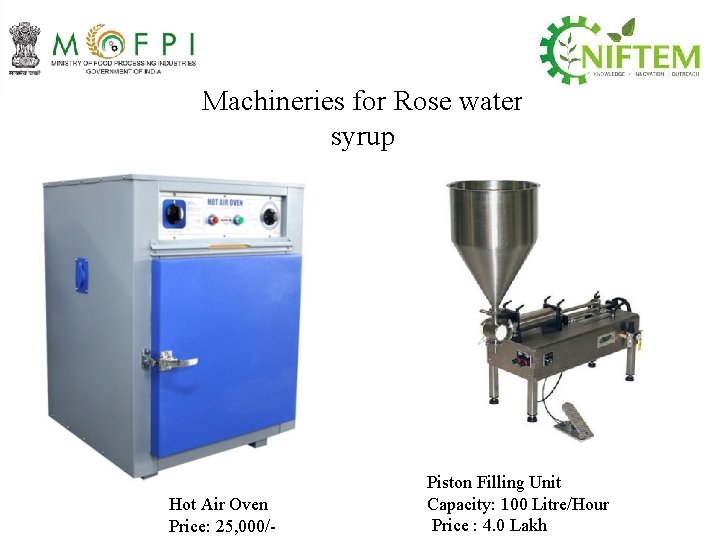
Machineries for Rose water syrup Hot Air Oven Price: 25, 000/- Piston Filling Unit Capacity: 100 Litre/Hour Price : 4. 0 Lakh
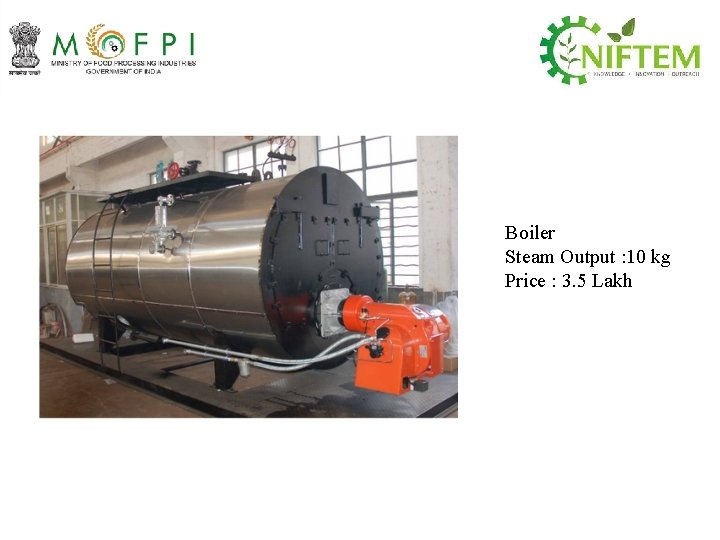
Boiler Steam Output : 10 kg Price : 3. 5 Lakh
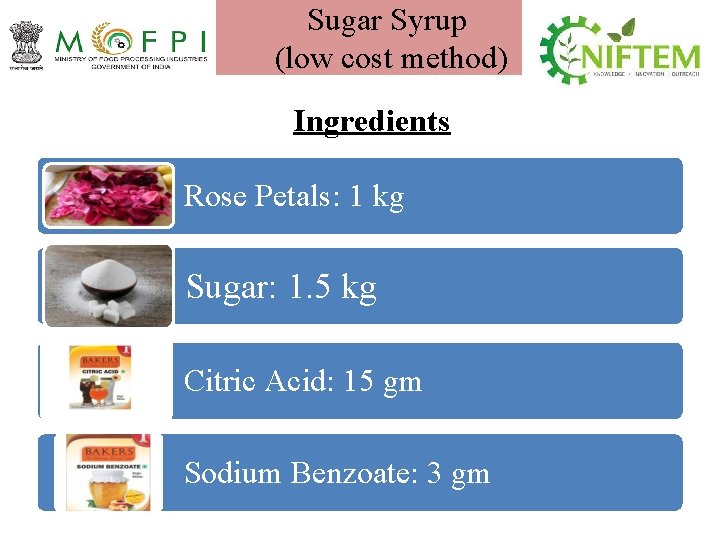
Sugar Syrup (low cost method) Ingredients Rose Petals: 1 kg Sugar: 1. 5 kg Citric Acid: 15 gm Sodium Benzoate: 3 gm
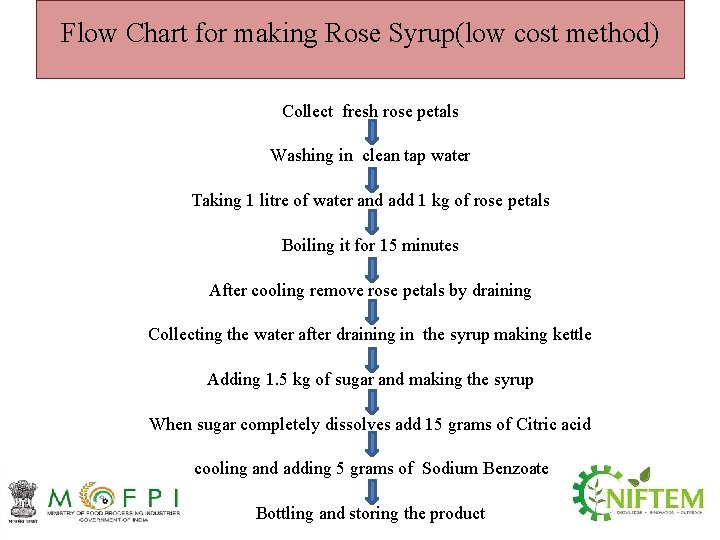
Flow Chart for making Rose Syrup(low cost method) Collect fresh rose petals Washing in clean tap water Taking 1 litre of water and add 1 kg of rose petals Boiling it for 15 minutes After cooling remove rose petals by draining Collecting the water after draining in the syrup making kettle Adding 1. 5 kg of sugar and making the syrup When sugar completely dissolves add 15 grams of Citric acid cooling and adding 5 grams of Sodium Benzoate Bottling and storing the product
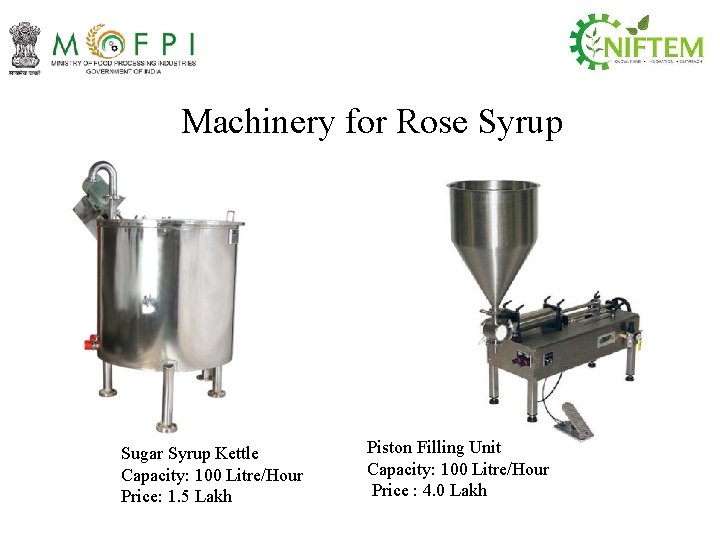
Machinery for Rose Syrup Sugar Syrup Kettle Capacity: 100 Litre/Hour Price: 1. 5 Lakh Piston Filling Unit Capacity: 100 Litre/Hour Price : 4. 0 Lakh
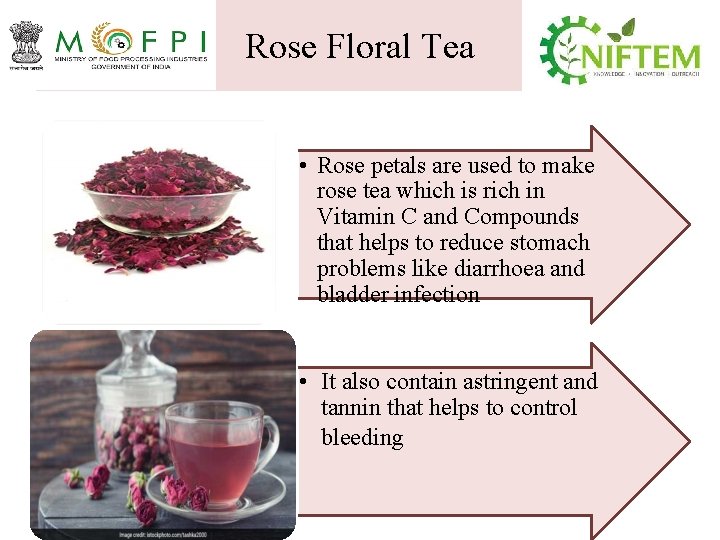
Rose Floral Tea • Rose petals are used to make rose tea which is rich in Vitamin C and Compounds that helps to reduce stomach problems like diarrhoea and bladder infection • It also contain astringent and tannin that helps to control bleeding
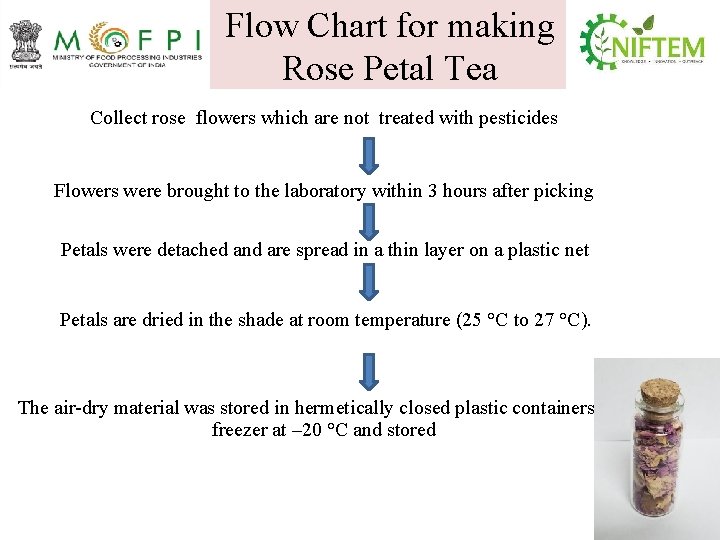
Flow Chart for making Rose Petal Tea Collect rose flowers which are not treated with pesticides Flowers were brought to the laboratory within 3 hours after picking Petals were detached and are spread in a thin layer on a plastic net Petals are dried in the shade at room temperature (25 °C to 27 °C). The air-dry material was stored in hermetically closed plastic containers in a freezer at – 20 °C and stored
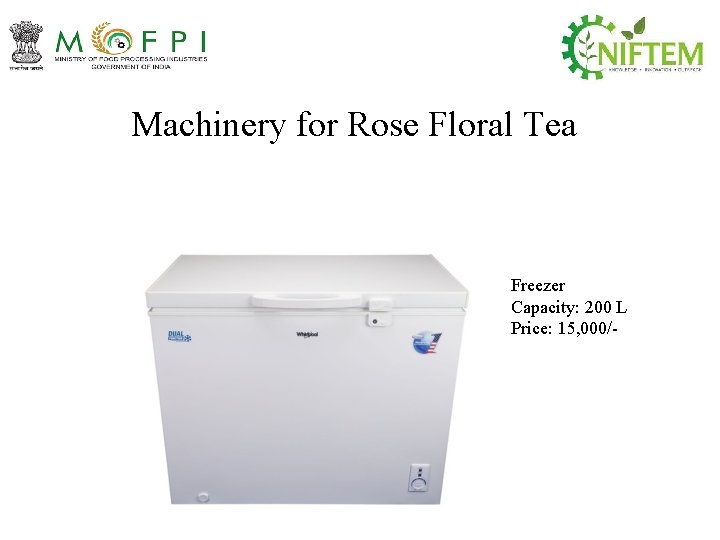
Machinery for Rose Floral Tea Freezer Capacity: 200 L Price: 15, 000/-
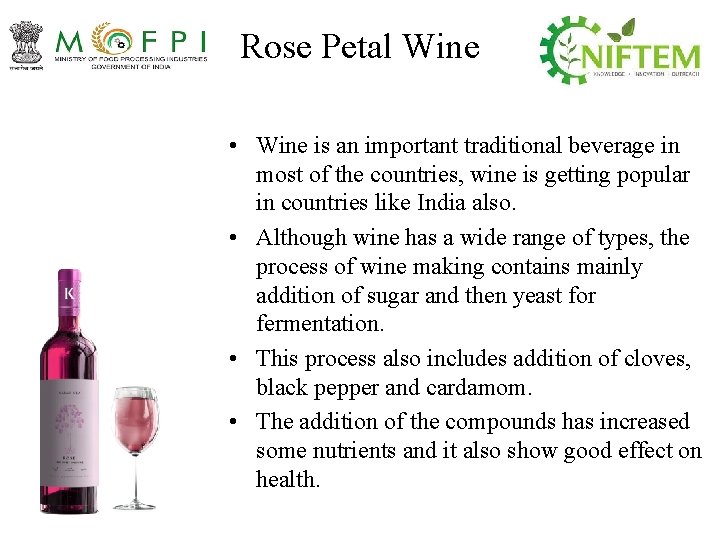
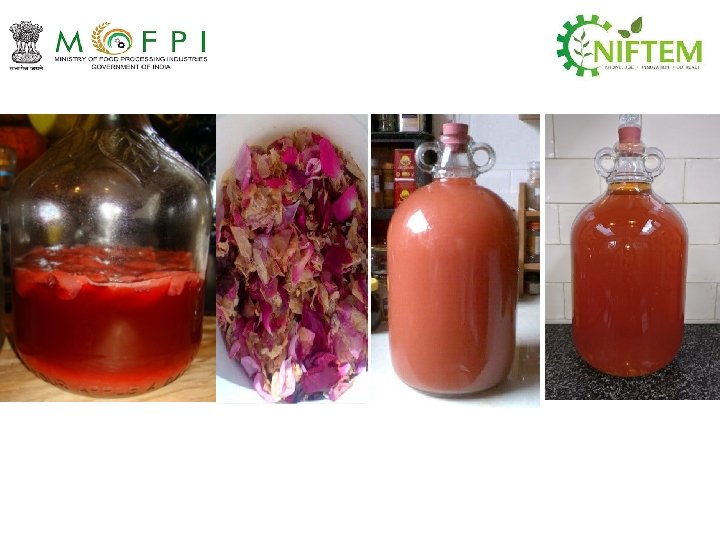
Rose Petal Wine • Wine is an important traditional beverage in most of the countries, wine is getting popular in countries like India also. • Although wine has a wide range of types, the process of wine making contains mainly addition of sugar and then yeast for fermentation. • This process also includes addition of cloves, black pepper and cardamom. • The addition of the compounds has increased some nutrients and it also show good effect on health.
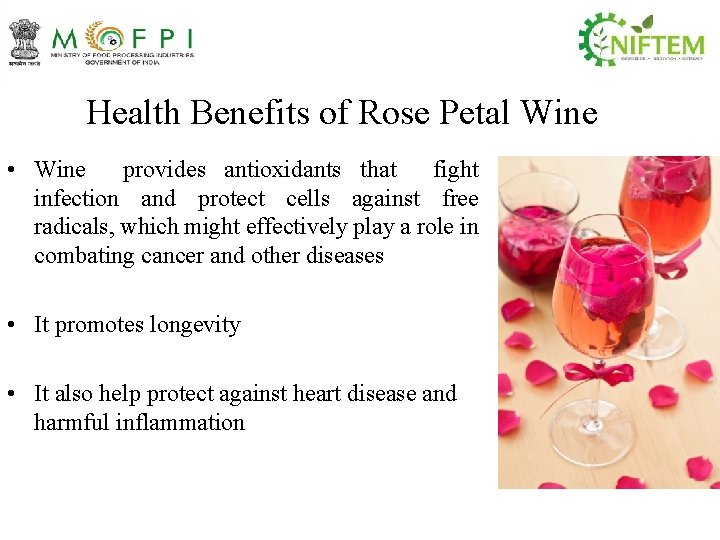
Health Benefits of Rose Petal Wine • Wine provides antioxidants that fight infection and protect cells against free radicals, which might effectively play a role in combating cancer and other diseases • It promotes longevity • It also help protect against heart disease and harmful inflammation
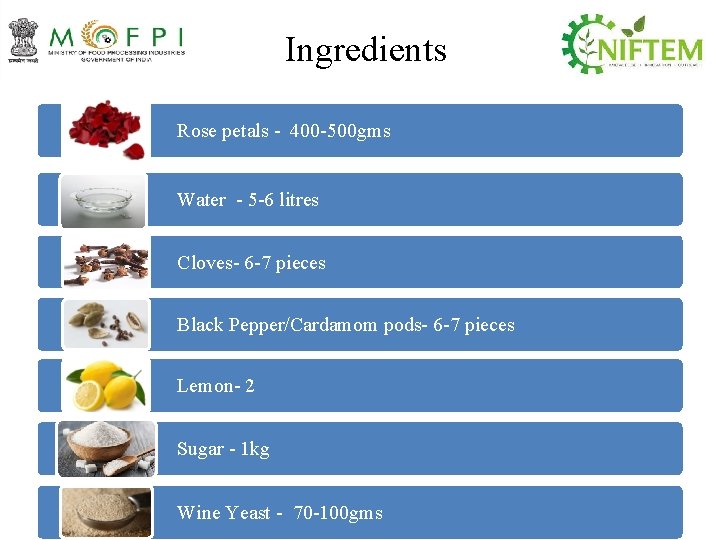
Ingredients Rose petals - 400 -500 gms Water - 5 -6 litres Cloves- 6 -7 pieces Black Pepper/Cardamom pods- 6 -7 pieces Lemon- 2 Sugar - 1 kg Wine Yeast - 70 -100 gms
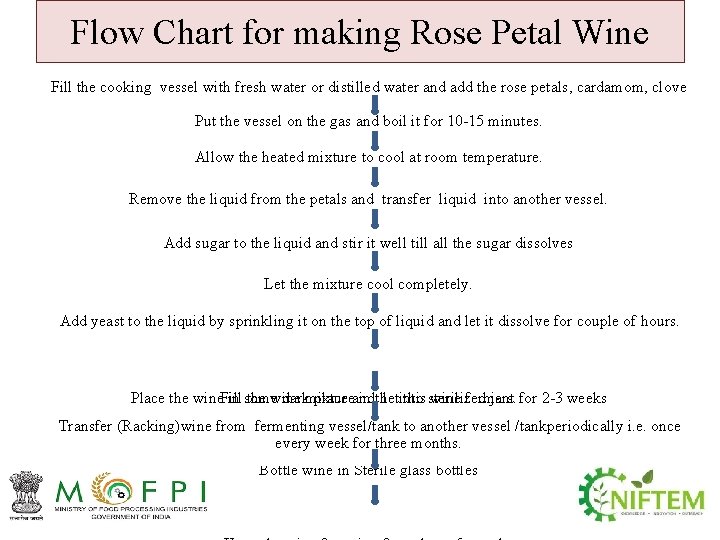
Flow Chart for making Rose Petal Wine Fill the cooking vessel with fresh water or distilled water and add the rose petals, cardamom, clove Put the vessel on the gas and boil it for 10 -15 minutes. Allow the heated mixture to cool at room temperature. Remove the liquid from the petals and transfer liquid into another vessel. Add sugar to the liquid and stir it well till all the sugar dissolves Let the mixture cool completely. Add yeast to the liquid by sprinkling it on the top of liquid and let it dissolve for couple of hours. Place the wine. Fill in some darkmixture place and letinto this sterilized wine ferment the wine in the jars. for 2 -3 weeks Transfer (Racking)wine from fermenting vessel/tank to another vessel /tankperiodically i. e. once every week for three months. Bottle wine in Sterile glass bottles
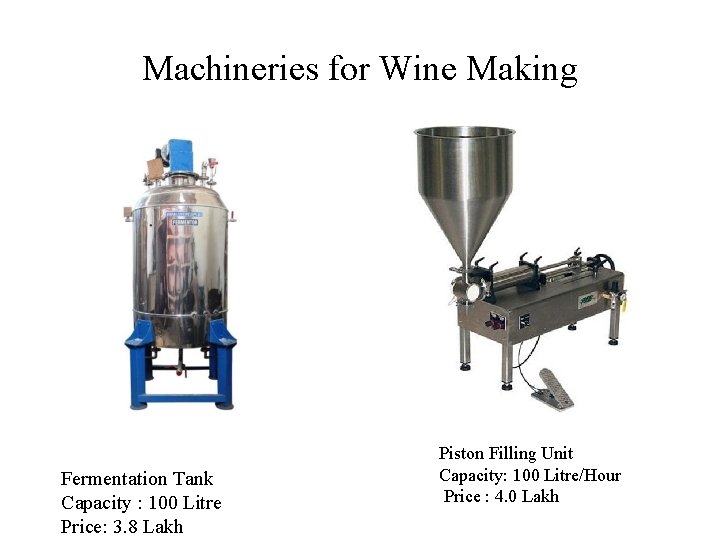
Machineries for Wine Making Fermentation Tank Capacity : 100 Litre Price: 3. 8 Lakh Piston Filling Unit Capacity: 100 Litre/Hour Price : 4. 0 Lakh
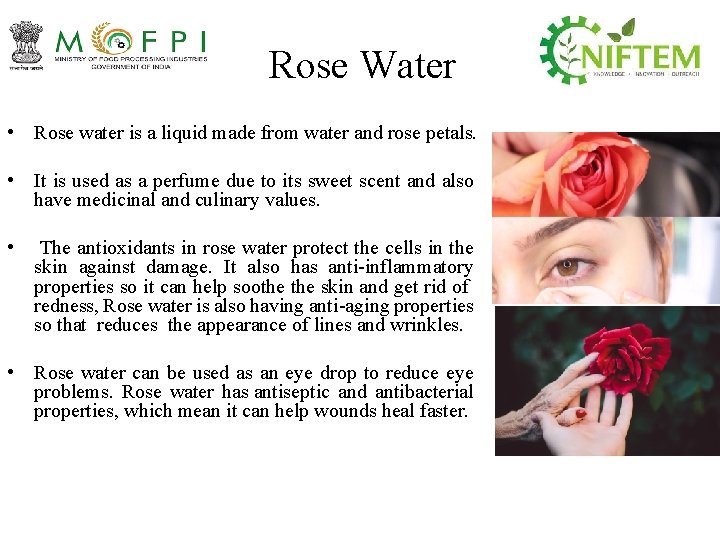
Rose Water • Rose water is a liquid made from water and rose petals. • It is used as a perfume due to its sweet scent and also have medicinal and culinary values. • The antioxidants in rose water protect the cells in the skin against damage. It also has anti-inflammatory properties so it can help soothe skin and get rid of redness, Rose water is also having anti-aging properties so that reduces the appearance of lines and wrinkles. • Rose water can be used as an eye drop to reduce eye problems. Rose water has antiseptic and antibacterial properties, which mean it can help wounds heal faster.
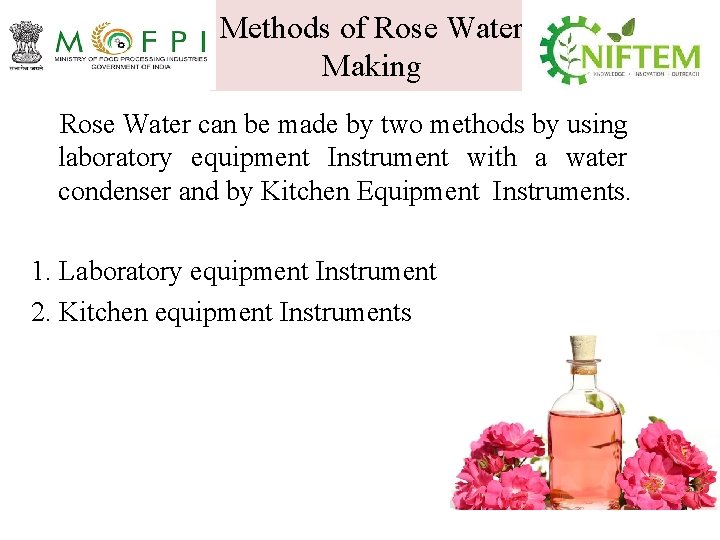
Methods of Rose Water Making Rose Water can be made by two methods by using laboratory equipment Instrument with a water condenser and by Kitchen Equipment Instruments. 1. Laboratory equipment Instrument 2. Kitchen equipment Instruments
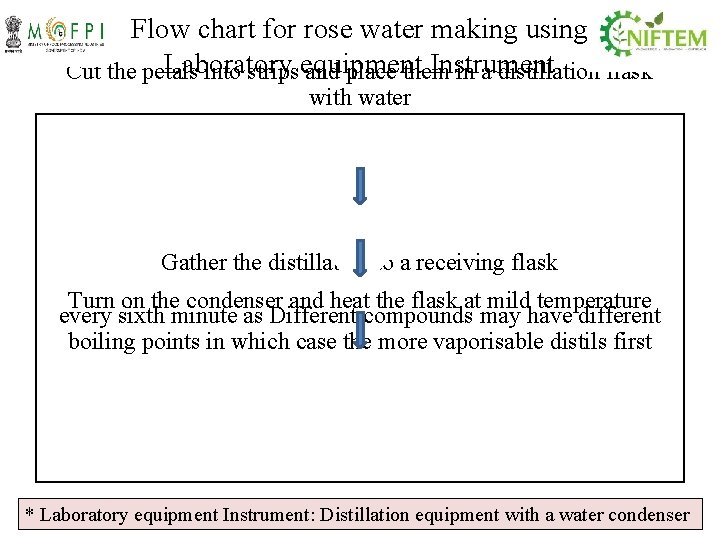
Flow chart for rose water making using Laboratory Instrument Cut the petals into strips equipment and place them in a distillation flask with water Gather the distillate into a receiving flask First fractions are collected the receiving flask change Turnthree on the condenser and heat and the flask at mild temperature every sixth minute as Different compounds may have different boiling points in which case the more vaporisable distils first * Laboratory equipment Instrument: Distillation equipment with a water condenser
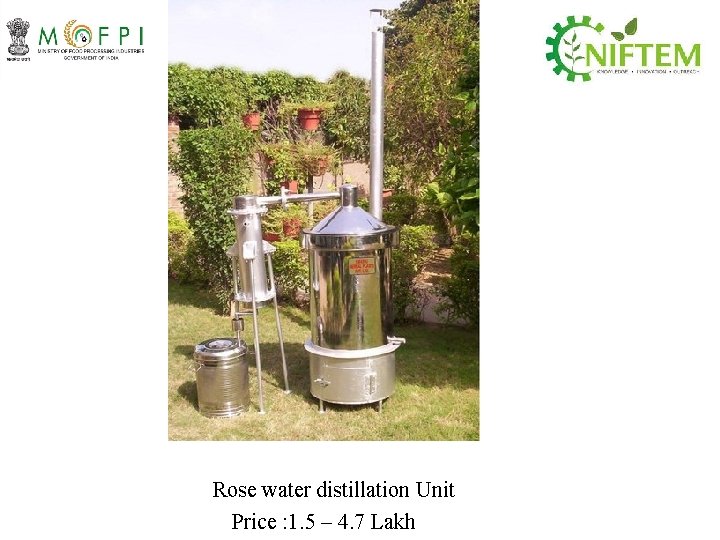
Rose water distillation Unit Price : 1. 5 – 4. 7 Lakh
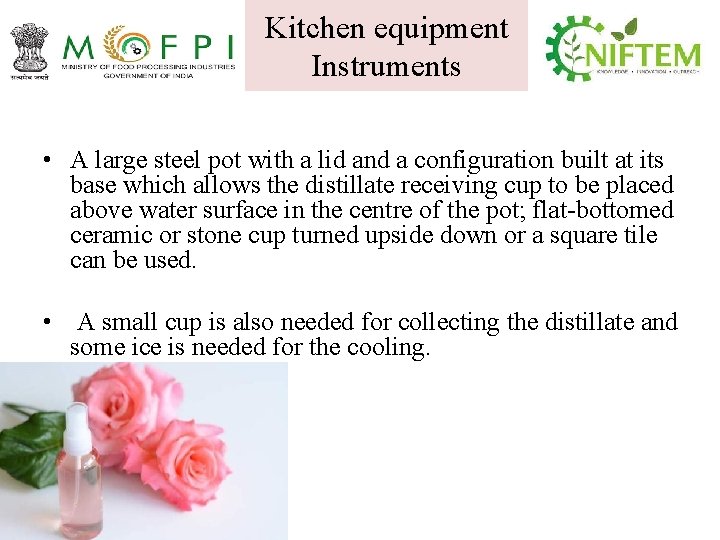
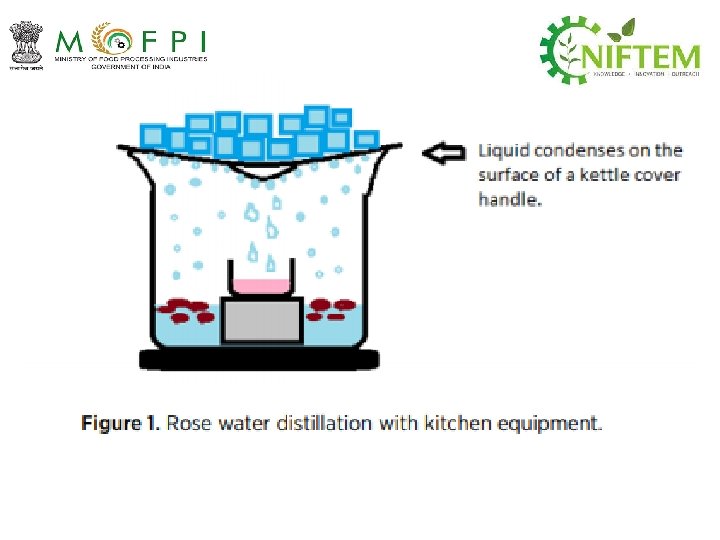
Kitchen equipment Instruments • A large steel pot with a lid and a configuration built at its base which allows the distillate receiving cup to be placed above water surface in the centre of the pot; flat-bottomed ceramic or stone cup turned upside down or a square tile can be used. • A small cup is also needed for collecting the distillate and some ice is needed for the cooling.
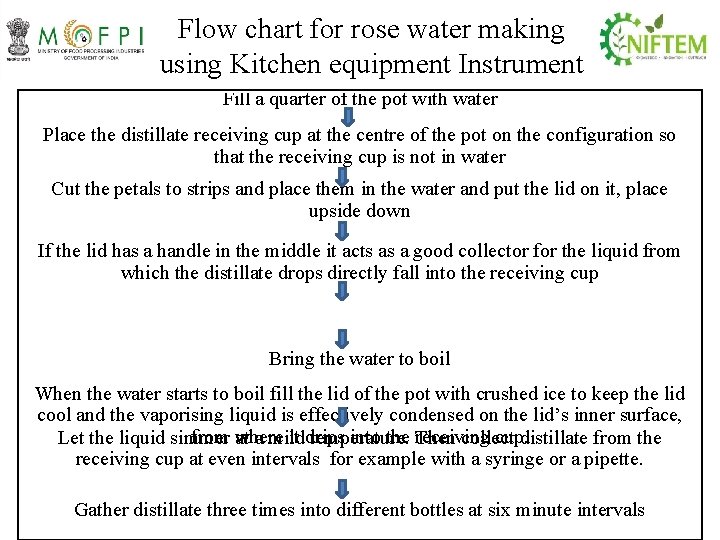
Flow chart for rose water making using Kitchen equipment Instrument Fill a quarter of the pot with water Place the distillate receiving cup at the centre of the pot on the configuration so that the receiving cup is not in water Cut the petals to strips and place them in the water and put the lid on it, place upside down If the lid has a handle in the middle it acts as a good collector for the liquid from which the distillate drops directly fall into the receiving cup Bring the water to boil When the water starts to boil fill the lid of the pot with crushed ice to keep the lid cool and the vaporising liquid is effectively condensed on the lid’s inner surface, from where it drips into the receiving cup. distillate from the Let the liquid simmer at a mild temperature. Then collect receiving cup at even intervals for example with a syringe or a pipette. Gather distillate three times into different bottles at six minute intervals
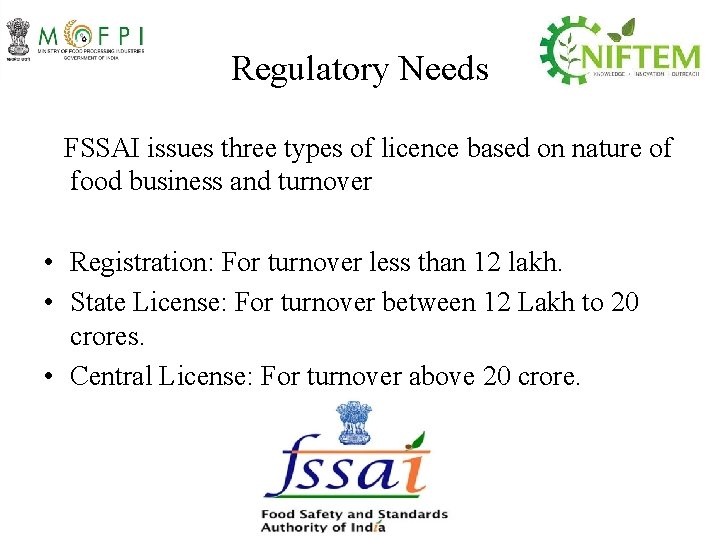
Regulatory Needs FSSAI issues three types of licence based on nature of food business and turnover • Registration: For turnover less than 12 lakh. • State License: For turnover between 12 Lakh to 20 crores. • Central License: For turnover above 20 crore.
Conclusion • Value Addition of rose increase economic value of farming community through branded products. • Consumer acceptability must be attained by maintaining quality and through packaging diversification. • Profit potential of rose based value added products can be increased when the raw commodity is converted to a unique product.
• Value Addition of Rose doubles farmers income as it is acceptable in both domestic as well as international market due to its medicinal value. • In producer level production of value added products helps in employment generation which helps in avoiding wastage during glut period.