
Processing of Biological Motion PointLight displays by Baboons
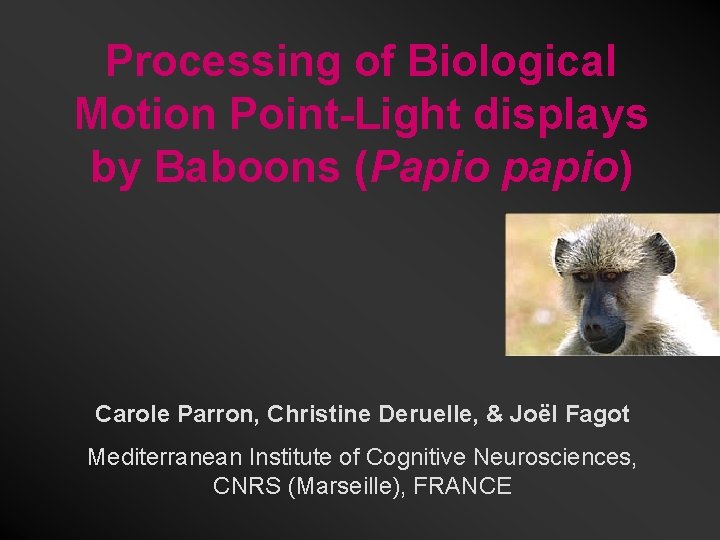
Processing of Biological Motion Point-Light displays by Baboons (Papio papio) Carole Parron, Christine Deruelle, & Joël Fagot Mediterranean Institute of Cognitive Neurosciences, CNRS (Marseille), FRANCE
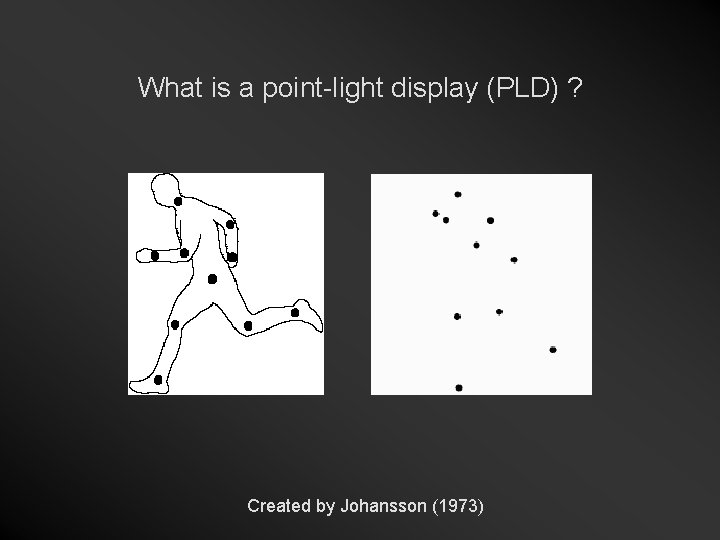
What is a point-light display (PLD) ? Created by Johansson (1973)
. . . From literature In Cat (Blake, 1993) Perception of a cat walking or running and discrimination from moving random dots In Chicks (Vallortigara et al. , 2005) Spontaneous preference in newly hatched chicks to approach biological motion patterns of various animal species In Pigeons (Dittrich et al. , 1998) Pigeons are able to discriminate between pecking and walking movement categories using point-light displays
BUT. . . Macaque monkeys (Shrier & Brady, 1987) unability to recognize highly degraded pictures Chimpanzees (Tomonaga, 2001) no specific use of biological motion patterns to solve a task of visual search asymmetries QUESTION ? Do animals interpret biological motion ? … … or have just the ability to discriminate biological type of motions vs others, without recognition ?
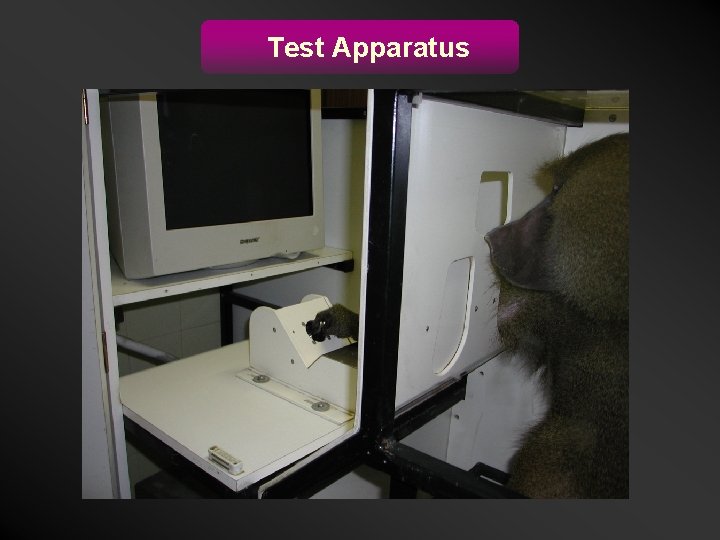
Test Apparatus
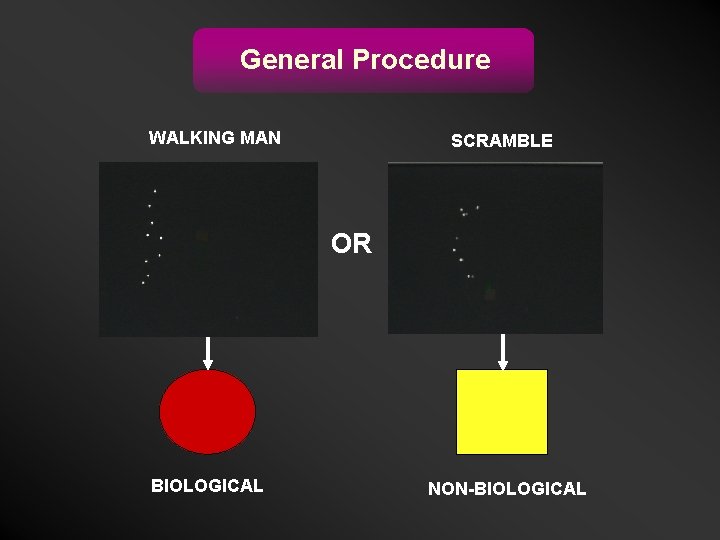
General Procedure WALKING MAN SCRAMBLE OR BIOLOGICAL NON-BIOLOGICAL
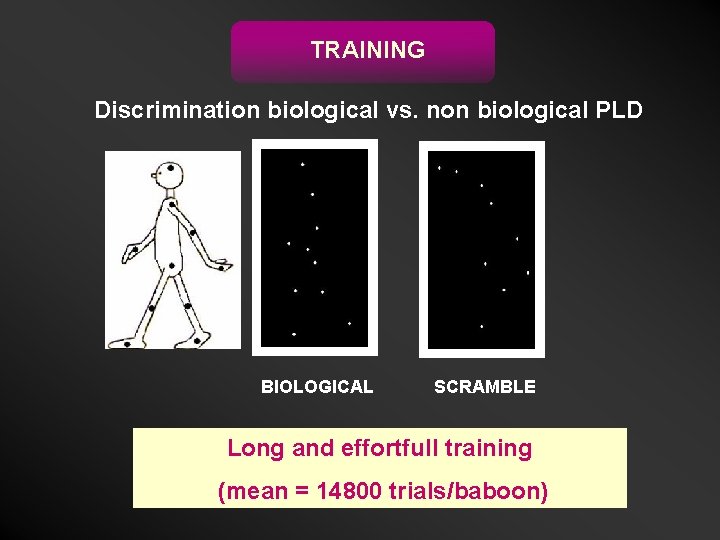
TRAINING Discrimination biological vs. non biological PLD BIOLOGICAL SCRAMBLE Long and effortfull training (mean = 14800 trials/baboon)

% correct responses TEST 1 : Transfer to novel actions of man 100 90 80 70 60 50 40 30 20 10 0 No transfer Walking Dancing (baseline) Pushing
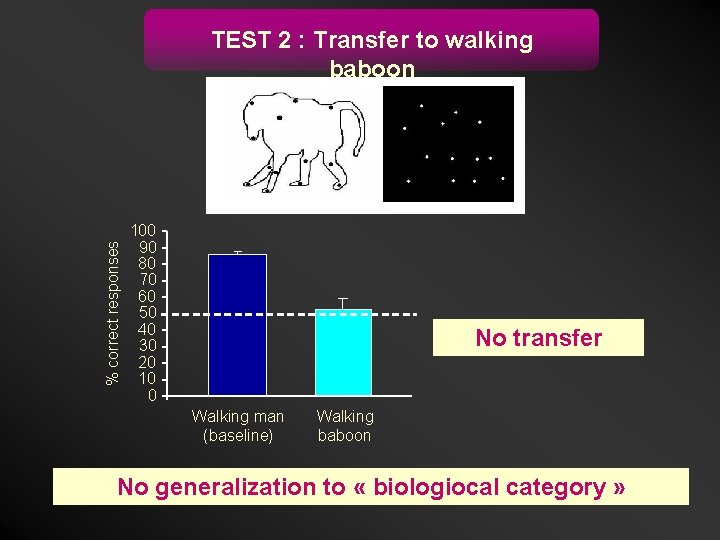
% correct responses TEST 2 : Transfer to walking baboon 100 90 80 70 60 50 40 30 20 10 0 No transfer Walking man (baseline) Walking baboon No generalization to « biologiocal category »
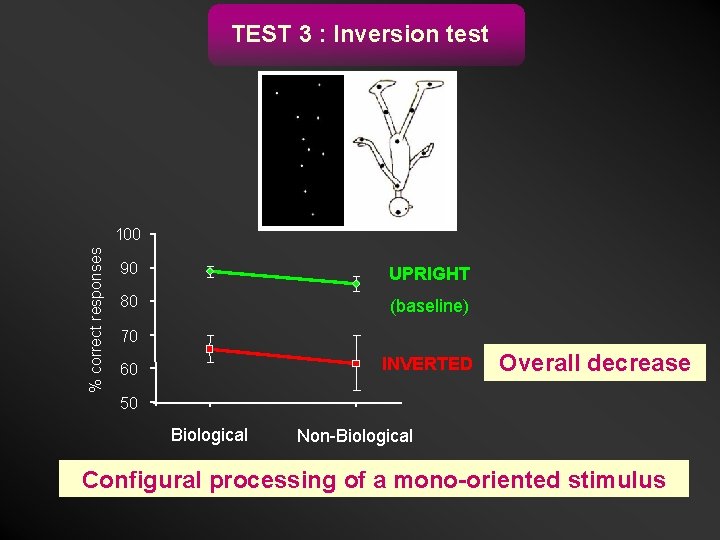
TEST 3 : Inversion test % correct responses 100 90 UPRIGHT 80 (baseline) 70 INVERTED 60 Overall decrease 50 Biological Non-Biological Configural processing of a mono-oriented stimulus
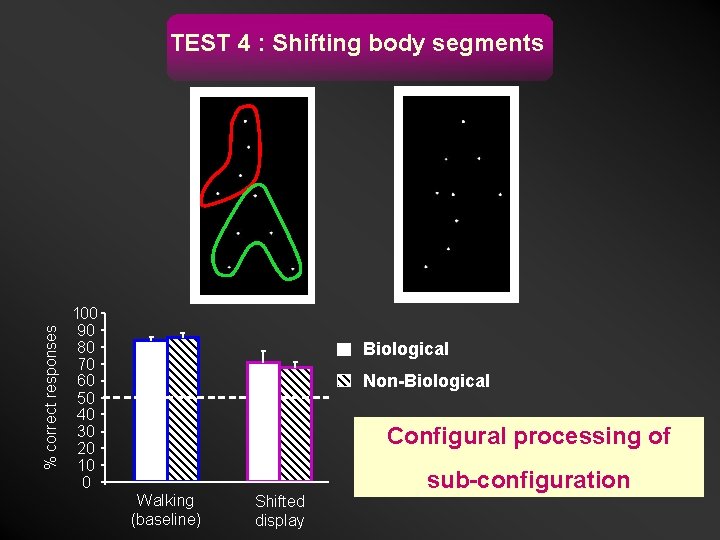
% correct responses TEST 4 : Shifting body segments 100 90 80 70 60 50 40 30 20 10 0 Biological Non-Biological Configural processing of Walking (baseline) sub-configuration Shifted display
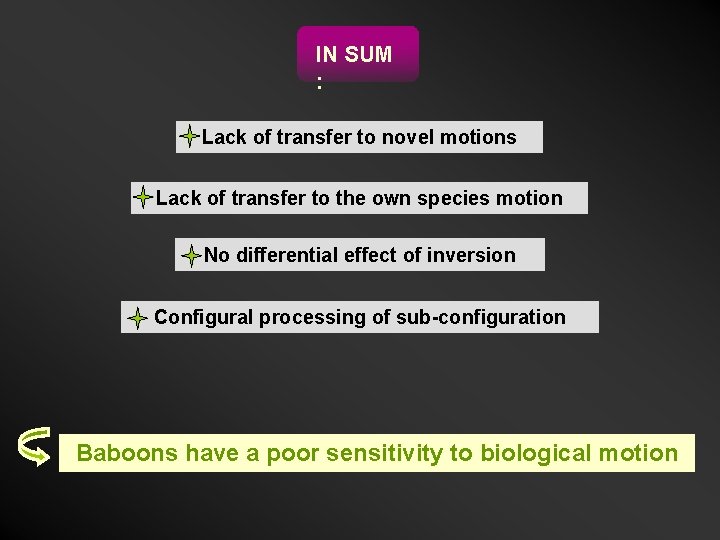
IN SUM : Lack of transfer to novel motions Lack of transfer to the own species motion No differential effect of inversion Configural processing of sub-configuration Baboons have a poor sensitivity to biological motion
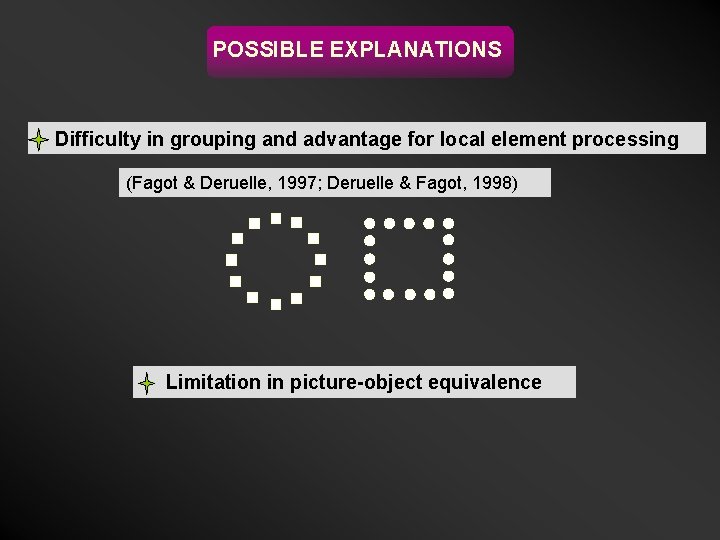
POSSIBLE EXPLANATIONS Difficulty in grouping and advantage for local element processing (Fagot & Deruelle, 1997; Deruelle & Fagot, 1998) Limitation in picture-object equivalence

Thank you…
- Slides: 14