
Processing modality by Chinese L 2 learners of

Processing modality by Chinese L 2 learners of English Nadia Mifka-Profozic University of York, UK TAML 2, Leiden, 21 April 2018
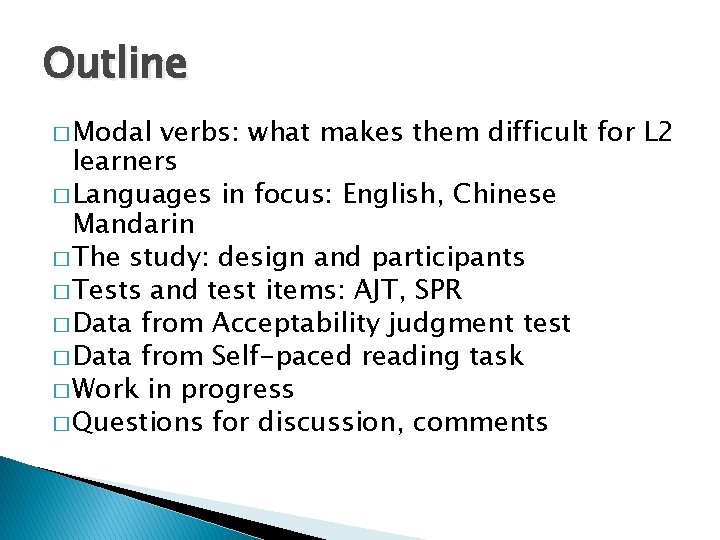
Outline � Modal verbs: what makes them difficult for L 2 learners � Languages in focus: English, Chinese Mandarin � The study: design and participants � Tests and test items: AJT, SPR � Data from Acceptability judgment test � Data from Self-paced reading task � Work in progress � Questions for discussion, comments
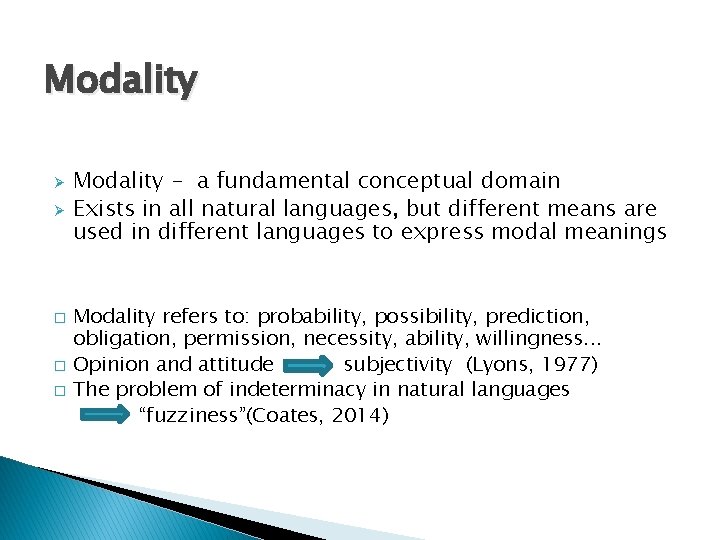
Modality Ø Ø � � � Modality - a fundamental conceptual domain Exists in all natural languages, but different means are used in different languages to express modal meanings Modality refers to: probability, possibility, prediction, obligation, permission, necessity, ability, willingness. . . Opinion and attitude subjectivity (Lyons, 1977) The problem of indeterminacy in natural languages “fuzziness”(Coates, 2014)
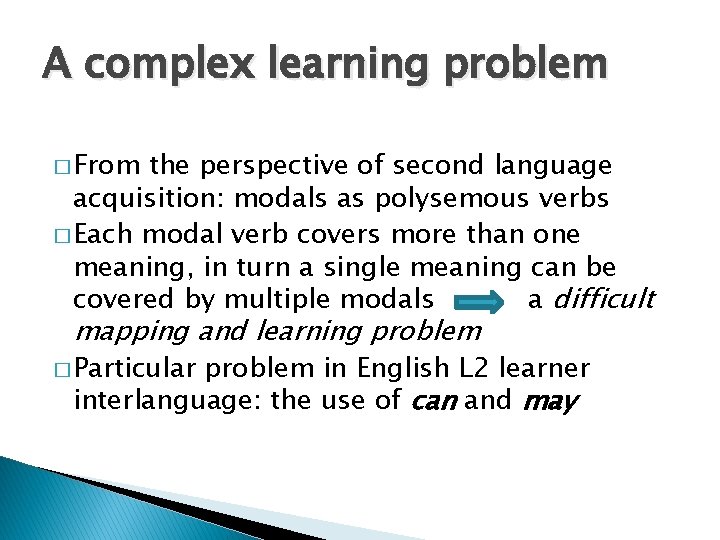
A complex learning problem � From the perspective of second language acquisition: modals as polysemous verbs � Each modal verb covers more than one meaning, in turn a single meaning can be covered by multiple modals a difficult mapping and learning problem � Particular problem in English L 2 learner interlanguage: the use of can and may
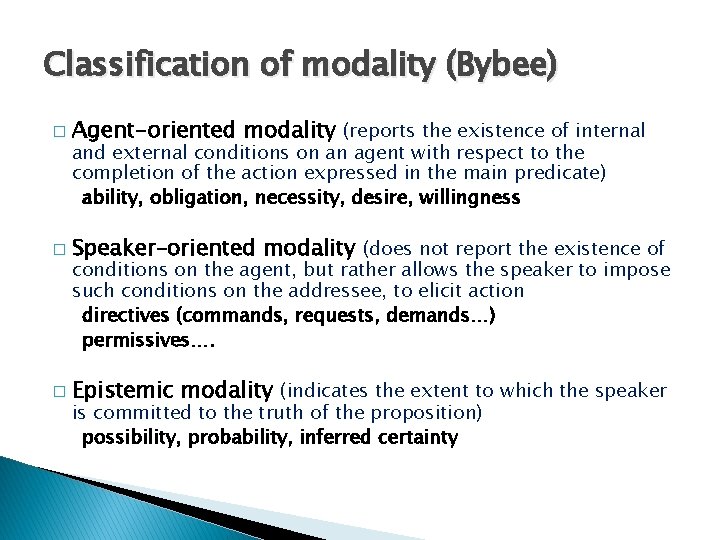
Classification of modality (Bybee) � Agent-oriented modality (reports the existence of internal � Speaker–oriented modality (does not report the existence of � Epistemic modality (indicates the extent to which the speaker and external conditions on an agent with respect to the completion of the action expressed in the main predicate) ability, obligation, necessity, desire, willingness conditions on the agent, but rather allows the speaker to impose such conditions on the addressee, to elicit action directives (commands, requests, demands…) permissives…. is committed to the truth of the proposition) possibility, probability, inferred certainty
Agent-oriented and epistemic meaning � Some of the English modal auxiliaries have both agent oriented or root meanings and epistemic meanings (similar overlapping exists in other languages) � Diachronically, epistemic senses develop later than, and out of the agent-oriented senses. � The current study: ability (agent-oriented) requests (speaker-oriented) permission (speaker-oriented) epistemic meaning
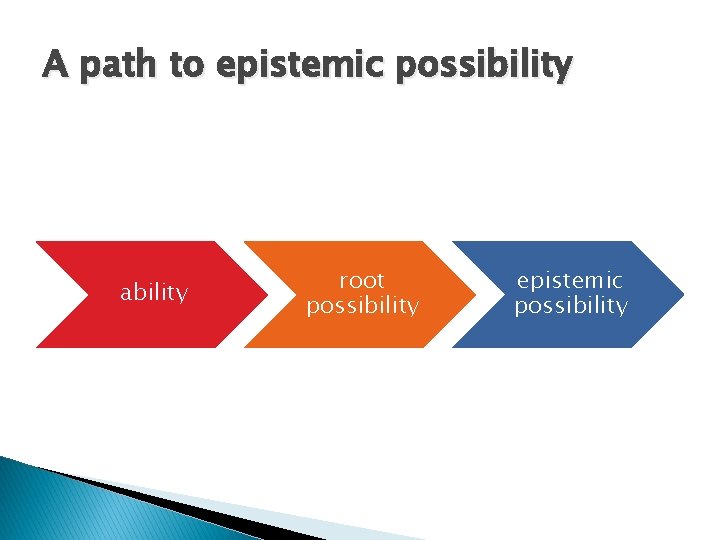
A path to epistemic possibility ability root possibility epistemic possibility
English L 1 acquisition of modal auxiliaries � Research on first language acquisition non-epistemic meaning is acquired earlier than epistemic meaning of modal verbs: older children (79 -year olds perform better than 4 -5 -year olds on tasks involving both comprehension and production of English modals that entail epistemic possibility and inferred certainty.
Acquisition of English L 2 �A difficult mapping problem involving matching the lexeme to complex syntax and semantics. � Modal lexemes typically map to multiple meanings, and in turn multiple lexemes may cover a single meaning. � What happens when Chinese speakers learn English as FL? How do they comprehend and process modal meaning? � RQ: To what extent do Chinese L 1 speakers learners of English as FL acquire the semantic meaning of modal auxiliaries can and may?
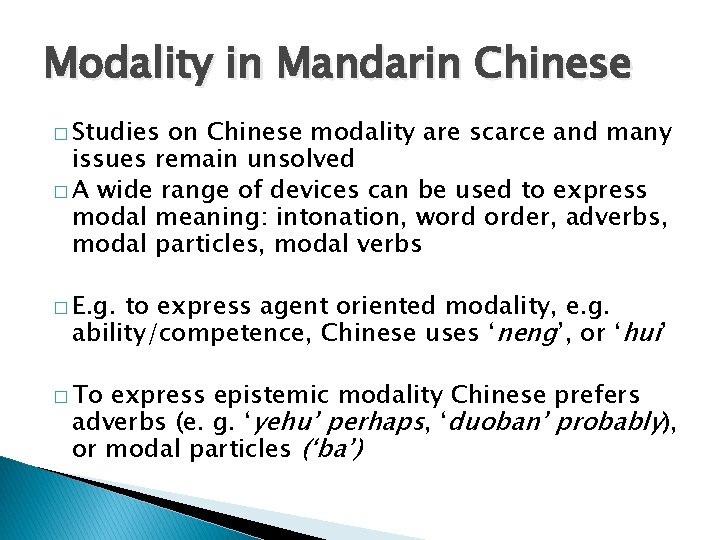
Modality in Mandarin Chinese � Studies on Chinese modality are scarce and many issues remain unsolved � A wide range of devices can be used to express modal meaning: intonation, word order, adverbs, modal particles, modal verbs � E. g. to express agent oriented modality, e. g. ability/competence, Chinese uses ‘neng’, or ‘hui’ � To express epistemic modality Chinese prefers adverbs (e. g. ‘yehu’ perhaps, ‘duoban’ probably), or modal particles (‘ba’)
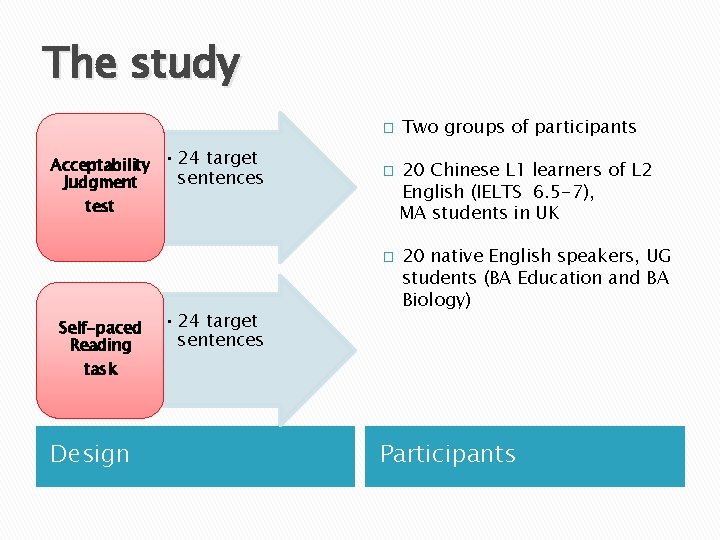
The study � Acceptability • 24 target sentences Judgment test � � Self-paced Reading • 24 target sentences Two groups of participants 20 Chinese L 1 learners of L 2 English (IELTS 6. 5 -7), MA students in UK 20 native English speakers, UG students (BA Education and BA Biology) task Design Participants
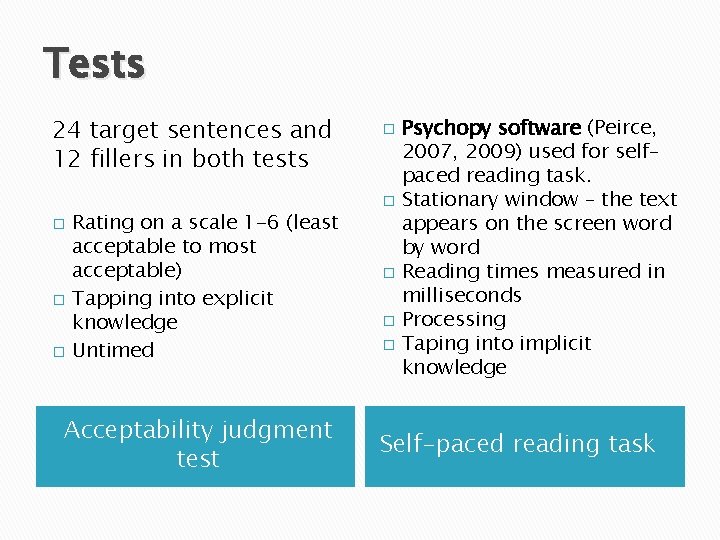
Tests 24 target sentences and 12 fillers in both tests � � � Rating on a scale 1 -6 (least acceptable to most acceptable) Tapping into explicit knowledge Untimed Acceptability judgment test � � � Psychopy software (Peirce, 2007, 2009) used for self– paced reading task. Stationary window – the text appears on the screen word by word Reading times measured in milliseconds Processing Taping into implicit knowledge Self-paced reading task
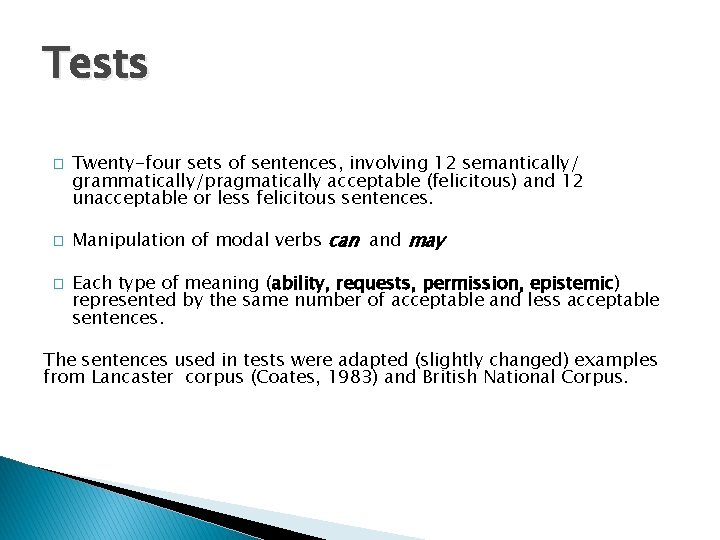
Tests � � � Twenty-four sets of sentences, involving 12 semantically/ grammatically/pragmatically acceptable (felicitous) and 12 unacceptable or less felicitous sentences. Manipulation of modal verbs can and may Each type of meaning (ability, requests, permission, epistemic) represented by the same number of acceptable and less acceptable sentences. The sentences used in tests were adapted (slightly changed) examples from Lancaster corpus (Coates, 1983) and British National Corpus.
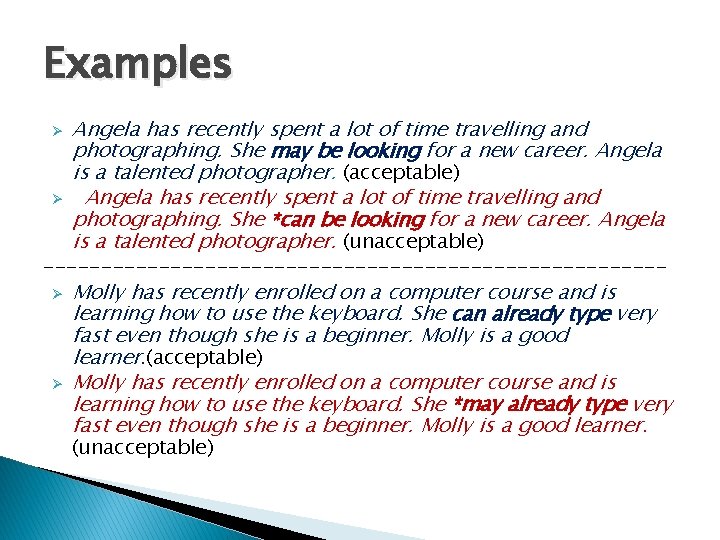
Examples Ø Ø Angela has recently spent a lot of time travelling and photographing. She may be looking for a new career. Angela is a talented photographer. (acceptable) Angela has recently spent a lot of time travelling and photographing. She *can be looking for a new career. Angela is a talented photographer. (unacceptable) ---------------------------Ø Ø Molly has recently enrolled on a computer course and is learning how to use the keyboard. She can already type very fast even though she is a beginner. Molly is a good learner. (acceptable) Molly has recently enrolled on a computer course and is learning how to use the keyboard. She *may already type very fast even though she is a beginner. Molly is a good learner. (unacceptable)
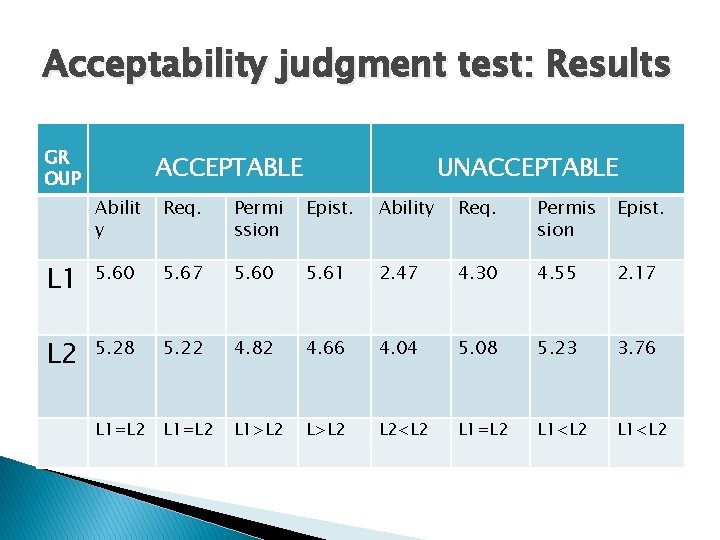
Acceptability judgment test: Results GR OUP ACCEPTABLE UNACCEPTABLE Abilit y Req. Permi ssion Epist. Ability Req. Permis sion Epist. L 1 5. 60 5. 67 5. 60 5. 61 2. 47 4. 30 4. 55 2. 17 L 2 5. 28 5. 22 4. 82 4. 66 4. 04 5. 08 5. 23 3. 76 L 1=L 2 L 1>L 2 L 2<L 2 L 1=L 2 L 1<L 2
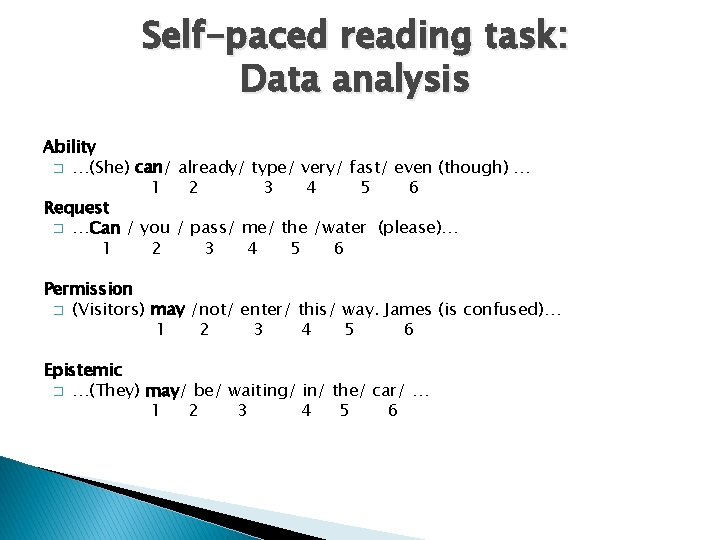
Self-paced reading task: Data analysis Ability � …(She) can/ already/ type/ very/ fast/ even (though) … 1 2 3 4 5 6 Request � …Can / you / pass/ me/ the /water (please)… 1 2 3 4 5 6 Permission � (Visitors) may /not/ enter/ this/ way. James (is confused)… 1 2 3 4 5 6 Epistemic � …(They) may/ be/ waiting/ in/ the/ car/ … 1 2 3 4 5 6
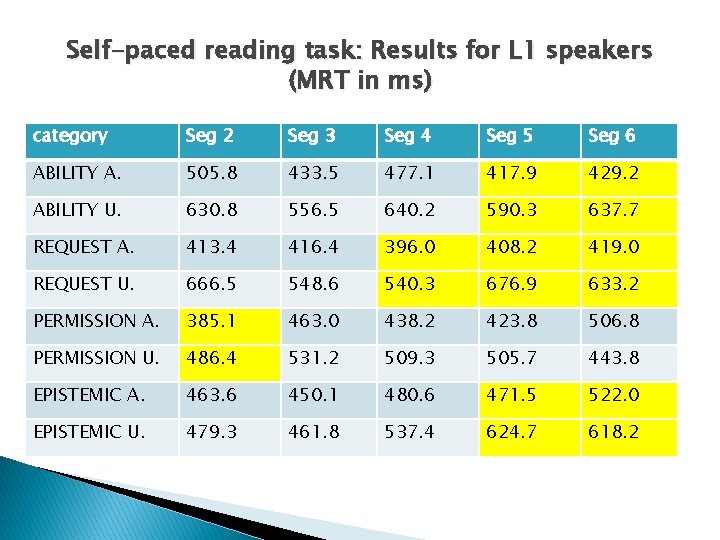
Self-paced reading task: Results for L 1 speakers (MRT in ms) category Seg 2 Seg 3 Seg 4 Seg 5 Seg 6 ABILITY A. 505. 8 433. 5 477. 1 417. 9 429. 2 ABILITY U. 630. 8 556. 5 640. 2 590. 3 637. 7 REQUEST A. 413. 4 416. 4 396. 0 408. 2 419. 0 REQUEST U. 666. 5 548. 6 540. 3 676. 9 633. 2 PERMISSION A. 385. 1 463. 0 438. 2 423. 8 506. 8 PERMISSION U. 486. 4 531. 2 509. 3 505. 7 443. 8 EPISTEMIC A. 463. 6 450. 1 480. 6 471. 5 522. 0 EPISTEMIC U. 479. 3 461. 8 537. 4 624. 7 618. 2
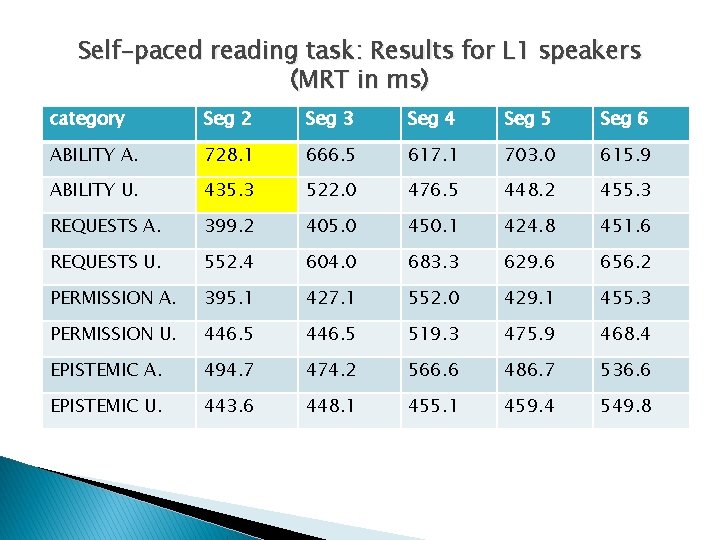
Self-paced reading task: Results for L 1 speakers (MRT in ms) category Seg 2 Seg 3 Seg 4 Seg 5 Seg 6 ABILITY A. 728. 1 666. 5 617. 1 703. 0 615. 9 ABILITY U. 435. 3 522. 0 476. 5 448. 2 455. 3 REQUESTS A. 399. 2 405. 0 450. 1 424. 8 451. 6 REQUESTS U. 552. 4 604. 0 683. 3 629. 6 656. 2 PERMISSION A. 395. 1 427. 1 552. 0 429. 1 455. 3 PERMISSION U. 446. 5 519. 3 475. 9 468. 4 EPISTEMIC A. 494. 7 474. 2 566. 6 486. 7 536. 6 EPISTEMIC U. 443. 6 448. 1 455. 1 459. 4 549. 8
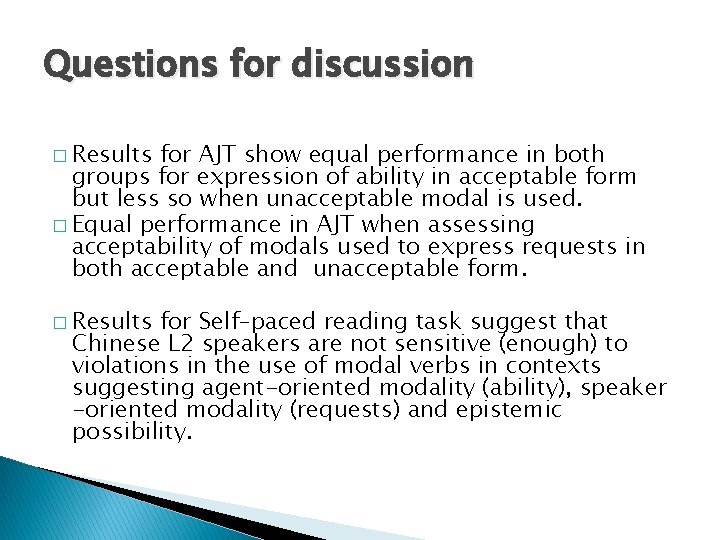
Questions for discussion � Results for AJT show equal performance in both groups for expression of ability in acceptable form but less so when unacceptable modal is used. � Equal performance in AJT when assessing acceptability of modals used to express requests in both acceptable and unacceptable form. � Results for Self–paced reading task suggest that Chinese L 2 speakers are not sensitive (enough) to violations in the use of modal verbs in contexts suggesting agent-oriented modality (ability), speaker -oriented modality (requests) and epistemic possibility.
Thank you! Questions? Comments? Suggestions?
- Slides: 20