
Processes Tarek Abdelzaher Vikram Adve Marco Caccamo Copyright
Processes Tarek Abdelzaher Vikram Adve Marco Caccamo Copyright ©: Nahrstedt, Angrave, Abdelzaher 1
Copyright ©: Nahrstedt, Angrave, Abdelzaher Users, Programs, Processes n n Users have accounts on the system Users launch programs n n n Many users may launch same program One user may launch many instances of the same program Processes: n an executing program (the unit of work of a modern computer) 2
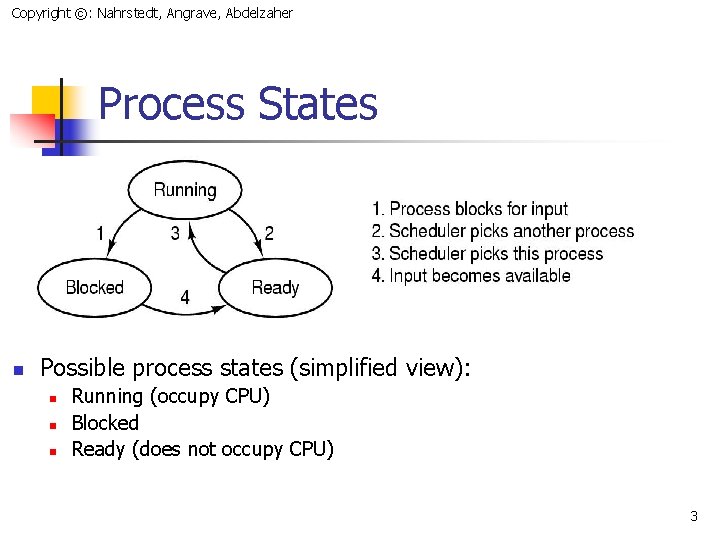
Copyright ©: Nahrstedt, Angrave, Abdelzaher Process States n Possible process states (simplified view): n n n Running (occupy CPU) Blocked Ready (does not occupy CPU) 3
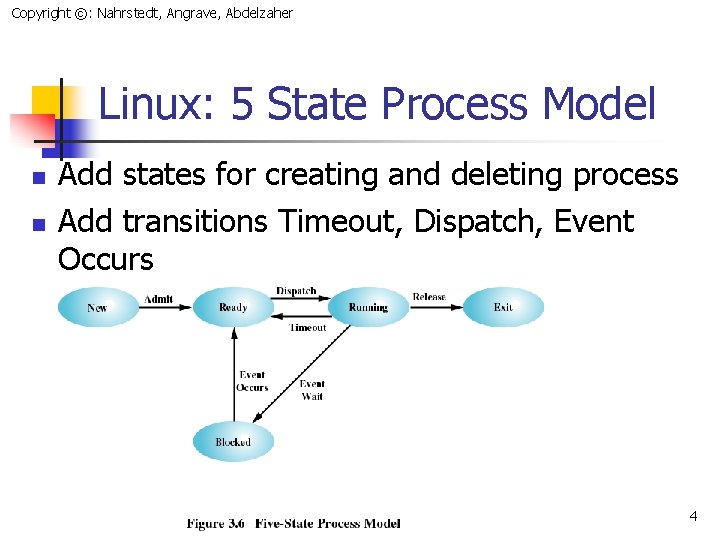
Copyright ©: Nahrstedt, Angrave, Abdelzaher Linux: 5 State Process Model n n Add states for creating and deleting process Add transitions Timeout, Dispatch, Event Occurs 4
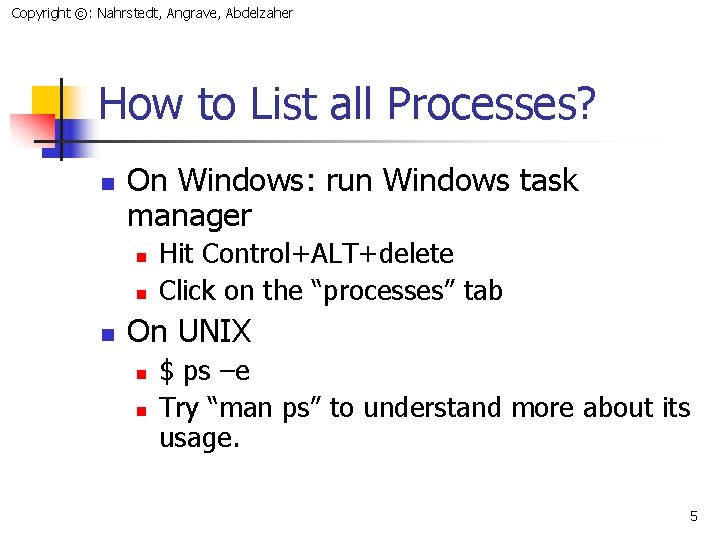
Copyright ©: Nahrstedt, Angrave, Abdelzaher How to List all Processes? n On Windows: run Windows task manager n n n Hit Control+ALT+delete Click on the “processes” tab On UNIX n n $ ps –e Try “man ps” to understand more about its usage. 5
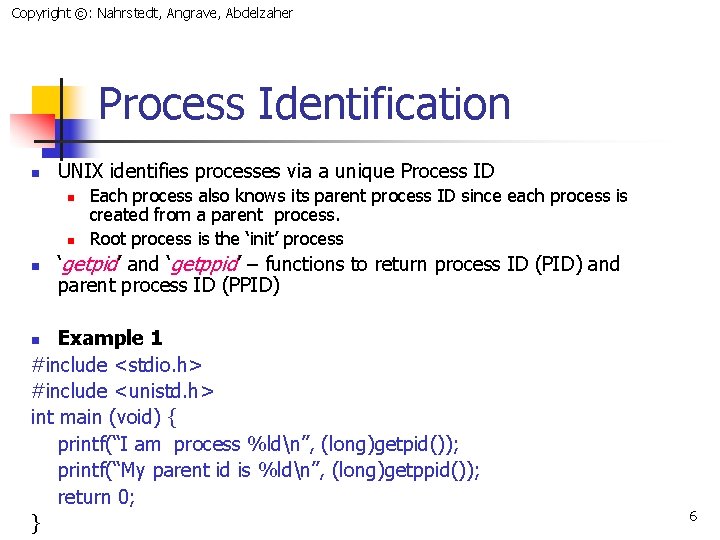
Copyright ©: Nahrstedt, Angrave, Abdelzaher Process Identification n UNIX identifies processes via a unique Process ID n n n Each process also knows its parent process ID since each process is created from a parent process. Root process is the ‘init’ process ‘getpid’ and ‘getppid’ – functions to return process ID (PID) and parent process ID (PPID) Example 1 #include <stdio. h> #include <unistd. h> int main (void) { printf(“I am process %ldn”, (long)getpid()); printf(“My parent id is %ldn”, (long)getppid()); return 0; } n 6
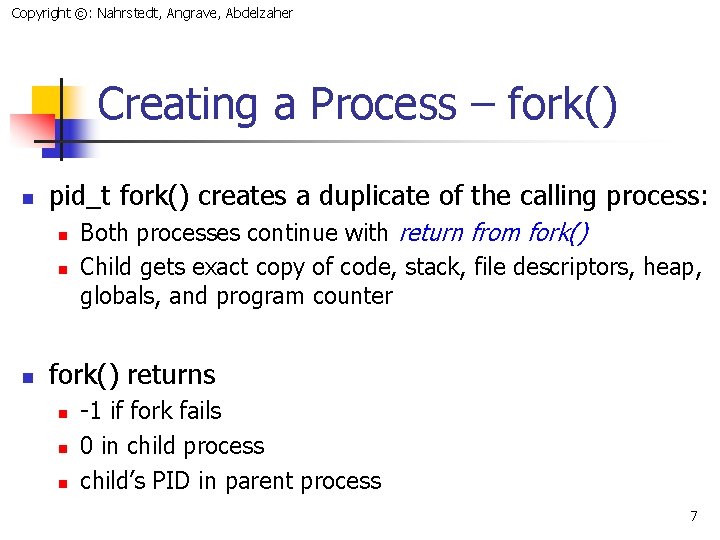
Copyright ©: Nahrstedt, Angrave, Abdelzaher Creating a Process – fork() n pid_t fork() creates a duplicate of the calling process: n n n Both processes continue with return from fork() Child gets exact copy of code, stack, file descriptors, heap, globals, and program counter fork() returns n n n -1 if fork fails 0 in child process child’s PID in parent process 7
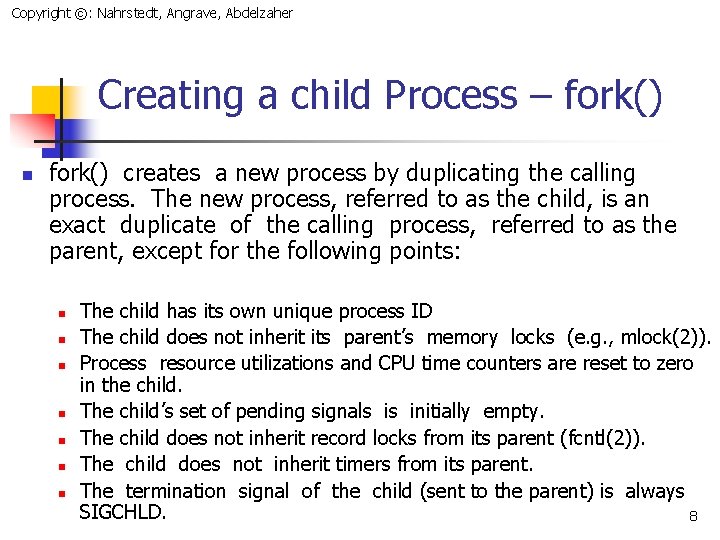
Copyright ©: Nahrstedt, Angrave, Abdelzaher Creating a child Process – fork() n fork() creates a new process by duplicating the calling process. The new process, referred to as the child, is an exact duplicate of the calling process, referred to as the parent, except for the following points: n n n n The child has its own unique process ID The child does not inherit its parent’s memory locks (e. g. , mlock(2)). Process resource utilizations and CPU time counters are reset to zero in the child. The child’s set of pending signals is initially empty. The child does not inherit record locks from its parent (fcntl(2)). The child does not inherit timers from its parent. The termination signal of the child (sent to the parent) is always SIGCHLD. 8
Copyright ©: Nahrstedt, Angrave, Abdelzaher Creating a child Process – fork() n n The entire virtual address space of the parent is replicated in the child, including the states of mutexes, etc. The child inherits copies of the parent’s set of open file descriptors. Each file descriptor in the child refers to the same open file description (see open(2)) as the corresponding file descriptor in the parent. This means that the two descriptors share open file status flags, and current file offset. 9
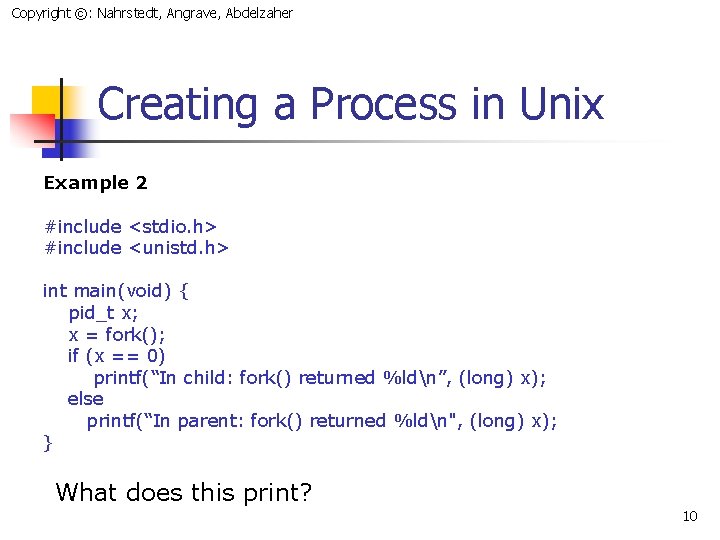
Copyright ©: Nahrstedt, Angrave, Abdelzaher Creating a Process in Unix Example 2 #include <stdio. h> #include <unistd. h> int main(void) { pid_t x; x = fork(); if (x == 0) printf(“In child: fork() returned %ldn”, (long) x); else printf(“In parent: fork() returned %ldn", (long) x); } What does this print? 10
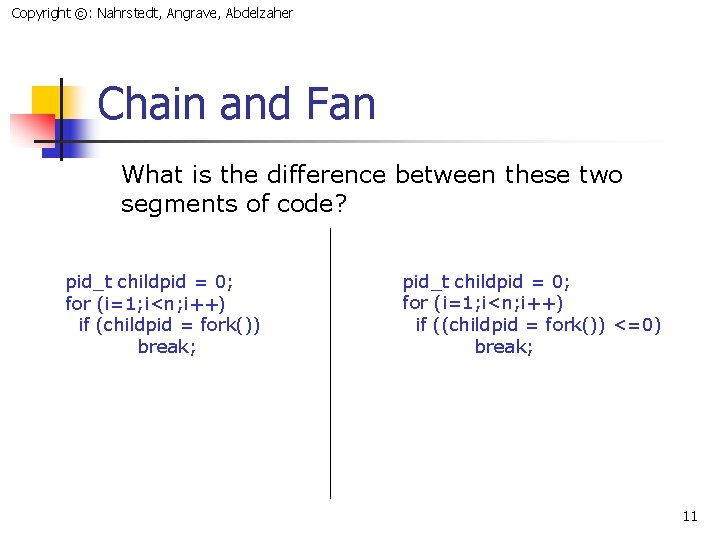
Copyright ©: Nahrstedt, Angrave, Abdelzaher Chain and Fan What is the difference between these two segments of code? pid_t childpid = 0; for (i=1; i<n; i++) if (childpid = fork()) break; pid_t childpid = 0; for (i=1; i<n; i++) if ((childpid = fork()) <=0) break; 11
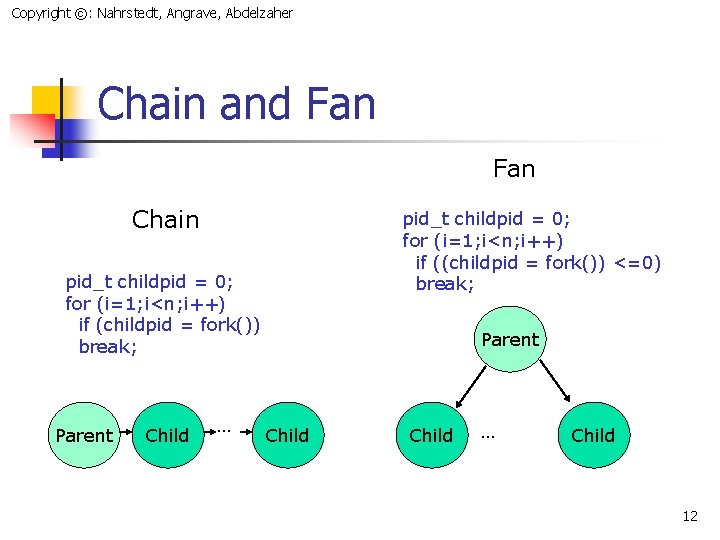
Copyright ©: Nahrstedt, Angrave, Abdelzaher Chain and Fan Chain pid_t childpid = 0; for (i=1; i<n; i++) if ((childpid = fork()) <=0) break; pid_t childpid = 0; for (i=1; i<n; i++) if (childpid = fork()) break; Parent Child … Child 12
Copyright ©: Nahrstedt, Angrave, Abdelzaher Process Operations: Creation n A new process needs resources such as CPU, memory, file descriptors n n n Child can get resources from OS or from parent Child address space is a duplicate of parent process Child process is given a subset of parent resources n n Prevents too many processes from overloading system Execution possibilities are n n Parent continues concurrently with child Parent waits until child has terminated 13
Copyright ©: Nahrstedt, Angrave, Abdelzaher Process Termination n Normal exit (voluntary) n n n Error exit (voluntary) n n exit(1) Fatal error (involuntary) n n Returning zero from main() exit(0) Divide by 0, seg fault, exceeded resources Killed by another process (involuntary) n Signal: kill(proc. ID) 14
Copyright ©: Nahrstedt, Angrave, Abdelzaher Process Operations: Termination n When a child process terminates: n n n Open files are flushed and closed tmp files are deleted Child’s resources are de-allocated n n n File descriptors, memory, semaphores, file locks, … Parent process is notified via signal SIGCHLD Exit status is available to parent via wait() 15
Copyright ©: Nahrstedt, Angrave, Abdelzaher Process Hierarchies n n Parent creates a child process, a child process can create its own child processes Forms a hierarchy n n UNIX calls this a "process group" Windows has no concept of process hierarchy n all processes are created equal 16
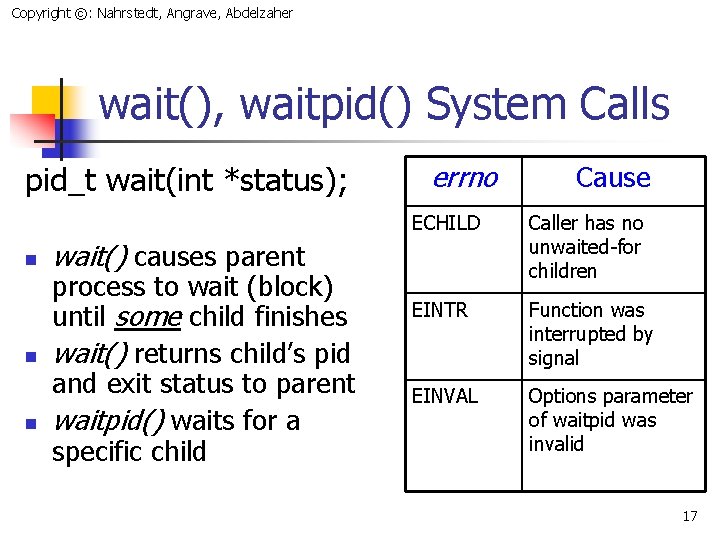
Copyright ©: Nahrstedt, Angrave, Abdelzaher wait(), waitpid() System Calls pid_t wait(int *status); n n n errno ECHILD Caller has no unwaited-for children EINTR Function was interrupted by signal EINVAL Options parameter of waitpid was invalid wait() causes parent process to wait (block) until some child finishes wait() returns child’s pid and exit status to parent waitpid() waits for a specific child Cause 17
Copyright ©: Nahrstedt, Angrave, Abdelzaher wait(), waitpid() System Calls pid_t wait(int *status); n n In the case of a terminated child, performing a wait allows the system to release the resources associated with the child; if a wait is not performed, then the terminated child remains in a "zombie“ state. If a child has already terminated, then the call returns immediately. Otherwise it blocks until either a child terminates or a signal handler interrupts the call. A child that has terminated and which has not yet been waited upon by this system call (or waitpid) is termed waitable. 18
Copyright ©: Nahrstedt, Angrave, Abdelzaher wait(), waitpid() System Calls n n If status is not NULL, wait() stores status information in the int to which it points. This integer can be inspected with specific macros (see man pages): WIFEXITED(status) n n returns true if the child terminated normally, that is, by calling exit, or by returning from main(). WEXITSTATUS(status) n returns the exit status of the child. This consists of the least significant 8 bits of the status argument that the child specified in a call to exit or as the argument for a return statement in main(). This macro should only be employed if WIFEXITED returned true. 19
Copyright ©: Nahrstedt, Angrave, Abdelzaher wait() & “zombie” n n n A child that terminates, but has not been waited for becomes a "zombie". The kernel maintains a minimal set of information about the zombie process (PID, termination status, resource usage information) in order to allow the parent to later perform a wait to obtain information about the child. As long as a zombie is not removed from the system via a wait, it will consume a slot in the kernel process table, and if this table fills, it will not be possible to create further processes. If a parent process terminates, then its "zombie" children (if any) are adopted by init(8), which automatically performs a wait to remove the zombies. 20
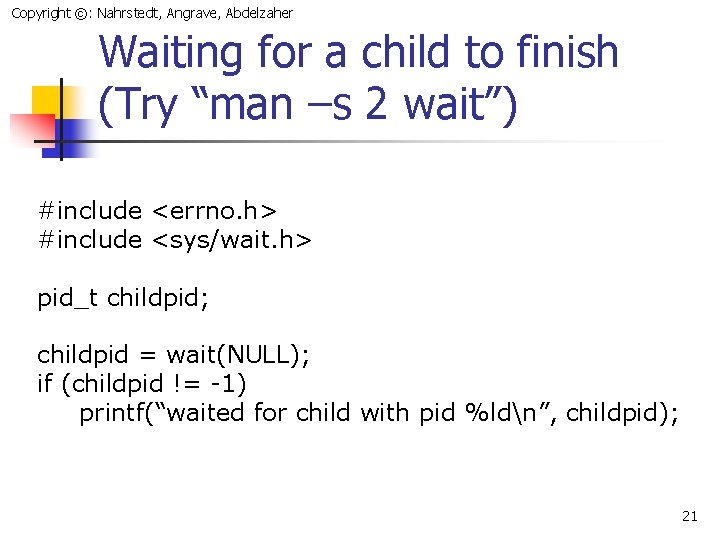
Copyright ©: Nahrstedt, Angrave, Abdelzaher Waiting for a child to finish (Try “man –s 2 wait”) #include <errno. h> #include <sys/wait. h> pid_t childpid; childpid = wait(NULL); if (childpid != -1) printf(“waited for child with pid %ldn”, childpid); 21
- Slides: 21