
Processes Modelling with UML Activity Diagram Erik Perjons

- Slides: 17
Processes Modelling with UML Activity Diagram Erik Perjons
Question to answer ● How do you model business processes using a formal business process modelling language, in this case UML Activity Diagram?
UML Activity Diagram 3
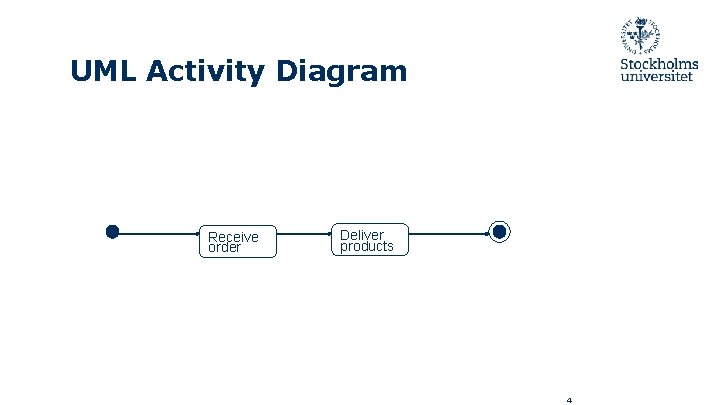
UML Activity Diagram Receive order Deliver products 4
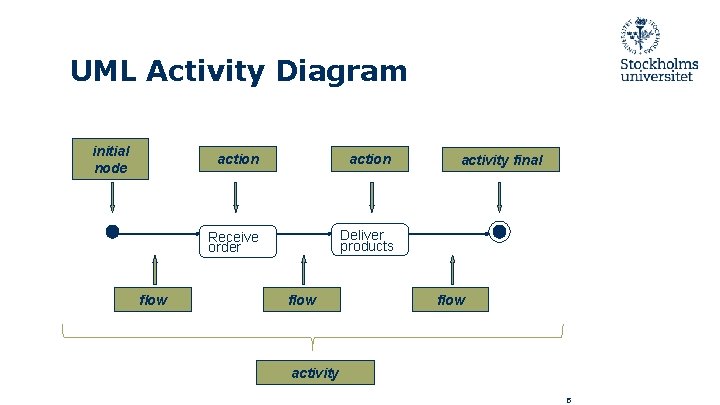
UML Activity Diagram initial node flow action Receive order Deliver products flow activity final flow activity 5
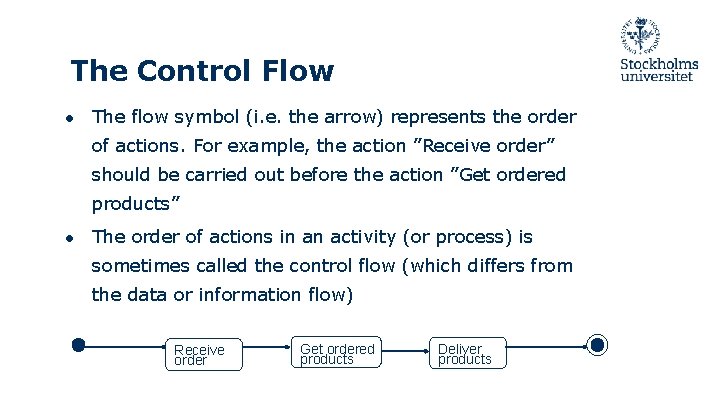
The Control Flow ● The flow symbol (i. e. the arrow) represents the order of actions. For example, the action ”Receive order” should be carried out before the action ”Get ordered products” ● The order of actions in an activity (or process) is sometimes called the control flow (which differs from the data or information flow) Receive order Get ordered products Deliver products
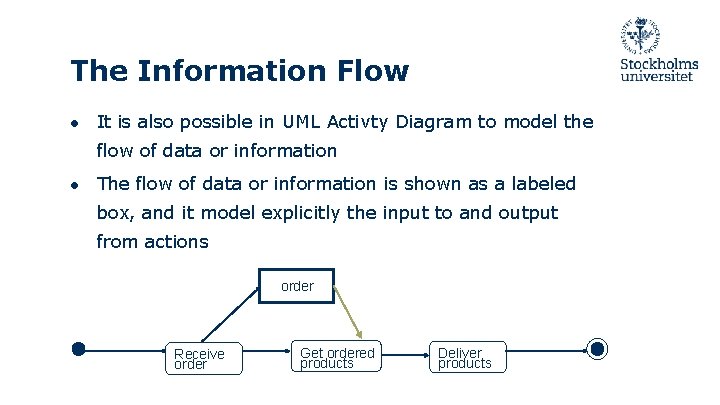
The Information Flow ● It is also possible in UML Activty Diagram to model the flow of data or information ● The flow of data or information is shown as a labeled box, and it model explicitly the input to and output from actions order Receive order Get ordered products Deliver products
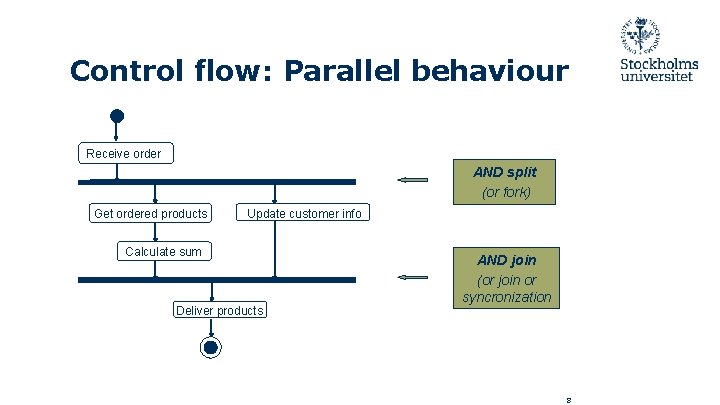
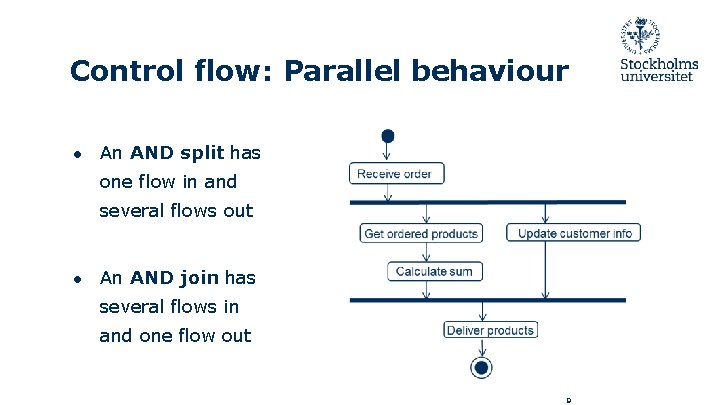
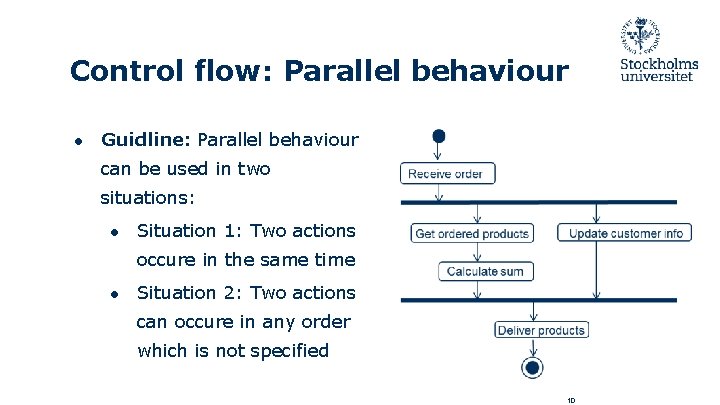
Control flow: Parallel behaviour Receive order AND split (or fork) Get ordered products Update customer info Calculate sum Deliver products AND join (or join or syncronization 8
Control flow: Parallel behaviour ● An AND split has one flow in and several flows out ● An AND join has several flows in and one flow out 9
Control flow: Parallel behaviour ● Guidline: Parallel behaviour can be used in two situations: ● Situation 1: Two actions occure in the same time ● Situation 2: Two actions can occure in any order which is not specified 10
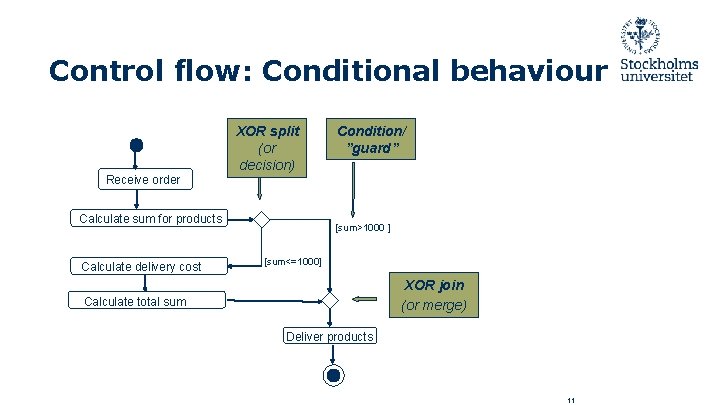
Control flow: Conditional behaviour XOR split (or decision) Condition/ ”guard” Receive order Calculate sum for products Calculate delivery cost [sum>1000 ] [sum<=1000] XOR join (or merge) Calculate total sum Deliver products 11
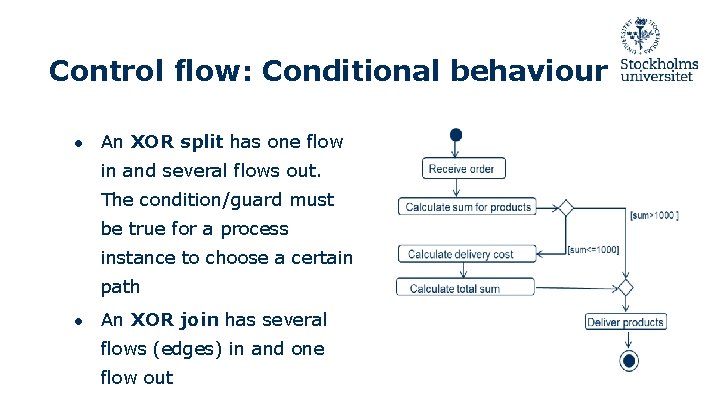
Control flow: Conditional behaviour ● An XOR split has one flow in and several flows out. The condition/guard must be true for a process instance to choose a certain path ● An XOR join has several flows (edges) in and one flow out
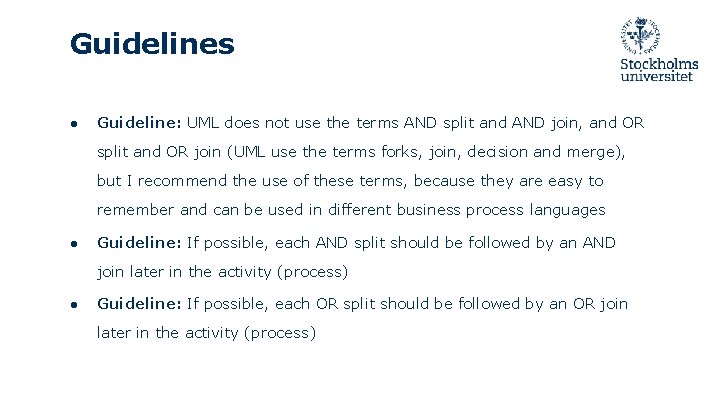
Guidelines ● Guideline: UML does not use the terms AND split and AND join, and OR split and OR join (UML use the terms forks, join, decision and merge), but I recommend the use of these terms, because they are easy to remember and can be used in different business process languages ● Guideline: If possible, each AND split should be followed by an AND join later in the activity (process) ● Guideline: If possible, each OR split should be followed by an OR join later in the activity (process)
More Guidelines ● Guidelines: Start an activity with one initial node (although UML Activity Diagram does not forbid to have several initial nodels in an activity) – since it a common requirement for business processes models to have one start node ● Guideline: Several activity final nodes can be used
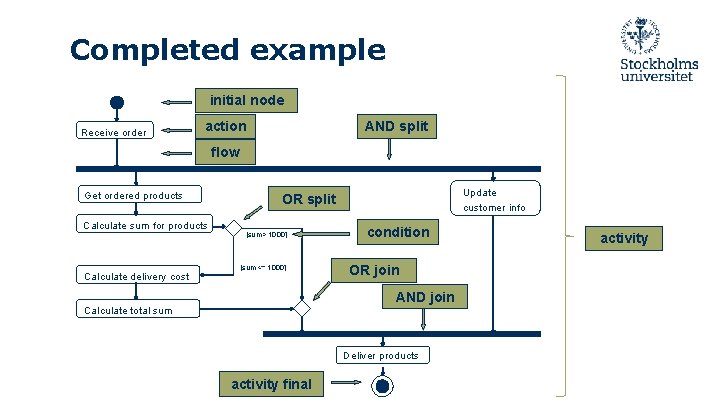
Completed example initial node Receive order AND split action flow Get ordered products Calculate sum for products Calculate delivery cost Update customer info OR split [sum> 1000] [sum<= 1000] condition OR join AND join Calculate total sum Deliver products activity final activity
Question to answer ● How do you model business processes using a formal business process modelling language, in this case UML Activity Diagram?
Medverkande Erik Perjons – Lärare Jonas Collin – Mediepedagog Inspelat 2021 -10 -28 Institutionen för data- och systemvetenskap, DSV