Processes in Protoplanetary Disks Phil Armitage Colorado Processes


- Slides: 19
Processes in Protoplanetary Disks Phil Armitage Colorado
Processes in Protoplanetary Disks 1. 2. 3. 4. 5. 6. 7. 8. Disk structure Disk evolution Turbulence Episodic accretion Single particle evolution Ice lines and persistent radial structure Transient structures in disks Disk dispersal
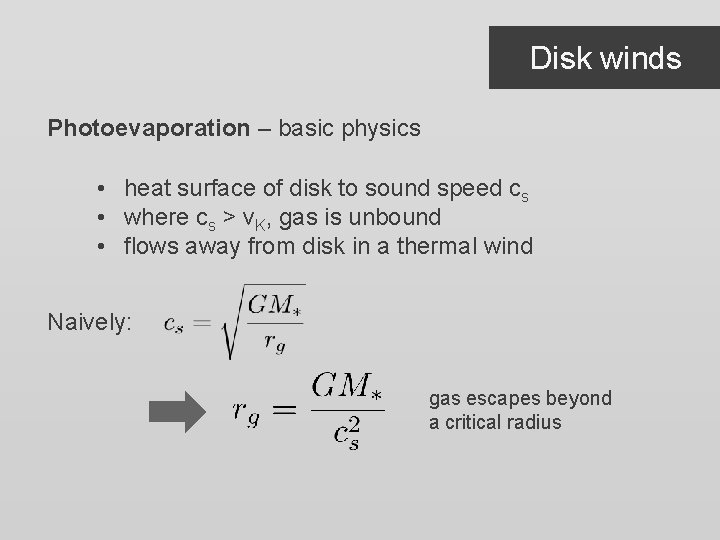
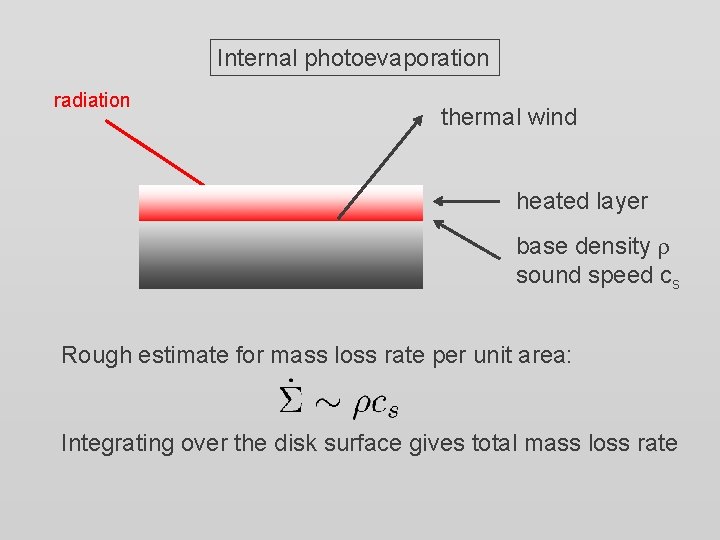
Disk winds Photoevaporation – basic physics • heat surface of disk to sound speed cs • where cs > v. K, gas is unbound • flows away from disk in a thermal wind Naively: gas escapes beyond a critical radius
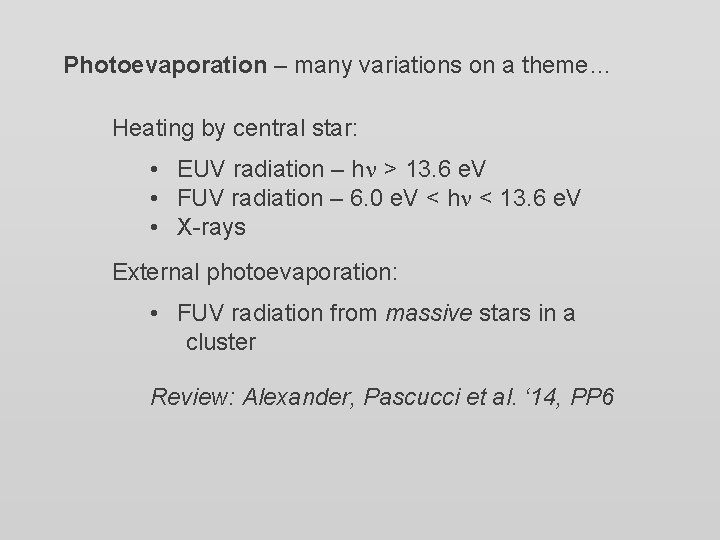
Photoevaporation – many variations on a theme… Heating by central star: • EUV radiation – hn > 13. 6 e. V • FUV radiation – 6. 0 e. V < hn < 13. 6 e. V • X-rays External photoevaporation: • FUV radiation from massive stars in a cluster Review: Alexander, Pascucci et al. ‘ 14, PP 6
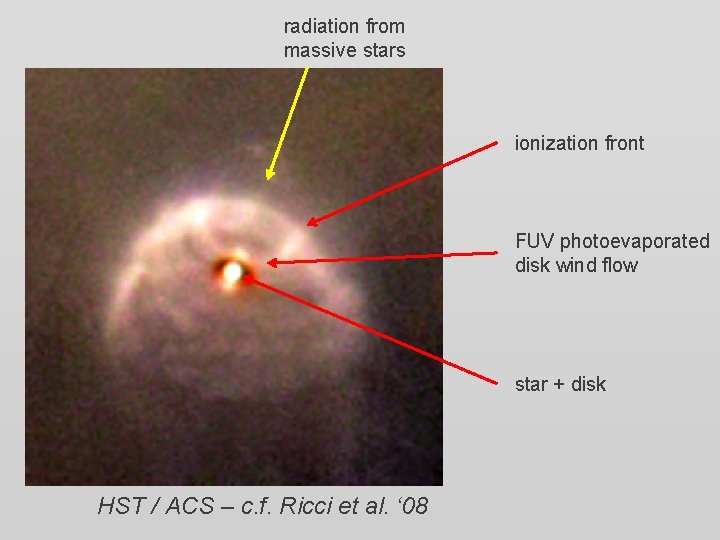
radiation from massive stars ionization front FUV photoevaporated disk wind flow star + disk HST / ACS – c. f. Ricci et al. ‘ 08
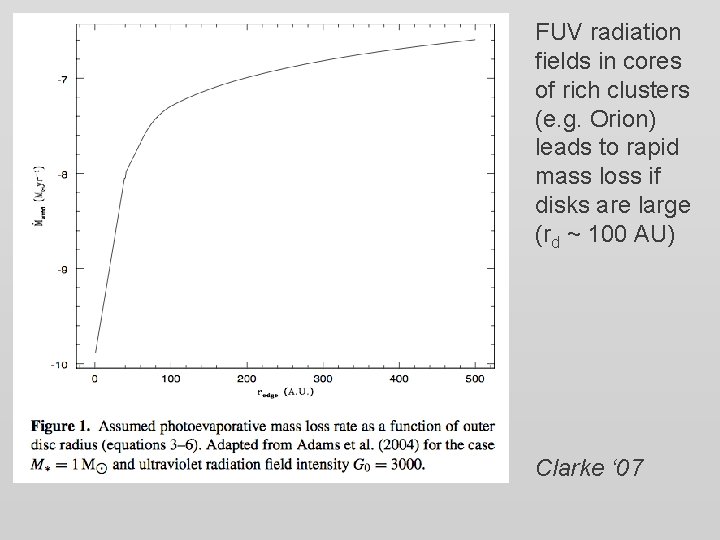
FUV radiation fields in cores of rich clusters (e. g. Orion) leads to rapid mass loss if disks are large (rd ~ 100 AU) Clarke ‘ 07
Internal photoevaporation radiation thermal wind heated layer base density r sound speed cs Rough estimate for mass loss rate per unit area: Integrating over the disk surface gives total mass loss rate
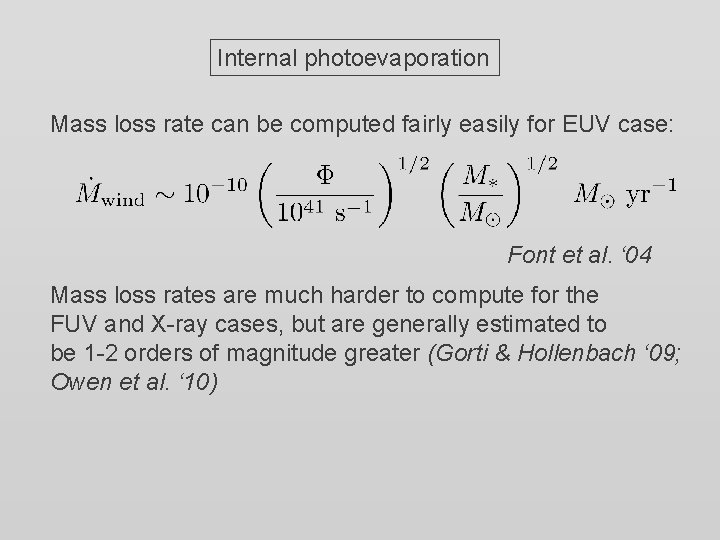
Internal photoevaporation Mass loss rate can be computed fairly easily for EUV case: Font et al. ‘ 04 Mass loss rates are much harder to compute for the FUV and X-ray cases, but are generally estimated to be 1 -2 orders of magnitude greater (Gorti & Hollenbach ‘ 09; Owen et al. ‘ 10)
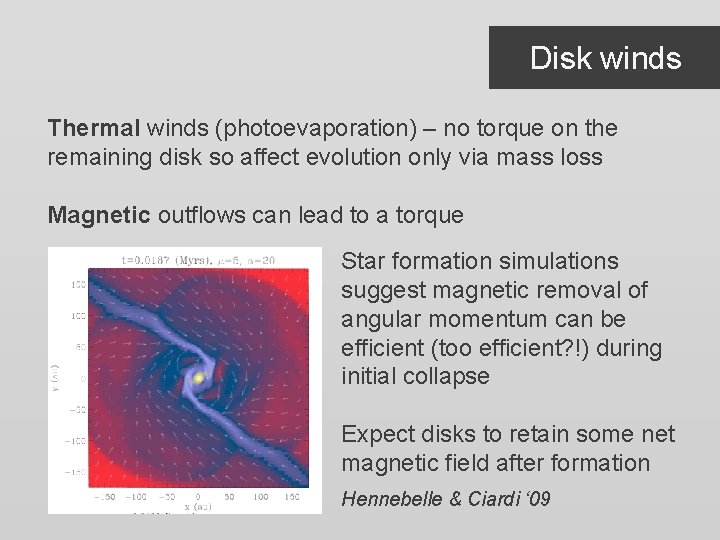
Disk winds Thermal winds (photoevaporation) – no torque on the remaining disk so affect evolution only via mass loss Magnetic outflows can lead to a torque Star formation simulations suggest magnetic removal of angular momentum can be efficient (too efficient? !) during initial collapse Expect disks to retain some net magnetic field after formation Hennebelle & Ciardi ‘ 09
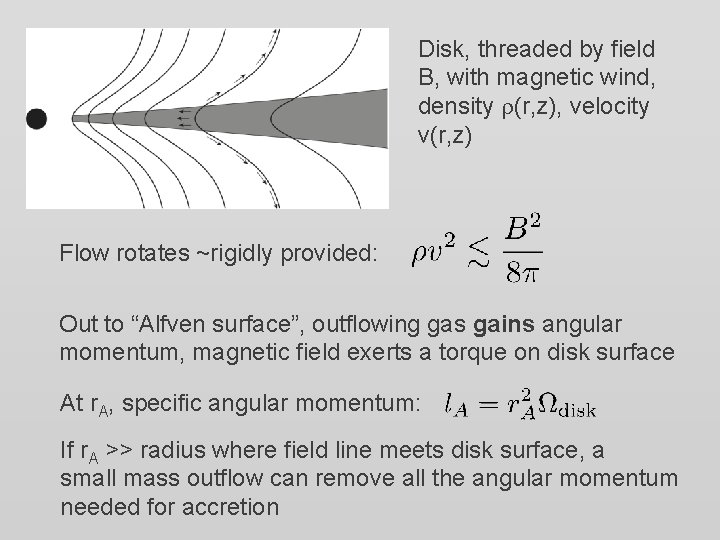
Disk, threaded by field B, with magnetic wind, density r(r, z), velocity v(r, z) Flow rotates ~rigidly provided: Out to “Alfven surface”, outflowing gas gains angular momentum, magnetic field exerts a torque on disk surface At r. A, specific angular momentum: If r. A >> radius where field line meets disk surface, a small mass outflow can remove all the angular momentum needed for accretion
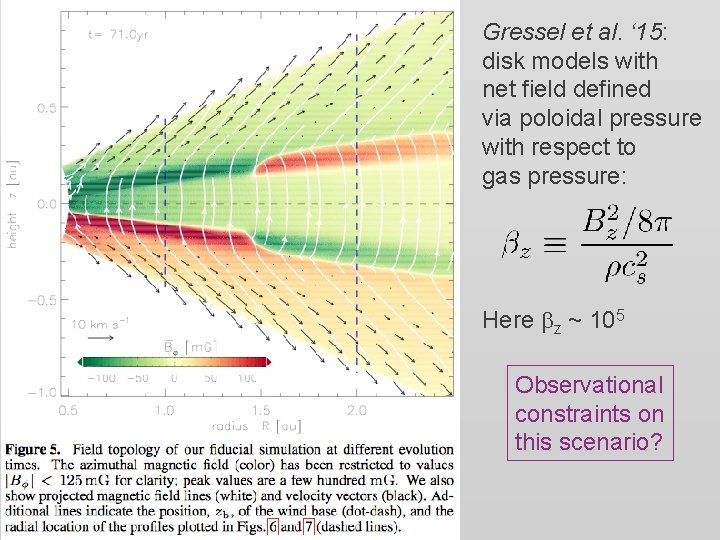
Gressel et al. ‘ 15: disk models with net field defined via poloidal pressure with respect to gas pressure: Here bz ~ 105 Observational constraints on this scenario?
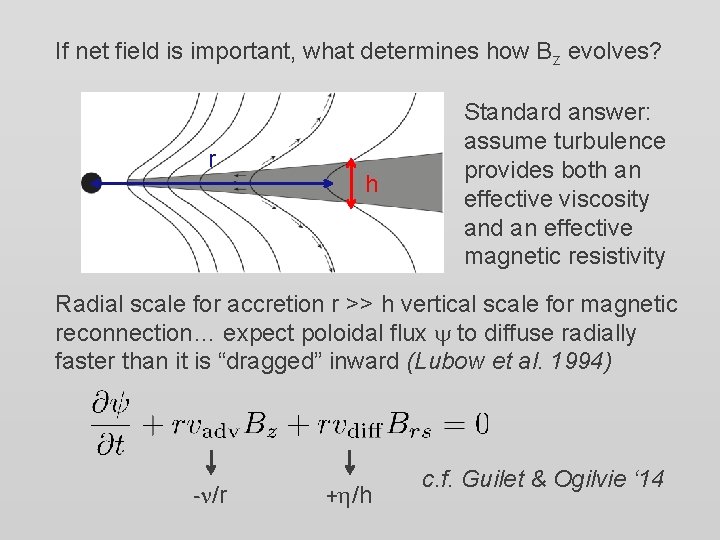
If net field is important, what determines how Bz evolves? r h Standard answer: assume turbulence provides both an effective viscosity and an effective magnetic resistivity Radial scale for accretion r >> h vertical scale for magnetic reconnection… expect poloidal flux y to diffuse radially faster than it is “dragged” inward (Lubow et al. 1994) -n/r +h/h c. f. Guilet & Ogilvie ‘ 14
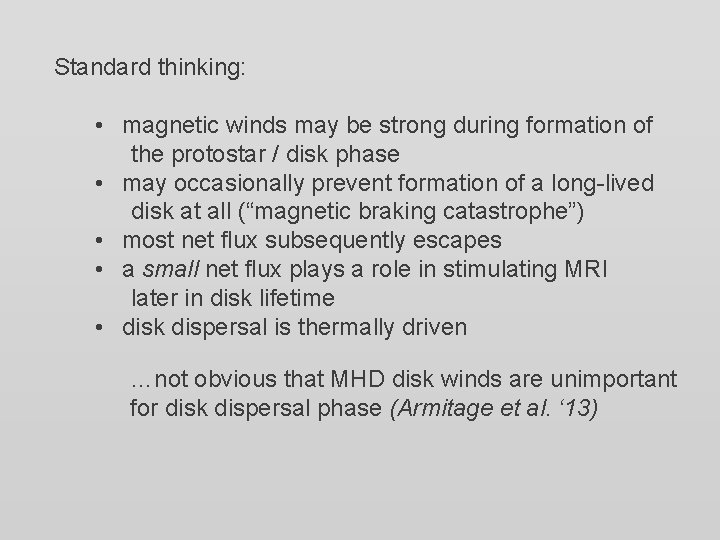
Standard thinking: • magnetic winds may be strong during formation of the protostar / disk phase • may occasionally prevent formation of a long-lived disk at all (“magnetic braking catastrophe”) • most net flux subsequently escapes • a small net flux plays a role in stimulating MRI later in disk lifetime • disk dispersal is thermally driven …not obvious that MHD disk winds are unimportant for disk dispersal phase (Armitage et al. ‘ 13)
Testing theory Pringle, ARA&A, 1981
Observational tests Even known theory of disk instabilities is complex enough that an entirely theoretical understanding of what’s going on in real disks is not feasible Observational tests come in two classes: • some mechanisms predict large-scale disk structure (e. g. rings, vortices), that may be directly observable • attempts to measure or constrain the small-scale turbulent velocity or magnetic field
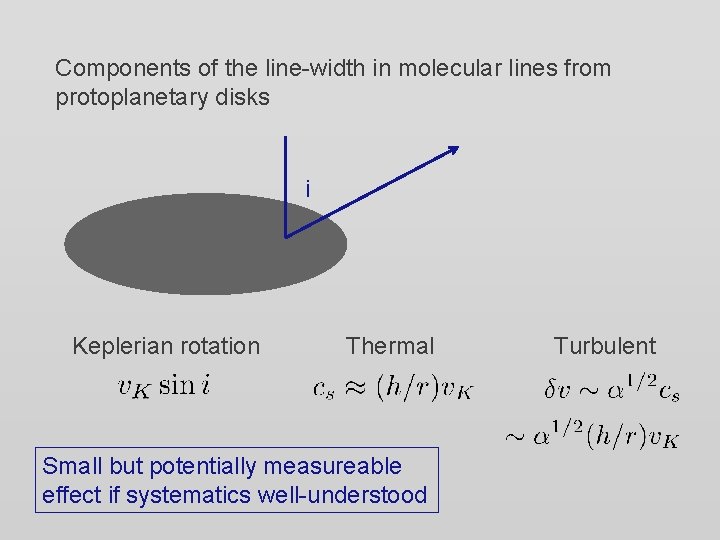
Components of the line-width in molecular lines from protoplanetary disks i Keplerian rotation Thermal Small but potentially measureable effect if systematics well-understood Turbulent
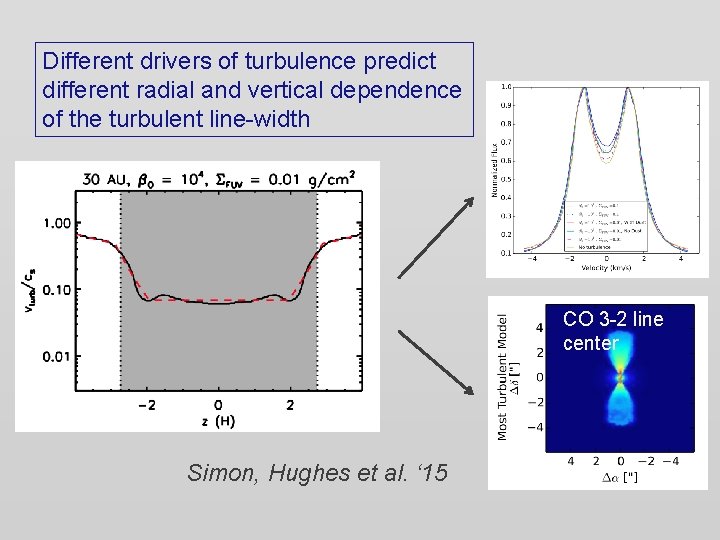
Different drivers of turbulence predict different radial and vertical dependence of the turbulent line-width CO 3 -2 line center Simon, Hughes et al. ‘ 15
“Boring” disks are interesting! There must be a time prior to which planets have not formed • is this time much earlier than conventionally assumed (i. e. still in the Class I phase)? suggested for HL Tau rings… this is not a conservative interpretation! If we can observe disks prior to planet formation • how quiescent are they? • are there large-scale structures that might be essential ingredients for planet formation? • how turbulent, how much grain growth, etc?