
Processes in Memory Three step process 1 Encoding


- Slides: 15
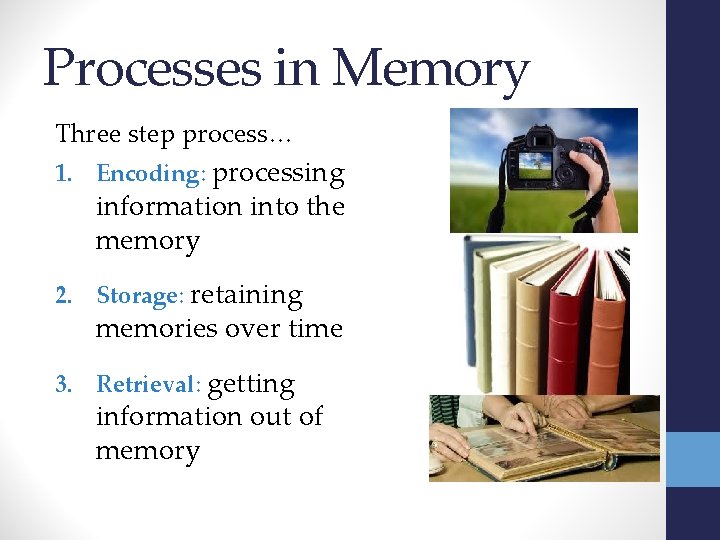
Processes in Memory Three step process… 1. Encoding: processing information into the memory 2. Storage: retaining memories over time 3. Retrieval: getting information out of memory
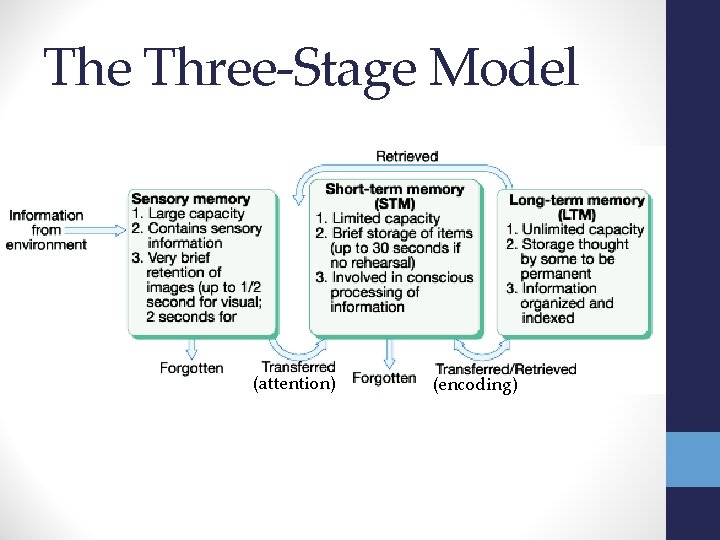
Storage • Memories can be stored for differing amounts of time depending on how they are encoded • The Atkinson-Shiffrin theory (three-stage model) of storage includes 3 separate memory store 1. sensory memory - up to several seconds 2. short-term memory - up to 30 seconds 3. long-term memory - up to a lifetime
The Three-Stage Model (attention) (encoding)
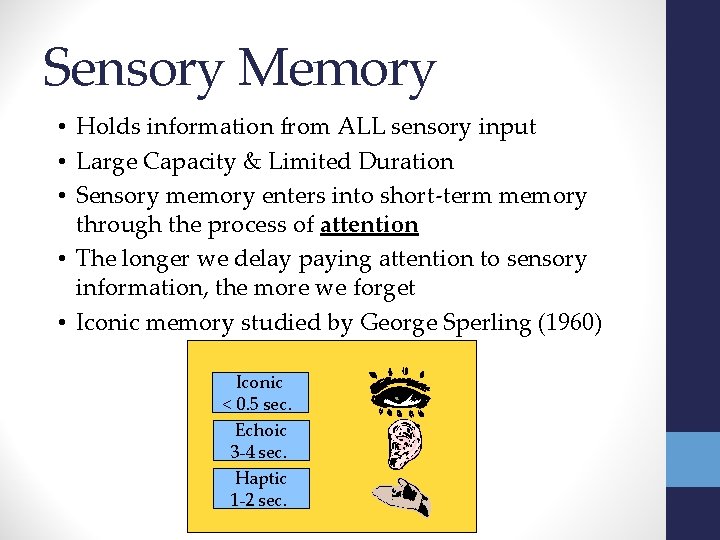
Sensory Memory • Holds information from ALL sensory input • Large Capacity & Limited Duration • Sensory memory enters into short-term memory through the process of attention • The longer we delay paying attention to sensory information, the more we forget • Iconic memory studied by George Sperling (1960) Iconic < 0. 5 sec. Echoic 3 -4 sec. Haptic 1 -2 sec.
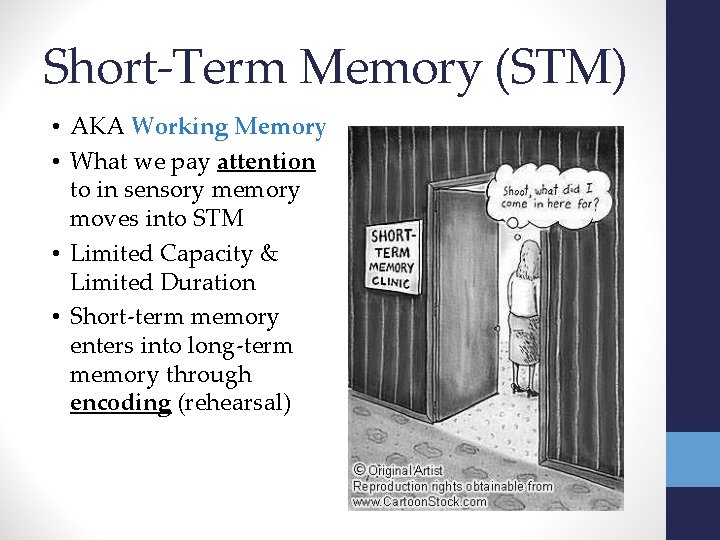
Short-Term Memory (STM) • AKA Working Memory • What we pay attention to in sensory memory moves into STM • Limited Capacity & Limited Duration • Short-term memory enters into long-term memory through encoding (rehearsal)
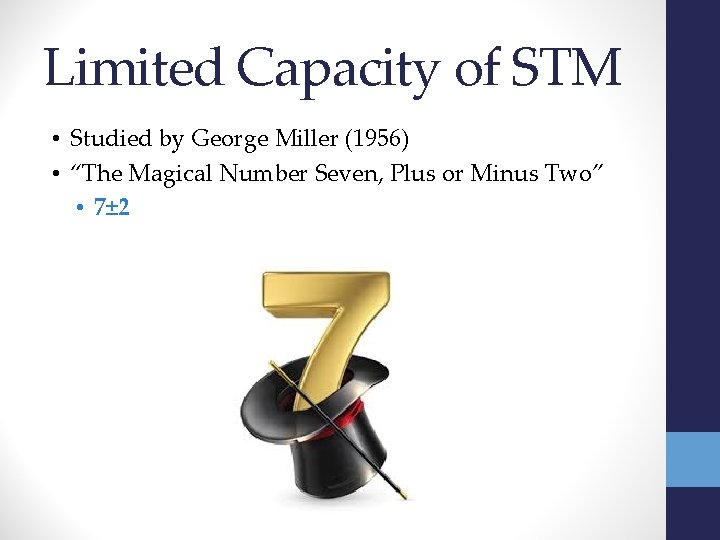
Limited Capacity of STM • Studied by George Miller (1956) • “The Magical Number Seven, Plus or Minus Two” • 7± 2
Increasing Capacity of STM • Chunking: grouping items together into familiar or easily manageable units • We remember numbers better than letters • Clustering: organizing information into categories
Limited Duration of STM • Studied by John Brown (1958)/Margaret Peterson & Lloyd Peterson (1959) • Made participants work on a counting task immediately after hearing meaningless threeconsonant syllables read to them • Duration of short-term memory is less than 30 seconds WITHOUT REHEARSAL
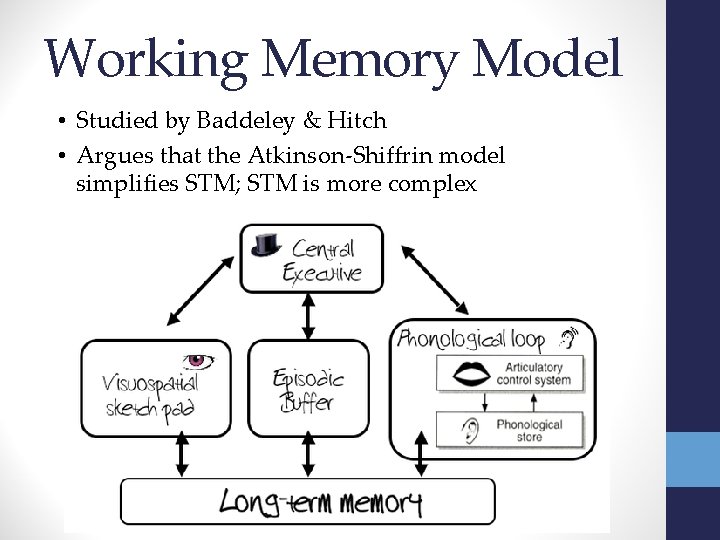
Working Memory Model • Studied by Baddeley & Hitch • Argues that the Atkinson-Shiffrin model simplifies STM; STM is more complex
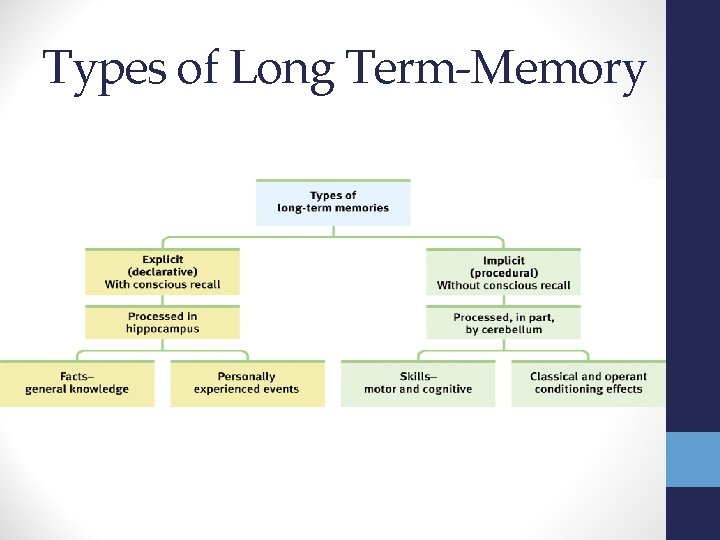
Long Term-Memory (LTM) • What we rehearse in STM gets encoded into LTM • Unlimited Capacity & possibly Unlimited Duration • Automatically processed information bypasses sensory memory & STM stores • Contains multiple types of memories: • Explicit Memory: facts and experiences; learned consciously • AKA Declarative Memory • Types: Semantic & Episodic Memories • Implicit Memory: skills & conditioning; learned unconsciously • AKA Non-declarative Memory • Types: Procedural & Conditioned Memories
Types of Long Term-Memory
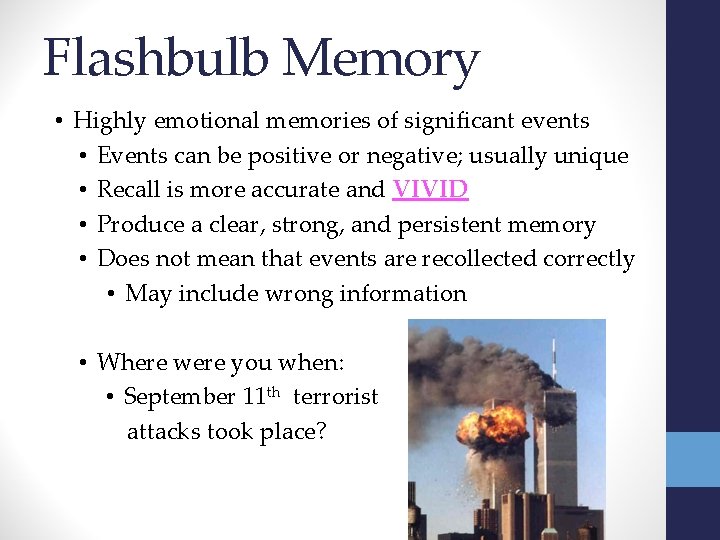
Flashbulb Memory • Highly emotional memories of significant events • Events can be positive or negative; usually unique • Recall is more accurate and VIVID • Produce a clear, strong, and persistent memory • Does not mean that events are recollected correctly • May include wrong information • Where were you when: • September 11 th terrorist attacks took place?
How Memory is Organized • Schemas: A pre-existing mental framework that helps people to organize and interpret information • Prior encounters with the environment influence the way that we encode, make inferences about, and retrieve information • Scripts: A schema for an event • Very specific schema for a particular order of expected events in a particular context
Long-term Potentiation • How a memory is physically created in the brain • At the neural level (neuron) • Research has shown that new dendrites form and create connections to other neurons when new information comes into the brain • As these neurons learn to fire together, they get better at it and the connection between them strengthens • Making the memory stronger • This creates an “express lane” for information
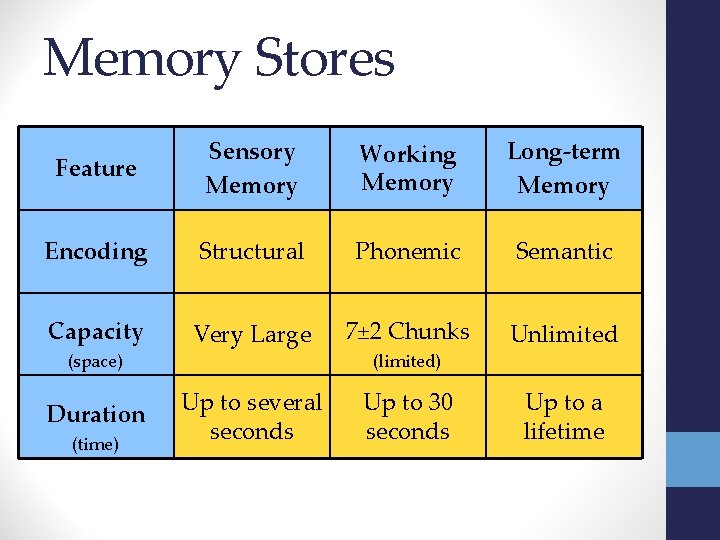
Memory Stores Feature Sensory Memory Working Memory Long-term Memory Encoding Structural Phonemic Semantic Capacity Very Large 7± 2 Chunks Unlimited Up to several seconds Up to 30 seconds (space) Duration (time) (limited) Up to a lifetime