
PROCESSES HISTORICAL CAUSES OF DIFFUSION BIG IDEAS Patterns
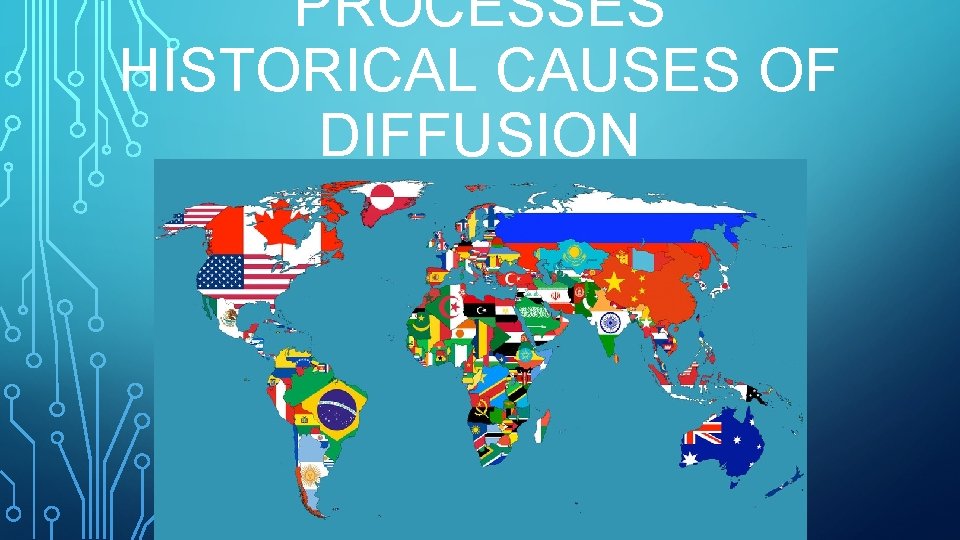
PROCESSES HISTORICAL CAUSES OF DIFFUSION
BIG IDEAS • Patterns and Spatial Organization (PSO) • How does where people live and what resources they have access to impact their cultural practices • Impacts and Interactions (IMP) • How does the interaction of people contribute to the spread of cultural practices? • Spatial Patterns and Societal Changes (SPS) • How and why do cultural ideas, practices, and innovations change or disappear over time?
ENDURING UNDERSTANDING: SPS-3 • Cultural ideas, practices, and innovations change or disappear over time • Learning Objective: SPS-3. A • Explain how historical processes impact current cultural patterns
ESSENTIAL KNOWLEDGE SPS-3. A. 1 • Interactions between and among cultural traits and larger global forces can lead to new forms of cultural expression; for example, creolization and lingua • As people franca from around world the interact and come together they have to find a way to communicate • When colonizers attempt to colonize new areas language communication can be a problem • The ability to communicate between two groups of people is crucial • Creolization • A language that results from the mixing of a colonizer's language with the indigenous language of the people being dominated • Example: French Creole in Haiti--Very different than the French spoken in France • Application: Creoles show the diffusion of one language into another, which gives insight as to the history of that country. • Creole language are languages that are a blend of the two languages into one that people speak • Needs to become a first language of a group of people to be classified as a creole
• Lingua Franca • This is a language spoken between speakers of two different languages for the purpos of commerce or trade • Historically, Arabic became lingua franca during the expansion of Islam • English became the lingua franca during colonial America • Still dominates today as the language of business • Modern day lingua franca in East Africa is Swahili
ESSENTIAL KNOWLEDGE SPS-3. A. 2 • Colonialism, imperialism, and trade helped to shape patterns and practices of culture • Colonialism – the establishment, exploitation, acquisition, and expansion of colonies in one territory by people from another territory or country • Imperialism – the forceful extension of a nation’s authority by territorial conquest or by establishing economic or political domination of other nations • Differences between the two – is a small but very important detail • Colonialism if you go into new land take control, but don’t rule the people – you move them or kill them; imperialism is going into a new land controlling the people as well as the land. • Colonialism and Imperialism can have huge negative affects on the region that is conquered. • Imperialism can result in the loss of culture and creation of conflict as space is divided without concern of the traditional ethnic boundaries
• With the imperialism of Africa this has led to ethnic conflict lasting to this day still • Colonialism has a long term lasting impact on the remaining culture even after the colonizers have left - Neocolonialism • One of the largest ways ideas and goods have moved across space is by trade • Through trade people are brought into contact with new cultures and traditions that can have an impact
- Slides: 7