
Processes 1102022 OS Processes 1 Objectives n n
Processes 1/10/2022 OS: Processes 1
Objectives n n To introduce the notion of a process – a program in execution To describe the various features of processes n n n 1/10/2022 Scheduling Creation Termination Communication Etc. To describe communication in client-server systems. OS: Processes 2
Outline n Process Concept … n Process Scheduling … n Operations on Processes … n Cooperating Processes … n Interprocess Communication … n Communication in Client-Server Systems … n Summary … 1/10/2022 OS: Processes 3
- Process Concept n Basic Concepts … n Process State … n Process Control Block (PCB) … 1/10/2022 OS: Processes 4
-- Basic Concept n An operating system executes a variety of programs: n n n Process – a program in execution; process execution must progress in sequential fashion. A process includes: n n Code stack data section Processes can be described as either: n n 1/10/2022 Batch system – jobs Time-shared systems – user programs or tasks I/O-bound process – spends more time doing I/O than computations, many short CPU bursts. CPU-bound process – spends more time doing computations; few very long CPU bursts. OS: Processes 5
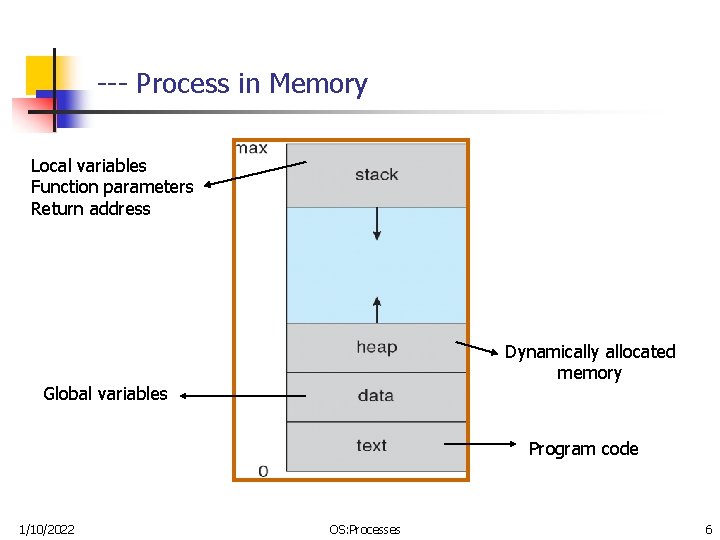
--- Process in Memory Local variables Function parameters Return address Dynamically allocated memory Global variables Program code 1/10/2022 OS: Processes 6
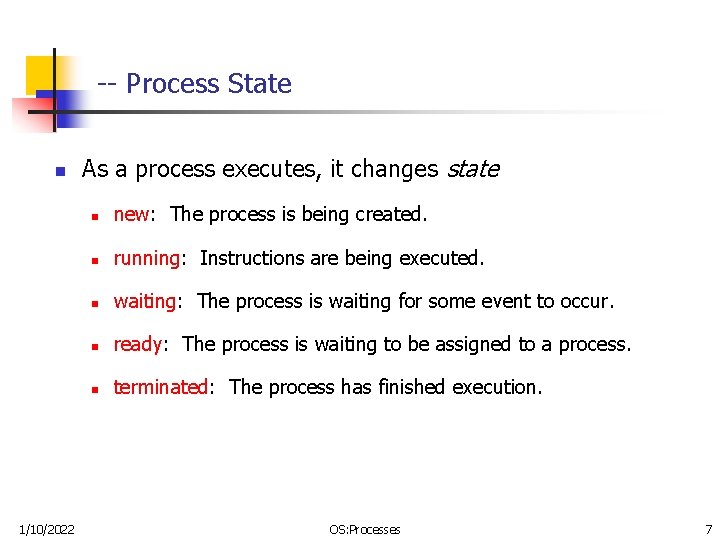
-- Process State n 1/10/2022 As a process executes, it changes state n new: The process is being created. n running: Instructions are being executed. n waiting: The process is waiting for some event to occur. n ready: The process is waiting to be assigned to a process. n terminated: The process has finished execution. OS: Processes 7
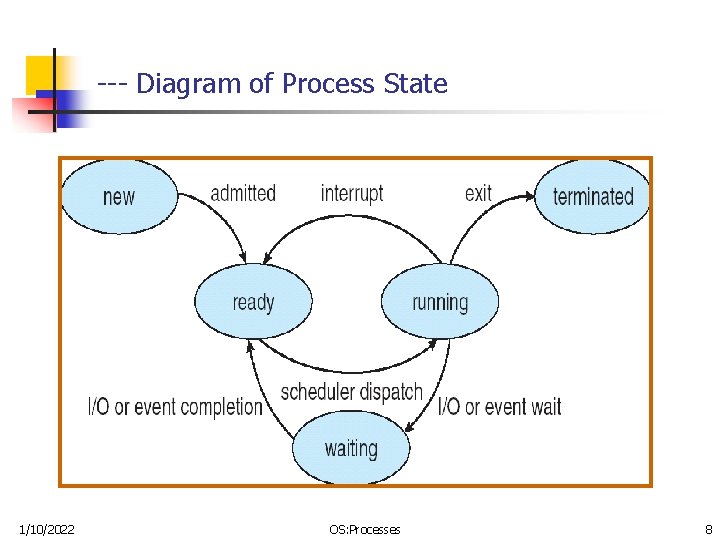
--- Diagram of Process State 1/10/2022 OS: Processes 8
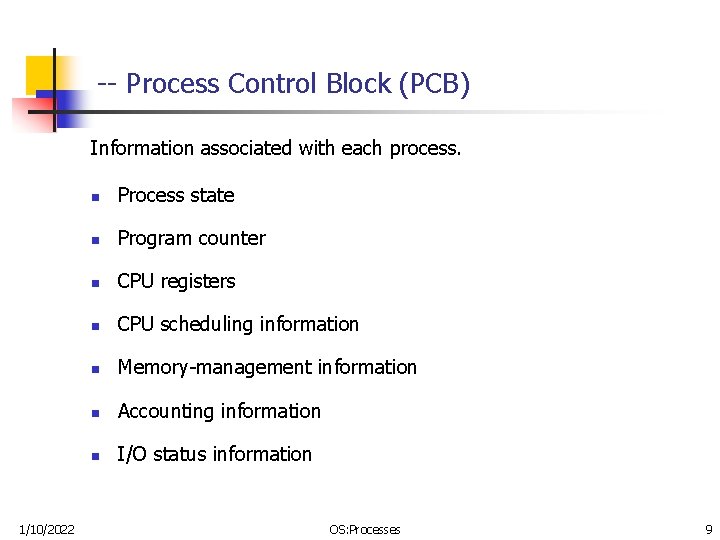
-- Process Control Block (PCB) Information associated with each process. 1/10/2022 n Process state n Program counter n CPU registers n CPU scheduling information n Memory-management information n Accounting information n I/O status information OS: Processes 9
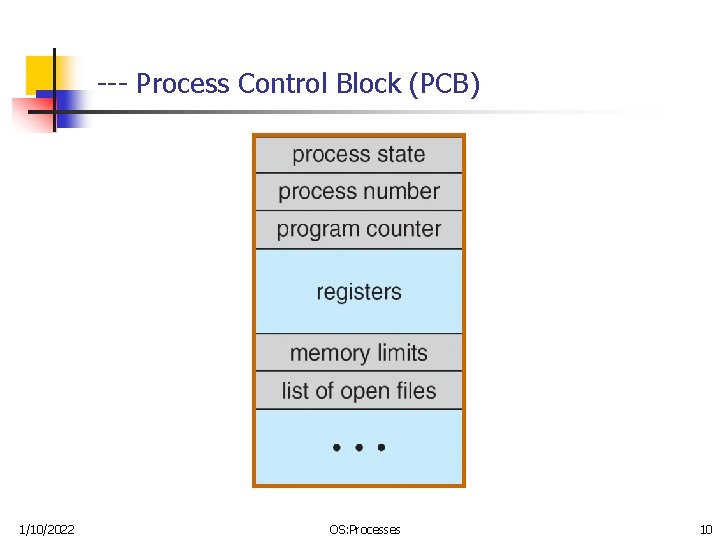
--- Process Control Block (PCB) 1/10/2022 OS: Processes 10
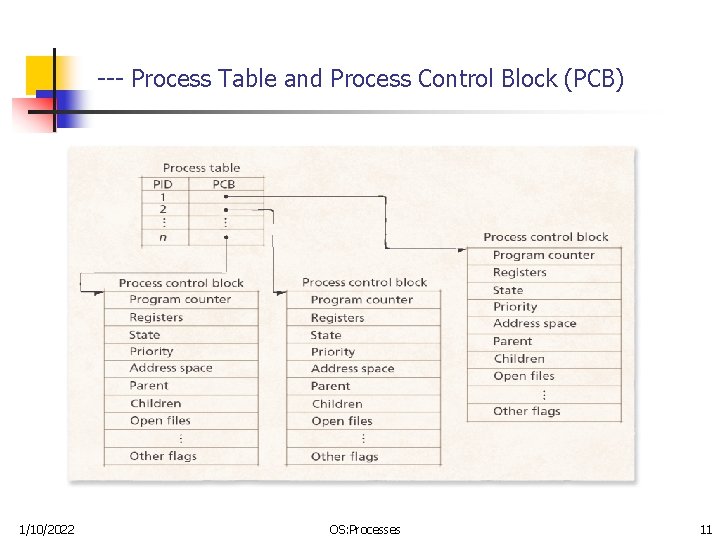
--- Process Table and Process Control Block (PCB) 1/10/2022 OS: Processes 11
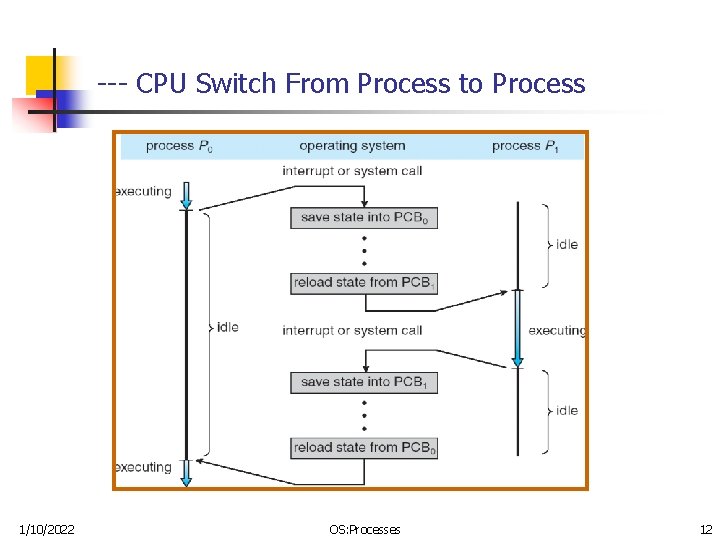
--- CPU Switch From Process to Process 1/10/2022 OS: Processes 12
- Process Scheduling n 1/10/2022 In multi-programming environment processes compete to get resources. Because the number of resources are limited, the OS efficiently schedules processes before it assigns them a resource. In this section we will cover: n Scheduling Queues … n Schedulers … n Context Switching … OS: Processes 13
-- Scheduling Queues n n Job queue – set of all processes in the system. Ready queue – set of all processes residing in main memory, ready and waiting to execute. n Device queues – set of processes waiting for an I/O device. n Process migration between the various queues. 1/10/2022 OS: Processes 14
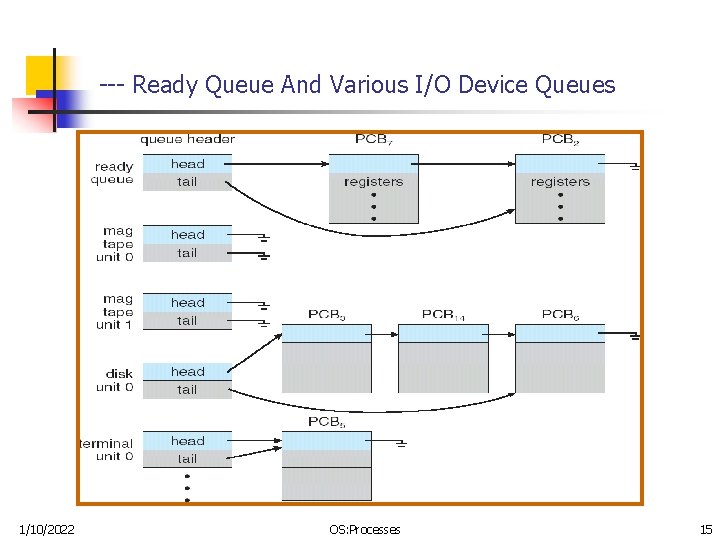
--- Ready Queue And Various I/O Device Queues 1/10/2022 OS: Processes 15
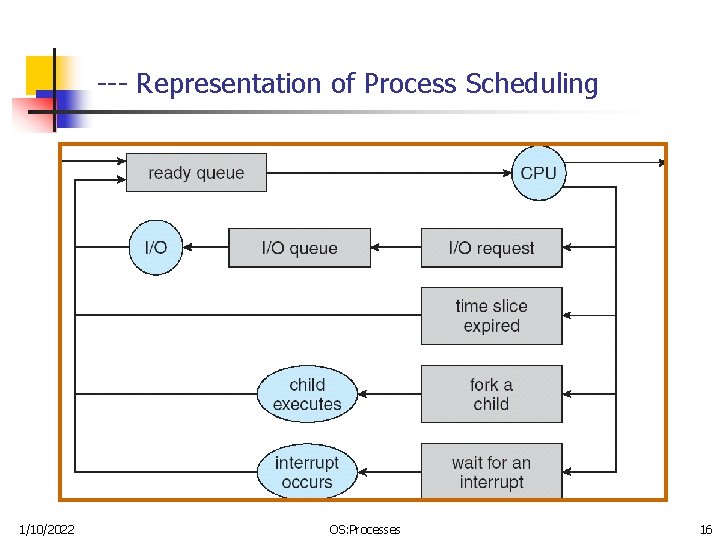
--- Representation of Process Scheduling 1/10/2022 OS: Processes 16
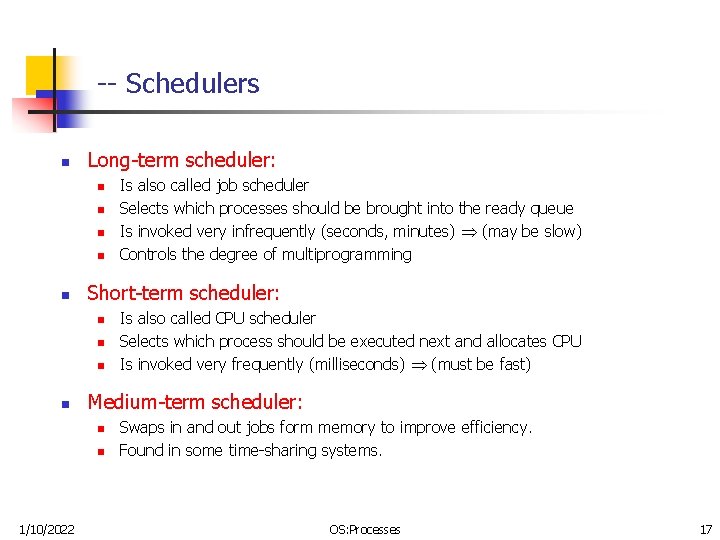
-- Schedulers n Long-term scheduler: n n n Short-term scheduler: n n Is also called CPU scheduler Selects which process should be executed next and allocates CPU Is invoked very frequently (milliseconds) (must be fast) Medium-term scheduler: n n 1/10/2022 Is also called job scheduler Selects which processes should be brought into the ready queue Is invoked very infrequently (seconds, minutes) (may be slow) Controls the degree of multiprogramming Swaps in and out jobs form memory to improve efficiency. Found in some time-sharing systems. OS: Processes 17
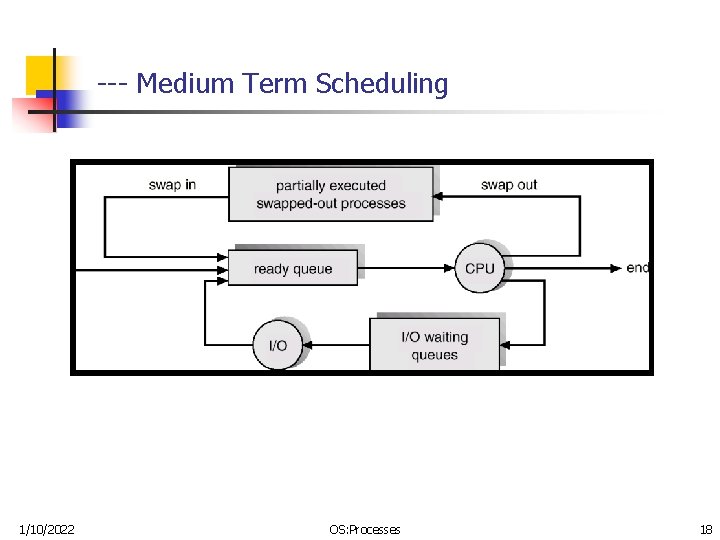
--- Medium Term Scheduling 1/10/2022 OS: Processes 18
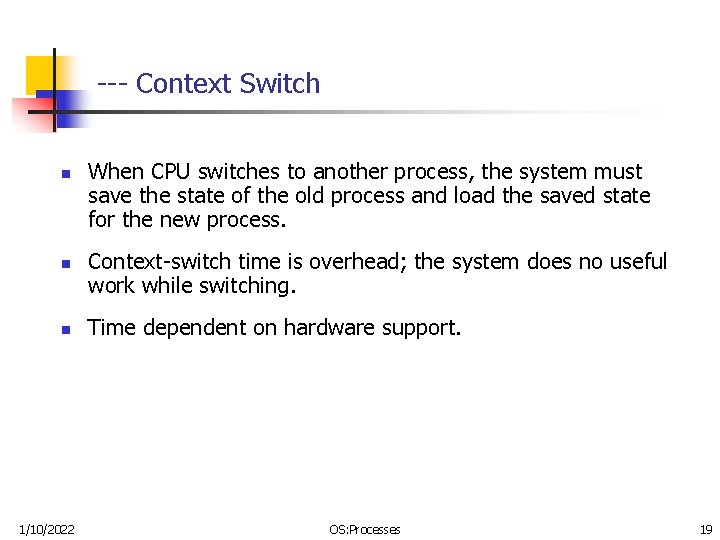
--- Context Switch n n n 1/10/2022 When CPU switches to another process, the system must save the state of the old process and load the saved state for the new process. Context-switch time is overhead; the system does no useful work while switching. Time dependent on hardware support. OS: Processes 19
- Operations on Processes n Process Creation … n Process Termination … 1/10/2022 OS: Processes 20
-- Process Creation … n n n 1/10/2022 Parent process create children processes, which, in turn create other processes, forming a tree of processes. Resource sharing n Parent and children share all resources. n Children share subset of parent’s resources. n Parent and child share no resources. Execution n Parent and children execute concurrently. n Parent waits until children terminate. OS: Processes 21
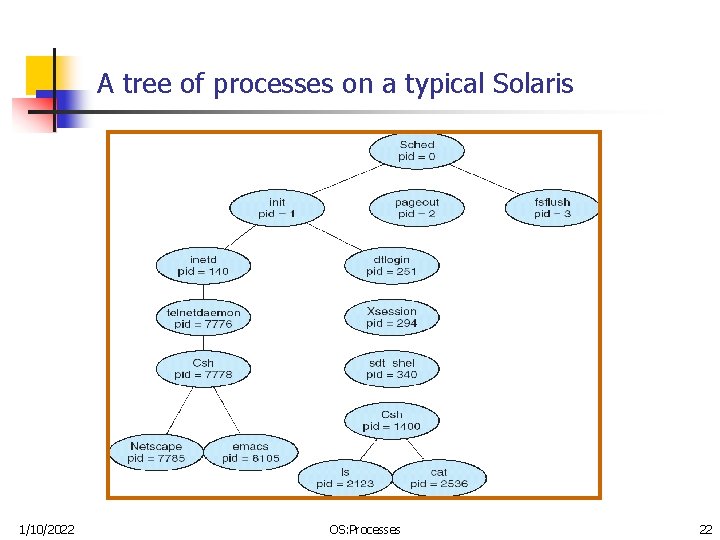
A tree of processes on a typical Solaris 1/10/2022 OS: Processes 22
… -- Process Creation n Address space n n n UNIX examples n n 1/10/2022 Child duplicate of parent. Child has a program loaded into it. fork system call creates new process exec system call used after a fork to replace the process’ memory space with a new program. OS: Processes 23
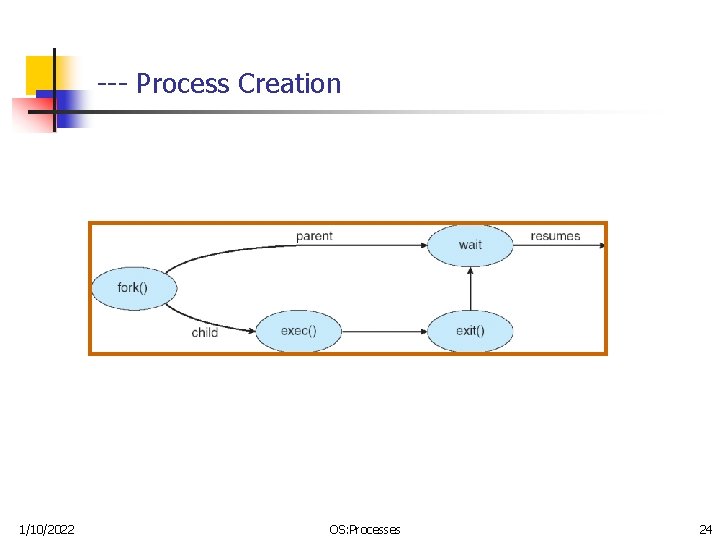
--- Process Creation 1/10/2022 OS: Processes 24
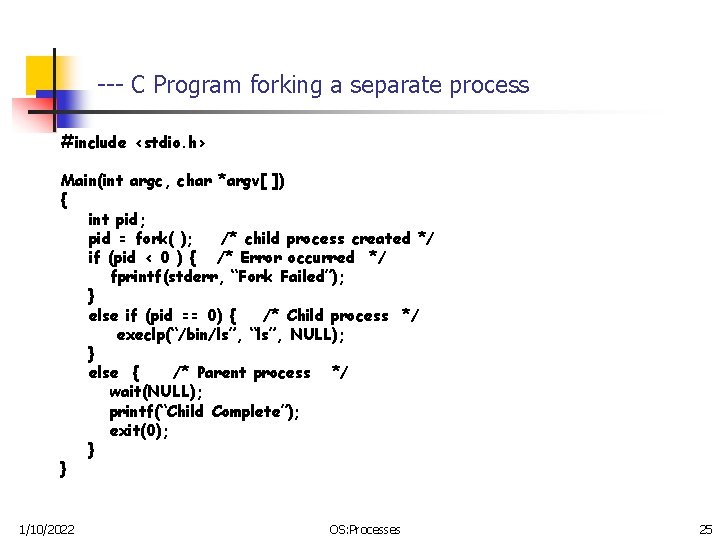
--- C Program forking a separate process #include <stdio. h> Main(int argc, char *argv[ ]) { int pid; pid = fork( ); /* child process created */ if (pid < 0 ) { /* Error occurred */ fprintf(stderr, “Fork Failed”); } else if (pid == 0) { /* Child process */ execlp(“/bin/ls”, “ls”, NULL); } else { /* Parent process */ wait(NULL); printf(“Child Complete”); exit(0); } } 1/10/2022 OS: Processes 25
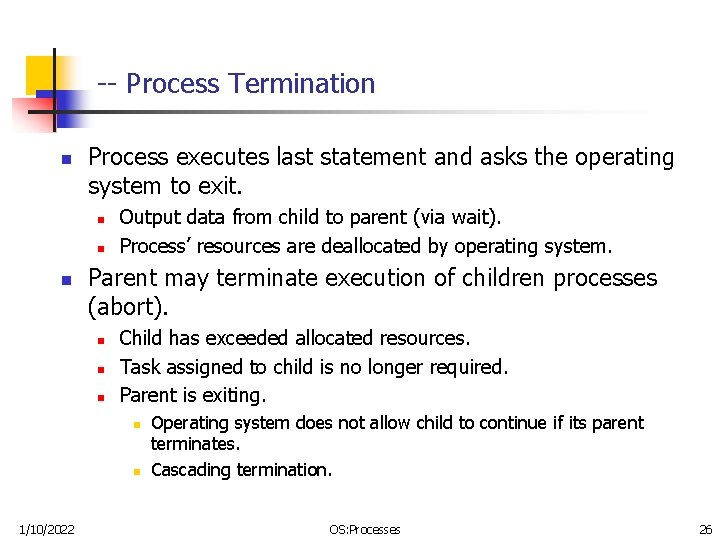
-- Process Termination n Process executes last statement and asks the operating system to exit. n n n Output data from child to parent (via wait). Process’ resources are deallocated by operating system. Parent may terminate execution of children processes (abort). n n n Child has exceeded allocated resources. Task assigned to child is no longer required. Parent is exiting. n n 1/10/2022 Operating system does not allow child to continue if its parent terminates. Cascading termination. OS: Processes 26
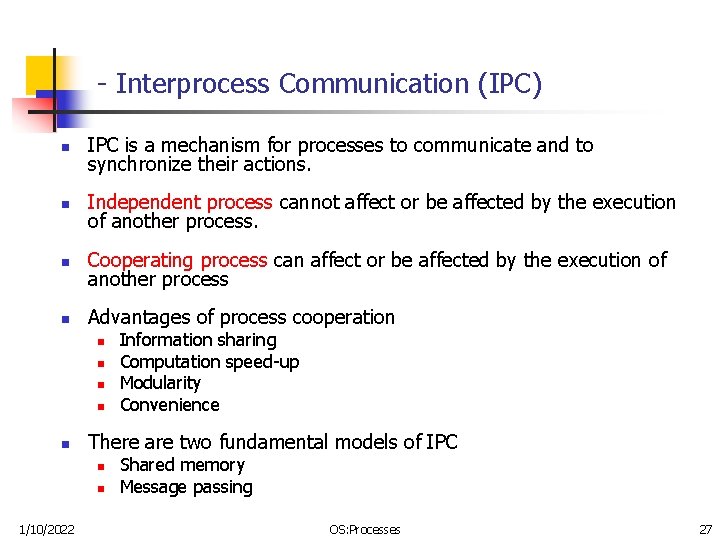
- Interprocess Communication (IPC) n IPC is a mechanism for processes to communicate and to synchronize their actions. n Independent process cannot affect or be affected by the execution of another process. n Cooperating process can affect or be affected by the execution of another process n Advantages of process cooperation n n There are two fundamental models of IPC n n 1/10/2022 Information sharing Computation speed-up Modularity Convenience Shared memory Message passing OS: Processes 27
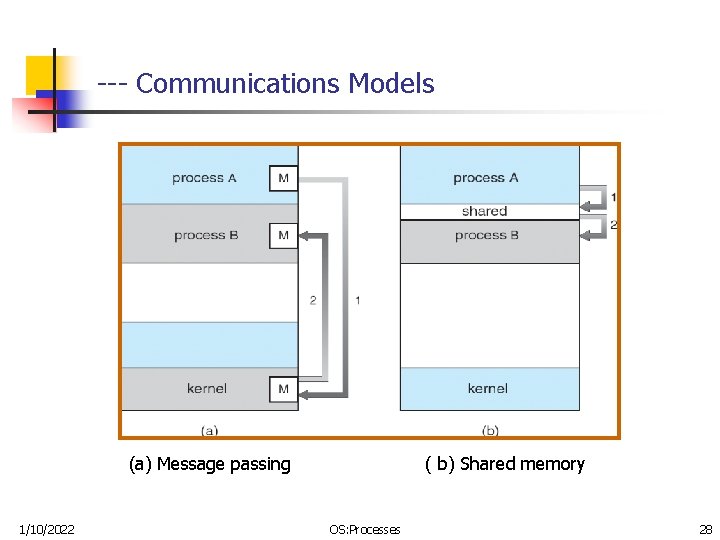
--- Communications Models (a) Message passing 1/10/2022 ( b) Shared memory OS: Processes 28
-- Shared Memory n Communicating processes establish a shared memory n Faster than message passing – memory speed n n 1/10/2022 Not easy to implement when processes are in separate computers connected by a network. Accessing and manipulating the shared memory be written explicitly by the application programmer OS: Processes 29
--- Example of Producer-Consumer Process … n Paradigm for cooperating processes, producer process produces information that is consumed by a consumer process. n n 1/10/2022 unbounded-buffer places no practical limit on the size of the buffer. bounded-buffer assumes that there is a fixed buffer size. OS: Processes 30
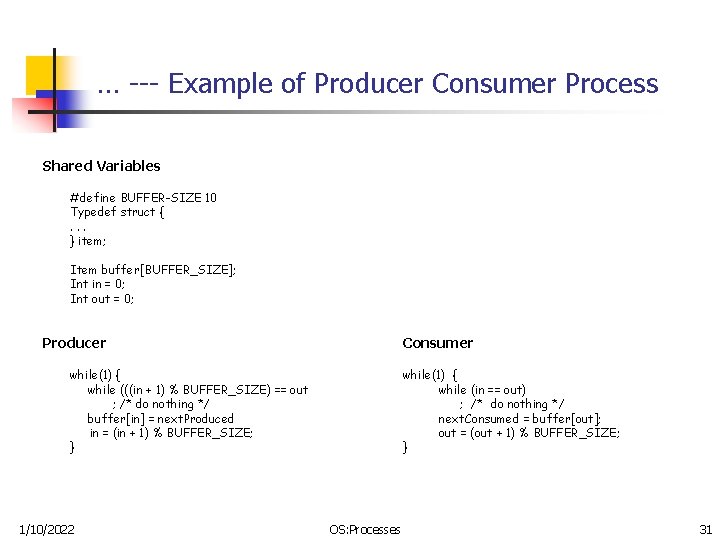
… --- Example of Producer Consumer Process Shared Variables #define BUFFER-SIZE 10 Typedef struct {. . . } item; Item buffer[BUFFER_SIZE]; Int in = 0; Int out = 0; Producer Consumer while(1) { while (((in + 1) % BUFFER_SIZE) == out ; /* do nothing */ buffer[in] = next. Produced in = (in + 1) % BUFFER_SIZE; } 1/10/2022 while(1) { while (in == out) ; /* do nothing */ next. Consumed = buffer[out]; out = (out + 1) % BUFFER_SIZE; } OS: Processes 31
-- Message passing n Basic Concepts … n Direct Communication … n Indirect communication … n Synchronization … n Buffering … 1/10/2022 OS: Processes 32
-- Basic Concepts n n Message-passing system – processes communicate with each other without resorting to shared variables. IPC facility provides two operations: n n n send(message) – message size fixed or variable receive(message) If P and Q wish to communicate, they need to: n establish a communication link between them n n n 1/10/2022 physical (e. g. , shared memory, hardware bus) logical (e. g. , logical properties like direct or indirect; symmetric or asymmetric) exchange messages via send/receive OS: Processes 33
--- Direct Communication n Processes must name each other explicitly: n Symmetry n n n Asymmetry n n n send (P, message) – send a message to process P receive(id, message) – receive message from any process. Properties of communication link n n 1/10/2022 send (P, message) – send a message to process P receive(Q, message) – receive a message from process Q Links are established automatically. A link is associated with exactly one pair of communicating processes. Between each pair there exists exactly one link. The link may be unidirectional, but is usually bi-directional. OS: Processes 34
--- Indirect Communication … n Messages are directed and received from mailboxes (also referred to as ports). n n n Properties of communication link n n 1/10/2022 Each mailbox has a unique id. Processes can communicate only if they share a mailbox. Link established only if processes share a common mailbox A link may be associated with many processes. Each pair of processes may share several communication links. Link may be unidirectional or bi-directional. OS: Processes 35
… --- Indirect Communication … n Operations n n Primitives are defined as: n n 1/10/2022 create a new mailbox send and receive messages through mailbox destroy a mailbox send(A, message) – send a message to mailbox A receive(A, message) – receive a message from mailbox A OS: Processes 36
… --- Indirect Communication n Mailbox sharing n P 1, P 2, and P 3 share mailbox A. P 1, sends; P 2 and P 3 receive. n Who gets the message? n n Solutions n n n 1/10/2022 Allow a link to be associated with at most two processes. Allow only one process at a time to execute a receive operation. Allow the system to select arbitrarily the receiver. Sender is notified who the receiver was. OS: Processes 37
--- Synchronization n Message passing is may be either blocking or nonblocking n Blocking: is considered synchronous n non-blocking: is considered asynchronous n n 1/10/2022 Blocking send has the sender block until the message is received Blocking receive has the receiver block until a message is available Non-blocking send has the sender send the message and continue Non-blocking receive has the receiver receive a valid message or null OS: Processes 38
-- Buffering n Queue of messages attached to the link; implemented in one of three ways. 1. Zero capacity – 0 messages Sender must wait for receiver (rendezvous). 2. Bounded capacity – finite length of n messages Sender must wait if link full. 3. Unbounded capacity – infinite length Sender never waits. 1/10/2022 OS: Processes 39
- Client-Server Communication n Sockets … n Remote Procedure Calls … n Remote Method Invocation (Java) … 1/10/2022 OS: Processes 40
-- Sockets n A socket is defined as an endpoint for communication. n Concatenation of IP address and port n n 1/10/2022 The socket 161. 25. 19. 8: 1625 refers to port 1625 on host 161. 25. 19. 8 Communication consists between a pair of sockets. OS: Processes 41
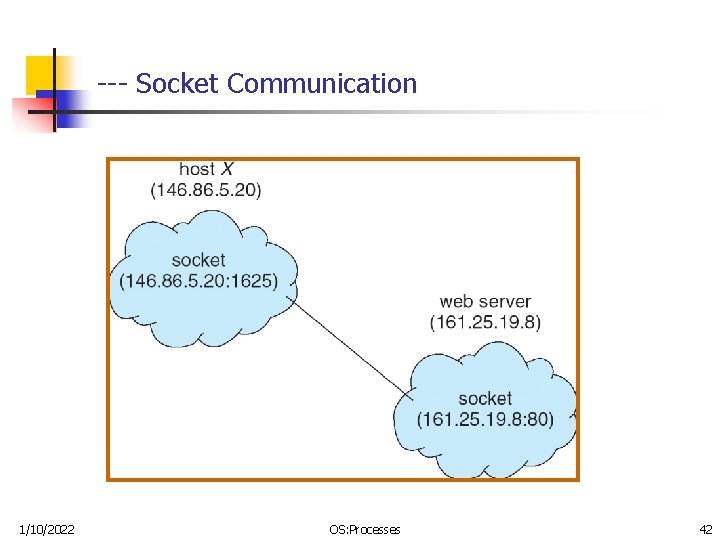
--- Socket Communication 1/10/2022 OS: Processes 42
-- Remote Procedure Calls n n 1/10/2022 Remote procedure call (RPC) abstracts procedure calls between processes on networked systems. Stubs – client-side proxy for the actual procedure on the server. The client-side stub locates the server and marshals the parameters. The server-side stub receives this message, unpacks the marshaled parameters, and performs the procedure on the server. OS: Processes 43
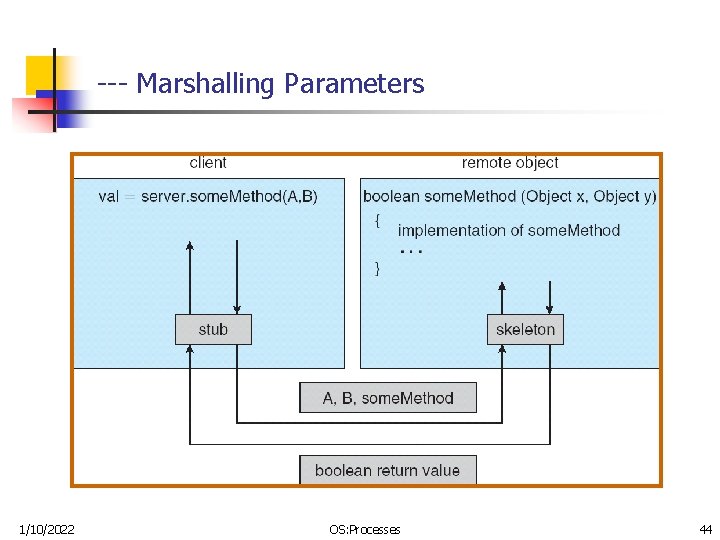
--- Marshalling Parameters 1/10/2022 OS: Processes 44
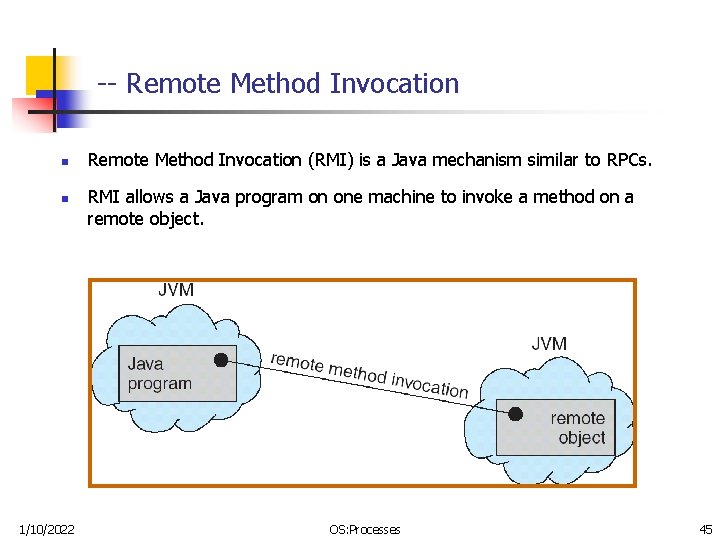
-- Remote Method Invocation n n 1/10/2022 Remote Method Invocation (RMI) is a Java mechanism similar to RPCs. RMI allows a Java program on one machine to invoke a method on a remote object. OS: Processes 45
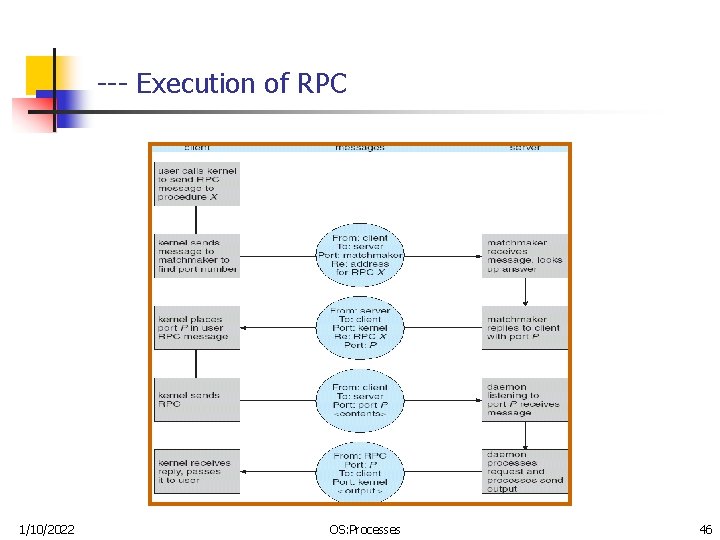
--- Execution of RPC 1/10/2022 OS: Processes 46
- Summary n Process: A program in execution n n n Batch vs. time sharing I/O bound process vs. CPU bound process Process state: new, ready, running, waiting, terminated Context switching: PCB Process scheduling: Short, medium, long term schedulers Operations on processes: process creation & termination. IPC: n shared memory n n message passing n n 1/10/2022 Producer consumer Direct vs. Indirect communication; Synchronization; Buffering Client-Server communication: Sockets, RPC, Stub, RMI OS: Processes 47
End of Chapter 3 1/10/2022 OS: Processes 48
- Slides: 48