
Process View Strategy Part 4 Some OM Tools
- Slides: 9
Process View & Strategy Part 4 - Some OM Tools and Techniques
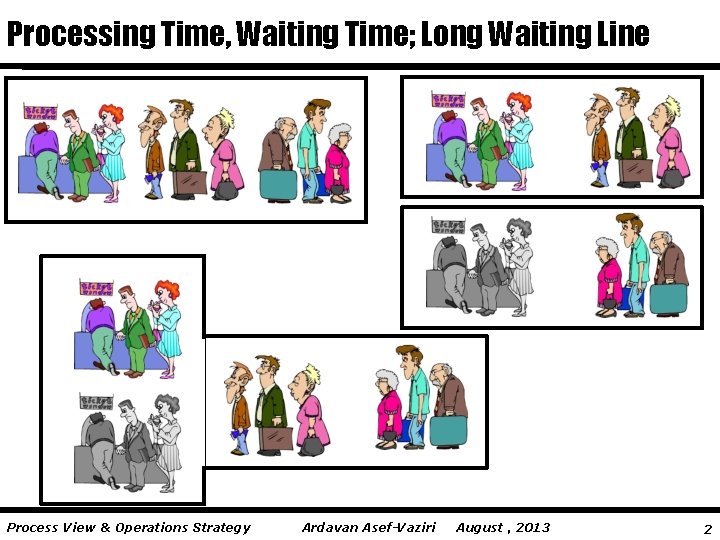
Processing Time, Waiting Time; Long Waiting Line Process View & Operations Strategy Ardavan Asef-Vaziri August , 2013 2
Recent Trends v Global Competition n n Global Market Global Suppliers v Supply Chain Management n n Not from RM storage to FG warehouse, but from the original suppliers to final consumers Under separate ownerships v Workers Involvement n Workers are not costs, they are assets v Total Quality Management v Lean Manufacturing n n Inventory is waste Variability is evil Process View & Operations Strategy Ardavan Asef-Vaziri August , 2013 3
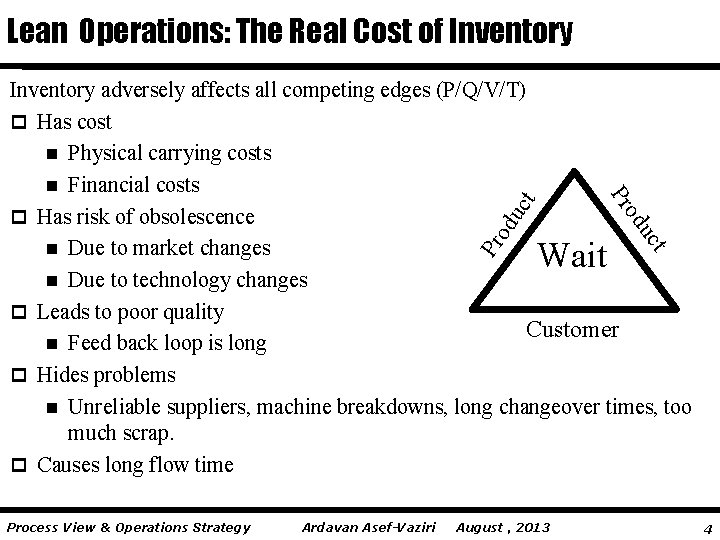
Lean Operations: The Real Cost of Inventory ct od u Pr Ardavan Asef-Vaziri Wait August , 2013 t uc od Process View & Operations Strategy Pr Inventory adversely affects all competing edges (P/Q/V/T) p Has cost n Physical carrying costs n Financial costs p Has risk of obsolescence n Due to market changes n Due to technology changes p Leads to poor quality Customer n Feed back loop is long p Hides problems n Unreliable suppliers, machine breakdowns, long changeover times, too much scrap. p Causes long flow time 4
Centralization; inventory and Capacity Centralization of stocks reduces inventory. Centralization of Servers reduces waiting line. Why doesn’t everybody do it? – Longer response time – Higher shipping cost – Less understanding of customer needs – Less understanding of cultural, linguistics, and regulatory barriers These disadvantages my reduce the demand. Process View & Operations Strategy Ardavan Asef-Vaziri August , 2013 5
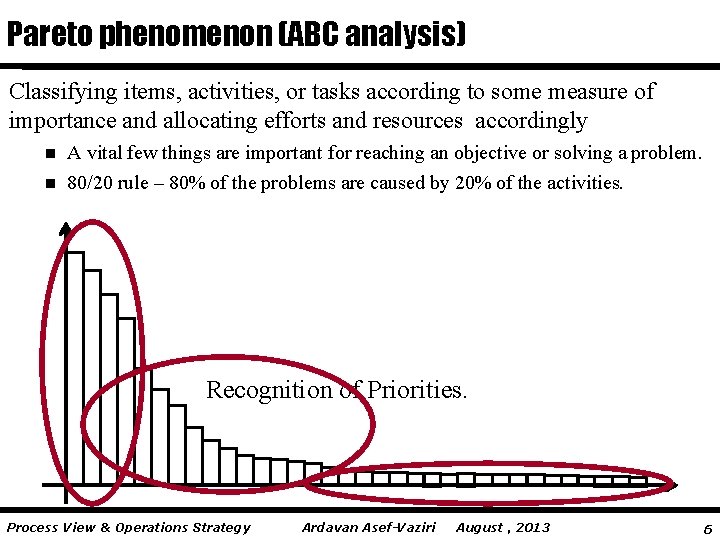
Pareto phenomenon (ABC analysis) Classifying items, activities, or tasks according to some measure of importance and allocating efforts and resources accordingly n n A vital few things are important for reaching an objective or solving a problem. 80/20 rule – 80% of the problems are caused by 20% of the activities. Recognition of Priorities. Process View & Operations Strategy Ardavan Asef-Vaziri August , 2013 6
Models -Representations Count what is countable. Measure what is measurable. What is not measurable, make it measurable. Galileo Galilei, 1564 -1642. A model is an abstraction of reality n n Narrative Tabular Schematic (Some times Physical) Mathematical Linear programming p Transportation model p Inventory models p Waiting line models p Statistical models p Process View & Operations Strategy Ardavan Asef-Vaziri August , 2013 7
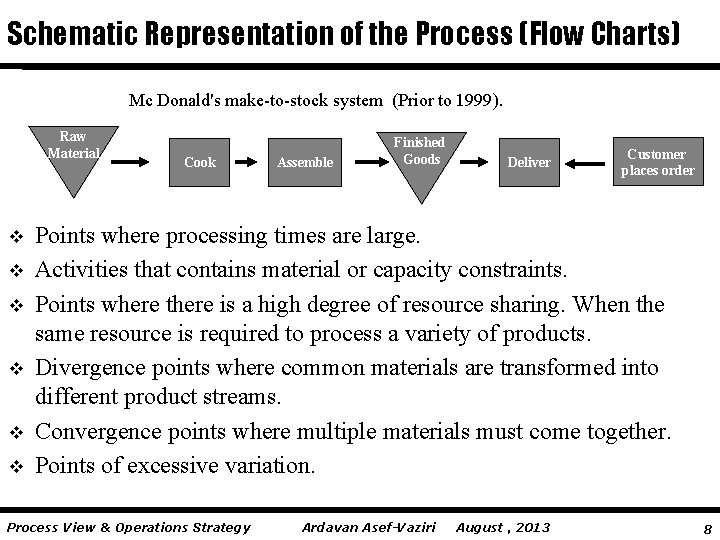
Schematic Representation of the Process (Flow Charts) Mc Donald's make-to-stock system (Prior to 1999). Raw Material v v v Cook Assemble Finished Goods Deliver Customer places order Points where processing times are large. Activities that contains material or capacity constraints. Points where there is a high degree of resource sharing. When the same resource is required to process a variety of products. Divergence points where common materials are transformed into different product streams. Convergence points where multiple materials must come together. Points of excessive variation. Process View & Operations Strategy Ardavan Asef-Vaziri August , 2013 8
Value Stream Mapping v v v Points where processing times are large. Activities that contains material or capacity constraints. Points where there is a high degree of resource sharing. When the same resource is required to process a variety of products. Divergence points where common materials are transformed into different product streams. Convergence points where multiple materials must come together. Points of excessive variation. Process View & Operations Strategy Ardavan Asef-Vaziri August , 2013 9