
Process to Revise Austins Land Development Code GENERAL

- Slides: 29
Process to Revise Austin’s Land Development Code GENERAL USE A priority program of George Adams, Assistant Director, PDRD
WHY? WHAT? WHO? HOW? WHEN? Presentation Overview
Why? Why revise the code?
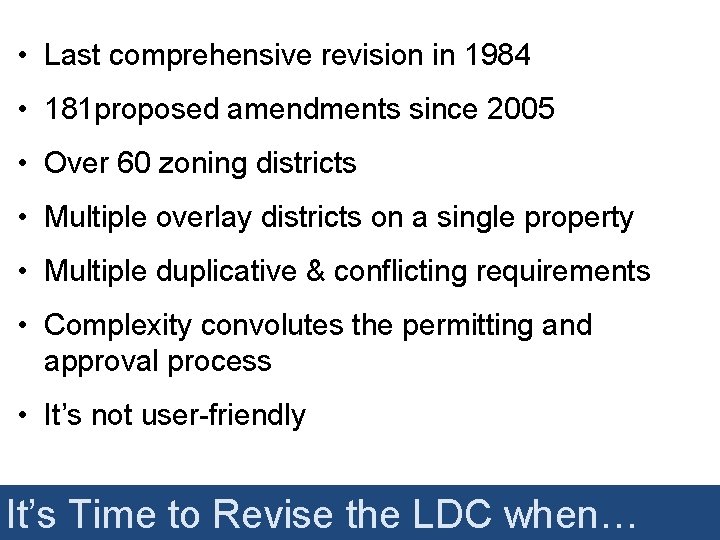
• Last comprehensive revision in 1984 • 181 proposed amendments since 2005 • Over 60 zoning districts • Multiple overlay districts on a single property • Multiple duplicative & conflicting requirements • Complexity convolutes the permitting and approval process • It’s not user-friendly It’s Time to Revise the LDC when…
offers clear direction for code revisions • • Vision statement 30+ policies 40+ actions Priority Program #8 Imagine Austin Provides Opportunity
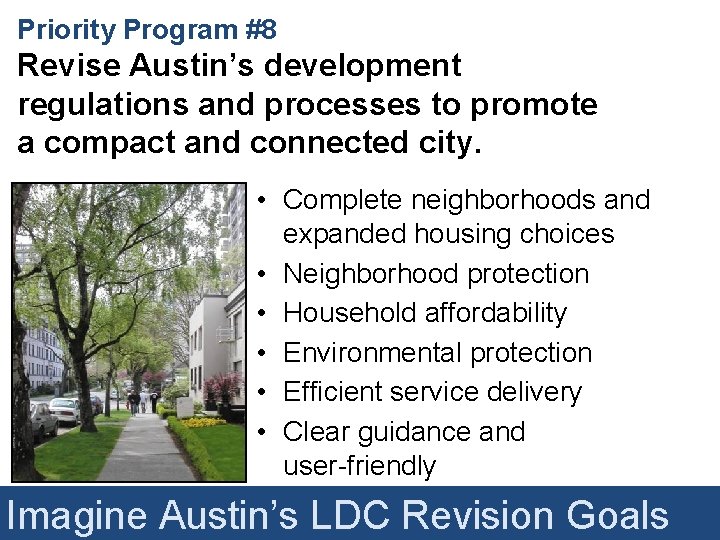
Priority Program #8 Revise Austin’s development regulations and processes to promote a compact and connected city. • Complete neighborhoods and expanded housing choices • Neighborhood protection • Household affordability • Environmental protection • Efficient service delivery • Clear guidance and user-friendly Code Revision Imagine Austin’s General LDC Revision Steps Goals
What should be revised? What?
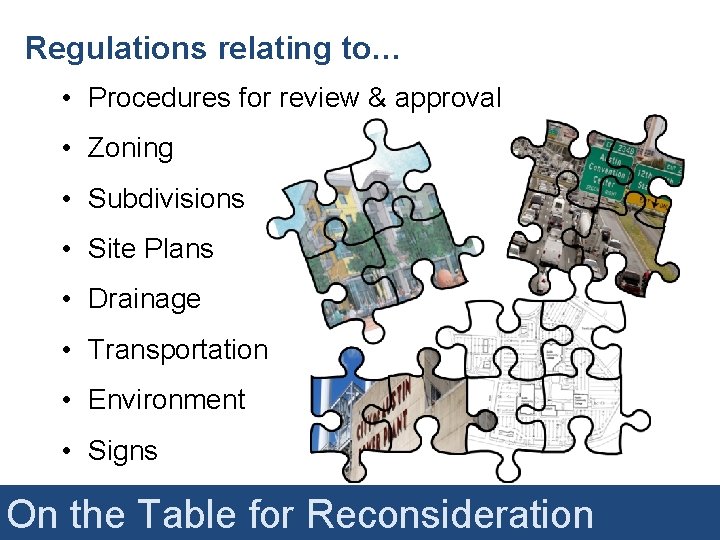
Regulations relating to… • Procedures for review & approval • Zoning • Subdivisions • Site Plans • Drainage • Transportation • Environment • Signs On the Table for Reconsideration
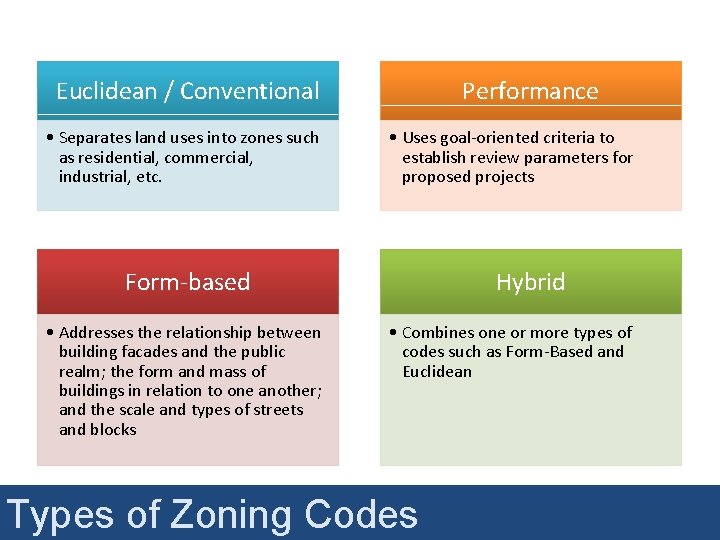
Euclidean / Conventional • Separates land uses into zones such as residential, commercial, industrial, etc. Performance • Uses goal-oriented criteria to establish review parameters for proposed projects Form-based • Addresses the relationship between building facades and the public realm; the form and mass of buildings in relation to one another; and the scale and types of streets and blocks Hybrid • Combines one or more types of codes such as Form-Based and Euclidean Types of Zoning Codes
Who? Who will revise the code?
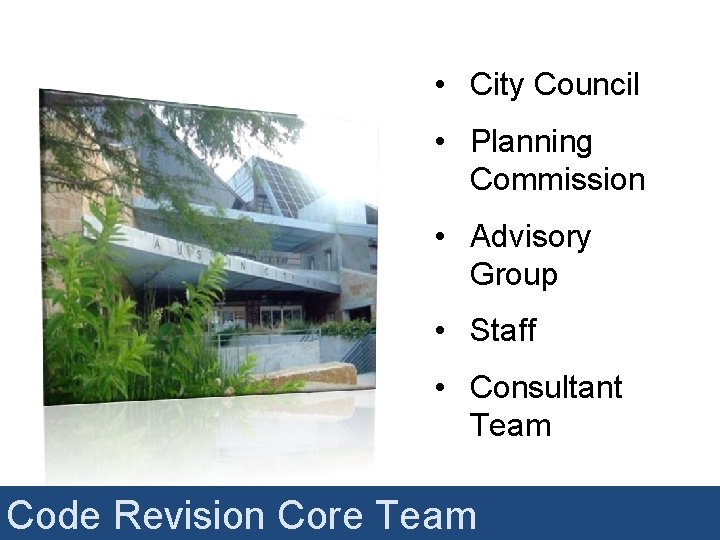
• City Council • Planning Commission • Advisory Group • Staff • Consultant Team Code Revision Core Team
• Purpose: • Assist with public outreach • Provide feedback on development and implementation of a revised code • Meets regularly throughout process • Advisory Group members: Chris Bradford Melissa Neslund Mandy De Mayo Stephen Oliver Stephen Delgado Brian Reis Jim Duncan Beverly Silas Will Herring Dave Sullivan Jeff Jack Advisory Group
• 3 1/2 new staff positions in Planning and Development Review Dept. (PDRD) • Support from multiple PDRD divisions and other departments as needed • Up to $2 M for consultant services and related expenses Staff & Consultant Resources
• Opticos Design – Lead consultant • Fregonese Assoc. • Peter J. Park • Mc. Cann Adams • Cultural Strategies • Group Solutions • Lisa Wise Consulting • RCLCO • ECONorthwest • Taniguchi Architects • Kimley Horn • Mc. Guire. Woods • Urban Design Group Staff & Consultant Resources
How will the code be revised? How?
• Preliminary outreach to key stakeholders—development and business community, affordable housing, neighborhoods, environment/sustainability, etc. (Complete as of Jan. 17, 2013) • Advisory Group appointed (Jan-Feb 2013) • “Code 101” and best practices • “Headliners” ongoing throughout the process • RFQ issued in early November 2012 • Consultant Team selected by Council March 21, 2013 Organizing the Process
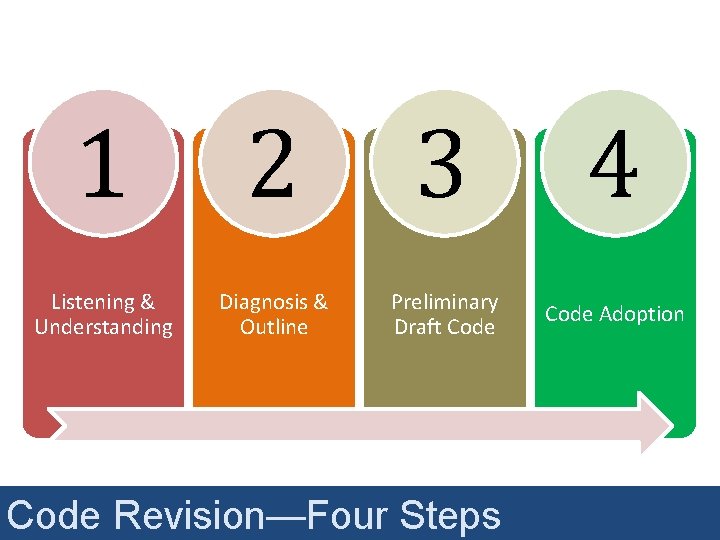
1 2 3 4 Listening & Understanding Diagnosis & Outline Preliminary Draft Code Adoption Code Revision—Four Steps
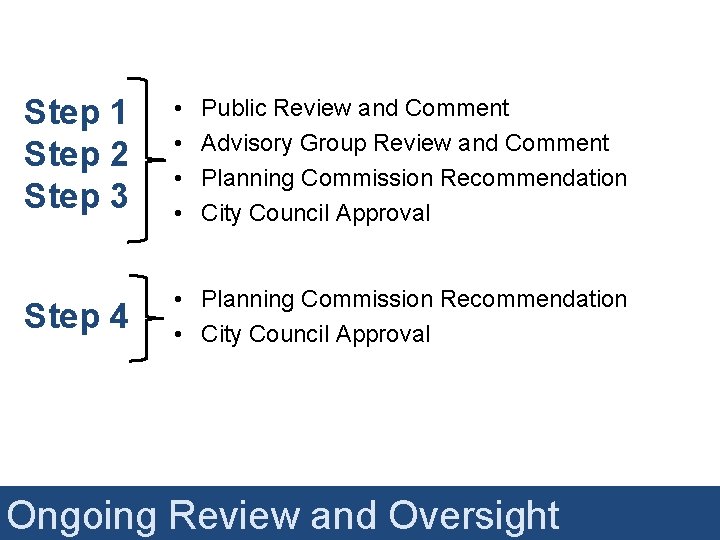
Step 1 Step 2 Step 3 • • Step 4 • Planning Commission Recommendation • City Council Approval Public Review and Comment Advisory Group Review and Comment Planning Commission Recommendation City Council Approval Ongoing Review and Oversight
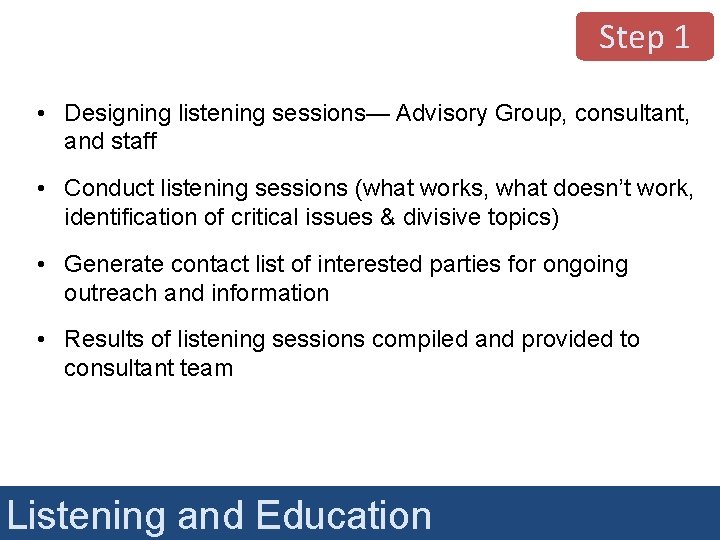
Step 1 • Designing listening sessions— Advisory Group, consultant, and staff • Conduct listening sessions (what works, what doesn’t work, identification of critical issues & divisive topics) • Generate contact list of interested parties for ongoing outreach and information • Results of listening sessions compiled and provided to consultant team Listening and Education
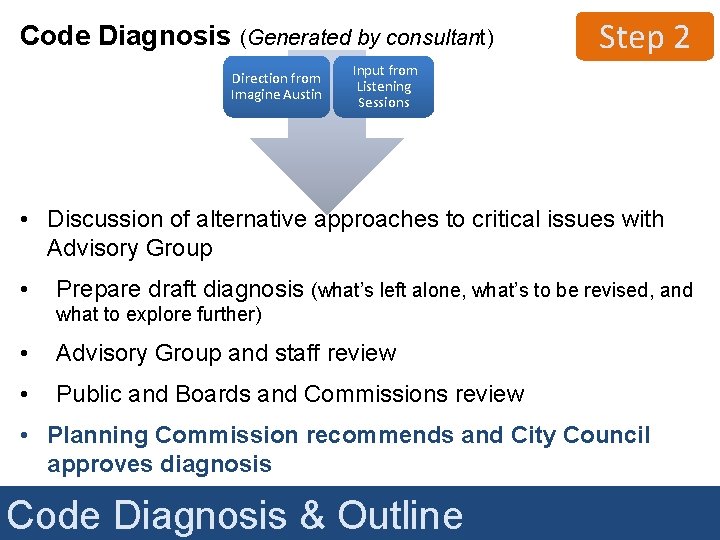
Code Diagnosis (Generated by consultant) Direction from Imagine Austin Step 2 Input from Listening Sessions • Discussion of alternative approaches to critical issues with Advisory Group • Prepare draft diagnosis (what’s left alone, what’s to be revised, and what to explore further) • Advisory Group and staff review • Public and Boards and Commissions review • Planning Commission recommends and City Council approves diagnosis Code Diagnosis & Outline
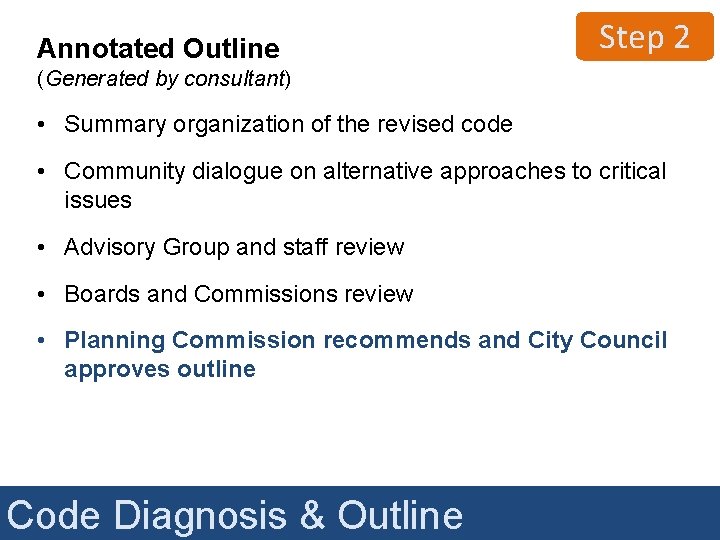
Annotated Outline Step 2 (Generated by consultant) • Summary organization of the revised code • Community dialogue on alternative approaches to critical issues • Advisory Group and staff review • Boards and Commissions review • Planning Commission recommends and City Council approves outline Code Diagnosis & Outline
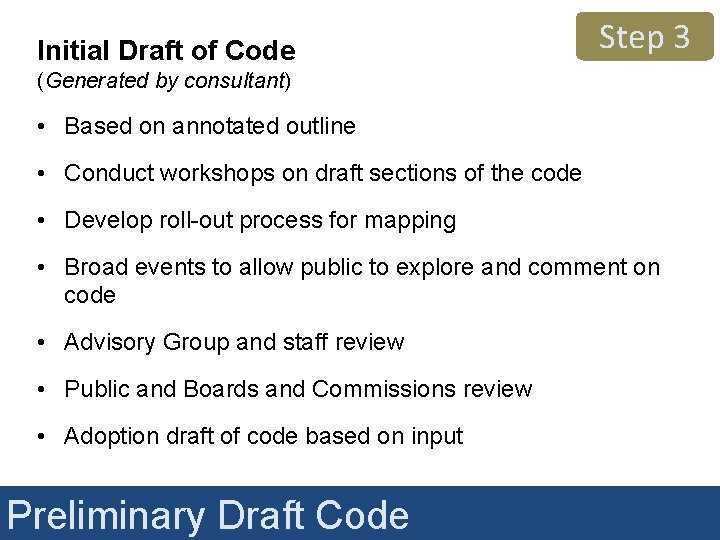
Initial Draft of Code Step 3 (Generated by consultant) • Based on annotated outline • Conduct workshops on draft sections of the code • Develop roll-out process for mapping • Broad events to allow public to explore and comment on code • Advisory Group and staff review • Public and Boards and Commissions review • Adoption draft of code based on input Diagnosis &Draft Preliminary Outline Code
Public Hearings Planning Commission recommends and City Council adopts Code Adoption Process Step 4
When? When will the project be complete?
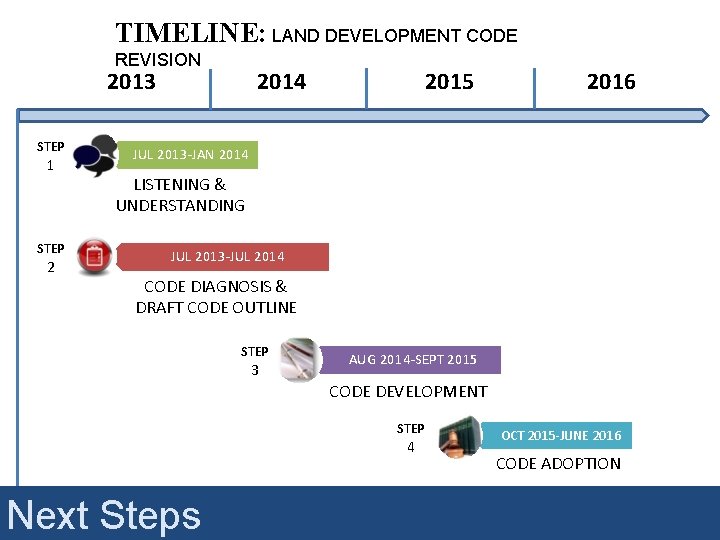
TIMELINE: LAND DEVELOPMENT CODE REVISION 2013 STEP 1 STEP 2 2014 2015 2016 JUL 2013 -JAN 2014 LISTENING & UNDERSTANDING JUL 2013 -JUL 2014 CODE DIAGNOSIS & DRAFT CODE OUTLINE STEP 3 AUG 2014 -SEPT 2015 CODE DEVELOPMENT STEP 4 Next Steps OCT 2015 -JUNE 2016 CODE ADOPTION
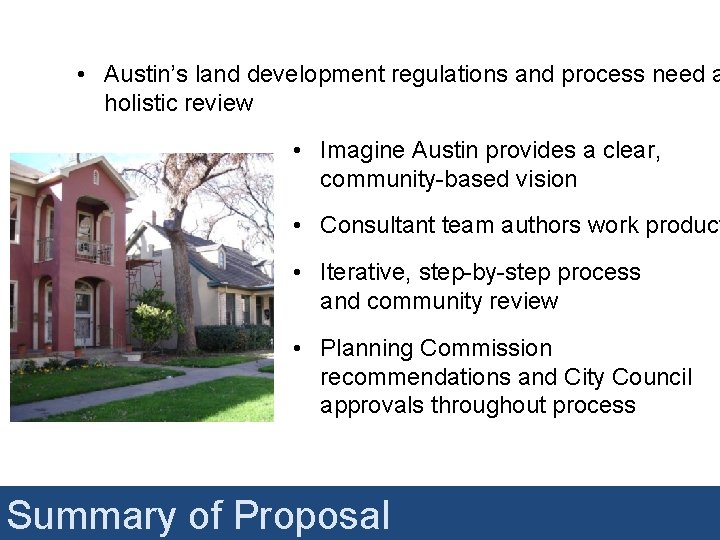
• Austin’s land development regulations and process need a holistic review • Imagine Austin provides a clear, community-based vision • Consultant team authors work product • Iterative, step-by-step process and community review • Planning Commission recommendations and City Council approvals throughout process Summary of Proposal
On time and within budget Engaging people who use the code Informative and educational Avoid assumptions Open to all Respectful and fair Focus on common ground Not letting perfection get in the way of improvement A clear, predictable, user-friendly code that implements What Does Success Look Like?
• Providing information, resources or expertise to consultant team • Meeting with consultant and serving as technical representative for your work area • Distributing information, status reports, and work products to your team for review and comment • Ensuring staff input from your department is provided to consultant team on schedule and in well-organized format Role of Department Representatives
Questions? G: Code Revision www. austintexas. gov/new. LDC