
Process Theories of Motivation Look at the actual
- Slides: 30
Process Theories of Motivation § Look at the actual process of motivation § Expectancy theory § Goal-setting theory Motivation Dr. M. Chaudhuri 1
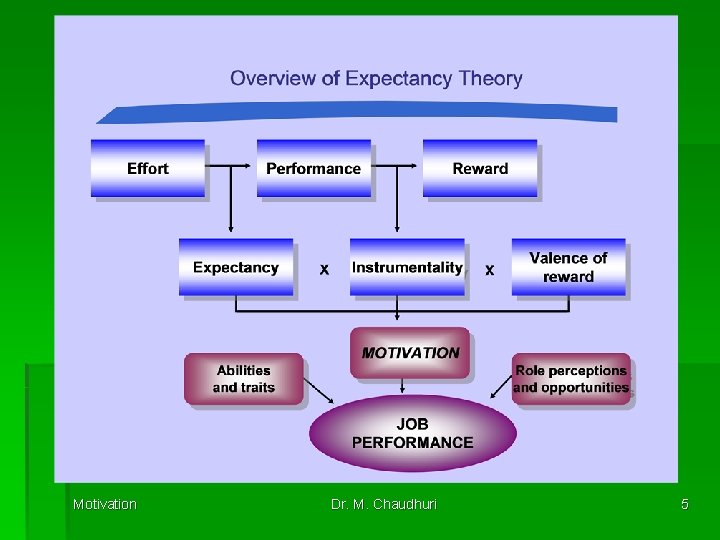
Expectancy Theory § The strength of a tendency to act in a certain way depends on the strength of an expectation that the act will be followed by a given outcome and on the attractiveness of that outcome to the individual. Motivation Dr. M. Chaudhuri 2
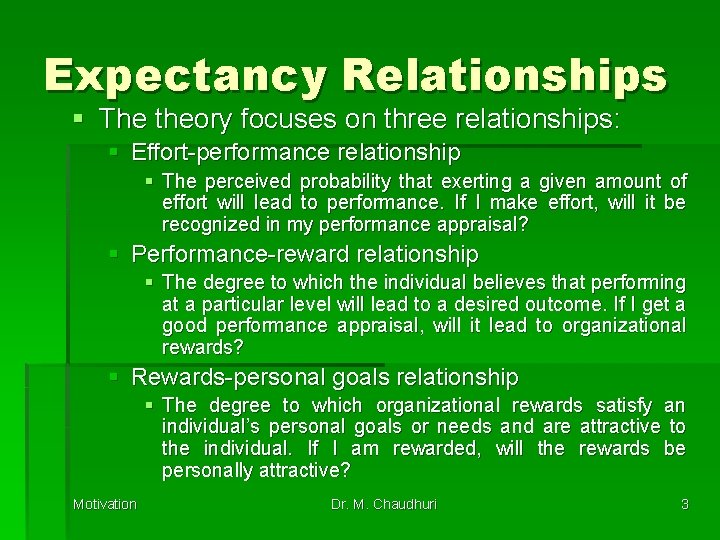
Expectancy Relationships § The theory focuses on three relationships: § Effort-performance relationship § The perceived probability that exerting a given amount of effort will lead to performance. If I make effort, will it be recognized in my performance appraisal? § Performance-reward relationship § The degree to which the individual believes that performing at a particular level will lead to a desired outcome. If I get a good performance appraisal, will it lead to organizational rewards? § Rewards-personal goals relationship § The degree to which organizational rewards satisfy an individual’s personal goals or needs and are attractive to the individual. If I am rewarded, will the rewards be personally attractive? Motivation Dr. M. Chaudhuri 3
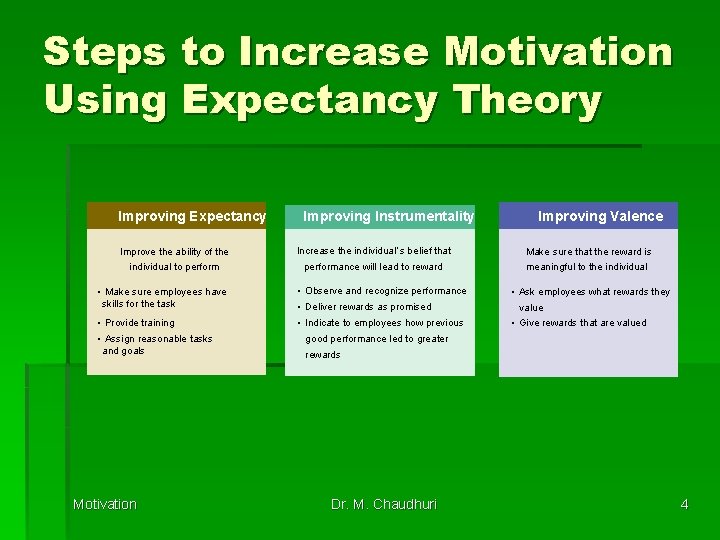
Steps to Increase Motivation Using Expectancy Theory Improving Expectancy Improving Instrumentality Improving Valence Improve the ability of the Increase the individual’s belief that Make sure that the reward is individual to performance will lead to reward meaningful to the individual • Make sure employees have skills for the task • Observe and recognize performance • Provide training • Indicate to employees how previous • Assign reasonable tasks and goals Motivation • Deliver rewards as promised • Ask employees what rewards they value • Give rewards that are valued good performance led to greater rewards Dr. M. Chaudhuri 4
Motivation Dr. M. Chaudhuri 5
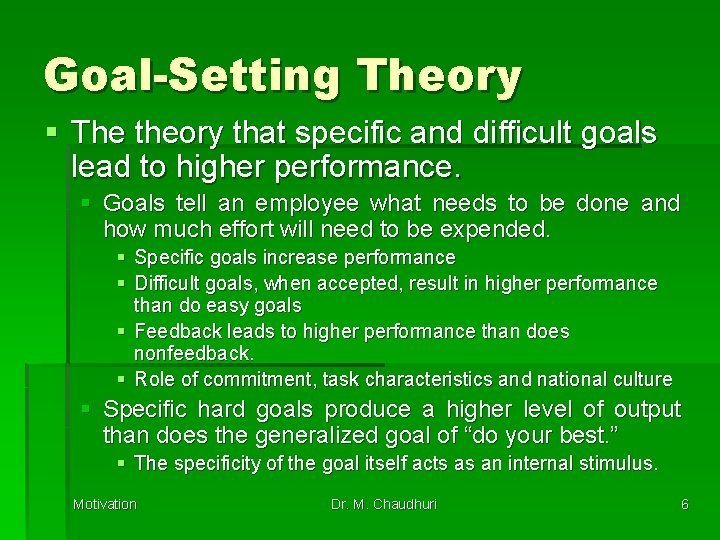
Goal-Setting Theory § The theory that specific and difficult goals lead to higher performance. § Goals tell an employee what needs to be done and how much effort will need to be expended. § Specific goals increase performance § Difficult goals, when accepted, result in higher performance than do easy goals § Feedback leads to higher performance than does nonfeedback. § Role of commitment, task characteristics and national culture § Specific hard goals produce a higher level of output than does the generalized goal of “do your best. ” § The specificity of the goal itself acts as an internal stimulus. Motivation Dr. M. Chaudhuri 6
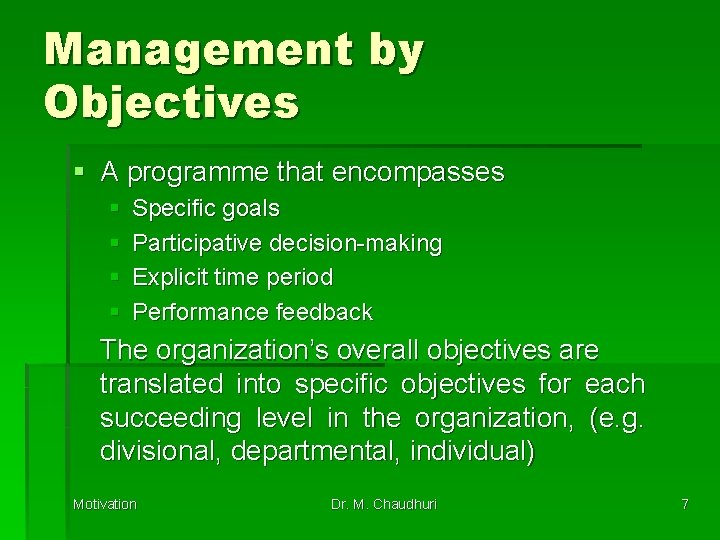
Management by Objectives § A programme that encompasses § § Specific goals Participative decision-making Explicit time period Performance feedback The organization’s overall objectives are translated into specific objectives for each succeeding level in the organization, (e. g. divisional, departmental, individual) Motivation Dr. M. Chaudhuri 7
Responses to the Reward System § Equity Theory § Fair Process Motivation Dr. M. Chaudhuri 8
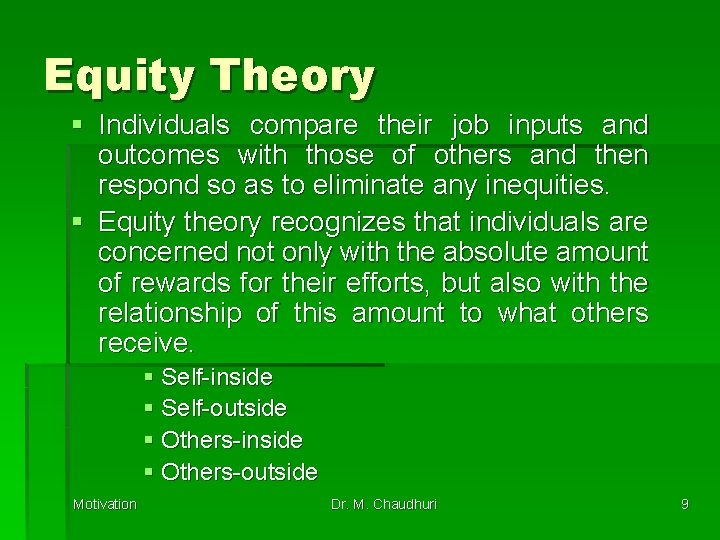
Equity Theory § Individuals compare their job inputs and outcomes with those of others and then respond so as to eliminate any inequities. § Equity theory recognizes that individuals are concerned not only with the absolute amount of rewards for their efforts, but also with the relationship of this amount to what others receive. § Self-inside § Self-outside § Others-inside § Others-outside Motivation Dr. M. Chaudhuri 9
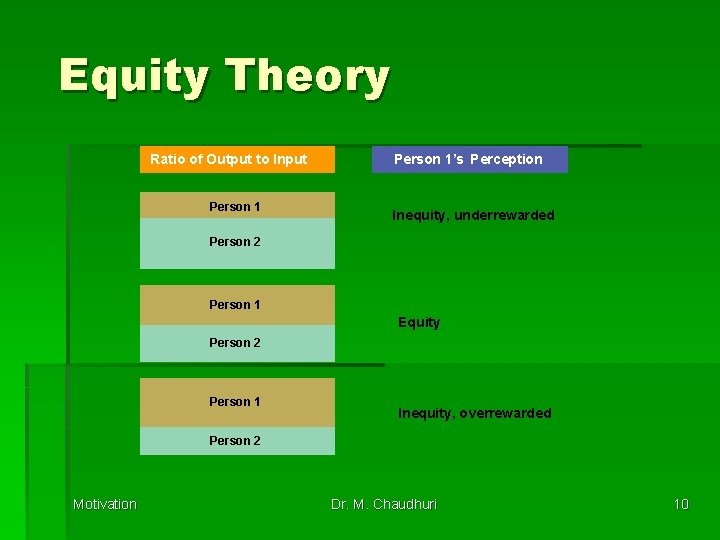
Equity Theory Ratio of Output to Input Person 1’s Perception Inequity, underrewarded Person 2 Person 1 Equity Person 2 Person 1 Inequity, overrewarded Person 2 Motivation Dr. M. Chaudhuri 10
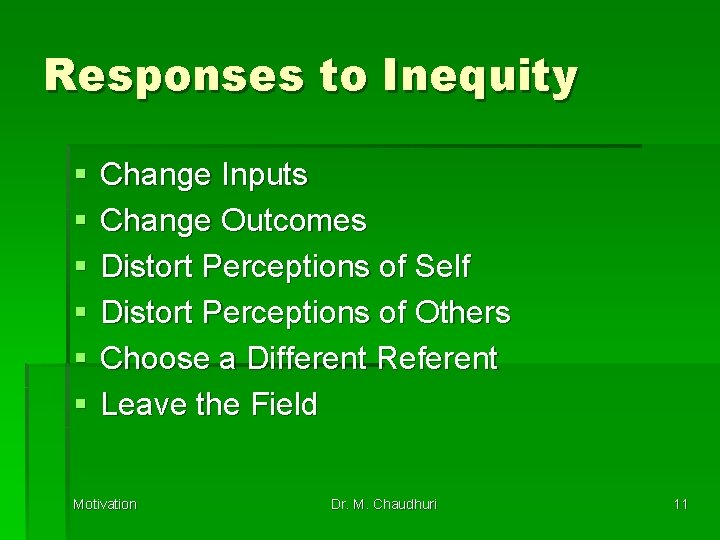
Responses to Inequity § § § Change Inputs Change Outcomes Distort Perceptions of Self Distort Perceptions of Others Choose a Different Referent Leave the Field Motivation Dr. M. Chaudhuri 11
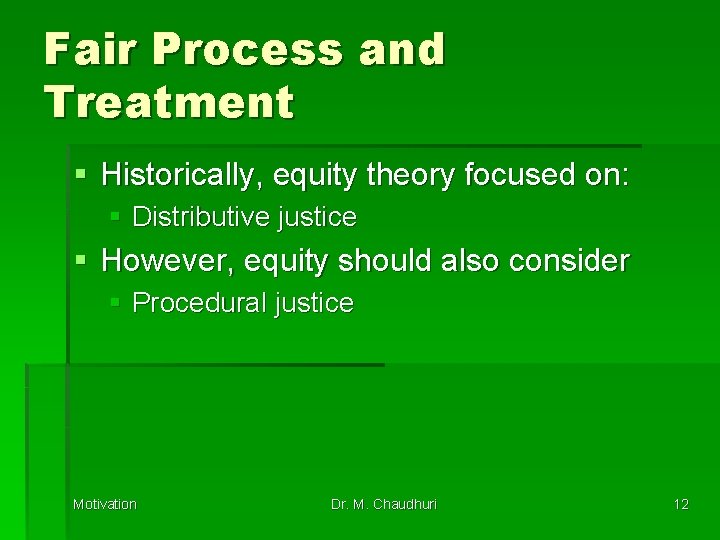
Fair Process and Treatment § Historically, equity theory focused on: § Distributive justice § However, equity should also consider § Procedural justice Motivation Dr. M. Chaudhuri 12
Fair Process § Distributive Justice § Perceived fairness of the amount and allocation of rewards among individuals § Procedural Justice § Perceived fairness of the process used to determine the distribution of rewards § Interactional Justice § Perceived degree to which one is treated with dignity and respect § Organizational Justice § Overall perception of what is fair in the workplace Motivation Dr. M. Chaudhuri 13
Role of Money § Money is the most commonly used reward in organizations § Money certainly helps some needs get met § But, money is not all employees’ top priority § Many emphasize relationships in the workplace Motivation Dr. M. Chaudhuri 14
Model of Intrinsic Motivation - Ken Thomas § Employees are intrinsically motivated when rewards an employee gets from work result from: § Choice– the ability to freely self-select and perform task activities. § Competence– the sense of accomplishment from skillfully performing chosen tasks/activities. § Meaningfulness– pursuing a task that matters in the larger scheme of things. § Progress– the feeling of significant advancement in achieving the task’s purpose. Motivation Dr. M. Chaudhuri 15
Motivating for Specific Organizational Goals § Employee Recognition: Motivating to Show People Matter § Employee recognition plans § Variable-Pay Programmes: Motivating for Improved Productivity § Individual-based incentives: piece rate § Group-based incentives: gainsharing § Organizational-based incentives: profit sharing, ESOPs Motivation Dr. M. Chaudhuri 16
Variable-Pay Programmes § A portion of an employee’s pay is based on some individual and/or organizational measure(s) of performance. § Individual-based § Piece-rate wages, bonuses § Group-based § Gainsharing § Organizational-based § Profit sharing § Employee stock ownership plans (ESOPs) Motivation Dr. M. Chaudhuri 17
Variable Pay Programmes § Piece-rate pay plans § Workers are paid a fixed sum for each unit of production completed. § Bonuses § Pay programme that rewards for recent performance § Gainsharing § An incentive plan where improvements in group productivity determine the total amount of money that is allocated. Motivation Dr. M. Chaudhuri 18
Variable Pay Programmes § Profit-sharing plans § Organization wide programmes that distribute compensation based on some established formula designed around a company’s profitability. § Employee stock ownership plans (ESOPs) § Company-established benefit plans in which employees acquire stock, often at belowmarket prices, as part of their benefits. Motivation Dr. M. Chaudhuri 19
Cross-Cultural Differences in Motivation § Canada and US rely on extrinsic rewards more than other countries § Japan and Germany rarely use individual incentives § Japan emphasizes group rewards § China more likely to give bonuses to everyone Motivation Dr. M. Chaudhuri 20
Are Rewards Overrated? Cognitive Evaluation Theory § Allocating extrinsic rewards for behaviour that had been previously intrinsically rewarding tends to decrease the overall level of motivation. § When extrinsic rewards are used by organizations as payoffs for superior performance, the intrinsic rewards, which are derived from individuals doing what they like, are reduced. This may be due to a perceived loss of control over one’s own behaviour. Motivation Dr. M. Chaudhuri 21
Abolishing Rewards § Alfie Kohn suggests that organizations should focus less on rewards, more on creating motivating environments § § § Abolish incentives Re-evaluate evaluation Create conditions for authentic motivation Collaboration Content Choice Motivation Dr. M. Chaudhuri 22
Implications § Recognize Individual Differences § Employees have different needs. § Don’t treat them all alike. § Spend the time necessary to understand what’s important to each employee. § Use Goals and Feedback § Allow Employees to Participate in Decisions That Affect Them Motivation Dr. M. Chaudhuri 23
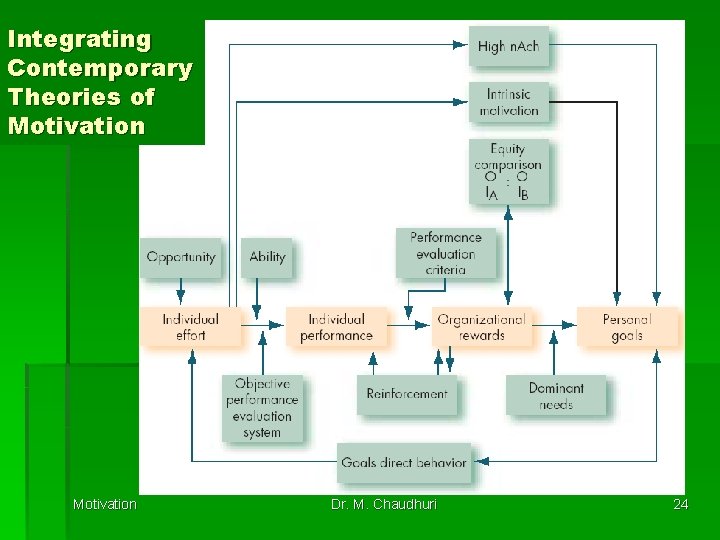
Integrating Contemporary Theories of Motivation Dr. M. Chaudhuri 24
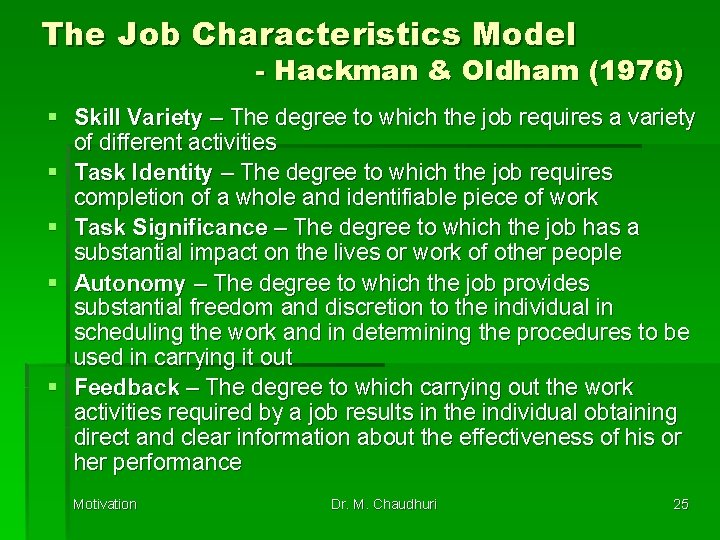
The Job Characteristics Model - Hackman & Oldham (1976) § Skill Variety – The degree to which the job requires a variety of different activities § Task Identity – The degree to which the job requires completion of a whole and identifiable piece of work § Task Significance – The degree to which the job has a substantial impact on the lives or work of other people § Autonomy – The degree to which the job provides substantial freedom and discretion to the individual in scheduling the work and in determining the procedures to be used in carrying it out § Feedback – The degree to which carrying out the work activities required by a job results in the individual obtaining direct and clear information about the effectiveness of his or her performance Motivation Dr. M. Chaudhuri 25
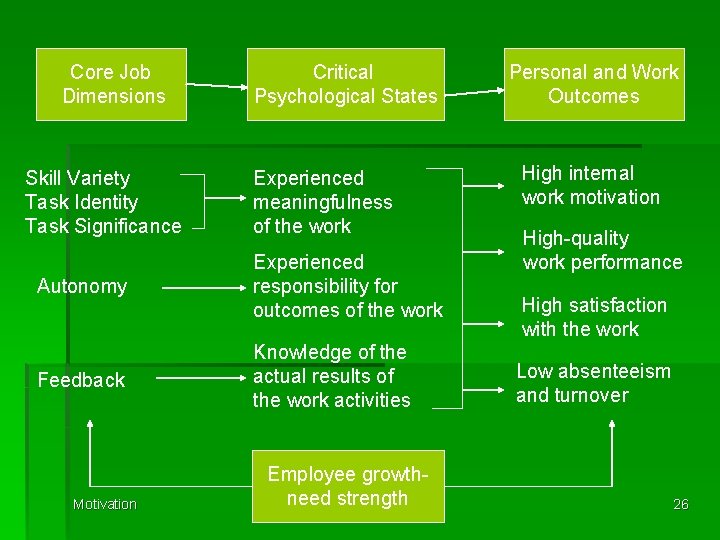
Core Job Dimensions Skill Variety Task Identity Task Significance Critical Psychological States Experienced meaningfulness of the work Autonomy Experienced responsibility for outcomes of the work Feedback Knowledge of the actual results of the work activities Motivation Employee growthneed strength M. Chaudhuri need Dr. strength Personal and Work Outcomes High internal work motivation High-quality work performance High satisfaction with the work Low absenteeism and turnover 26
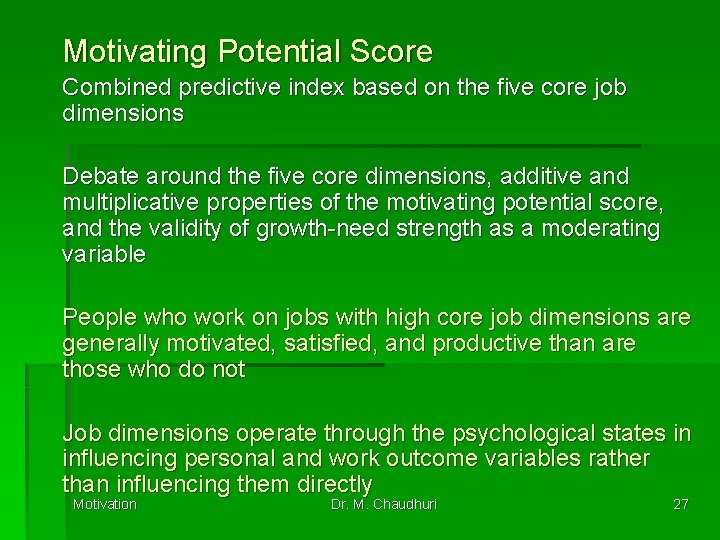
Motivating Potential Score Combined predictive index based on the five core job dimensions Debate around the five core dimensions, additive and multiplicative properties of the motivating potential score, and the validity of growth-need strength as a moderating variable People who work on jobs with high core job dimensions are generally motivated, satisfied, and productive than are those who do not Job dimensions operate through the psychological states in influencing personal and work outcome variables rather than influencing them directly Motivation Dr. M. Chaudhuri 27
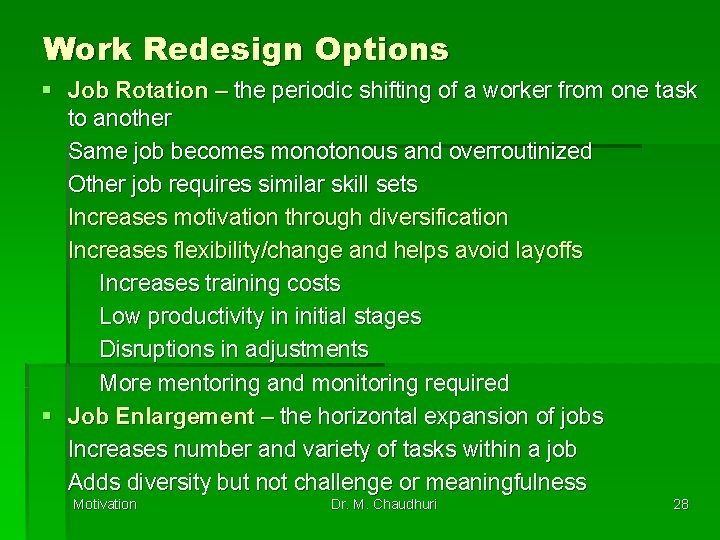
Work Redesign Options § Job Rotation – the periodic shifting of a worker from one task to another Same job becomes monotonous and overroutinized Other job requires similar skill sets Increases motivation through diversification Increases flexibility/change and helps avoid layoffs Increases training costs Low productivity in initial stages Disruptions in adjustments More mentoring and monitoring required § Job Enlargement – the horizontal expansion of jobs Increases number and variety of tasks within a job Adds diversity but not challenge or meaningfulness Motivation Dr. M. Chaudhuri 28
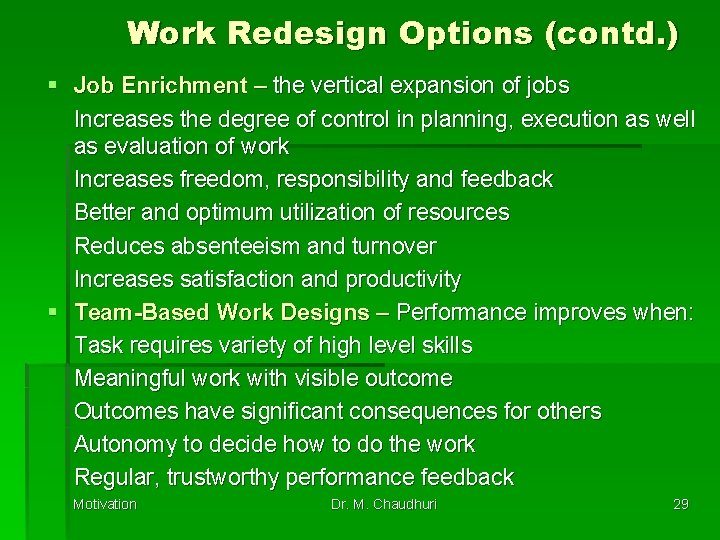
Work Redesign Options (contd. ) § Job Enrichment – the vertical expansion of jobs Increases the degree of control in planning, execution as well as evaluation of work Increases freedom, responsibility and feedback Better and optimum utilization of resources Reduces absenteeism and turnover Increases satisfaction and productivity § Team-Based Work Designs – Performance improves when: Task requires variety of high level skills Meaningful work with visible outcome Outcomes have significant consequences for others Autonomy to decide how to do the work Regular, trustworthy performance feedback Motivation Dr. M. Chaudhuri 29
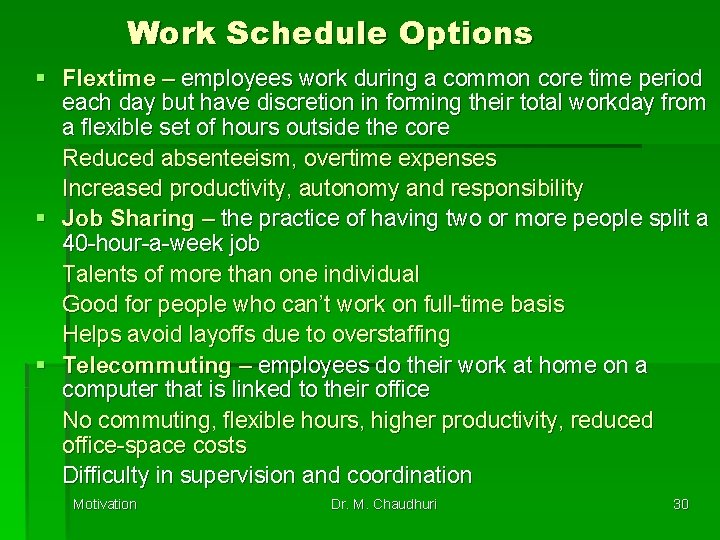
Work Schedule Options § Flextime – employees work during a common core time period each day but have discretion in forming their total workday from a flexible set of hours outside the core Reduced absenteeism, overtime expenses Increased productivity, autonomy and responsibility § Job Sharing – the practice of having two or more people split a 40 -hour-a-week job Talents of more than one individual Good for people who can’t work on full-time basis Helps avoid layoffs due to overstaffing § Telecommuting – employees do their work at home on a computer that is linked to their office No commuting, flexible hours, higher productivity, reduced office-space costs Difficulty in supervision and coordination Motivation Dr. M. Chaudhuri 30