
Process Simulation for the LCLSII Cryogenic Systems V
- Slides: 1
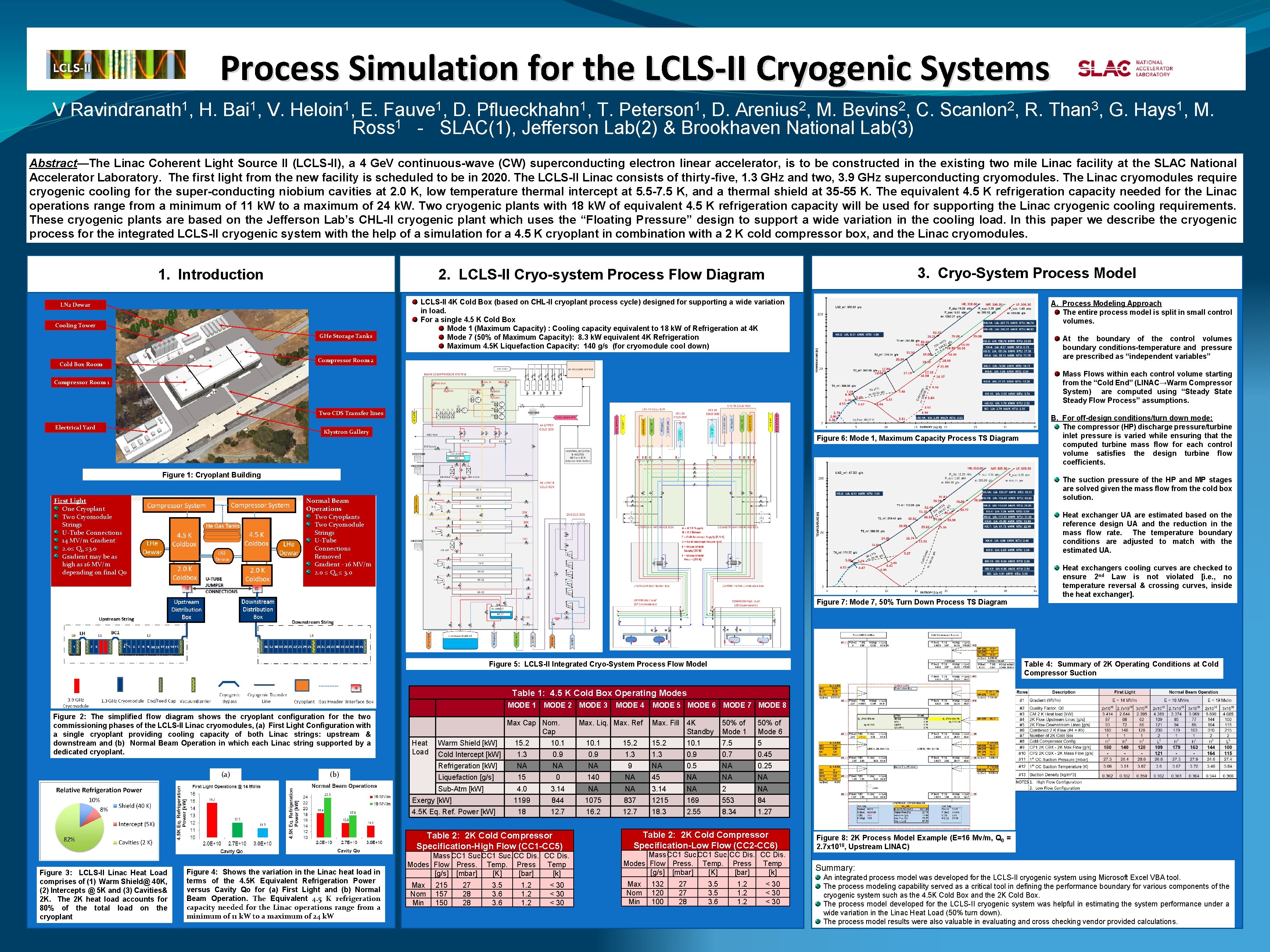
Process Simulation for the LCLS-II Cryogenic Systems V 1 Ravindranath , H. 1 Bai , V. 1 Heloin , 1 1 1 2 2 E. Fauve , D. Pflueckhahn , T. Peterson , D. Arenius , M. Bevins , C. 1 Ross - SLAC(1), Jefferson Lab(2) & Brookhaven National Lab(3) 2 Scanlon , R. 3 Than , G. 1 Hays , M. Abstract—The Linac Coherent Light Source II (LCLS-II), a 4 Ge. V continuous-wave (CW) superconducting electron linear accelerator, is to be constructed in the existing two mile Linac facility at the SLAC National Accelerator Laboratory. The first light from the new facility is scheduled to be in 2020. The LCLS-II Linac consists of thirty-five, 1. 3 GHz and two, 3. 9 GHz superconducting cryomodules. The Linac cryomodules require cryogenic cooling for the super-conducting niobium cavities at 2. 0 K, low temperature thermal intercept at 5. 5 -7. 5 K, and a thermal shield at 35 -55 K. The equivalent 4. 5 K refrigeration capacity needed for the Linac operations range from a minimum of 11 k. W to a maximum of 24 k. W. Two cryogenic plants with 18 k. W of equivalent 4. 5 K refrigeration capacity will be used for supporting the Linac cryogenic cooling requirements. These cryogenic plants are based on the Jefferson Lab’s CHL-II cryogenic plant which uses the “Floating Pressure” design to support a wide variation in the cooling load. In this paper we describe the cryogenic process for the integrated LCLS-II cryogenic system with the help of a simulation for a 4. 5 K cryoplant in combination with a 2 K cold compressor box, and the Linac cryomodules. 3. Cryo-System Process Model 2. LCLS-II Cryo-system Process Flow Diagram 1. Introduction LN 2 Dewar Cooling Tower GHe Storage Tanks LCLS-II 4 K Cold Box (based on CHL-II cryoplant process cycle) designed for supporting a wide variation in load. For a single 4. 5 K Cold Box Mode 1 (Maximum Capacity) : Cooling capacity equivalent to 18 k. W of Refrigeration at 4 K Mode 7 (50% of Maximum Capacity): 8. 3 k. W equivalent 4 K Refrigeration Maximum 4. 5 K Liquefaction Capacity: 140 g/s (for cryomodule cool down) A. Process Modeling Approach The entire process model is split in small control volumes. At the boundary of the control volumes boundary conditions-temperature and pressure are prescribed as “independent variables” Compressor Room 2 Cold Box Room Mass Flows within each control volume starting from the “Cold End” (LINAC→Warm Compressor System) are computed using “Steady State Steady Flow Process” assumptions. Compressor Room 1 Two CDS Transfer lines Electrical Yard Klystron Gallery Figure 6: Mode 1, Maximum Capacity Process TS Diagram Figure 1: Cryoplant Building First Light One Cryoplant Two Cryomodule Strings U-Tube Connections 14 MV/m Gradient* 2. 0≤ Qo ≤ 3. 0 Gradient may be as high as 16 MV/m depending on final Qo B. For off-design conditions/turn down mode: The compressor (HP) discharge pressure/turbine inlet pressure is varied while ensuring that the computed turbine mass flow for each control volume satisfies the design turbine flow coefficients. The suction pressure of the HP and MP stages are solved given the mass flow from the cold box solution. Normal Beam Operations Two Cryoplants Two Cryomodule Strings U-Tube Connections Removed Gradient - 16 MV/m 2. 0 ≤ Qo ≤ 3. 0 Heat exchanger UA are estimated based on the reference design UA and the reduction in the mass flow rate. The temperature boundary conditions are adjusted to match with the estimated UA. Figure 7: Mode 7, 50% Turn Down Process TS Diagram Figure 5: LCLS-II Integrated Cryo-System Process Flow Model Heat exchangers cooling curves are checked to ensure 2 nd Law is not violated [i. e. , no temperature reversal & crossing curves, inside the heat exchanger]. Table 4: Summary of 2 K Operating Conditions at Cold Compressor Suction Table 1: 4. 5 K Cold Box Operating Modes MODE 1 Figure 2: The simplified flow diagram shows the cryoplant configuration for the two commissioning phases of the LCLS-II Linac cryomodules, (a) First Light Configuration with a single cryoplant providing cooling capacity of both Linac strings: upstream & downstream and (b) Normal Beam Operation in which each Linac string supported by a dedicated cryoplant. (a) MODE 2 MODE 3 Max Cap Nom. Cap Heat Load (b) Max. Fill 4 K Standby 50% of Mode 1 50% of Mode 6 10. 1 15. 2 10. 1 7. 5 5 Cold Intercept [k. W] 1. 3 0. 9 0. 7 0. 45 Refrigeration [k. W] NA NA NA 9 NA 0. 5 NA 0. 25 Liquefaction [g/s] 15 0 140 NA 45 NA NA NA Sub-Atm [k. W] 4. 0 3. 14 NA NA 3. 14 NA 2 NA 1199 844 1075 837 1215 169 553 84 18 12. 7 16. 2 12. 7 18. 3 2. 55 8. 34 1. 27 Table 2: 2 K Cold Compressor Specification-High Flow (CC 1 -CC 5) Mass CC 1 Suc. CC Dis. Modes Flow Press. Temp. Press Temp [g/s] [mbar] [K] [bar] [k] Max Nom Min MODE 7 MODE 8 15. 2 4. 5 K Eq. Ref. Power [k. W] Figure 4: Shows the variation in the Linac heat load in terms of the 4. 5 K Equivalent Refrigeration Power versus Cavity Qo for (a) First Light and (b) Normal Beam Operation. The Equivalent 4. 5 K refrigeration capacity needed for the Linac operations range from a minimum of 11 k. W to a maximum of 24 k. W Max. Liq. Max. Ref MODE 5 MODE 6 Warm Shield [k. W] Exergy [k. W] Figure 3: LCLS-II Linac Heat Load comprises of (1) Warm Shield@ 40 K, (2) Intercepts @ 5 K and (3) Cavities& 2 K. The 2 K heat load accounts for 80% of the total load on the cryoplant MODE 4 215 157 150 27 28 28 3. 5 3. 6 1. 2 < 30 Table 2: 2 K Cold Compressor Specification-Low Flow (CC 2 -CC 6) Mass CC 1 Suc. CC Dis. Modes Flow Press. Temp. Press Temp [g/s] [mbar] [K] [bar] [k] Max Nom Min 132 120 100 27 27 28 3. 5 3. 6 1. 2 < 30 Figure 8: 2 K Process Model Example (E=16 Mv/m, Q 0 = 2. 7 x 10¹⁰, Upstream LINAC) Summary: An integrated process model was developed for the LCLS-II cryogenic system using Microsoft Excel VBA tool. The process modeling capability served as a critical tool in defining the performance boundary for various components of the cryogenic system such as the 4. 5 K Cold Box and the 2 K Cold Box. The process model developed for the LCLS-II cryogenic system was helpful in estimating the system performance under a wide variation in the Linac Heat Load (50% turn down). The process model results were also valuable in evaluating and cross checking vendor provided calculations.