
Process Scheduling B Ramamurthy Page 1 2122022 Introduction
Process Scheduling B. Ramamurthy Page 1 2/12/2022
Introduction • An important aspect of multiprogramming is scheduling. The resources that are scheduled are IO and processors. • The goal is to achieve – High processor utilization – High throughput • number of processes completed per unit time – Low response time • time elapse from the submission of a request to the beginning of the response 2 2/12/2022
Topics for discussion Motivation Types of scheduling Short-term scheduling Various scheduling criteria Various algorithms – Priority queues – First-come, first-served – Round-robin – Shortest process first – Shortest remaining time and others • Realtime scheduling • • • 3 2/12/2022
The CPU-I/O Cycle • We observe that processes require alternate use of processor and I/O in a repetitive fashion • Each cycle consist of a CPU burst (typically of 5 ms) followed by a (usually longer) I/O burst • A process terminates on a CPU burst • CPU-bound processes have longer CPU bursts than I/O-bound processes 4 2/12/2022
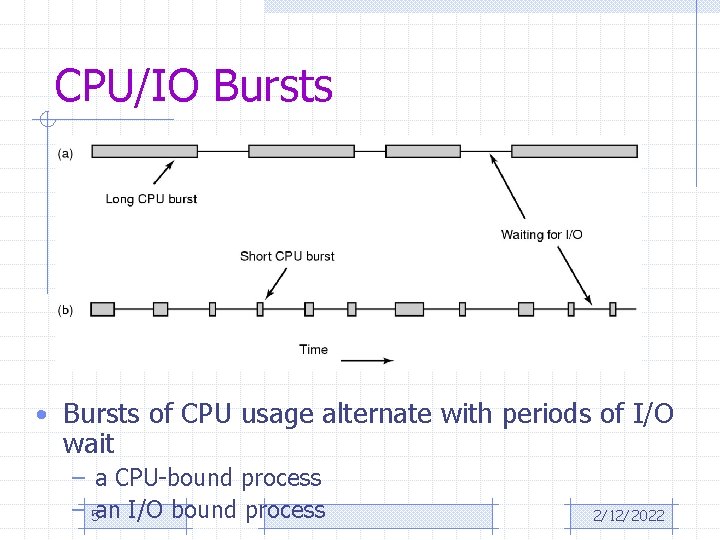
CPU/IO Bursts • Bursts of CPU usage alternate with periods of I/O wait – a CPU-bound process – 5 an I/O bound process 2/12/2022
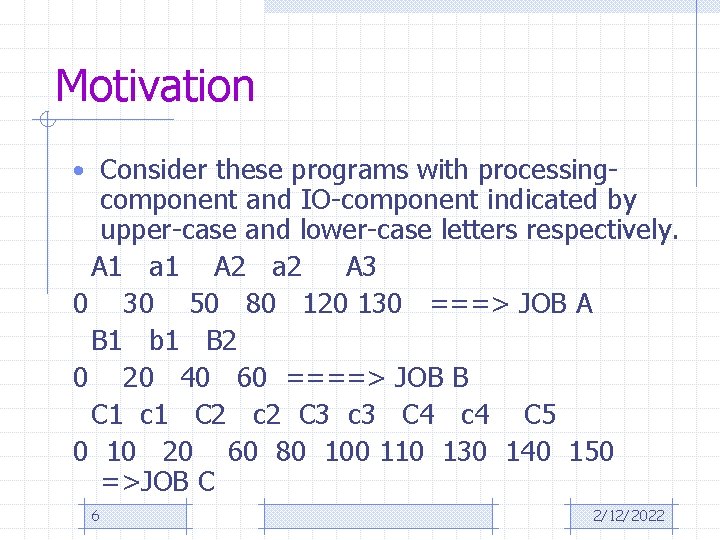
Motivation • Consider these programs with processing- component and IO-component indicated by upper-case and lower-case letters respectively. A 1 a 1 A 2 a 2 A 3 0 30 50 80 120 130 ===> JOB A B 1 b 1 B 2 0 20 40 60 ====> JOB B C 1 c 1 C 2 c 2 C 3 c 3 C 4 c 4 C 5 0 10 20 60 80 100 110 130 140 150 =>JOB C 6 2/12/2022
Motivation • The starting and ending time of each component are indicated beneath the symbolic references (A 1, b 1 etc. ) • Now lets consider three different ways for scheduling: no overlap, round-robin, simple overlap. • Compare utilization U = time CPU busy / total run time 7 2/12/2022
Scheduling Criteria • CPU utilization – keep the CPU as busy as • • possible Throughput – # of processes that complete their execution per time unit Turnaround time – amount of time to execute a particular process Waiting time – amount of time a process has been waiting in the ready queue and blocked queue Response time – amount of time it takes from when a request was submitted until the first response is produced, not output (for time-sharing environment) 8 2/12/2022
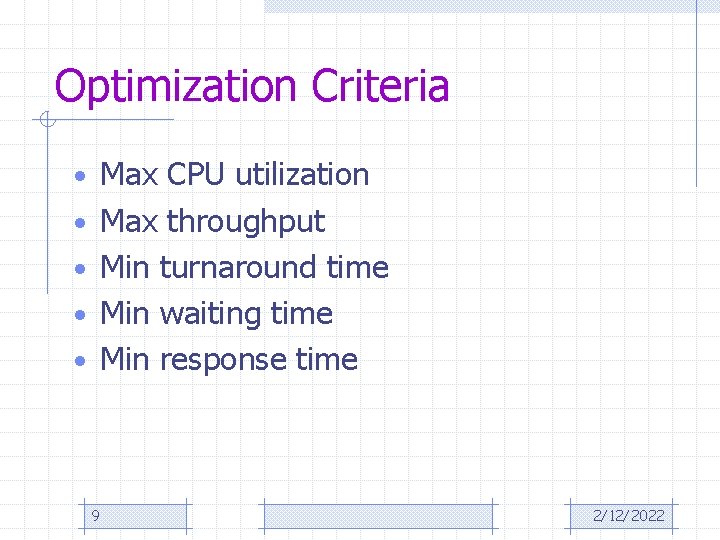
Optimization Criteria • Max CPU utilization • Max throughput • Min turnaround time • Min waiting time • Min response time 9 2/12/2022
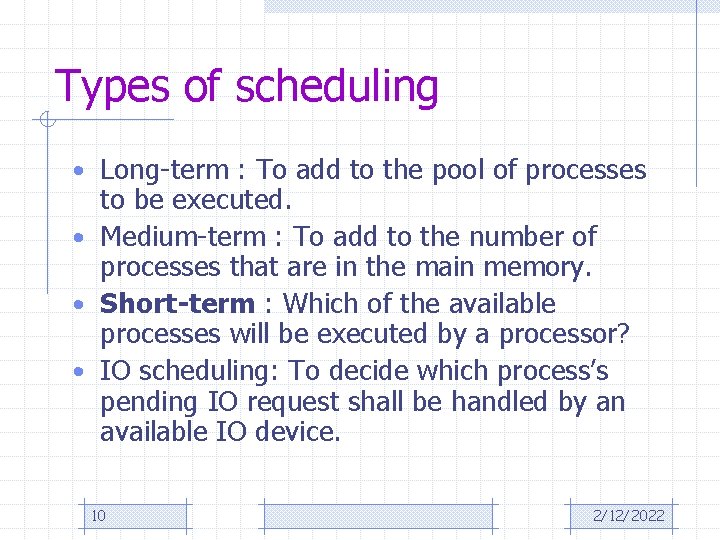
Types of scheduling • Long-term : To add to the pool of processes to be executed. • Medium-term : To add to the number of processes that are in the main memory. • Short-term : Which of the available processes will be executed by a processor? • IO scheduling: To decide which process’s pending IO request shall be handled by an available IO device. 10 2/12/2022
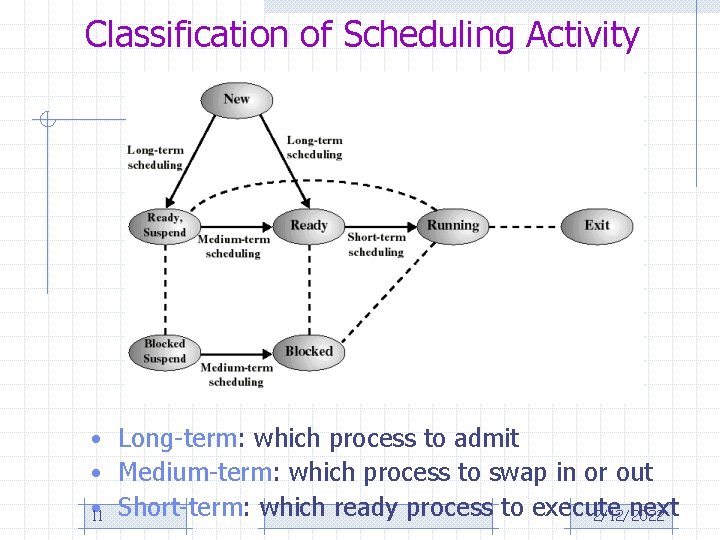
Classification of Scheduling Activity • Long-term: which process to admit • Medium-term: which process to swap in or out • Short-term: which ready process to execute next 11 2/12/2022
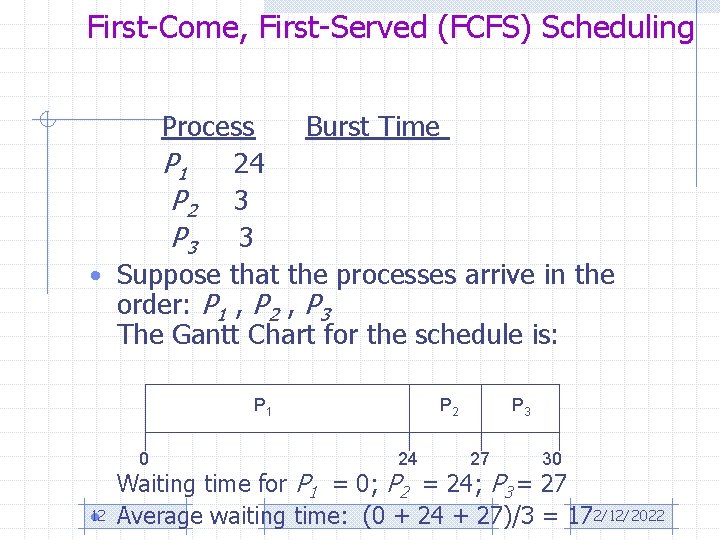
First-Come, First-Served (FCFS) Scheduling Process Burst Time P 1 24 P 2 3 P 3 3 • Suppose that the processes arrive in the order: P 1 , P 2 , P 3 The Gantt Chart for the schedule is: P 1 0 P 2 24 P 3 27 30 Waiting time for P 1 = 0; P 2 = 24; P 3 = 27 • 12 Average waiting time: (0 + 24 + 27)/3 = 172/12/2022
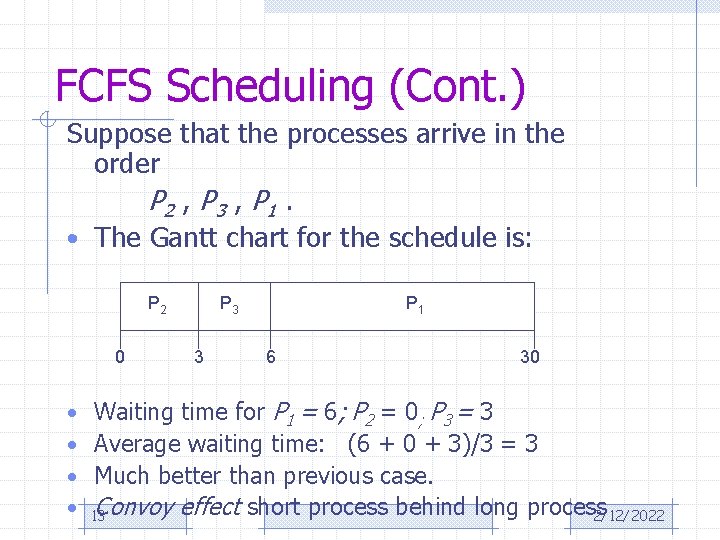
FCFS Scheduling (Cont. ) Suppose that the processes arrive in the order P 2 , P 3 , P 1. • The Gantt chart for the schedule is: P 2 0 • • P 3 3 P 1 6 30 Waiting time for P 1 = 6; P 2 = 0; P 3 = 3 Average waiting time: (6 + 0 + 3)/3 = 3 Much better than previous case. Convoy effect short process behind long process 13 2/12/2022
Shortest-Job-First (SJR) Scheduling • Associate with each process the length of its next CPU burst. Use these lengths to schedule the process with the shortest time. • Two schemes: – nonpreemptive – once CPU given to the process it cannot be preempted until completes its CPU burst. – preemptive – if a new process arrives with CPU burst length less than remaining time of current executing process, preempt. This scheme is know as the Shortest-Remaining-Time-First (SRTF). • SJF is optimal – gives minimum average waiting 14 2/12/2022 time for a given set of processes.
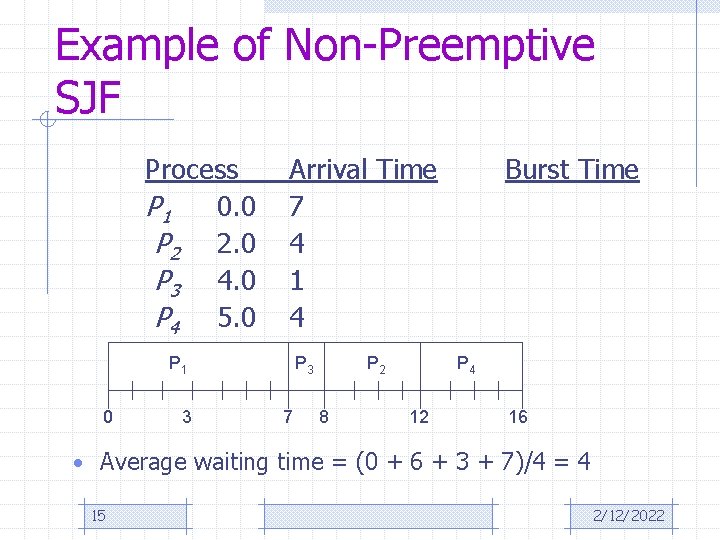
Example of Non-Preemptive SJF Process P 1 0. 0 P 2 2. 0 P 3 4. 0 P 4 5. 0 Arrival Time 7 4 1 4 P 1 0 3 P 3 7 P 2 8 Burst Time P 4 12 16 • Average waiting time = (0 + 6 + 3 + 7)/4 = 4 15 2/12/2022

Example of Preemptive SJF Process P 1 0. 0 P 2 2. 0 P 3 4. 0 P 4 5. 0 P 1 0 P 2 2 Arrival Time 7 4 1 4 P 3 4 P 2 5 P 4 7 Burst Time P 1 11 16 • 16 Average waiting time = (9 + 1 + 0 +2)/4 =3 2/12/2022
Shortest job first: critique • Possibility of starvation for longer processes as long as there is a steady supply of shorter processes • Lack of preemption is not suited in a time sharing environment – CPU bound process gets lower priority (as it should) but a process doing no I/O could still monopolize the CPU if he is the first one to enter the system • SJF implicitly incorporates priorities: shortest jobs are given preferences • The next (preemptive) algorithm penalizes directly longer jobs 17 2/12/2022
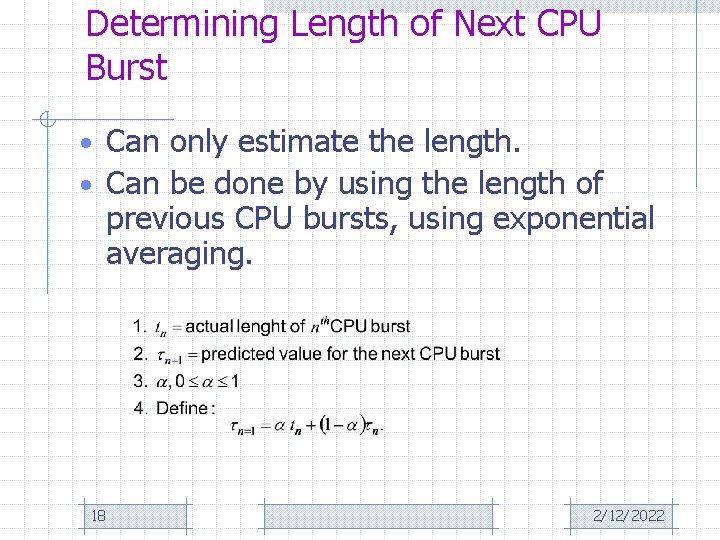
Determining Length of Next CPU Burst • Can only estimate the length. • Can be done by using the length of previous CPU bursts, using exponential averaging. 18 2/12/2022
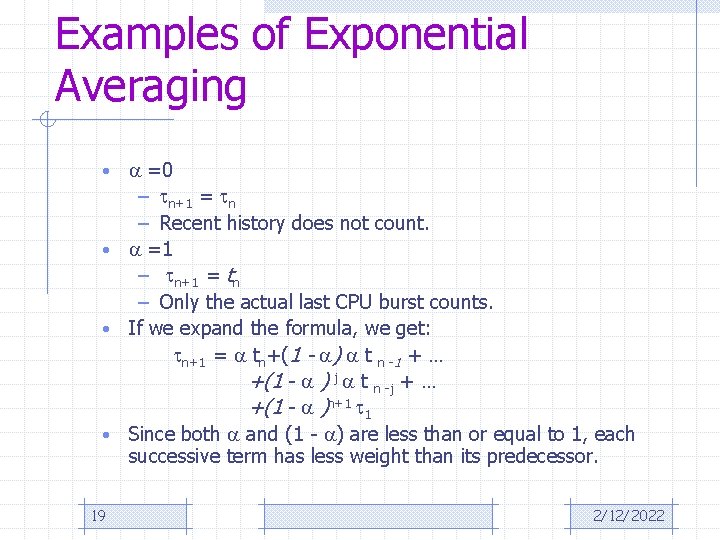
Examples of Exponential Averaging =0 – n+1 = n – Recent history does not count. • =1 – n+1 = tn – Only the actual last CPU burst counts. • If we expand the formula, we get: n+1 = tn+(1 - ) t n -1 + … +(1 - ) j t n -j + … +(1 - )n+1 1 • Since both and (1 - ) are less than or equal to 1, each successive term has less weight than its predecessor. • 19 2/12/2022
![More on Exponential Averaging • S[n+1] next burst, s[n] current burst – S[n+1] =](http://slidetodoc.com/presentation_image_h2/aea86d46e3136f2efd79e1d8a1145a98/image-20.jpg "More on Exponential Averaging • S[n+1] next burst, s[n] current burst – S[n+1] =")
More on Exponential Averaging • S[n+1] next burst, s[n] current burst – S[n+1] = T[n] + (1 - ) S[n] ; 0 < < 1 – more weight is put on recent instances whenever > 1/n • By expanding this eqn, we see that weights of past instances are decreasing exponentially – S[n+1] = T[n] + (1 - ) T[n-1] +. . . (1 - )i T[n-i] +. . . + (1 - )n. S[1] – predicted value of 1 st instance S[1] is not calculated; usually set to 0 to give priority to to new processes 20 2/12/2022
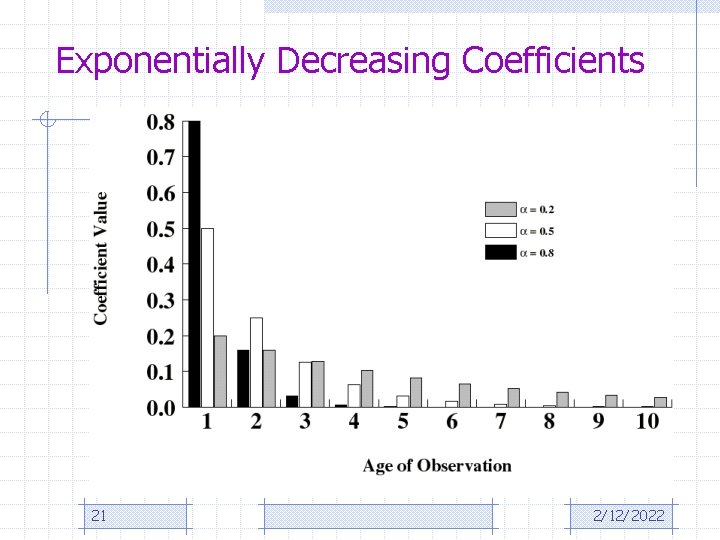
Exponentially Decreasing Coefficients 21 2/12/2022
Priority Scheduling • • • A priority number (integer) is associated with each process The CPU is allocated to the process with the highest priority (smallest integer highest priority). – Preemptive – nonpreemptive SJF is a priority scheduling where priority is the predicted next CPU burst time. Problem Starvation – low priority processes may never execute. Solution Aging – as time progresses increase the priority of the process. 22 2/12/2022
Round Robin (RR) • Each process gets a small unit of CPU time (time quantum), usually 10 -100 milliseconds. After this time has elapsed, the process is preempted and added to the end of the ready queue. • If there are n processes in the ready queue and the time quantum is q, then each process gets 1/n of the CPU time in chunks of at most q time units at once. No process waits more than (n-1)q time units. • Performance – q large FIFO – q small q must be large with respect to context switch, otherwise overhead is too 2/12/2022 high. 23
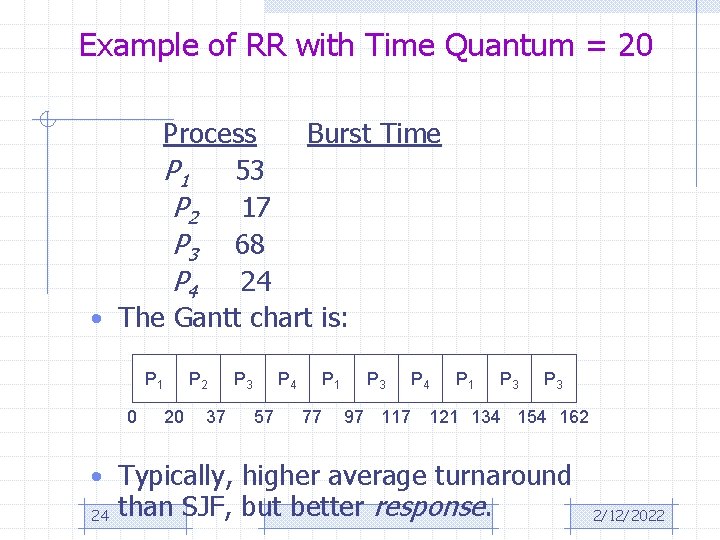
Example of RR with Time Quantum = 20 Process Burst Time P 1 53 P 2 17 P 3 68 P 4 24 • The Gantt chart is: P 1 0 P 2 20 37 P 3 P 4 57 P 1 77 P 3 P 4 P 1 P 3 97 117 121 134 154 162 • Typically, higher average turnaround 24 than SJF, but better response. 2/12/2022
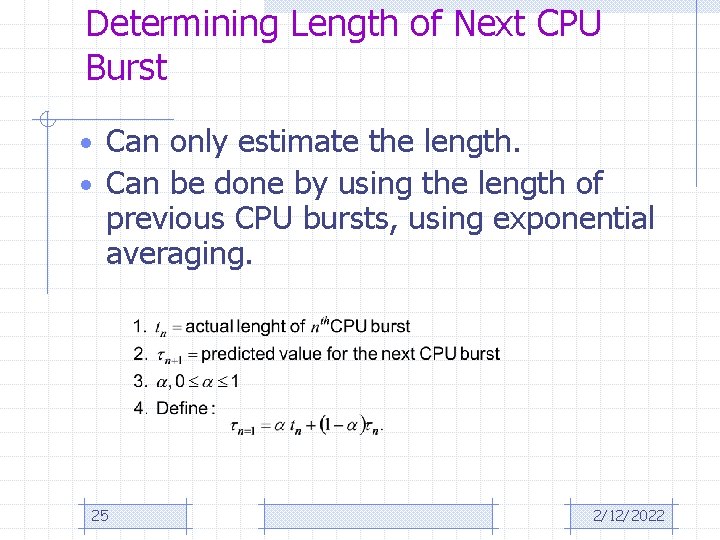
Determining Length of Next CPU Burst • Can only estimate the length. • Can be done by using the length of previous CPU bursts, using exponential averaging. 25 2/12/2022
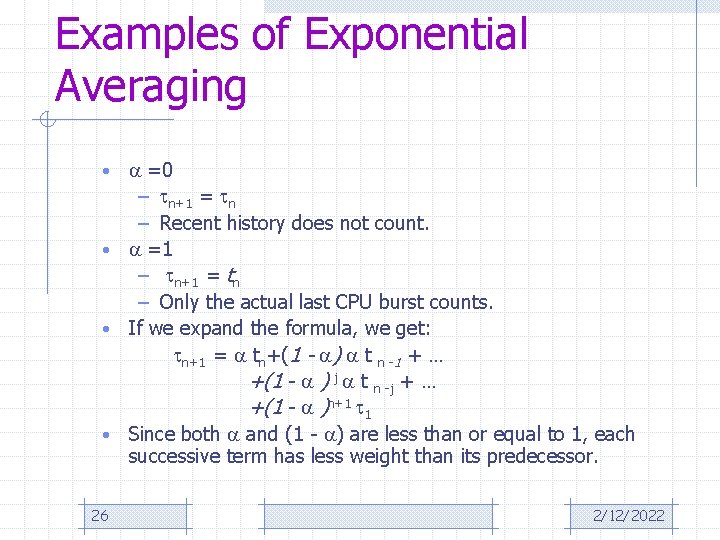
Examples of Exponential Averaging =0 – n+1 = n – Recent history does not count. • =1 – n+1 = tn – Only the actual last CPU burst counts. • If we expand the formula, we get: n+1 = tn+(1 - ) t n -1 + … +(1 - ) j t n -j + … +(1 - )n+1 1 • Since both and (1 - ) are less than or equal to 1, each successive term has less weight than its predecessor. • 26 2/12/2022
![More on Exponential Averaging • S[n+1] next burst, s[n] current burst – S[n+1] =](http://slidetodoc.com/presentation_image_h2/aea86d46e3136f2efd79e1d8a1145a98/image-27.jpg "More on Exponential Averaging • S[n+1] next burst, s[n] current burst – S[n+1] =")
More on Exponential Averaging • S[n+1] next burst, s[n] current burst – S[n+1] = T[n] + (1 - ) S[n] ; 0 < < 1 – more weight is put on recent instances whenever > 1/n • By expanding this eqn, we see that weights of past instances are decreasing exponentially – S[n+1] = T[n] + (1 - ) T[n-1] +. . . (1 - )i T[n-i] +. . . + (1 - )n. S[1] – predicted value of 1 st instance S[1] is not calculated; usually set to 0 to give priority to to new processes 27 2/12/2022
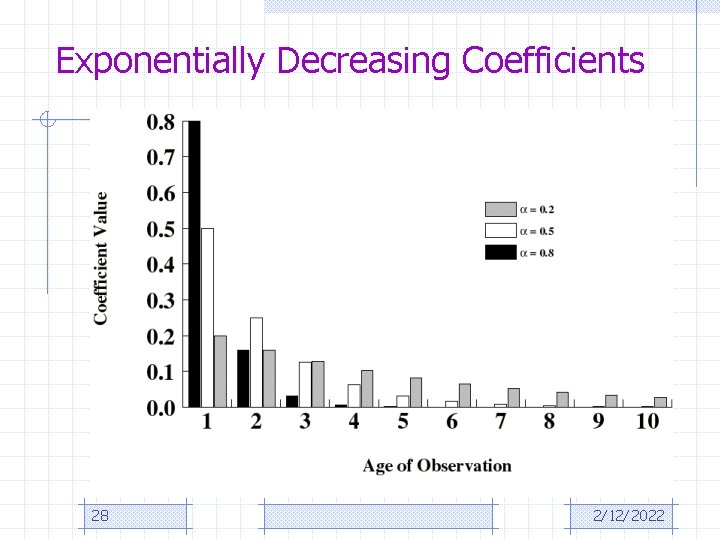
Exponentially Decreasing Coefficients 28 2/12/2022
Summary • Scheduling is important for improving the system performance. • Methods of prediction play an important role in Operating system and network functions. • Simulation is a way of experimentally evaluating the performance of a technique. 29 2/12/2022
- Slides: 29