
Process Safety Performance Indicators API 754 Revision Committee

- Slides: 11
Process Safety Performance Indicators API 754 – Revision Committee January 29, 2020 Rodney Reibold PE, CPSP Marathon Petroleum 1220 L Street, NW • Washington, DC 20005 -4070 • www. api. org
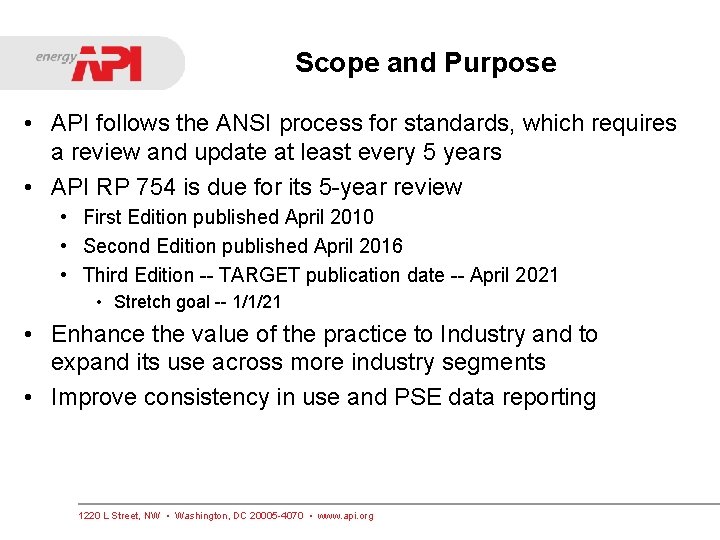
Scope and Purpose • API follows the ANSI process for standards, which requires a review and update at least every 5 years • API RP 754 is due for its 5 -year review • First Edition published April 2010 • Second Edition published April 2016 • Third Edition -- TARGET publication date -- April 2021 • Stretch goal -- 1/1/21 • Enhance the value of the practice to Industry and to expand its use across more industry segments • Improve consistency in use and PSE data reporting 1220 L Street, NW • Washington, DC 20005 -4070 • www. api. org
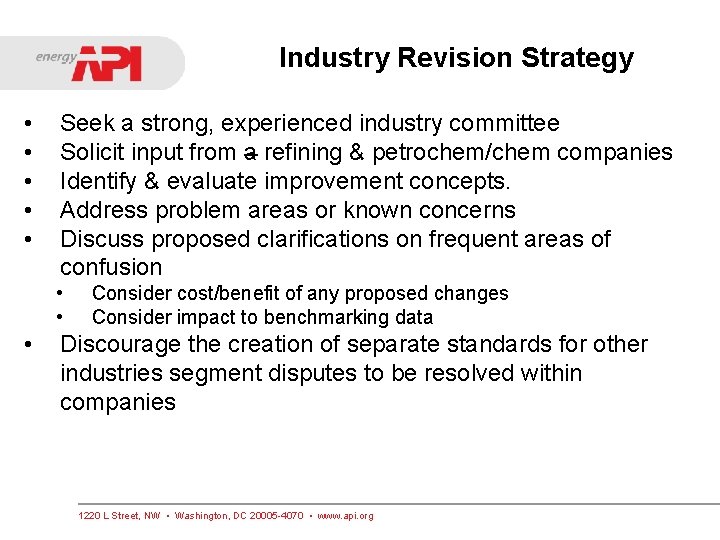
Industry Revision Strategy • • • Seek a strong, experienced industry committee Solicit input from a refining & petrochem/chem companies Identify & evaluate improvement concepts. Address problem areas or known concerns Discuss proposed clarifications on frequent areas of confusion • • • Consider cost/benefit of any proposed changes Consider impact to benchmarking data Discourage the creation of separate standards for other industries segment disputes to be resolved within companies 1220 L Street, NW • Washington, DC 20005 -4070 • www. api. org
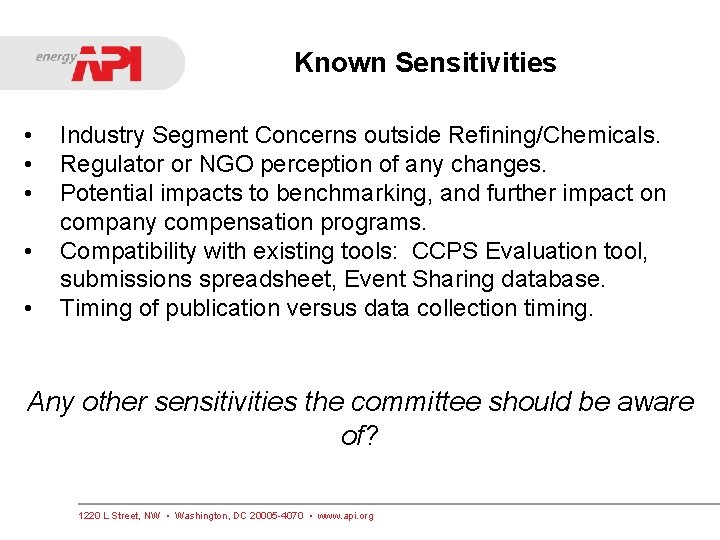
Known Sensitivities • • • Industry Segment Concerns outside Refining/Chemicals. Regulator or NGO perception of any changes. Potential impacts to benchmarking, and further impact on company compensation programs. Compatibility with existing tools: CCPS Evaluation tool, submissions spreadsheet, Event Sharing database. Timing of publication versus data collection timing. Any other sensitivities the committee should be aware of? 1220 L Street, NW • Washington, DC 20005 -4070 • www. api. org
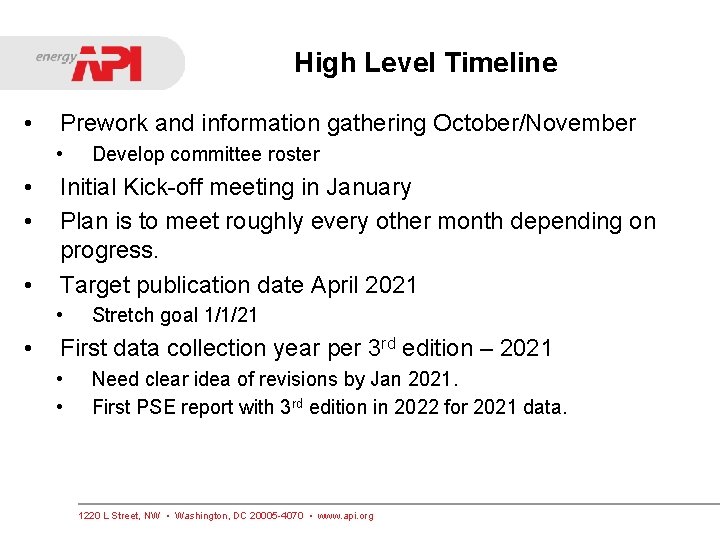
High Level Timeline • Prework and information gathering October/November • • Initial Kick-off meeting in January Plan is to meet roughly every other month depending on progress. Target publication date April 2021 • • Develop committee roster Stretch goal 1/1/21 First data collection year per 3 rd edition – 2021 • • Need clear idea of revisions by Jan 2021. First PSE report with 3 rd edition in 2022 for 2021 data. 1220 L Street, NW • Washington, DC 20005 -4070 • www. api. org
Soliciting Committee Members and Input • API has already issued the Announcement of Revision via ANSI, soliciting interested committee members. • Issued survey to gather input for input from refining & petrochem/chemical industry prior to engaging full revision committee. 1220 L Street, NW • Washington, DC 20005 -4070 • www. api. org
Outreach Activities • Pipeline Interests • 754 Chair and API staff to have call with API Pipeline and Pipeline Awards committee chairs • Inviting Canadian Standards Association reps to 754 Revision Committee • API staff communication • Petrochemicals • AFPM members can participate in 754 Interpretations Group and strategy meeting(s) • API presented to ACC Process Safety Committee Sept. 17 • API attended ACC Process Safety Committee in November • API staff meeting with ACC staff on data collection and overall process safety work • Upstream • IOGP member of 754 QAQC team invited to revision committee • API staff communication 1220 L Street, NW • Washington, DC 20005 -4070 • www. api. org
Known Potential Review Areas Examples: • Allow space for some exposure injuries to be categorized as occupational. • Corrosives released into secondary containment. • $2500 Direct Cost threshold for Tier 2 PSE. • Reconsider “Primary and Secondary Containment” • Consistency of FAQs and disposition of non-normative FAQs. • Variability in Crude oil classification (TRC 5, 6, or 7) • Fire damage vs threshold quantity • Clarifications • • Indoor vs outdoor Safe Location Secondary containment as related to Severity Direct cost 1220 L Street, NW • Washington, DC 20005 -4070 • www. api. org
Guiding Principles 1. The resulting data should drive performance and drive learning (test throughout development process); the indicator must be meaningful. 2. Statistically valid at industry, corporate and site level for trending and comparison; data may still be valuable for reporting, even if not statistically valid. 3. Strive for simplicity; the indicator be easy to implement and easily understood by workers and the public. 4. The indicators should be broadly applicable to different facilities and countries (e. g. , refining, chemicals, pipelines, exploration and production, PSM/major hazard facilities, unregulated facilities). 5. It should provide easily auditable results (may vary based on the tier of the pyramid) —objective, repeatable, consistent reporting by knowledgeable people. 6. Build in an assessment of the indicators to determine if they drive performance and drive learning. 7. Ensure communication and reality check with disciplinary/technical experts (statisticians, legal, etc. ) and senior executives, other labor groups, union, nonunion, contractor, civic organizations, LEPCs, federal and state agencies. 8. Ensure there is a distinction/separation between indicators for public reporting and indicators that are site-specific. 9. Consider/allow for grouping in presentation of results by sector. 1220 L Street, NW • Washington, DC 20005 -4070 • www. api. org
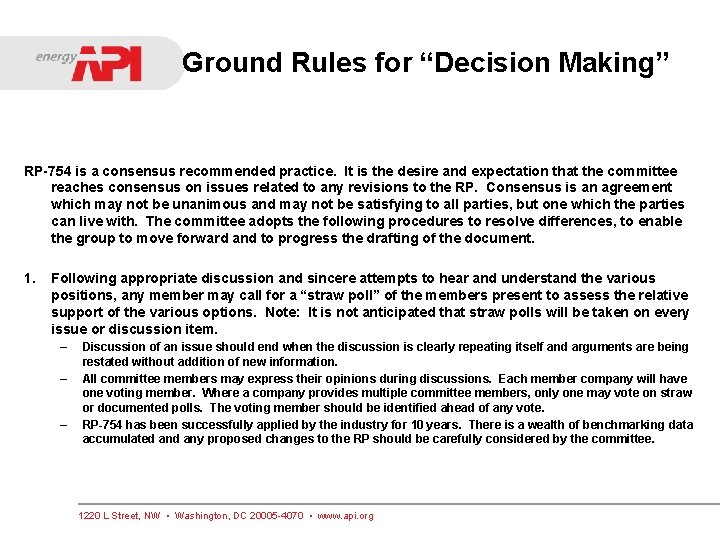
Ground Rules for “Decision Making” RP-754 is a consensus recommended practice. It is the desire and expectation that the committee reaches consensus on issues related to any revisions to the RP. Consensus is an agreement which may not be unanimous and may not be satisfying to all parties, but one which the parties can live with. The committee adopts the following procedures to resolve differences, to enable the group to move forward and to progress the drafting of the document. 1. Following appropriate discussion and sincere attempts to hear and understand the various positions, any member may call for a “straw poll” of the members present to assess the relative support of the various options. Note: It is not anticipated that straw polls will be taken on every issue or discussion item. – – – Discussion of an issue should end when the discussion is clearly repeating itself and arguments are being restated without addition of new information. All committee members may express their opinions during discussions. Each member company will have one voting member. Where a company provides multiple committee members, only one may vote on straw or documented polls. The voting member should be identified ahead of any vote. RP-754 has been successfully applied by the industry for 10 years. There is a wealth of benchmarking data accumulated any proposed changes to the RP should be carefully considered by the committee. 1220 L Street, NW • Washington, DC 20005 -4070 • www. api. org
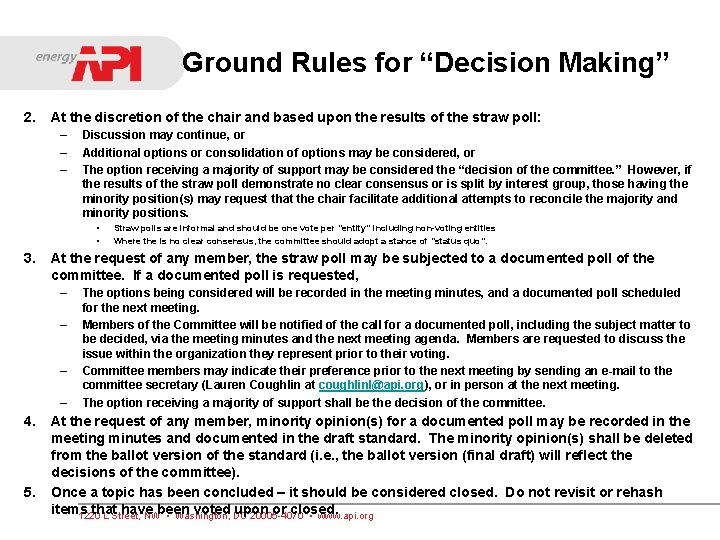
Ground Rules for “Decision Making” 2. At the discretion of the chair and based upon the results of the straw poll: – – – Discussion may continue, or Additional options or consolidation of options may be considered, or The option receiving a majority of support may be considered the “decision of the committee. ” However, if the results of the straw poll demonstrate no clear consensus or is split by interest group, those having the minority position(s) may request that the chair facilitate additional attempts to reconcile the majority and minority positions. • • 3. At the request of any member, the straw poll may be subjected to a documented poll of the committee. If a documented poll is requested, – – 4. 5. Straw polls are informal and should be one vote per “entity” including non-voting entities Where the is no clear consensus, the committee should adopt a stance of “status quo”. The options being considered will be recorded in the meeting minutes, and a documented poll scheduled for the next meeting. Members of the Committee will be notified of the call for a documented poll, including the subject matter to be decided, via the meeting minutes and the next meeting agenda. Members are requested to discuss the issue within the organization they represent prior to their voting. Committee members may indicate their preference prior to the next meeting by sending an e-mail to the committee secretary (Lauren Coughlin at coughlinl@api. org), or in person at the next meeting. The option receiving a majority of support shall be the decision of the committee. At the request of any member, minority opinion(s) for a documented poll may be recorded in the meeting minutes and documented in the draft standard. The minority opinion(s) shall be deleted from the ballot version of the standard (i. e. , the ballot version (final draft) will reflect the decisions of the committee). Once a topic has been concluded – it should be considered closed. Do not revisit or rehash items that have been voted upon or closed. 1220 L Street, NW • Washington, DC 20005 -4070 • www. api. org