
Process Operability Class Materials Process Troubleshooting Basic flowsheet
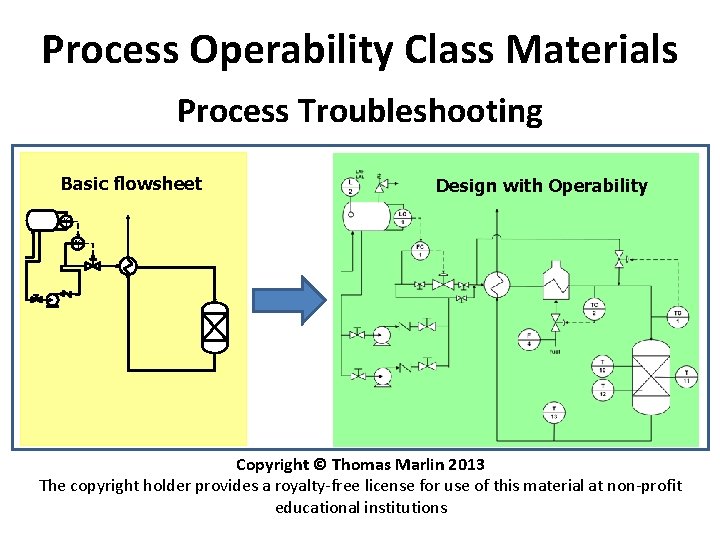
Process Operability Class Materials Process Troubleshooting Basic flowsheet Design with Operability LC 1 FC 1 Copyright © Thomas Marlin 2013 The copyright holder provides a royalty-free license for use of this material at non-profit educational institutions
TROUBLE SHOOTING IN THE PROCESS INDUSTRIES A “bread and butter” skill for all chemical engineers! No systematic method. No way to focus technical knowledge. Uses systematic TS method and builds technical knowledge through experience.
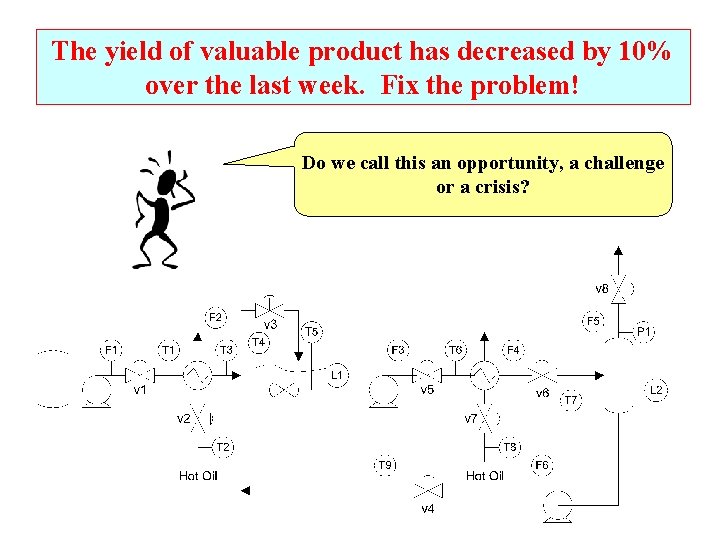
The yield of valuable product has decreased by 10% over the last week. Fix the problem! Do we call this an opportunity, a challenge or a crisis?
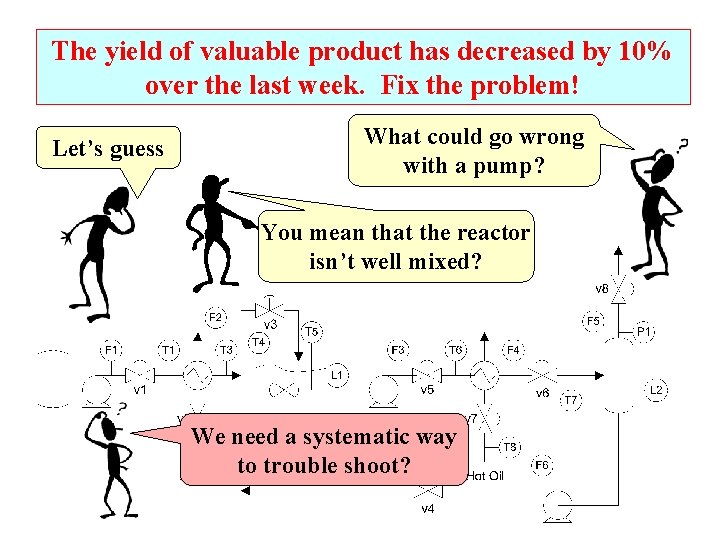
The yield of valuable product has decreased by 10% over the last week. Fix the problem! Let’s guess What could go wrong with a pump? You mean that the reactor isn’t well mixed? We need a systematic way to trouble shoot?
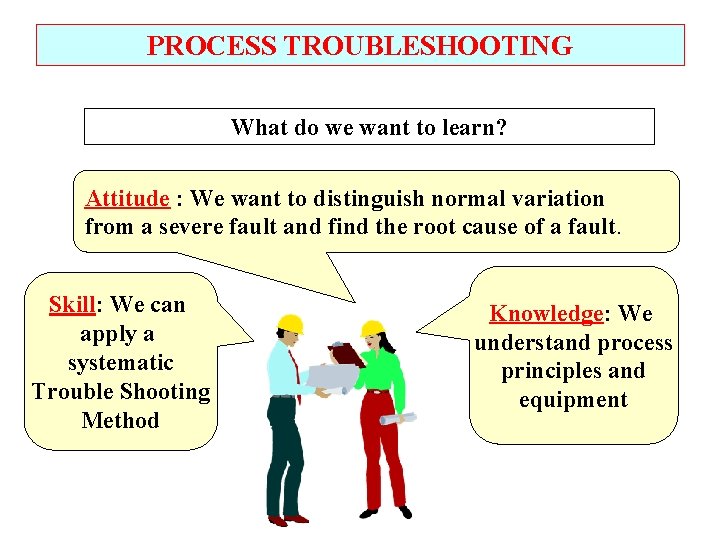
PROCESS TROUBLESHOOTING What do we want to learn? Attitude : We want to distinguish normal variation from a severe fault and find the root cause of a fault. Skill: We can apply a systematic Trouble Shooting Method Knowledge: We understand process principles and equipment
What is Trouble Shooting? • Application of Problem Solving methods to the diagnosis and improvement after deviations occur in a system. We do this in our every-day lives all the time Why doesn’t the printout look like the screen display? We only have 30 minutes to hand in our laboratory report!
PROCESS TROUBLESHOOTING A WORTHWHILE EDUCATIONAL TOPIC Can we teach Trouble Shooting? • People improve with experience and education • Students benefit from a systematic method and early experience • TS motivates and guides learning of process principles and designs that can be easily monitored • TS gives new insights for life-long skill improvement
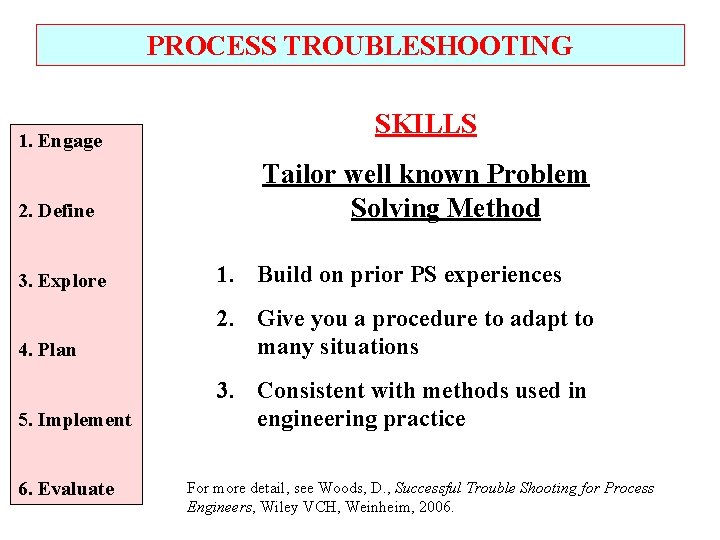
PROCESS TROUBLESHOOTING 1. Engage 2. Define SKILLS Tailor well known Problem Solving Method 3. Explore 1. Build on prior PS experiences 4. Plan 2. Give you a procedure to adapt to many situations 5. Implement 3. Consistent with methods used in engineering practice 6. Evaluate For more detail, see Woods, D. , Successful Trouble Shooting for Process Engineers, Wiley VCH, Weinheim, 2006.
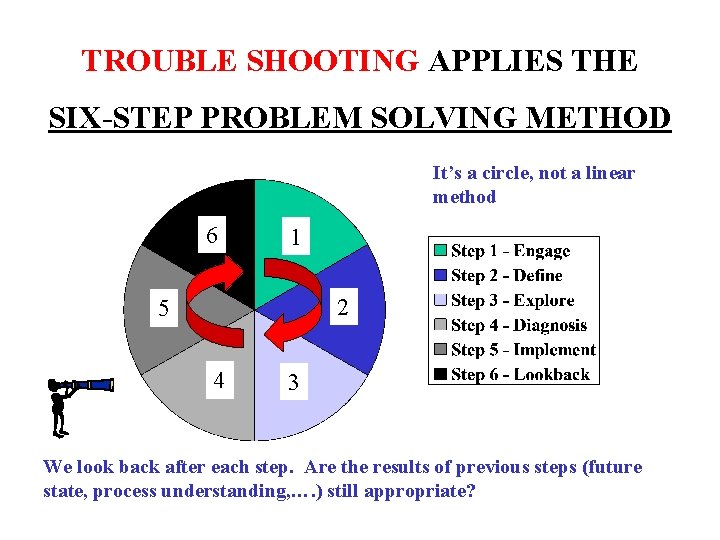
TROUBLE SHOOTING APPLIES THE SIX-STEP PROBLEM SOLVING METHOD It’s a circle, not a linear method 6 1 2 5 4 3 We look back after each step. Are the results of previous steps (future state, process understanding, …. ) still appropriate?
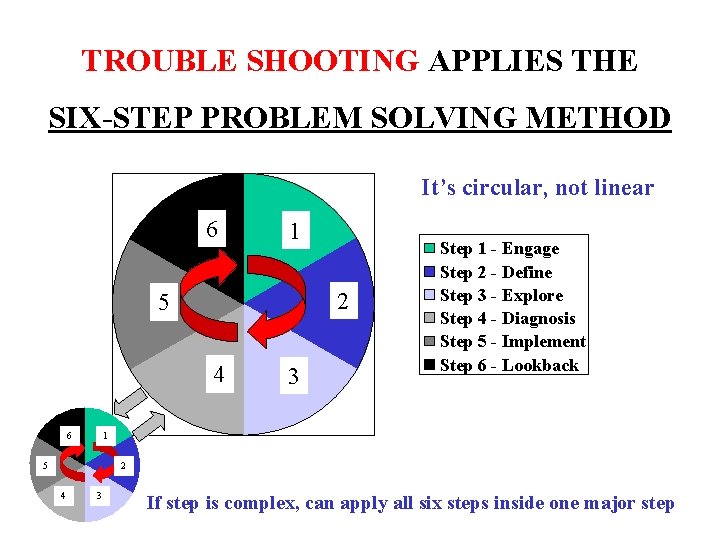
TROUBLE SHOOTING APPLIES THE SIX-STEP PROBLEM SOLVING METHOD It’s circular, not linear 6 1 2 5 4 6 3 Step 1 - Engage Step 2 - Define Step 3 - Explore Step 4 - Diagnosis Step 5 - Implement Step 6 - Lookback 1 5 2 4 3 If step is complex, can apply all six steps inside one major step
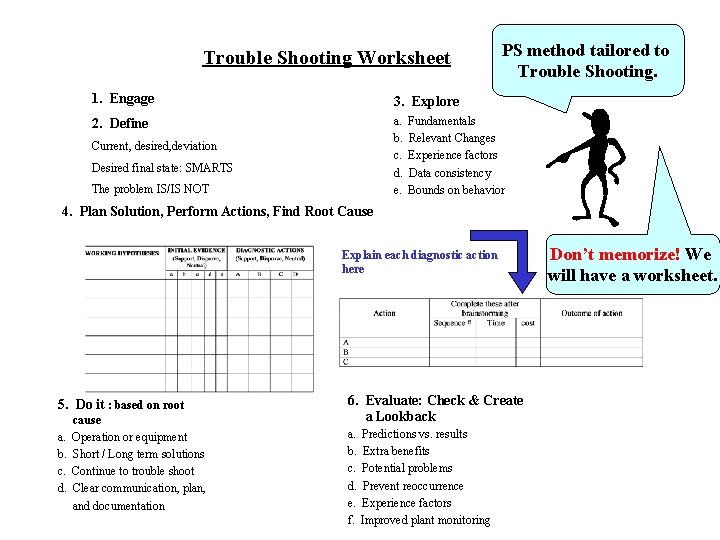
Trouble Shooting Worksheet 1. Engage 3. Explore 2. Define a. b. c. d. e. Current, desired, deviation Desired final state: SMARTS The problem IS/IS NOT PS method tailored to Trouble Shooting. Fundamentals Relevant Changes Experience factors Data consistency Bounds on behavior 4. Plan Solution, Perform Actions, Find Root Cause Explain each diagnostic action here 5. Do it : based on root a. b. c. d. cause Operation or equipment Short / Long term solutions Continue to trouble shoot Clear communication, plan, and documentation 6. Evaluate: Check & Create a Lookback a. b. c. d. e. f. Predictions vs. results Extra benefits Potential problems Prevent reoccurrence Experience factors Improved plant monitoring Don’t memorize! We will have a worksheet.
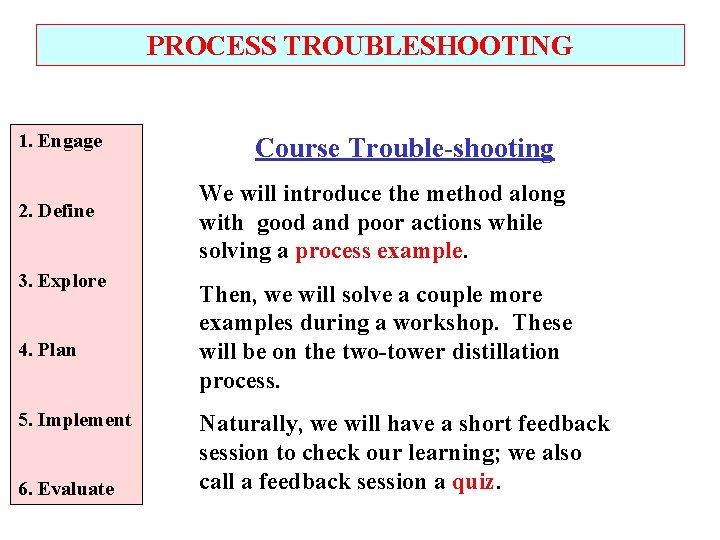
PROCESS TROUBLESHOOTING 1. Engage 2. Define 3. Explore 4. Plan 5. Implement 6. Evaluate Course Trouble-shooting We will introduce the method along with good and poor actions while solving a process example. Then, we will solve a couple more examples during a workshop. These will be on the two-tower distillation process. Naturally, we will have a short feedback session to check our learning; we also call a feedback session a quiz.
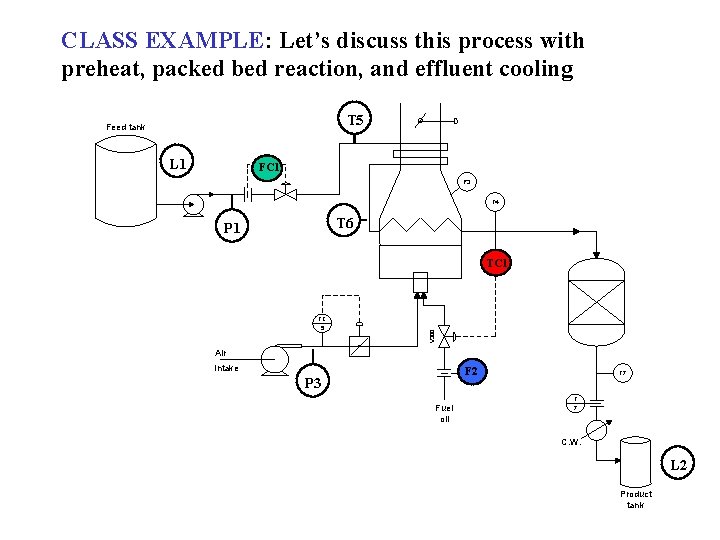
CLASS EXAMPLE: Let’s discuss this process with preheat, packed bed reaction, and effluent cooling T 5 Feed tank L 1 FC 1 P 3 T 4 T 6 P 1 TC FC 5 V 300 3 TC 1 Air Intake F 2 F 2 P 3 Fuel oil T 7 F 7 C. W. L 2 Product tank
CLASS EXAMPLE: Fired Heater Scenario You are working at your first job, in which you are responsible for the chemical plant in Figure 1. Good news, the market for your product has been increasing. During the morning meeting, you have asked the operator to slowly increase the feed flow rate. In addition, the maintenance group will be calibrating all flow meters this week. In the afternoon, you are visiting the control room to check on the instrumentation maintenance. The technicians have completed two sensors and are on a break. The operator notes that the plant changed feed tanks recently. One of the outside operators has reported an unusual smell around the feed pump. The control room operator asks for your assistance. She shows you the trend of data in the figure. This doesn’t look usual to you, and she believes that it is caused by improper behavior of the stack damper. Fortunately, you learned trouble-shooting skills in university. Now, you can combine your skills with the operator’s insights to solve the problem.
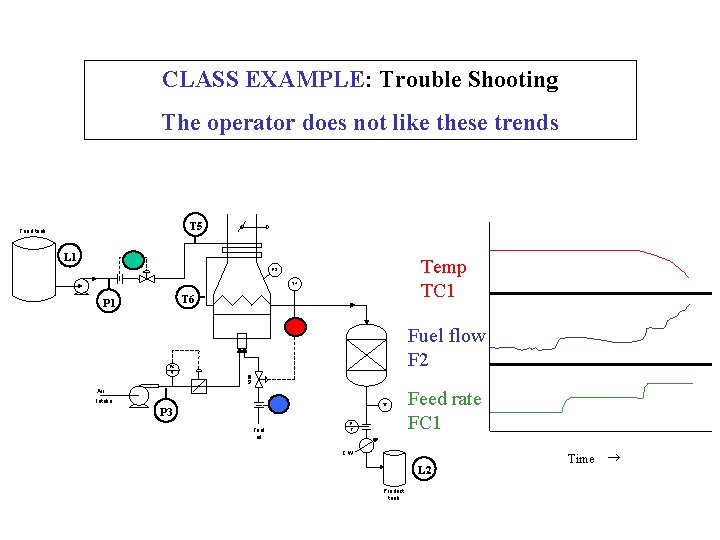
CLASS EXAMPLE: Trouble Shooting The operator does not like these trends T 5 Feed tank L 1 FC 1 Temp TC 1 P 3 T 4 T 6 P 1 TC 3 V 300 FC 5 Fuel flow F 2 Air Intake F 2 P 3 Fuel oil T 7 Feed rate FC 1 C. W. L 2 Product tank Time ®
PROCESS TROUBLESHOOTING 1. Engage 2. Define Deal with emotions Manage stress 3. Explore 4. Plan 5. Implement 6. Evaluate First few times we won’t achieve perfection
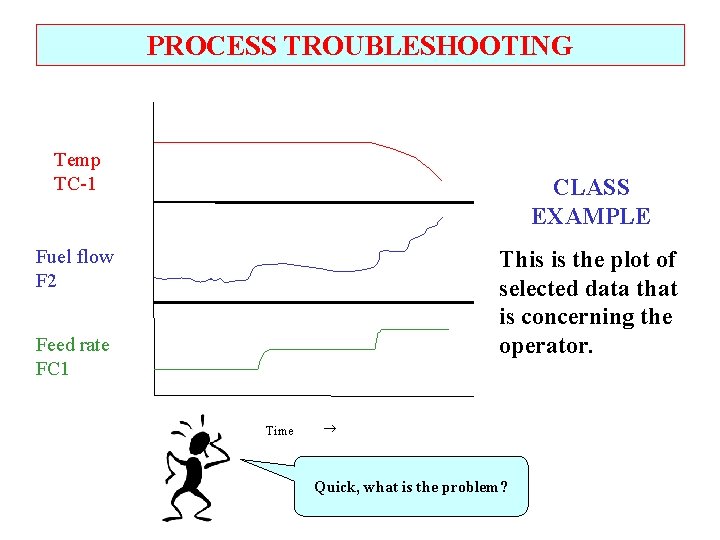
PROCESS TROUBLESHOOTING Temp TC-1 CLASS EXAMPLE Fuel flow F 2 This is the plot of selected data that is concerning the operator. Feed rate FC 1 Time ® Quick, what is the problem?
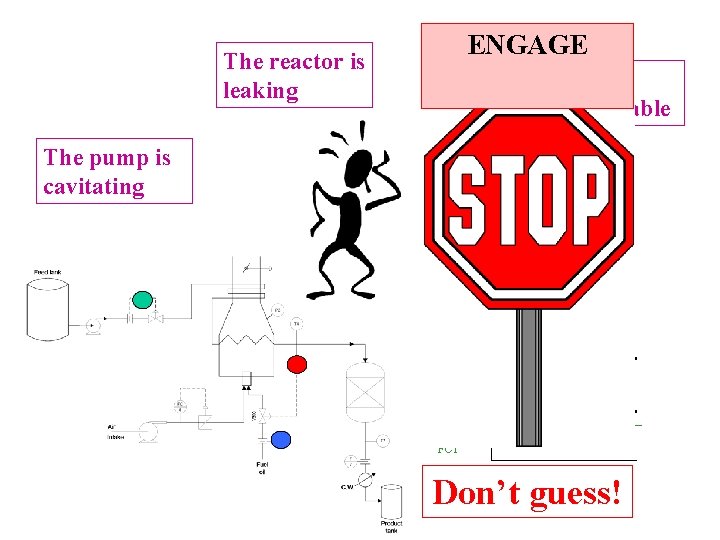
The reactor is leaking ENGAGE The control system is unstable The pump is cavitating Aliens have landed! Temp TC 1 Fuel flow F 2 Feed rate FC 1 Don’t guess! Time ®
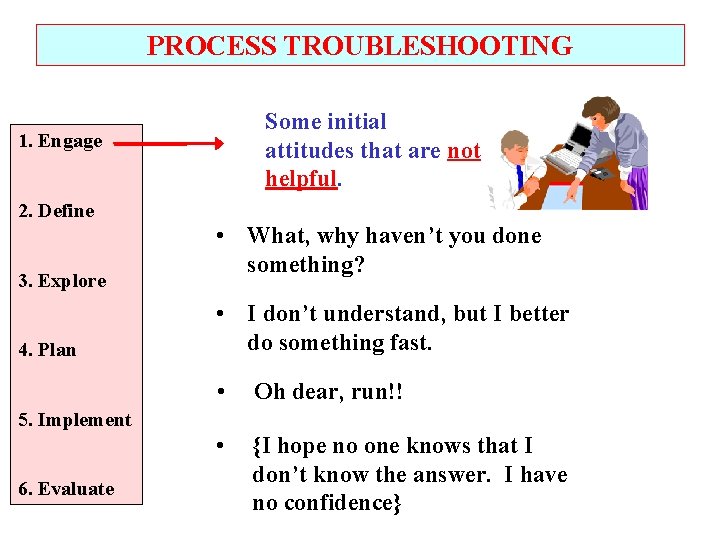
PROCESS TROUBLESHOOTING Some initial attitudes that are not helpful. 1. Engage 2. Define 3. Explore 4. Plan • What, why haven’t you done something? • I don’t understand, but I better do something fast. • Oh dear, run!! • {I hope no one knows that I don’t know the answer. I have no confidence} 5. Implement 6. Evaluate
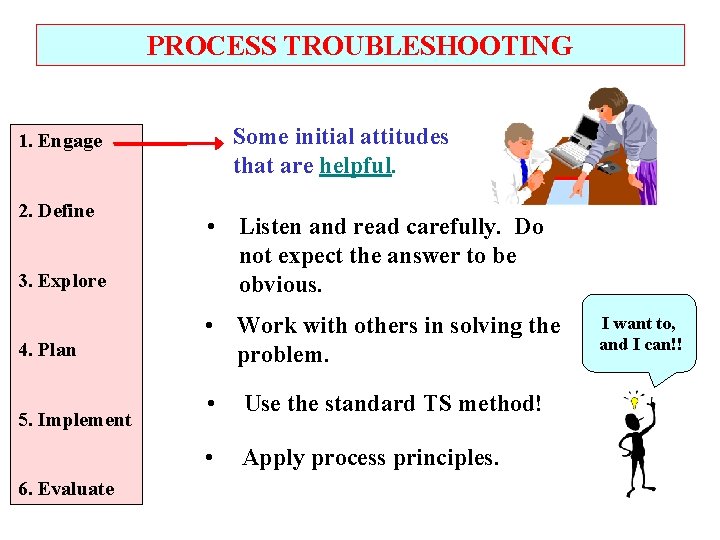
PROCESS TROUBLESHOOTING Some initial attitudes that are helpful. 1. Engage 2. Define 3. Explore • Listen and read carefully. Do not expect the answer to be obvious. 4. Plan • Work with others in solving the problem. 5. Implement 6. Evaluate • Use the standard TS method! • Apply process principles. I want to, and I can!!
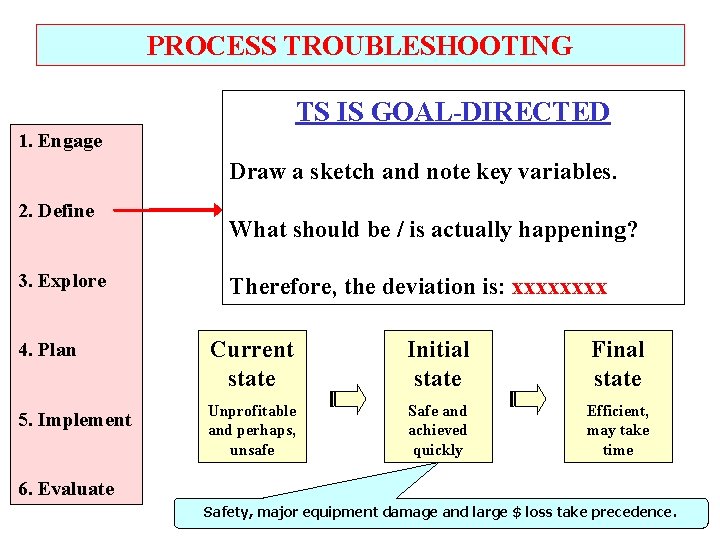
PROCESS TROUBLESHOOTING TS IS GOAL-DIRECTED 1. Engage Draw a sketch and note key variables. 2. Define 3. Explore What should be / is actually happening? Therefore, the deviation is: xxxx 4. Plan Current state Initial state Final state 5. Implement Unprofitable and perhaps, unsafe Safe and achieved quickly Efficient, may take time 6. Evaluate Safety, major equipment damage and large $ loss take precedence.
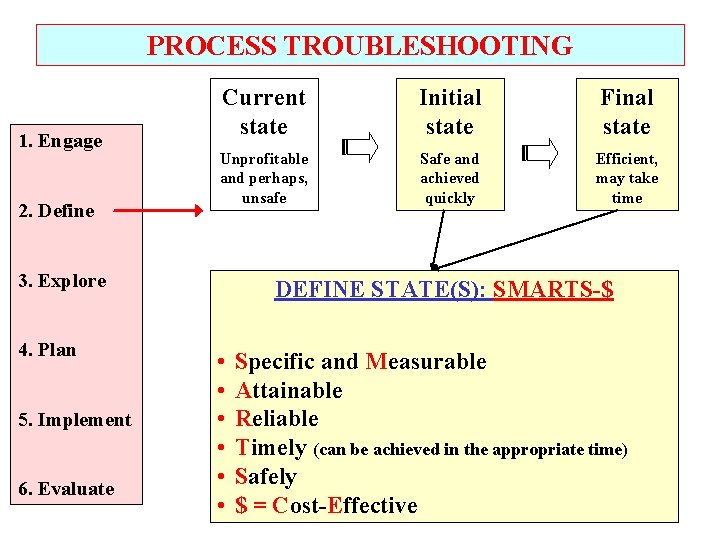
PROCESS TROUBLESHOOTING 1. Engage 2. Define Current state Initial state Final state Unprofitable and perhaps, unsafe Safe and achieved quickly Efficient, may take time 3. Explore 4. Plan 5. Implement 6. Evaluate DEFINE STATE(S): SMARTS-$ • • • Specific and Measurable Attainable Reliable Timely (can be achieved in the appropriate time) Safely $ = Cost-Effective
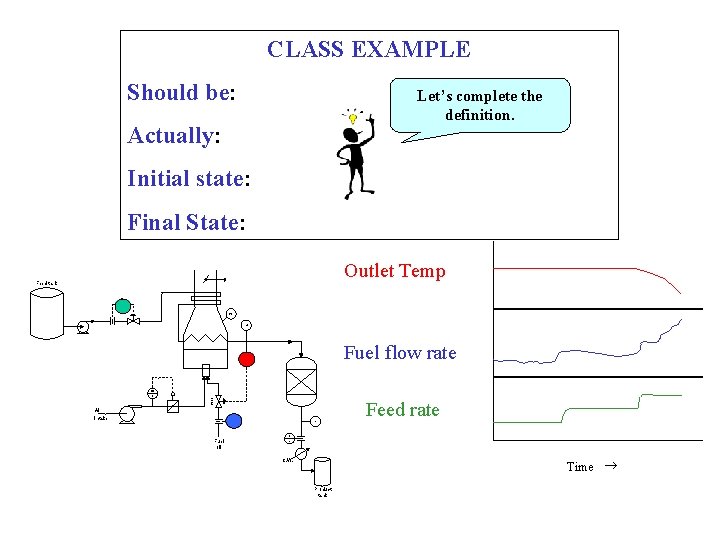
CLASS EXAMPLE Should be: Let’s complete the definition. Actually: Initial state: Final State: Outlet Temp Feed tank FC 1 P 3 T 4 Fuel flow rate TC 3 FC V 300 5 Air Intake F T 7 2 Feed rate F Fuel oil 7 Time ® C. W. Product tank
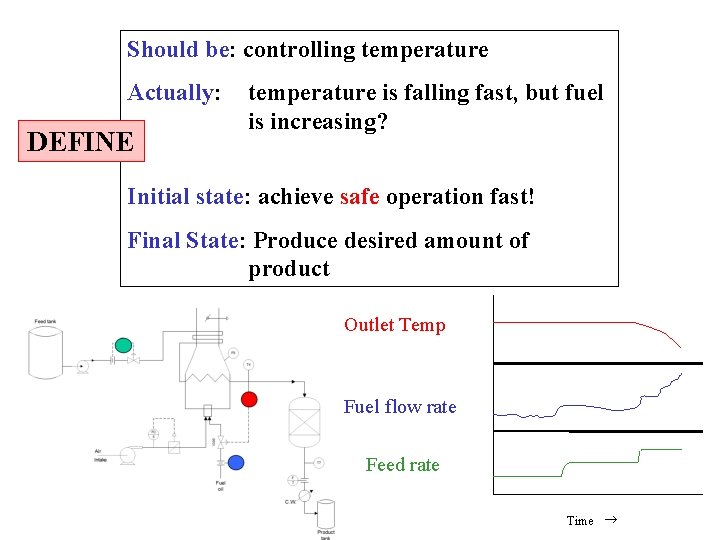
Should be: controlling temperature Actually: DEFINE temperature is falling fast, but fuel is increasing? Initial state: achieve safe operation fast! Final State: Produce desired amount of product Outlet Temp Fuel flow rate Feed rate Time ®
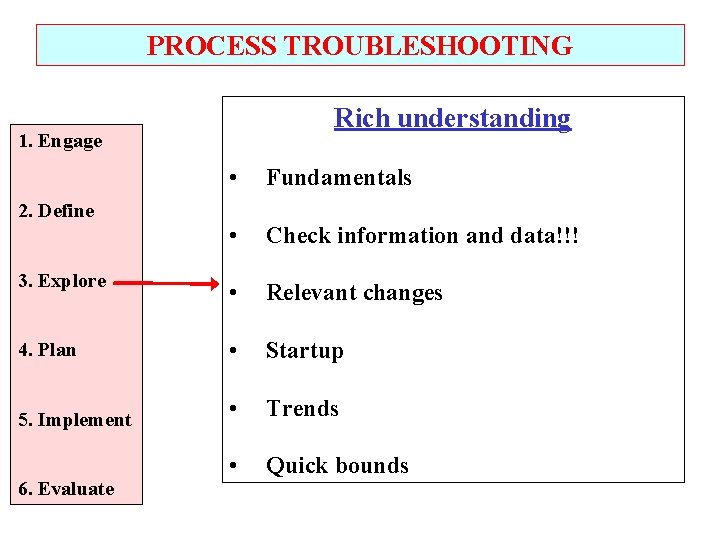
PROCESS TROUBLESHOOTING Rich understanding 1. Engage • Fundamentals • Check information and data!!! 3. Explore • Relevant changes 4. Plan • Startup 5. Implement • Trends • Quick bounds 2. Define 6. Evaluate
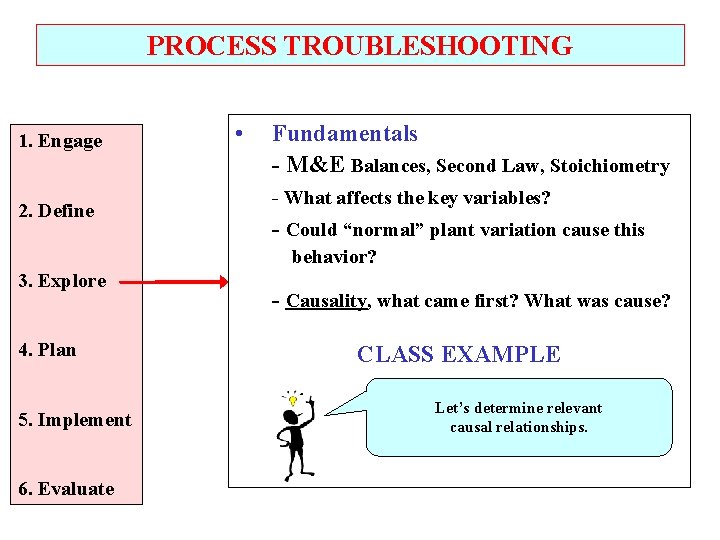
PROCESS TROUBLESHOOTING 1. Engage 2. Define • Fundamentals - M&E Balances, Second Law, Stoichiometry - What affects the key variables? - Could “normal” plant variation cause this behavior? 3. Explore 4. Plan 5. Implement 6. Evaluate - Causality, what came first? What was cause? CLASS EXAMPLE Let’s determine relevant causal relationships.
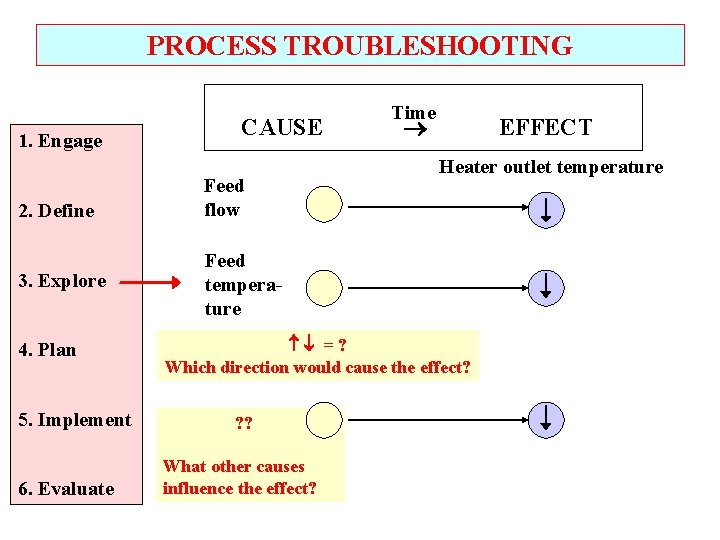
PROCESS TROUBLESHOOTING 1. Engage 2. Define 3. Explore 4. Plan 5. Implement 6. Evaluate CAUSE Feed flow Time EFFECT Heater outlet temperature Feed temperature =? Which direction would cause the effect? ? ? What other causes influence the effect?
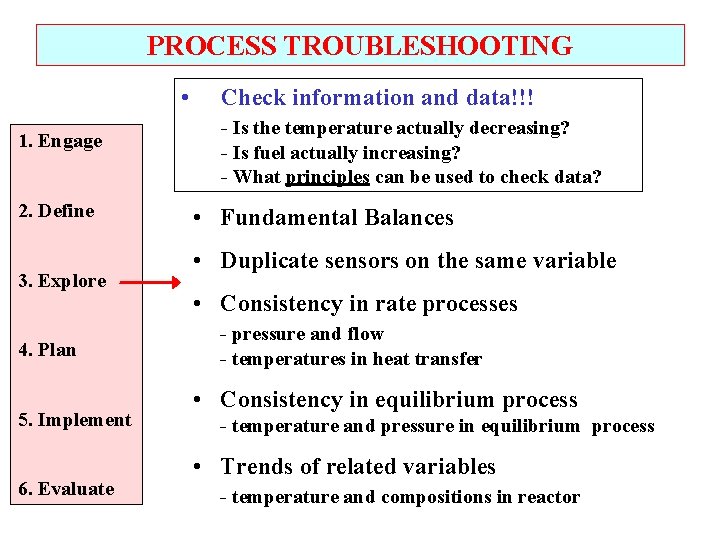
PROCESS TROUBLESHOOTING • 1. Engage 2. Define 3. Explore 4. Plan 5. Implement 6. Evaluate Check information and data!!! - Is the temperature actually decreasing? - Is fuel actually increasing? - What principles can be used to check data? • Fundamental Balances • Duplicate sensors on the same variable • Consistency in rate processes - pressure and flow - temperatures in heat transfer • Consistency in equilibrium process - temperature and pressure in equilibrium process • Trends of related variables - temperature and compositions in reactor
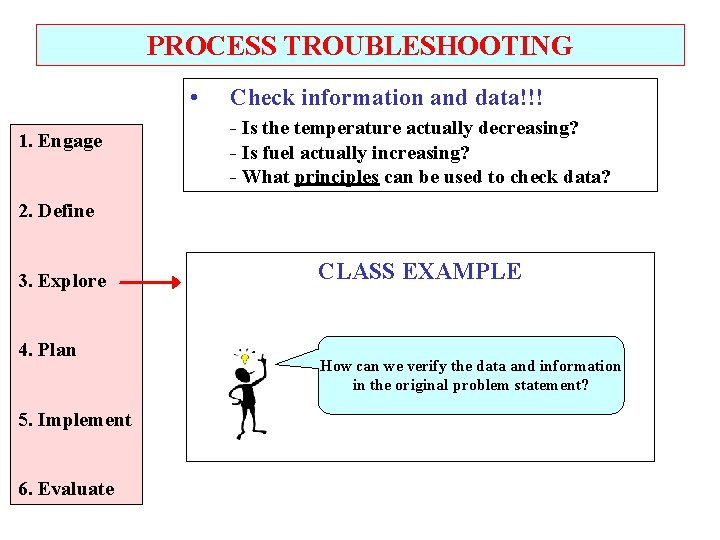
PROCESS TROUBLESHOOTING • 1. Engage Check information and data!!! - Is the temperature actually decreasing? - Is fuel actually increasing? - What principles can be used to check data? 2. Define 3. Explore 4. Plan 5. Implement 6. Evaluate CLASS EXAMPLE How can we verify the data and information in the original problem statement?
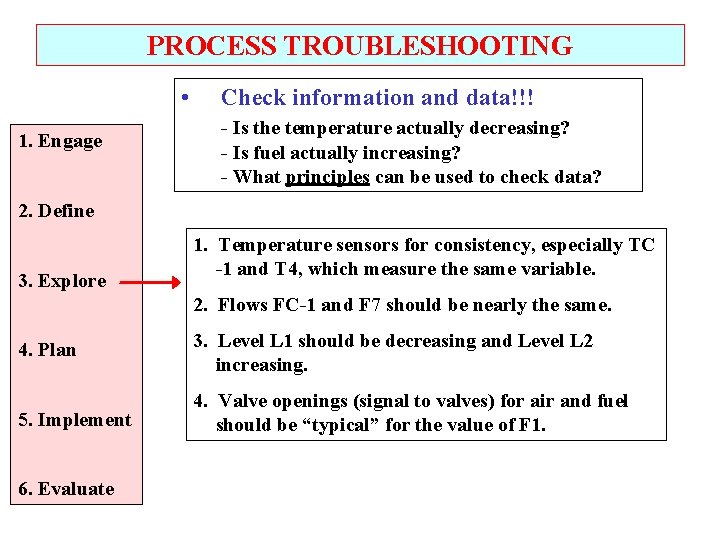
PROCESS TROUBLESHOOTING • 1. Engage Check information and data!!! - Is the temperature actually decreasing? - Is fuel actually increasing? - What principles can be used to check data? 2. Define 3. Explore 1. Temperature sensors for consistency, especially TC -1 and T 4, which measure the same variable. 2. Flows FC-1 and F 7 should be nearly the same. 4. Plan 3. Level L 1 should be decreasing and Level L 2 increasing. 5. Implement 4. Valve openings (signal to valves) for air and fuel should be “typical” for the value of F 1. 6. Evaluate
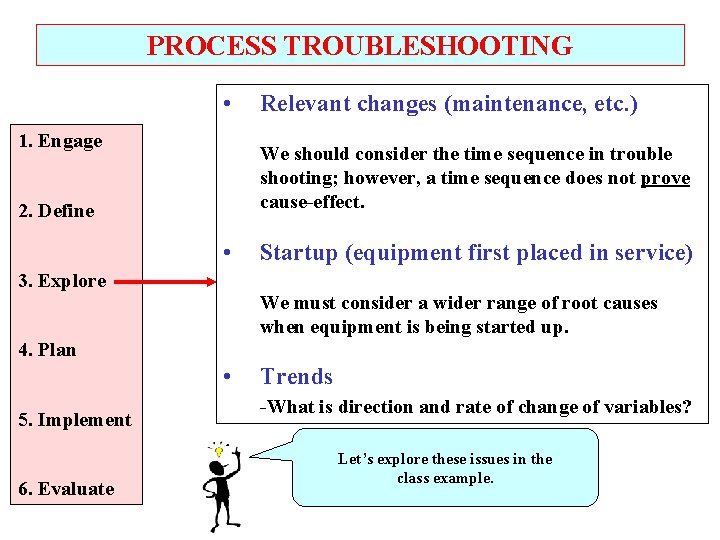
PROCESS TROUBLESHOOTING • 1. Engage Relevant changes (maintenance, etc. ) We should consider the time sequence in trouble shooting; however, a time sequence does not prove cause-effect. 2. Define • 3. Explore Startup (equipment first placed in service) We must consider a wider range of root causes when equipment is being started up. 4. Plan • 5. Implement 6. Evaluate Trends -What is direction and rate of change of variables? Let’s explore these issues in the class example.
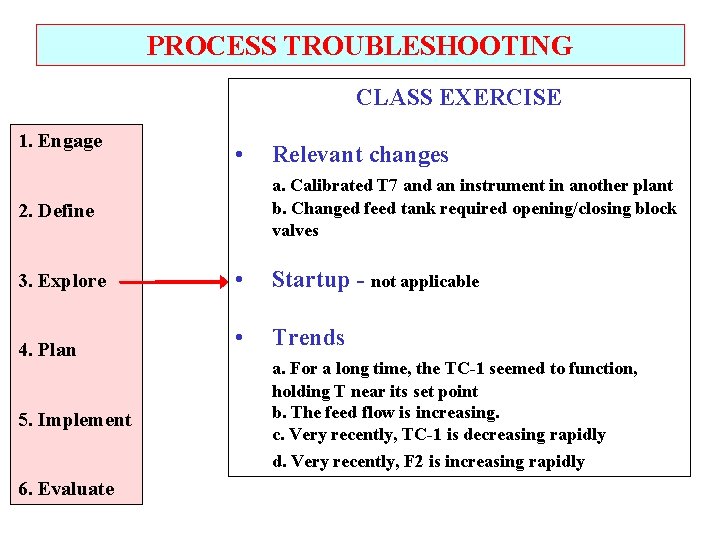
PROCESS TROUBLESHOOTING CLASS EXERCISE 1. Engage • a. Calibrated T 7 and an instrument in another plant b. Changed feed tank required opening/closing block valves 2. Define 3. Explore 4. Plan 5. Implement Relevant changes • Startup - not applicable • Trends a. For a long time, the TC-1 seemed to function, holding T near its set point b. The feed flow is increasing. c. Very recently, TC-1 is decreasing rapidly d. Very recently, F 2 is increasing rapidly 6. Evaluate
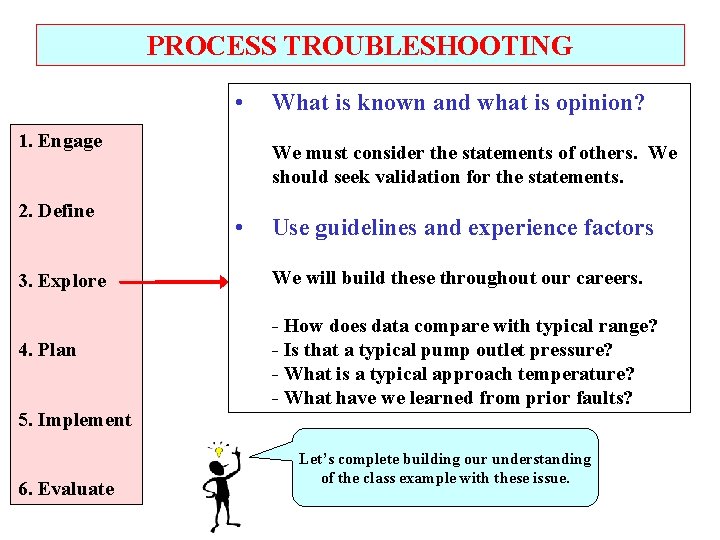
PROCESS TROUBLESHOOTING • 1. Engage 2. Define 3. Explore 4. Plan What is known and what is opinion? We must consider the statements of others. We should seek validation for the statements. • Use guidelines and experience factors We will build these throughout our careers. - How does data compare with typical range? - Is that a typical pump outlet pressure? - What is a typical approach temperature? - What have we learned from prior faults? 5. Implement 6. Evaluate Let’s complete building our understanding of the class example with these issue.
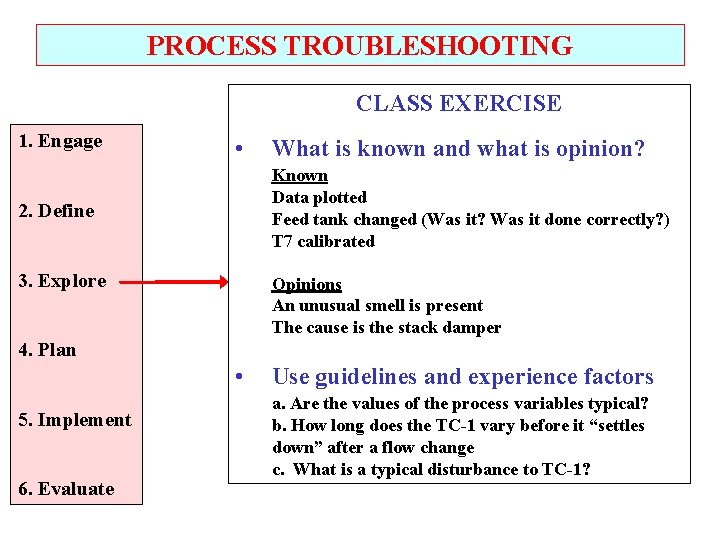
PROCESS TROUBLESHOOTING CLASS EXERCISE 1. Engage • What is known and what is opinion? Known Data plotted Feed tank changed (Was it? Was it done correctly? ) T 7 calibrated 2. Define 3. Explore Opinions An unusual smell is present The cause is the stack damper 4. Plan • 5. Implement 6. Evaluate Use guidelines and experience factors a. Are the values of the process variables typical? b. How long does the TC-1 vary before it “settles down” after a flow change c. What is a typical disturbance to TC-1?
PROCESS TROUBLESHOOTING 1. Engage 2. Define “The solution to a process problem isn’t found by sitting behind your desk, but by going to the plant and carrying out tests and evaluating the data. ” 3. Explore by Laird, et al, Chem. Engr. Progress, (2000) 4. Plan 5. Implement 6. Evaluate We have to analyze the initial data and formulate working hypotheses. These hypotheses give us a basis for investigations: they focus our investigations.
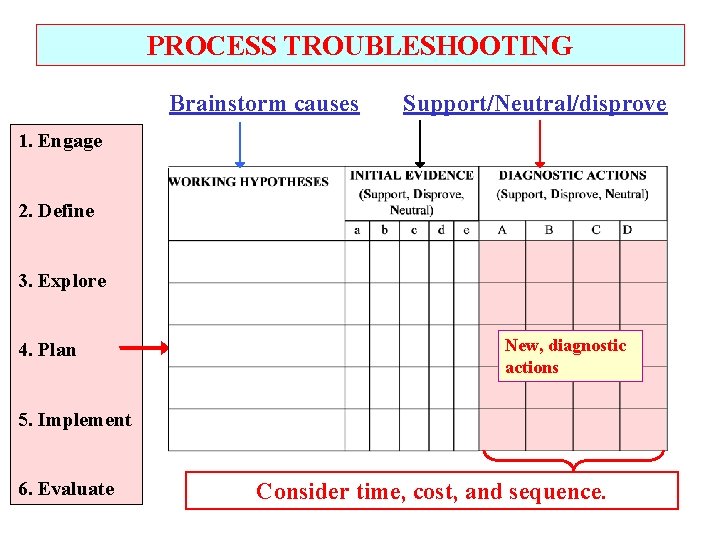
PROCESS TROUBLESHOOTING Brainstorm causes Support/Neutral/disprove 1. Engage 2. Define 3. Explore 4. Plan New, diagnostic actions 5. Implement 6. Evaluate Consider time, cost, and sequence.
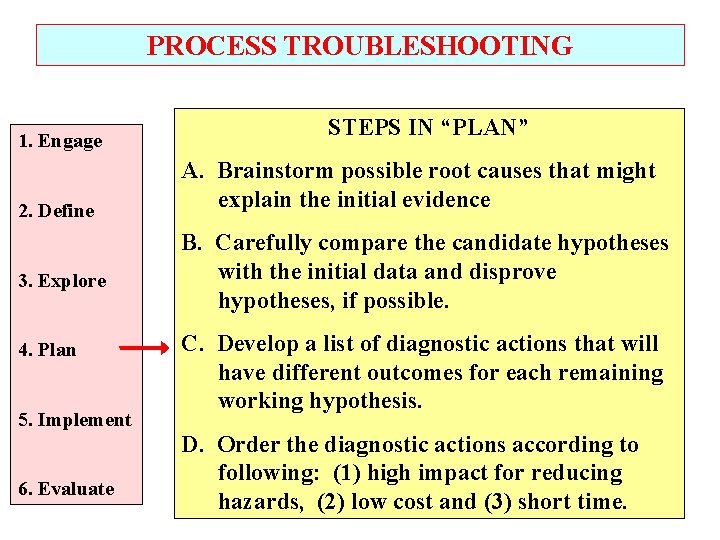
PROCESS TROUBLESHOOTING 1. Engage 2. Define 3. Explore 4. Plan 5. Implement 6. Evaluate STEPS IN “PLAN” A. Brainstorm possible root causes that might explain the initial evidence B. Carefully compare the candidate hypotheses with the initial data and disprove hypotheses, if possible. C. Develop a list of diagnostic actions that will have different outcomes for each remaining working hypothesis. D. Order the diagnostic actions according to following: (1) high impact for reducing hazards, (2) low cost and (3) short time.
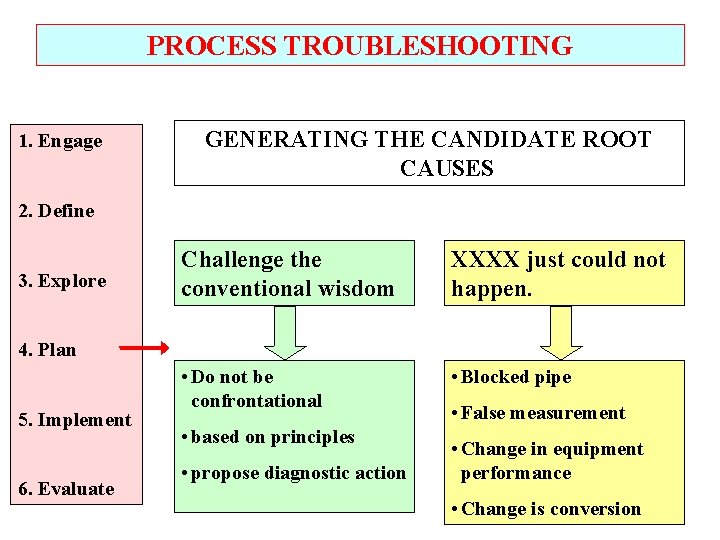
PROCESS TROUBLESHOOTING 1. Engage GENERATING THE CANDIDATE ROOT CAUSES 2. Define 3. Explore Challenge the conventional wisdom XXXX just could not happen. • Do not be confrontational • Blocked pipe 4. Plan 5. Implement 6. Evaluate • based on principles • propose diagnostic action • False measurement • Change in equipment performance • Change is conversion
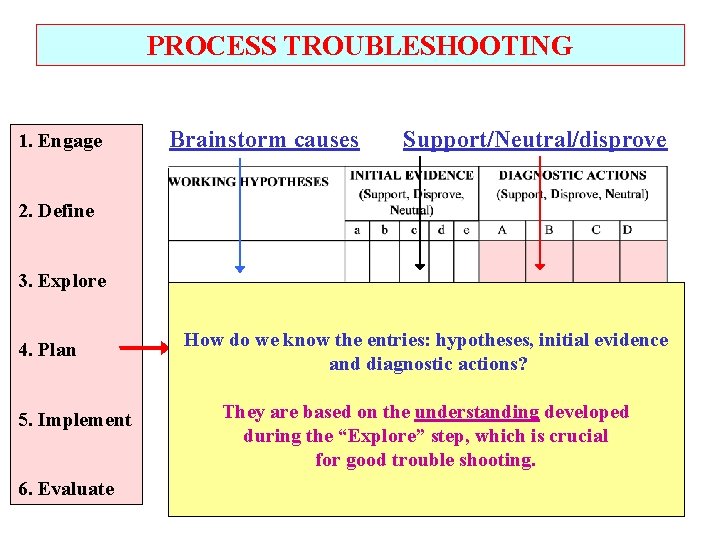
PROCESS TROUBLESHOOTING 1. Engage Brainstorm causes Support/Neutral/disprove 2. Define 3. Explore 4. Plan 5. Implement 6. Evaluate How do we know the entries: hypotheses, evidence New, initial diagnostic and diagnostic actions? actions They are based on the understanding developed during the “Explore” step, which is crucial for good trouble shooting. Consider time, cost, and sequence.
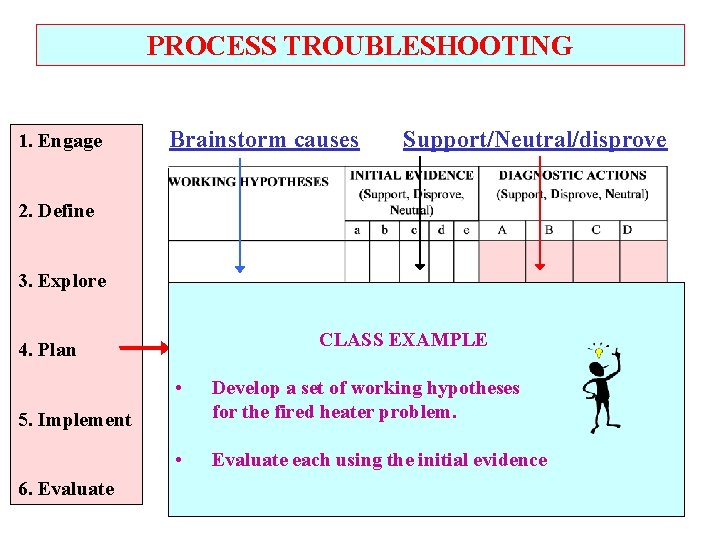
PROCESS TROUBLESHOOTING 1. Engage Brainstorm causes Support/Neutral/disprove 2. Define 3. Explore CLASS EXAMPLE New, diagnostic 4. Plan • Develop a set of working hypotheses for the fired heater problem. • Evaluate each using the initial evidence 5. Implement 6. Evaluate actions Consider time, cost, and sequence.
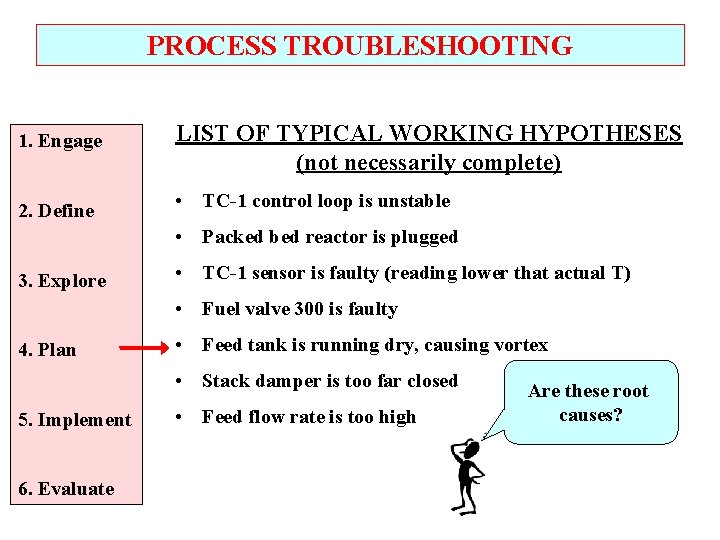
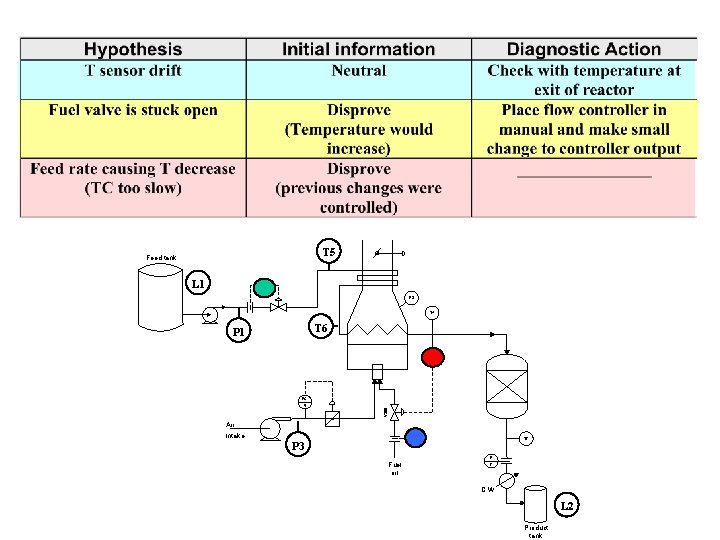
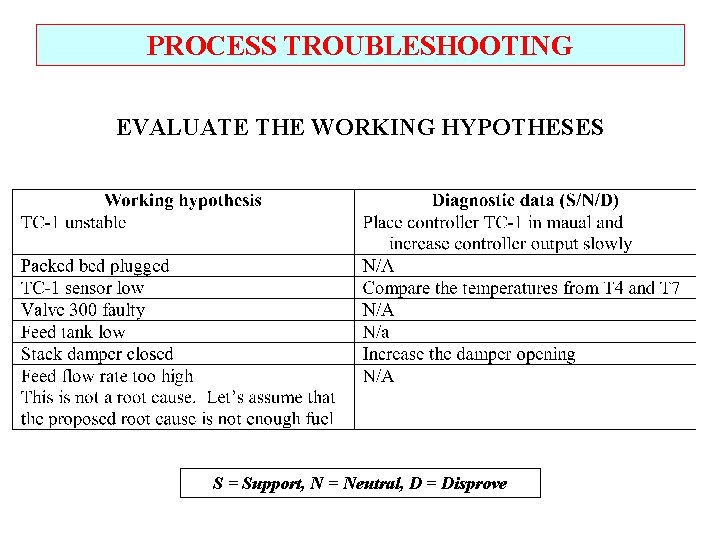
PROCESS TROUBLESHOOTING 1. Engage 2. Define LIST OF TYPICAL WORKING HYPOTHESES (not necessarily complete) • TC-1 control loop is unstable • Packed bed reactor is plugged 3. Explore • TC-1 sensor is faulty (reading lower that actual T) • Fuel valve 300 is faulty 4. Plan • Feed tank is running dry, causing vortex • Stack damper is too far closed 5. Implement 6. Evaluate • Feed flow rate is too high Are these root causes?
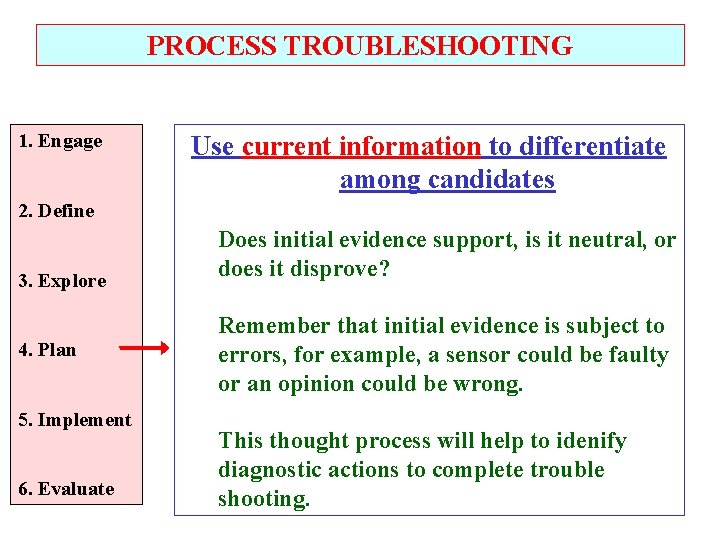
PROCESS TROUBLESHOOTING 1. Engage Use current information to differentiate among candidates 2. Define 3. Explore 4. Plan 5. Implement 6. Evaluate Does initial evidence support, is it neutral, or does it disprove? Remember that initial evidence is subject to errors, for example, a sensor could be faulty or an opinion could be wrong. This thought process will help to idenify diagnostic actions to complete trouble shooting.
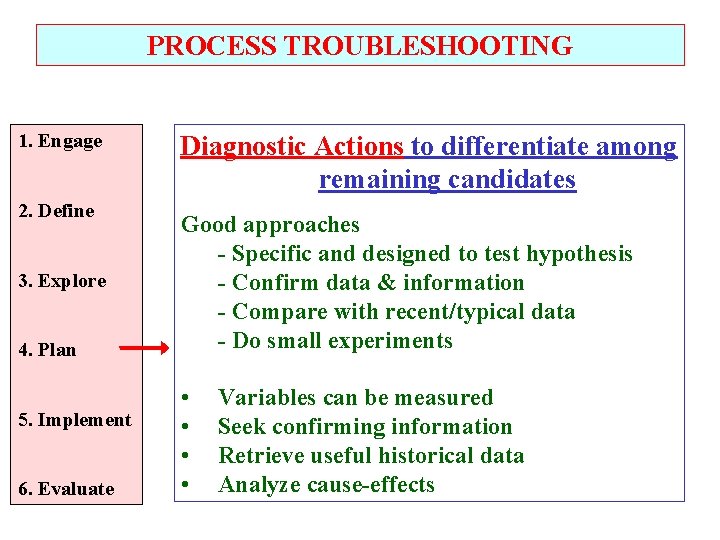
PROCESS TROUBLESHOOTING 1. Engage 2. Define 3. Explore 4. Plan 5. Implement 6. Evaluate Diagnostic Actions to differentiate among remaining candidates Good approaches - Specific and designed to test hypothesis - Confirm data & information - Compare with recent/typical data - Do small experiments • • Variables can be measured Seek confirming information Retrieve useful historical data Analyze cause-effects
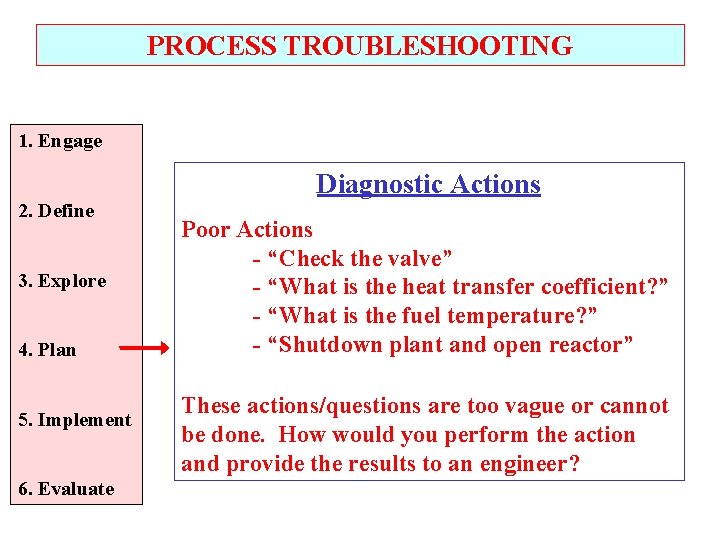
PROCESS TROUBLESHOOTING 1. Engage Diagnostic Actions 2. Define 3. Explore 4. Plan 5. Implement 6. Evaluate Poor Actions - “Check the valve” - “What is the heat transfer coefficient? ” - “What is the fuel temperature? ” - “Shutdown plant and open reactor” These actions/questions are too vague or cannot be done. How would you perform the action and provide the results to an engineer?
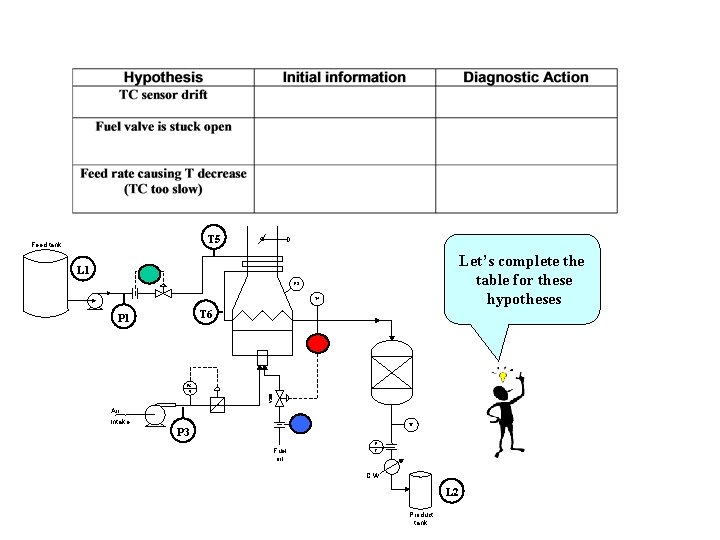
T 5 Feed tank L 1 Let’s complete the table for these hypotheses FC 1 P 3 T 4 T 6 P 1 TC 3 5 V 300 FC Air Intake F T 7 2 P 3 F Fuel oil 7 C. W. L 2 Product tank
T 5 Feed tank L 1 FC 1 P 3 T 4 T 6 P 1 TC 3 5 V 300 FC Air Intake F T 7 2 P 3 F Fuel oil 7 C. W. L 2 Product tank
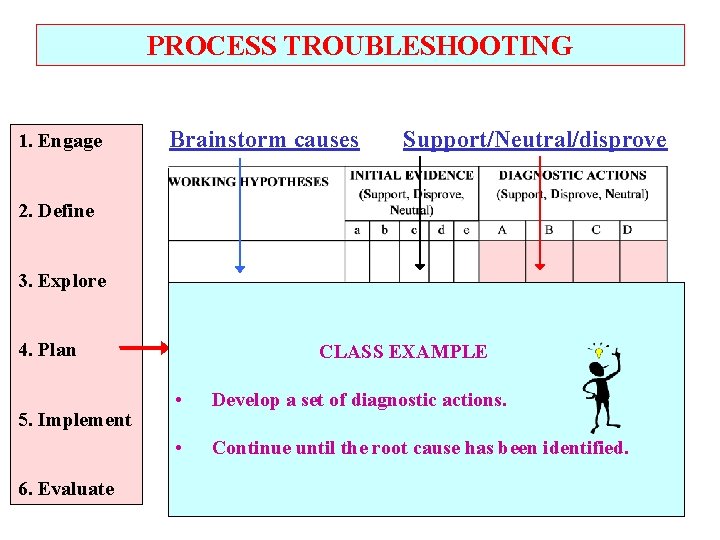
PROCESS TROUBLESHOOTING 1. Engage Brainstorm causes Support/Neutral/disprove 2. Define 3. Explore CLASS EXAMPLE New, diagnostic 4. Plan 5. Implement 6. Evaluate actions • Develop a set of diagnostic actions. • Continue until the root cause has been identified. Consider time, cost, and sequence.
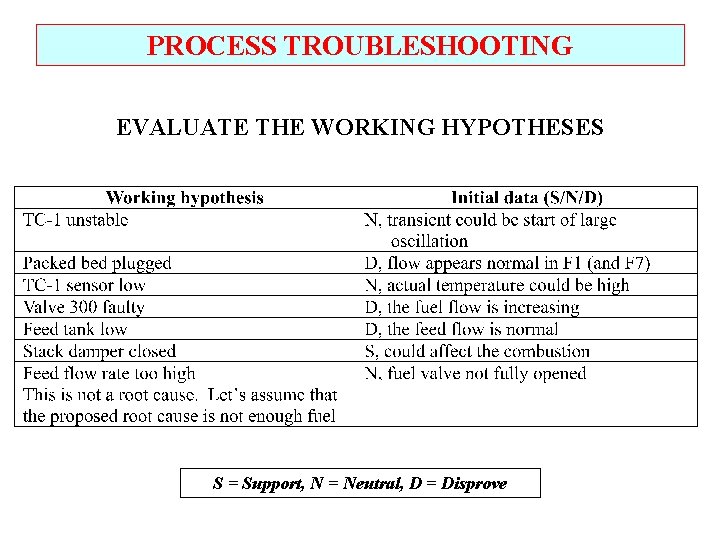
PROCESS TROUBLESHOOTING EVALUATE THE WORKING HYPOTHESES S = Support, N = Neutral, D = Disprove
PROCESS TROUBLESHOOTING EVALUATE THE WORKING HYPOTHESES S = Support, N = Neutral, D = Disprove
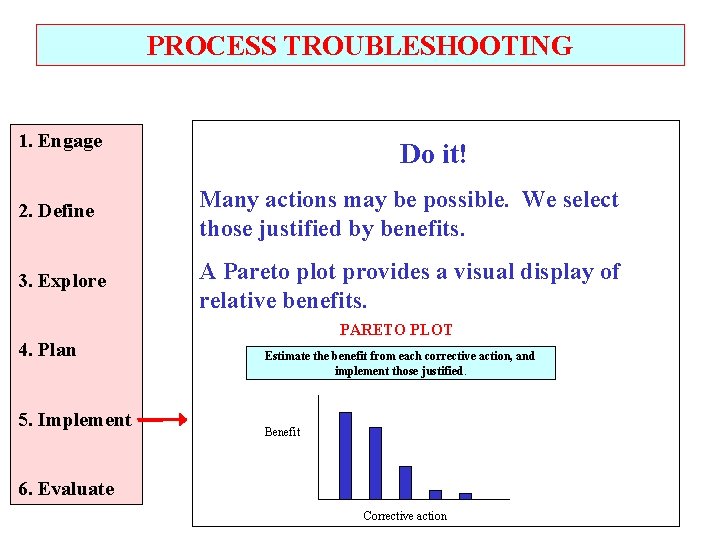
PROCESS TROUBLESHOOTING 1. Engage Do it! 2. Define Many actions may be possible. We select those justified by benefits. 3. Explore A Pareto plot provides a visual display of relative benefits. 4. Plan 5. Implement PARETO PLOT Estimate the benefit from each corrective action, and implement those justified. Benefit 6. Evaluate Corrective action
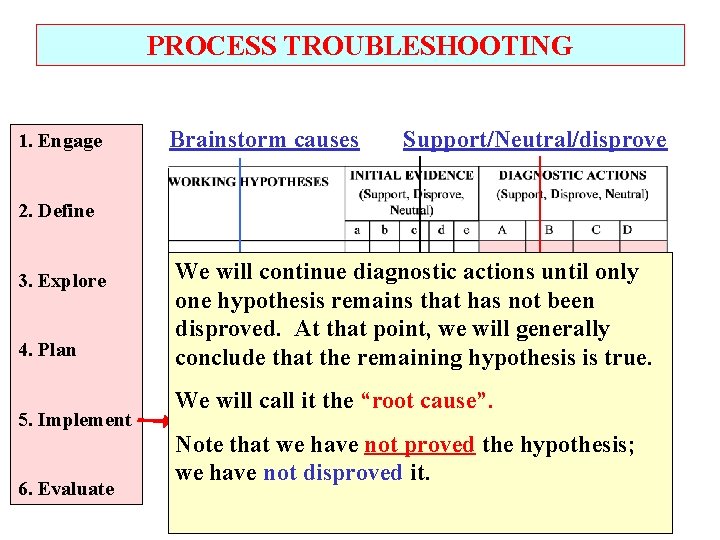
PROCESS TROUBLESHOOTING 1. Engage Brainstorm causes Support/Neutral/disprove 2. Define 3. Explore 4. Plan 5. Implement 6. Evaluate We will continue diagnostic actions until only one hypothesis remains that has not been disproved. At that point, we will generally New, diagnostic conclude that the remaining hypothesis actions is true. We will call it the “root cause”. Note that we have not proved the hypothesis; we have not disproved it. Consider time, cost, and sequence.
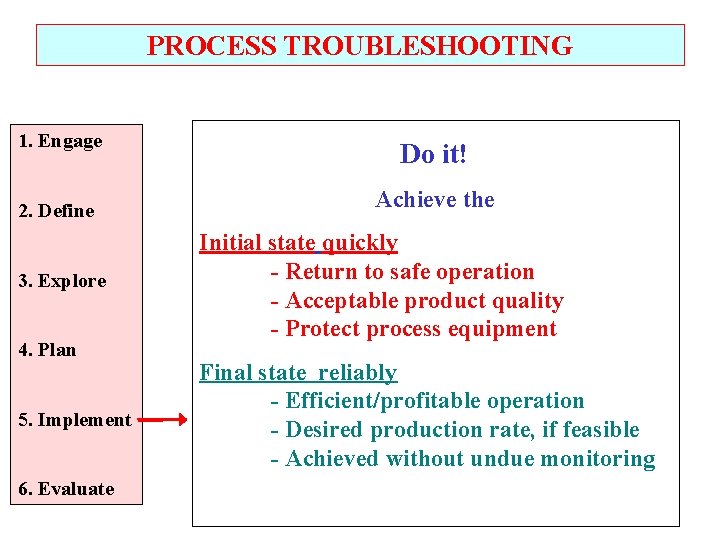
PROCESS TROUBLESHOOTING 1. Engage 2. Define 3. Explore 4. Plan 5. Implement 6. Evaluate Do it! Achieve the Initial state quickly - Return to safe operation - Acceptable product quality - Protect process equipment Final state reliably - Efficient/profitable operation - Desired production rate, if feasible - Achieved without undue monitoring
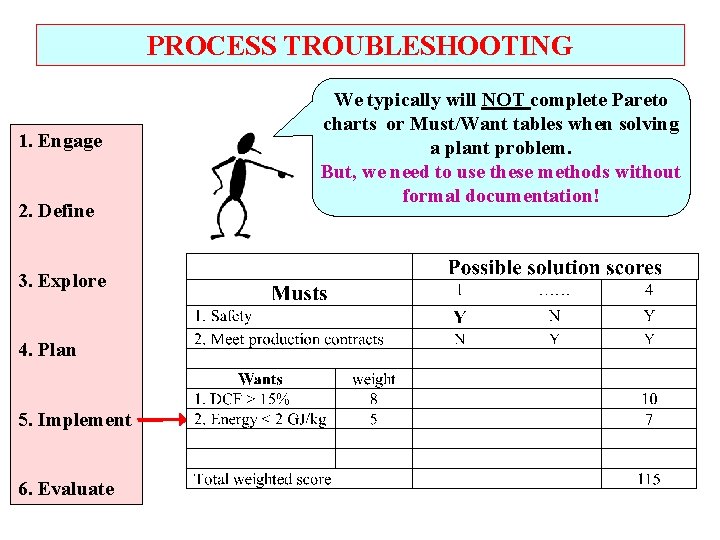
PROCESS TROUBLESHOOTING 1. Engage 2. Define 3. Explore 4. Plan 5. Implement 6. Evaluate We typically will NOT complete Pareto charts or Must/Want tables when solving a plant problem. But, we need to use these methods without formal documentation!
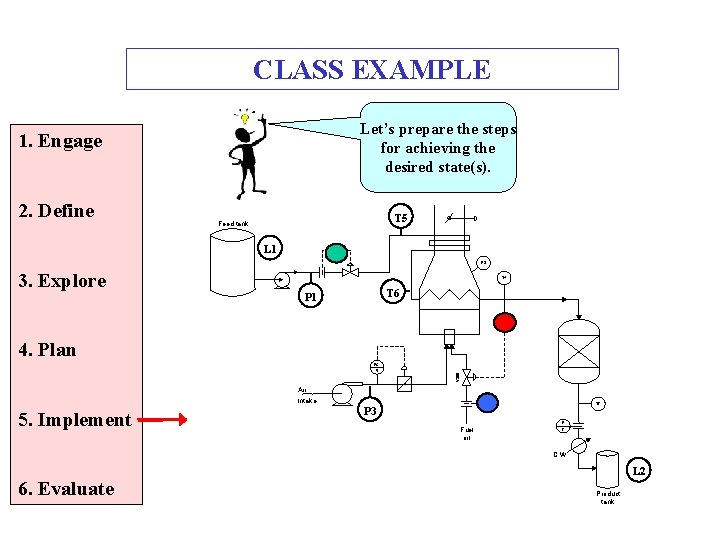
CLASS EXAMPLE Let’s prepare the steps for achieving the desired state(s). 1. Engage 2. Define T 5 Feed tank L 1 FC 1 P 3 3. Explore T 4 T 6 P 1 TC 3 4. Plan 5 V 300 FC Air Intake 5. Implement F T 7 2 P 3 F Fuel oil 7 C. W. 6. Evaluate L 2 Product tank
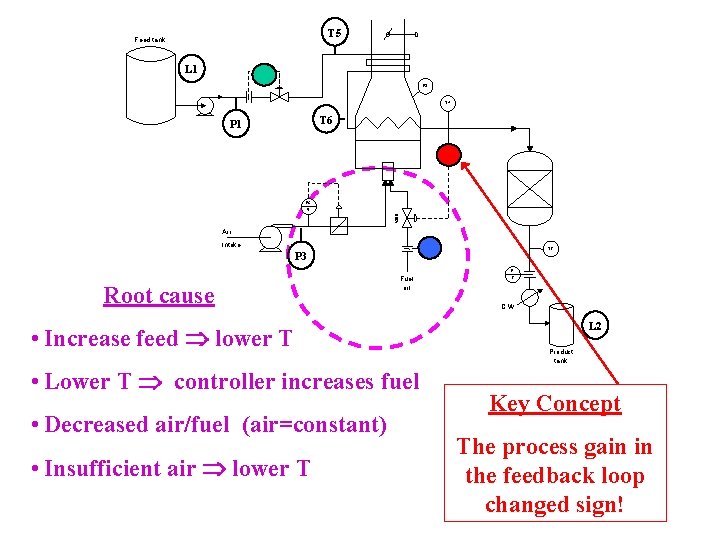
T 5 Feed tank L 1 FC 1 P 3 T 4 T 6 P 1 TC 3 FC V 300 5 Air Intake F T 7 2 P 3 F Root cause Fuel oil • Increase feed lower T • Lower T controller increases fuel • Decreased air/fuel (air=constant) • Insufficient air lower T 7 C. W. L 2 Product tank Key Concept The process gain in the feedback loop changed sign!
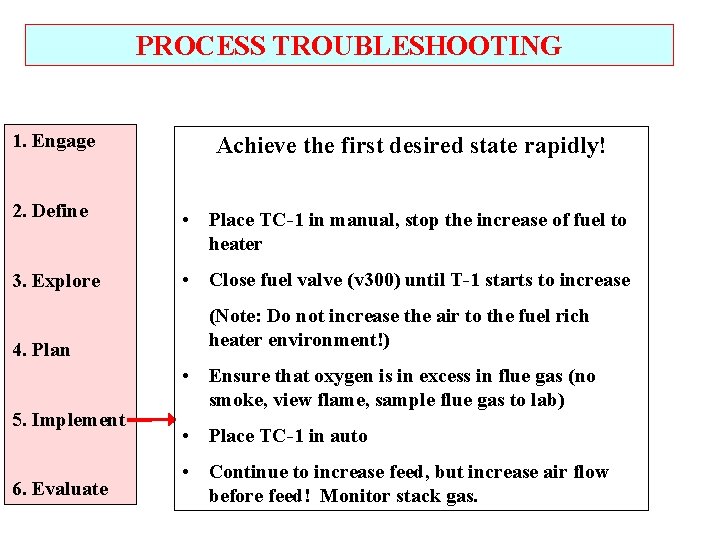
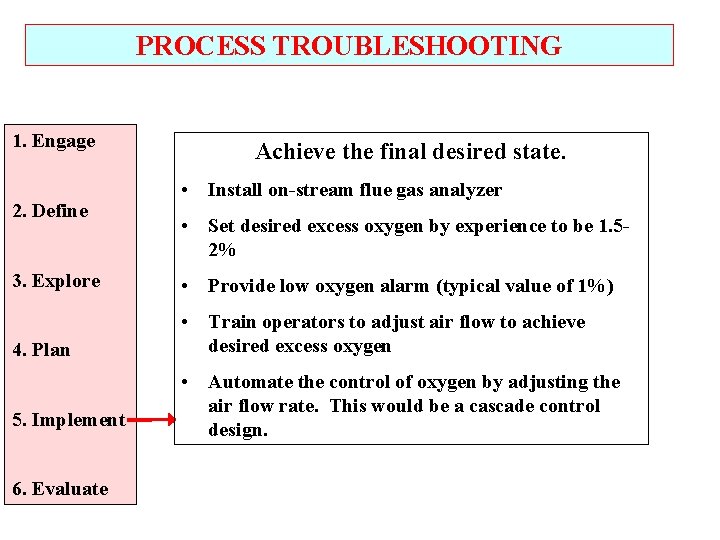
PROCESS TROUBLESHOOTING 1. Engage Achieve the first desired state rapidly! 2. Define • Place TC-1 in manual, stop the increase of fuel to heater 3. Explore • Close fuel valve (v 300) until T-1 starts to increase 4. Plan 5. Implement 6. Evaluate (Note: Do not increase the air to the fuel rich heater environment!) • Ensure that oxygen is in excess in flue gas (no smoke, view flame, sample flue gas to lab) • Place TC-1 in auto • Continue to increase feed, but increase air flow before feed! Monitor stack gas.
PROCESS TROUBLESHOOTING 1. Engage 2. Define Achieve the final desired state. • Install on-stream flue gas analyzer • Set desired excess oxygen by experience to be 1. 52% 3. Explore • Provide low oxygen alarm (typical value of 1%) 4. Plan • Train operators to adjust air flow to achieve desired excess oxygen 5. Implement • Automate the control of oxygen by adjusting the air flow rate. This would be a cascade control design. 6. Evaluate
PROCESS TROUBLESHOOTING 1. Engage Create a “Lookback” • Did we solve the Root Cause? 2. Define • Did we generate more confirming information? 3. Explore • How can we prevent in the future 4. Plan 5. Implement - training - monitoring programs - modifications to current plant equipment &/or procedures - design guidelines for future plants • Enhance our personal experience factors 6. Evaluate • Check ethics and legal one more time
CLASS EXAMPLE 1. Engage Let’s prepare a look back with steps to prevent future incidents 2. Define T 5 Feed tank 3. Explore L 1 FC 1 P 3 T 4 T 6 P 1 4. Plan TC 3 5 5. Implement V 300 FC Air Intake F T 7 2 P 3 F Fuel oil 6. Evaluate 7 C. W. L 2 Product tank
PROCESS TROUBLESHOOTING SOME TYPICAL STRATEGIES THAT DO NOT WORK 1. If you don’t understand, guess. 2. Confuse symptoms with root cause. 3. Get tunnel vision. It’s the pump, no! It’s the valve, no! It’s the pipe, no! …. . It must be the pump. But, the symptoms point away from the pump. It’s the pump. 4. Accept all information as relevant and correct.
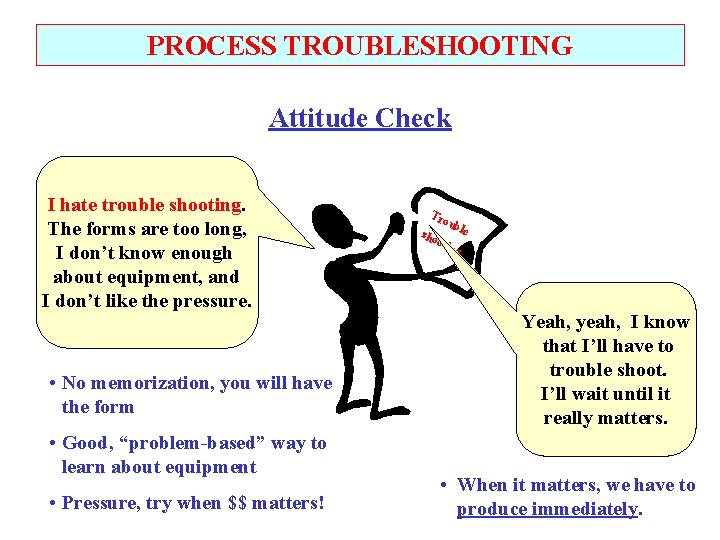
PROCESS TROUBLESHOOTING Attitude Check I hate trouble shooting. The forms are too long, I don’t know enough about equipment, and I don’t like the pressure. • No memorization, you will have the form • Good, “problem-based” way to learn about equipment • Pressure, try when $$ matters! Tro ubl e otin g sho Yeah, yeah, I know that I’ll have to trouble shoot. I’ll wait until it really matters. • When it matters, we have to produce immediately.
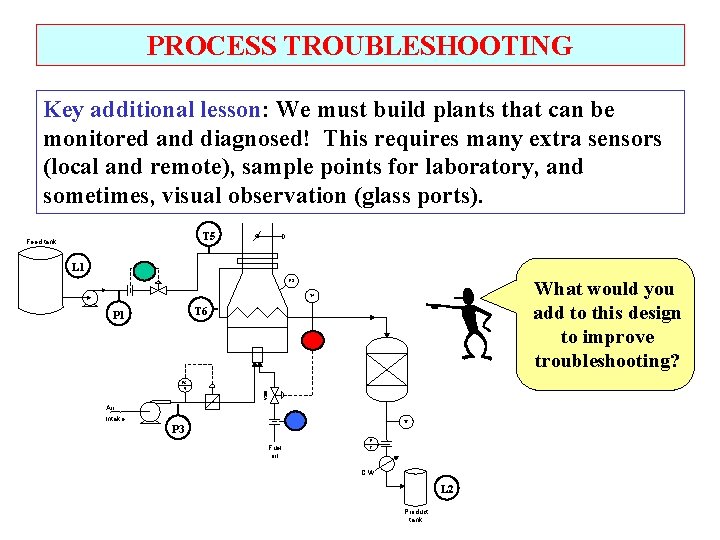
PROCESS TROUBLESHOOTING Key additional lesson: We must build plants that can be monitored and diagnosed! This requires many extra sensors (local and remote), sample points for laboratory, and sometimes, visual observation (glass ports). T 5 Feed tank L 1 FC 1 What would you add to this design to improve troubleshooting? P 3 T 4 T 6 P 1 TC 3 5 V 300 FC Air Intake F T 7 2 P 3 F Fuel oil 7 C. W. L 2 Product tank
PROCESS TROUBLESHOOTING Further Steps to Refine Trouble Shooting Skills • Review attached table with enriching and detracting behaviors for a trouble shooter • Skim references on the next slide and locate hints most helpful to you • Perform the workshops included in this lesson • Practice the trouble shooting method on problems you encounter in you studies (laboratory, independent research, operability project in this course, etc. )
References for Trouble Shooting The following three resources provide excellent approaches and useful references for further study. Fogler, H. Scott and Steve Le. Blanc, Strategies for Creative Problem Solving, Prentice Hall PTR, Upper Saddle River, 1995. Kepner, Charles and Benjamin Tregoe, The New Rational Manager, Mc. Graw-Hill, New York, 1981. Woods, Donald, Problem Based Learning: How to Gain the Most from PBL, Griffin Printing, Hamilton, Ontario, 1994. Woods, Donald, Successful Trouble Shooting for Process Engineers, Wiley VCH, Weinheim, 2006. Key reference Additional references: Laird, D. , B. Albert, C. Steiner, and D. Little, Take a Hands-0 n Approach to Refinery Troubleshooting, CEP, 98, 6, 68 -73 (June 2002)
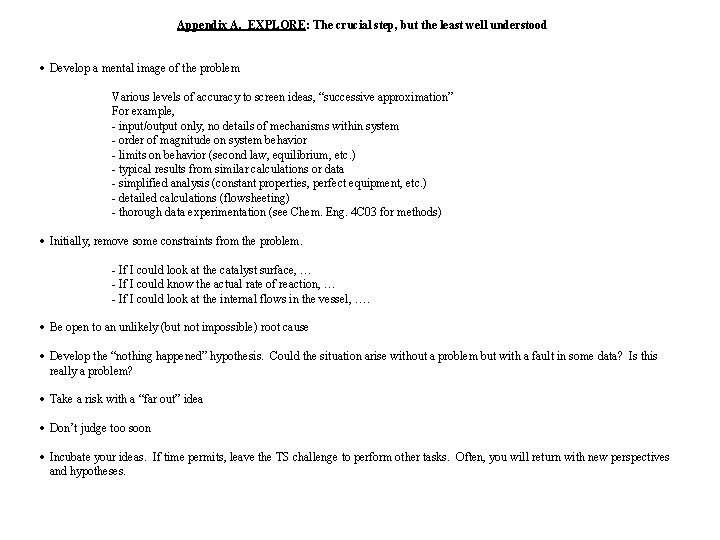
Appendix A. EXPLORE: The crucial step, but the least well understood · Develop a mental image of the problem Various levels of accuracy to screen ideas, “successive approximation” For example, - input/output only, no details of mechanisms within system - order of magnitude on system behavior - limits on behavior (second law, equilibrium, etc. ) - typical results from similar calculations or data - simplified analysis (constant properties, perfect equipment, etc. ) - detailed calculations (flowsheeting) - thorough data experimentation (see Chem. Eng. 4 C 03 for methods) · Initially, remove some constraints from the problem. - If I could look at the catalyst surface, … - If I could know the actual rate of reaction, … - If I could look at the internal flows in the vessel, …. · Be open to an unlikely (but not impossible) root cause · Develop the “nothing happened” hypothesis. Could the situation arise without a problem but with a fault in some data? Is this really a problem? · Take a risk with a “far out” idea · Don’t judge too soon · Incubate your ideas. If time permits, leave the TS challenge to perform other tasks. Often, you will return with new perspectives and hypotheses.
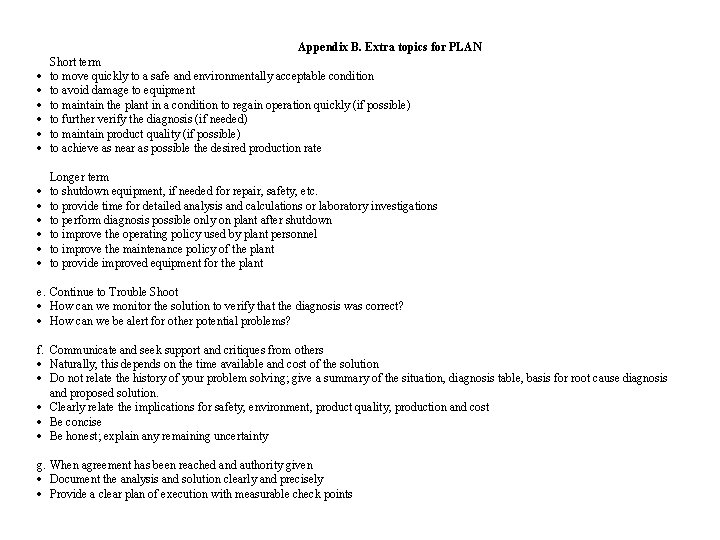
Appendix B. Extra topics for PLAN · · · Short term to move quickly to a safe and environmentally acceptable condition to avoid damage to equipment to maintain the plant in a condition to regain operation quickly (if possible) to further verify the diagnosis (if needed) to maintain product quality (if possible) to achieve as near as possible the desired production rate · · · Longer term to shutdown equipment, if needed for repair, safety, etc. to provide time for detailed analysis and calculations or laboratory investigations to perform diagnosis possible only on plant after shutdown to improve the operating policy used by plant personnel to improve the maintenance policy of the plant to provide improved equipment for the plant e. Continue to Trouble Shoot · How can we monitor the solution to verify that the diagnosis was correct? · How can we be alert for other potential problems? f. Communicate and seek support and critiques from others · Naturally, this depends on the time available and cost of the solution · Do not relate the history of your problem solving; give a summary of the situation, diagnosis table, basis for root cause diagnosis and proposed solution. · Clearly relate the implications for safety, environment, product quality, production and cost · Be concise · Be honest; explain any remaining uncertainty g. When agreement has been reached and authority given · Document the analysis and solution clearly and precisely · Provide a clear plan of execution with measurable check points
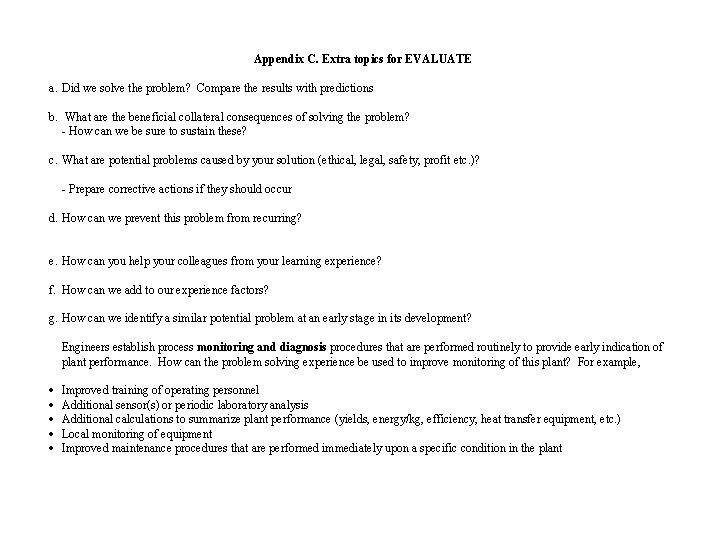
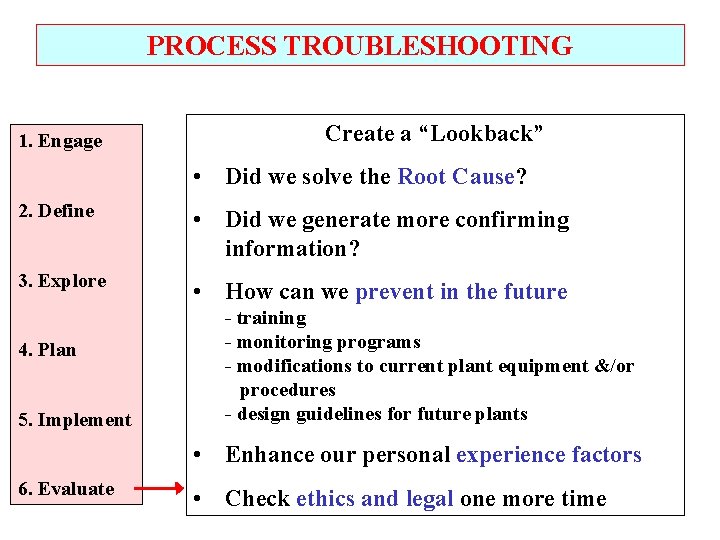
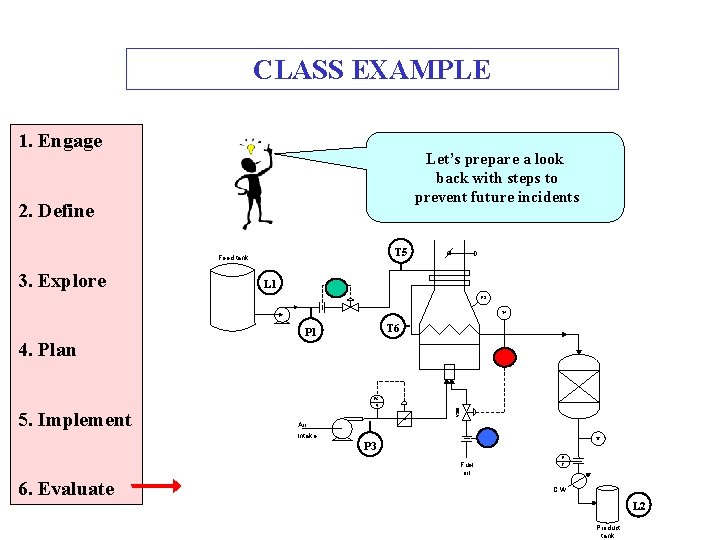
Appendix C. Extra topics for EVALUATE a. Did we solve the problem? Compare the results with predictions b. What are the beneficial collateral consequences of solving the problem? - How can we be sure to sustain these? c. What are potential problems caused by your solution (ethical, legal, safety, profit etc. )? - Prepare corrective actions if they should occur d. How can we prevent this problem from recurring? e. How can you help your colleagues from your learning experience? f. How can we add to our experience factors? g. How can we identify a similar potential problem at an early stage in its development? Engineers establish process monitoring and diagnosis procedures that are performed routinely to provide early indication of plant performance. How can the problem solving experience be used to improve monitoring of this plant? For example, · · · Improved training of operating personnel Additional sensor(s) or periodic laboratory analysis Additional calculations to summarize plant performance (yields, energy/kg, efficiency, heat transfer equipment, etc. ) Local monitoring of equipment Improved maintenance procedures that are performed immediately upon a specific condition in the plant
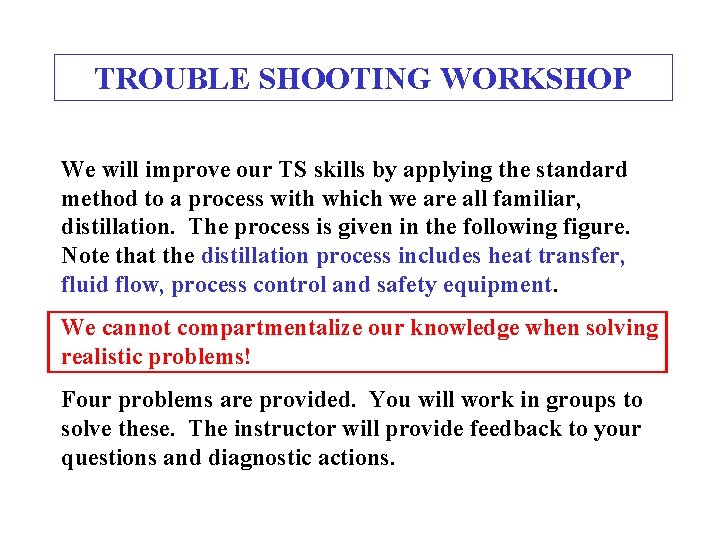
TROUBLE SHOOTING WORKSHOP We will improve our TS skills by applying the standard method to a process with which we are all familiar, distillation. The process is given in the following figure. Note that the distillation process includes heat transfer, fluid flow, process control and safety equipment. We cannot compartmentalize our knowledge when solving realistic problems! Four problems are provided. You will work in groups to solve these. The instructor will provide feedback to your questions and diagnostic actions.
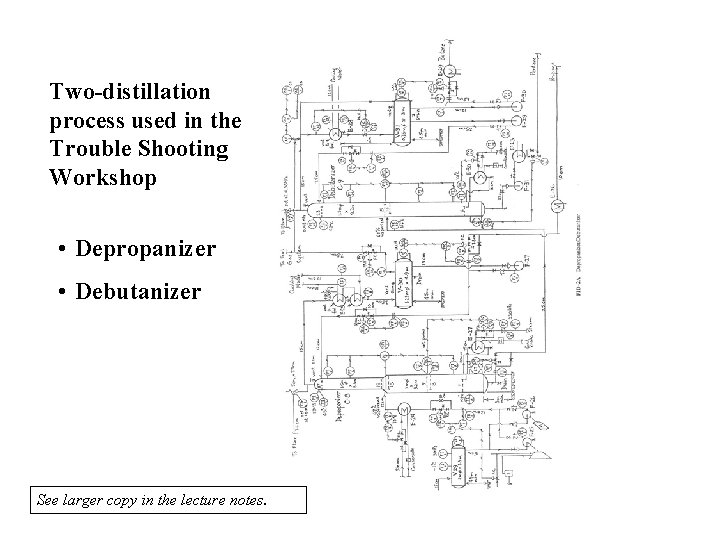
Two-distillation process used in the Trouble Shooting Workshop • Depropanizer • Debutanizer See larger copy in the lecture notes.
TROUBLE SHOOTING WORKSHOP EXERCISE 1 The new two-distillation tower plant in the figure was just started up today. It has been running well for several shifts. The operators have been slowly increasing production rate, and they have achieved 80% of the design feed rate to the tower. Just one hour ago a new operator came on duty, and this operator changed the pressure at which the Depropanizer, C-8, is operated, raising the pressure by 0. 1 MPa. She has also continued to very slowly increase the production rate. About 10 minutes after the pressure was increased, the tray temperatures began to go crazy and the bottoms level started to decrease. The operator believes that the reboiler has “stopped heating”. Everyone=s Christmas bonus depends upon a profitable plant startup. Better fix this problem, or you will need a loan to buy those Christmas presents!
TROUBLE SHOOTING WORKSHOP EXERCISE 2 To be able to sell your products, your plant must obtain ISO certification. (This ensures that the plant has consistently enforced quality control procedures. ) Your customer service engineer reports that one of the customers is dissatisfied with the butane product; you don’t have more details. As a result, you have established a routine composition analysis of various streams in the depropanizer and debutanizer in the two-distillation process that has been operating for years. The composition monitoring program has been operating for one week. The laboratory analyses indicate too much variability in the mole fraction propane in the bottoms of the depropanizer, C-8. For the last day, the mole fraction propane has been about 0. 04, while the target is 0. 015. Before the new procedures, we never knew that we were operating the plant poorly, so no one cared! If you cannot obtain ISO certification, the company will not be able to sell products to the key customers. Everyone is mad at you for finding the problem! You better solve this problem so that the plant can continue to operate and you are safe at work.
TROUBLE SHOOTING WORKSHOP EXERCISE 3 The operation of the upstream process, which prepares the feed to the two-distillation tower process, is being modified to accommodate a new catalyst and modified raw material composition. The new upstream process has been operating for nearly a shift, and the two distillation towers seem to be functioning well. You note that some of the tray temperatures are different from before the change, but the product purities, as measured by special laboratory analysis, are very near their specifications. You are satisfied that all is well. You return to your office to eat that muffin that you purchased on the way to work this morning. Just when you have brewed the coffee and heated the muffin in the microwave, the plant operator calls you. The high pressure alarm in the debutanizer is on, and the operator is worried that the safety valve will open. (You are never sure that it will close completely, so we don=t want it to open unless needed. ) He thinks that the upstream change is the cause of the problem but doesn’t give you a clear reason why. You have not been working in this unit for long, so here is your chance to make friends with the operator. Let=s work with the operator to fix this problem!
TROUBLE SHOOTING WORKSHOP EXERCISE 4 This two-distillation tower process was successfully started up in January, when a careful check indicated that the operation was very close to the design values. You are sure of that because you worked 12 hours per day to check and double check everything. In August, you are assigned the responsibility for this process. You decide to take a careful look at the current operation. Laboratory analysis of the depropanizer vapor product indicates a high loss of propane to the fuel system, 2. 5 times the design value. This loss of product to fuel is costing lots of money! You want to find the cause fast – you would like to provide a solution as well as a problem to the plant manager. Time to apply your trouble shooting skills!
- Slides: 73