
PROCESS OF SCIENCE SCIENTIFIC METHOD INTRODUCTION As kids
- Slides: 8
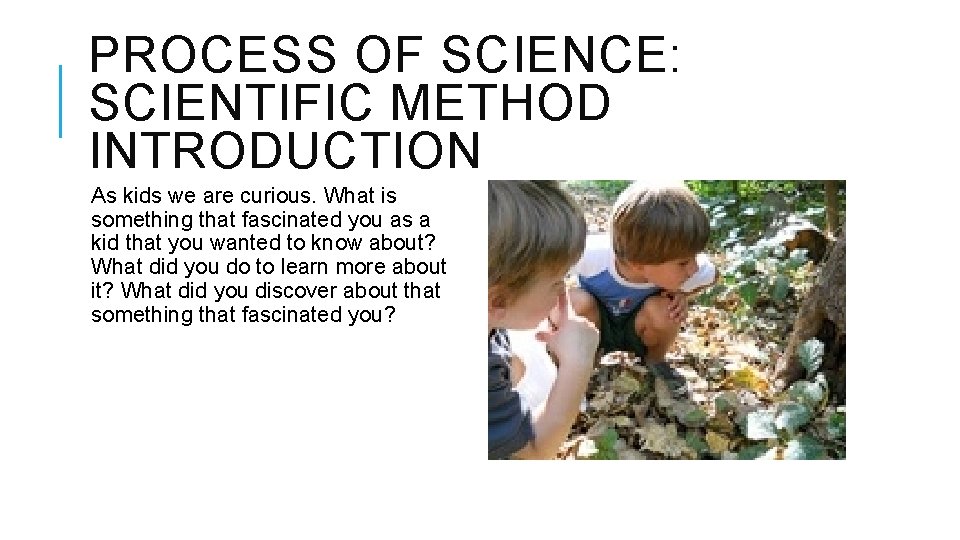
PROCESS OF SCIENCE: SCIENTIFIC METHOD INTRODUCTION As kids we are curious. What is something that fascinated you as a kid that you wanted to know about? What did you do to learn more about it? What did you discover about that something that fascinated you?
PROCESS OF SCIENCE: SCIENTIFIC METHOD EXPLICIT INSTRUCTION What is science? What is not science? The 6 Criterial of Science: CONPTT Consistent – When performing repeating investigations observations and results are reasonably the same. Observable – Using your five senses or extensions of those senses the phenomenon may observed. Natural – Explanation of the phenomenon or event relies on naturally occurring explanations. Predictable – The naturally occurring phenomenon is consistent enough that it may be predicted and tested. Testable – The phenomenon or even may be tested through controlled studies (controlled experiments) or observational studies. Tentative – Explanations are open to modification (revisions and/or correction), even to the point of a theory being disproven.
PROCESS OF SCIENCE: SCIENTIFIC METHOD EXPLICIT INSTRUCTION The process of science involves: Making observations – Identification of a phenomenon wished to be explained Asking questions – The process of researching to learn more about the phenomenon Developing a hypothesis – A testable idea that attempts to explain the phenomenon Making and testing predictions – A experiment is designed to test the validity of the hypothesis or prediction. Independent variable – Manipulated by the scientist Dependent variable – Responds based on the conditions set Controlled variable – Variables that are intentionally kept constant Analyzing and interpreting results – Concluding whether the hypothesis is disproven or failed to be disproven.
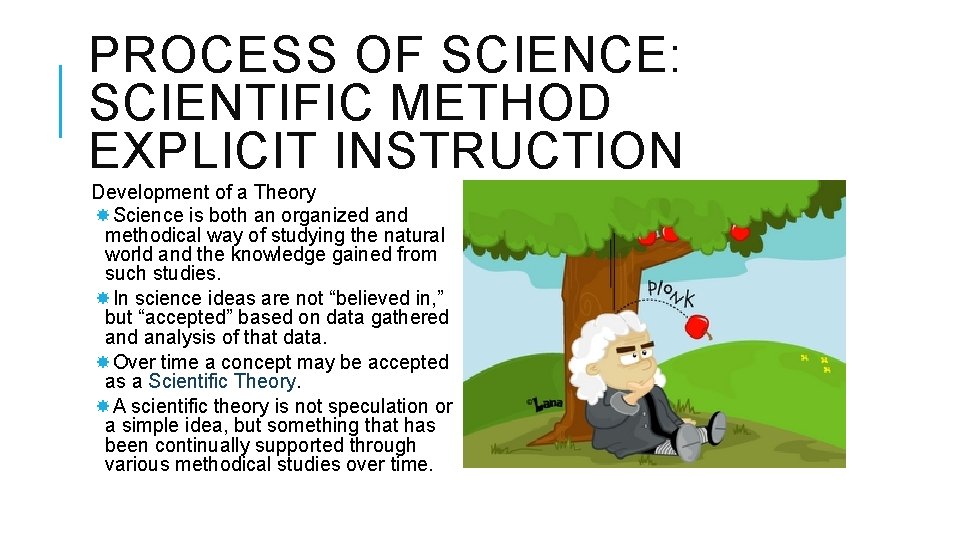
PROCESS OF SCIENCE: SCIENTIFIC METHOD EXPLICIT INSTRUCTION Development of a Theory Science is both an organized and methodical way of studying the natural world and the knowledge gained from such studies. In science ideas are not “believed in, ” but “accepted” based on data gathered analysis of that data. Over time a concept may be accepted as a Scientific Theory. A scientific theory is not speculation or a simple idea, but something that has been continually supported through various methodical studies over time.
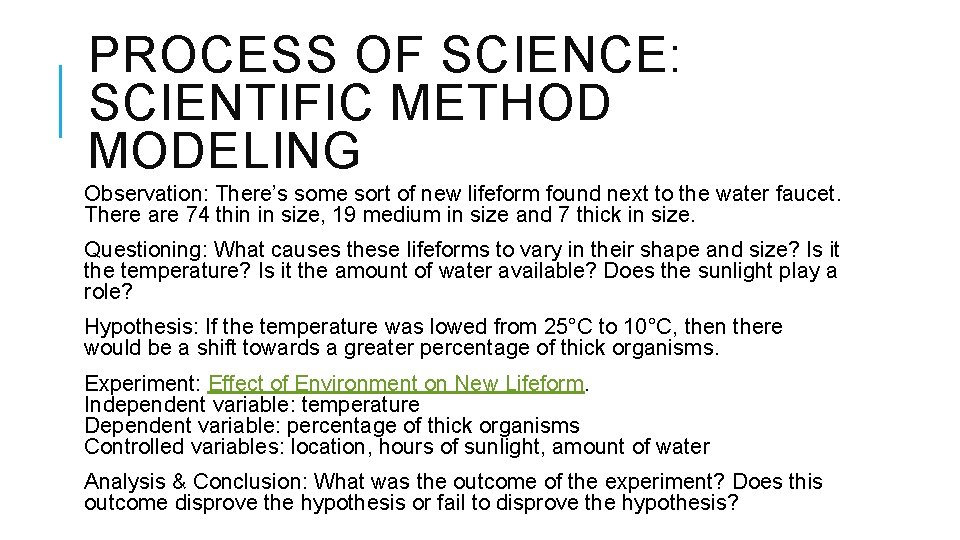
PROCESS OF SCIENCE: SCIENTIFIC METHOD MODELING Observation: There’s some sort of new lifeform found next to the water faucet. There are 74 thin in size, 19 medium in size and 7 thick in size. Questioning: What causes these lifeforms to vary in their shape and size? Is it the temperature? Is it the amount of water available? Does the sunlight play a role? Hypothesis: If the temperature was lowed from 25°C to 10°C, then there would be a shift towards a greater percentage of thick organisms. Experiment: Effect of Environment on New Lifeform. Independent variable: temperature Dependent variable: percentage of thick organisms Controlled variables: location, hours of sunlight, amount of water Analysis & Conclusion: What was the outcome of the experiment? Does this outcome disprove the hypothesis or fail to disprove the hypothesis?
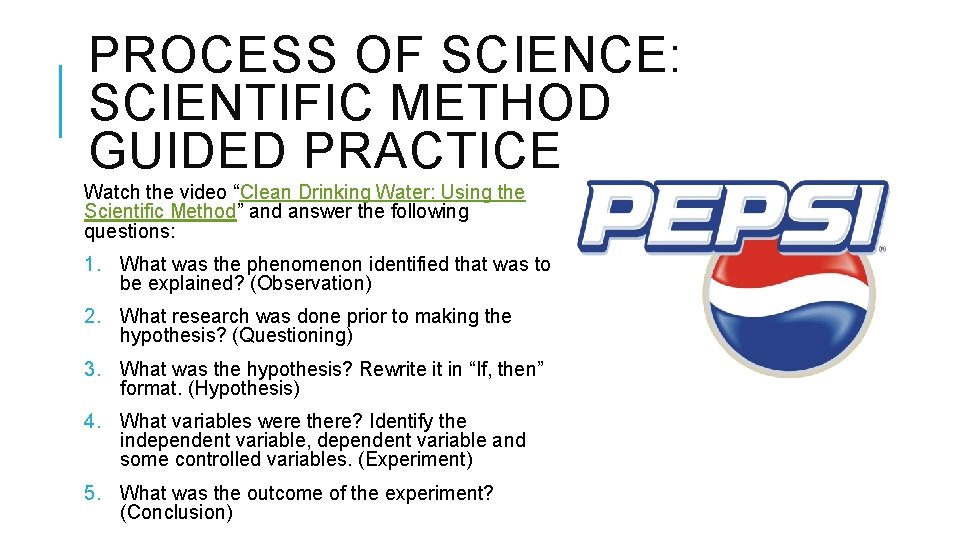
PROCESS OF SCIENCE: SCIENTIFIC METHOD GUIDED PRACTICE Watch the video “Clean Drinking Water: Using the Scientific Method” and answer the following questions: 1. What was the phenomenon identified that was to be explained? (Observation) 2. What research was done prior to making the hypothesis? (Questioning) 3. What was the hypothesis? Rewrite it in “If, then” format. (Hypothesis) 4. What variables were there? Identify the independent variable, dependent variable and some controlled variables. (Experiment) 5. What was the outcome of the experiment? (Conclusion)
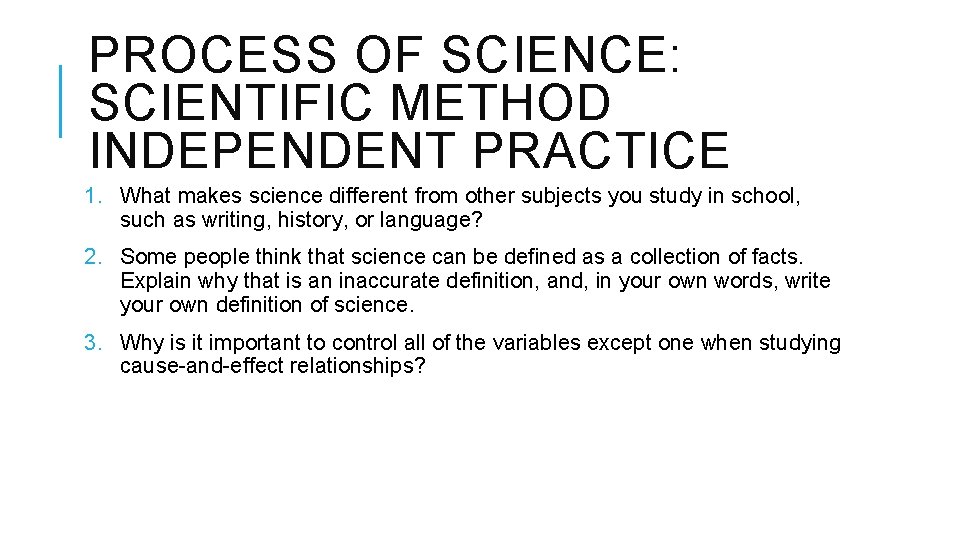
PROCESS OF SCIENCE: SCIENTIFIC METHOD INDEPENDENT PRACTICE 1. What makes science different from other subjects you study in school, such as writing, history, or language? 2. Some people think that science can be defined as a collection of facts. Explain why that is an inaccurate definition, and, in your own words, write your own definition of science. 3. Why is it important to control all of the variables except one when studying cause-and-effect relationships?
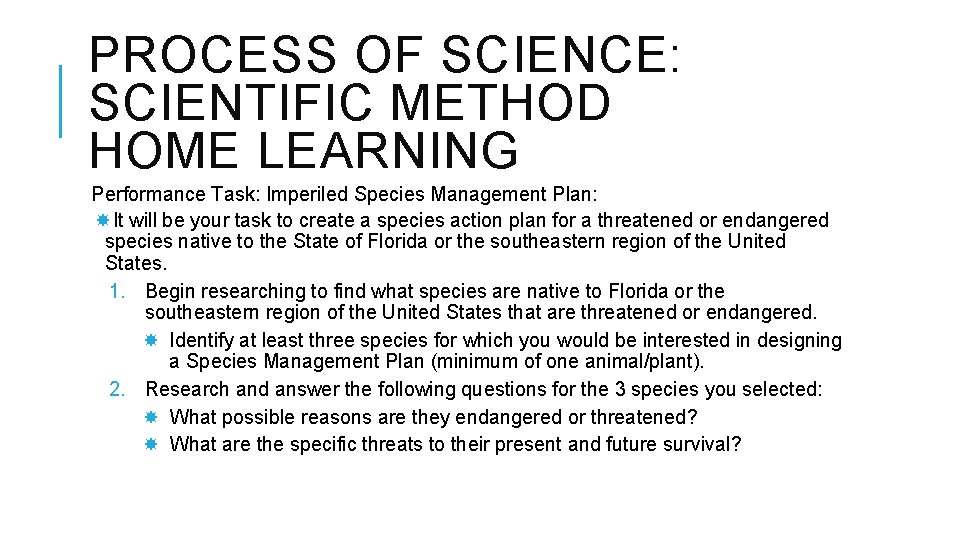
PROCESS OF SCIENCE: SCIENTIFIC METHOD HOME LEARNING Performance Task: Imperiled Species Management Plan: It will be your task to create a species action plan for a threatened or endangered species native to the State of Florida or the southeastern region of the United States. 1. Begin researching to find what species are native to Florida or the southeastern region of the United States that are threatened or endangered. Identify at least three species for which you would be interested in designing a Species Management Plan (minimum of one animal/plant). 2. Research and answer the following questions for the 3 species you selected: What possible reasons are they endangered or threatened? What are the specific threats to their present and future survival?