
Process of change of BDS baseline to 1414
Process of change of BDS baseline to 14/14 configuration BDS Area leaders Deepa Angal-Kalinin, Hitoshi Yamamoto, Andrei Seryi ILC MAC meeting, September 20 -22, 2006, KEK September 20, 2006 Global Design Effort 1
Contents • Brief overview of Vancouver baseline – Two IRs, 20/2 mrad • Process of technical evaluation pre-Vancouver – physics reach, beamline conditions & operability, technical feasibility • Vancouver cost estimation – difference of costs for 2 mr and 20 mr • Interactions at and after Vancouver – configuration change request for 14/14 baseline – evaluations by WWS, MDI panels & CCB • Further cost optimizations of baseline September 20, 06 Global Design Effort 2
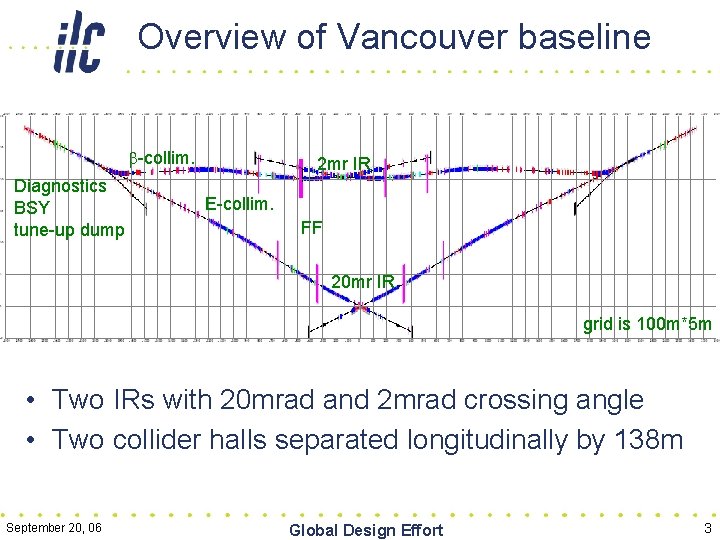
Overview of Vancouver baseline b-collim. Diagnostics BSY tune-up dump 2 mr IR E-collim. FF 20 mr IR grid is 100 m*5 m • Two IRs with 20 mrad and 2 mrad crossing angle • Two collider halls separated longitudinally by 138 m September 20, 06 Global Design Effort 3
Evaluation of baseline before Vancouver • Evaluation is focused on the differences between 20 mr and 2 mr branches, and focused on – – – study of physics reach background conditions in IR radiation conditions in extraction lines performance of downstream diagnostics technical feasibility of magnets power consumption and cost • Next, flash through some examples of such comparisons, presented at Vancouver September 20, 06 Global Design Effort 4
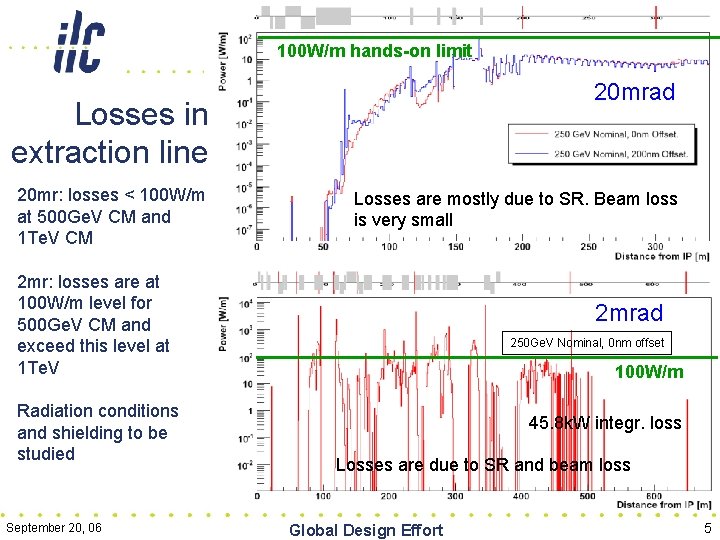
100 W/m hands-on limit 20 mrad Losses in extraction line 20 mr: losses < 100 W/m at 500 Ge. V CM and 1 Te. V CM Losses are mostly due to SR. Beam loss is very small 2 mr: losses are at 100 W/m level for 500 Ge. V CM and exceed this level at 1 Te. V Radiation conditions and shielding to be studied September 20, 06 2 mrad 250 Ge. V Nominal, 0 nm offset 100 W/m 45. 8 k. W integr. loss Losses are due to SR and beam loss Global Design Effort 5
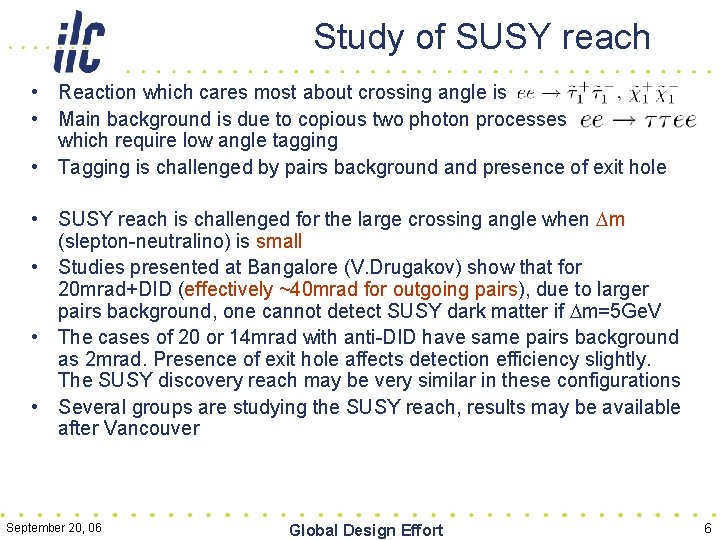
Study of SUSY reach • Reaction which cares most about crossing angle is • Main background is due to copious two photon processes which require low angle tagging • Tagging is challenged by pairs background and presence of exit hole • SUSY reach is challenged for the large crossing angle when Dm (slepton-neutralino) is small • Studies presented at Bangalore (V. Drugakov) show that for 20 mrad+DID (effectively ~40 mrad for outgoing pairs), due to larger pairs background, one cannot detect SUSY dark matter if Dm=5 Ge. V • The cases of 20 or 14 mrad with anti-DID have same pairs background as 2 mrad. Presence of exit hole affects detection efficiency slightly. The SUSY discovery reach may be very similar in these configurations • Several groups are studying the SUSY reach, results may be available after Vancouver September 20, 06 Global Design Effort 6
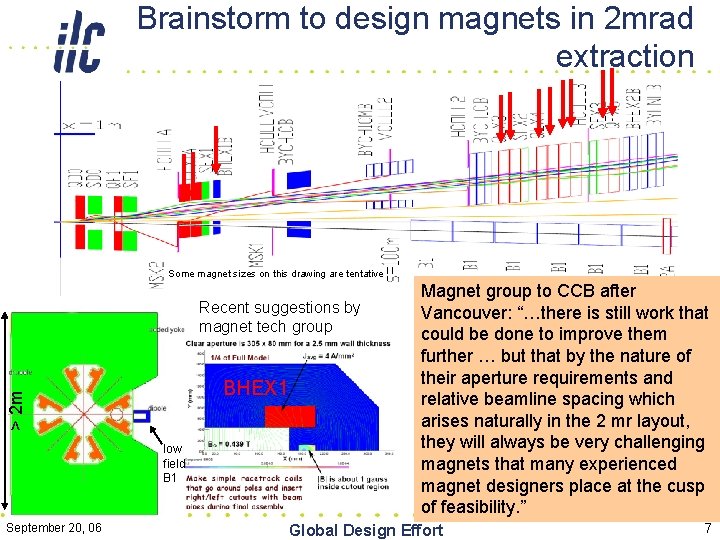
Brainstorm to design magnets in 2 mrad extraction Some magnet sizes on this drawing are tentative Recent suggestions by magnet tech group > 2 m BHEX 1 low field B 1 September 20, 06 Magnet group to CCB after Vancouver: “…there is still work that could be done to improve them further … but that by the nature of their aperture requirements and relative beamline spacing which arises naturally in the 2 mr layout, they will always be very challenging magnets that many experienced magnet designers place at the cusp of feasibility. ” Global Design Effort 7
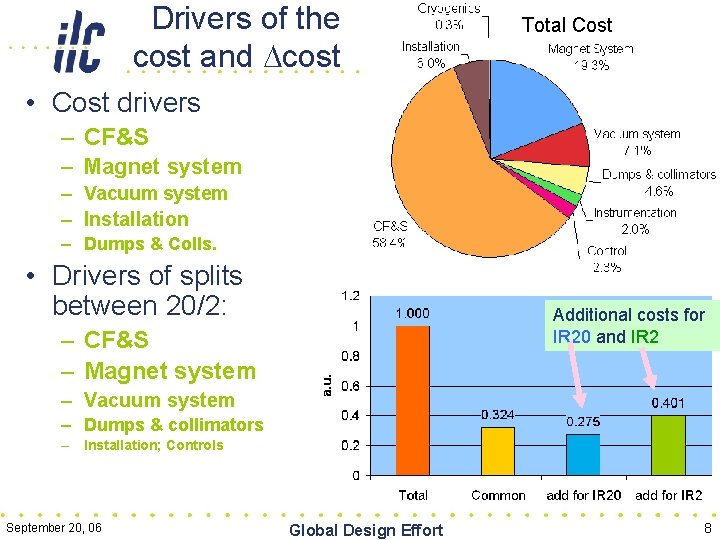
Drivers of the cost and Dcost Total Cost • Cost drivers – CF&S – Magnet system – Vacuum system – Installation – Dumps & Colls. • Drivers of splits between 20/2: Additional costs for IR 20 and IR 2 – CF&S – Magnet system – Vacuum system – Dumps & collimators – Installation; Controls September 20, 06 Global Design Effort 8
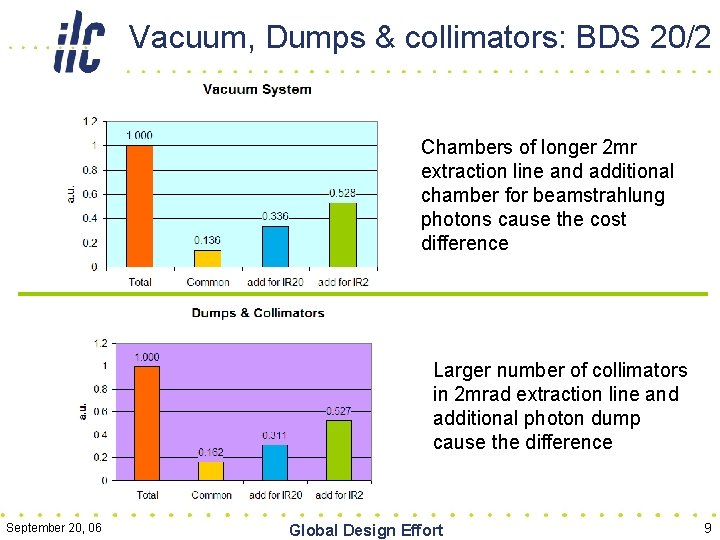
Vacuum, Dumps & collimators: BDS 20/2 Chambers of longer 2 mr extraction line and additional chamber for beamstrahlung photons cause the cost difference Larger number of collimators in 2 mrad extraction line and additional photon dump cause the difference September 20, 06 Global Design Effort 9

Magnet system: BDS 20/2 Larger number of huge extraction line magnets, and its power supplies (PS) cause the cost difference September 20, 06 Global Design Effort 10
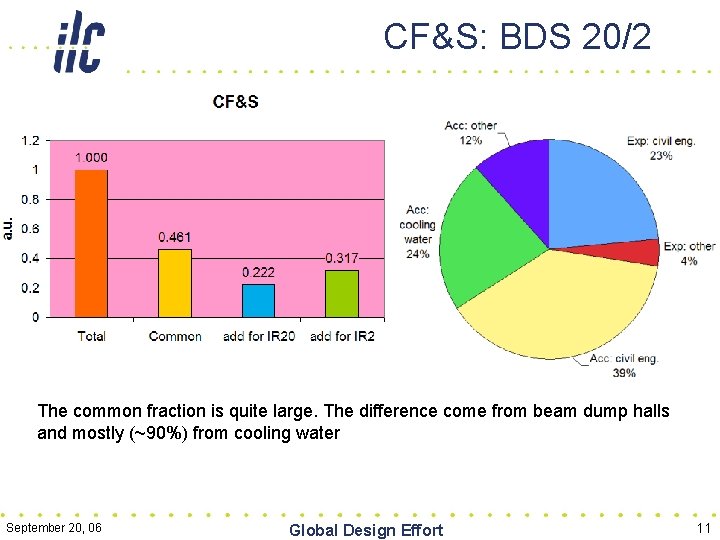
CF&S: BDS 20/2 The common fraction is quite large. The difference come from beam dump halls and mostly (~90%) from cooling water September 20, 06 Global Design Effort 11
At Vancouver • Discussion of 20/2 baseline situation – – – by BDS area leaders with present colleagues from BDS group with MDI panel (plus those connected remotely) with WWS organizing committee with EC and GDE director • It was decided to cut the Gordian knot of the cost, technical and nontechnical issues and propose to change the baseline to two IR with 14/14 configuration – Design & cost of 14/14 with common collider hall & z=0 • Design of 14 mr beamline is almost the same as for 20 mrad • In the 14/14 cost estimation, the following adjustments were estimated and taken into account: removed stretches in optics; shorter (~11 mr/14 mr) tapered tunnels; remove one surface building; savings due to common hall (but volume still twice the single volume); add cost of 42% more gradient bends (for 14 mrad bend), their PS, BPMs, movers, etc • The two IR config with 14 mrad in both IRs reduces the cost by 15. 6% September 20, 06 Global Design Effort 12
After Vancouver: submission of CCR, evaluation by WWS, MDI and CCB • CCR (Class 2) for 14/14 configuration submitted on July 28 • MDI panel meeting on Aug. 15 (link to agenda), to discuss – – 14/14 configuration <= CCR submitted on July 28 single collider hall on-surface detector assembly <= CCR in preparation 5 m muon spoilers instead of 9 m+18 m <=CCR submitted on Sept. 8 • The MDI panel accepted those changes. The conclusions were sent to WWS and CCB. (Link to MDI panel minutes) • The WWS OC was asked to comment about the first two items and also accepted them • CCB considered the CCR for 14/14, and on September 8 issued a recommendation for EC to adopt the CCR as is • CCB noted that it was the first Class-2 request and part of the time was spent on nailing down the protocols for cost information handling September 20, 06 Global Design Effort 13
From minutes of MDI panel (shortened quote) • • • The (physics) mode most affected by crossing angle is the slepton pair production where the slepton-LSP Dm is small. The main background is 2 -g processes and an efficient low-angle electron tag by BEAMCAL is needed to veto them. Difference in expected background (is due to) different levels of veto efficiency. Signal to noise will be ~4 to 1 with 2 mrad crossing angle. For a large crossing angle (14 or 20 mrad), anti-DID is needed to collimate the pair background along the outgoing beam. For 14 mrad crossing with anti-DID, the … background is expected to be comparable to the 2 mrad case while the signal efficiency reduces by about 30% to 40%. This is mainly due to the 2 nd hole of BEAMCAL that is needed for the large crossing angle which will force additional cuts to remove the 2 -photon and other backgrounds. This is not based on a complete analysis but on a study of the pair background distribution on the BEAMCAL: that for 20 mrad crossing with anti-DID was found to be essentially the same as the 2 mrad case. A complete analysis is needed for 14 mrad with anti-DID, also covering different values of the mass difference (namely, for different SUSY parameter space). Backgrounds considered here is mainly the pair background a lesser extent Bhabha events. More studies are sorely needed in this area. With this limited information, the MDI panel thinks that the 14 mrad is acceptable as the baseline at this time. However, we would like to stress that the 2 mrad crossing angle is clearly desirable than larger crossing angles for the slepton search, and R&Ds related to 2 mrad should be encouraged. * LSP= lightest super-symmetric particle September 20, 06 Global Design Effort 14
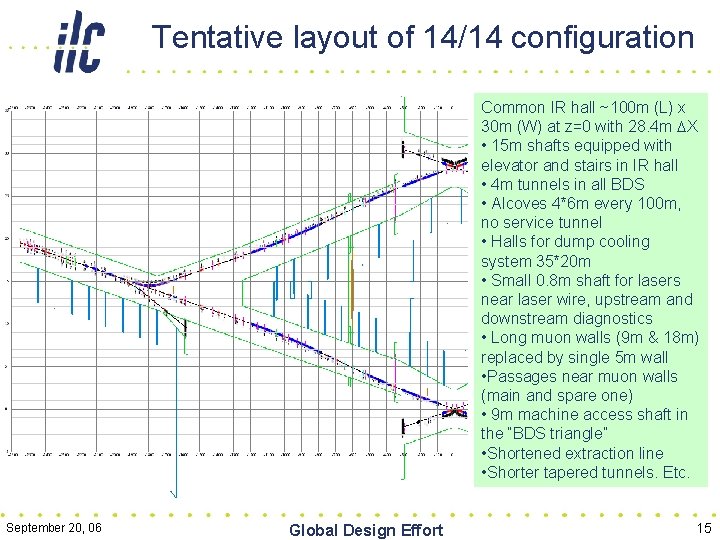
Tentative layout of 14/14 configuration Common IR hall ~100 m (L) x 30 m (W) at z=0 with 28. 4 m DX • 15 m shafts equipped with elevator and stairs in IR hall • 4 m tunnels in all BDS • Alcoves 4*6 m every 100 m, no service tunnel • Halls for dump cooling system 35*20 m • Small 0. 8 m shaft for lasers near laser wire, upstream and downstream diagnostics • Long muon walls (9 m & 18 m) replaced by single 5 m wall • Passages near muon walls (main and spare one) • 9 m machine access shaft in the “BDS triangle” • Shortened extraction line • Shorter tapered tunnels. Etc. September 20, 06 Global Design Effort 15
Further work baseline cost • Optimizing the IR hall requirement and detector assembly procedure – considering pure-CMS and modified CMS approached • Optimizing CF&S design • Working on installation model and refining the cost • Reviewing systems for possible cost reductions • Discussing other possible cost saving strategies September 20, 06 Global Design Effort 16
Summary • The process of change of baseline from 20/2 to 14/14, briefly outlined in this talk, included – – – – September 20, 06 Development of baseline design Evaluation of backgrounds & physics reach Study of beamline conditions & operability Engineering evaluation of the design Comparison of cost and operational expenses CCR for change of baseline Evaluation by WWS & CCB Further optimization of new baseline Global Design Effort 17

END September 20, 06 Global Design Effort 18
Backup slides • Several slides related to – – September 20, 06 estimated error of Dcost CCR on muon walls (submitted) CCR for on-surface detector assembly Some other example of comparative studies Global Design Effort 19
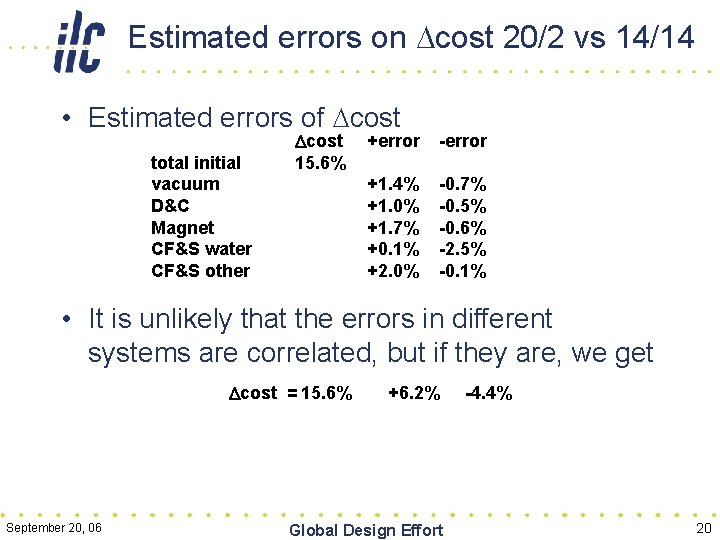
Estimated errors on Dcost 20/2 vs 14/14 • Estimated errors of Dcost total initial vacuum D&C Magnet CF&S water CF&S other Dcost 15. 6% +error -error +1. 4% +1. 0% +1. 7% +0. 1% +2. 0% -0. 7% -0. 5% -0. 6% -2. 5% -0. 1% • It is unlikely that the errors in different systems are correlated, but if they are, we get Dcost = 15. 6% September 20, 06 +6. 2% Global Design Effort -4. 4% 20
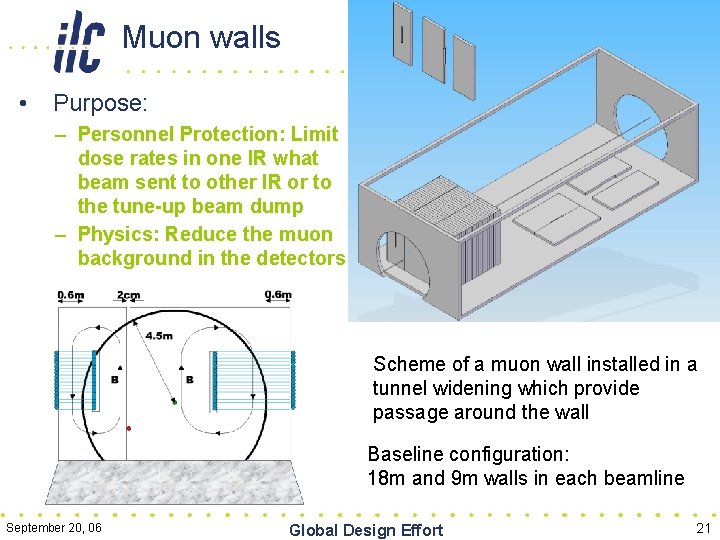
Muon walls • Purpose: – Personnel Protection: Limit dose rates in one IR what beam sent to other IR or to the tune-up beam dump – Physics: Reduce the muon background in the detectors Scheme of a muon wall installed in a tunnel widening which provide passage around the wall Baseline configuration: 18 m and 9 m walls in each beamline September 20, 06 Global Design Effort 21
Muon walls CCR • Baseline config (18 m+9 m walls) reduce muon flux to < 10 muons/200 bunches if 0. 1% of the beam is collimated • Considered that – The estimation of 0. 1% beam halo population is conservative and such high amount is not supported by any simulations – The min muon wall required for personnel protection is 5 m – Detector can tolerate higher muon flux. With single 5 m wall there is ~400 muon/200 bunches (500 Ge. V CM, 0. 1% of the beam collimated) which corresponds to ~0. 15% occupancy of TPC – Cost of long muon spoilers is substantial, dominated by material cost and thus approximately proportional to the muon wall length • Suggested CCR to install initially only 5 m single walls – The caverns will be built for full length walls, allowing upgrade if higher muons flux would be measured – Such upgrade could be done in ~3 month • MDI panel accepted this change September 20, 06 Global Design Effort 22
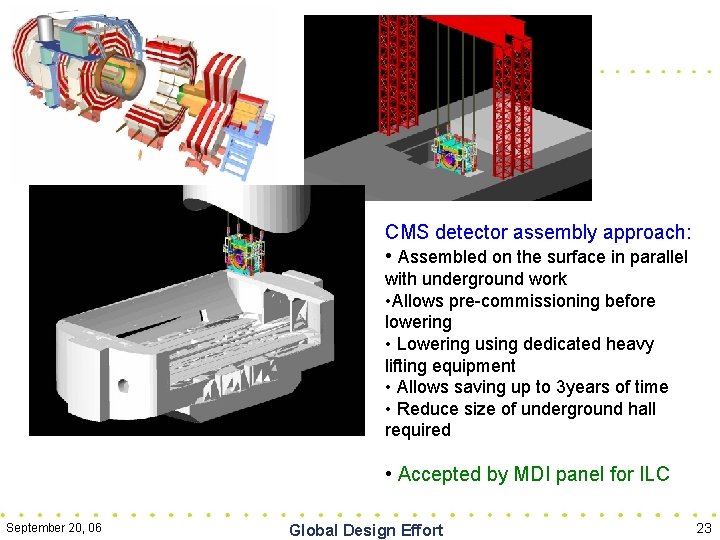
CMS detector assembly approach: • Assembled on the surface in parallel with underground work • Allows pre-commissioning before lowering • Lowering using dedicated heavy lifting equipment • Allows saving up to 3 years of time • Reduce size of underground hall required • Accepted by MDI panel for ILC September 20, 06 Global Design Effort 23
On-surface (a la CMS) assembly • According to tentative CF&S schedule, the detector hall is ready for detector assembly after 4 y 11 m after project start • If so, cannot fit into the goal of “ 7 years until first beam” and “ 8 years until physics run” • Surface assembly allows to save 2 -2. 5 years and allows to fit into this goal • The collider hall size is also smaller in this case – A building on surface is needed, but savings are still substantial September 20, 06 Global Design Effort 24
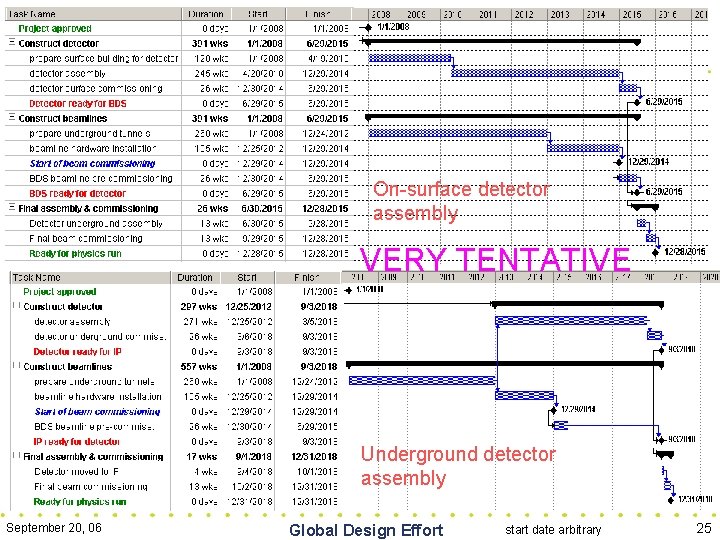
On-surface detector assembly VERY TENTATIVE Underground detector assembly September 20, 06 Global Design Effort start date arbitrary 25
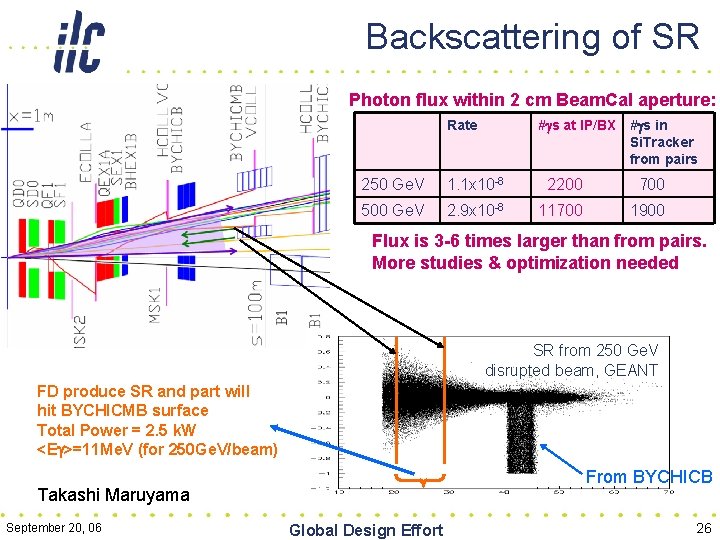
Backscattering of SR Photon flux within 2 cm Beam. Cal aperture: Rate # s at IP/BX # s in Si. Tracker from pairs 250 Ge. V 1. 1 x 10 -8 2200 700 500 Ge. V 2. 9 x 10 -8 11700 1900 Flux is 3 -6 times larger than from pairs. More studies & optimization needed SR from 250 Ge. V disrupted beam, GEANT FD produce SR and part will hit BYCHICMB surface Total Power = 2. 5 k. W <E >=11 Me. V (for 250 Ge. V/beam) From BYCHICB Takashi Maruyama September 20, 06 Global Design Effort 26
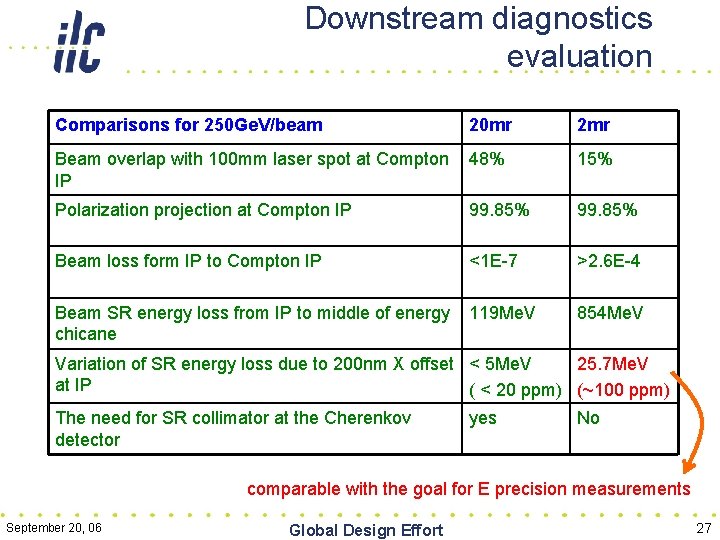
Downstream diagnostics evaluation Comparisons for 250 Ge. V/beam 20 mr 2 mr Beam overlap with 100 mm laser spot at Compton IP 48% 15% Polarization projection at Compton IP 99. 85% Beam loss form IP to Compton IP <1 E-7 >2. 6 E-4 Beam SR energy loss from IP to middle of energy chicane 119 Me. V 854 Me. V Variation of SR energy loss due to 200 nm X offset < 5 Me. V 25. 7 Me. V at IP ( < 20 ppm) (~100 ppm) The need for SR collimator at the Cherenkov detector yes No comparable with the goal for E precision measurements September 20, 06 Global Design Effort 27
- Slides: 27