
Process Mining Discovering processes from event logs All



- Slides: 58
Process Mining: Discovering processes from event logs All truths are easy to understand once they are discovered; the point is to discover them. Galileo Galilei (1564 - 1642) Prof. dr. ir. Wil van der Aalst Eindhoven University of Technology Department of Information and Technology P. O. Box 513, 5600 MB Eindhoven The Netherlands w. m. p. v. d. aalst@tm. tue. nl
Outline • BPM research in Eindhoven • Process Mining • Pro. M – Architecture – Process mining plug-ins • Alpha-algorithm • Multi-phase mining • Genetic mining – – – Analysis plug-ins Conformance testing plug-in LTL checker plug-in Social network plug-in Convertors (e-mail, Staffware, In. Concert, SAP, etc. ) • Conclusion
BPM research in Eindhoven
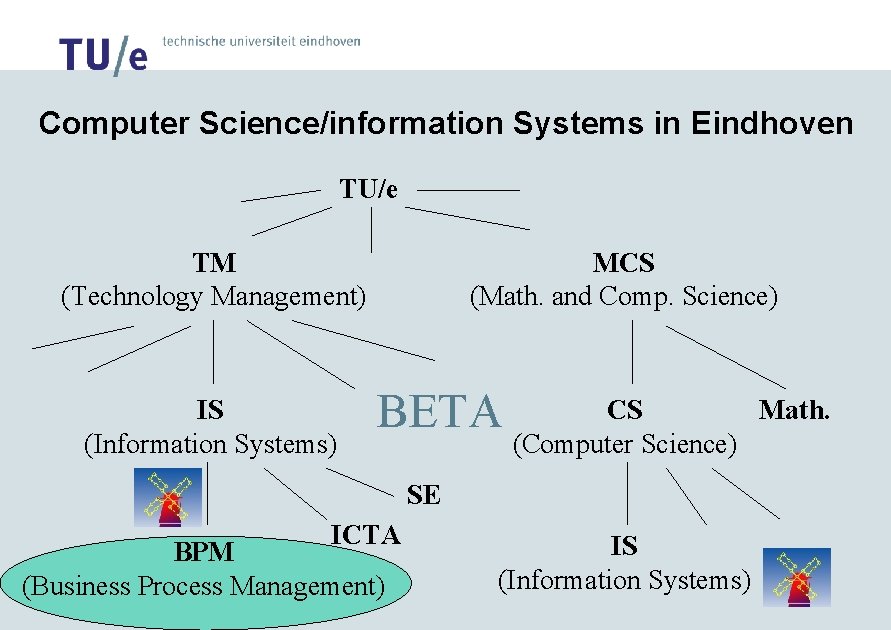
Computer Science/information Systems in Eindhoven TU/e TM (Technology Management) IS (Information Systems) MCS (Math. and Comp. Science) BETA CS Math. (Computer Science) SE ICTA BPM (Business Process Management) IS (Information Systems)
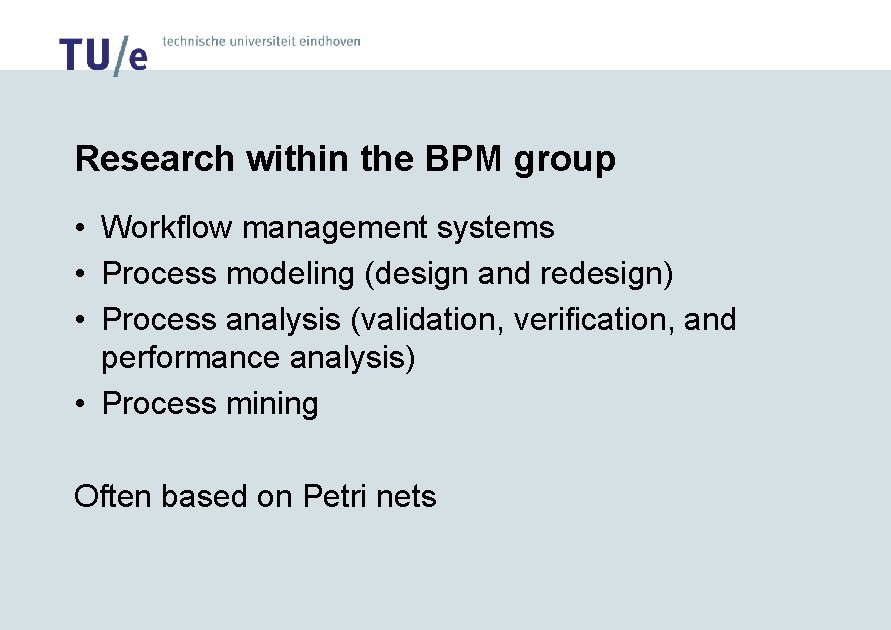
Research within the BPM group • Workflow management systems • Process modeling (design and redesign) • Process analysis (validation, verification, and performance analysis) • Process mining Often based on Petri nets
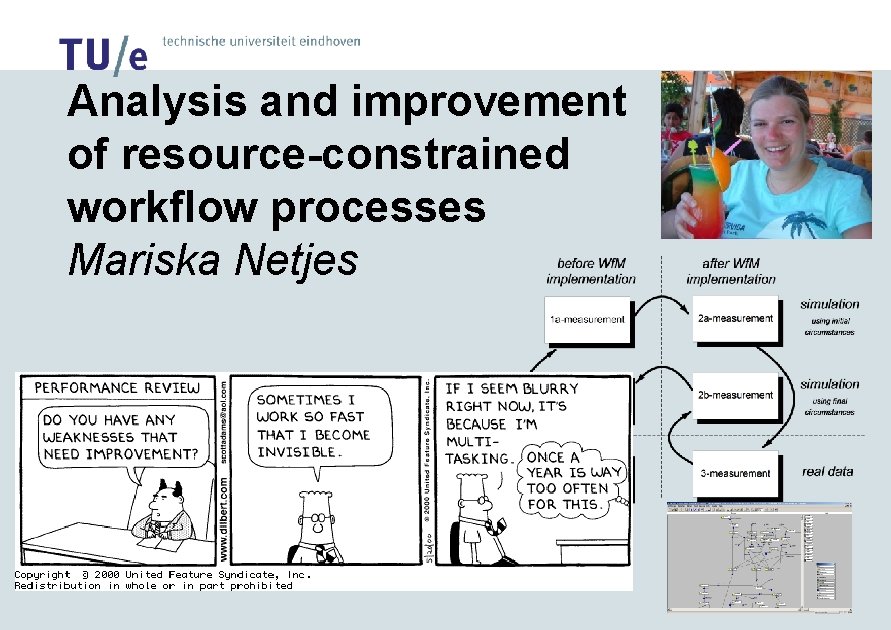
Analysis and improvement of resource-constrained workflow processes Mariska Netjes
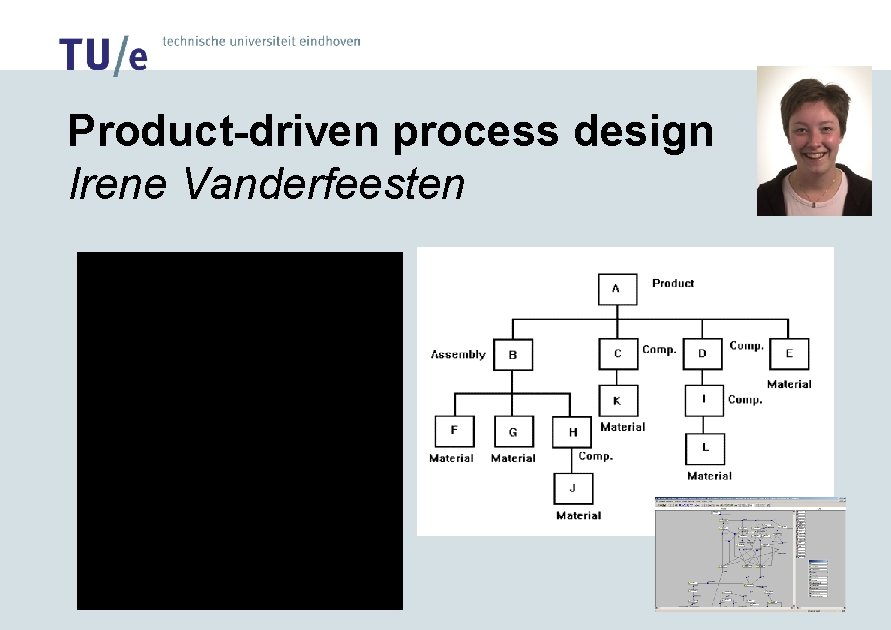
Product-driven process design Irene Vanderfeesten
Improving work distribution mechanisms in WFM systems Maja Pesic
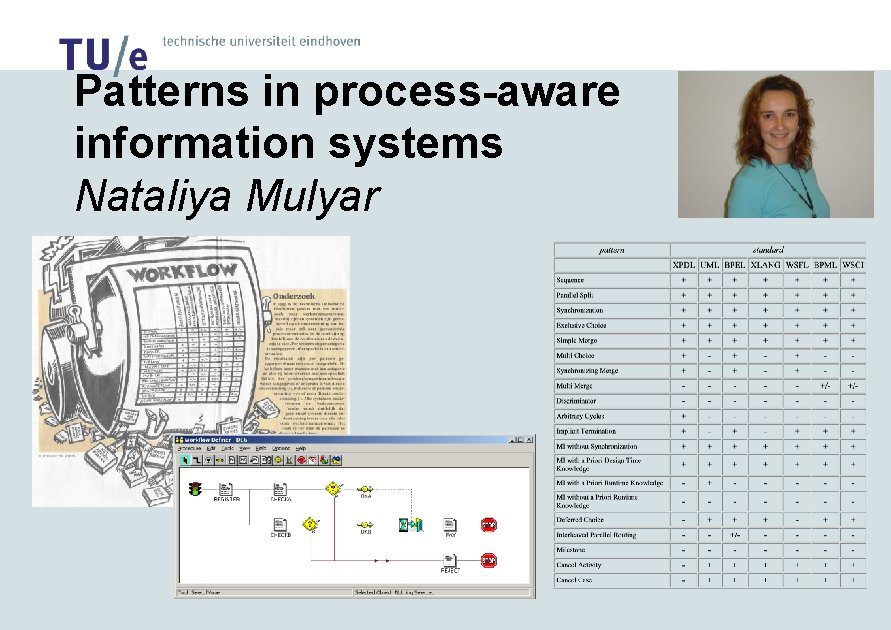
Patterns in process-aware information systems Nataliya Mulyar
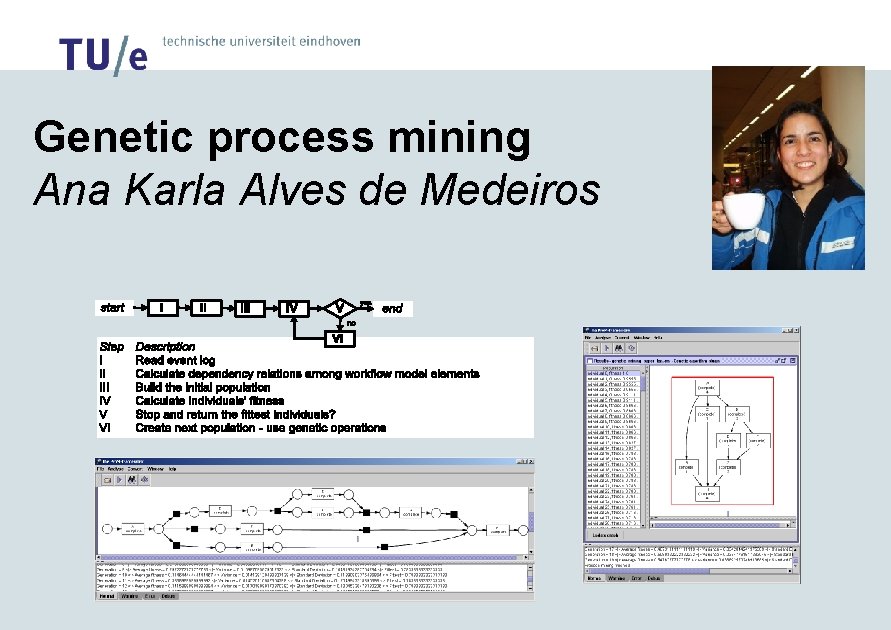
Genetic process mining Ana Karla Alves de Medeiros
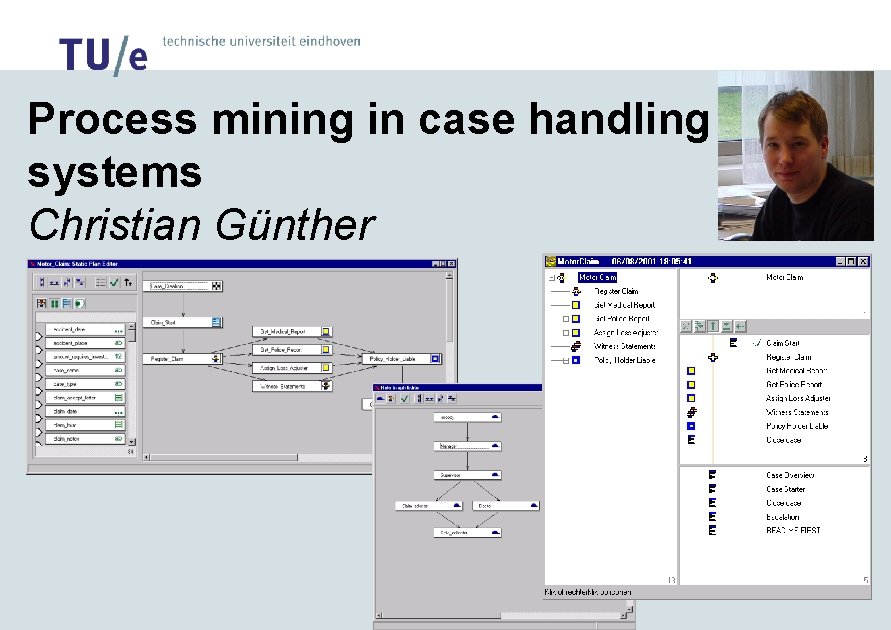
Process mining in case handling systems Christian Günther
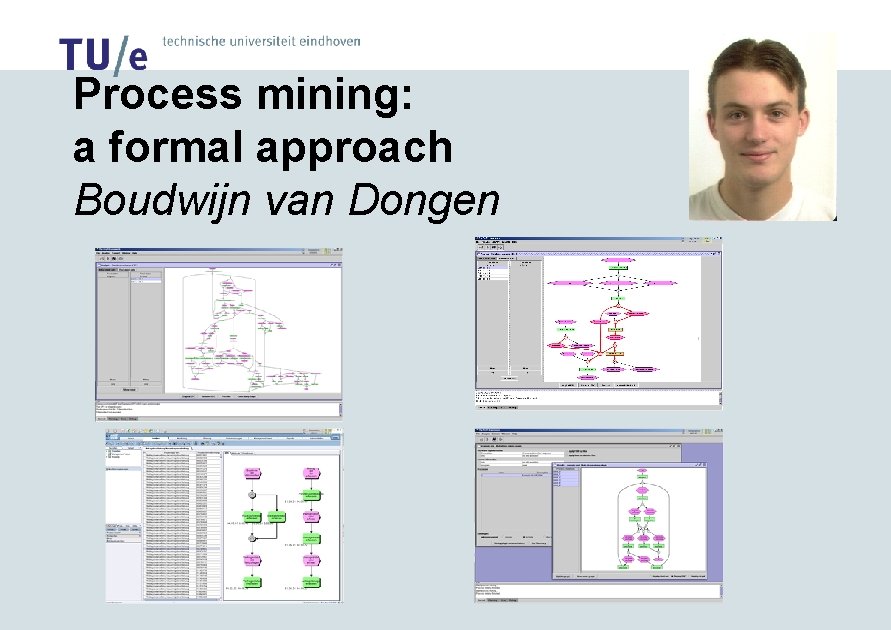
Process mining: a formal approach Boudwijn van Dongen
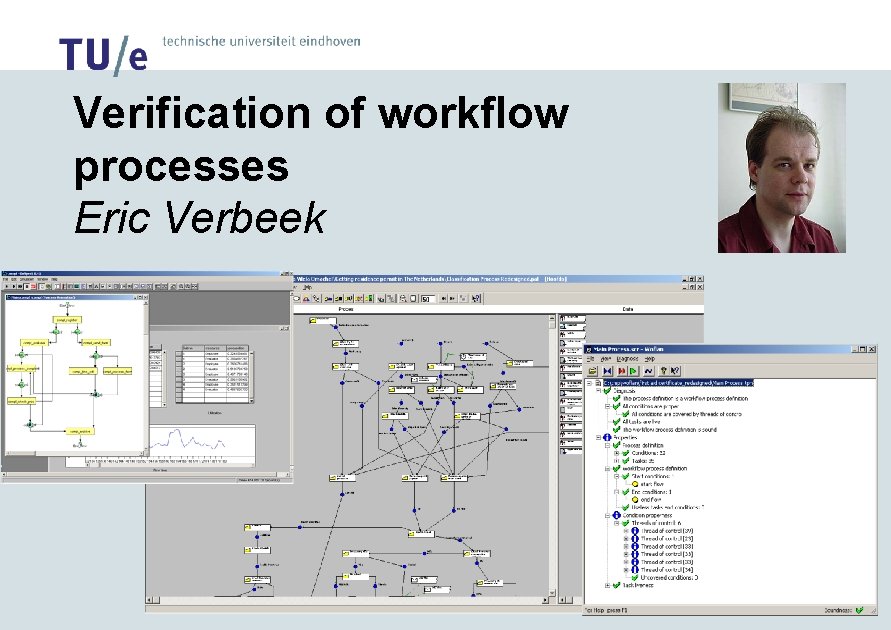
Verification of workflow processes Eric Verbeek
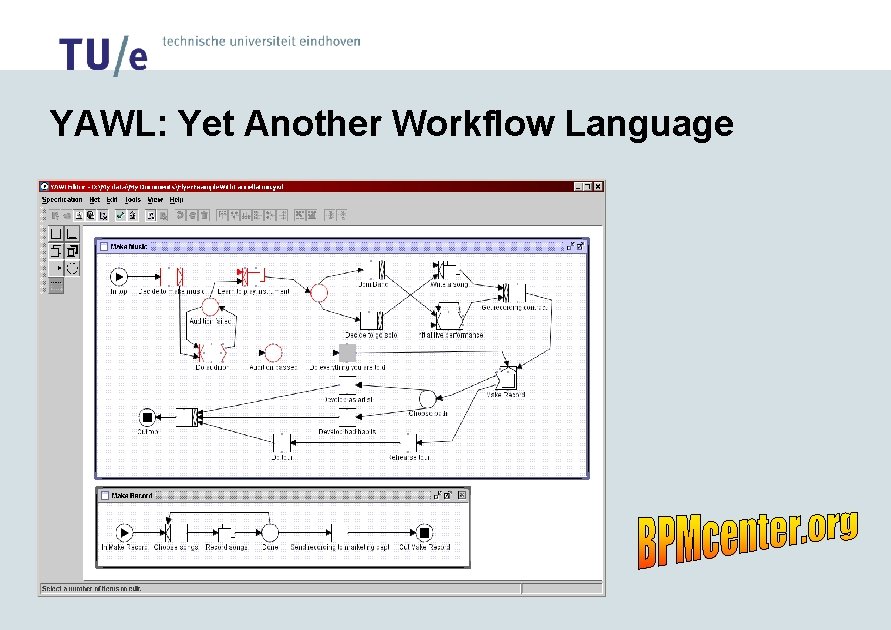
YAWL: Yet Another Workflow Language
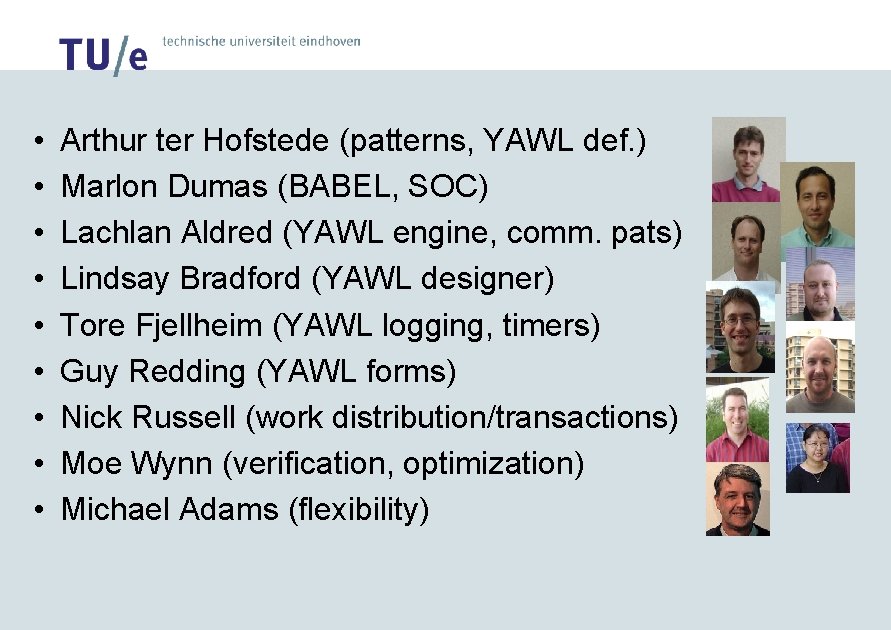
• • • Arthur ter Hofstede (patterns, YAWL def. ) Marlon Dumas (BABEL, SOC) Lachlan Aldred (YAWL engine, comm. pats) Lindsay Bradford (YAWL designer) Tore Fjellheim (YAWL logging, timers) Guy Redding (YAWL forms) Nick Russell (work distribution/transactions) Moe Wynn (verification, optimization) Michael Adams (flexibility)
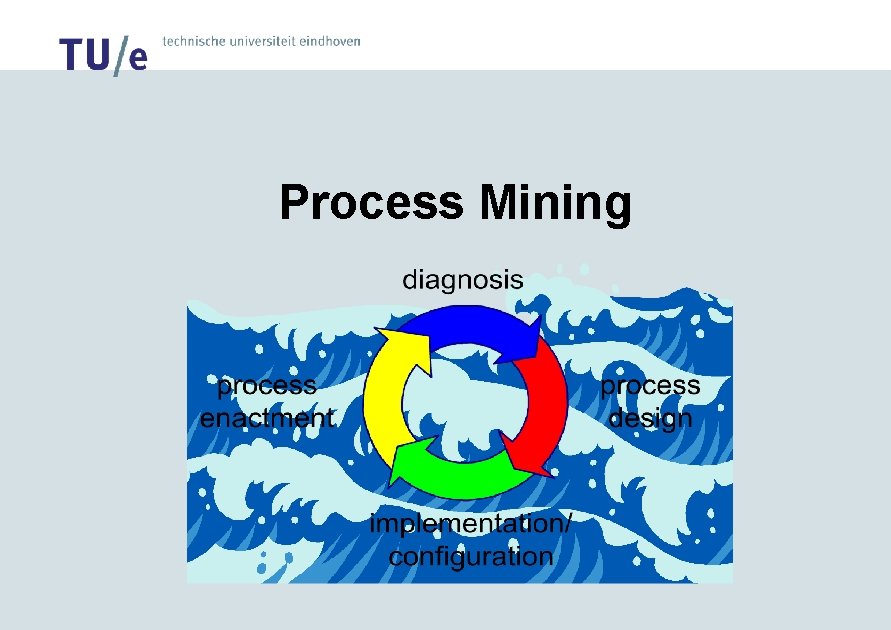
Process Mining
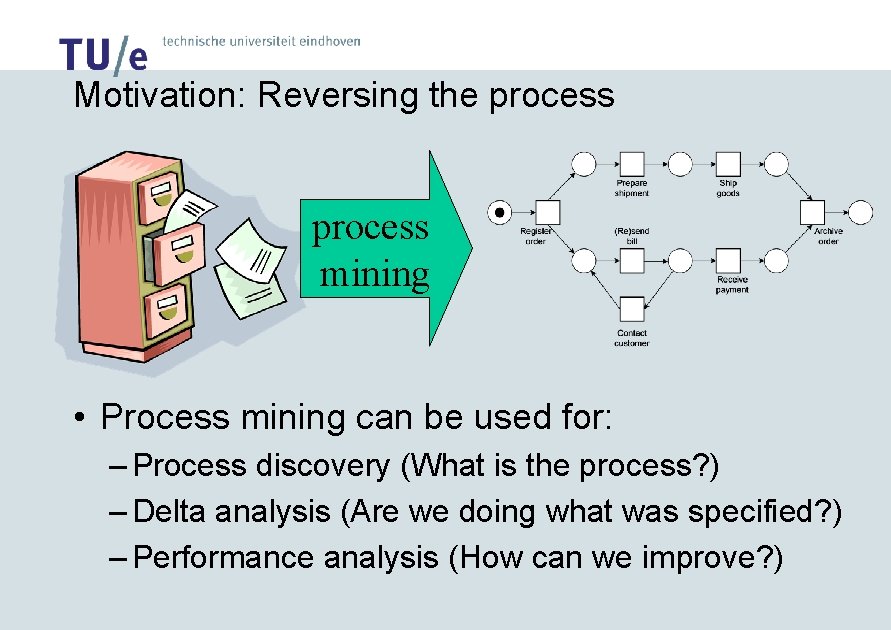
Motivation: Reversing the process mining • Process mining can be used for: – Process discovery (What is the process? ) – Delta analysis (Are we doing what was specified? ) – Performance analysis (How can we improve? )
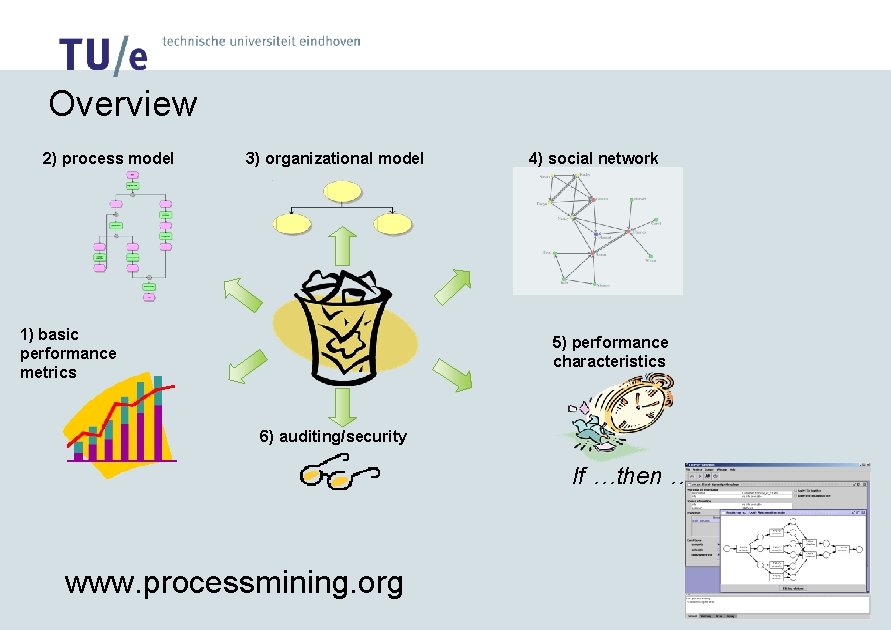
Overview 2) process model 3) organizational model 1) basic performance metrics 4) social network 5) performance characteristics 6) auditing/security If …then … www. processmining. org
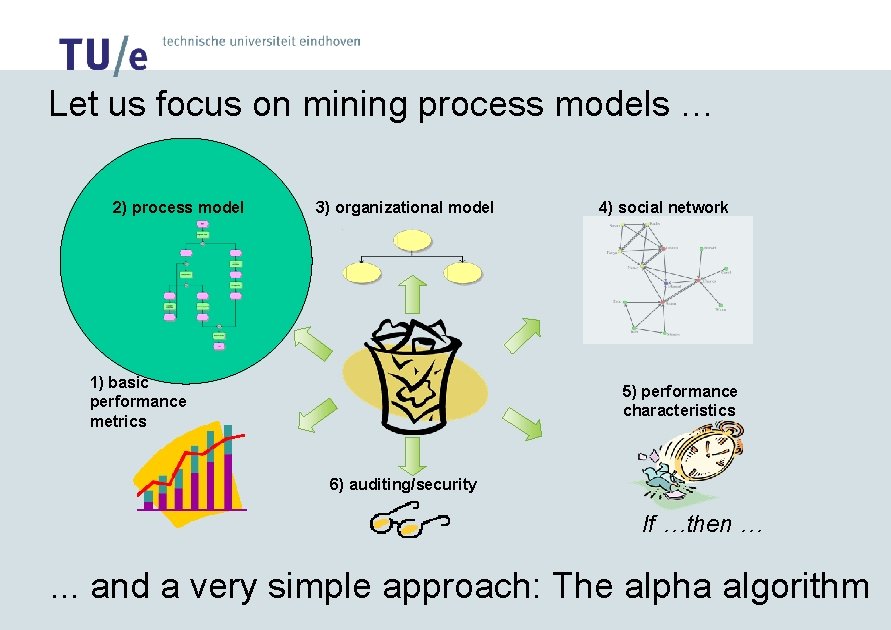
Let us focus on mining process models … 2) process model 3) organizational model 1) basic performance metrics 4) social network 5) performance characteristics 6) auditing/security If …then … . . . and a very simple approach: The alpha algorithm
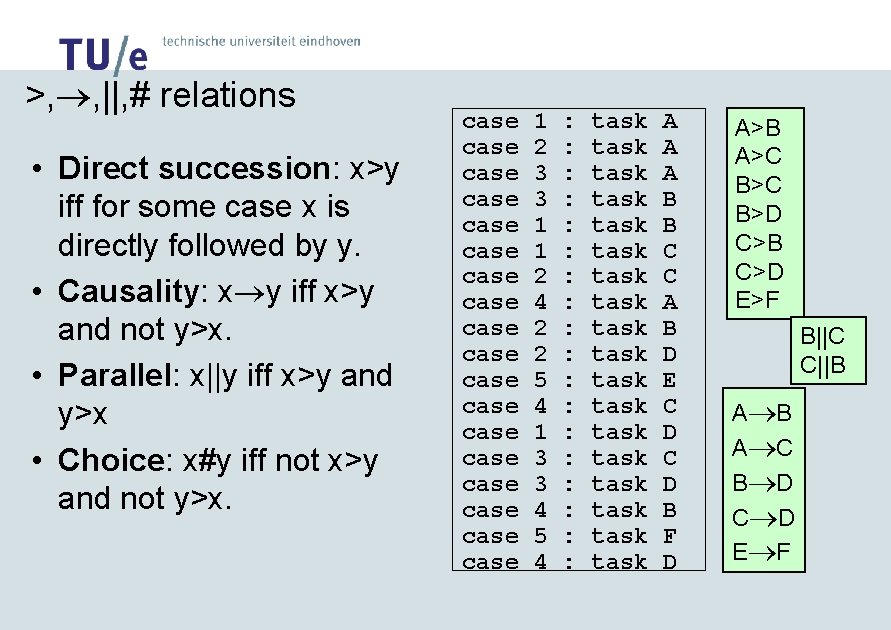
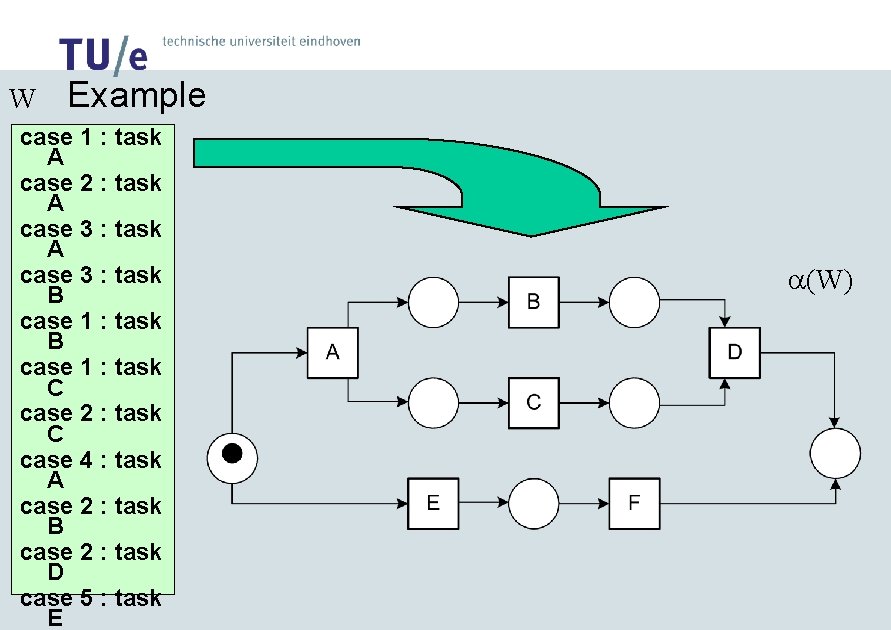
Process log • Minimal information in log: case id’s and task id’s. • Additional information: event type, time, resources, and data. • In this log there are three possible sequences: – ABCD – ACBD – EF case case case case case 1 2 3 3 1 1 2 4 2 2 5 4 1 3 3 4 5 4 : : : : : task task task task task A A A B B C C A B D E C D B F D
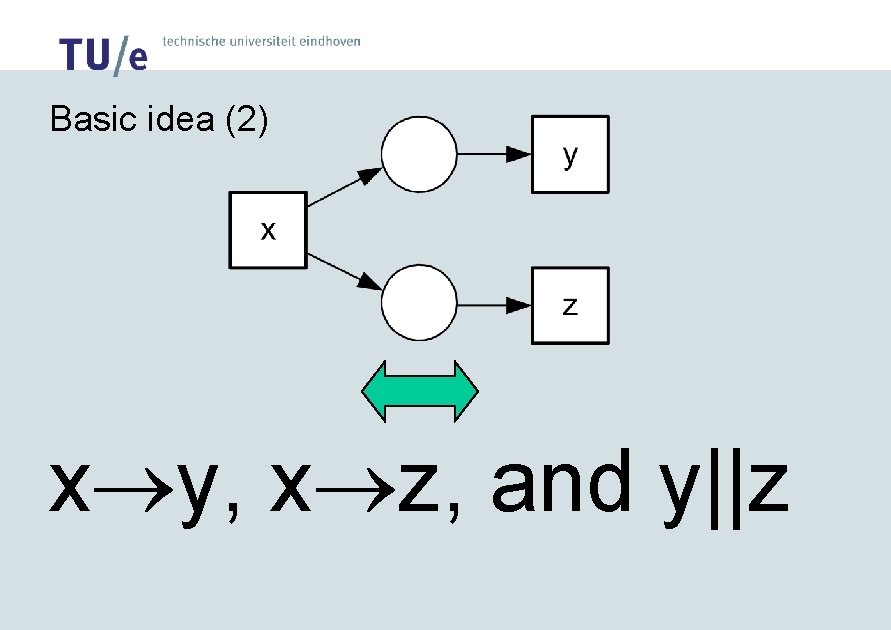
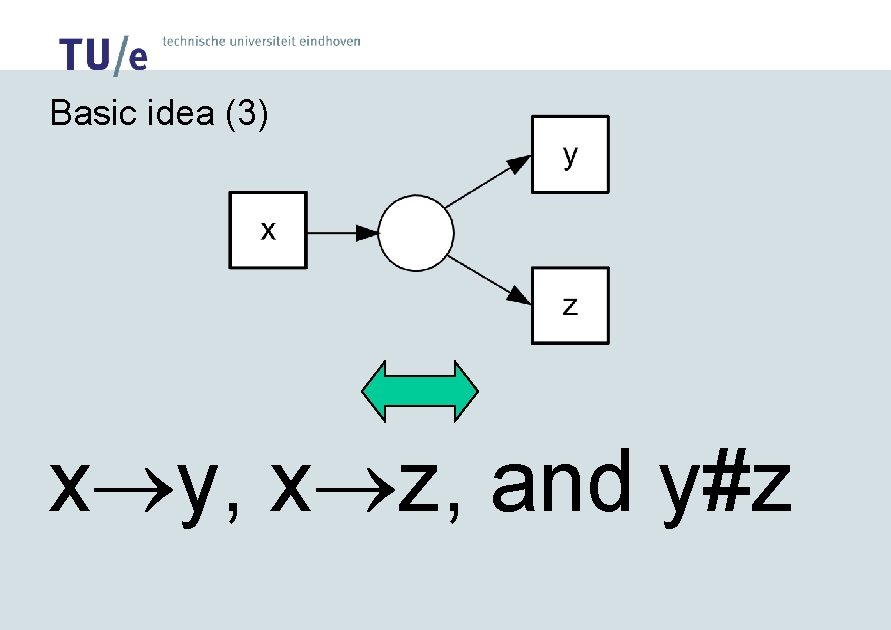
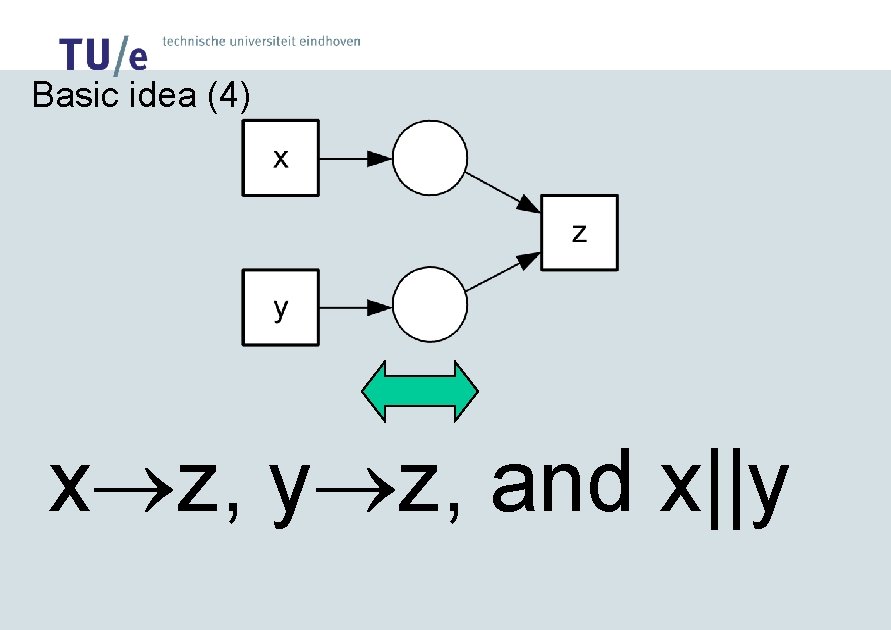
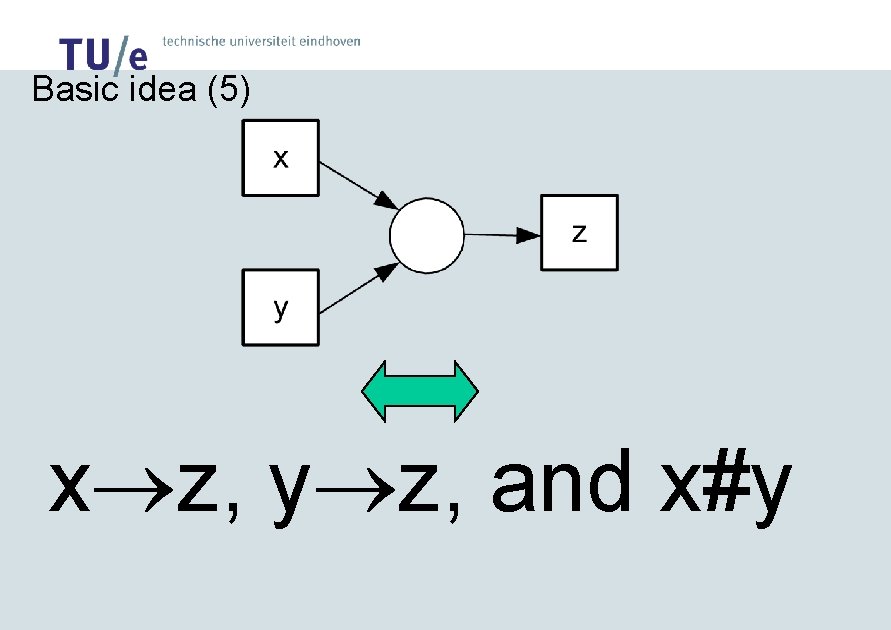
>, , ||, # relations • Direct succession: x>y iff for some case x is directly followed by y. • Causality: x y iff x>y and not y>x. • Parallel: x||y iff x>y and y>x • Choice: x#y iff not x>y and not y>x. case case case case case 1 2 3 3 1 1 2 4 2 2 5 4 1 3 3 4 5 4 : : : : : task task task task task A A A B B C C A B D E C D B F D A>B A>C B>D C>B C>D E>F B||C C||B A C B D C D E F
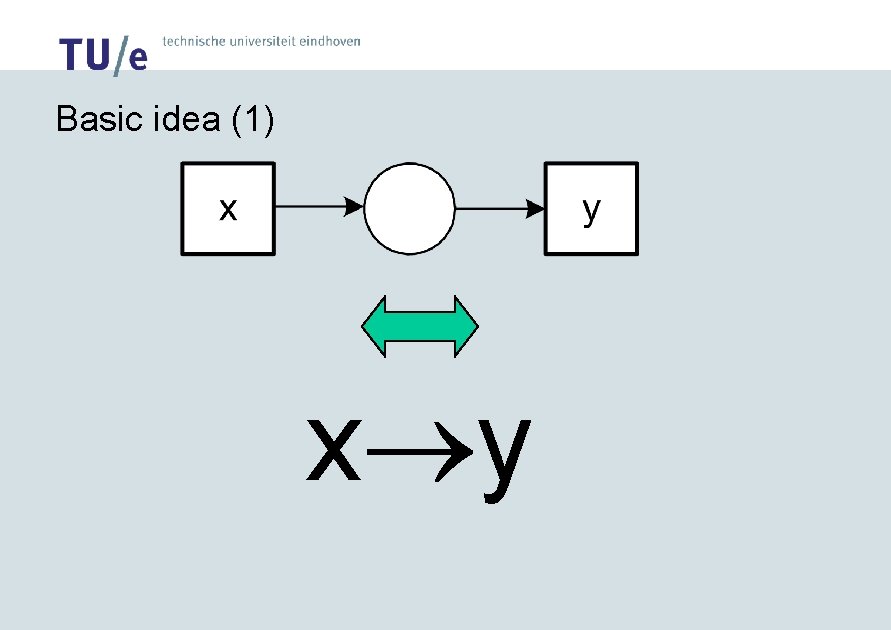
Basic idea (1) x y
Basic idea (2) x y, x z, and y||z
Basic idea (3) x y, x z, and y#z
Basic idea (4) x z, y z, and x||y
Basic idea (5) x z, y z, and x#y
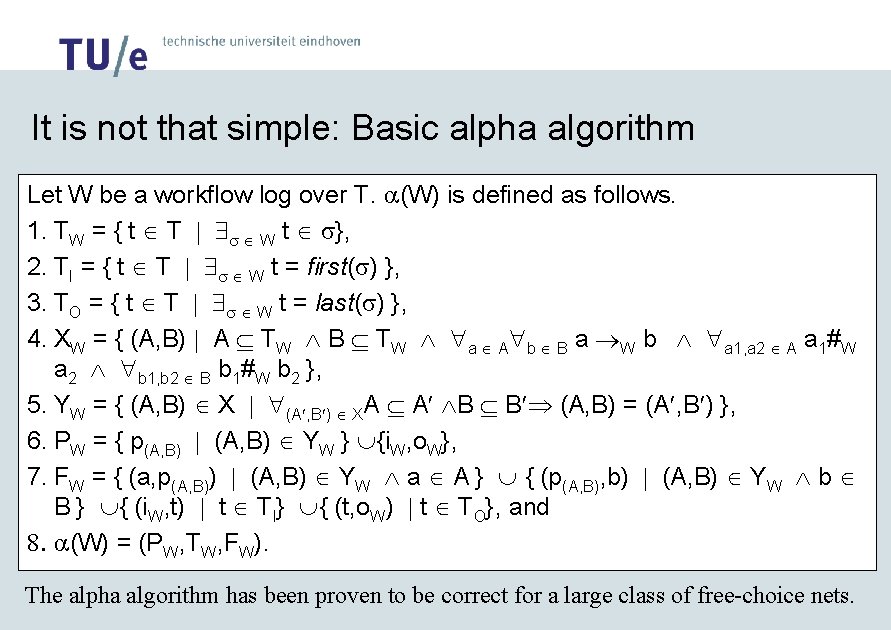
It is not that simple: Basic alpha algorithm Let W be a workflow log over T. a(W) is defined as follows. 1. TW = { t Î T | $s Î W t Î s}, 2. TI = { t Î T | $s Î W t = first(s) }, 3. TO = { t Î T | $s Î W t = last(s) }, 4. XW = { (A, B) | A Í TW Ù B Í TW Ù "a Î A"b Î B a W b Ù "a 1, a 2 Î A a 1#W a 2 Ù "b 1, b 2 Î B b 1#W b 2 }, 5. YW = { (A, B) Î X | "(A¢, B¢) Î XA Í A¢ ÙB Í B¢Þ (A, B) = (A¢, B¢) }, 6. PW = { p(A, B) | (A, B) Î YW } È{i. W, o. W}, 7. FW = { (a, p(A, B)) | (A, B) Î YW Ù a Î A } È { (p(A, B), b) | (A, B) Î YW Ù b Î B } È{ (i. W, t) | t Î TI} È{ (t, o. W) | t Î TO}, and 8. a(W) = (PW, TW, FW). The alpha algorithm has been proven to be correct for a large class of free-choice nets.
W Example case 1 : task A case 2 : task A case 3 : task B case 1 : task C case 2 : task C case 4 : task A case 2 : task B case 2 : task D case 5 : task E a(W)
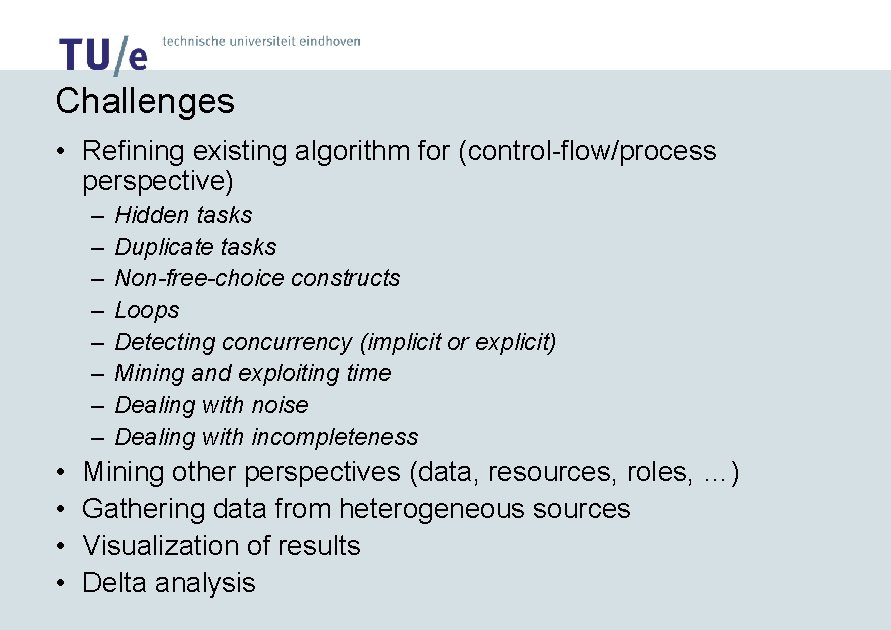
Challenges • Refining existing algorithm for (control-flow/process perspective) – – – – • • Hidden tasks Duplicate tasks Non-free-choice constructs Loops Detecting concurrency (implicit or explicit) Mining and exploiting time Dealing with noise Dealing with incompleteness Mining other perspectives (data, resources, roles, …) Gathering data from heterogeneous sources Visualization of results Delta analysis
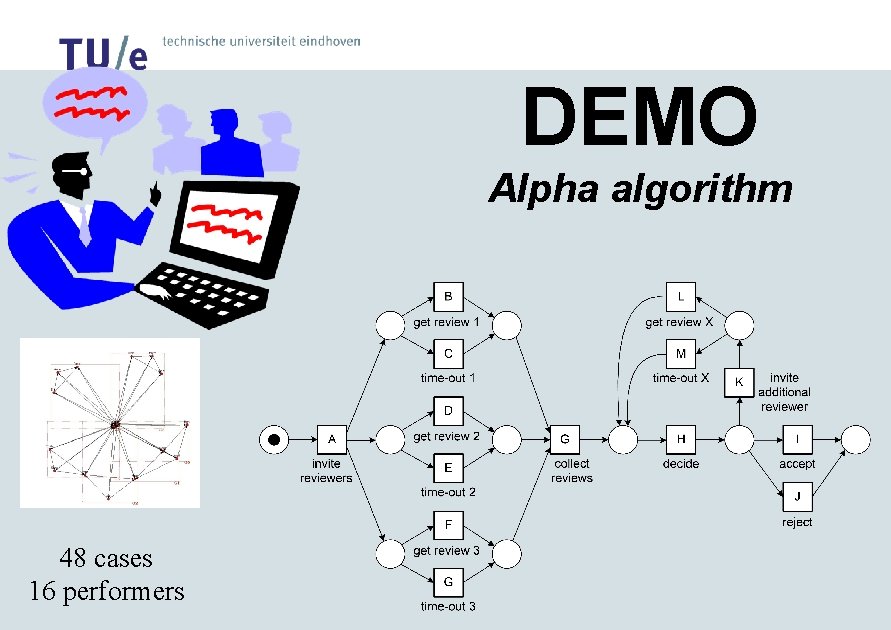
DEMO Alpha algorithm 48 cases 16 performers
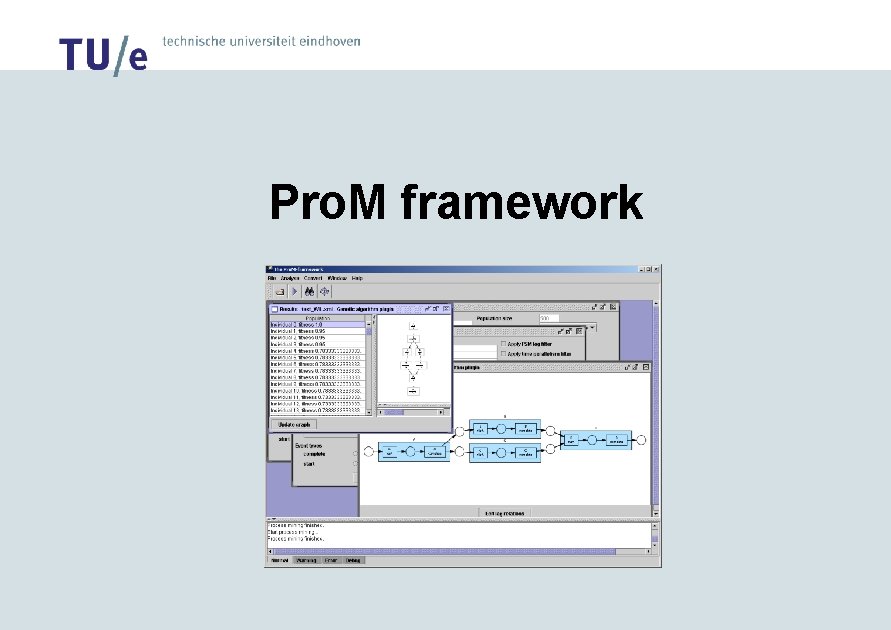
Pro. M framework
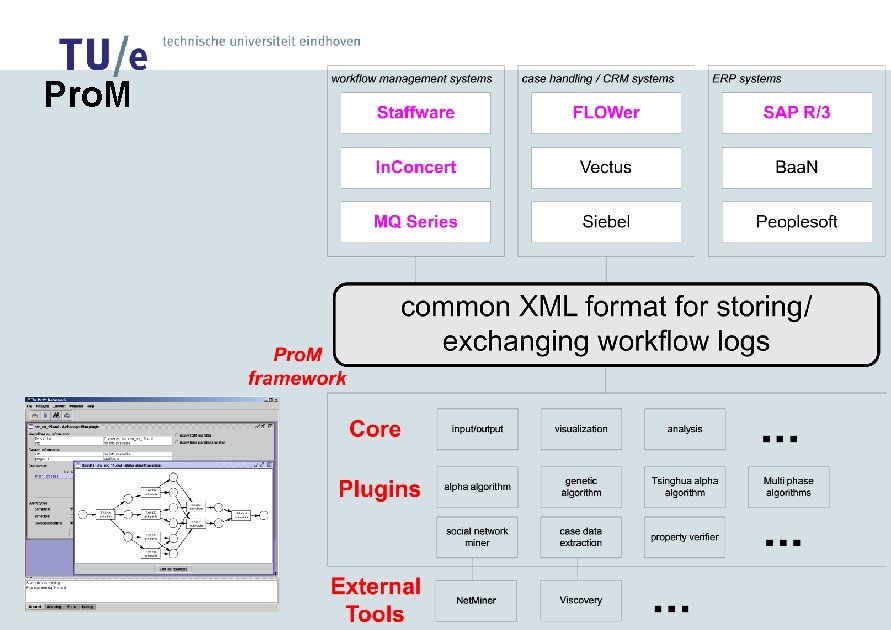
Pro. M
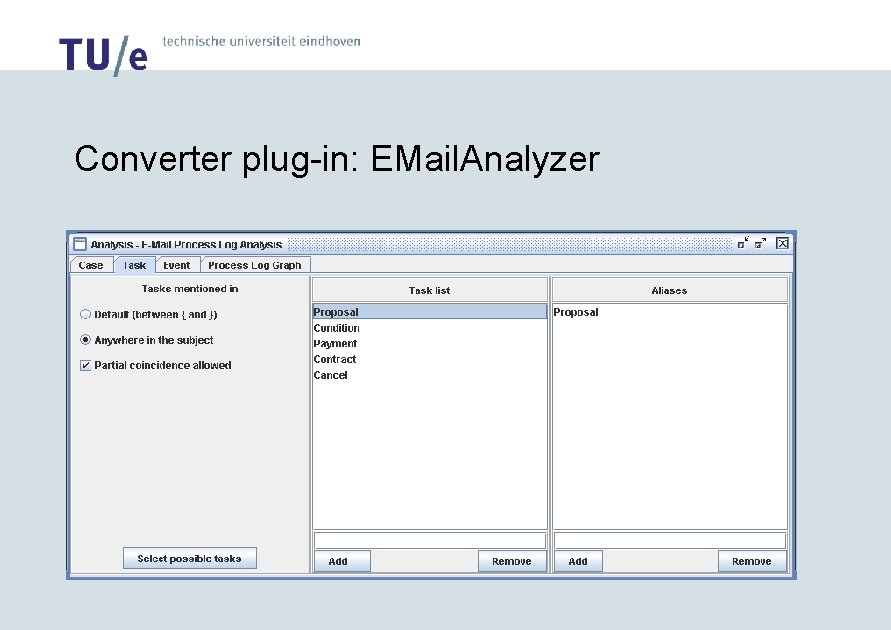
Converter plug-in: EMail. Analyzer
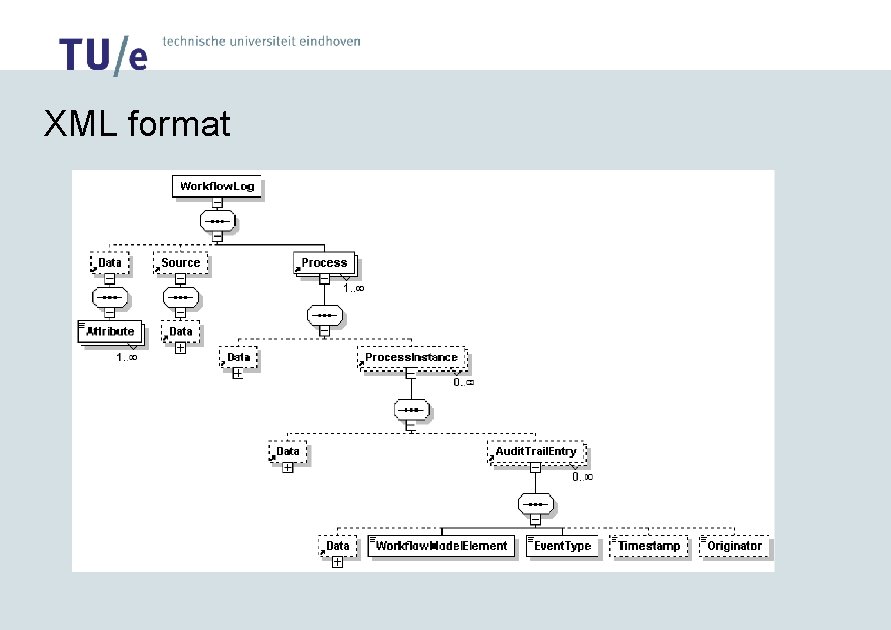
XML format
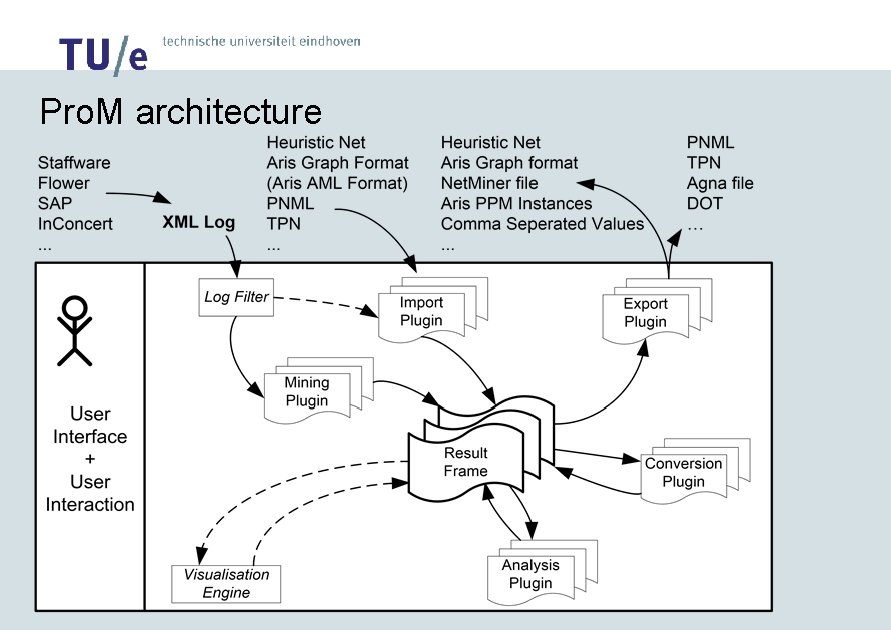
Pro. M architecture
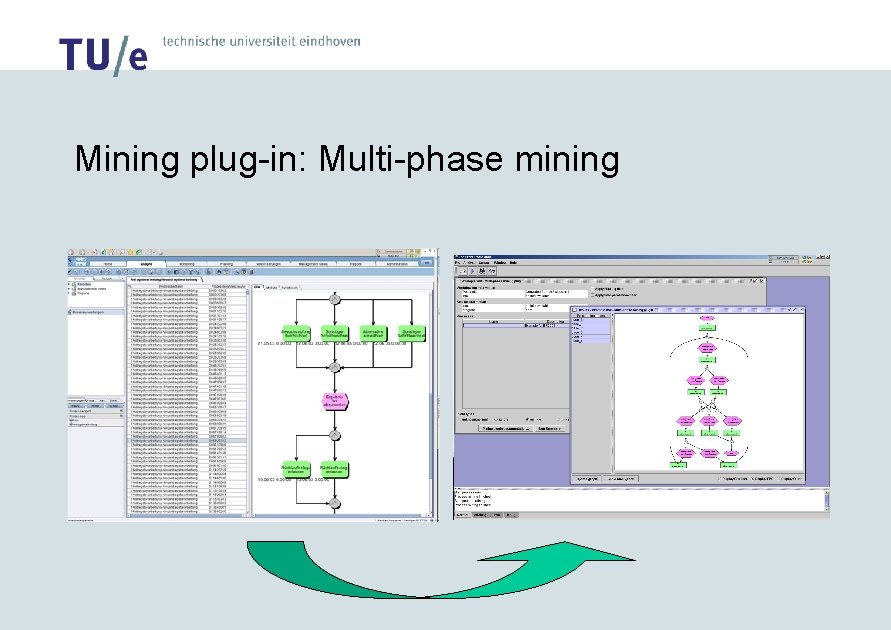
Mining plug-in: Multi-phase mining
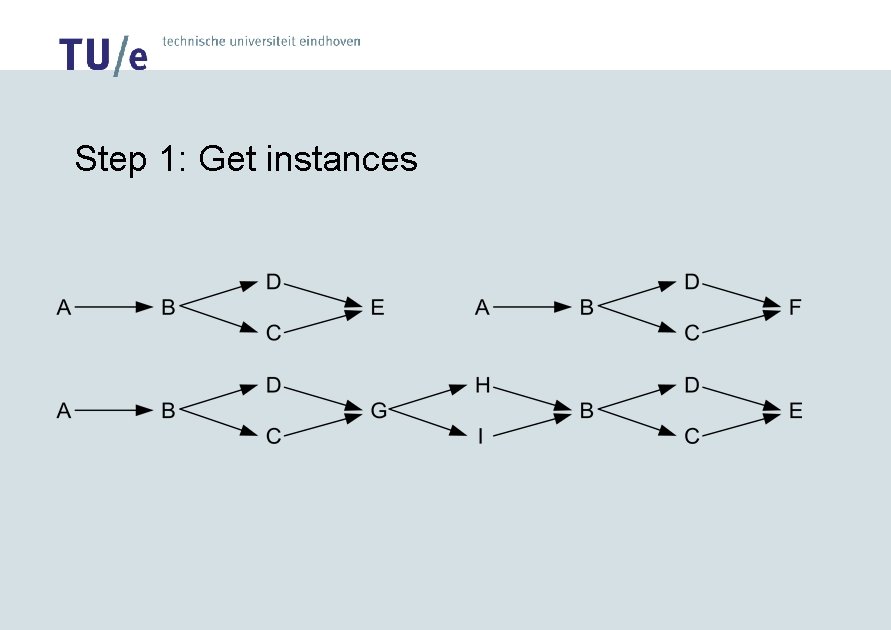
Step 1: Get instances
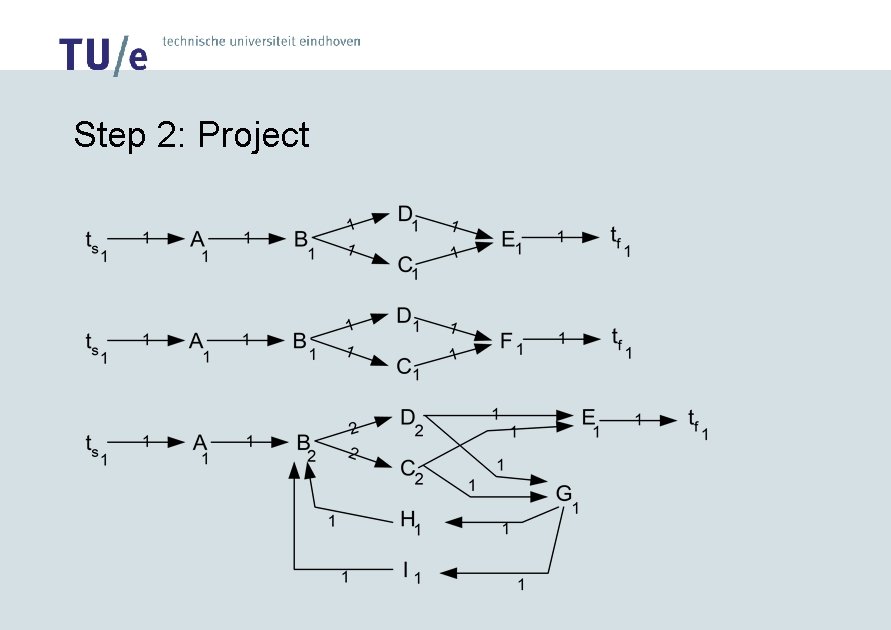
Step 2: Project
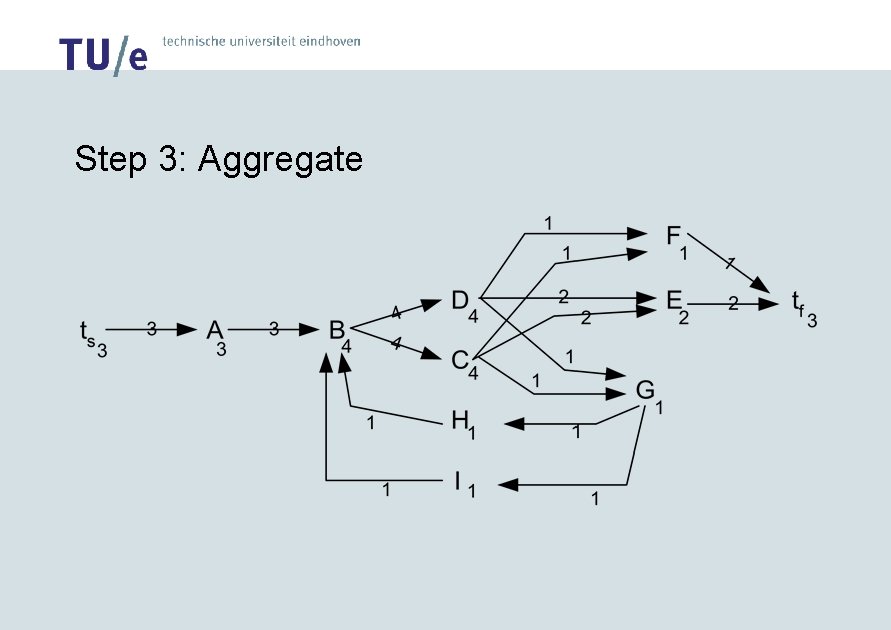
Step 3: Aggregate
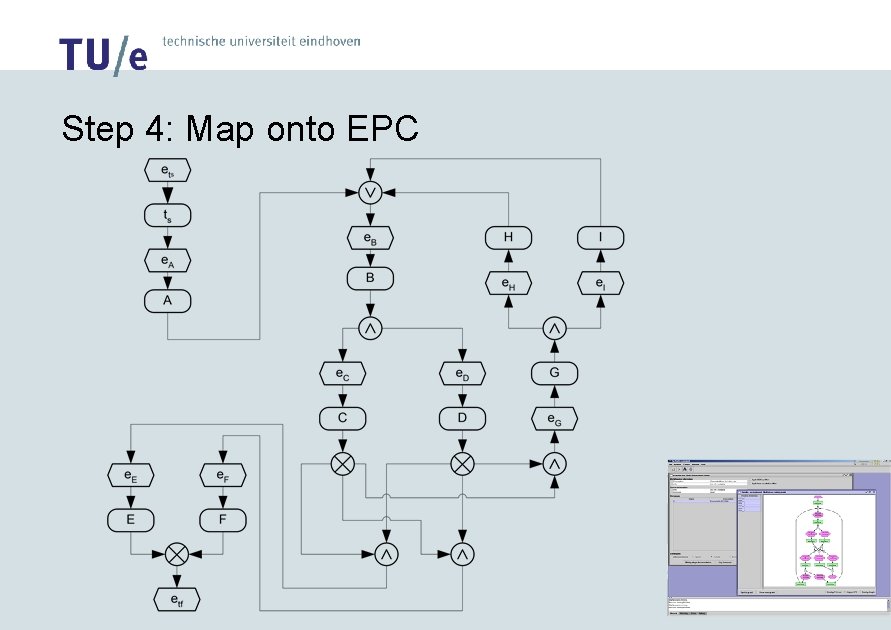
Step 4: Map onto EPC
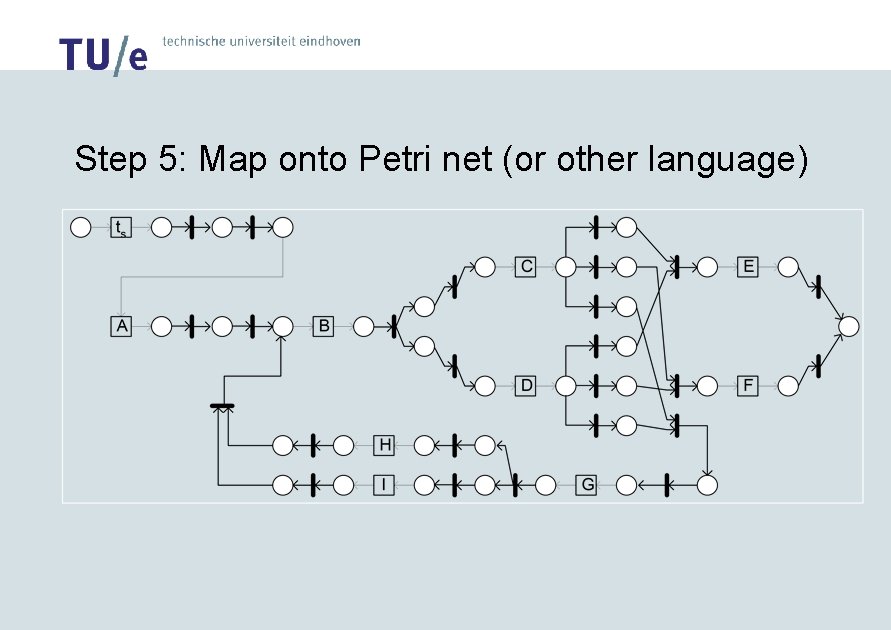
Step 5: Map onto Petri net (or other language)
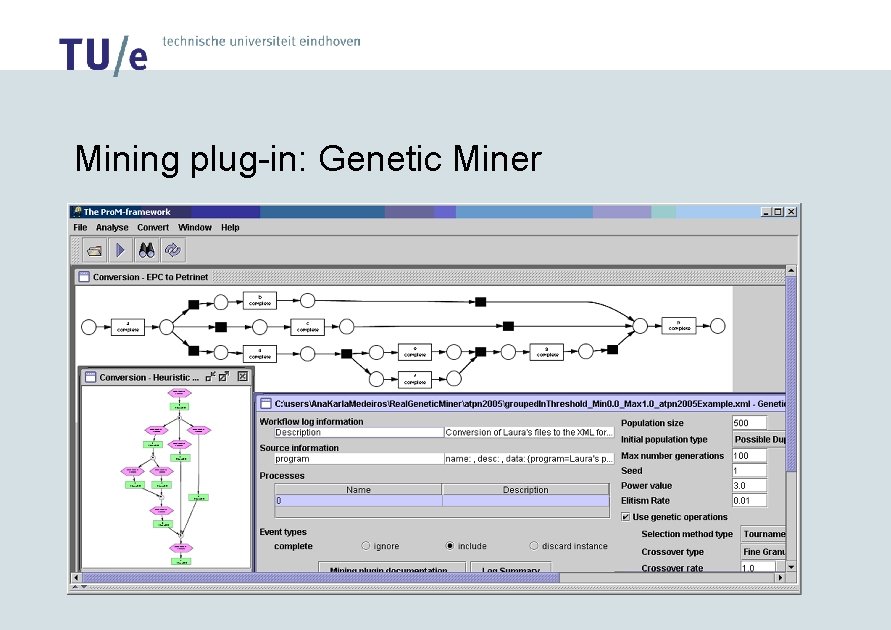
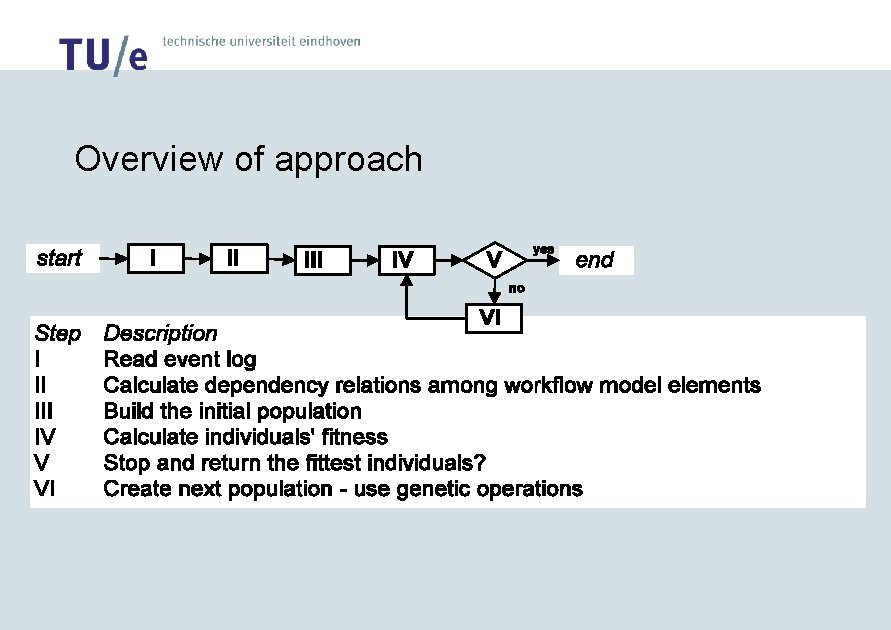
Mining plug-in: Genetic Miner
Overview of approach
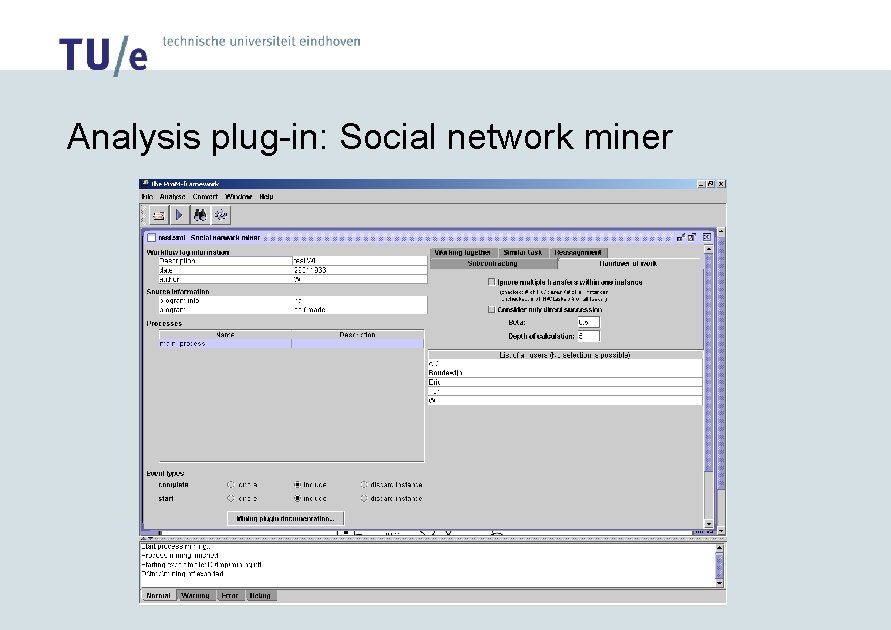
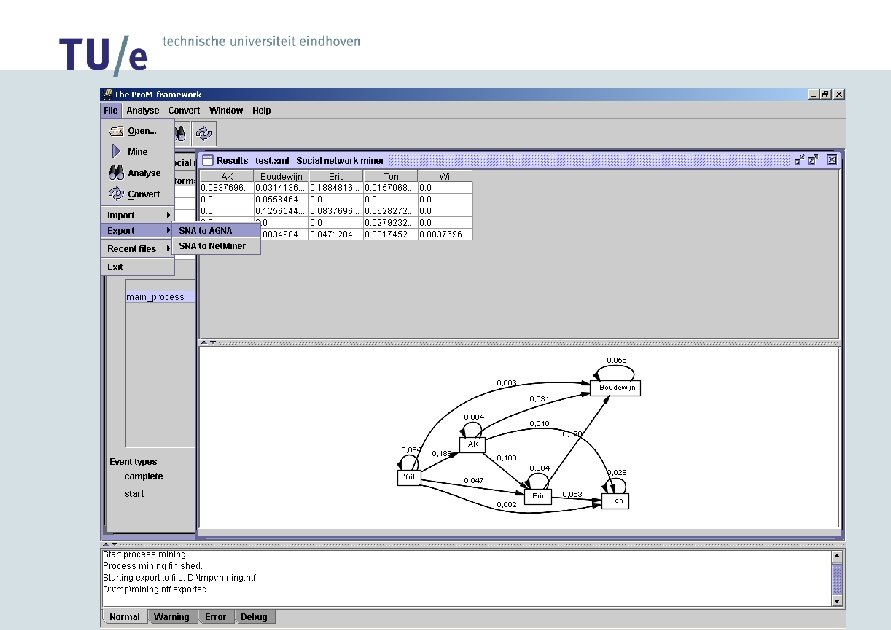
Analysis plug-in: Social network miner
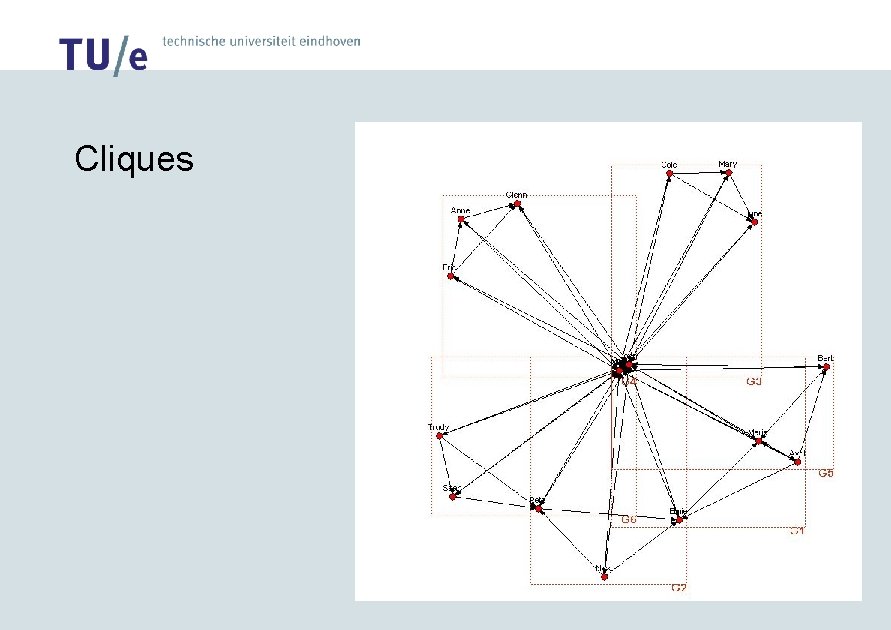
Cliques
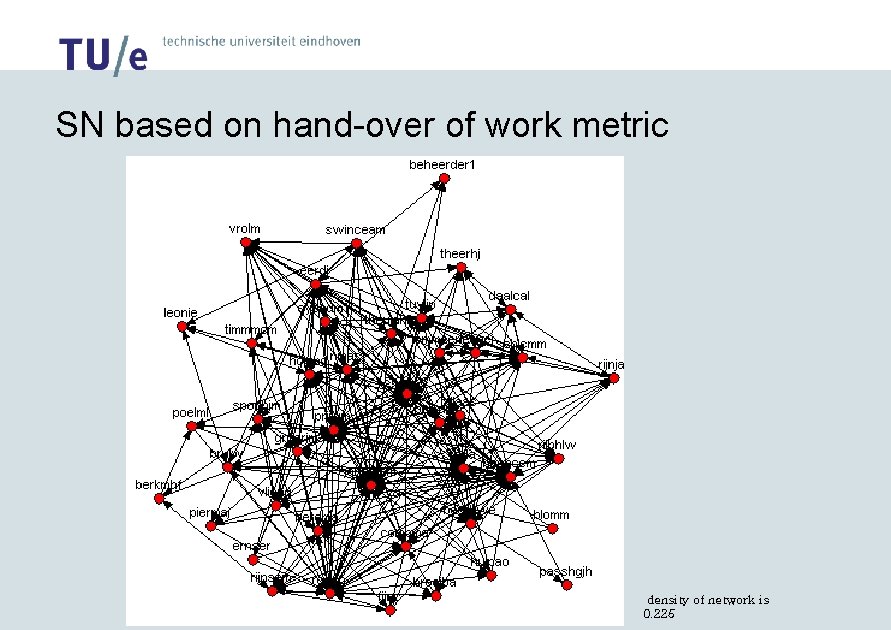
SN based on hand-over of work metric density of network is 0. 225
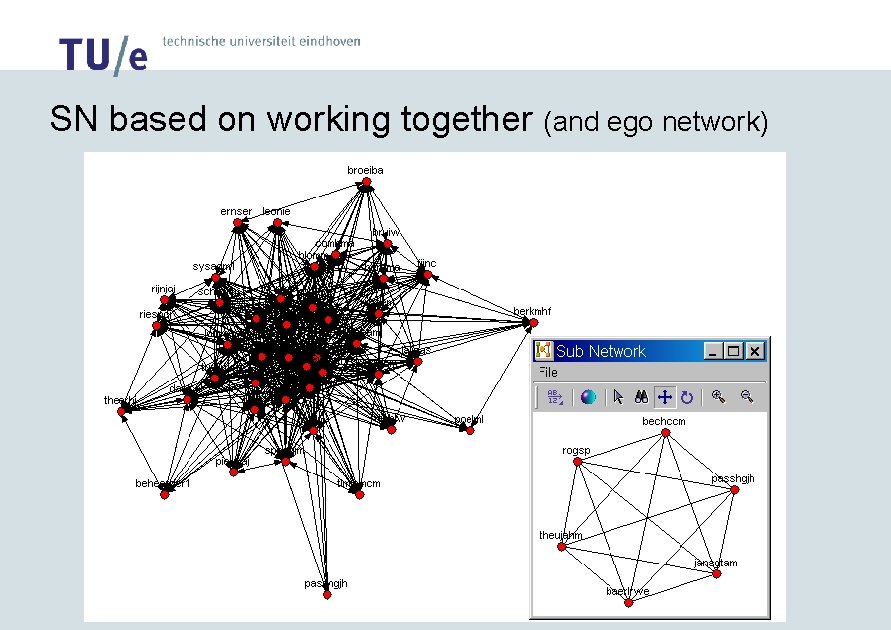
SN based on working together (and ego network)
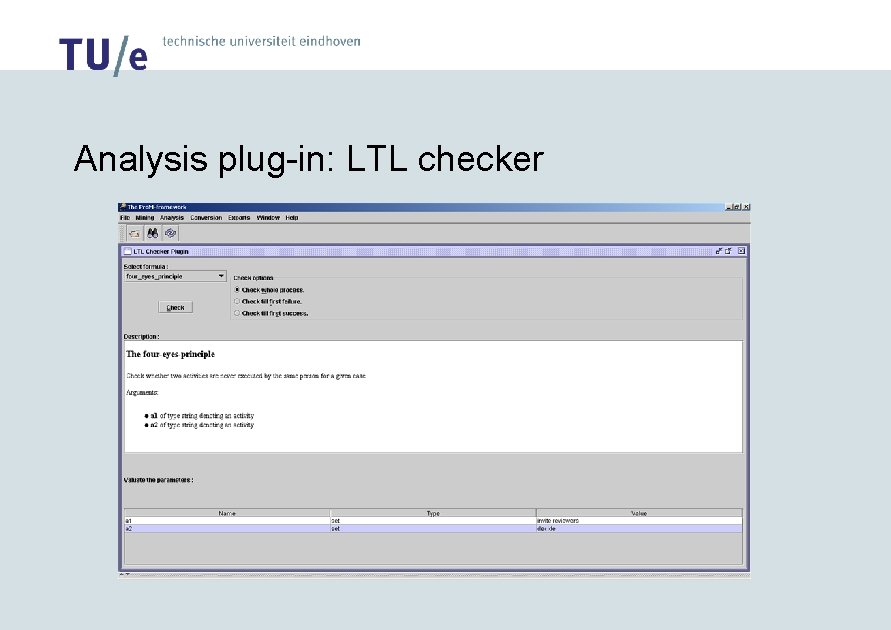
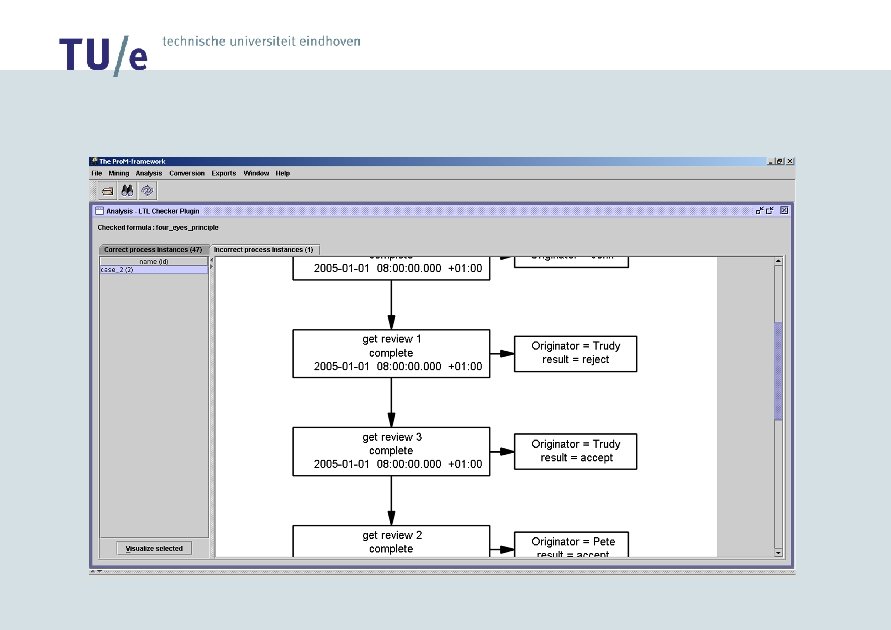
Analysis plug-in: LTL checker
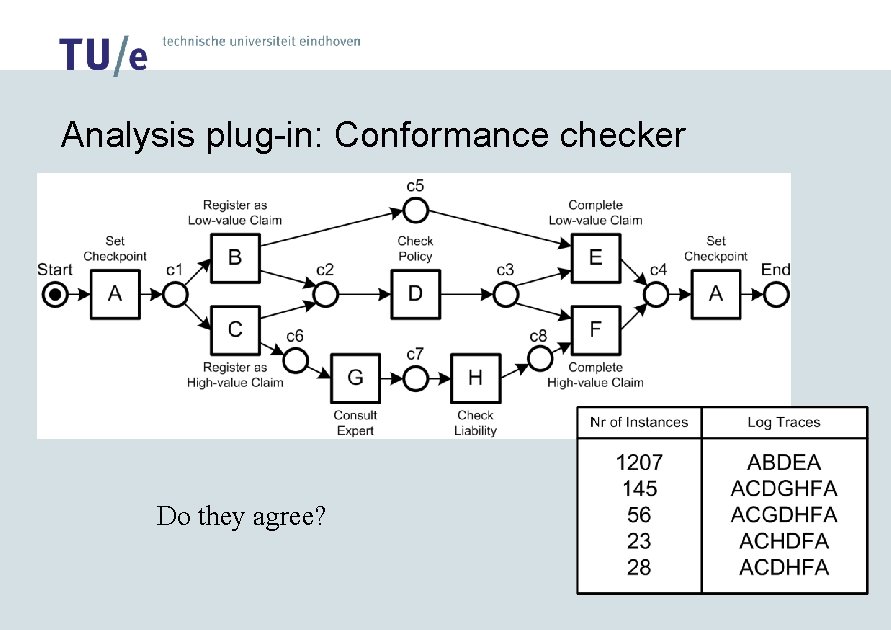
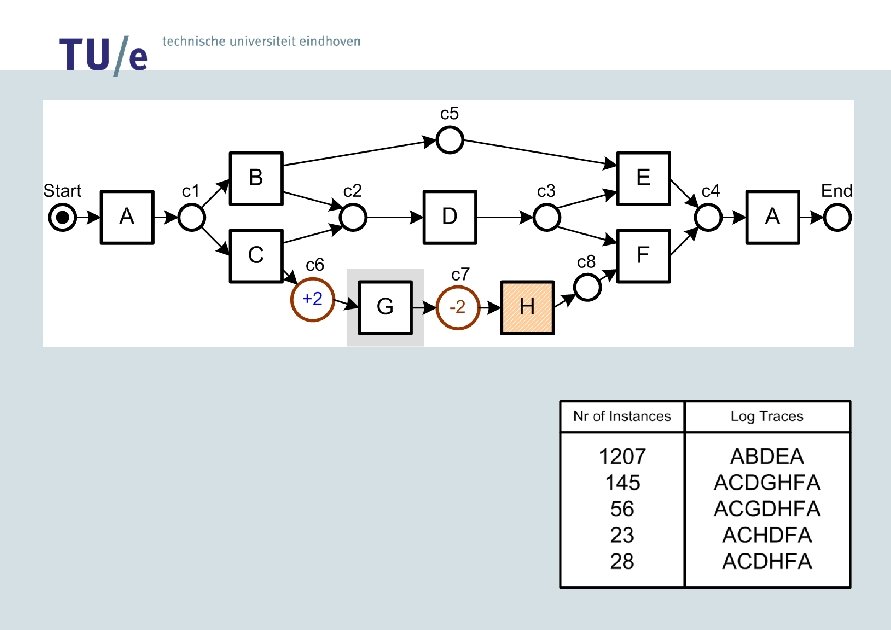
Analysis plug-in: Conformance checker Do they agree?
Fitness is not enough
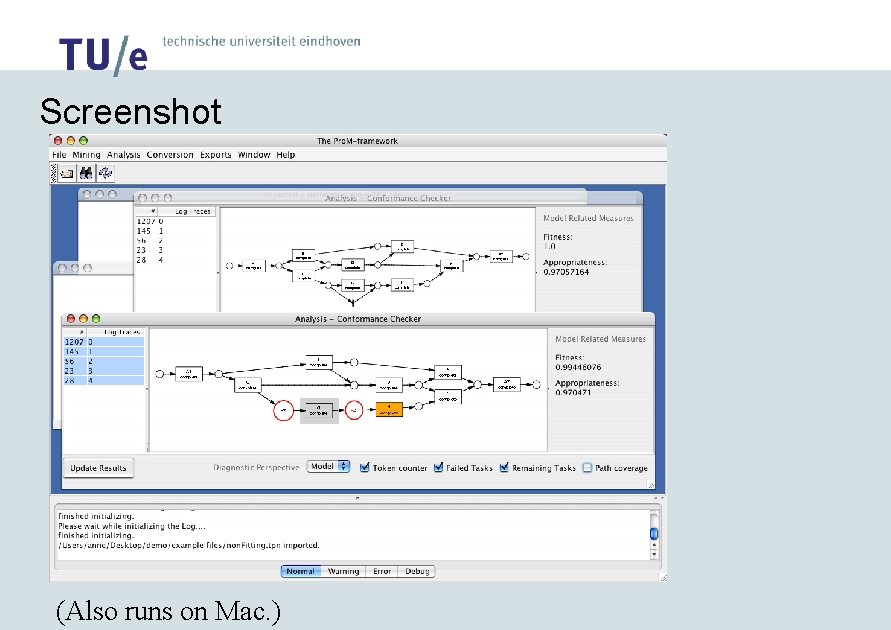
Screenshot (Also runs on Mac. )
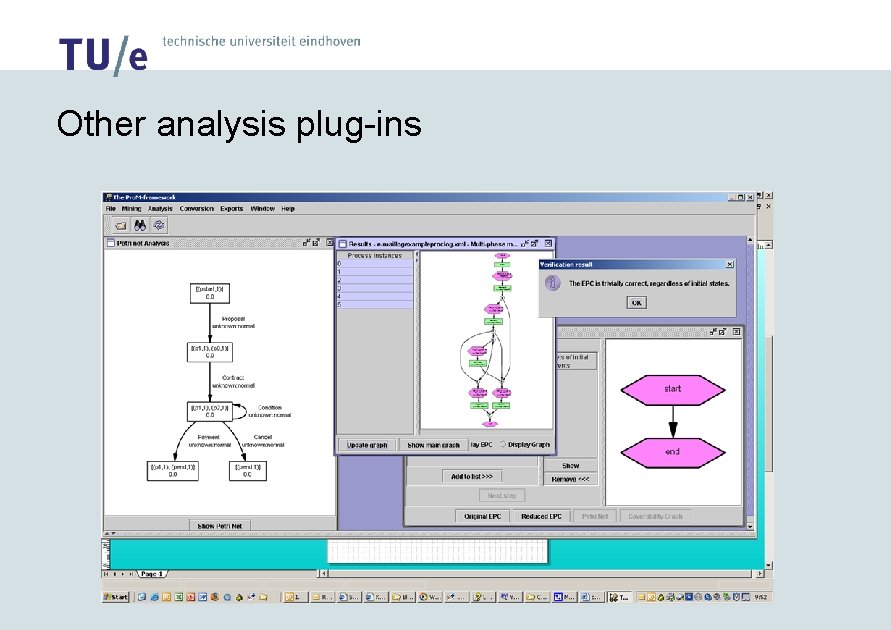
Other analysis plug-ins
More demos?
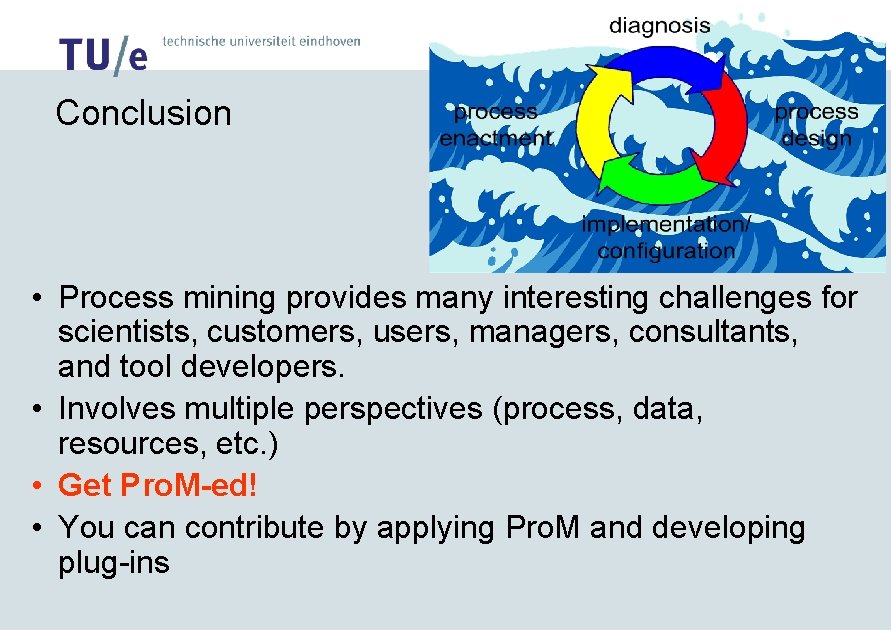
Conclusion • Process mining provides many interesting challenges for scientists, customers, users, managers, consultants, and tool developers. • Involves multiple perspectives (process, data, resources, etc. ) • Get Pro. M-ed! • You can contribute by applying Pro. M and developing plug-ins
More information http: //www. workflowcourse. com http: //www. workflowpatterns. com http: //www. processmining. org