
PROCESS MAPPING THEORY AND RATIONALE This Photo by

PROCESS MAPPING THEORY AND RATIONALE This Photo by Unknown Author is licensed under CC BY-SA HCS 150 Unit 2 -1 This work is licensed under a Creative Commons Attribution-Non. Commercial-Share. Alike 4. 0 International License. Based on a work at https: //www. healthit. gov/. This workforce product was funded by a grant awarded by the U. S. Department of Labor's Employment and Training Administration. The product was created by the grantee and does not necessarily reflect the official position of the U. S. Department of Labor. The Department of Labor makes no guarantees, warranties, or assurances of any kind, express or implied, with respect to such information, including any information on linked sites and including, but not limited to, accuracy of the information or its completeness, timeliness, usefulness, adequacy, continued availability, or ownership.
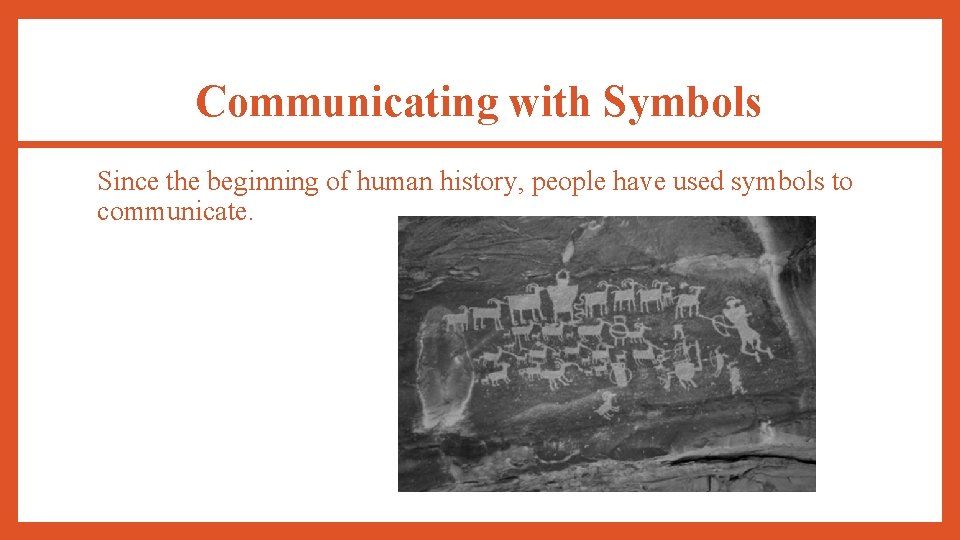
Communicating with Symbols Since the beginning of human history, people have used symbols to communicate.
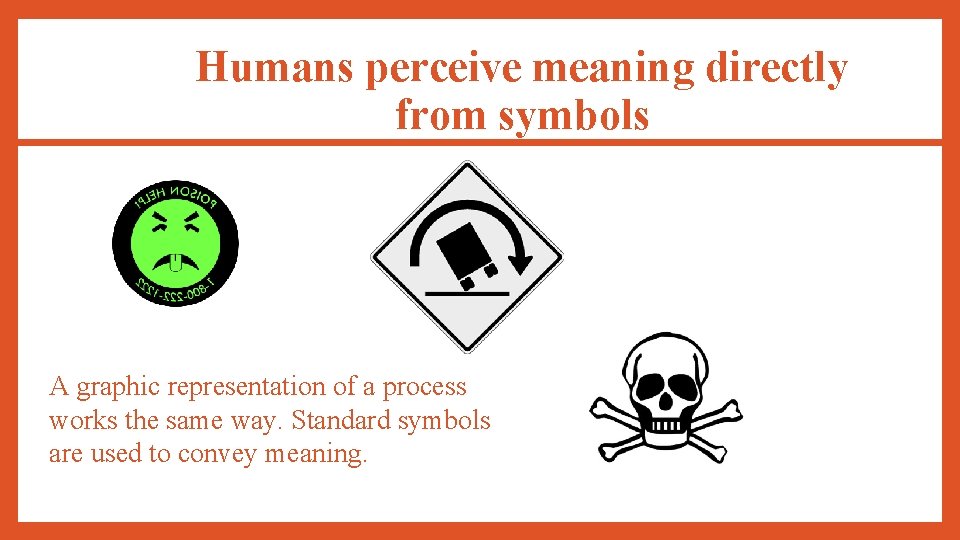
Humans perceive meaning directly from symbols A graphic representation of a process works the same way. Standard symbols are used to convey meaning.
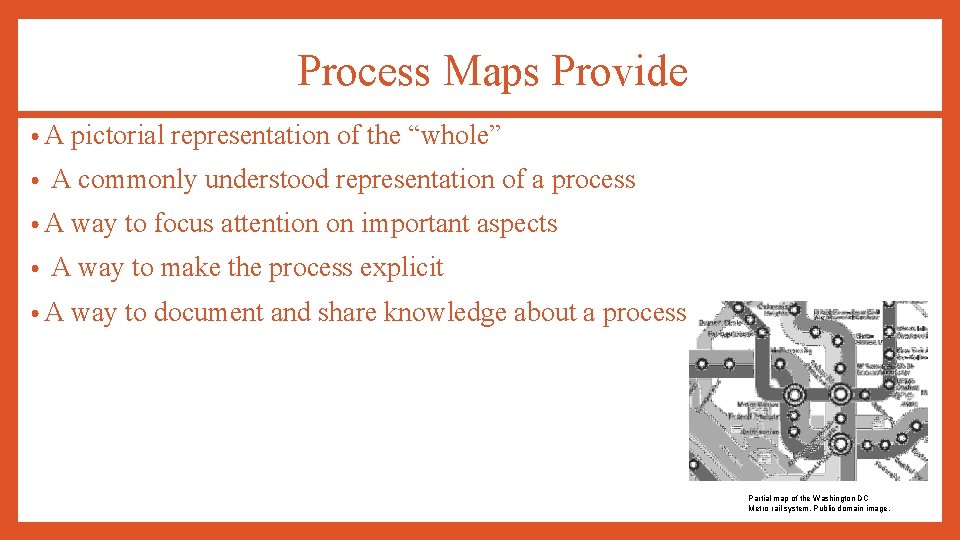
Process Maps Provide • A • A commonly understood representation of a process • A • pictorial representation of the “whole” way to focus attention on important aspects A way to make the process explicit • A way to document and share knowledge about a process Partial map of the Washington DC Metro rail system, Public domain image.
Example: Process Perspectives • Looking up a restaurant phone number in the yellow pages involves: – Physical and mental steps – Exchange of information • This process can be described at different detail levels – “Obtain phone number” • Versus – Open search engine – Find electronic yellow pages – Type text name of restaurant and zip code – Visually inspect returned results – Select the one you were looking for
Process Vocabulary • Process • Process map, process diagram • Task • Workflow • Data flow • Flowchart • Notation • Symbols
Process • A process is a series of steps and decisions • involved in the way work is accomplished. • Everything we do in our lives involves processes. • The health care system is an interconnected web of many processes. • Gall: “A complex system that works is made up of simple systems that work. ”
Process Map • A visual representation of a process that shows – The boundaries, i. e. where the process begins and ends – The steps or tasks in the process – The sequence or order of the steps • Use standard symbols so that a process map created by one person can be understood and used by others • Different approaches use different symbol sets • Also called process diagrams and flowcharts
Task • A step in a process • Physical action that a human or machine performs • Mental action that a human performs • Some may be decomposed into smaller tasks • Smallest • Those ones called primitive, or atomic tasks that can be decomposed no further
Example: Process Tasks • List the process tasks required to schedule an appointment with your physician using an on-line scheduler.
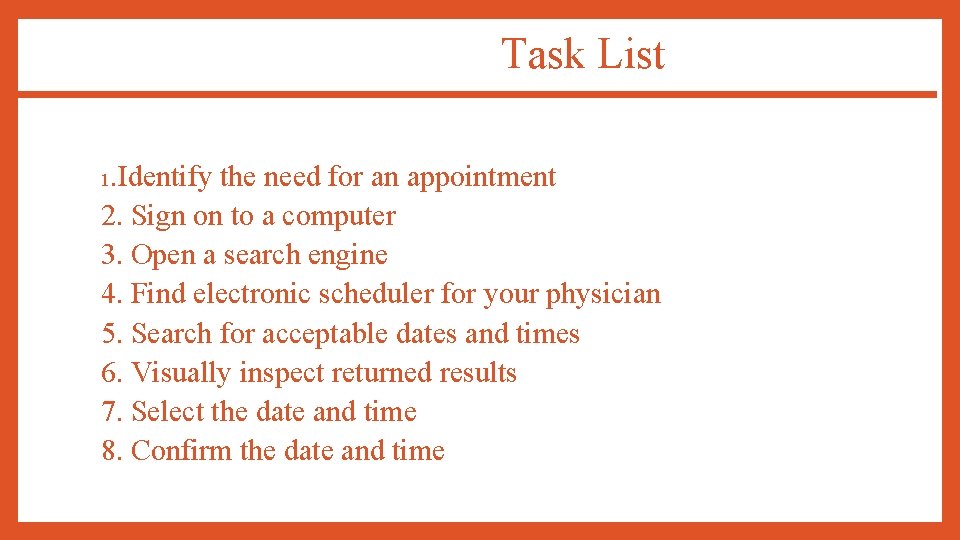
Task List 1. Identify the need for an appointment 2. Sign on to a computer 3. Open a search engine 4. Find electronic scheduler for your physician 5. Search for acceptable dates and times 6. Visually inspect returned results 7. Select the date and time 8. Confirm the date and time
Workflow versus Dataflow • Workflow tasks. is usually defined as a sequence of connected steps or • Dataflow involves the transformations (operations) performed on data as it moves within and between systems. • Data and information are often part of workflow, and vice versa.
Workflow • We care about the physical and sometimes mental steps that occur In the phone number example, these steps are: – Clicking the mouse to open the browser, – Clicking to open the search engine, – Typing in the search text, – Results being returned, and – Scrolling and assessment of each result.

Dataflow • Data and information content care about: – The data points that are being communicated or transferred – Where the data are stored – How those data are transformed • In the phone number example, we just care about: – The data values returned by the search – Where the data are stored
Workflow versus Dataflow • Emphasis • One • on one or the other can be less or both representations can be used Often, both are important and multiple diagrams are required.
Flowchart • Diagram that shows step-by-step progression through a procedure or system especially using connecting lines and a set of conventional symbols. • Used to diagram the logic paths through computer programs, • Tasks of work processes.

Notation and Symbols • Notation: – Used to refer to the shapes and conventions • used • – to diagram a process Several different notation formalisms in use today • Symbols: – Shapes used to create a diagram. – For example, a diamond represents a decision point • In most notations
- Slides: 17