
Process Management Levels Analysing and Monitoring Business Processes
Process Management Levels -- Analysing and Monitoring Business Processes -© Josef Schiefer, IBM Watson Process Information Factory

Process Management Levels
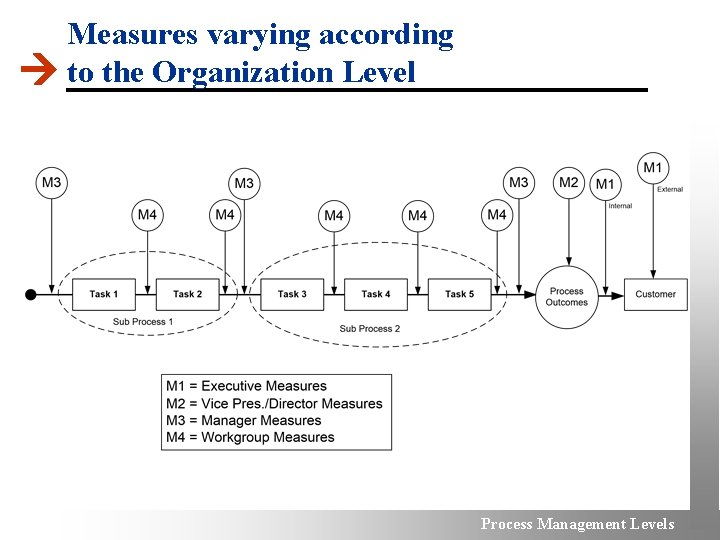
Measures varying according to the Organization Level Process Management Levels
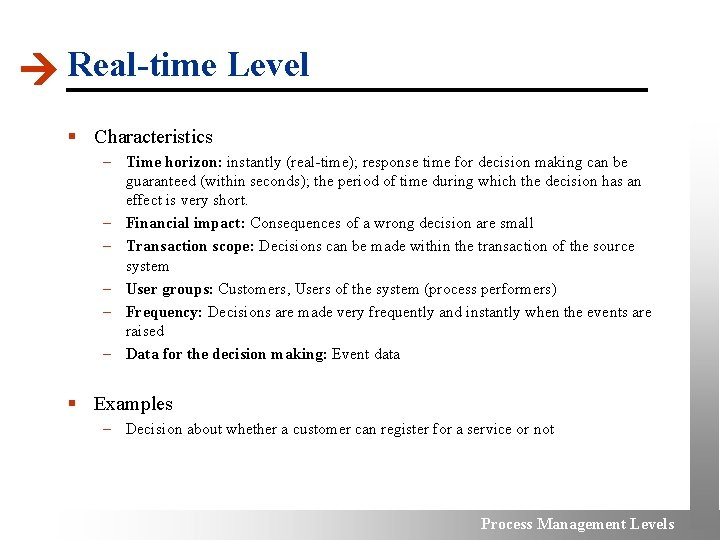
Real-time Level § Characteristics – Time horizon: instantly (real-time); response time for decision making can be guaranteed (within seconds); the period of time during which the decision has an effect is very short. – Financial impact: Consequences of a wrong decision are small – Transaction scope: Decisions can be made within the transaction of the source system – User groups: Customers, Users of the system (process performers) – Frequency: Decisions are made very frequently and instantly when the events are raised – Data for the decision making: Event data § Examples – Decision about whether a customer can register for a service or not Process Management Levels
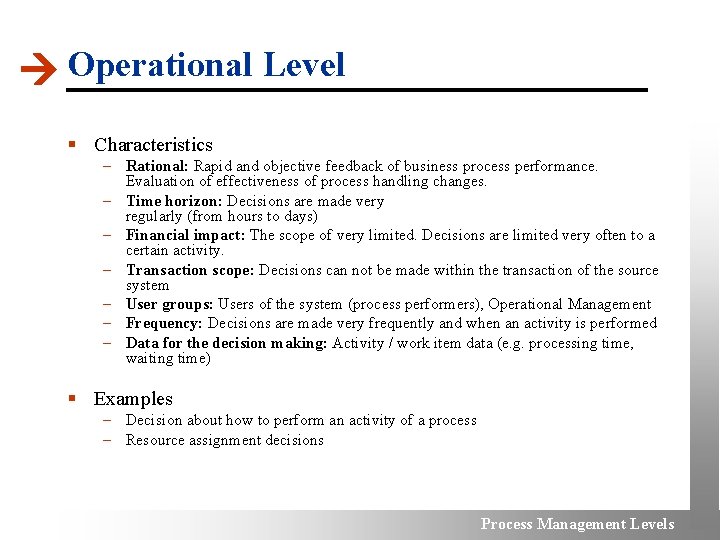
Operational Level § Characteristics – Rational: Rapid and objective feedback of business process performance. Evaluation of effectiveness of process handling changes. – Time horizon: Decisions are made very regularly (from hours to days) – Financial impact: The scope of very limited. Decisions are limited very often to a certain activity. – Transaction scope: Decisions can not be made within the transaction of the source system – User groups: Users of the system (process performers), Operational Management – Frequency: Decisions are made very frequently and when an activity is performed – Data for the decision making: Activity / work item data (e. g. processing time, waiting time) § Examples – Decision about how to perform an activity of a process – Resource assignment decisions Process Management Levels
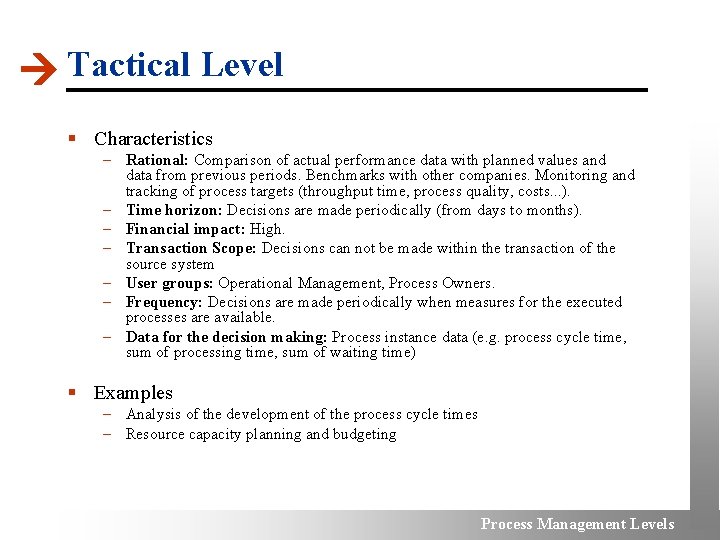
Tactical Level § Characteristics – Rational: Comparison of actual performance data with planned values and data from previous periods. Benchmarks with other companies. Monitoring and tracking of process targets (throughput time, process quality, costs. . . ). – Time horizon: Decisions are made periodically (from days to months). – Financial impact: High. – Transaction Scope: Decisions can not be made within the transaction of the source system – User groups: Operational Management, Process Owners. – Frequency: Decisions are made periodically when measures for the executed processes are available. – Data for the decision making: Process instance data (e. g. process cycle time, sum of processing time, sum of waiting time) § Examples – Analysis of the development of the process cycle times – Resource capacity planning and budgeting Process Management Levels
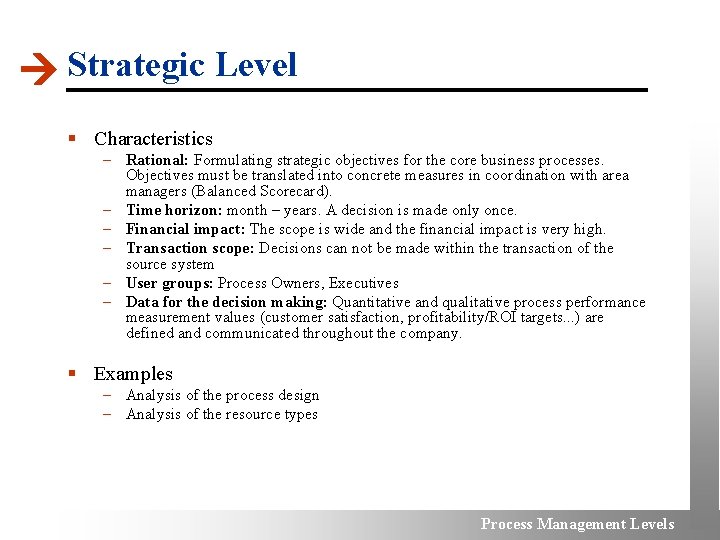
Strategic Level § Characteristics – Rational: Formulating strategic objectives for the core business processes. Objectives must be translated into concrete measures in coordination with area managers (Balanced Scorecard). – Time horizon: month – years. A decision is made only once. – Financial impact: The scope is wide and the financial impact is very high. – Transaction scope: Decisions can not be made within the transaction of the source system – User groups: Process Owners, Executives – Data for the decision making: Quantitative and qualitative process performance measurement values (customer satisfaction, profitability/ROI targets. . . ) are defined and communicated throughout the company. § Examples – Analysis of the process design – Analysis of the resource types Process Management Levels
- Slides: 7