
PROCESS IMPROVEMENT FOR A HIGHMIX LABORINTENSIVE PRODUCTION SYSTEM

PROCESS IMPROVEMENT FOR A HIGH-MIX, LABOR-INTENSIVE PRODUCTION SYSTEM WITH UNKNOWN STOCHASTIC DEMAND Gina Adibi, Sam Ruiz, Andrew Schneider and Meghan Travis Industrial Engineering - Capstone Design Project 2015 Supervisor: Dr. Jesus Jimenez and Dr. Tongdan Jin
CONTENT Background & Problem Statement System Configuration Methodology Simulation Optimization Results & Recommendations
BACKGROUND This capstone design project targets the manufacture and assembly of insulated material for airplanes. The system is labor intensive. The product is custom-made. Product demand is highly variable. Company has requested to keep their name confidential.
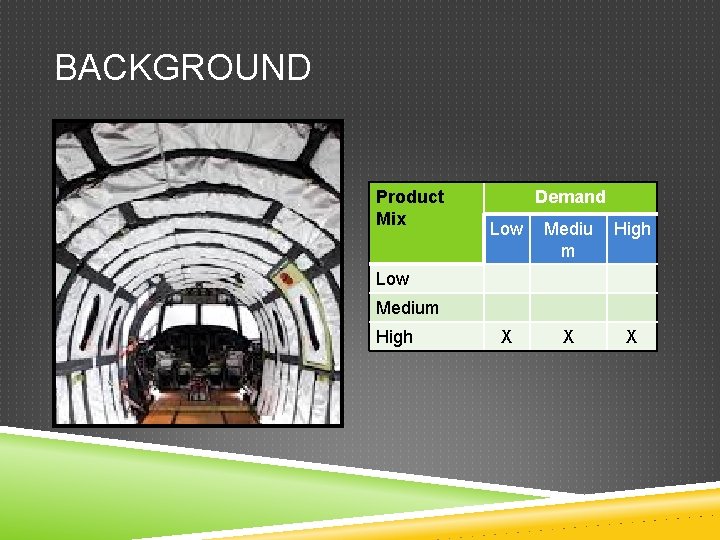
BACKGROUND Product Mix Demand Low Mediu m High X X X Low Medium High
PROBLEM STATEMENT Objective: improve throughput by at least 10% by: Clustering similar parts into families using group technology (GT) Designing GT cells usingle piece flow assembly lines Determine required number of operators per cell Company is experiencing the following problems: Losing money due to unmet customer demand Long cycle times and high work-in process (WIP) levels Significant quality problems Demand will experience a significant increase over the next few months
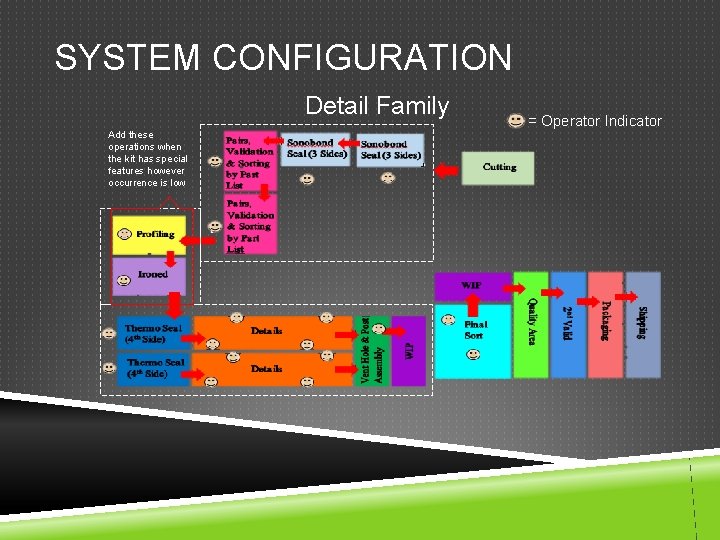
SYSTEM CONFIGURATION Detail Family Add these operations when the kit has special features however occurrence is low = Operator Indicator
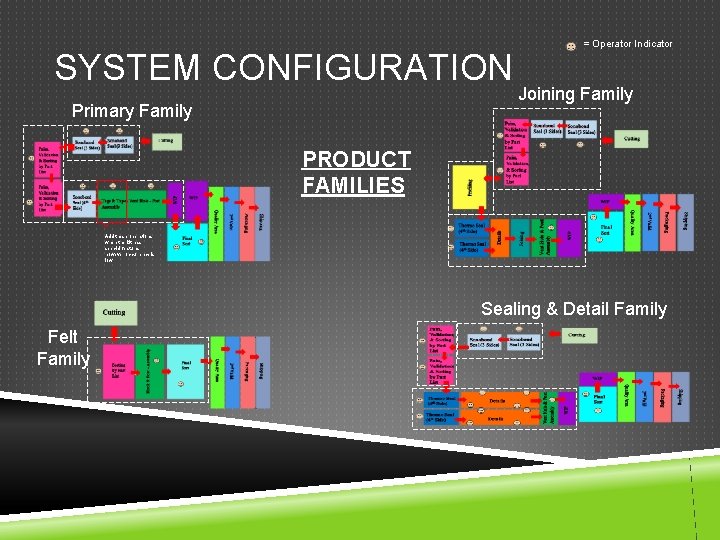
SYSTEM CONFIGURATION Primary Family = Operator Indicator Joining Family PRODUCT FAMILIES Add these operations when the kit has special features however occurrence is low Sealing & Detail Family Felt Family
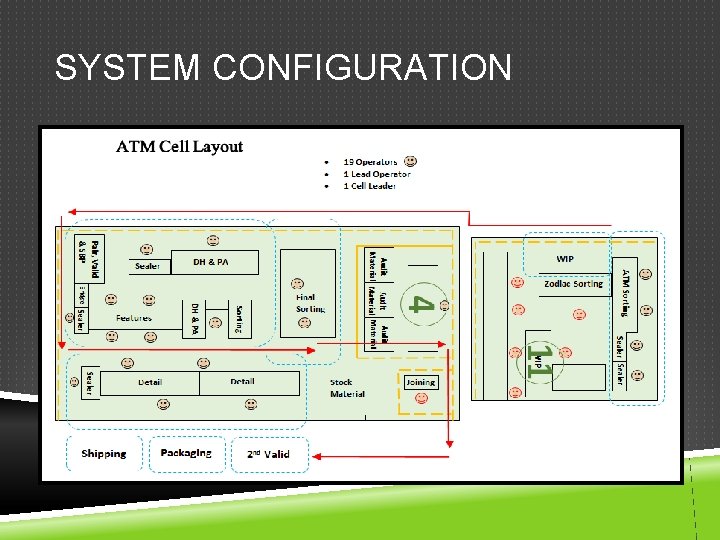
SYSTEM CONFIGURATION
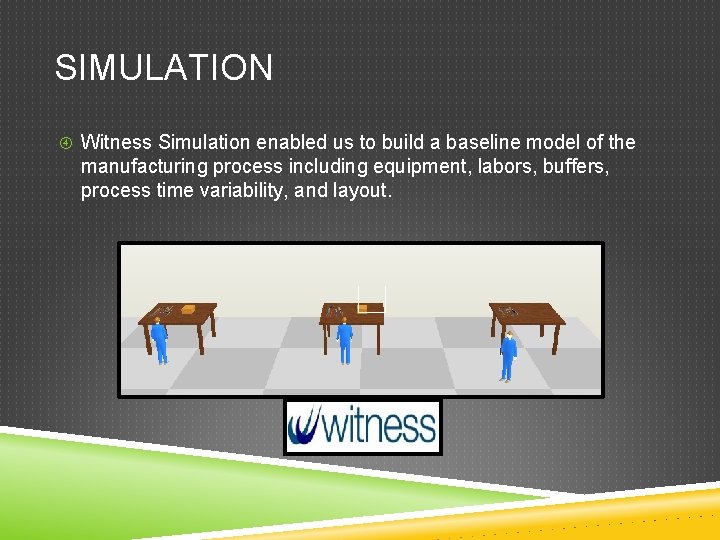
SIMULATION Witness Simulation enabled us to build a baseline model of the manufacturing process including equipment, labors, buffers, process time variability, and layout.
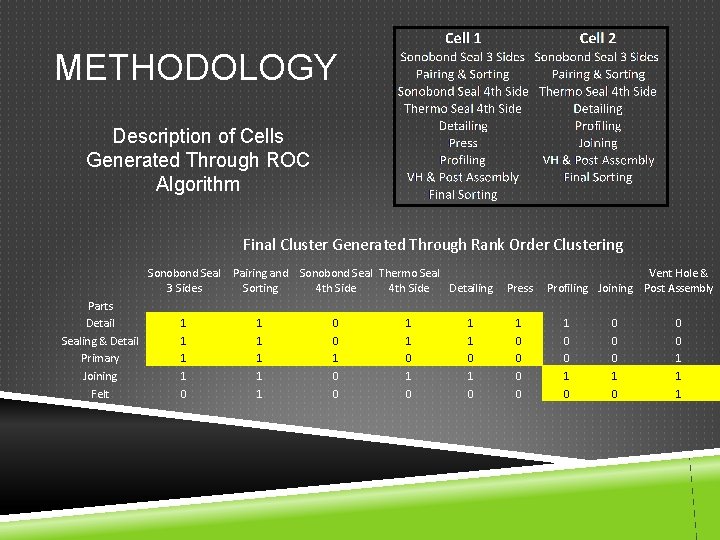
METHODOLOGY Description of Cells Generated Through ROC Algorithm Final Cluster Generated Through Rank Order Clustering Parts Detail Sealing & Detail Primary Joining Felt Sonobond Seal 3 Sides Pairing and Sorting 1 1 0 1 1 1 Sonobond Seal Thermo Seal 4 th Side Detailing 0 0 1 1 0 Press 1 0 0 Vent Hole & Profiling Joining Post Assembly 1 0 0 0 0 1 1 1
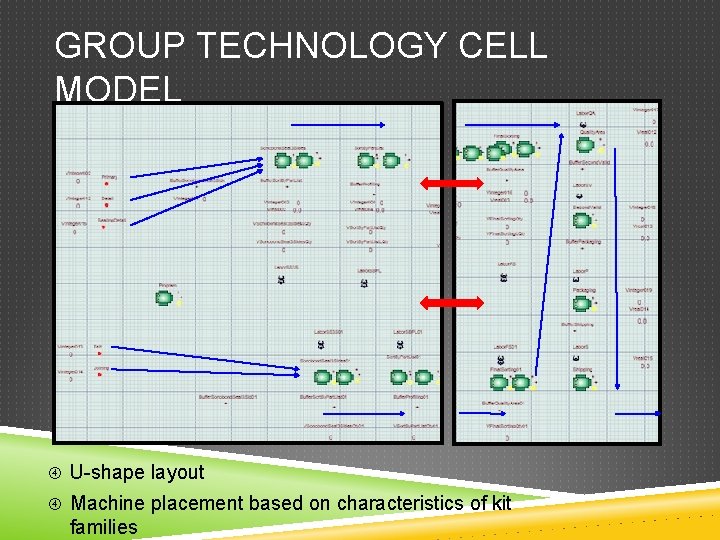
GROUP TECHNOLOGY CELL MODEL U-shape layout Machine placement based on characteristics of kit families
SIMULATION OPTIMIZATION Maximize throughput by changing number of stations and laborers for each station. WITNESS defaults to Simulated Annealing Algorithm. In this simulation optimization, the simulation length was 1 year or 230, 400 minutes assuming 16 hour shifts in a day. Experiment ran 222 scenarios with 5 replications for each scenario.
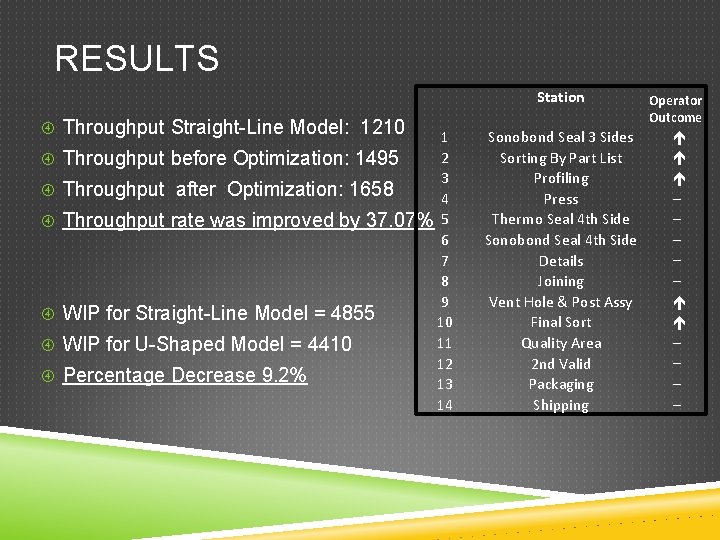
RESULTS Station Throughput Straight-Line Model: 1210 1 2 Throughput before Optimization: 1495 3 Throughput after Optimization: 1658 4 Throughput rate was improved by 37. 07% 5 6 7 8 9 WIP for Straight-Line Model = 4855 10 11 WIP for U-Shaped Model = 4410 12 Percentage Decrease 9. 2% 13 14 Sonobond Seal 3 Sides Sorting By Part List Profiling Press Thermo Seal 4 th Side Sonobond Seal 4 th Side Details Joining Vent Hole & Post Assy Final Sort Quality Area 2 nd Valid Packaging Shipping Operator Outcome é é é − − − é é − −
RECOMMENDATIONS AND FUTURE WORK Shorter setup Recommend higher quality machines Generate cross-trained workers and place them on a rotational work cycle Build a user interface so the company can forecast labor requirements on a monthly basis Gain more insight to highly variable demand custom products

ACKNOWLEDGEMENTS Special thanks to: Anonymous Sponsor and The Lanner Group* *Sponsor of WITNESS simulation language
- Slides: 15