
Process engineering Quality controls Objectives Advanced product quality
Process engineering Quality controls
Objectives Advanced product quality planning (APQP) is a system used for designing a quality product that meets the customers needs. APQP can be applied to any industry. Its purpose is to produce a quality plan which supports the development of a product or service that will satisfy the customer. 2
Why use APQP? The APQP assists with: • Understanding the customer needs – Determine customer needs and translate into product characteristics and requirements. • Proactive feedback and corrective action – Provides other feedback for similar projects with the objective of developing solutions for potential failures. • Ensuring that the design is within your process capabilities – This brings the processes under statistical control and ensures that your manufacturing process can meet customer requirements and quantities. 3
Why use APQP? The APQP assists with: • Identify and analyse potential failure modes – This uses failure modes and effects analysis (FMEA) to solve potential failures. • Verification and validation of design process and product – This is testing to assure that the design output meet design input requirements. 4
Why use APQP? The APQP assists with: • Conduct reviews – These are formal reviews carried during the development of a product to assure it meets the specified requirements. • Control special or critical characteristics – Special/critical characteristics are identified and the process is assessed to assure it can meet the requirements. A control plan is prepared to indicate how this will be achieved. 5
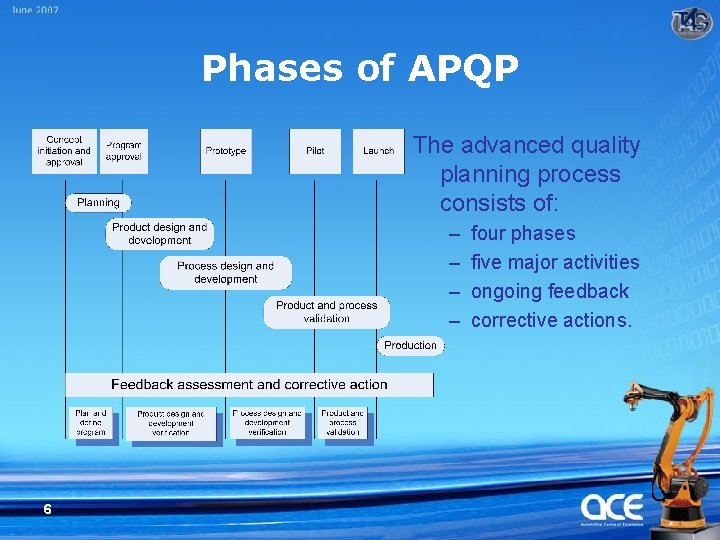
Phases of APQP The advanced quality planning process consists of: – – 6 four phases five major activities ongoing feedback corrective actions.
Phases of APQP The Plan define program phase is made up of steps which include: • Define goals • Reliability and quality goals • Preliminary bill of materials • Preliminary process flow • Preliminary listing of special product and process characteristics • Product assurance plan. 7
Phases of APQP The Product design and development verification phase is made up of steps which include: • Design FMEA • DFMA • Design verification • Design reviews • Prototype build • Engineering drawings • Engineering specifications • Material specifications • Drawing specification changes • New equipment, tooling and facilities requirements • Special product and process characteristics • Prototype control plan • Gauges and testing equipment requirements. 8
Phases of APQP The Process design and development verification phase is made up of steps which include: • Packaging standards • Product and quality process systems review • Process flow chart • Floor plan layout • Characteristics matrix • Process FMEA • Pre launch control plan • Process instructions • Measurements systems analysis plan • Preliminary process capability study plan • Packaging specifications. 9
Phases of APQP The Product and process validation phase is made up of process steps, which include: • Production trial run • Measurement systems evaluation • Preliminary process capability study • Production part approval • Production validation testing • Packaging evaluation • Production control plan • Quality planning sign-off. 10

11

Summary 12

End
- Slides: 13