
Process Engineering Basics of Process Planning for computer
Process Engineering Basics of Process Planning for computer implementation IE 550 -- Manufacturing Systems Fall 2008 Dr. R. A. Wysk 11/25/2020 4 - 1
Chapter 6 -- Process Engineering 11/25/2020 4 - 2

The Engineering Process Design specifications Process capability Process planning Stock Material Processes Inspection Finished part Need to understand the process capabilities. 11/25/2020 4 - 3
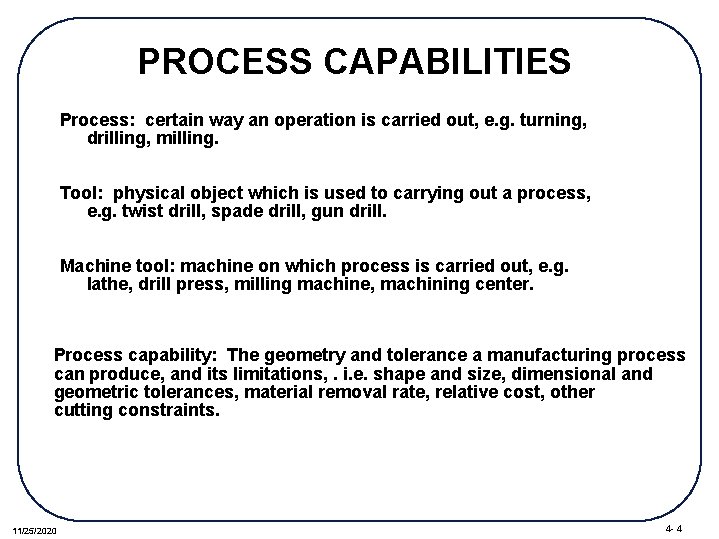
PROCESS CAPABILITIES Process: certain way an operation is carried out, e. g. turning, drilling, milling. Tool: physical object which is used to carrying out a process, e. g. twist drill, spade drill, gun drill. Machine tool: machine on which process is carried out, e. g. lathe, drill press, milling machine, machining center. Process capability: The geometry and tolerance a manufacturing process can produce, and its limitations, . i. e. shape and size, dimensional and geometric tolerances, material removal rate, relative cost, other cutting constraints. 11/25/2020 4 - 4
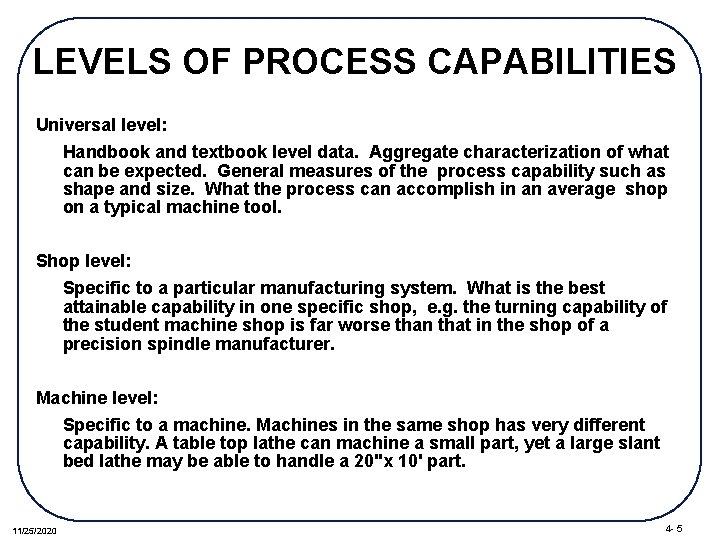
LEVELS OF PROCESS CAPABILITIES Universal level: Handbook and textbook level data. Aggregate characterization of what can be expected. General measures of the process capability such as shape and size. What the process can accomplish in an average shop on a typical machine tool. Shop level: Specific to a particular manufacturing system. What is the best attainable capability in one specific shop, e. g. the turning capability of the student machine shop is far worse than that in the shop of a precision spindle manufacturer. Machine level: Specific to a machine. Machines in the same shop has very different capability. A table top lathe can machine a small part, yet a large slant bed lathe may be able to handle a 20"x 10' part. 11/25/2020 4 - 5
PROCESS KNOWLEDGE COLLECTION Few scientific data available or published. Most process knowledge are gained during actual manufacturing practice. Practical manufacturing knowledge is still an art instead of a science. Certain information can be found in the textbooks, handbooks, machining data handbook, etc. Tolerance capability may be obtained from control charts, inspection reports, and on-line sensor data. 11/25/2020 4 - 6
EXPERIENCE-BASED PLANNING Relay on one's experience. Most frequently this is the way industry operates. Problems: a. Experience requires a significant period of time to accumulate. b. Experience represents only approximate, not exact knowledge. c. Experience is not directly applicable to new processes or new systems. Need to automate. 11/25/2020 4 - 7
MACHINIST HANDBOOKS Universal or shop level knowledge. e. g. Surface-finish chart - limiting extremes of process 8 : in - use grinding, polishing, lapping Usually not with milling, however, finish milling may achieve the specification. The information is general. It does not mean every machine or shop can achieve that accuracy. Turning limit (6. 3 - 0. 4 : m or 250 - 16 : inch) Diamond turning at Lawrence Livermore Lab (12. 5 nm or 0. 47 : inch) 11/25/2020 4 - 8
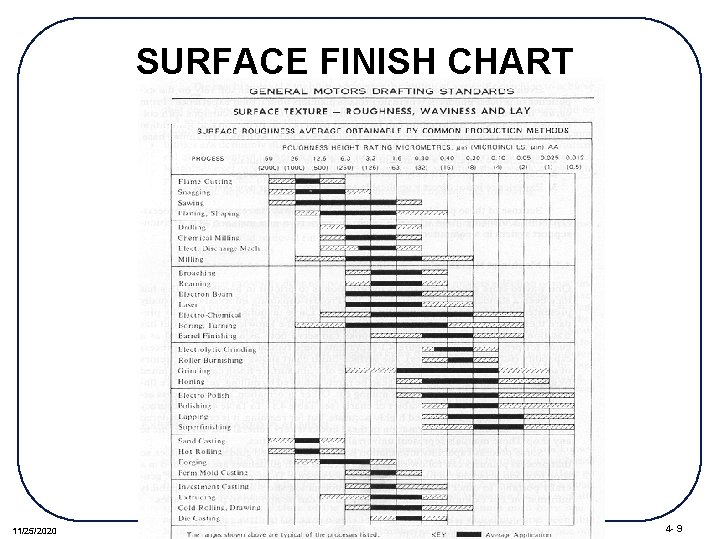
SURFACE FINISH CHART 11/25/2020 4 - 9

11/25/2020 4 - 10
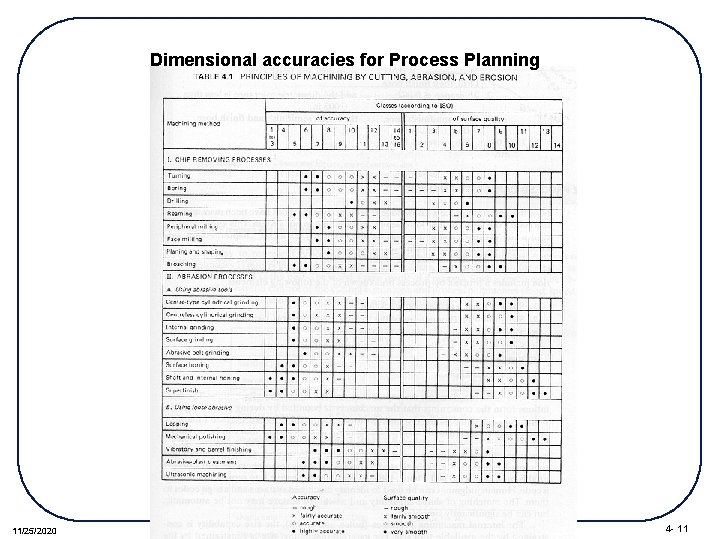
Dimensional accuracies for Process Planning 11/25/2020 4 - 11
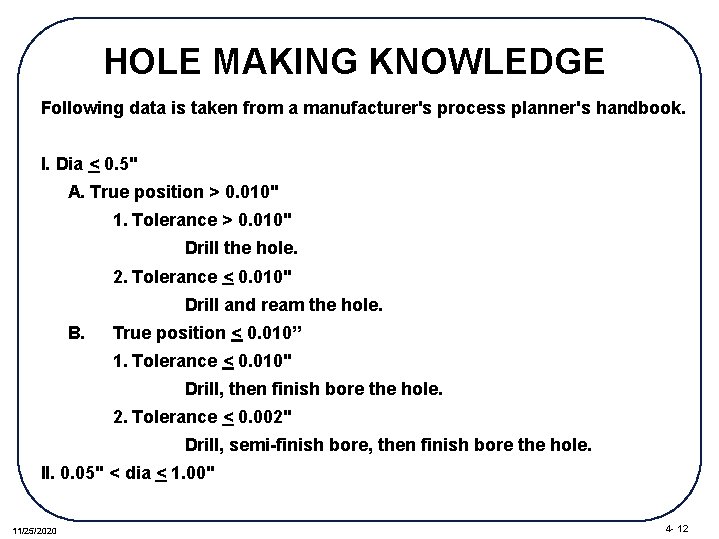
HOLE MAKING KNOWLEDGE Following data is taken from a manufacturer's process planner's handbook. I. Dia < 0. 5" A. True position > 0. 010" 1. Tolerance > 0. 010" Drill the hole. 2. Tolerance < 0. 010" Drill and ream the hole. B. True position < 0. 010” 1. Tolerance < 0. 010" Drill, then finish bore the hole. 2. Tolerance < 0. 002" Drill, semi-finish bore, then finish bore the hole. II. 0. 05" < dia < 1. 00" 11/25/2020 4 - 12

DECISION TABLES To computerize the decision making, one simple way is to use decision tables. If the conditions set in an entry are satisfied, the actions in the entry are executed. The stub contains the condition or action statements. Entries mark which conditions or actions are applicable. Each entry contain one rule. Stub Entries Conditions Actions 11/25/2020 4 - 13

EXAMPLE DECISION TABLE Dia < 0. 5 < Dia < 1. 0 T. P < 0. 010 Tol > 0. 010 0. 002 < Tol < 0. 010 Tol < 0. 002 Drill Ream Semi-finish bore Finish bore 11/25/2020 X X X X X X 4 - 14
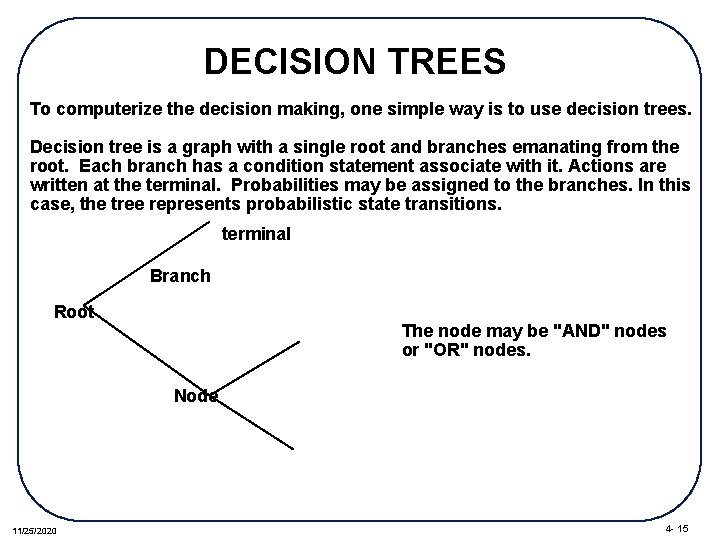
DECISION TREES To computerize the decision making, one simple way is to use decision trees. Decision tree is a graph with a single root and branches emanating from the root. Each branch has a condition statement associate with it. Actions are written at the terminal. Probabilities may be assigned to the branches. In this case, the tree represents probabilistic state transitions. terminal Branch Root The node may be "AND" nodes or "OR" nodes. Node 11/25/2020 4 - 15

EXAMPLE DECISION TREE Tol > 0. 010 Drill Tol < 0. 010 Dia < 0. 5 T. P < 0. 010 Drill, then ream T. P < 0. 010 0. 5 < Dia < 1. 0 0. 002 < Tol < 0. 010 Drill, then finish bore Tol < 0. 002 Drill, semifinish bore, then finish bore 11/25/2020 4 - 16
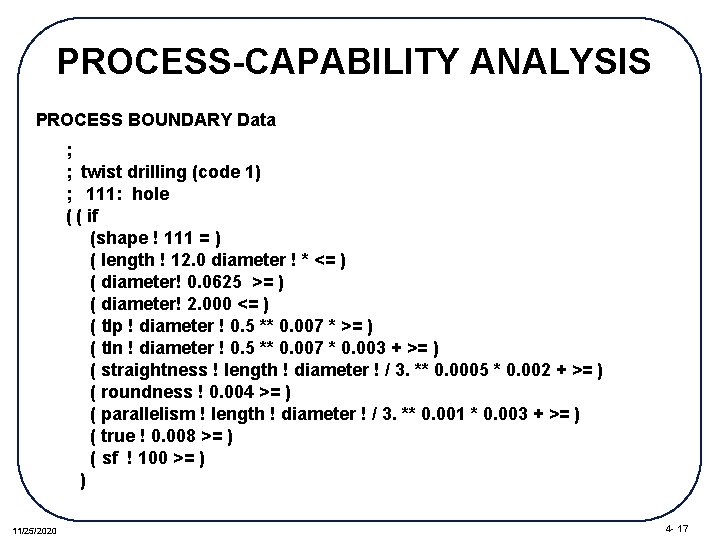
PROCESS-CAPABILITY ANALYSIS PROCESS BOUNDARY Data ; ; twist drilling (code 1) ; 111: hole ( ( if (shape ! 111 = ) ( length ! 12. 0 diameter ! * <= ) ( diameter! 0. 0625 >= ) ( diameter! 2. 000 <= ) ( tlp ! diameter ! 0. 5 ** 0. 007 * >= ) ( tln ! diameter ! 0. 5 ** 0. 007 * 0. 003 + >= ) ( straightness ! length ! diameter ! / 3. ** 0. 0005 * 0. 002 + >= ) ( roundness ! 0. 004 >= ) ( parallelism ! length ! diameter ! / 3. ** 0. 001 * 0. 003 + >= ) ( true ! 0. 008 >= ) ( sf ! 100 >= ) ) 11/25/2020 4 - 17
PROCESSES, TOOLS, AND MACHINES • 11/25/2020 4 - 18
PROCESSES, TOOLS, AND MACHINES 11/25/2020 4 - 19
CUTTING EDGE AND FEED 11/25/2020 4 - 20
VOLUME PRODUCING CAPABILITIES 11/25/2020 4 - 21
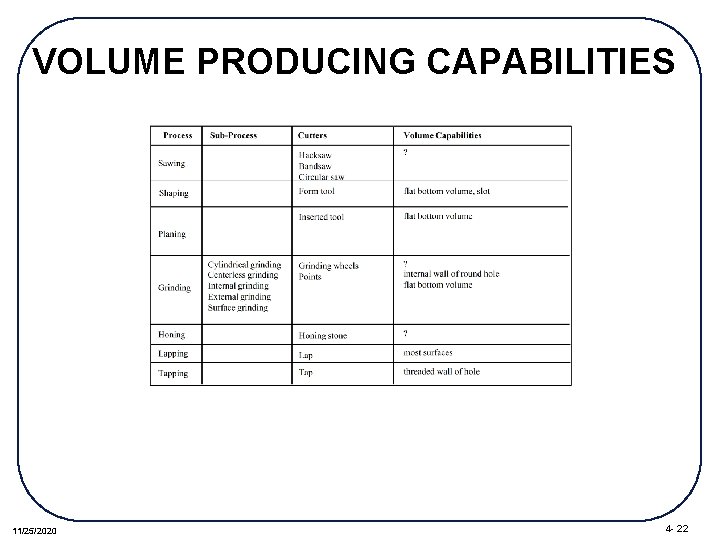
VOLUME PRODUCING CAPABILITIES 11/25/2020 4 - 22
PROCESS TOLERANCE RANGE 11/25/2020 4 - 23
PROCESS TOLERANCE RANGE 11/25/2020 4 - 24
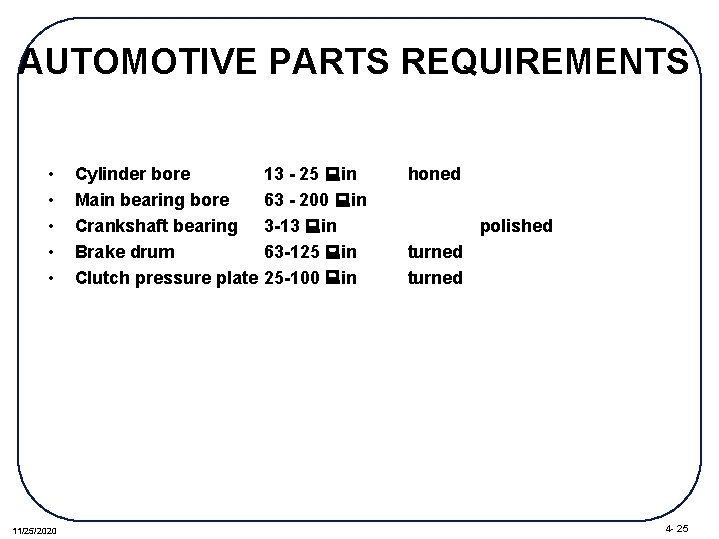
AUTOMOTIVE PARTS REQUIREMENTS • • • 11/25/2020 Cylinder bore 13 - 25 : in Main bearing bore 63 - 200 : in Crankshaft bearing 3 -13 : in Brake drum 63 -125 : in Clutch pressure plate 25 -100 : in honed polished turned 4 - 25
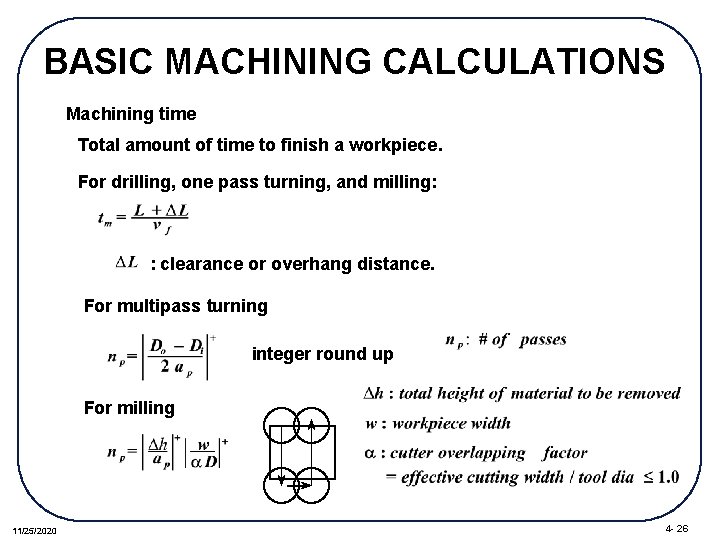
BASIC MACHINING CALCULATIONS Machining time Total amount of time to finish a workpiece. For drilling, one pass turning, and milling: : clearance or overhang distance. For multipass turning integer round up For milling 11/25/2020 4 - 26
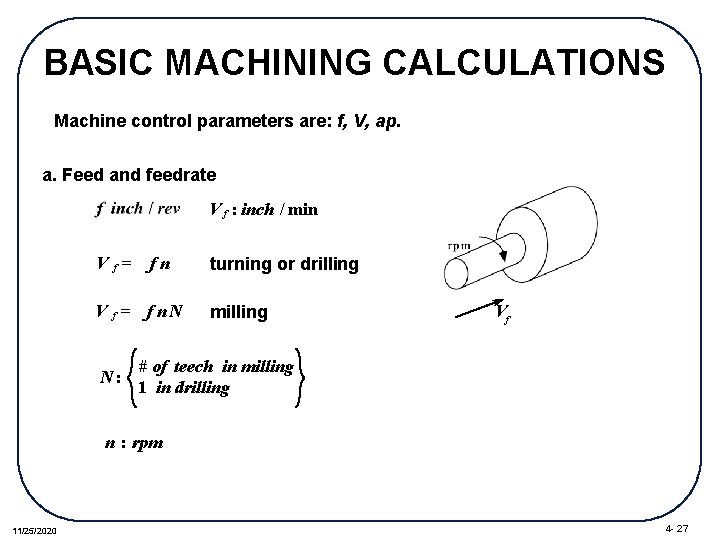
BASIC MACHINING CALCULATIONS Machine control parameters are: f, V, ap. a. Feed and feedrate V f : inch / min V f= fn turning or drilling V f = f n. N milling N: Vf # of teech in milling 1 in drilling n : rpm 11/25/2020 4 - 27
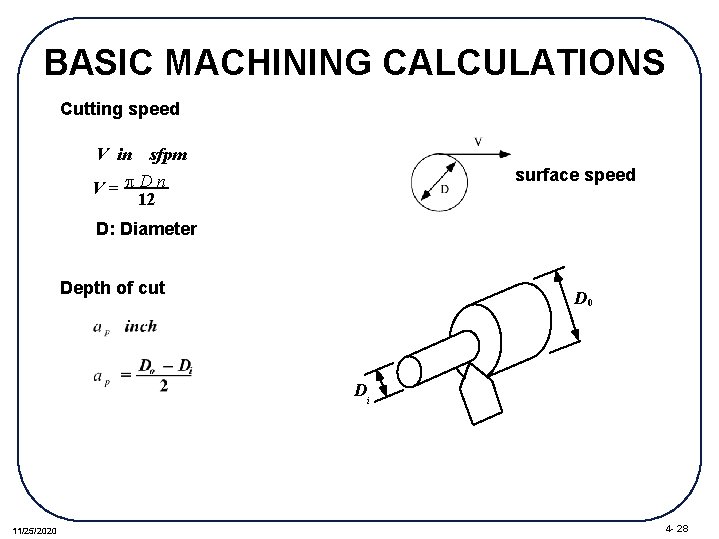
BASIC MACHINING CALCULATIONS Cutting speed V in sfpm V= p. Dn 12 surface speed D: Diameter Depth of cut D 0 Di 11/25/2020 4 - 28
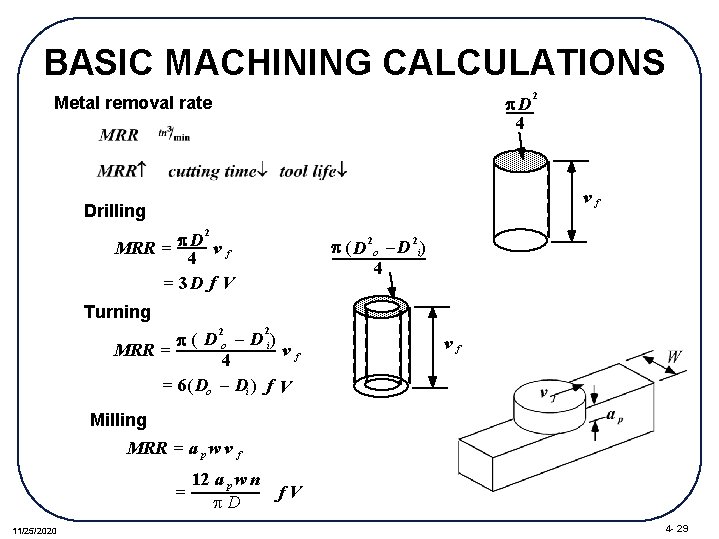
BASIC MACHINING CALCULATIONS p. D 4 Metal removal rate 2 vf Drilling 2 MRR = p D v f 4 = 3 D f V p ( D 2 o – D 2 i) 4 Turning 2 2 p ( D o – D i) MRR = vf 4 = 6( Do – Di ) f V vf Milling MRR = a p w v = 11/25/2020 f 12 a p w n p. D f. V 4 - 29
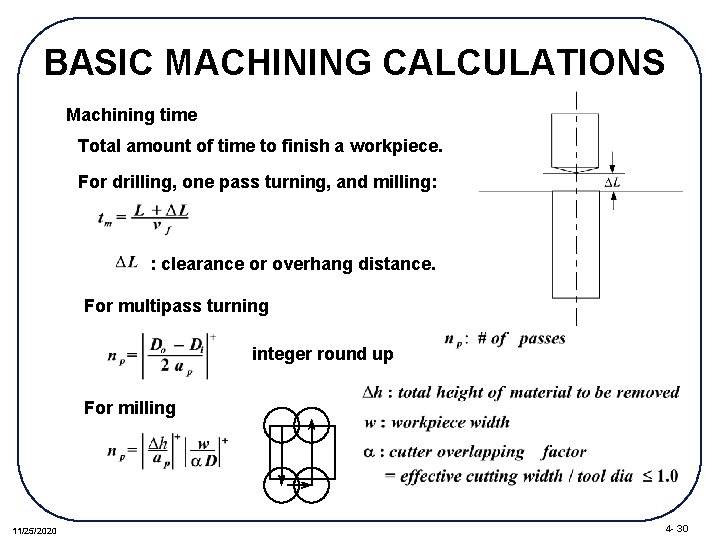
BASIC MACHINING CALCULATIONS Machining time Total amount of time to finish a workpiece. For drilling, one pass turning, and milling: : clearance or overhang distance. For multipass turning integer round up For milling 11/25/2020 4 - 30
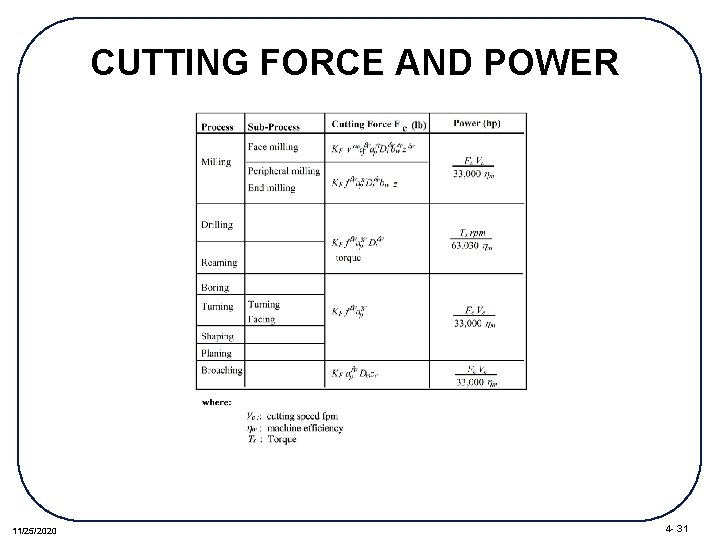
CUTTING FORCE AND POWER 11/25/2020 4 - 31
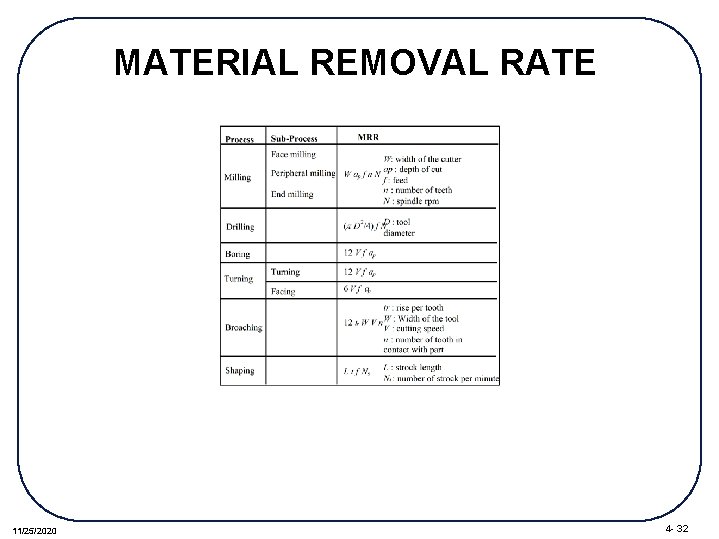
MATERIAL REMOVAL RATE 11/25/2020 4 - 32

CONSTRAINTS Spindle-speed constraint: workpiece tool Feed constraint: f min £ f max Cutting-force constraint: Power constraint: Surface-finish constraint: 11/25/2020 4 - 33
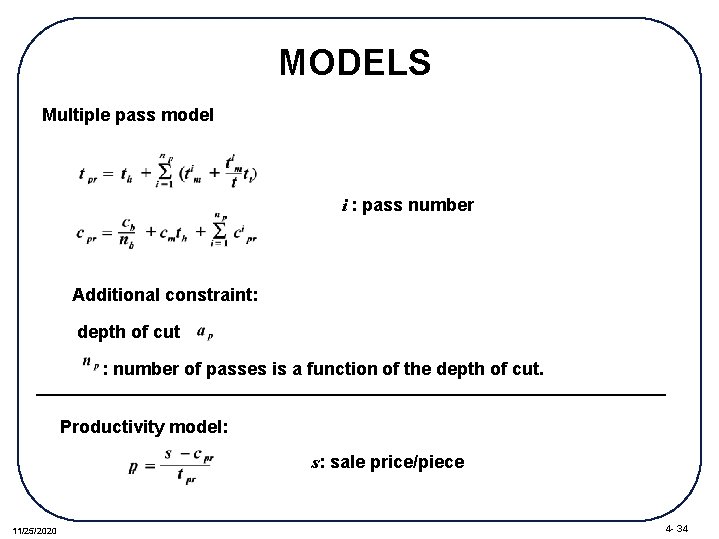
MODELS Multiple pass model i : pass number Additional constraint: depth of cut : number of passes is a function of the depth of cut. Productivity model: s: sale price/piece 11/25/2020 4 - 34
- Slides: 34