
Process Development and Process Integration of Semiconductor Devices

- Slides: 20
Process Development and Process Integration of Semiconductor Devices Mark T. Tinker, Ph. D. Department of Electrical Engineering University of Texas at Dallas
Process Development Activities • • • Worked in Process Development for Fifteen Years Both at IBM and Texas Instruments Activities Ranged Across a Wide Variety of Different Areas Ø Failure Analysis Ø Reliability Ø Process Engineering Ø Equipment Engineering Ø Yield Enhancement Main Focus of Activities Centered on Reliability and Yield Enhancement
Product Cycle • • Objective of Wafer Fab is to Produce Product Next Generation Product Requires Several Years to Development Cycle Must Encompass Following Stages Ø Research Ø Early Development Ø Productization Development Ø Manufacturing Product Evolves from Basic Concepts and Processes to an Integrated Product and Finally Full Scale Manufacturing
Product Cycle Example • • IBM Employs a Product Cycle Encompassing Several Increasingly Demanding Checkpoints Include T 0, T 1, T 2, S 0, S 1, and S 2 Ø T 0 and T 1 Includes Basic Development with Increasing Levels of Product Qualification Ø T 2 Includes Extensive Functional and Reliability Qualification by an Independent Assurance Group Ø S 0 and Beyond Involves Release to Manufacturing and Transition to Quality Control
Wafer Fab Culture • • • Wafer Fabs are Manufacturing Facilities Running Around the Clock Seven Days a Week Most Development Runs in this Type of Environment Wafer Fabs are Large Multi-Billion Dollar Facilities Involving the Contribution of a Variety of Different Groups Process Engineering is One of the Most Key Groups in a Fab PE is a Very Interdisciplinary Area Involving Engineers from Ø Materials Science Ø Physics Ø Chemistry Ø Chemical Engineering Ø Electrical Engineering
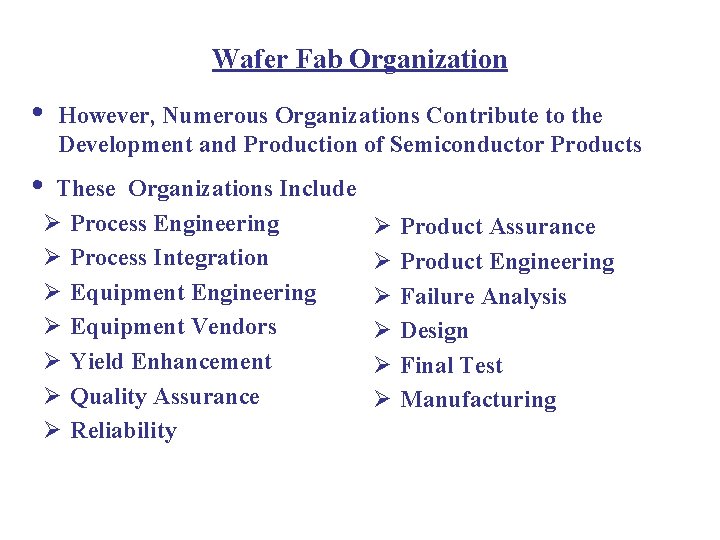
Wafer Fab Organization • However, Numerous Organizations Contribute to the Development and Production of Semiconductor Products • These Organizations Include Ø Process Engineering Ø Process Integration Ø Equipment Engineering Ø Equipment Vendors Ø Yield Enhancement Ø Quality Assurance Ø Reliability Ø Ø Ø Product Assurance Product Engineering Failure Analysis Design Final Test Manufacturing
Process Engineering • • • Responsible for All Process Related Issues Throughout Wafer Fab Can Broadly Categorize PE Into Three General Functions Ø Thin Films Ø Photolithography Ø Etch Process Engineers Have Very Specific Functions Ø Ø Ø • Ion Implant Poly Dep Oxide Deposition Metal Deposition CVD Barrier Metal Ø Ø Ø Silicon Etch Oxide Etch Metal Etch CMP Clean PE is a Very Large and Important Engineering Area
Process Integration • Responsible for Coordinating and Integrating Semiconductor Processes in Order to Develop a Functional, Reliable, and Yieldable Product • • Key Wafer Fab Organization Much Smaller Than Process Engineering Function
Equipment Engineering • • Sustains and Supports Manufacturing Equipment In-Line PE and EE Often Work Together on Resolving Tool Issues Responsible for Coordinating Tool Installs EE Oftentimes Works with PE on Evaluating and Accepting Next Generation Tools
Equipment Vendors • • Develops Equipment for Semiconductor Manufacturing Ø Develops Tool Platform and Process for Manufacturing Ø PE May Alter or Adjust Process to Meet Manufacturing Needs Often Supports and Maintains Their Equipment In-Line in Place of EE Under Equipment Service Contract
Yield Enhancement • • Drives Product Yield In-Line In Order to Expedite Yield Learning Ø Shorten Product Cycle During Product Development Ø Or Maximize Product Yield During Manufacturing Typically Uses Expensive Defect Detection Tools In-Line to Identify Yield Limiting Problems Companies Like IBM Also Depend Heavily Upon In-Line Parametrics on Test Sites to Drive Yield In-Line Problems May Range from Regular Daily Particle Excursions to Large Catastrophic Yield Problems
Quality Assurance • • Sets Up Control Charts and Limits for Various Process Parameters May Actively Monitor and Enforce Quality Standards
Reliability • • Assures and Monitors Product Reliability Ø Serious Reliability Issues Can Be Disastrous for a Company Ø Can Be Costly for a Company and Seriously Hurt Its Reputation Ø Responding to a Reliability Problem in the Field Can Take Months Main Responsibilities Include Ø Stressing Product During Product Qualification Ø Implementing In-Line Monitors and Controls Ø Monitoring Field Returns for Problems and Issues
Product Assurance • • Performs Qualification of Product Prior to Product Release Ø Extensive Reliability Test Ø Extensive Functionality Test Ø Assures Manufacturability of Product Performed by Independent Product Organization to Assure Unbiased Assessment
Product Engineering • • • Drives Yield from End of Line By Ø Evaluating End of Line Final Test Data and Parametrics Ø Performing Failure Analysis of Defective Product Provides a Powerful Combination of Electrical Data Analysis with Physical Failure Analysis However, Issues Include Ø Long Turnaround Time Before Product Reaches Final Test Ø Extensive Time Required for Physical Failure Analysis
Failure Analysis • • Provides Physical Failure Analysis and Construction Analysis for Various Engineering Functions Including Ø Process Engineering Ø Process Integration Ø Yield Enhancement Ø Reliability Ø Product Assurance Ø Product Engineering Provides Ø Basic Metallographic Services Such as Polishing and SEM Ø More Sophisticated Services Such as STEM, SIMS, Auger, and ESCA
Design • Design May Get Involved with Process Development Issues Ø Most Issues Are Typically Resolved Through a Process Action Ø However, Occasional Issues Must Be Resolved with a Design Change
Final Test • • • Develops Final Test for Semiconductor Product Provides Electrical Parametric Data Which Drives Manufacturing Line Also, Provides Key Final Test Data Commonly Required to Fix Product Yield
Manufacturing • • • Actually Runs the Product Through the Manufacturing Line Large and Powerful Group Within a Wafer Fab Typically Engineering Teams Must Work Around Manufacturing Even in Development in Order to Ø Minimize Turnaround Times and Maximize Yield Learning in Development or Ø Minimize Turnaround Times and Improve Tool Utilization in Manufacturing
Conclusions • • Process Development Very Long and Involved Engineering Process Requires Numerous Groups to Develop and Yield a Semiconductor Product