
Process Control System Programming 2018 Hanyang University System

![Q and A Hanyang University – System Programming. [ 2018 ]](https://slidetodoc.com/presentation_image_h/06550528d05990d356af231ebbef977f/image-24.jpg "Q and A Hanyang University – System Programming. [ 2018 ]")
- Slides: 24
Process Control System Programming 2018 여름 계절학기 한양대학교 공과대학 컴퓨터소프트웨어학부 홍석준 Hanyang University – System Programming. [ 2018 ]
Process Control Process control – process creation, program execution, and process termination Process properties – real, effective, and saved; user and group IDs Interpreter files and the system function Process accounting Hanyang University – System Programming. [ 2018 ] -2 -
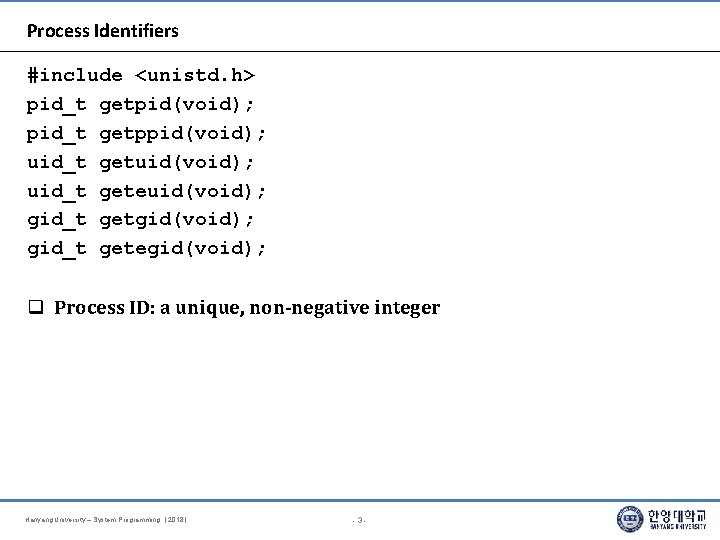
Process Identifiers #include <unistd. h> pid_t getpid(void); pid_t getppid(void); uid_t getuid(void); uid_t geteuid(void); gid_t getgid(void); gid_t getegid(void); Process ID: a unique, non-negative integer Hanyang University – System Programming. [ 2018 ] -3 -
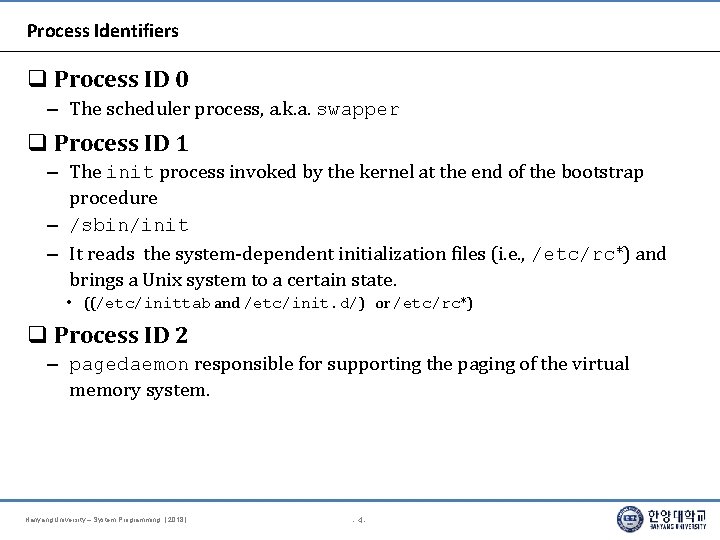
Process Identifiers Process ID 0 – The scheduler process, a. k. a. swapper Process ID 1 – The init process invoked by the kernel at the end of the bootstrap procedure – /sbin/init – It reads the system-dependent initialization files (i. e. , /etc/rc*) and brings a Unix system to a certain state. • ((/etc/inittab and /etc/init. d/) or /etc/rc*) Process ID 2 – pagedaemon responsible for supporting the paging of the virtual memory system. Hanyang University – System Programming. [ 2018 ] -4 -
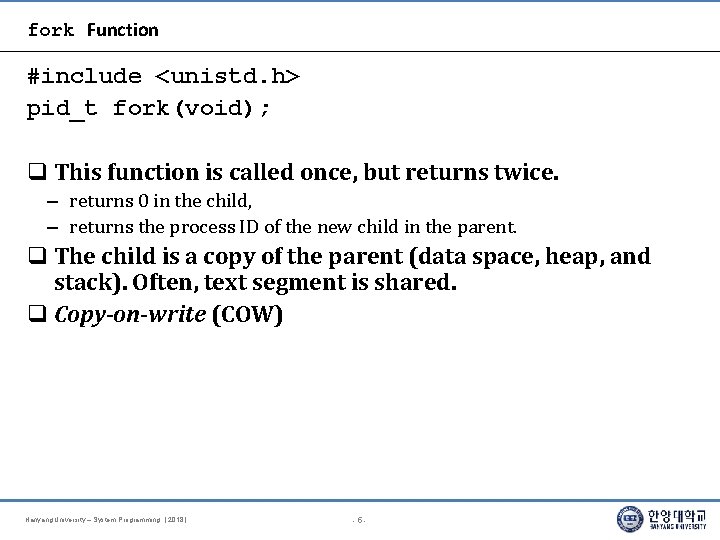
fork Function #include <unistd. h> pid_t fork(void); This function is called once, but returns twice. – returns 0 in the child, – returns the process ID of the new child in the parent. The child is a copy of the parent (data space, heap, and stack). Often, text segment is shared. Copy-on-write (COW) Hanyang University – System Programming. [ 2018 ] -5 -
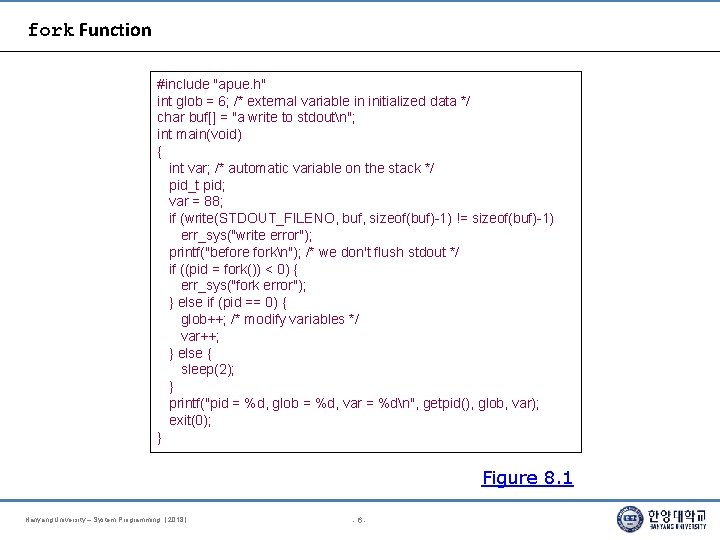
fork Function #include "apue. h" int glob = 6; /* external variable in initialized data */ char buf[] = "a write to stdoutn"; int main(void) { int var; /* automatic variable on the stack */ pid_t pid; var = 88; if (write(STDOUT_FILENO, buf, sizeof(buf)-1) != sizeof(buf)-1) err_sys("write error"); printf("before forkn"); /* we don't flush stdout */ if ((pid = fork()) < 0) { err_sys("fork error"); } else if (pid == 0) { glob++; /* modify variables */ var++; } else { sleep(2); } printf("pid = %d, glob = %d, var = %dn", getpid(), glob, var); exit(0); } Figure 8. 1 Hanyang University – System Programming. [ 2018 ] -6 -
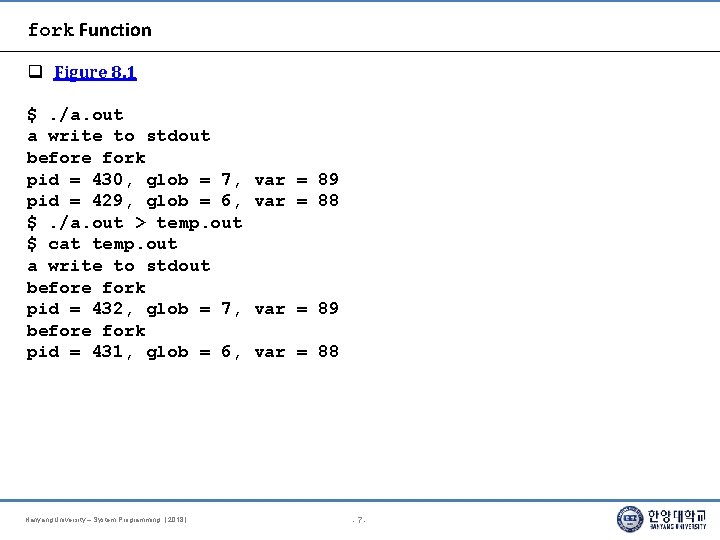
fork Function Figure 8. 1 $. /a. out a write to stdout before fork pid = 430, glob = 7, pid = 429, glob = 6, $. /a. out > temp. out $ cat temp. out a write to stdout before fork pid = 432, glob = 7, before fork pid = 431, glob = 6, Hanyang University – System Programming. [ 2018 ] var = 89 var = 88 -7 -
fork Function v-node table parent process table entry fd 0: fd 1: fd 2: file table file status flags fd flags ptr current file offset v-node ptr … file status flags current file size current file offset v-node ptr child process table entry fd 0: fd 1: fd 2: fd flags ptr v-node information i-node information current file size file status flags current file offset v-node ptr … v-node information i-node information current file size • All descriptors that are open in the parent are duplicated in the child. Hanyang University – System Programming. [ 2018 ] -8 -
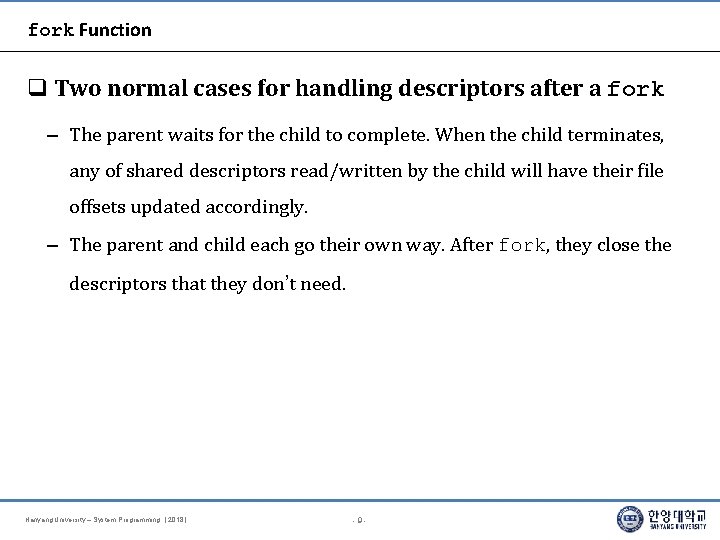
fork Function Two normal cases for handling descriptors after a fork – The parent waits for the child to complete. When the child terminates, any of shared descriptors read/written by the child will have their file offsets updated accordingly. – The parent and child each go their own way. After fork, they close the descriptors that they don’t need. Hanyang University – System Programming. [ 2018 ] -9 -
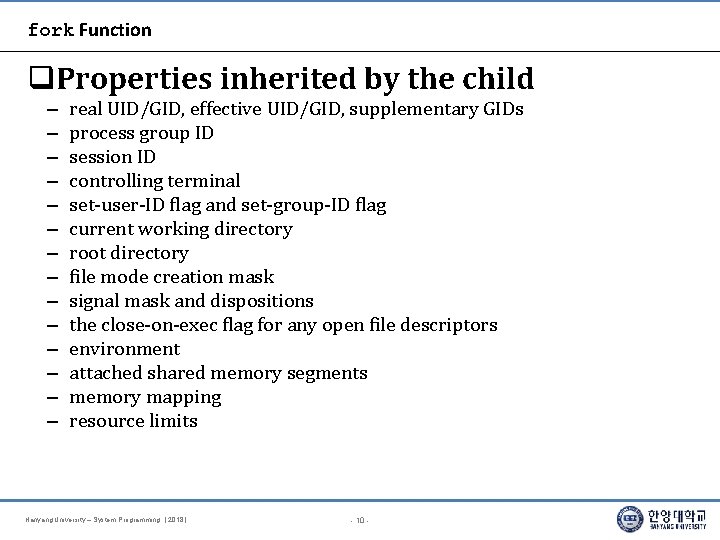
fork Function Properties inherited by the child – – – – real UID/GID, effective UID/GID, supplementary GIDs process group ID session ID controlling terminal set-user-ID flag and set-group-ID flag current working directory root directory file mode creation mask signal mask and dispositions the close-on-exec flag for any open file descriptors environment attached shared memory segments memory mapping resource limits Hanyang University – System Programming. [ 2018 ] - 10 -
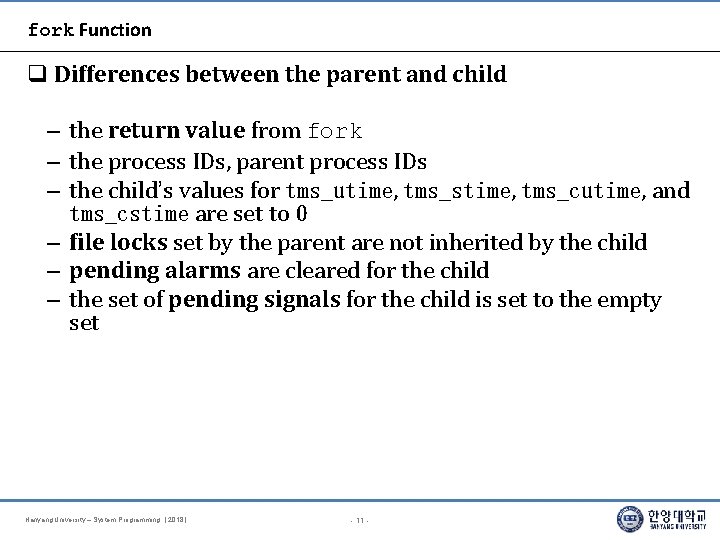
fork Function Differences between the parent and child – the return value from fork – the process IDs, parent process IDs – the child’s values for tms_utime, tms_stime, tms_cutime, and tms_cstime are set to 0 – file locks set by the parent are not inherited by the child – pending alarms are cleared for the child – the set of pending signals for the child is set to the empty set Hanyang University – System Programming. [ 2018 ] - 11 -
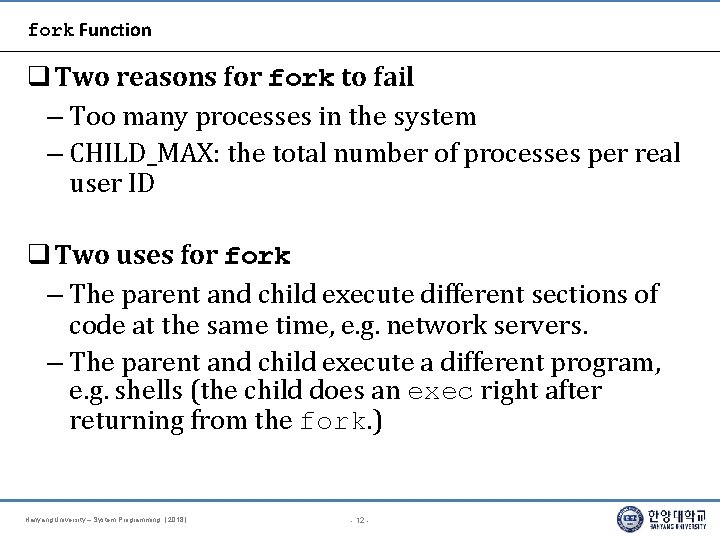
fork Function Two reasons fork to fail – Too many processes in the system – CHILD_MAX: the total number of processes per real user ID Two uses fork – The parent and child execute different sections of code at the same time, e. g. network servers. – The parent and child execute a different program, e. g. shells (the child does an exec right after returning from the fork. ) Hanyang University – System Programming. [ 2018 ] - 12 -
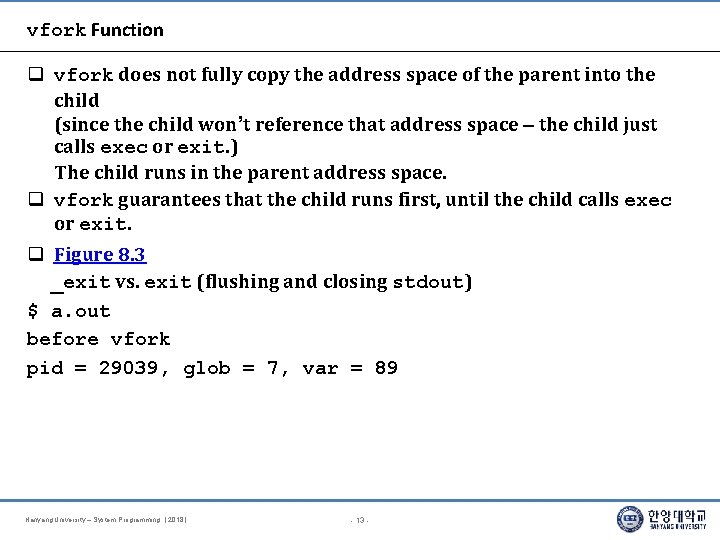
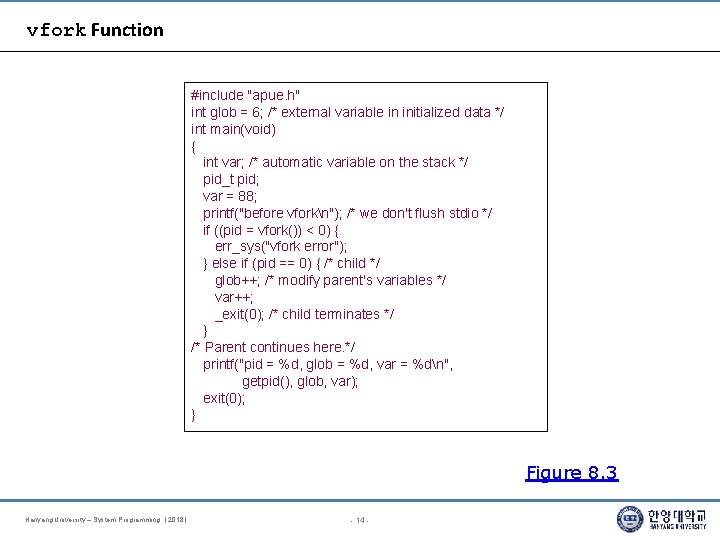
vfork Function vfork does not fully copy the address space of the parent into the child (since the child won’t reference that address space – the child just calls exec or exit. ) The child runs in the parent address space. vfork guarantees that the child runs first, until the child calls exec or exit. Figure 8. 3 _exit vs. exit (flushing and closing stdout) $ a. out before vfork pid = 29039, glob = 7, var = 89 Hanyang University – System Programming. [ 2018 ] - 13 -
vfork Function #include "apue. h" int glob = 6; /* external variable in initialized data */ int main(void) { int var; /* automatic variable on the stack */ pid_t pid; var = 88; printf("before vforkn"); /* we don't flush stdio */ if ((pid = vfork()) < 0) { err_sys("vfork error"); } else if (pid == 0) { /* child */ glob++; /* modify parent's variables */ var++; _exit(0); /* child terminates */ } /* Parent continues here. */ printf("pid = %d, glob = %d, var = %dn", getpid(), glob, var); exit(0); } Figure 8. 3 Hanyang University – System Programming. [ 2018 ] - 14 -
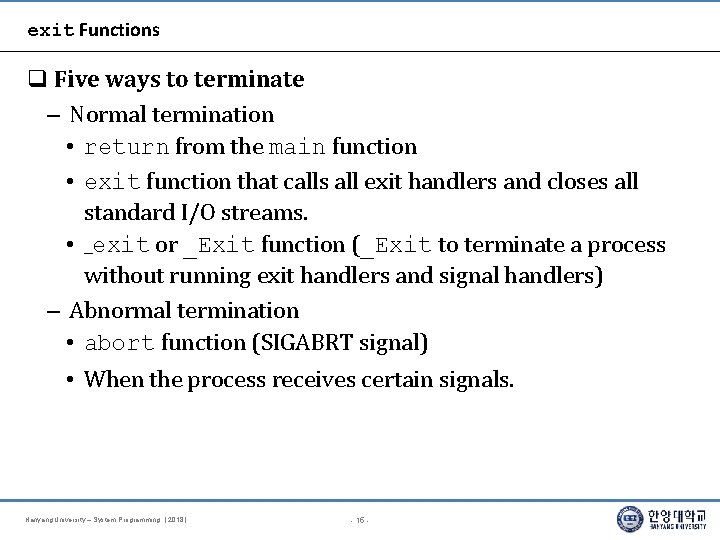
exit Functions Five ways to terminate – Normal termination • return from the main function • exit function that calls all exit handlers and closes all standard I/O streams. • _exit or _Exit function (_Exit to terminate a process without running exit handlers and signal handlers) – Abnormal termination • abort function (SIGABRT signal) • When the process receives certain signals. Hanyang University – System Programming. [ 2018 ] - 15 -
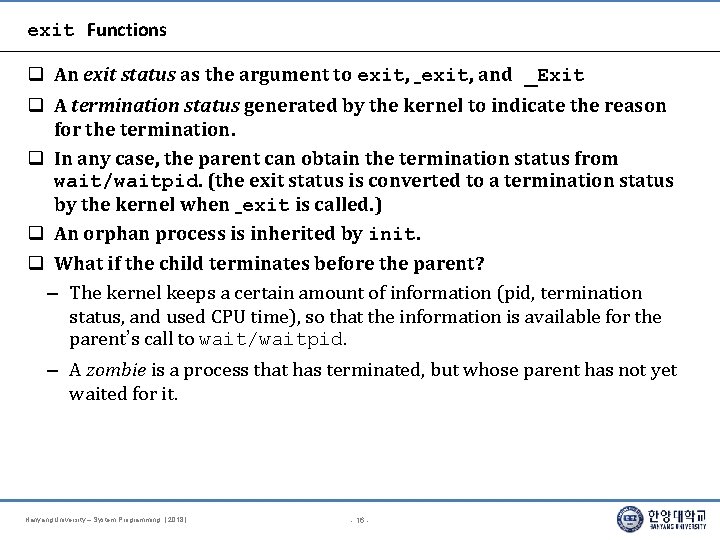
exit Functions An exit status as the argument to exit, _exit, and _Exit A termination status generated by the kernel to indicate the reason for the termination. In any case, the parent can obtain the termination status from wait/waitpid. (the exit status is converted to a termination status by the kernel when _exit is called. ) An orphan process is inherited by init. What if the child terminates before the parent? – The kernel keeps a certain amount of information (pid, termination status, and used CPU time), so that the information is available for the parent’s call to wait/waitpid. – A zombie is a process that has terminated, but whose parent has not yet waited for it. Hanyang University – System Programming. [ 2018 ] - 16 -
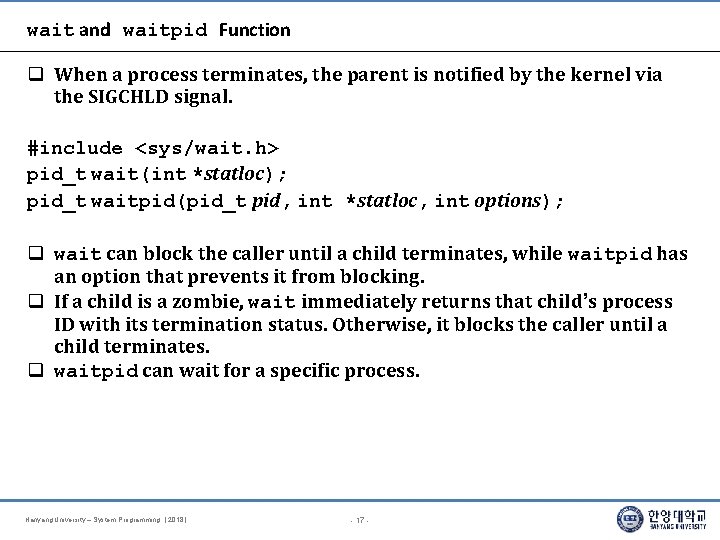
wait and waitpid Function When a process terminates, the parent is notified by the kernel via the SIGCHLD signal. #include <sys/wait. h> pid_t wait(int *statloc); pid_t waitpid(pid_t pid, int *statloc, int options); wait can block the caller until a child terminates, while waitpid has an option that prevents it from blocking. If a child is a zombie, wait immediately returns that child’s process ID with its termination status. Otherwise, it blocks the caller until a child terminates. waitpid can wait for a specific process. Hanyang University – System Programming. [ 2018 ] - 17 -
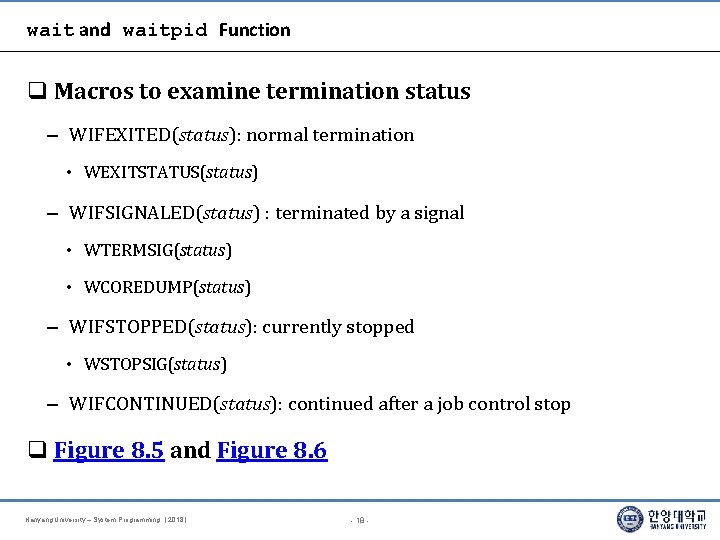
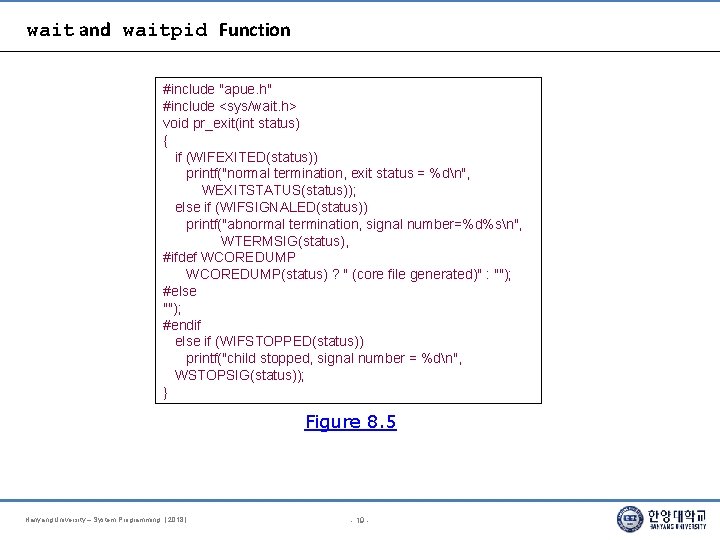
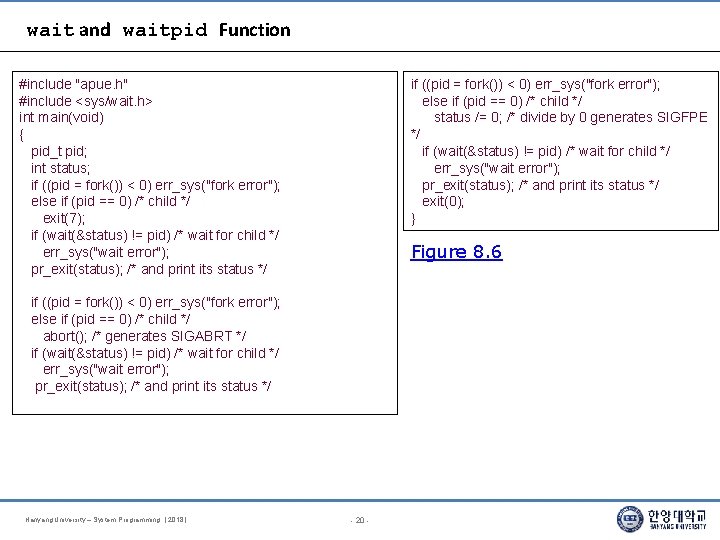
wait and waitpid Function Macros to examine termination status – WIFEXITED(status): normal termination • WEXITSTATUS(status) – WIFSIGNALED(status) : terminated by a signal • WTERMSIG(status) • WCOREDUMP(status) – WIFSTOPPED(status): currently stopped • WSTOPSIG(status) – WIFCONTINUED(status): continued after a job control stop Figure 8. 5 and Figure 8. 6 Hanyang University – System Programming. [ 2018 ] - 18 -
wait and waitpid Function #include "apue. h" #include <sys/wait. h> void pr_exit(int status) { if (WIFEXITED(status)) printf("normal termination, exit status = %dn", WEXITSTATUS(status)); else if (WIFSIGNALED(status)) printf("abnormal termination, signal number=%d%sn", WTERMSIG(status), #ifdef WCOREDUMP(status) ? " (core file generated)" : ""); #else ""); #endif else if (WIFSTOPPED(status)) printf("child stopped, signal number = %dn", WSTOPSIG(status)); } Figure 8. 5 Hanyang University – System Programming. [ 2018 ] - 19 -
wait and waitpid Function if ((pid = fork()) < 0) err_sys("fork error"); else if (pid == 0) /* child */ status /= 0; /* divide by 0 generates SIGFPE */ if (wait(&status) != pid) /* wait for child */ err_sys("wait error"); pr_exit(status); /* and print its status */ exit(0); } #include "apue. h" #include <sys/wait. h> int main(void) { pid_t pid; int status; if ((pid = fork()) < 0) err_sys("fork error"); else if (pid == 0) /* child */ exit(7); if (wait(&status) != pid) /* wait for child */ err_sys("wait error"); pr_exit(status); /* and print its status */ Figure 8. 6 if ((pid = fork()) < 0) err_sys("fork error"); else if (pid == 0) /* child */ abort(); /* generates SIGABRT */ if (wait(&status) != pid) /* wait for child */ err_sys("wait error"); pr_exit(status); /* and print its status */ Hanyang University – System Programming. [ 2018 ] - 20 -
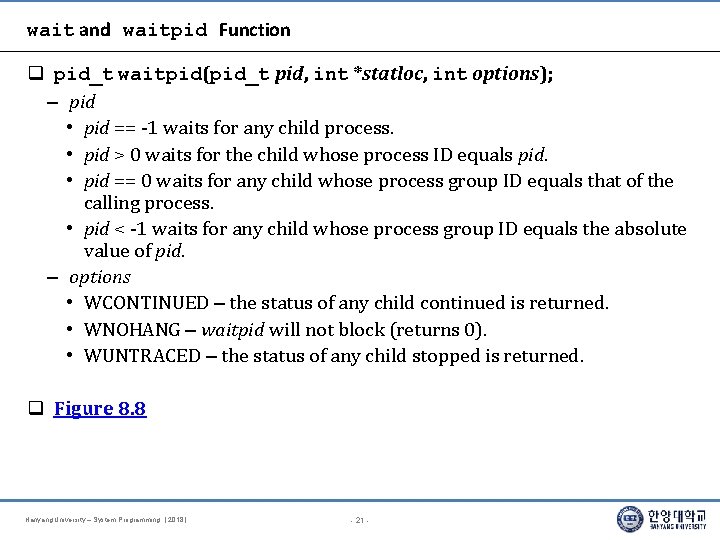
wait and waitpid Function pid_t waitpid(pid_t pid, int *statloc, int options); – pid • pid == -1 waits for any child process. • pid > 0 waits for the child whose process ID equals pid. • pid == 0 waits for any child whose process group ID equals that of the calling process. • pid < -1 waits for any child whose process group ID equals the absolute value of pid. – options • WCONTINUED – the status of any child continued is returned. • WNOHANG – waitpid will not block (returns 0). • WUNTRACED – the status of any child stopped is returned. Figure 8. 8 Hanyang University – System Programming. [ 2018 ] - 21 -
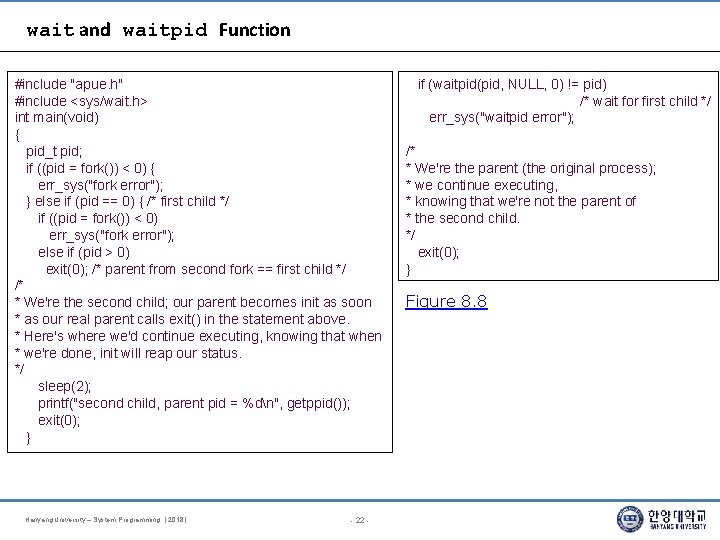
wait and waitpid Function #include "apue. h" #include <sys/wait. h> int main(void) { pid_t pid; if ((pid = fork()) < 0) { err_sys("fork error"); } else if (pid == 0) { /* first child */ if ((pid = fork()) < 0) err_sys("fork error"); else if (pid > 0) exit(0); /* parent from second fork == first child */ /* * We're the second child; our parent becomes init as soon * as our real parent calls exit() in the statement above. * Here's where we'd continue executing, knowing that when * we're done, init will reap our status. */ sleep(2); printf("second child, parent pid = %dn", getppid()); exit(0); } Hanyang University – System Programming. [ 2018 ] - 22 - if (waitpid(pid, NULL, 0) != pid) /* wait for first child */ err_sys("waitpid error"); /* * We're the parent (the original process); * we continue executing, * knowing that we're not the parent of * the second child. */ exit(0); } Figure 8. 8
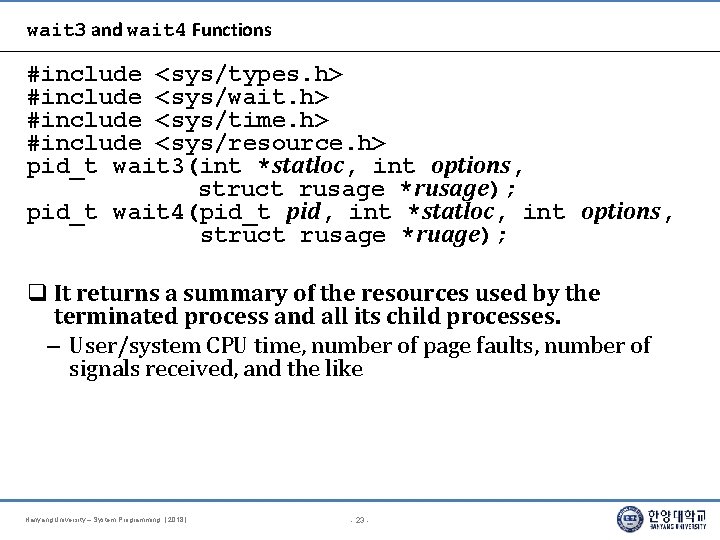
wait 3 and wait 4 Functions #include <sys/types. h> #include <sys/wait. h> #include <sys/time. h> #include <sys/resource. h> pid_t wait 3(int *statloc, int options, struct rusage *rusage); pid_t wait 4(pid_t pid, int *statloc, int options, struct rusage *ruage); It returns a summary of the resources used by the terminated process and all its child processes. – User/system CPU time, number of page faults, number of signals received, and the like Hanyang University – System Programming. [ 2018 ] - 23 -
Q and A Hanyang University – System Programming. [ 2018 ]