
Process Control Designing Process and Control Systems for
- Slides: 43
Process Control: Designing Process and Control Systems for Dynamic Performance Chapter 19. Single-Loop IMC Copyright © Thomas Marlin 2013 The copyright holder provides a royalty-free license for use of this material at non-profit educational institutions
CHAPTER 19: Single-Loop IMC Control When I complete this chapter, I want to be able to do the following. • Recognize that other feedback algorithms are possible • Understand the IMC structure and how it provides the essential control features • Tune an IMC controller • Correctly select between PID and IMC
CHAPTER 19: Single-Loop IMC Control Outline of the lesson. • Thought exercise for model-based control • IMC structure • Desired control features • IMC algorithm and tuning • Application guidelines
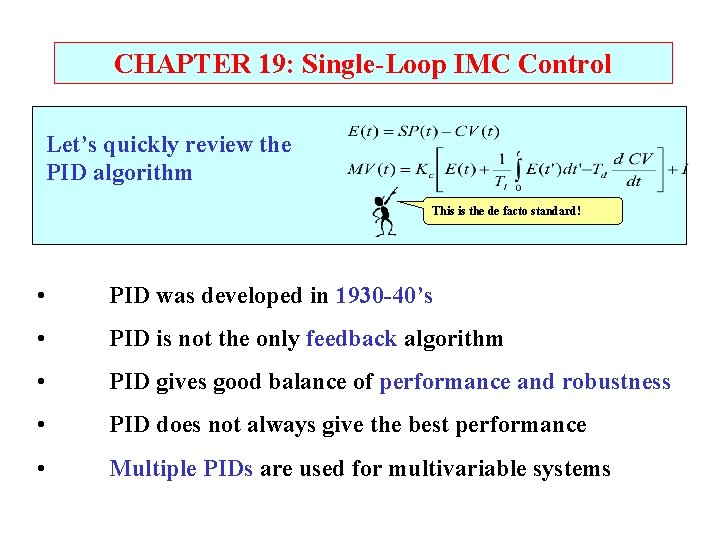
CHAPTER 19: Single-Loop IMC Control Let’s quickly review the PID algorithm This is the de facto standard! • PID was developed in 1930 -40’s • PID is not the only feedback algorithm • PID gives good balance of performance and robustness • PID does not always give the best performance • Multiple PIDs are used for multivariable systems
CHAPTER 19: Single-Loop IMC Control Let’s look ahead to the IMC structure and algorithm We will have another algorithm to learn!!!! • IMC was developed formally in 1980’s, but the ideas began in 1950’s • IMC uses a process model explicitly • IMC involves a different structure and controller • IMC could replace PID, but we chose to retain PID unless an advantage exists • A single “IMC” can be used for multivariable systems
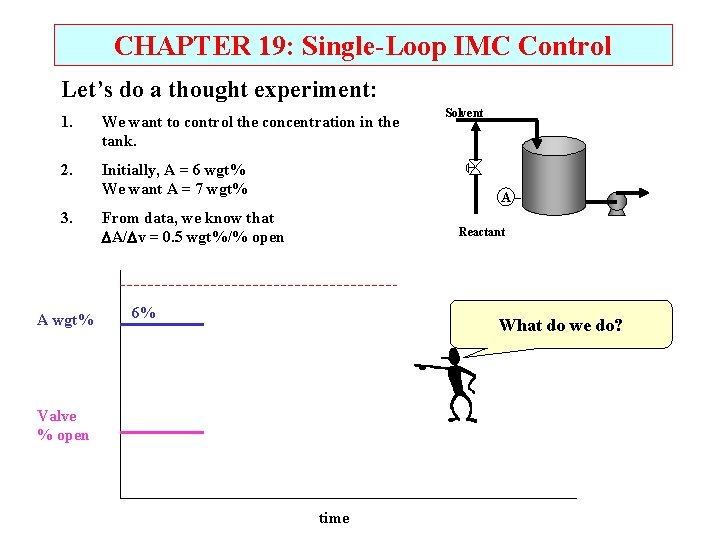
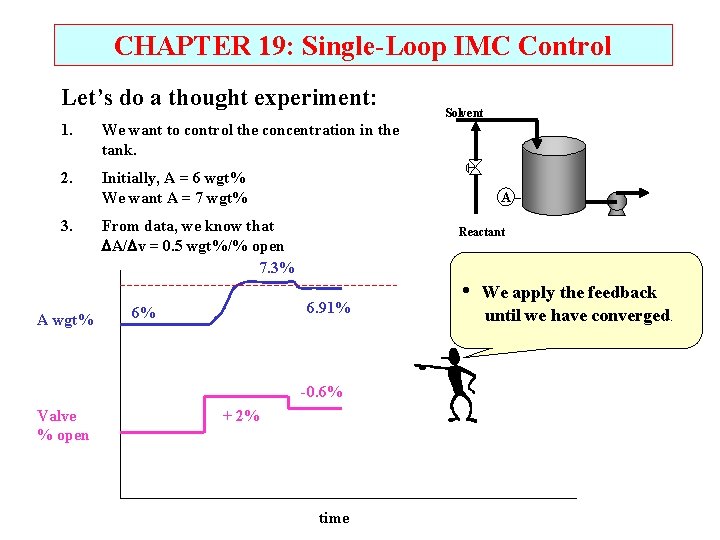
CHAPTER 19: Single-Loop IMC Control Let’s do a thought experiment: 1. We want to control the concentration in the tank. 2. Initially, A = 6 wgt% We want A = 7 wgt% 3. A wgt% Solvent A From data, we know that A/ v = 0. 5 wgt%/% open Reactant 6% What do we do? Valve % open time
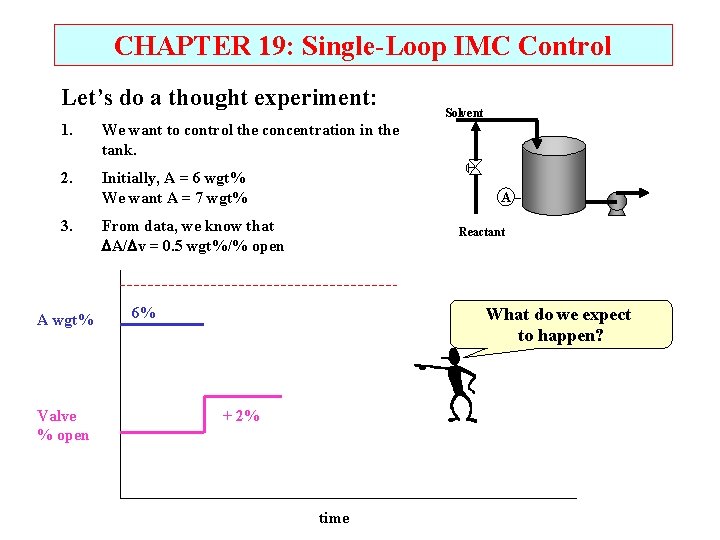
CHAPTER 19: Single-Loop IMC Control Let’s do a thought experiment: 1. We want to control the concentration in the tank. 2. Initially, A = 6 wgt% We want A = 7 wgt% 3. A wgt% Valve % open Solvent A From data, we know that A/ v = 0. 5 wgt%/% open Reactant 6% What do we expect to happen? + 2% time
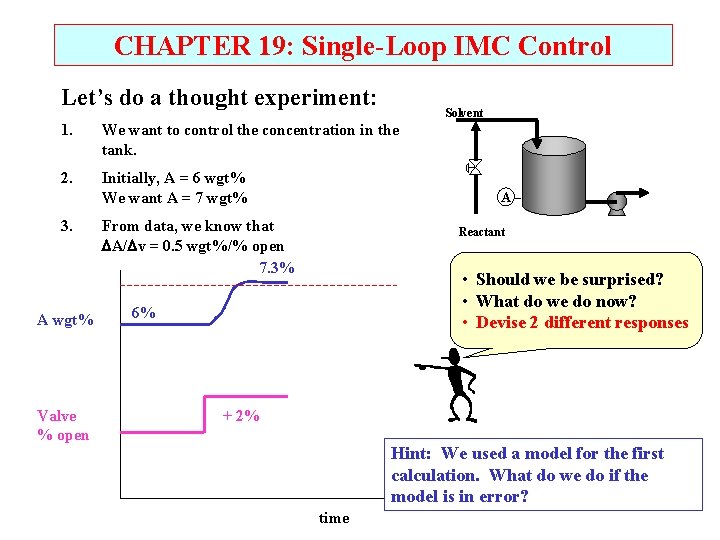
CHAPTER 19: Single-Loop IMC Control Let’s do a thought experiment: Solvent 1. We want to control the concentration in the tank. 2. Initially, A = 6 wgt% We want A = 7 wgt% 3. A wgt% Valve % open A From data, we know that A/ v = 0. 5 wgt%/% open 7. 3% Reactant • Should we be surprised? • What do we do now? • Devise 2 different responses 6% + 2% Hint: We used a model for the first calculation. What do we do if the model is in error? time
CHAPTER 19: Single-Loop IMC Control Let’s do a thought experiment: 1. We want to control the concentration in the tank. 2. Initially, A = 6 wgt% We want A = 7 wgt% 3. A wgt% A From data, we know that A/ v = 0. 5 wgt%/% open 7. 3% Reactant 6. 91% 6% -0. 6% Valve % open Solvent + 2% time • We apply the feedback until we have converged.
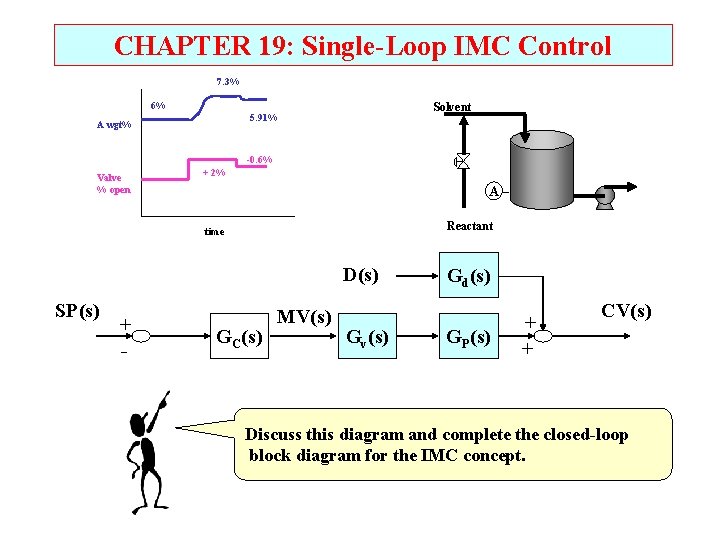
CHAPTER 19: Single-Loop IMC Control 7. 3% 6% Solvent 5. 91% A wgt% -0. 6% Valve % open + 2% A Reactant time D(s) SP(s) + - GC(s) MV(s) Gv(s) Gd(s) GP(s) + + CV(s) Discuss this diagram and complete the closed-loop block diagram for the IMC concept.
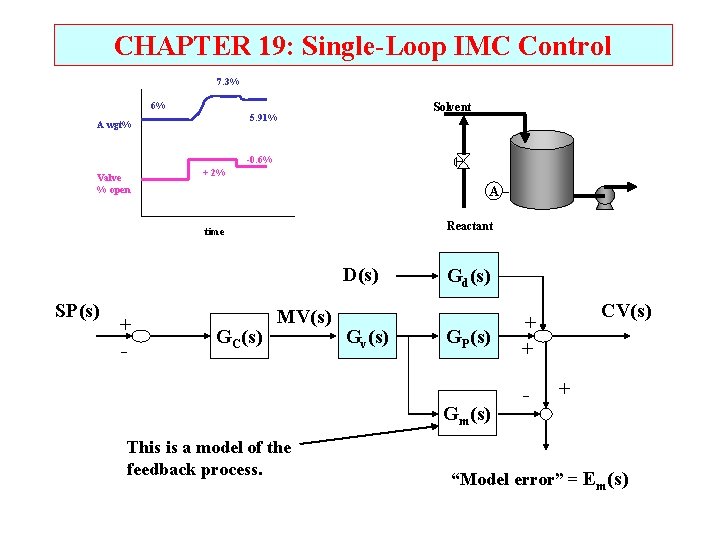
CHAPTER 19: Single-Loop IMC Control 7. 3% 6% Solvent 5. 91% A wgt% -0. 6% Valve % open + 2% A Reactant time D(s) SP(s) + - GC(s) MV(s) Gv(s) Gd(s) GP(s) Gm(s) This is a model of the feedback process. CV(s) + + - + “Model error” = Em(s)
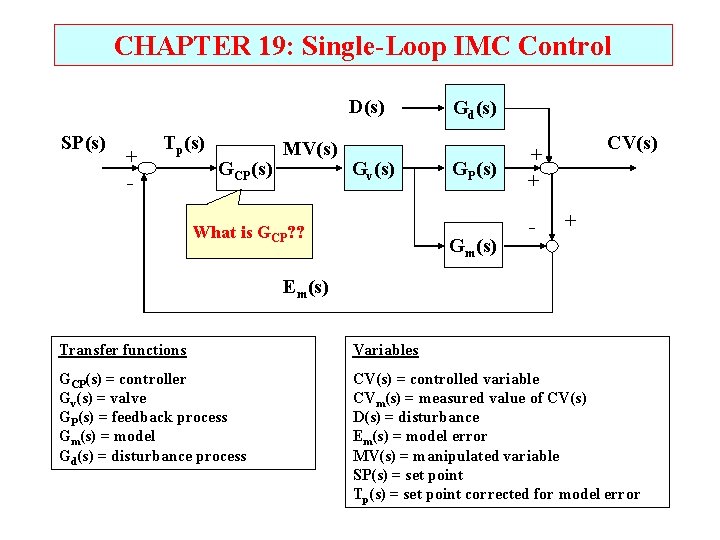
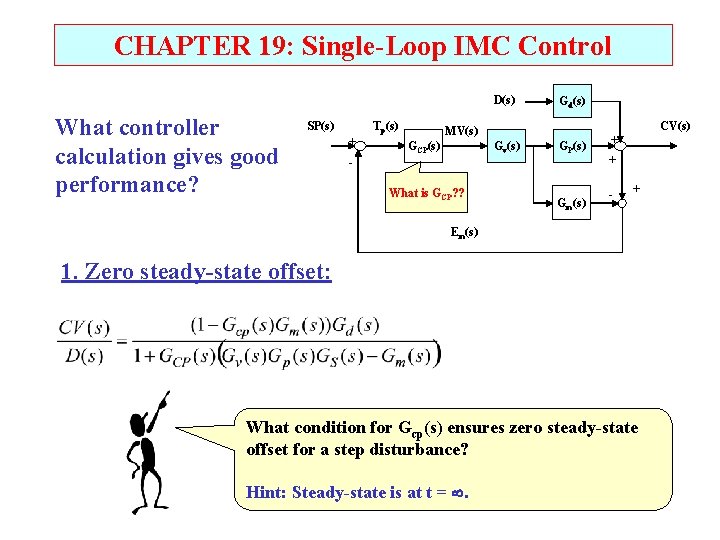
CHAPTER 19: Single-Loop IMC Control D(s) SP(s) + - Tp(s) GCP(s) MV(s) Gv(s) What is GCP? ? Gd(s) GP(s) Gm(s) CV(s) + + - + Em(s) Transfer functions Variables GCP(s) = controller Gv(s) = valve GP(s) = feedback process Gm(s) = model Gd(s) = disturbance process CV(s) = controlled variable CVm(s) = measured value of CV(s) D(s) = disturbance Em(s) = model error MV(s) = manipulated variable SP(s) = set point Tp(s) = set point corrected for model error
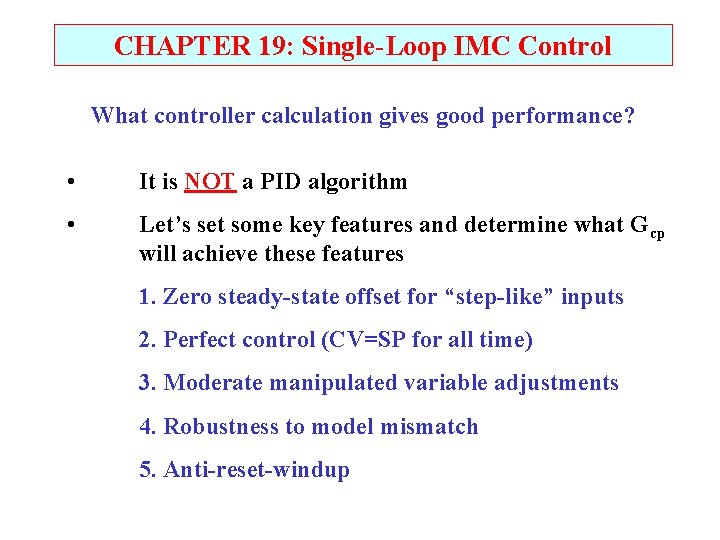
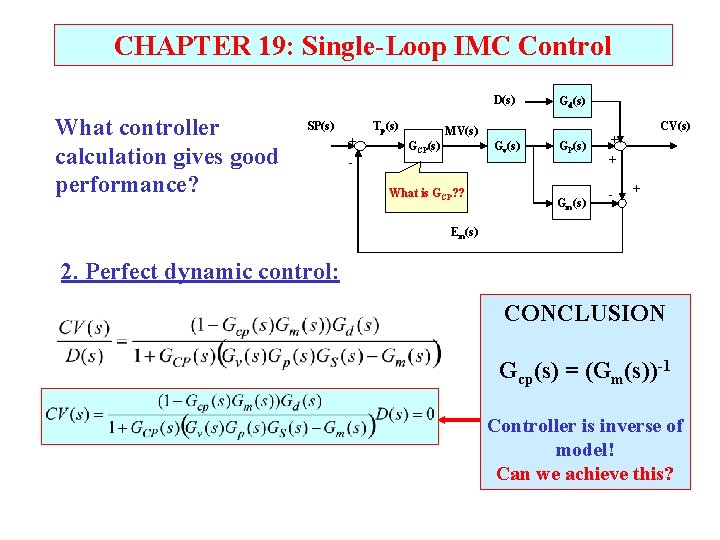
CHAPTER 19: Single-Loop IMC Control What controller calculation gives good performance? • It is NOT a PID algorithm • Let’s set some key features and determine what Gcp will achieve these features 1. Zero steady-state offset for “step-like” inputs 2. Perfect control (CV=SP for all time) 3. Moderate manipulated variable adjustments 4. Robustness to model mismatch 5. Anti-reset-windup
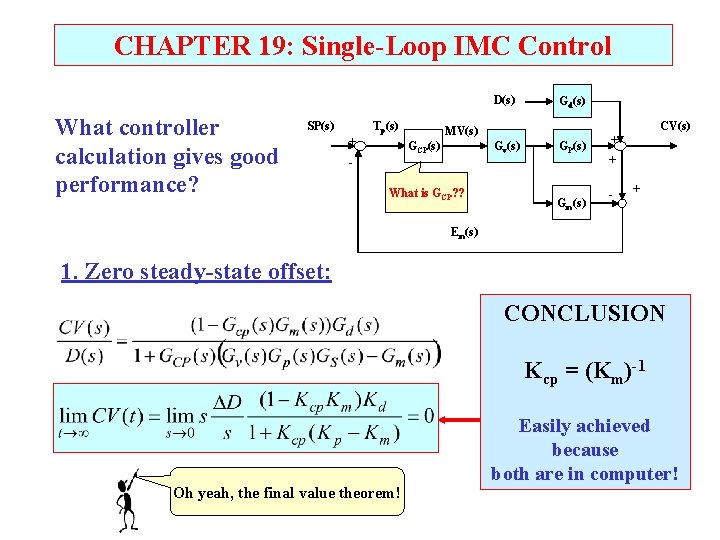
CHAPTER 19: Single-Loop IMC Control D(s) What controller calculation gives good performance? SP(s) Tp(s) + Gd(s) CV(s) MV(s) GCP(s) Gv(s) GP(s) What is GCP? ? Gm(s) + + - + Em(s) 1. Zero steady-state offset: What condition for Gcp(s) ensures zero steady-state offset for a step disturbance? Hint: Steady-state is at t = .
CHAPTER 19: Single-Loop IMC Control D(s) What controller calculation gives good performance? SP(s) Tp(s) + Gd(s) CV(s) MV(s) GCP(s) Gv(s) GP(s) What is GCP? ? Gm(s) + + - + Em(s) 1. Zero steady-state offset: CONCLUSION Kcp = (Km)-1 Oh yeah, the final value theorem! Easily achieved because both are in computer!
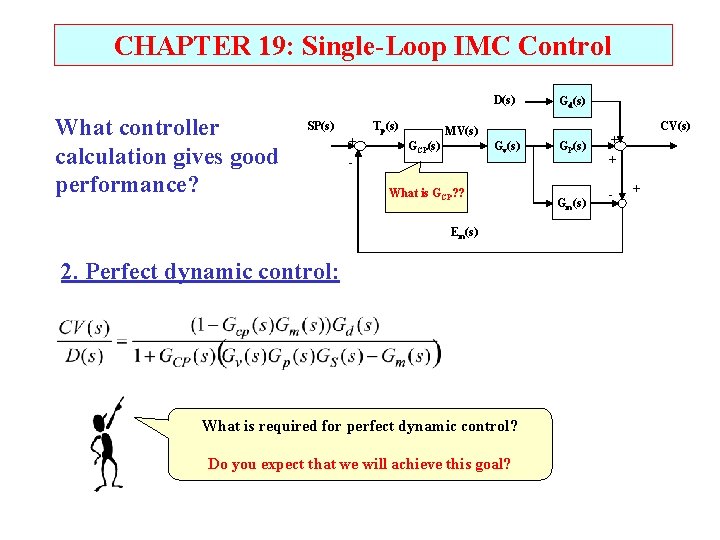
CHAPTER 19: Single-Loop IMC Control D(s) What controller calculation gives good performance? SP(s) Tp(s) + Gd(s) CV(s) MV(s) GCP(s) Gv(s) GP(s) What is GCP? ? Em(s) 2. Perfect dynamic control: What is required for perfect dynamic control? Do you expect that we will achieve this goal? Gm(s) + + - +
CHAPTER 19: Single-Loop IMC Control D(s) What controller calculation gives good performance? SP(s) Tp(s) + Gd(s) CV(s) MV(s) GCP(s) Gv(s) GP(s) What is GCP? ? Gm(s) + + - + Em(s) 2. Perfect dynamic control: CONCLUSION Gcp(s) = (Gm(s))-1 Controller is inverse of model! Can we achieve this?
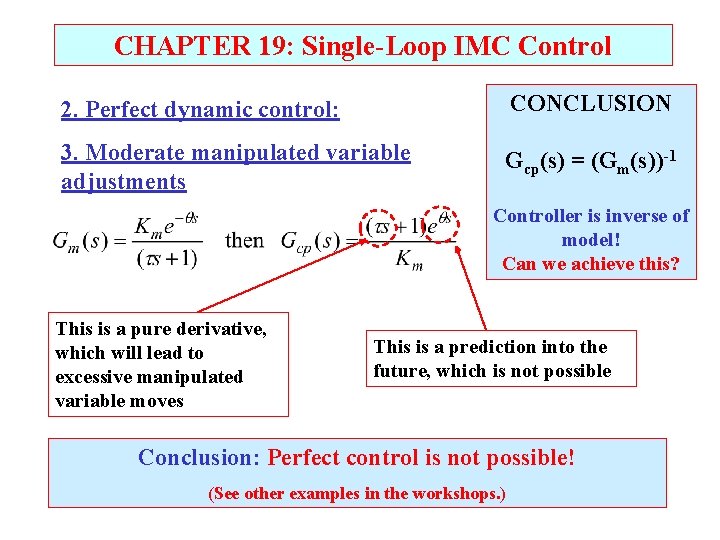
CHAPTER 19: Single-Loop IMC Control 2. Perfect dynamic control: CONCLUSION 3. Moderate manipulated variable adjustments Gcp(s) = (Gm(s))-1 Controller is inverse of model! Can we achieve this? This is a pure derivative, which will lead to excessive manipulated variable moves This is a prediction into the future, which is not possible Conclusion: Perfect control is not possible! (See other examples in the workshops. )
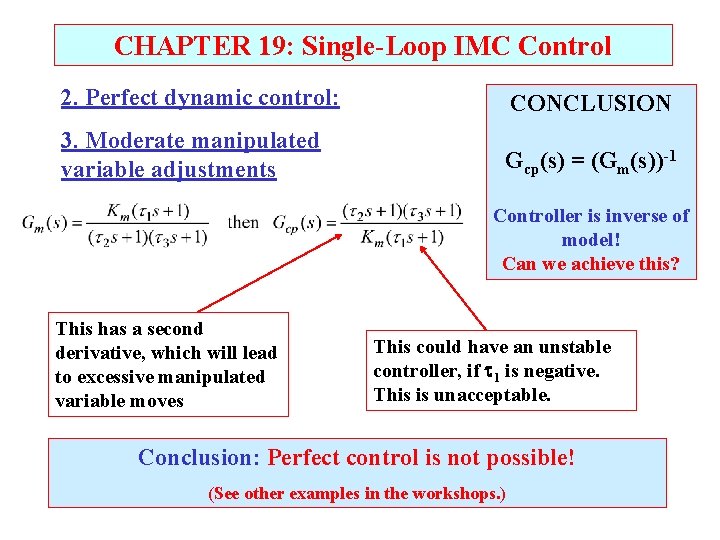
CHAPTER 19: Single-Loop IMC Control 2. Perfect dynamic control: CONCLUSION 3. Moderate manipulated variable adjustments Gcp(s) = (Gm(s))-1 Controller is inverse of model! Can we achieve this? This has a second derivative, which will lead to excessive manipulated variable moves This could have an unstable controller, if 1 is negative. This is unacceptable. Conclusion: Perfect control is not possible! (See other examples in the workshops. )
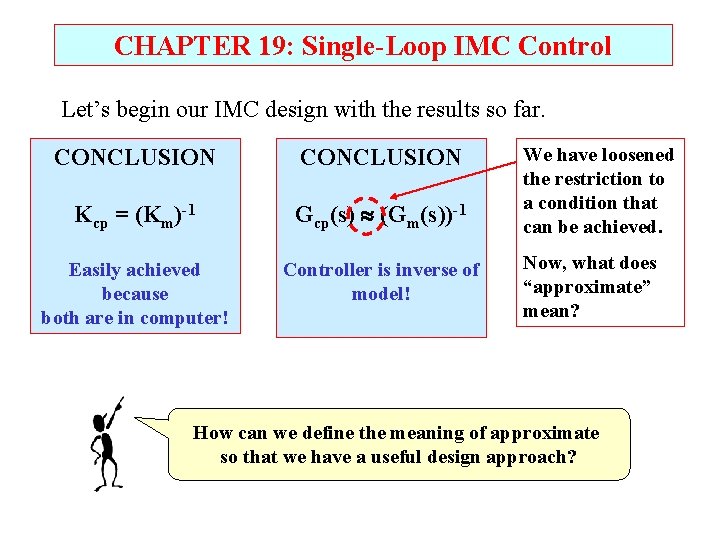
CHAPTER 19: Single-Loop IMC Control Let’s begin our IMC design with the results so far. CONCLUSION Kcp = (Km)-1 Gcp(s) (Gm(s))-1 Easily achieved because both are in computer! Controller is inverse of model! We have loosened the restriction to a condition that can be achieved. Now, what does “approximate” mean? How can we define the meaning of approximate so that we have a useful design approach?
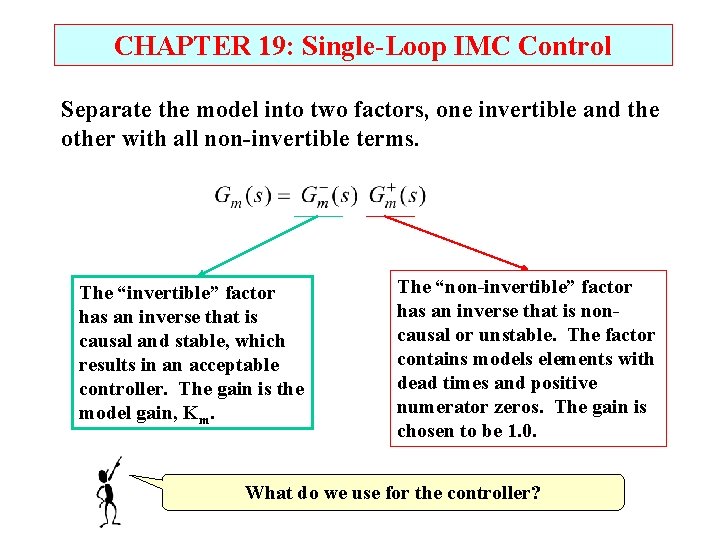
CHAPTER 19: Single-Loop IMC Control Separate the model into two factors, one invertible and the other with all non-invertible terms. The “invertible” factor has an inverse that is causal and stable, which results in an acceptable controller. The gain is the model gain, Km. The “non-invertible” factor has an inverse that is noncausal or unstable. The factor contains models elements with dead times and positive numerator zeros. The gain is chosen to be 1. 0. What do we use for the controller?
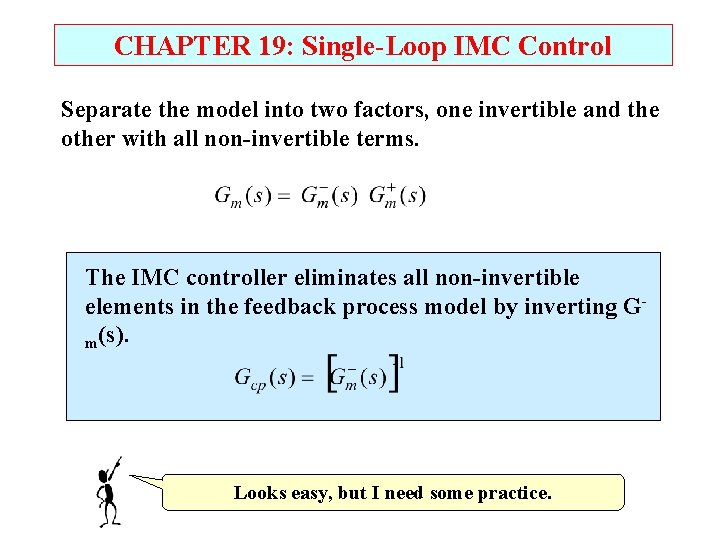
CHAPTER 19: Single-Loop IMC Control Separate the model into two factors, one invertible and the other with all non-invertible terms. The IMC controller eliminates all non-invertible elements in the feedback process model by inverting Gm(s). Looks easy, but I need some practice.
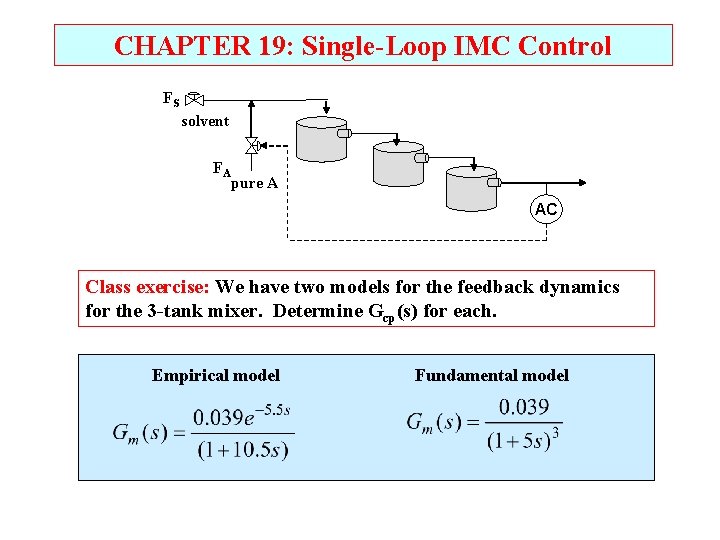
CHAPTER 19: Single-Loop IMC Control FS solvent FA pure A AC Class exercise: We have two models for the feedback dynamics for the 3 -tank mixer. Determine Gcp(s) for each. Empirical model Fundamental model
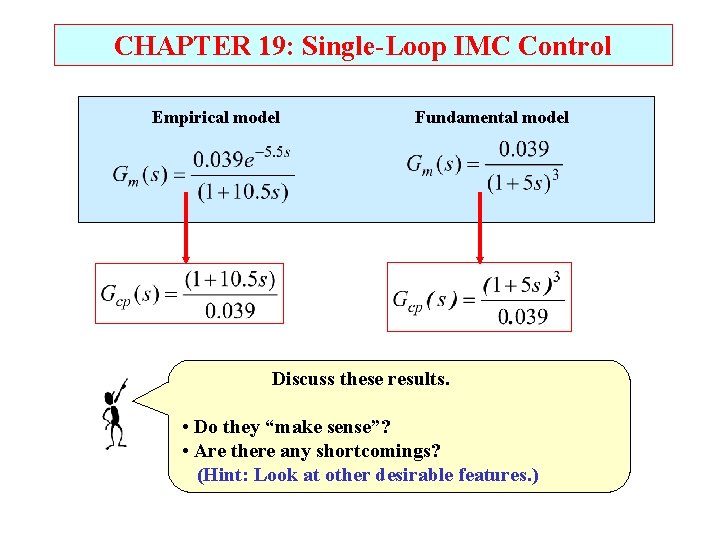
CHAPTER 19: Single-Loop IMC Control Empirical model Fundamental model Discuss these results. • Do they “make sense”? • Are there any shortcomings? (Hint: Look at other desirable features. )
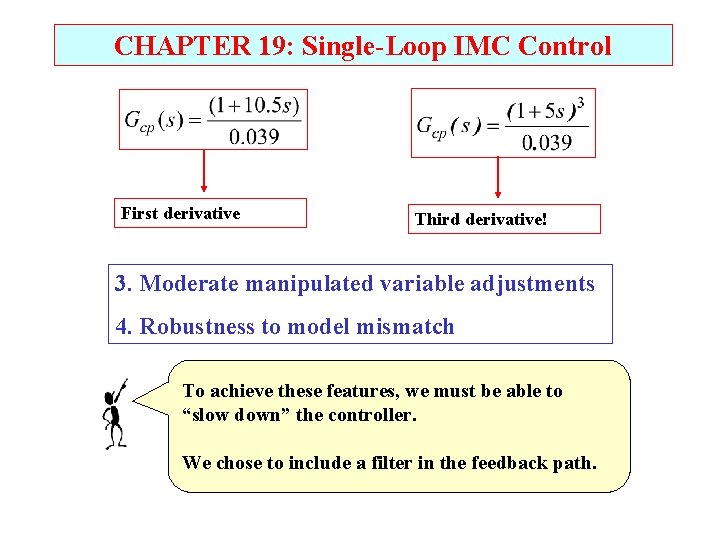
CHAPTER 19: Single-Loop IMC Control First derivative Third derivative! 3. Moderate manipulated variable adjustments 4. Robustness to model mismatch To achieve these features, we must be able to “slow down” the controller. We chose to include a filter in the feedback path.
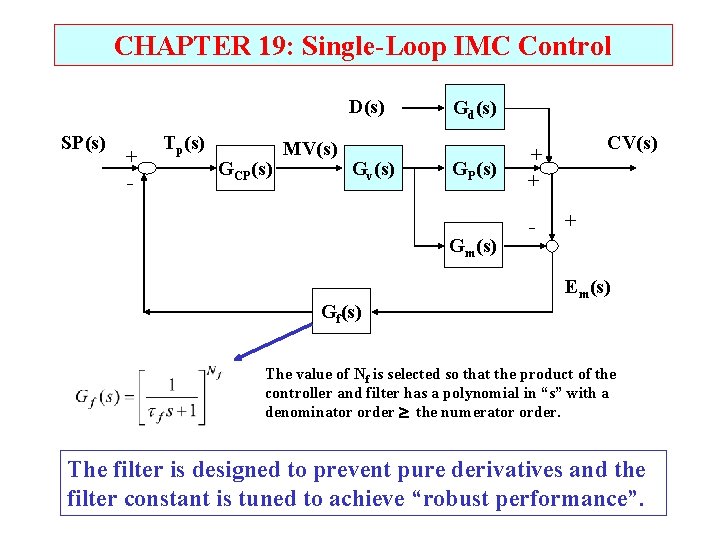
CHAPTER 19: Single-Loop IMC Control D(s) SP(s) + - Tp(s) GCP(s) MV(s) Gv(s) Gd(s) GP(s) Gm(s) Gf(s) CV(s) + + - + Em(s) The value of Nf is selected so that the product of the controller and filter has a polynomial in “s” with a denominator order the numerator order. The filter is designed to prevent pure derivatives and the filter constant is tuned to achieve “robust performance”.
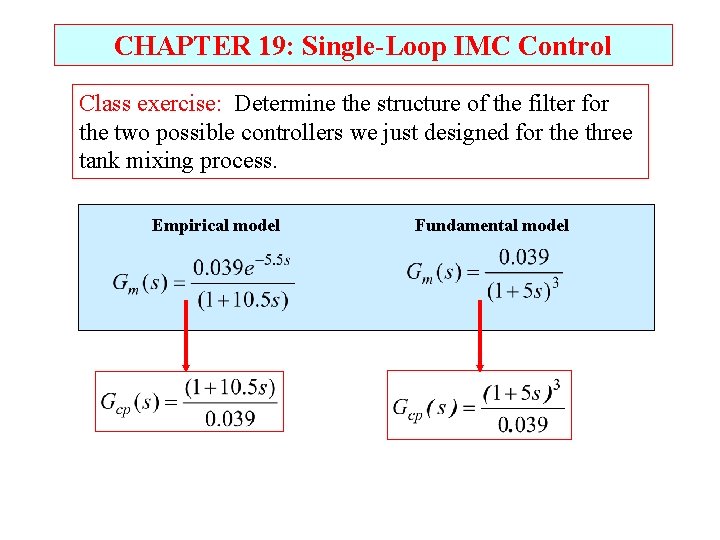
CHAPTER 19: Single-Loop IMC Control Class exercise: Determine the structure of the filter for the two possible controllers we just designed for the three tank mixing process. Empirical model Fundamental model
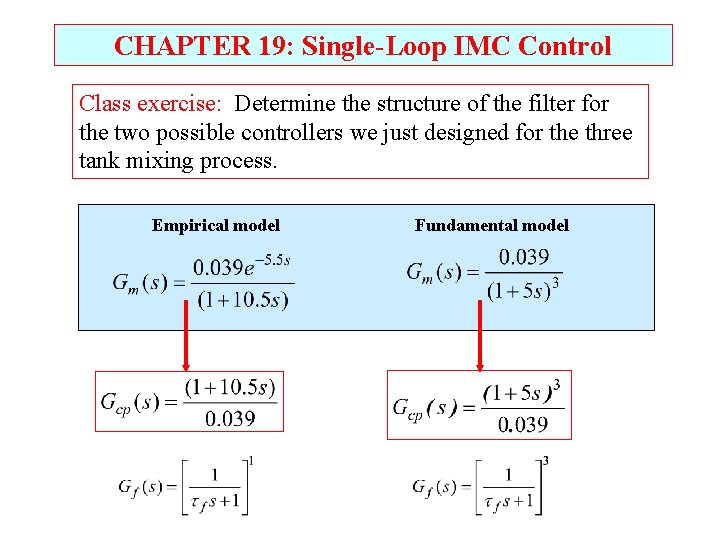
CHAPTER 19: Single-Loop IMC Control Class exercise: Determine the structure of the filter for the two possible controllers we just designed for the three tank mixing process. Empirical model Fundamental model
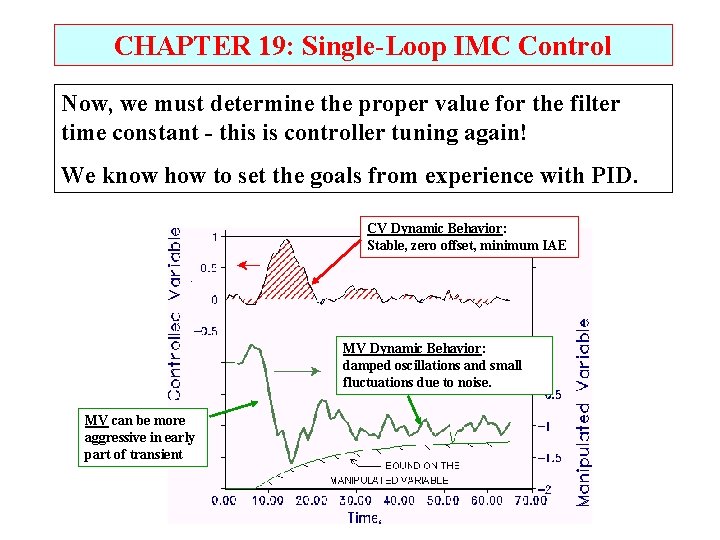
CHAPTER 19: Single-Loop IMC Control Now, we must determine the proper value for the filter time constant - this is controller tuning again! We know how to set the goals from experience with PID. CV Dynamic Behavior: Stable, zero offset, minimum IAE MV Dynamic Behavior: damped oscillations and small fluctuations due to noise. MV can be more aggressive in early part of transient
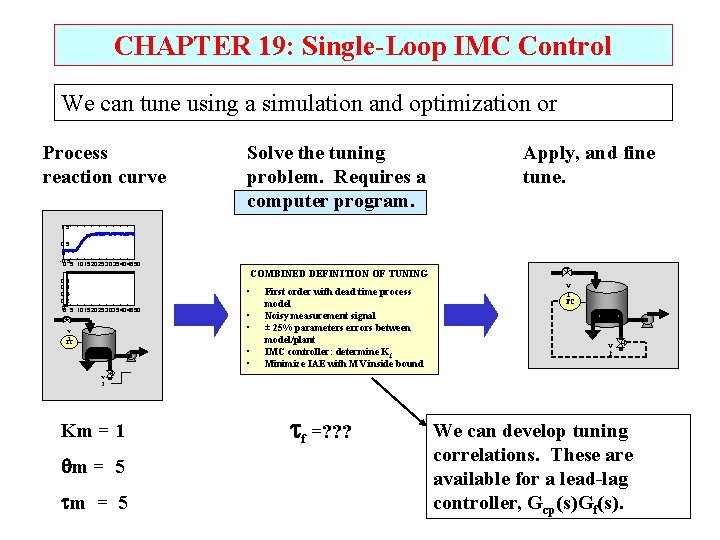
CHAPTER 19: Single-Loop IMC Control We can tune using a simulation and optimization or Process reaction curve Solve the tuning problem. Requires a computer program. Apply, and fine tune. 1. 5 1 0. 5 0 -0. 5 0 5 10 1520253035404550 1 0. 8 0. 6 0. 4 0. 2 00 5 10 1520253035404550 v 1 TC COMBINED DEFINITION OF TUNING • • • First order with dead time process model Noisy measurement signal ± 25% parameters errors between model/plant IMC controller: determine K f Minimize IAE with MV inside bound v 1 TC v 2 Km = 1 m = 5 f =? ? ? We can develop tuning correlations. These are available for a lead-lag controller, Gcp(s)Gf(s).
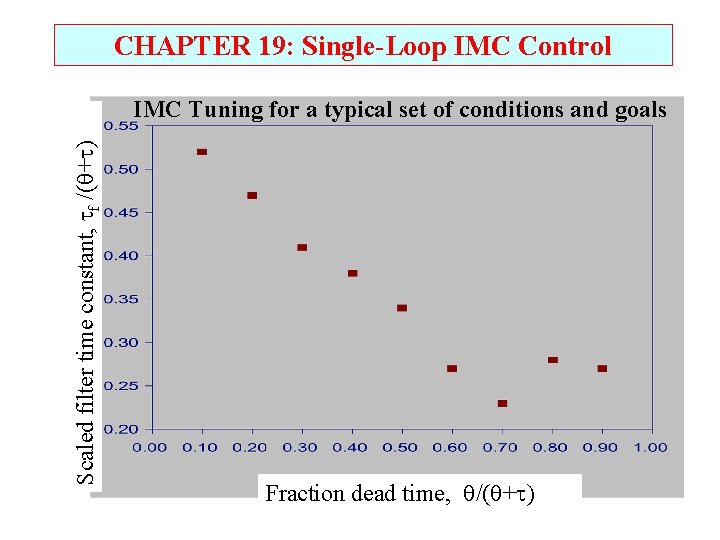
CHAPTER 19: Single-Loop IMC Control Scaled filter time constant, f /( + ) IMC Tuning for a typical set of conditions and goals Fraction dead time, /( + )
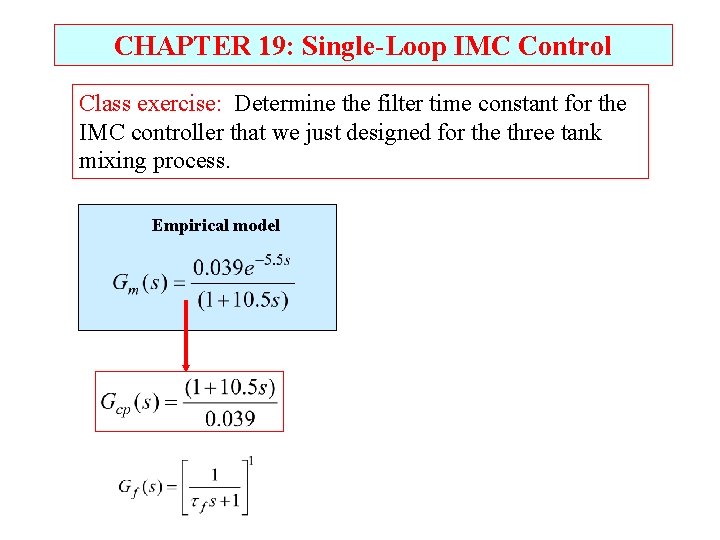
CHAPTER 19: Single-Loop IMC Control Class exercise: Determine the filter time constant for the IMC controller that we just designed for the three tank mixing process. Empirical model
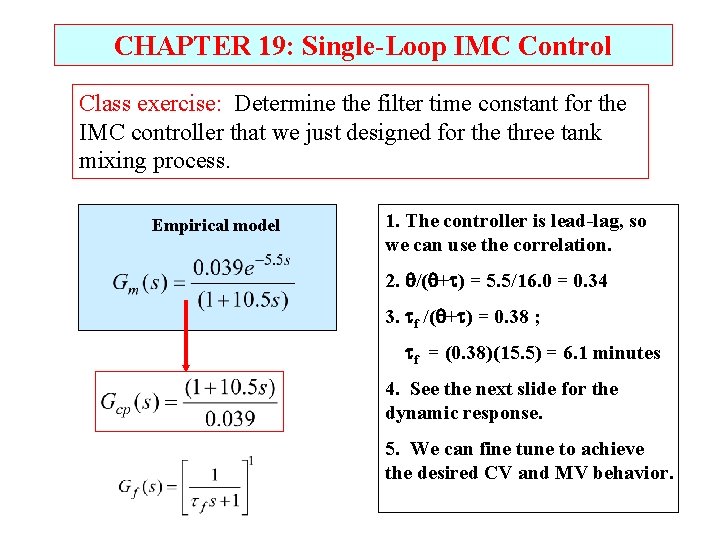
CHAPTER 19: Single-Loop IMC Control Class exercise: Determine the filter time constant for the IMC controller that we just designed for the three tank mixing process. Empirical model 1. The controller is lead-lag, so we can use the correlation. 2. /( + ) = 5. 5/16. 0 = 0. 34 3. f /( + ) = 0. 38 ; f = (0. 38)(15. 5) = 6. 1 minutes 4. See the next slide for the dynamic response. 5. We can fine tune to achieve the desired CV and MV behavior.
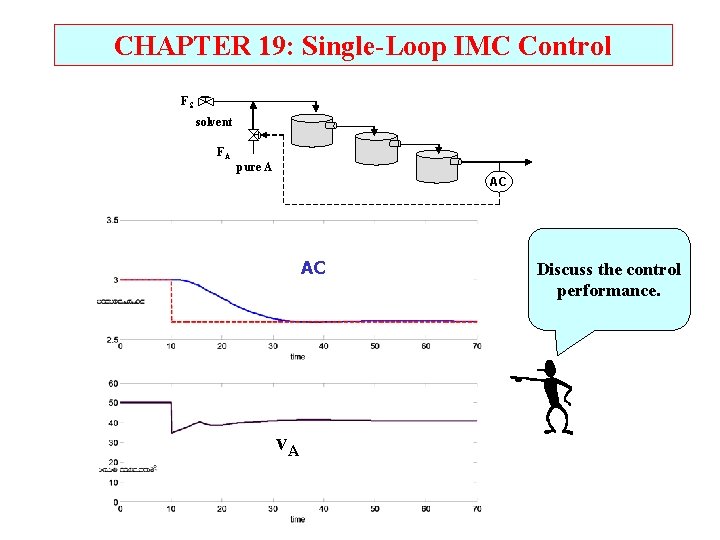
CHAPTER 19: Single-Loop IMC Control FS solvent FA pure A AC AC v. A Discuss the control performance.
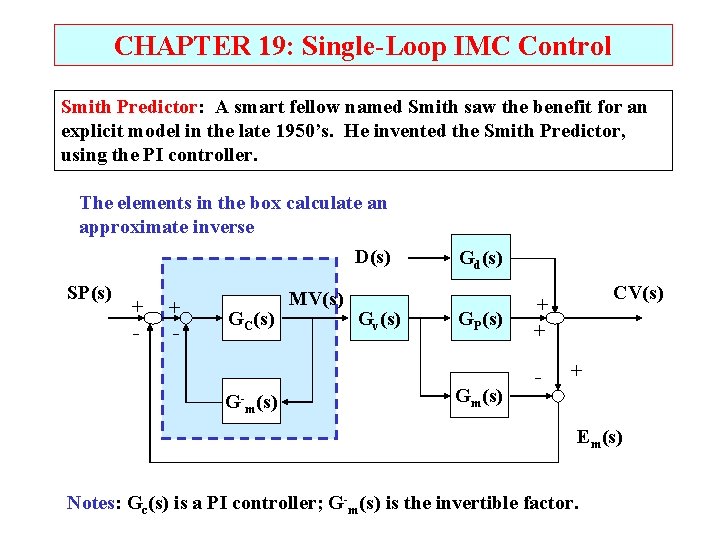
CHAPTER 19: Single-Loop IMC Control Smith Predictor: A smart fellow named Smith saw the benefit for an explicit model in the late 1950’s. He invented the Smith Predictor, using the PI controller. The elements in the box calculate an approximate inverse D(s) SP(s) + - GC(s) G-m(s) MV(s) Gv(s) Gd(s) GP(s) Gm(s) CV(s) + + - + Em(s) Notes: Gc(s) is a PI controller; G-m(s) is the invertible factor.
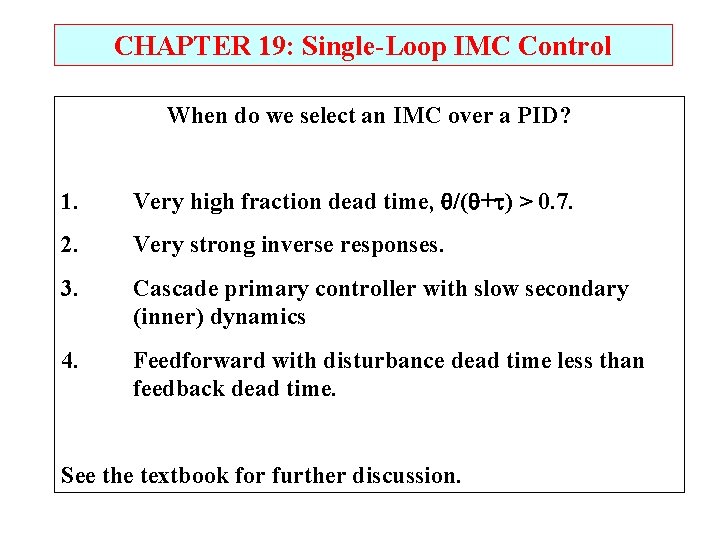
CHAPTER 19: Single-Loop IMC Control When do we select an IMC over a PID? 1. Very high fraction dead time, /( + ) > 0. 7. 2. Very strong inverse responses. 3. Cascade primary controller with slow secondary (inner) dynamics 4. Feedforward with disturbance dead time less than feedback dead time. See the textbook for further discussion.
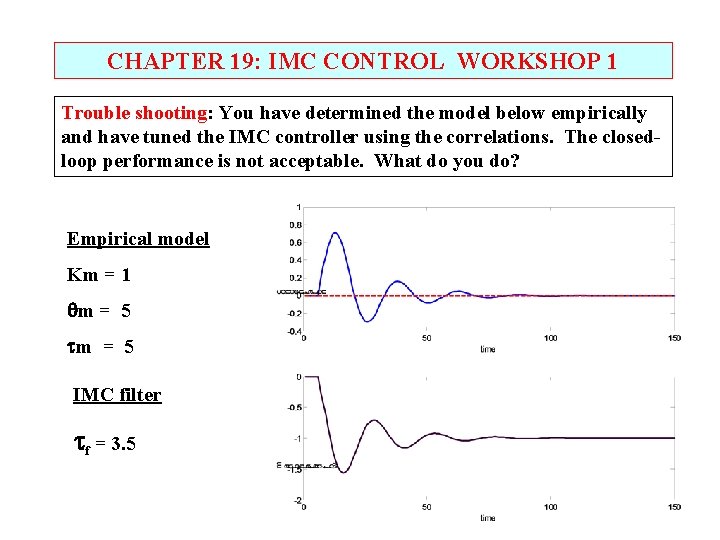
CHAPTER 19: IMC CONTROL WORKSHOP 1 Trouble shooting: You have determined the model below empirically and have tuned the IMC controller using the correlations. The closedloop performance is not acceptable. What do you do? Empirical model Km = 1 m = 5 IMC filter f = 3. 5
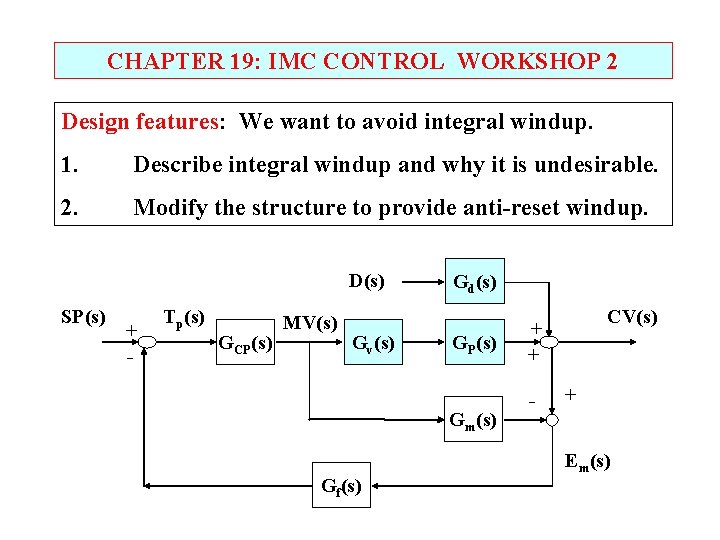
CHAPTER 19: IMC CONTROL WORKSHOP 2 Design features: We want to avoid integral windup. 1. Describe integral windup and why it is undesirable. 2. Modify the structure to provide anti-reset windup. D(s) SP(s) + - Tp(s) GCP(s) MV(s) Gv(s) Gd(s) GP(s) Gm(s) Gf(s) CV(s) + + - + Em(s)
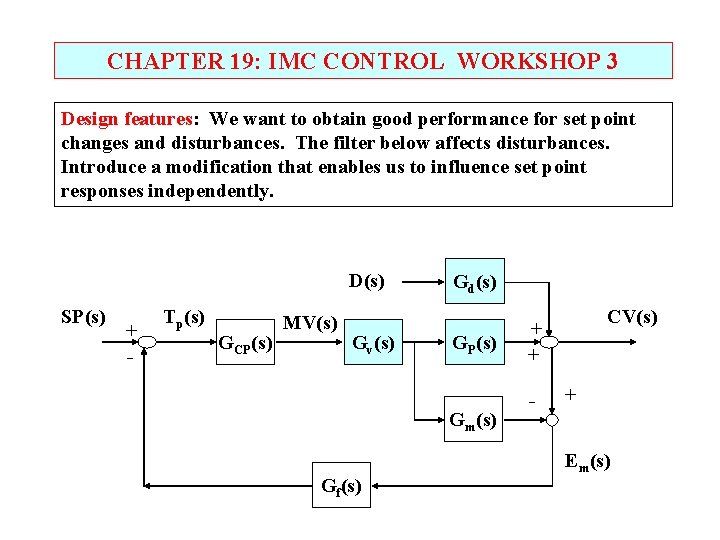
CHAPTER 19: IMC CONTROL WORKSHOP 3 Design features: We want to obtain good performance for set point changes and disturbances. The filter below affects disturbances. Introduce a modification that enables us to influence set point responses independently. D(s) SP(s) + - Tp(s) GCP(s) MV(s) Gv(s) Gd(s) GP(s) Gm(s) Gf(s) CV(s) + + - + Em(s)
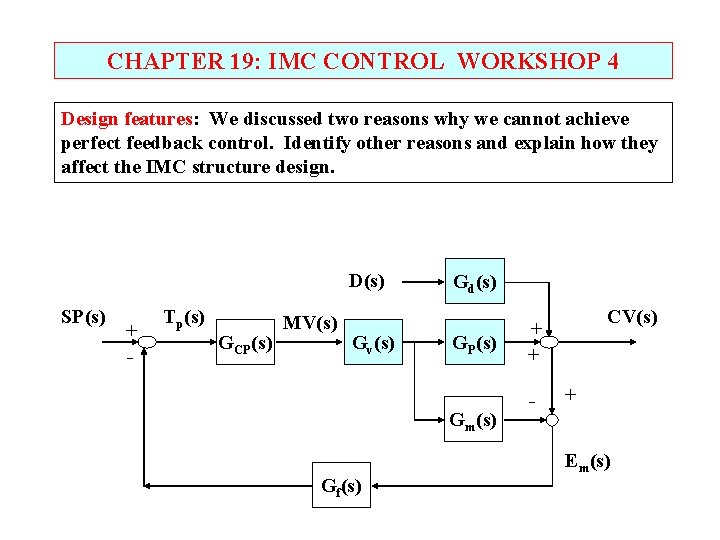
CHAPTER 19: IMC CONTROL WORKSHOP 4 Design features: We discussed two reasons why we cannot achieve perfect feedback control. Identify other reasons and explain how they affect the IMC structure design. D(s) SP(s) + - Tp(s) GCP(s) MV(s) Gv(s) Gd(s) GP(s) Gm(s) Gf(s) CV(s) + + - + Em(s)
CHAPTER 19: Single-Loop IMC Control When I complete this chapter, I want to be able to do the following. • Recognize that other feedback algorithms are possible • Understand the IMC structure and how it provides the essential control features • Tune an IMC controller • Correctly select between PID and IMC Lot’s of improvement, but we need some more study! • Read the textbook • Review the notes, especially learning goals and workshop • Try out the self-study suggestions • Naturally, we’ll have an assignment!
CHAPTER 19: LEARNING RESOURCES • SITE PC-EDUCATION WEB - Tutorials (Chapter 19) • The Textbook, naturally, for many more examples. • Addition information on IMC control is given in the following reference. Brosilow, C. and B. Joseph, Techniques of Model. Based Control, Prentice-Hall, Upper Saddle River, 2002
CHAPTER 19: SUGGESTIONS FOR SELF-STUDY 1. Discuss the similarities and differences between IMC and Smith Predictor algorithms 2. Develop the equations that would be solved for a digital implementation of the IMC controller for the three-tank mixer. 3. Select a feedback control example in the textbook and determine the IMC tuning for this process. 4. Find a feedback control example in the textbook for which IMC is a better choice than PID. 5. Explain how you would implement a digital algorithm to provide good control for the process in Example 19. 8 experiencing the flow variation described.