
Process Control Designing Process and Control Systems for
- Slides: 36
Process Control: Designing Process and Control Systems for Dynamic Performance Chapter 22. Variable Structure and Constraint Control Copyright © Thomas Marlin 2013 The copyright holder provides a royalty-free license for use of this material at non-profit educational institutions
CHAPTER 22: VARIABLE STRUCTURE CONTROL When I complete this chapter, I want to be able to do the following. • Understand why many applications of process control require variable structure • Implement a design using more than one valve in a “control loop” • Implement a design using more than one controlled variable in a “control loop”
CHAPTER 22: VARIABLE STRUCTURE CONTROL Outline of the lesson. • Reasons for variable structure • Split range control • Signal select control • Applications for constraint control • Workshop
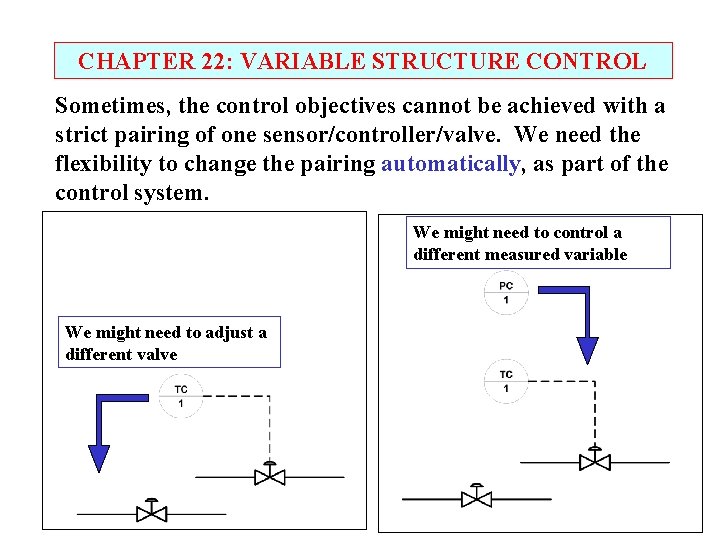
CHAPTER 22: VARIABLE STRUCTURE CONTROL Sometimes, the control objectives cannot be achieved with a strict pairing of one sensor/controller/valve. We need the flexibility to change the pairing automatically, as part of the control system. We might need to control a different measured variable We might need to adjust a different valve
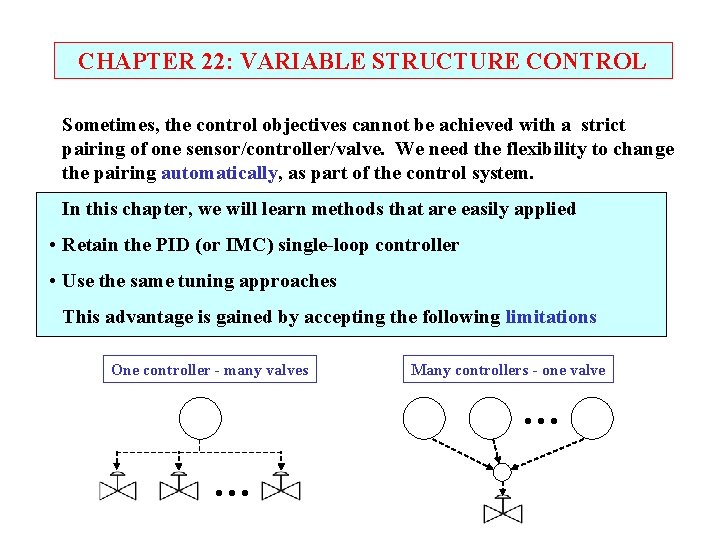
CHAPTER 22: VARIABLE STRUCTURE CONTROL Sometimes, the control objectives cannot be achieved with a strict pairing of one sensor/controller/valve. We need the flexibility to change the pairing automatically, as part of the control system. In this chapter, we will learn methods that are easily applied • Retain the PID (or IMC) single-loop controller • Use the same tuning approaches This advantage is gained by accepting the following limitations One controller - many valves Many controllers - one valve
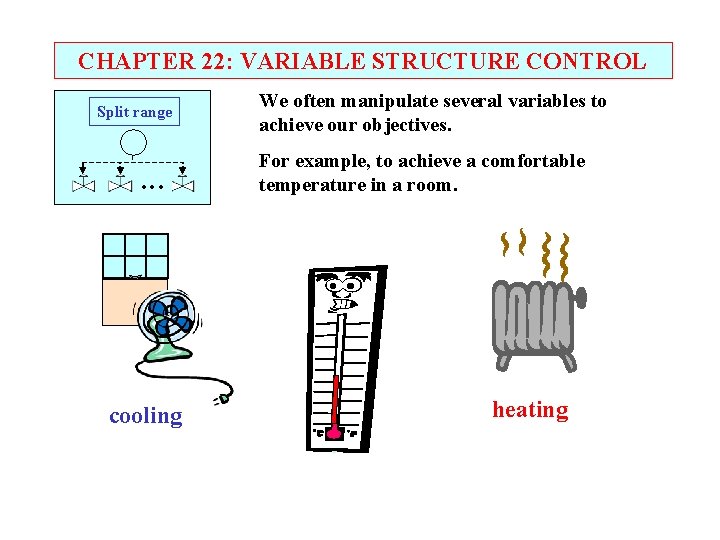
CHAPTER 22: VARIABLE STRUCTURE CONTROL Split range cooling We often manipulate several variables to achieve our objectives. For example, to achieve a comfortable temperature in a room. heating
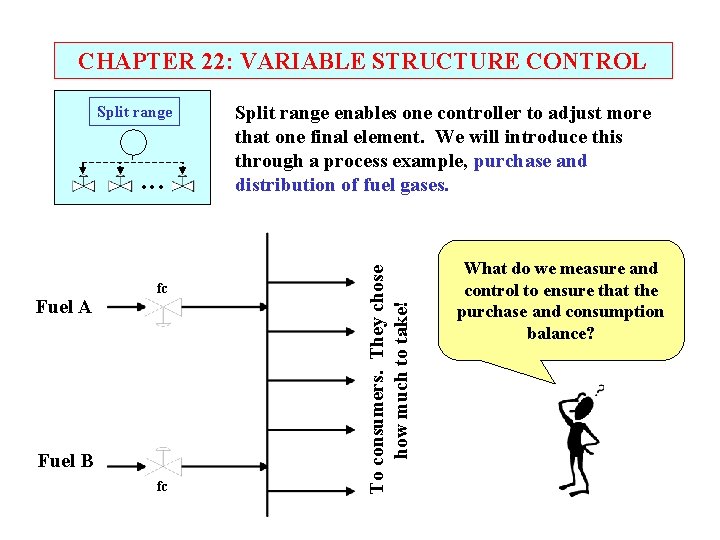
CHAPTER 22: VARIABLE STRUCTURE CONTROL Fuel A fc Fuel B fc Split range enables one controller to adjust more that one final element. We will introduce this through a process example, purchase and distribution of fuel gases. To consumers. They chose how much to take! Split range What do we measure and control to ensure that the purchase and consumption balance?
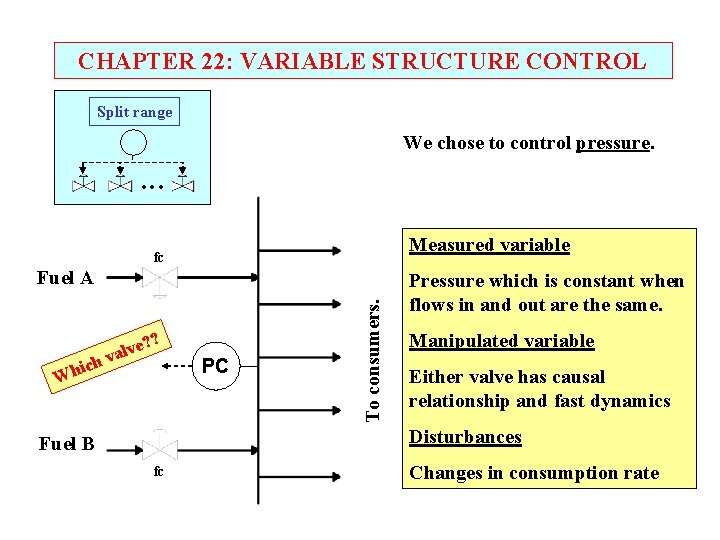
CHAPTER 22: VARIABLE STRUCTURE CONTROL Split range We chose to control pressure. Measured variable fc ? ? e v l a ch v i Wh PC To consumers. Fuel A Pressure which is constant when flows in and out are the same. Manipulated variable Either valve has causal relationship and fast dynamics Disturbances Fuel B fc Changes in consumption rate
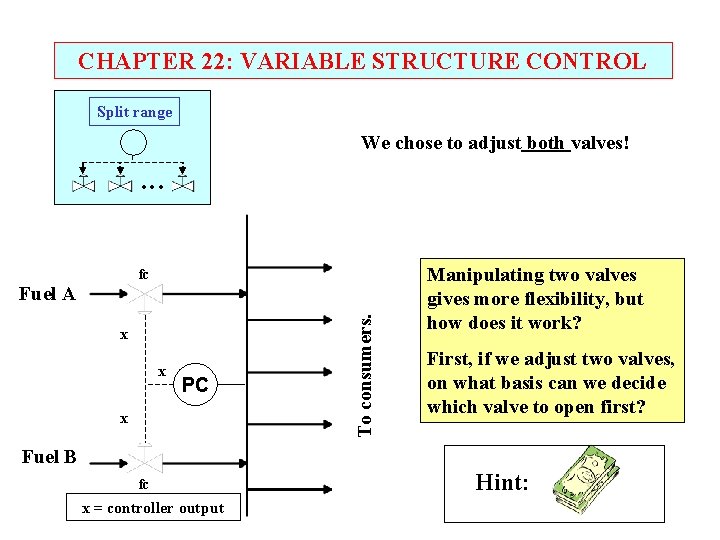
CHAPTER 22: VARIABLE STRUCTURE CONTROL Split range We chose to adjust both valves! fc x x PC x To consumers. Fuel A Manipulating two valves gives more flexibility, but how does it work? First, if we adjust two valves, on what basis can we decide which valve to open first? Fuel B fc x = controller output Hint:
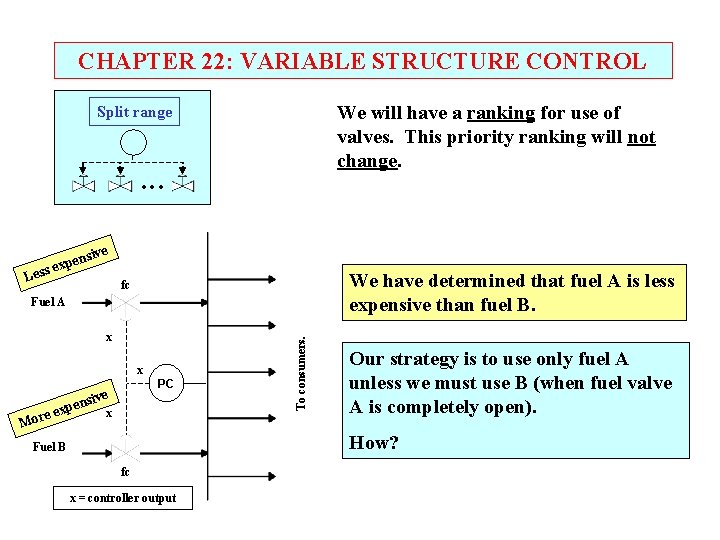
CHAPTER 22: VARIABLE STRUCTURE CONTROL We will have a ranking for use of valves. This priority ranking will not change. Split range ve nsi e p x ss e Le We have determined that fuel A is less expensive than fuel B. fc x x e nsiv e p x x ee Mor PC To consumers. Fuel A Our strategy is to use only fuel A unless we must use B (when fuel valve A is completely open). How? Fuel B fc x = controller output
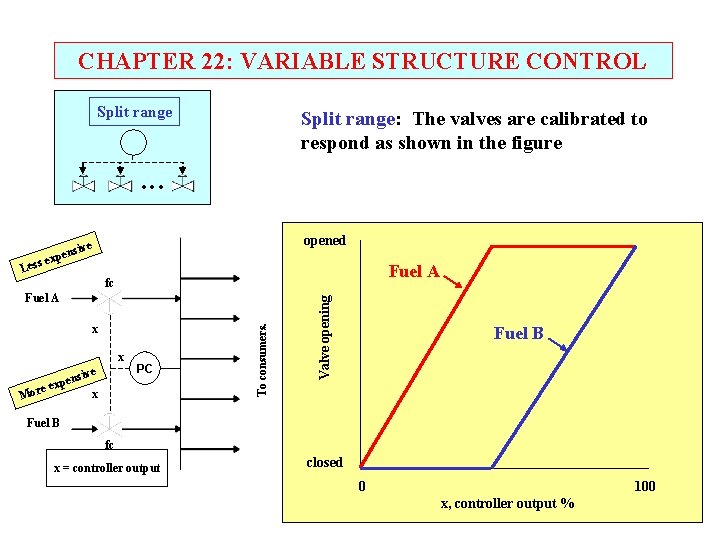
CHAPTER 22: VARIABLE STRUCTURE CONTROL Split range: The valves are calibrated to respond as shown in the figure opened ve Less nsi expe Fuel A x x ve Mor e nsi expe PC x To consumers. Fuel A Valve opening fc Fuel B fc x = controller output closed 0 100 x, controller output %
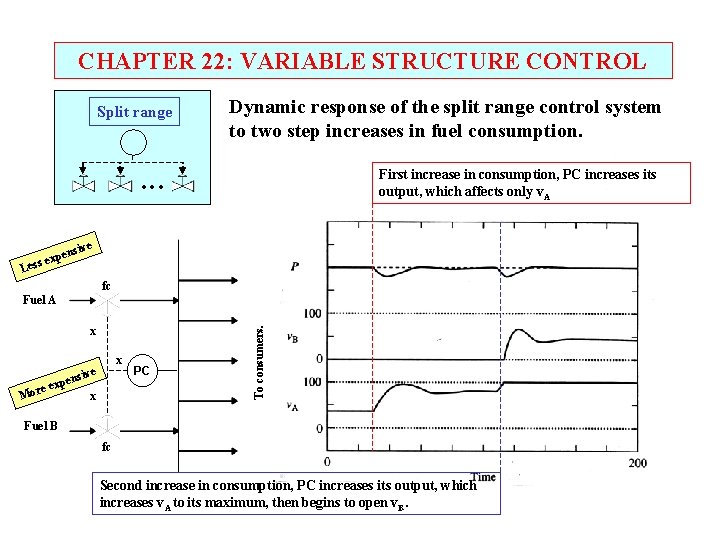
CHAPTER 22: VARIABLE STRUCTURE CONTROL Split range Dynamic response of the split range control system to two step increases in fuel consumption. First increase in consumption, PC increases its output, which affects only v. A Le e nsiv e p x ss e fc x x sive pen x e e x Mor PC To consumers. Fuel A Fuel B fc Second increase in consumption, PC increases its output, which increases v. A to its maximum, then begins to open v. B.
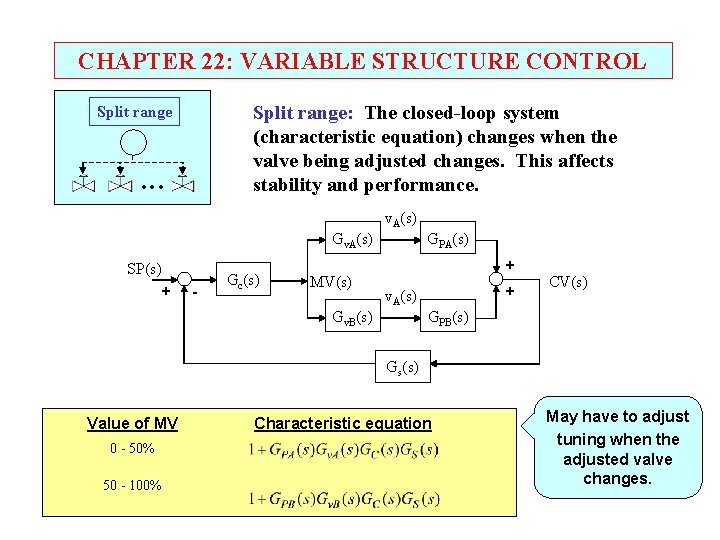
CHAPTER 22: VARIABLE STRUCTURE CONTROL Split range: The closed-loop system (characteristic equation) changes when the valve being adjusted changes. This affects stability and performance. Split range Gv. A(s) SP(s) + - Gc(s) MV(s) v. A(s) GPA(s) + + v. A(s) Gv. B(s) CV(s) GPB(s) Gs(s) Value of MV 0 - 50% 50 - 100% Characteristic equation May have to adjust tuning when the adjusted valve changes.
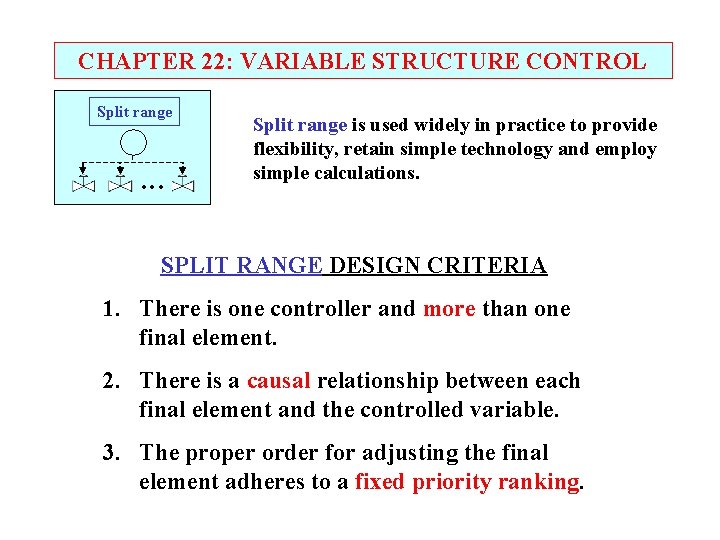
CHAPTER 22: VARIABLE STRUCTURE CONTROL Split range is used widely in practice to provide flexibility, retain simple technology and employ simple calculations. SPLIT RANGE DESIGN CRITERIA 1. There is one controller and more than one final element. 2. There is a causal relationship between each final element and the controlled variable. 3. The proper order for adjusting the final element adheres to a fixed priority ranking.
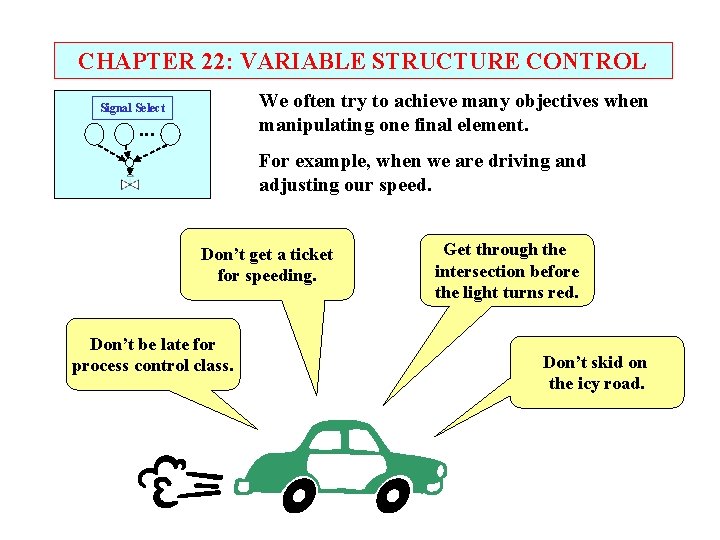
CHAPTER 22: VARIABLE STRUCTURE CONTROL We often try to achieve many objectives when manipulating one final element. Signal Select For example, when we are driving and adjusting our speed. Don’t get a ticket for speeding. Don’t be late for process control class. Get through the intersection before the light turns red. Don’t skid on the icy road.
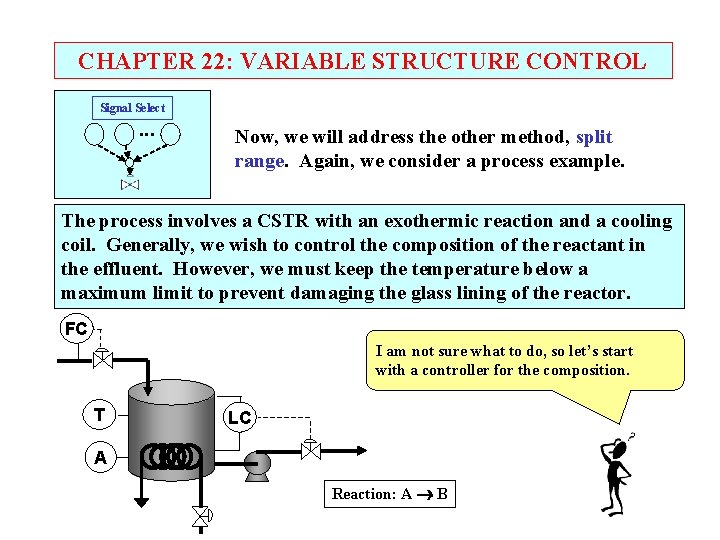
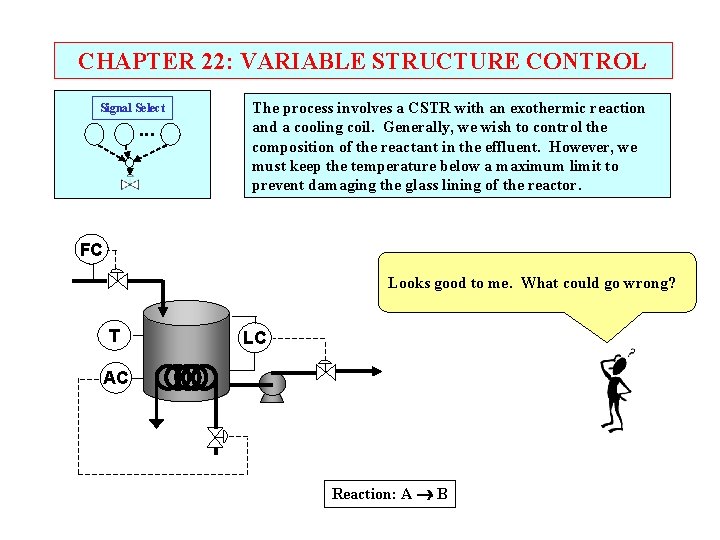
CHAPTER 22: VARIABLE STRUCTURE CONTROL Signal Select Now, we will address the other method, split range. Again, we consider a process example. The process involves a CSTR with an exothermic reaction and a cooling coil. Generally, we wish to control the composition of the reactant in the effluent. However, we must keep the temperature below a maximum limit to prevent damaging the glass lining of the reactor. FC I am not sure what to do, so let’s start with a controller for the composition. T LC A Reaction: A B
CHAPTER 22: VARIABLE STRUCTURE CONTROL Signal Select The process involves a CSTR with an exothermic reaction and a cooling coil. Generally, we wish to control the composition of the reactant in the effluent. However, we must keep the temperature below a maximum limit to prevent damaging the glass lining of the reactor. FC Looks good to me. What could go wrong? T LC AC Reaction: A B
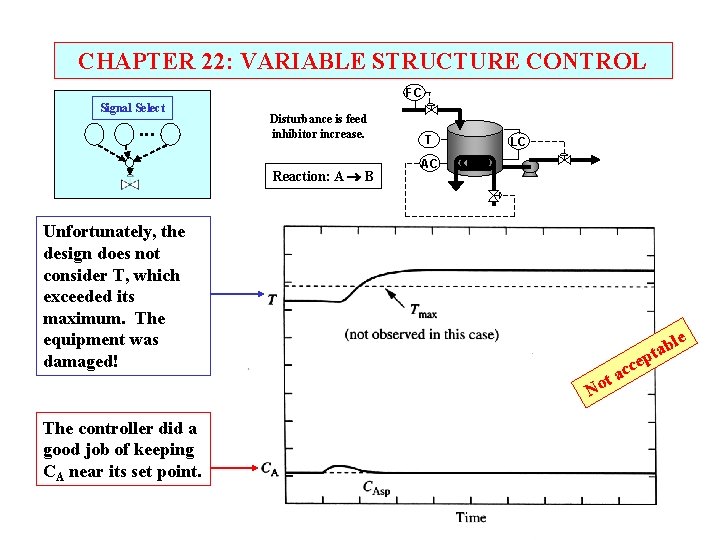
CHAPTER 22: VARIABLE STRUCTURE CONTROL FC Signal Select Disturbance is feed inhibitor increase. Reaction: A B T LC AC Unfortunately, the design does not consider T, which exceeded its maximum. The equipment was damaged! ble a t p No cce a t The controller did a good job of keeping CA near its set point.
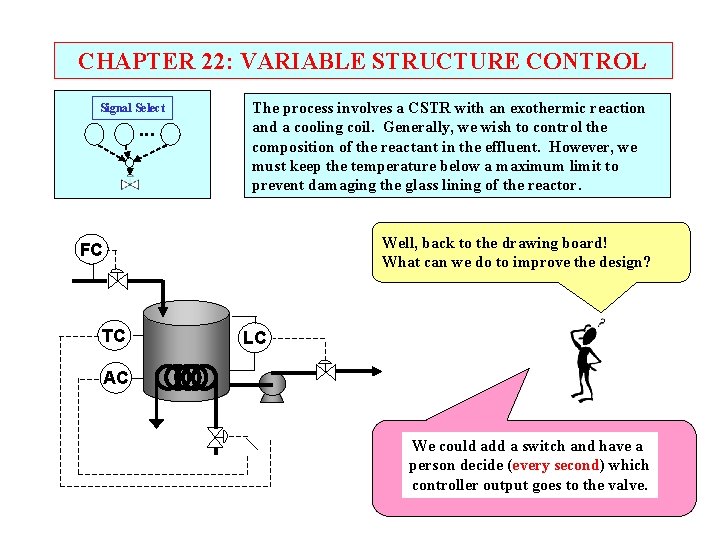
CHAPTER 22: VARIABLE STRUCTURE CONTROL Signal Select The process involves a CSTR with an exothermic reaction and a cooling coil. Generally, we wish to control the composition of the reactant in the effluent. However, we must keep the temperature below a maximum limit to prevent damaging the glass lining of the reactor. Well, back to the drawing board! What can we do to improve the design? FC TC LC AC We could add a switch and have a person decide (every second) which controller output goes to the valve.
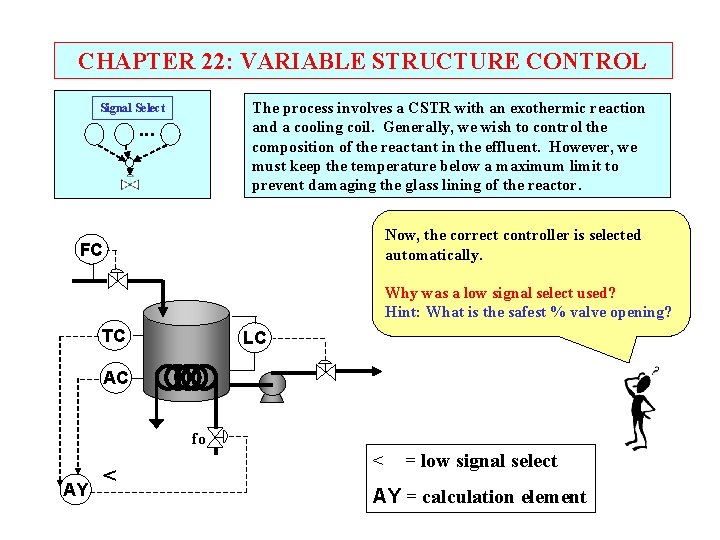
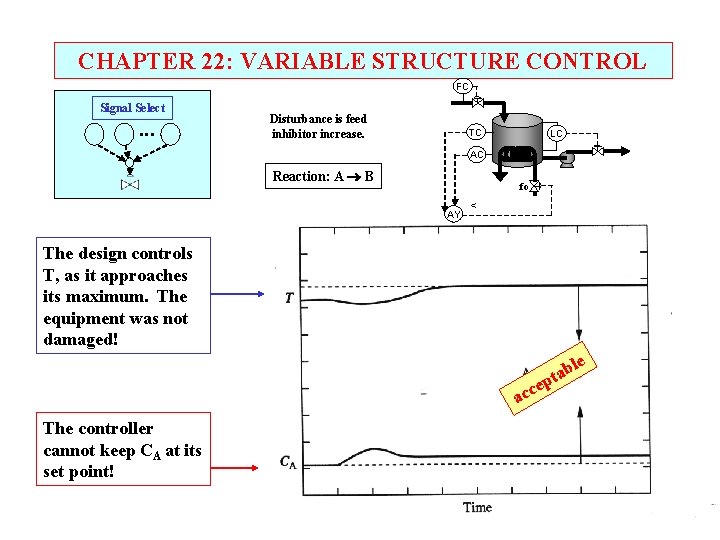
CHAPTER 22: VARIABLE STRUCTURE CONTROL The process involves a CSTR with an exothermic reaction and a cooling coil. Generally, we wish to control the composition of the reactant in the effluent. However, we must keep the temperature below a maximum limit to prevent damaging the glass lining of the reactor. Signal Select Now, the correct controller is selected automatically. FC Why was a low signal select used? Hint: What is the safest % valve opening? TC LC AC fo AY < < = low signal select AY = calculation element
CHAPTER 22: VARIABLE STRUCTURE CONTROL FC Signal Select Disturbance is feed inhibitor increase. TC LC AC Reaction: A B fo AY < The design controls T, as it approaches its maximum. The equipment was not damaged! le b a pt e c ac The controller cannot keep CA at its set point!
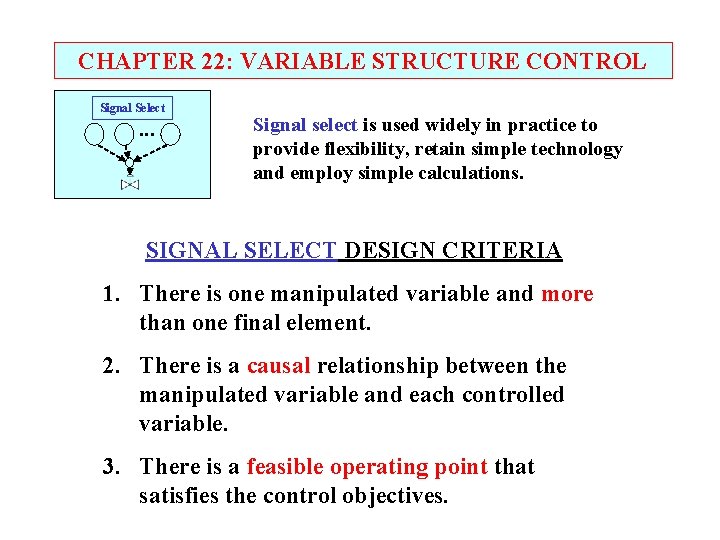
CHAPTER 22: VARIABLE STRUCTURE CONTROL Signal Select Signal select is used widely in practice to provide flexibility, retain simple technology and employ simple calculations. SIGNAL SELECT DESIGN CRITERIA 1. There is one manipulated variable and more than one final element. 2. There is a causal relationship between the manipulated variable and each controlled variable. 3. There is a feasible operating point that satisfies the control objectives.
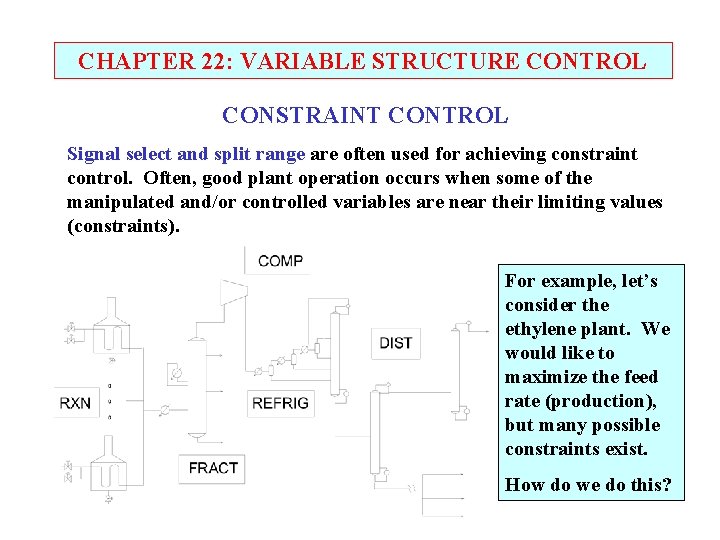
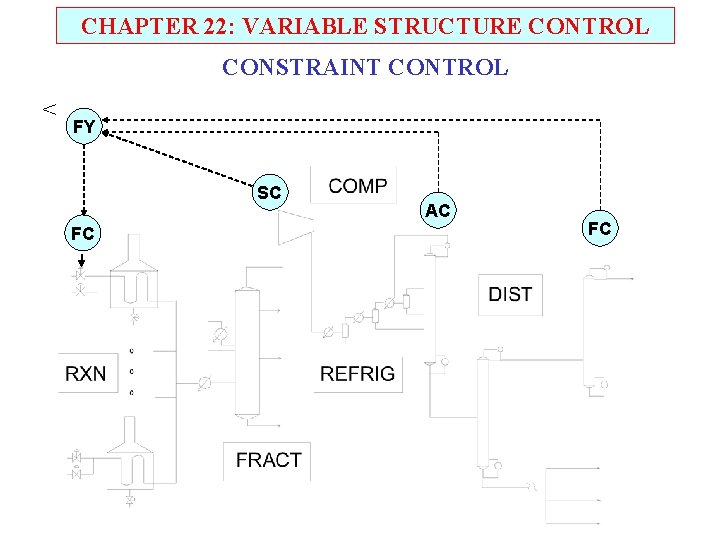
CHAPTER 22: VARIABLE STRUCTURE CONTROL CONSTRAINT CONTROL Signal select and split range are often used for achieving constraint control. Often, good plant operation occurs when some of the manipulated and/or controlled variables are near their limiting values (constraints). For example, let’s consider the ethylene plant. We would like to maximize the feed rate (production), but many possible constraints exist. How do we do this?
CHAPTER 22: VARIABLE STRUCTURE CONTROL CONSTRAINT CONTROL < FY SC FC AC FC
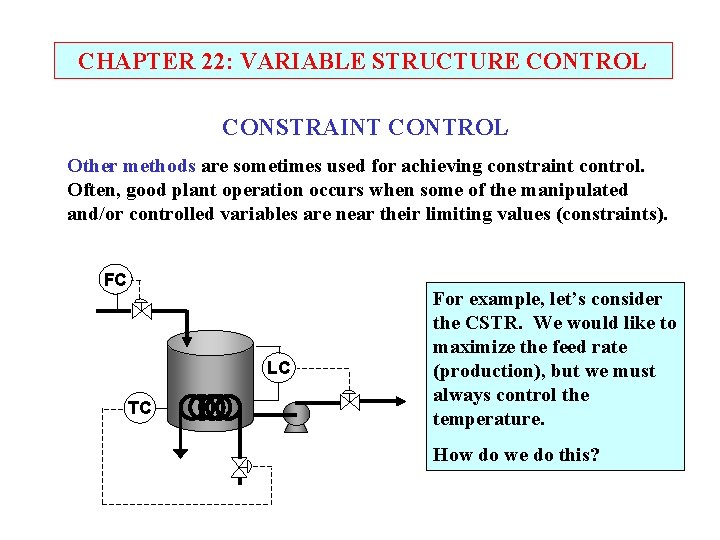
CHAPTER 22: VARIABLE STRUCTURE CONTROL CONSTRAINT CONTROL Other methods are sometimes used for achieving constraint control. Often, good plant operation occurs when some of the manipulated and/or controlled variables are near their limiting values (constraints). FC LC TC For example, let’s consider the CSTR. We would like to maximize the feed rate (production), but we must always control the temperature. How do we do this?
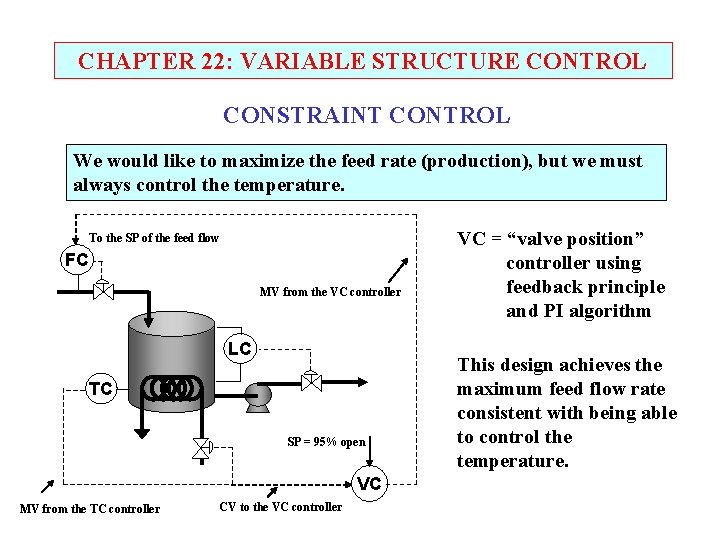
CHAPTER 22: VARIABLE STRUCTURE CONTROL CONSTRAINT CONTROL We would like to maximize the feed rate (production), but we must always control the temperature. To the SP of the feed flow FC MV from the VC controller LC TC SP = 95% open VC MV from the TC controller CV to the VC controller VC = “valve position” controller using feedback principle and PI algorithm This design achieves the maximum feed flow rate consistent with being able to control the temperature.
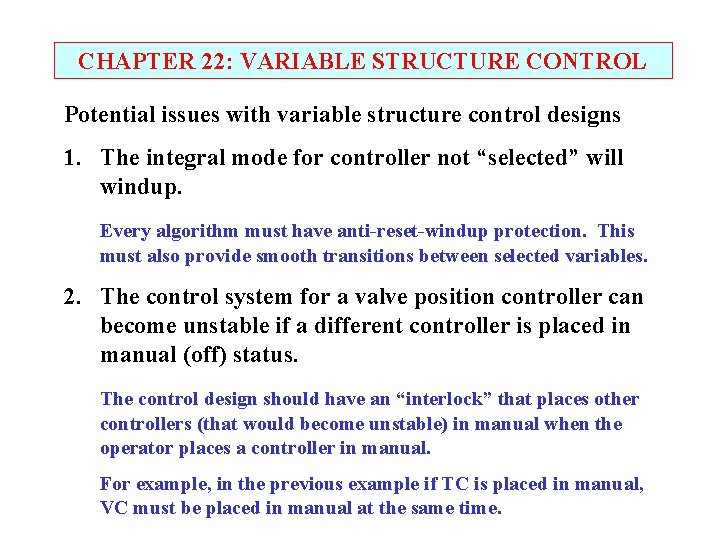
CHAPTER 22: VARIABLE STRUCTURE CONTROL Potential issues with variable structure control designs 1. The integral mode for controller not “selected” will windup. Every algorithm must have anti-reset-windup protection. This must also provide smooth transitions between selected variables. 2. The control system for a valve position controller can become unstable if a different controller is placed in manual (off) status. The control design should have an “interlock” that places other controllers (that would become unstable) in manual when the operator places a controller in manual. For example, in the previous example if TC is placed in manual, VC must be placed in manual at the same time.
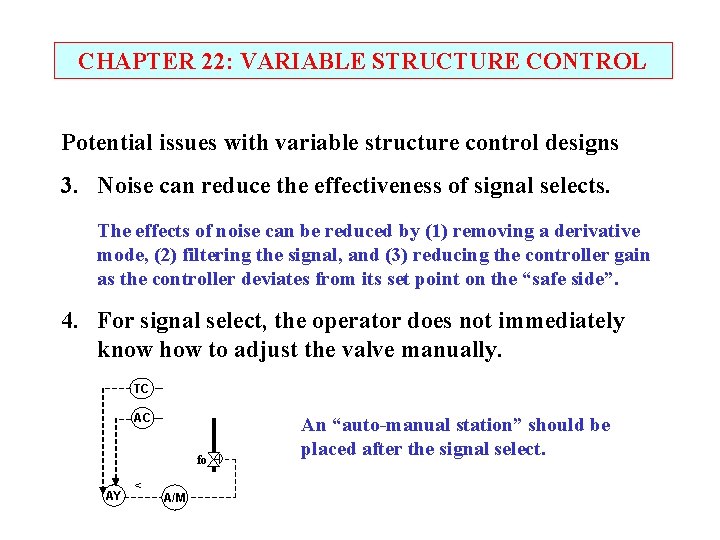
CHAPTER 22: VARIABLE STRUCTURE CONTROL Potential issues with variable structure control designs 3. Noise can reduce the effectiveness of signal selects. The effects of noise can be reduced by (1) removing a derivative mode, (2) filtering the signal, and (3) reducing the controller gain as the controller deviates from its set point on the “safe side”. 4. For signal select, the operator does not immediately know how to adjust the valve manually. TC AC fo AY < A/M An “auto-manual station” should be placed after the signal select.
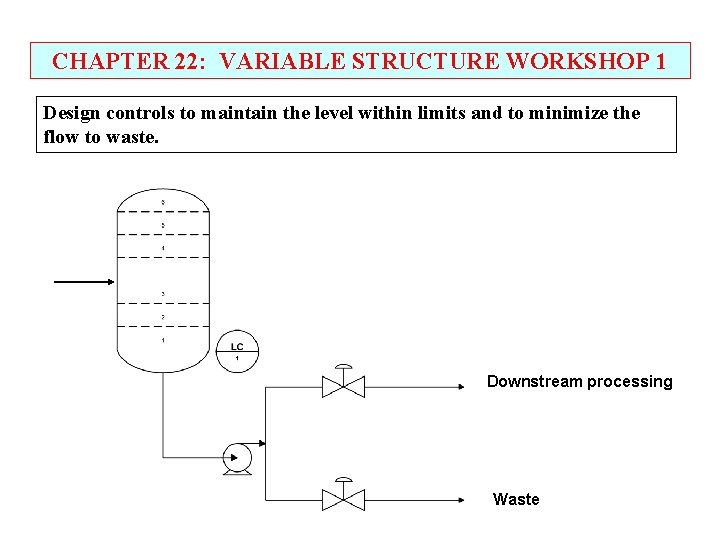
CHAPTER 22: VARIABLE STRUCTURE WORKSHOP 1 Design controls to maintain the level within limits and to minimize the flow to waste. Downstream processing Waste
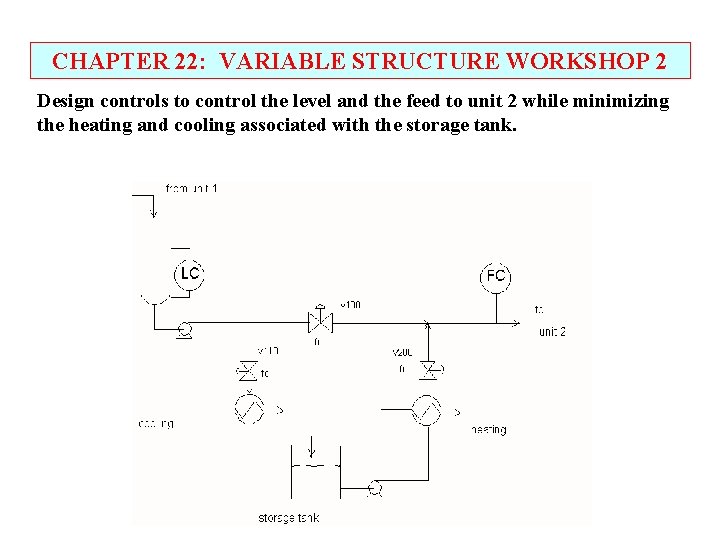
CHAPTER 22: VARIABLE STRUCTURE WORKSHOP 2 Design controls to control the level and the feed to unit 2 while minimizing the heating and cooling associated with the storage tank.
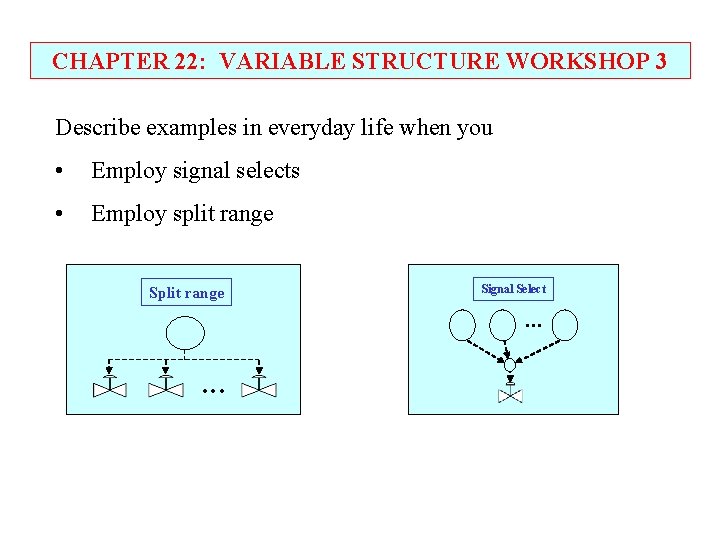
CHAPTER 22: VARIABLE STRUCTURE WORKSHOP 3 Describe examples in everyday life when you • Employ signal selects • Employ split range Signal Select
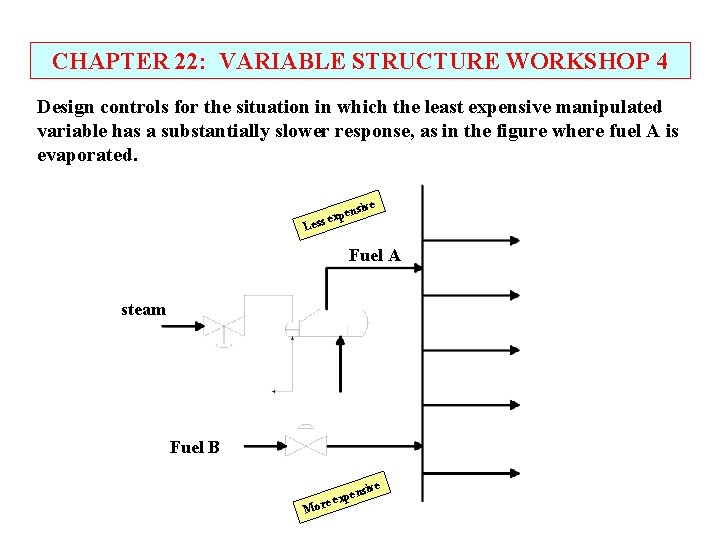
CHAPTER 22: VARIABLE STRUCTURE WORKSHOP 4 Design controls for the situation in which the least expensive manipulated variable has a substantially slower response, as in the figure where fuel A is evaporated. e nsiv xpe ess e L Fuel A steam Fuel B sive Mor pen e ex
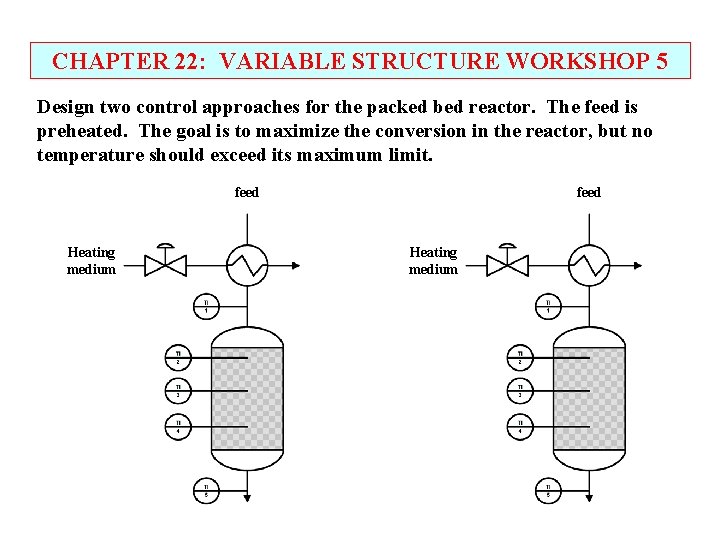
CHAPTER 22: VARIABLE STRUCTURE WORKSHOP 5 Design two control approaches for the packed bed reactor. The feed is preheated. The goal is to maximize the conversion in the reactor, but no temperature should exceed its maximum limit. feed Heating medium
CHAPTER 22: VARIABLE STRUCTURE CONTROL When I complete this chapter, I want to be able to do the following. • Understand why many applications of process control require variable structure • Implement a design using more than one valve in a “control loop” • Implement a design using more than one controlled variable in a “control loop” Lot’s of improvement, but we need some more study! • Read the textbook • Review the notes, especially learning goals and workshop • Try out the self-study suggestions • Naturally, we’ll have an assignment!
CHAPTER 22: Learning Resources • SITE PC-EDUCATION WEB - Interactive Learning Module (Chapter 22) • The Textbook, naturally, for many more examples.
CHAPTER 22: Suggestions for self-study 1. Evaluate additional examples of variable structure control given in Shinskey, F. G. , Controlling Multivariable Processes, ISA, Research Triangle Park, NC, 1981. 2. Program the controllers and additional logic for the CSTR signal select control example in the lecture and textbook. 3. Design a modified split range control implementation in which different signals with different values are sent to the two valves for the fuel gas pressure control example in the lecture and textbook.