
Process Concept n An operating system executes a
- Slides: 19
Process Concept n An operating system executes a variety of programs F Batch system – jobs F Time-shared systems – user programs or tasks n Process – a program in execution n A process includes: F Text segment F Data segment F Stack segment F Program counter Operating System Concepts 4. 1 Silberschatz, Galvin and Gagne 2002
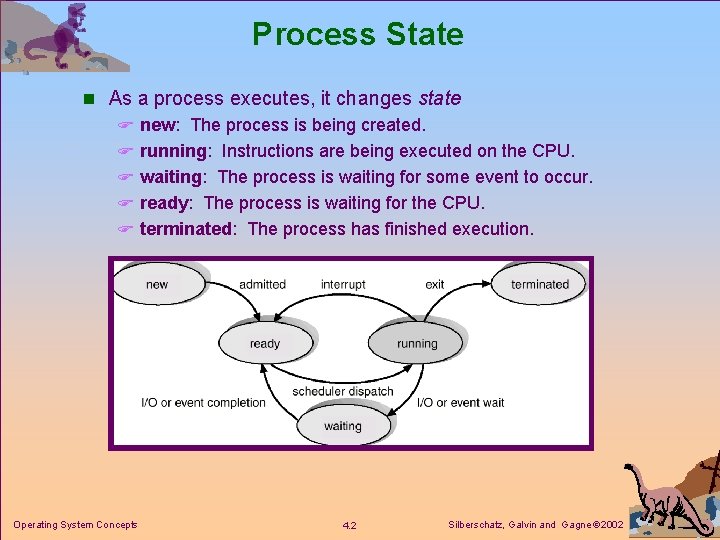
Process State n As a process executes, it changes state F new: The process is being created. F running: Instructions are being executed on the CPU. F waiting: The process is waiting for some event to occur. F ready: The process is waiting for the CPU. F terminated: The process has finished execution. Operating System Concepts 4. 2 Silberschatz, Galvin and Gagne 2002
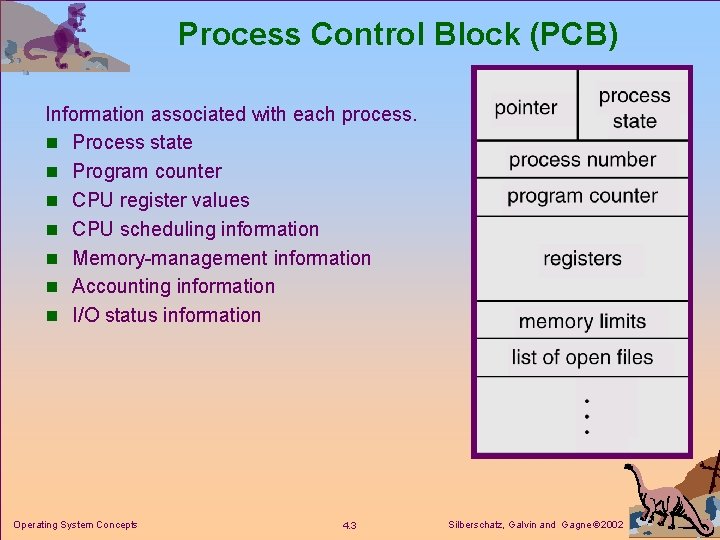
Process Control Block (PCB) Information associated with each process. n Process state n Program counter n CPU register values n CPU scheduling information n Memory-management information n Accounting information n I/O status information Operating System Concepts 4. 3 Silberschatz, Galvin and Gagne 2002
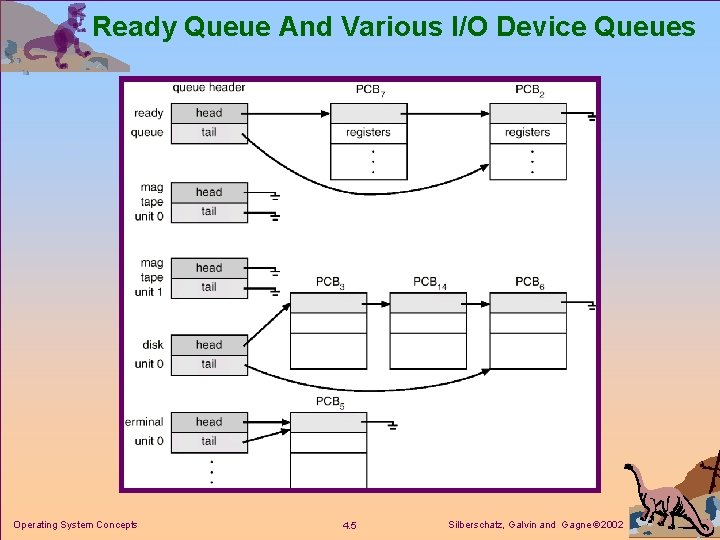
Process Queues n Job queue – set of all PCBs in the system. n Ready queue – set of all processes residing in main memory, ready and waiting to execute. n Device queues – set of processes waiting for a resource, e. g. , an I/O device. n PCBs migrate between the various queues. Operating System Concepts 4. 4 Silberschatz, Galvin and Gagne 2002
Ready Queue And Various I/O Device Queues Operating System Concepts 4. 5 Silberschatz, Galvin and Gagne 2002
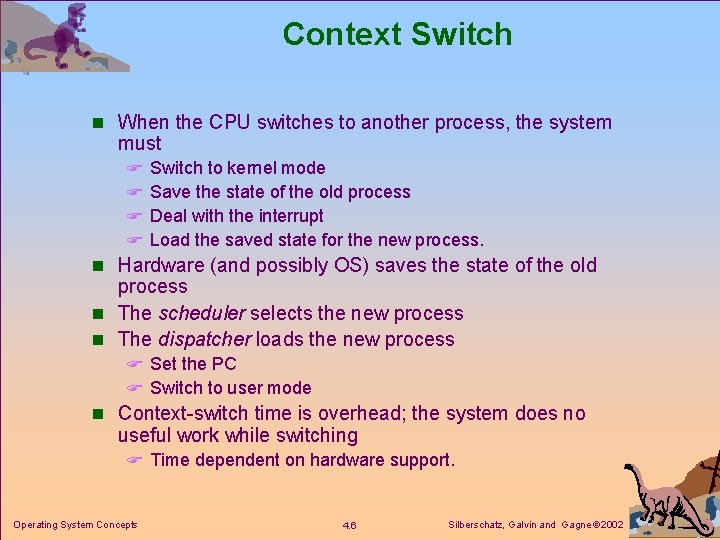
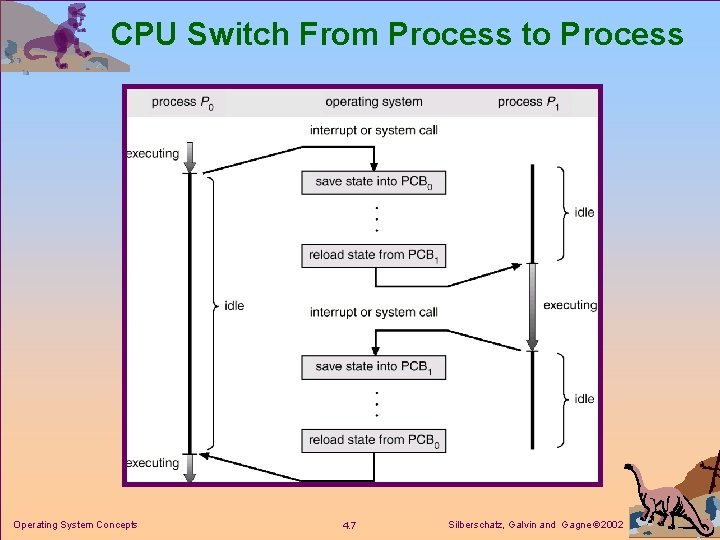
Context Switch n When the CPU switches to another process, the system must F F Switch to kernel mode Save the state of the old process Deal with the interrupt Load the saved state for the new process. n Hardware (and possibly OS) saves the state of the old process n The scheduler selects the new process n The dispatcher loads the new process F Set the PC F Switch to user mode n Context-switch time is overhead; the system does no useful work while switching F Time dependent on hardware support. Operating System Concepts 4. 6 Silberschatz, Galvin and Gagne 2002
CPU Switch From Process to Process Operating System Concepts 4. 7 Silberschatz, Galvin and Gagne 2002
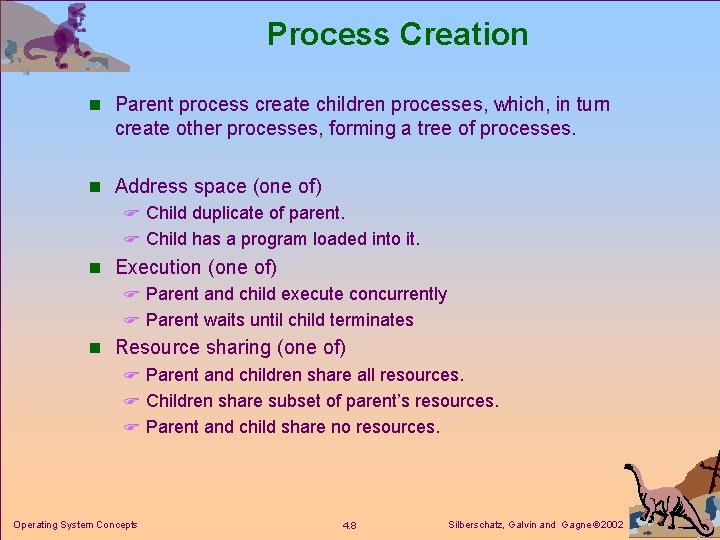
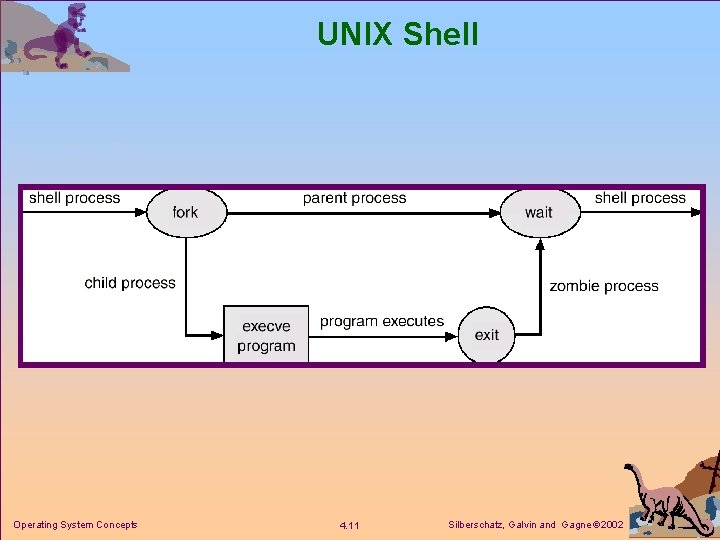
Process Creation n Parent process create children processes, which, in turn create other processes, forming a tree of processes. n Address space (one of) F Child duplicate of parent. F Child has a program loaded into it. n Execution (one of) F Parent and child execute concurrently F Parent waits until child terminates n Resource sharing (one of) F Parent and children share all resources. F Children share subset of parent’s resources. F Parent and child share no resources. Operating System Concepts 4. 8 Silberschatz, Galvin and Gagne 2002
Process Termination n Process executes last statement and tells the OS F Output status from child to parent F Process’ resources are (eventually) deallocated by the operating system n Parent may terminate execution of children processes F Child has exceeded allocated resources. F Task assigned to child is no longer required. F Parent is exiting 4 With cascading termination, the operating system does not allow child to continue if its parent terminates Operating System Concepts 4. 9 Silberschatz, Galvin and Gagne 2002
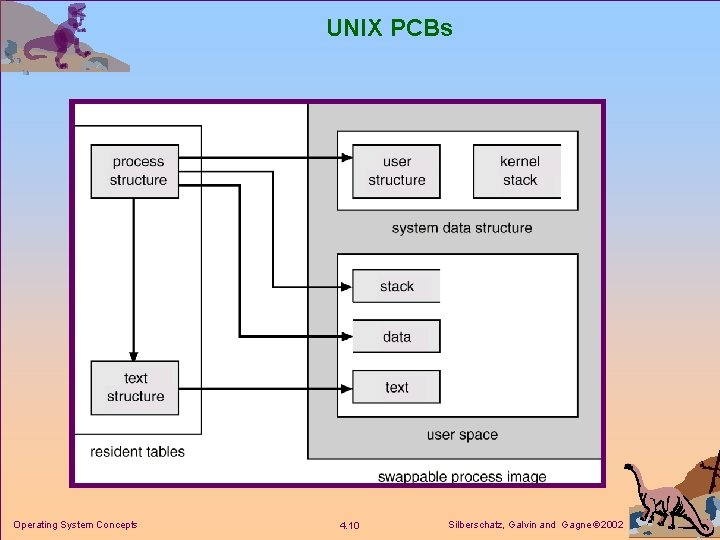
UNIX PCBs Operating System Concepts 4. 10 Silberschatz, Galvin and Gagne 2002
UNIX Shell Operating System Concepts 4. 11 Silberschatz, Galvin and Gagne 2002
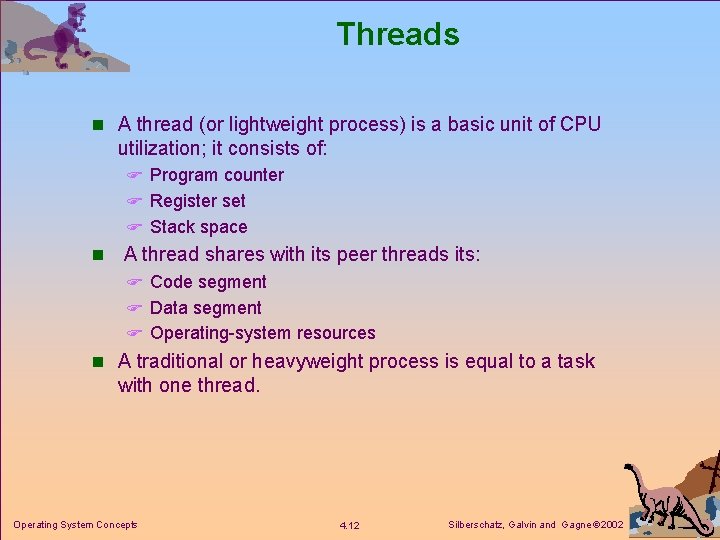
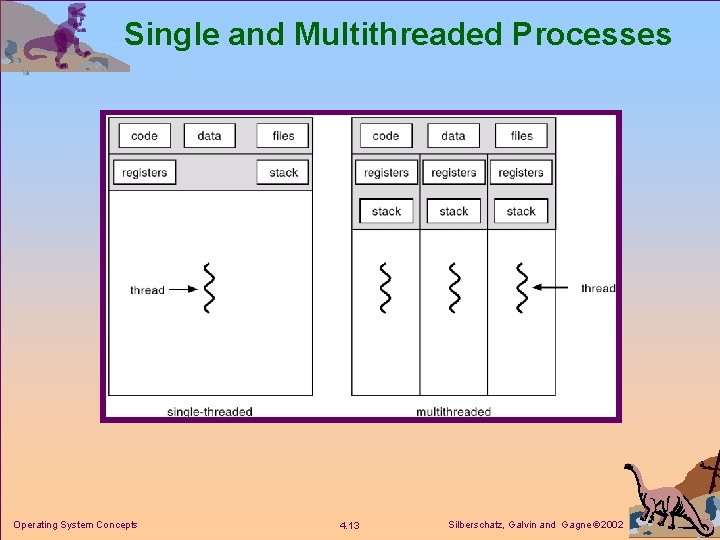
Threads n A thread (or lightweight process) is a basic unit of CPU utilization; it consists of: F Program counter F Register set F Stack space n A thread shares with its peer threads its: F Code segment F Data segment F Operating-system resources n A traditional or heavyweight process is equal to a task with one thread. Operating System Concepts 4. 12 Silberschatz, Galvin and Gagne 2002
Single and Multithreaded Processes Operating System Concepts 4. 13 Silberschatz, Galvin and Gagne 2002
Thread Implementations n User-level threads library F POSIX Pthreads F Mach C-threads F Solaris threads n Kernel Threads F Windows 95/98/NT/2000 F Solaris F Linux Operating System Concepts 4. 14 Silberschatz, Galvin and Gagne 2002
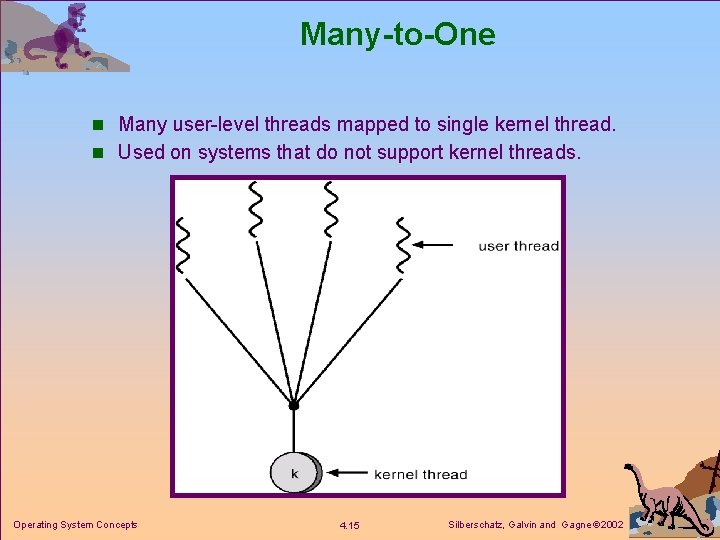
Many-to-One n Many user-level threads mapped to single kernel thread. n Used on systems that do not support kernel threads. Operating System Concepts 4. 15 Silberschatz, Galvin and Gagne 2002
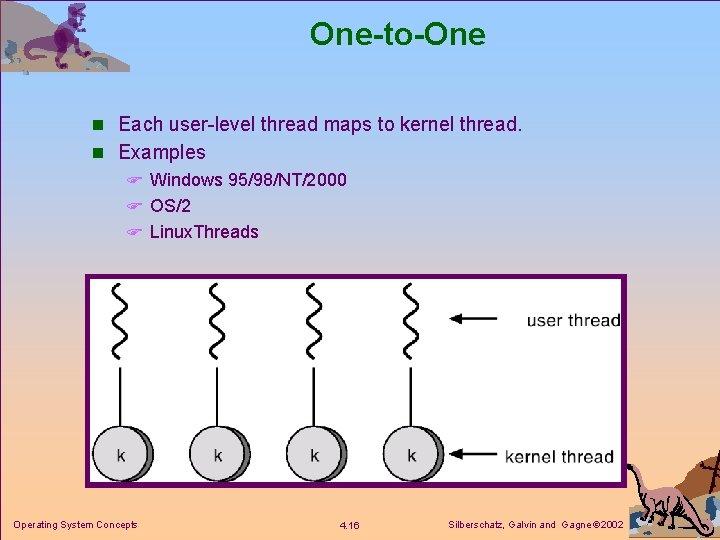
One-to-One n Each user-level thread maps to kernel thread. n Examples F Windows 95/98/NT/2000 F OS/2 F Linux. Threads Operating System Concepts 4. 16 Silberschatz, Galvin and Gagne 2002
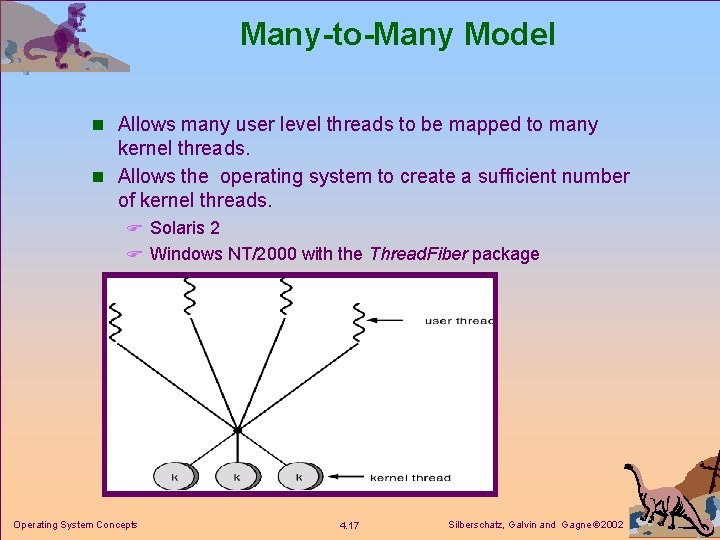
Many-to-Many Model n Allows many user level threads to be mapped to many kernel threads. n Allows the operating system to create a sufficient number of kernel threads. F Solaris 2 F Windows NT/2000 with the Thread. Fiber package Operating System Concepts 4. 17 Silberschatz, Galvin and Gagne 2002
Pthreads n A POSIX standard (IEEE 1003. 1 c) API for thread creation and synchronization. n API specifies behavior of the thread library, implementation is up to development of the library. n Common in UNIX operating systems. Operating System Concepts 4. 18 Silberschatz, Galvin and Gagne 2002
Benefits n Responsiveness F In a multiple threaded task, while one thread is blocked and waiting, a second thread in the same task can run. F Kernel level threads provide a mechanism that allows sequential processes to make blocking system calls while also achieving parallelism. n Resource Sharing n Economy n Utilization of MP Architectures Operating System Concepts 4. 19 Silberschatz, Galvin and Gagne 2002